MCViewPoint

Opinion from a Libertarian ViewPoint

Posts Tagged ‘Decentralization’

Is 2020 Going To Be the New 1860? – LewRockwell

Posted by M. C. on February 21, 2020

Fortunately, this won’t end in war, but I do think that no matter who wins, decentralization will get a boost in 2021.

It really doesn’t matter who wins the 2020 election. Nearly fifty percent of the American population, if not more, loses. But not if we had real federalism.

https://www.lewrockwell.com/2020/02/brion-mcclanahan/is-2020-going-to-be-the-new-1860/

By

BrionMcClanahan.com

If you watched the debate last night, I pity you. I watched it for you so you wouldn’t have to, but [spoiler alert] you didn’t miss anything by tuning out.

Regardless, I think some things became clear in the two hour snooze fest.

1. Joe Biden still looks like he is too old to be president. He stumbles, stutters, drools, and loses his train of thought in two seconds. Not a good showing for Uncle Joe.

2. Elena Klobuchar isn’t ready to be president, and probably never will be. She is in over her head and needs to quickly exit the race. Foreign policy is the most important role for the president, and Elena lost any momentum with her debate performance.

3. Mayor Mister Bean is attempting to appeal to centrist Democrats that do not exist while banking on LGBTQ support to increase his “woke” credentials. That, coupled with his Frederick Douglass initiative, is bad optics in that Party that is made up of various factions defined by Victim status.

4. Elizabeth Warren delivered the tomahawk chop to Bloomberg’s chances for the Democratic nomination, but she’s still too awkward and weird to win the nomination, even in a Party full of awkward and weird people. No one feels comfortable watching her. It’s like watching every boomer on social media trying to appeal to the kids with a meme about medical marijuana.

5. Comrade Sanders is the most authentic candidate in the the Party and appeals to its real base, the neo-Stalinists who comprise a good portion of the online Bernie Bros. He has never shied away from being a communist, and that means he has the inside shot at winning the nomination, unless the Party steals it from him again.

6. Mike Bloomberg isn’t going to get the nomination, but I think he will run as an independent candidate on a Never Trump/Never Sanders ticket, potentially with Hillary Clinton as his running mate. He is too many of the things the modern Victim Democrats can’t stand: racist, womanizer, billionaire, etc. That was clear as every candidate took shots at his character, money, and influence.

So what does this mean? 2020 looks a lot like 1860 or perhaps 1912.

Substitute Trump, Bloomberg, and Sanders for Douglas, Lincoln, and Bell or Taft, Wilson, and Debs and you have the 2020 presidential election.

The only real modern comparison could be 1992 with Perot, Clinton, and Bush, but Trump represents everything Perot advocated in 1992 while Bloomberg is the establishment. Sanders will be the socialist side show.

And Trump will win.

Fortunately, this won’t end in war, but I do think that no matter who wins, decentralization will get a boost in 2021.

Think locally, act locally. We are already seeing more Americans sign on to the idea of secession and nullification than at any point since 1860. And this time it will be peaceful. There are secession movements in Oregon and Virginia in addition to California, Illinois, New York, Texas, Alaska, Hawaii, Colorado, and Vermont. Self-determination is the American tradition.

It really doesn’t matter who wins the 2020 election. Nearly fifty percent of the American population, if not more, loses. But not if we had real federalism.

Every president before Lincoln knew it, as did nearly the entire founding generation.

The States, and perhaps even the counties, are the key to breaking apart the monstrosity that is Washington D.C.

I discuss the debates and the future of American politics in Episode 292 of The Brion McClanahan Show.

You can watch it here.

OR

You can listen to it here.

Be seeing you


Posted in Uncategorized | Tagged: , , , , , , , | Leave a Comment »

Thoughts on Tyler Cowen’s “State Capacity Libertarianism” – LewRockwell

Posted by M. C. on January 13, 2020

https://mises.org/power-market/thoughts-tyler-cowens-state-capacity-libertarianism

Jeff Deist

George Mason University economist Tyler Cowen has penned a brief manifesto for what he calls “State Capacity Libertarianism” on the Marginal Revolution blog. In it he makes the case for libertarians to embrace “state capacity” in certain limited cases. You can read his essay here.

My initial responses, in no particular order, are as follows:

1. There is no political will or constituency for skillful technocratic state management of society. This is a pipe dream, once simply referred to as elusive “good government.” When do public choicers of all people give this up?
2. There is no third way between state and market, regardless of technology or material development. Futurism is bunk; the question before us today is the same as thirty, fifty, or one hundred years ago: who decides? Decentralization vs. centralization is the most important policy question.
3. Western states won’t give up their sclerotic regulatory, tax, central banking, and entitlement systems no matter how many flying cars or hyperloops we want. This reality will be a huge drag on science, infrastructure, medicine/health, and overall well-being.
4. The environmental movement will quash nuclear (especially after Fukushima), and the energy capacity vs. weight/cost issue will continue to plague electric cars/planes.
5. Left socialism, not libertarian futurism, is the rising tide across the West — and its constituency skews young. Adopting its pose, language, or ostensible goals won’t produce Singapore.
6. Climate change is not a problem or issue for anyone to solve.
7. The West can’t advance until it stops warring. War and peace won’t be solved technocratically, and true noninterventionism requires a painful rethinking of the hubris known as universalism. I thought technocrats believed in realpolitik?
8. Human happiness and prosperity depend on elements of civil society which libertarian futurists don’t like (faith, family, et al.). Hence the cheap jab at “Ron Paulism.”
9. We build “capacity” in society through profit, saving, and capital investment. Government makes this worse, not better, in each and every case.
10. Libertarianism simply means “private.” It is a non-state approach to organizing human society. It is not narrow or confining; in fact everything Cowen desires in an improved society can be advanced through private mechanisms.

Be seeing you


Posted in Uncategorized | Tagged: , , , , | Leave a Comment »

How to Avoid Civil War: Decentralization, Nullification, Secession

Posted by M. C. on December 5, 2019

The FBI and CIA will go to even greater lengths to ensure the voters are never again “allowed” to elect anyone who doesn’t receive the explicit imprimatur of the American intelligence “community.”

It is true, however, that if the idea of a legally, culturally, and politically unified United States wins the day, Americans may be looking toward a future of ever greater political repression marked by increasingly common episodes of bloodshed. This is simply the logical outcome of any system where it is assumed the ruling party has a right and a duty to force the ways of the one group upon another. That is the endgame of a unified America.

https://mises.org/wire/how-avoid-civil-war-decentralization-nullification-secession?utm_source=Mises+Institute+Subscriptions&utm_campaign=fe934d9513-EMAIL_CAMPAIGN_9_21_2018_9_59_COPY_01&utm_medium=email&utm_term=0_8b52b2e1c0-fe934d9513-228343965

It’s becoming more and more apparent that the United States will not be going back to “business as usual” after Donald Trump leaves office, and it is easy to imagine that the anti-Trump parties will use their return to power as an opportunity to settle scores against the hated rubes and “deplorables” who dared attempt to oppose their betters in Washington, DC, California, and New York.

This ongoing conflict may manifest itself in the culture war through further attacks on people who take religious faith seriously, and on those who hold any social views unpopular among degreed people from major urban centers. The First Amendment will be imperiled like never before with both religious freedom and freedom of speech regarded as vehicles of “hate.” Certainly, the Second Amendment will hang by a thread.

But even more dangerous will be the deep state’s return to a vaunted position of enjoying a near-total absence of opposition from elected officials in the civilian government. The FBI and CIA will go to even greater lengths to ensure the voters are never again “allowed” to elect anyone who doesn’t receive the explicit imprimatur of the American intelligence “community.” The Fourth Amendment will be banished so that the NSA and its friends can spy on every American with impunity. The FBI and CIA will more freely combine the use of surveillance and media leaks to destroy adversaries.

Anyone who objects to the deep state’s wars on either Americans or on foreigners will be denounced as stooges of foreign powers.

These scenarios may seem overly dramatic, but the extremity of the situation is suggested by the fact that Trump — who is only a very mild opponent of the status quo — has received such hysterical opposition. After all, Trump has not dismantled the welfare state. He has not slashed — or even failed to increase — the military budget. His fights with the deep state are largely based on political issues, and not on major policy disagreements. Trump, for example, sides with the surveillance state on matters such as the prosecution of Edward Snowden.

His sins lie merely in his lack of enthusiasm for the center-left’s current drive toward ever more vicious identity politics. And, more importantly, he has been insufficiently gung ho about starting more wars, expanding NATO, and generally pushing the Russians toward World War III.

For even these minor deviations, we are told, he must be destroyed.

So, we can venture a guess as to what the agenda will look like once Trump is out of the way. It looks to be neither mild nor measured.

And then what?

In that situation, half the country — much of it from the half that calls itself “Red-State America” may regard itself as conquered, powerless, and unheard.

That’s a recipe for civil war.

The Need for Separation

But how can we take steps now to minimize this polarization the damage it is likely to cause?

The answer lies in greater decentralization and local autonomy. But as long as most Americans labor under the authoritarian notion that the United States is “one nation, indivisible” there will be no answer to the problem of one powerful region (or party) wielding unchallenged power over a minority.

Many conservatives naïvely claim that the Constitution and the “rule of law” will protect minorities in this situation. But their theories only hold water if the people making and interpreting the laws subscribe to an ideology which respects local autonomy and freedom for worldviews in conflict with the ruling class. That is increasingly not the ideology of the majority, let alone the majority of powerful judges and politicians.

Thus, for those who can manage to leave behind the flag-waving propaganda of their youths, it is increasingly evident that something other than repeating bromides about teaching high-school civics, reading the Constitution, or electing “strong leaders” will have to be done.

As I’ve noted in the past, the notion of increasing local autonomy through nullification and secession has long been gaining steam in Europe, where referendums on decentralization are growing more frequent.

And conservatives are increasingly seeing the writing on the wall. Among the more insightful of these has been Angelo Codevilla. In 2017, Codevilla, writing in the Claremont Review of Books, laid out a blueprint for local opposition to federal power and noted:

Texas passed a law that, in effect, closes down most of its abortion clinics. The U.S. Supreme Court struck it down. What if Texas closed them nonetheless? Send the Army to point guns at Texas rangers to open them? What would the federal government do if North Dakota declared itself a “Sanctuary for the Unborn” and simply banned abortion? For that matter, what is the federal government doing about the fact that, for practical purposes, its laws concerning marijuana are being ignored in Colorado and California? Utah objects to the boundaries of national monuments created by decree within its borders. What if the state ignored those boundaries? Prayer in schools? What could bureaucrats in Washington, D.C., do if any number of states decided that what the federal courts have to say about such things is bad?

Now that identity politics have replaced the politics of persuasion and blended into the art of war, statesmen should try to preserve what peace remains through mutual forbearance toward jurisdictions that ignore or act contrary to federal laws, regulations, or court orders. Blue states and red states deal differently with some matters of health, education, welfare, and police. It does no good to insist that all do all things uniformly.

And by 2019, the need for separation was becoming more urgent. Last week Codevilla continued in this line of thinking:

[A]fter the 2020 elections ordinary Americans will have to deal with the same dreadful question we faced in 2016: How do we secure and perhaps restore our fast-diminishing freedom to live as Americans? And while we may wish for help from Trump, we have to look to ourselves and to other leaders for how we may counter the ruling class’s manifold assaults now, and especially in the long term…

The logical recourse is to conserve what can be conserved, and for it to be done by, of, and for those who wish to conserve it. However much force of what kind may be required to accomplish that, the objective has to be conservation of the people and ways that wish to be conserved.

That means some kind of separation.

The rest here

Be seeing you

Project MKUltra: The CIA's Dally with Mind Control


Posted in Uncategorized | Tagged: , , , , , , | Leave a Comment »

The Sheriff Revolt on New Gun Laws Shows Why America Needs More Decentralization | Mises Wire

Posted by M. C. on July 20, 2019

https://mises.org/wire/sheriff-revolt-new-gun-laws-shows-why-america-needs-more-decentralization

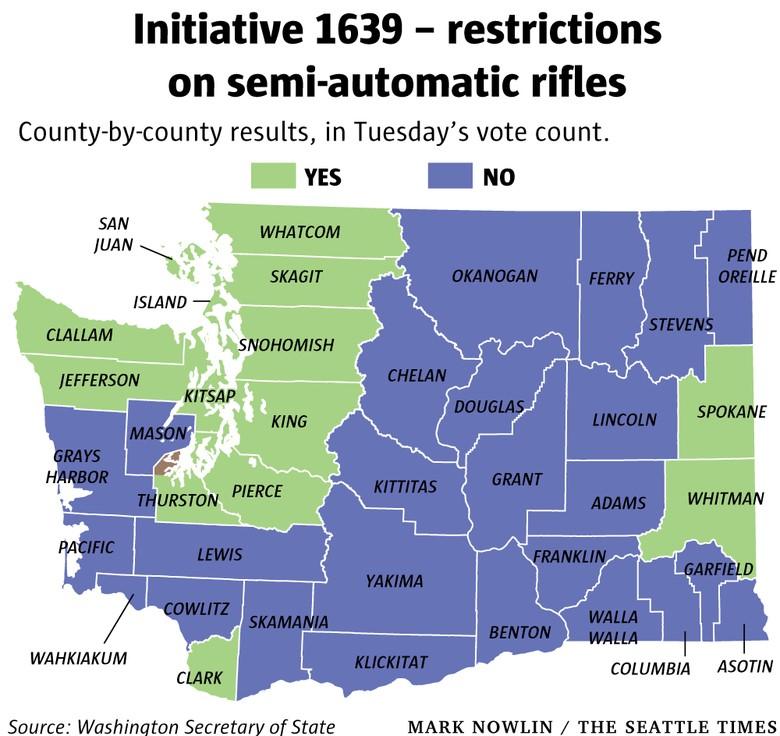
Recently, a dozen sheriffs in Washington State announced that they would refuse to enforce the newly passed referendum 1639 which raised the legal age of purchasing a firearm of any sort to 21, expanded background check requirements, increased the waiting period and mandated weapon storage when not in active use. Predictably, political proponents immediately threatened these sheriffs, who were hired to enforce county, not State, laws, with legal action. Of course, when I say passed, what I really mean is that 14 of 39 counties in Washington decided the referendum was a good idea.

murray1.jpg

Based on actual voting patterns, the victory of this particular bill can be almost entirely explained by the margin of victory in King County (506k), where Seattle is located, which accounted for 87% the margin of victory of the State-wide referendum (580k). This is a common phenomenon in many States that have a large single urban population. Another classic example is New York and the political dominance of the City in State-wide politics.

What the refusal of the 12 county law enforcement officials is doing is voicing displeasure with what amounts to a distant population dictating how they’ll operate in their own homes. Why are people in Seattle, who may never even set foot on the Eastern-side of the Cascades, let alone actually make that region their permanent home, imposing law on residents of Omak?

A nearly identical result of the above picture was experienced in Legislative Initiative 940, which mandated law enforcement personnel behave like good citizens, such as mandating de-escalation as first response and legally mandating police provide first aid to wounded individuals, including suspects shot.

Though to be fair to residents of King County, this reliance on State-wide referendums for local issues can backfire. Initiative 1634, which banned taxation of sodas and other items politicians in Seattle find in vogue to tax, also passed, essentially with only King, San Juan and Jefferson disagreeing with it.

murray2.jpg

An identical result to the above picture was experienced, though with colors flipped since it failed, for Initiative 1631 which would have imposed CO2 taxes on Washington residents. If we take all four referendums in bulk, only six counties in Washington can be considered 100% happy about the results. Everyone else basically only got some of the policies they wanted. This means that only the majorities of 15% of the counties in the State could be classified as satisfied with the results of the election cycle, leaving the other 85% stewing like those dozen sheriffs.

This is a terrible way to run a society, where only a small fraction of the people are happy with political and social decisions, the vast majority always having to eat “compromise” imposed upon them by outsiders…

Be seeing you

'Welcome to 'All Sides of the Issues.' Here's our panel of commentators -- a communist, a socialist, a liberal, and a progressive....'


Posted in Uncategorized | Tagged: , , , | Leave a Comment »

Economics Everywhere, Politics Nowhere: Switzerland’s Six Pointers Towards Hope For Western Civilization. – Center for Individualism

Posted by M. C. on October 4, 2018

https://centerforindividualism.org/economics-everywhere-politics-nowhere-switzerlands-six-pointers-towards-hope-for-western-civilization/

September 18, 2018 / by Hunter Hastings

Is there any hope in the Western World that individual citizens can win some release from the relentless and imprisoning growth of government? In the US, government spending, a reasonable proxy for their power over us, increases every year, except for a few minor blips. The citizens’ situation becomes more and more dire. We have precious little say and little influence over our taxes, our health care, our energy and water supplies and costs, not to mention the social rules with which the government constrains us. The number of rules and regulations, using the proxy of pages in the Federal Register, also increases every year, and very few rules are removed. The government closes in on us more and more every day.

There is one western country that we might look at to see a glimpse of hope. That country is Switzerland. In a small landlocked country with precious little in the way of natural resources except water, the people have created a high level of prosperity based on innovation and creative capitalism.

100% Economics, Zero % Politics.

Prior to its 1848 constitution, Switzerland was a confederation of states, each of which was sovereign and independent, bound together by a treaty of mutual defense from external aggression. As a country, it was the most economically developed in Europe. It was religiously and ethnically diverse, highly innovative and highly productive. Huguenots expelled from France in religious wars started the Swiss watch industry, and German protestants escaping Catholic oppression founded major industrial companies. There was a focus on knowledge and education to compensate for the lack of natural resources, and the Swiss were globally networked and energetic traders.

“Economics was everywhere and politics nowhere” was a phrase used to describe this productive, energetic, innovative, decentralized trading nation in the mid nineteenth century. What a wonderful picture of economic freedom unencumbered by political extraction is conjured up by that description.

Switzerland has been able to retain some of these characteristics despite the predations of the twentieth century. It stayed on a gold standard until 1999, and resisted internationalization until it joined the UN in 2002. In fact, internationalization is what has eroded Switzerland’s uniqueness as a nation. The influx of internationally-oriented MBA’s and the McKinsey mafia is dragging Switzerland down towards the lowest common denominator of statism and interventionism. The EU aims to get Switzerland to sign a bilateral agreement which will inevitably lead to Brussels gradually imposing its multicultural socialism, just as it did on the UK.

Nevertheless, Switzerland has at least six structural advantages which will keep it ahead of its mediocre peers for a while longer.

1) Decentralization.

Read the rest of this entry »

Posted in Uncategorized | Tagged: , , | Leave a Comment »