MCViewPoint

Opinion from a Libertarian ViewPoint

Posts Tagged ‘ESG’

From Boom To Bust: Doug Casey on Fading Enthusiasm for Electric Vehicles

Posted by M. C. on March 25, 2024

They forgot that Tesla is run by a genius who designed an electric car from the ground up with lots of technical innovations. GM, Ford, and the other legacy companies are run by ESG-oriented suits whose first consideration is kowtowing to their HR and compliance departments.

Doug Casey: The shareholders and customers take a back seat to legislators and regulators. It’s perverse.

by Doug Casey

International Man: Outside of Tesla, fewer and fewer people want electric vehicles (EVs). Other car companies have spent billions producing EVs that buyers don’t trust. Why are they developing products their customers clearly don’t want?

Doug Casey: Perhaps they thought that if Tesla, an undercapitalized start-up run by an eccentric with no auto manufacturing experience, could become a trillion-dollar company, then how hard could it be? They forgot that Tesla is run by a genius who designed an electric car from the ground up with lots of technical innovations. GM, Ford, and the other legacy companies are run by ESG-oriented suits whose first consideration is kowtowing to their HR and compliance departments.

Apple was working on an EV, but they just pulled the plug on it after dropping US $10 billion. Building a good EV isn’t as easy as Elon made it look.

There’s nothing wrong with the concept of electric vehicles. The problem—as with most economic problems in today’s world—is the State. The government has basically decided that fossil fuels are evil, and so are the vehicles that burn them. They hate fossil fuels for all kinds of specious and hysterical reasons that mostly revolve around “saving” the planet. Most of which are nonsensical, at least if you want to have an industrial civilization.

The kind of people who go into government hate cars and the freedom that they give the common man.

That’s why they want to put everybody in 15-minute cities, where you presumably won’t need real cars, just EV golf carts.

The federal government has lots of legal mandates designating what kind of cars manufacturers can and cannot make. Average fleet mileage specifications are a major factor in determining what kind of cars we have. But governments are going farther, essentially trying to ban most conventional ICE (internal combustion engine) cars by 2035 or even 2030. Their mandates against ICEs have skewed production towards electronic vehicles.

At the same time, they’ve offered large tax advantages to consumers, getting them to buy EVs that they’d otherwise avoid. So, although EVs have merit for certain places and conditions and have a place in the automotive world, government pushing and pulling creates huge distortions in how people act.

International Man: Last year, Ford lost $4.7 billion on its EV models, and it’s projected that this year, it could lose up to $5.5 billion.

The Wall Street Journal estimates that Ford could actually boost its profits by 50% by ditching EVs altogether. It seems Ford and other companies could care less about serving their shareholders or their customers.

What is really going on here?

Doug Casey: The shareholders and customers take a back seat to legislators and regulators. It’s perverse.

See the rest here

Be seeing you

Posted in Uncategorized | Tagged: , , , | Leave a Comment »

Here’s Why the Renewable Energy Agenda Won’t Work… And What It Means For Investors

Posted by M. C. on November 13, 2023

Apart from the obvious (the US for all intents and purposes has no strategic oil reserve), there is a hell of a lot of buying that has to occur to build those reserves up. In other words, we aren’t going to see any selling pressure hereon in from the strategic reserve but rather a whole lot of buying. We suspect that Vlad Putin is well aware of this.

Let’s cut to the chase: the next 10 years will see a repeat of 2000-2010. The outperformance may well last for a lot longer than this. The essence is that we don’t have to be concerned at all about energy related stocks underperforming the general stock market for a very long time.

by Chris MacIntosh

We are reminded of the below words of wisdom…

We noticed lately an uptick in analysis and commentary that is questioning the climate change narrative. Pieces like this one:

Clearly this climate change narrative/ideology too shall pass like every fad, but it will take time. This is ok. It just means that we will see the fossil fuel sector (oil, gas, coal, and related services) continually outperform the S&P 500 over the next 10+ years.

Take China… It Doesn’t Care…

I assure you, China doesn’t care about the ESG nonsense. What’s interesting is China’s dependency on coal – some 64% of their electricity comes from coal.

China produces (from domestic sources) about 85% of the coal it consumes (granted, this includes both coking and thermal coal).

With respect to coal, China has two big problems, and few appreciate the magnitude of the problems.

Firstly, China only has 35 years of coal reserves at today’s consumption levels, and secondly, the grade of those reserves is deteriorating. In other words, it is taking more coal to produce the same amount of heat.

Not only this but China wants to increase coal-fired power stations by 20-30% over the next 10 years or so. Where is all this coal going to come from if the volume and quality of China’s reserves are deteriorating?

This Bloomberg article highlights the deterioration in China’s coal grades.

From the article:

China’s coal imports, including low-grade lignite, climbed to an all-time high of 44 million tons in August, while domestic production of 382 million tons was also a record for the time of year. Imports over the first eight months have nearly doubled to 306 million tons, more than the country usually takes in a whole year.

The increases in supply come as the government seeks to avoid the power shortages that have crippled the economy in recent years. China’s rush to extract more coal has also degraded the quality of its domestic output so that more fuel is needed to generate the same amount of heat.

When energy security is discussed, few pay second thought to coal (particularly in light of today’s climate change ideology). China is going to have to source an increasing amount of coal from other countries, and there is only a few they can source it from (unlike oil).

How about the US? Only 17 days left ?!

While US government shutdowns make the headlines, quietly in the background the US only has 17 days of supply left in its strategic reserve.

Apart from the obvious (the US for all intents and purposes has no strategic oil reserve), there is a hell of a lot of buying that has to occur to build those reserves up. In other words, we aren’t going to see any selling pressure hereon in from the strategic reserve but rather a whole lot of buying. We suspect that Vlad Putin is well aware of this.

Would this be an opportune time to hit back at the US? Rockets, bombs, tanks — that is the way old fashioned wars were played. Yeah, it is still how regional conflicts are played, but wars on a global scale are likely to be fought using energy as the weapon of choice.

What is going on here?

See the rest here

Be seeing you

Posted in Uncategorized | Tagged: , , , , , | Leave a Comment »

“Inflection Point In The Conversation On Atomic Power” Begins 

Posted by M. C. on May 17, 2023

A movement is building behind nuclear power to unleash a carbon-free future supporting the proliferation of electric vehicles on US roadways. 

The dark lining to the silver cloud.

https://www.zerohedge.com/commodities/inflection-point-conversation-atomic-power-begins

Tyler Durden's Photo

BY TYLER DURDEN

“The world should increase use of nuclear power!” Elon Musk tweeted last week while commenting on a Times Magazine article featuring J. Robert Oppenheimer’s grandson, who stated transitioning to a net zero-carbon economy would involve nuclear power. 

We presented a bull nuclear thesis to readers back in December 2020, recommending uranium on the belief that nuclear energy would eventually be incorporated into the ESG (Environmental, Social, and Governance) framework, as highlighted in our article “Is This The Beginning Of The Next ESG Craze,” is proving to be accurate.

“It’s also important to underscore that nuclear energy became unpopular in part due to its association with nuclear weapons and fears about its safety. But the actual safety record shows it is one of the safest sources of energy, and it is becoming more popular to be an environmentalist and pro-nuclear,” Charles Oppenheimer wrote.

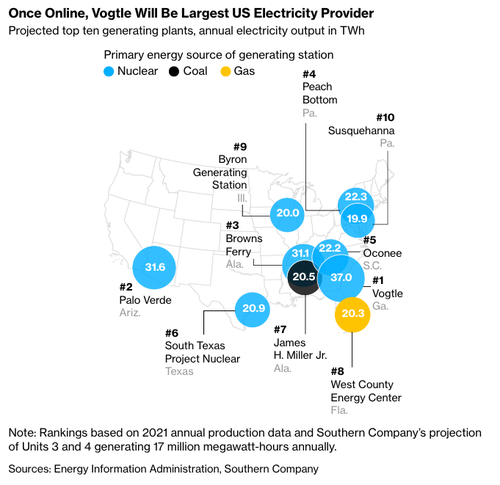
Meanwhile, seven years and $16 billion over budget, Southern Co.’s Vogtle nuclear power plant project in Georgia is coming online and will unleash a new nuclear generation of carbon-free electricity. 

“It’s also coming online just as the world has hit an inflection point in the conversation on atomic power,” Bloomberg explained. 

Source: Bloomberg 

Vogtle’s new plant will be the nation’s largest nuclear power plant and the first to be constructed in decades. 

See the rest here

Be seeing you

Posted in Uncategorized | Tagged: , , , | Leave a Comment »

ESG: Another Fraudulent Hustle That Progressive Elites Have Foisted on the Economy | Mises Wire

Posted by M. C. on April 29, 2023

ESG funds have done worse than their S&P counterparts, and the typical ESG fund fees can be three times the reported figure.

Research from Massachusetts Institute of Technology asserts that ESG goals don’t always align with shareholders’ preferences. Even when there is an explicit mandate to pursue social objectives, ESG funds still vote against shareholders.

https://mises.org/wire/esg-another-fraudulent-hustle-progressive-elites-have-foisted-economy

Lipton Matthews

The allure of environmental, social, and governance (ESG) goals has hypnotized corporate America into offering ESG funds that score investments for prioritizing social goals. Companies that account for environmental, social, and governance goals in their decisions collectively held $8.4 trillion in US investment assets at the beginning of 2022. Leading investment firm BlackRock more than doubled its holdings to over $500 billion and other players are following its lead.

ESG investing is becoming a permanent fixture in the global corporate landscape, but not without backlash. Some entrepreneurs and politicians in the United States argue that prioritizing ESG investing at the expense of shareholder welfare will diminish returns for investors. Strong concerns about the viability of ESG investing led Florida to pull $2 billion worth of assets from BlackRock in a nationwide ESG purge.

But the battle is only heating up because President Joe Biden overturned a Senate bill that prevented fund managers from factoring environmental, social, and governance goals into their investment decisions. In the private sector, tycoons have been launching firms to counter ESG investing by buying shares in companies like Apple and Disney to undercut the activism of management.

Undoubtedly, ESG investing is creating a storm in the United States, but aside from the excitement surrounding ESG investments, what are the implications? Maximizing shareholder welfare is the primary objective of an investment fund and ESG funds should not be pursued if they fail to meet this goal. Some posit that since shareholders are the owners of the company, they must be free to advocate policies that achieve ESG goals. Therefore, ESG investing can be compatible with maximizing shareholder welfare.

However, companies must ensure that shareholders are appreciative of the costs and benefits of ESG investing. Shareholders might perceive virtue in using their investments to effect social change, but learning that ESG funds are uncompetitive will surely alter their outlook. Although research on the feasibility of ESG funds is in its infancy, studies show that they have not been delivering for investors.

See the rest here

Be seeing you

Posted in Uncategorized | Tagged: , | Leave a Comment »

“Woke” Asset Managers Stung By Silicon Valley Bank’s ESG Appeal | ZeroHedge

Posted by M. C. on March 16, 2023

https://www.zerohedge.com/markets/woke-asset-managers-were-stung-svbs-esg-appeal

Tyler Durden's Photo

by Tyler Durden

Never before has it been clearer how useless ESG investing has become than in the case of Silicon Valley Bank. The bank, which donated to Black Lives Matter causes and frequently touted its virtuous diversity and equity policies, has blown a hole directly through “woke” capital allocators who sought it out for this appeal.

…as opposed to…you know…the quality of the bank’s assets and its ability to generate cash. 

“Hundreds” of ESG managers have been stung by the Silicon Valley Bank collapse, Bloomberg has reported. A new report says that “915 funds registered under European Union regulations as either ‘promoting’ ESG or declaring it as their ‘objective’ had exposure” to the bank. 

The bank “tick[ed] several boxes” for these managers, including a low carbon footprint. However, the “G” in ESG – which stands for governance – seemed to take a back seat to the “E” and the “S”. 

Sasja Beslik, a sustainable finance veteran who’s now the chief investment officer at NextGen ESG told Bloomberg: “There are a lot of lazy asset managers taking ESG scores for granted. The bank’s failure was a sign that managers who go “all in on carbon are not necessarily managing other risks.”

Former senior banker at HSBC Rebecca Self said that focusing on just one component of the ESG moniker was the problem. But Rebecca – what ever happened to good ole’ ‘investing for returns’, we have to ask?

See the rest here

Be seeing you

Posted in Uncategorized | Tagged: , , , | Leave a Comment »

ESG’s Perverse, Narrow, Fraudulent Ethical Principles – LewRockwell

Posted by M. C. on December 28, 2022

Failure of basic fiduciary duties to investors is just the tip of ESG fraud iceberg

By Paul Driessen

https://www.lewrockwell.com/2022/12/paul-driessen/esgs-perverse-narrow-fraudulent-ethical-principles/

Warning: Your retirement fund may have been Shanghaied by BlackRock or other Wall Street asset managers who’ve unilaterally decided that the tens of trillions of dollars of other people’s money they control should be used to advance political causes they favor – to “make the world a better place.”

As most people know, ESG stands for Environmental protection, Social justice, and Governance of corporate and societal affairs. They’re all noble-sounding causes. However, under ESG they’re centered around progressive, woke agendas, with prevention of “manmade climate cataclysms” uppermost. Fund assets are used to drive “net zero” climate agendas and punish or de-fund fossil fuel companies.

That narrow focus creates serious problems. Those trillions of dollars are supposed to be passively invested in index and other funds, under fiduciary obligations to secure maximum returns in support of state, local, corporate and personal retirement and investment accounts. Under ESG, however, strong returns are too often sacrificed to serve politicized agendas, often in collusion with governments, activists and other financial institutions, and thus also in violation of antitrust laws and basic ethical principles.

That’s why Asset manager Vanguard recently left the UN-sponsored “Glasgow Financial Alliance for Net Zero.” Meanwhile, Arizona, Florida, Kentucky, Louisiana, Missouri, North Carolina, Texas, West Virginia and other states are pulling tens of billions of dollars out of BlackRock, State Street and other Wall Street asset management firms, for violating fiduciary duties. It’s just the tip of the fraud iceberg.

Woke ESG practitioners also employ narrow ES&G definitions to virtue-signal, pontificate and impose prescriptive agendas with little or no regard for the consequences. When the “existential threat of manmade climate change” is the primary arbiter, enormous problems associated with replacing fossil fuels with “clean renewable energy” are simply ignored, suppressed and censored out of the analysis.

People and planet realities absolutely have to be included in any ethical ESG analysis.

Environmental protection. Rather than looking only at the temperatures, storms, droughts, rising seas and other environmental costs that climate models falsely blame on fossil fuel emissions – any accurate and honest ESG scorecard must also assess the enormous ecological impacts from wind-solar-battery (WSB) energy systems that will supposedly replace oil, gas and coal.

WSB systems and associated transmission lines do not appear spontaneously, via Materials Acquisition for Global Industrial Change (MAGIC). They require mining on unprecedented scales. President Biden’s initial batch of offshore wind turbines alone would require 110,000 tons of copper, refined from 25,000,000 tons of ore, after removing 40,000,000 tons of overburden – plus millions of tons of iron, manganese, aluminum, nickel, concrete, plastics and other materials … from billions of tons of ores.

Replacing all U.S. coal and gas electricity generation with WSB – plus gasoline vehicles and gas stoves and furnaces – would require tens of thousands of wind turbines, billions of solar panels, billions of battery modules for vehicles and backup electricity storage, and thousands of miles of new transmission lines. Has BlackRock calculated the ore body and mining requirements for that? For a global transition?

All those turbines, panels, modules, transmission lines, mines, processing plants and factories have to be located somewhere. Have the ESG potentates determined in whose backyards they will go? (Probably not Larry Fink’s or John Kerry’s.) Have they assessed the impacts on scenery, habitats and wildlife? the air and water pollution from the mines and other operations? the likelihood that endangered right whales would be driven to extinction by wind turbine installations off the U.S. Atlantic Coast?

Do all these WSB mines, foundries, factories and impacts even get (obviously negative) ESG scores?

See the rest here

Be seeing you

Posted in Uncategorized | Tagged: , , | Leave a Comment »

Doug Casey’s Top 4 Predictions for 2023 – International Man

Posted by M. C. on December 26, 2022

It’s a border war between two shithole countries in a region where wars like this have been going on for a thousand years. Russia actually has a very good historical case for reacquiring the Donbas and Crimea, and that’s all they wanted to start with. But the situation has gotten out of control—courtesy of the US Deep State.

https://internationalman.com/articles/doug-caseys-top-4-predictions-for-2023/

by Doug Casey

International Man: What important trends do you see unfolding in 2023?

Doug Casey: Perhaps the biggest turning point in recent modern history will turn out to be 2020. Governments and their minions found novel ways to gain huge amounts of control. These things were well underway before 2020, but since Covid, they’ve all gone hyperbolic. That trend will accelerate this year—albeit with some much-delayed pushback.

Four areas stand out.

First, a relatively inconsequential flu, followed by a vaccine hysteria, got far more voluntary compliance to all manner of extreme measures than most anyone could have imagined. The powers that be found that the public is vastly more likely to do as they’re told if the rationale is health rather than politics, ideology, economics, or the like. So we can count on many replays of this tune, including mandatory vaccine passports and lockdowns.

Second, the drumbeat against the newly-minted enemy element, carbon, has reached manic levels. A substantial part of the population, and a large majority of youth, have been convinced that Global Warming will destroy the planet unless we go Green, stop using fossil fuels, and attempt to run an industrial civilization on windmills and sunshine. It stands a chance of destroying civilization.

Third, central banks are racing to impose CBDCs, while governments run multi-trillion dollar deficits and bailouts, doubling and tripling debt levels with little discussion. This is unprecedented.

Fourth, the widespread acceptance of Wokism, racial quotas, aggressive LBGT++ promotion, ESG, and DIE. There are serious discussions of race reparation payments and a Guaranteed Annual Income. It’s part of an accelerated general collapse of traditional moral values.

What’s happening will, I think, be seen as a turning point greater than either WW1 or WW2. And there’s an excellent chance we’re looking at something akin to WW3 in the bargain. I don’t doubt that the era before 2020 will soon be referred to as the “Before Times,” a phrase that’s been used in dystopian science fiction. And the future could resemble dystopian sci-fi.

The future is what this discussion is about. But I’m not a fortuneteller and don’t have a crystal ball. All I can do is look at the facts. Ideally, facts that not everybody is paying attention to—interpreted through a lens that not everybody else is using.

Let’s briefly run down trends in the major markets.

See the rest here

Be seeing you

Posted in Uncategorized | Tagged: , , , , , , , | Leave a Comment »

U.S. States Wage War Against The ESG Scam

Posted by M. C. on October 22, 2022

More and more people are realizing the absurdity of “getting rid of fossil fuels,” and don’t find the idea of “eating the bugs” as appetizing. We work to bring home the bacon, not the insects. The ideas of “woke capitalism” and “climate finance” are crushing our standard of living and many U.S. states are now fighting back against it.

Be seeing you

Posted in Uncategorized | Tagged: , , | Leave a Comment »

Republicans Withdraw $1 Billion From BlackRock Due To Its ESG Policies

Posted by M. C. on October 11, 2022

Tyler Durden's Photo

BY TYLER DURDEN

Authored by Tsvetana Paraskova via OilPrice.com,

“This divestment is necessary to protect Louisiana from mandates BlackRock has called for that would cripple our critical energy sector,” said Schroder.

“I refuse to spend a penny of Treasury funds with a company that will take food off tables, money out of pockets and jobs away from hardworking Louisianans.”

https://www.zerohedge.com/energy/republicans-withdraw-1-billion-blackrock-due-its-esg-policies

Multiple U.S. states governed by Republicans are withdrawing state funds from BlackRock’s management, as they disapprove of the ESG investment policies of the world’s top asset manager, the Financial Times reports.

In recent weeks, Louisiana, South Carolina, Utah, and Arkansas have announced they would divest funds from BlackRock totaling more than $1 billion.

Last week, Louisiana State Treasurer John Schroder announced in a letter to BlackRock’s CEO Larry Fink that he would divest all Treasury funds from BlackRock. Louisiana has removed $560 million to date and will pull out a total of $794 million by year’s end, Schroder noted.

“This divestment is necessary to protect Louisiana from mandates BlackRock has called for that would cripple our critical energy sector,” said Schroder.

“I refuse to spend a penny of Treasury funds with a company that will take food off tables, money out of pockets and jobs away from hardworking Louisianans.”

South Carolina will pull $200 million from BlackRock by the end of the year, State Treasurer Curtis Loftis told FT in an interview. 

For months now, Republican states have said they would not do business anymore with asset managers who have ESG-aligned investment policies, which, the states say, show that those financial firms are boycotting the oil and gas industry. 

See the rest here

Be seeing you

Posted in Uncategorized | Tagged: , , | Leave a Comment »

‘ESG,’ the Threat to Liberty You Haven’t Heard Of

Posted by M. C. on June 20, 2022

When Coca-Cola, Gillette, Disney, BP, and other multinational corporations act counter to good business practices to advance a political agenda antithetical to the beliefs of most of their consumer base it is an effort to improve the new value-based credit score known as ESG.

by Tommy Salmons

In March of 2020 COVID-19 spread to the shores of the United States, introducing a medical threat that had all the signs of devastating families from sea to shining sea. But in the shadows, slipping in under the veil of a potentially deadly pandemic, another threat loomed. This threat, known as ESG, was not airborne or viral in the traditional sense. This threat was birthed in the imaginations of banks, corporations, and governments, and much like COVID, this threat is going to alter the life of millions of people worldwide.

ESG is an acronym that stands for Environmental, Social (Justice), and (Corporate) Governance. The goal of ESG, as World Economic Forum founder Klaus Schwab stated in Shaping the Future of the Fourth Industrial Revolution, is to utilize investors to move corporations into a more socially progressive direction; moving technologies and businesses away from the current models of doing business to a new stakeholder method of business.

“Entrepreneurs and Investors are the vanguard when it comes to marrying a values-based approach to technological development…It makes sense that thinking about broader social impact at this stage would have significant cascading effects. Investors, on the other hand, have the carrot with which to direct the development of technologies…The values of entrepreneurs and organizational leaders have a tremendous influence on the workplace and how technologies are developed. Leading from the front can transform company culture and prioritize societal values.”

When Coca-Cola, Gillette, Disney, BP, and other multinational corporations act counter to good business practices to advance a political agenda antithetical to the beliefs of most of their consumer base it is an effort to improve the new value-based credit score known as ESG. As corporations respond to investors and the credit score used to determine societal value, they push agendas intended to move the Overton Window and cultural acceptance towards a more progressive agenda.

Proponents of ESG metrics utilize the famous libertarian mantra of private companies being able to do whatever they feel is best for their company and fiduciary responsibilities, but there’s nothing private about ESG. In March of 2020 the SEC announced they would be forming an ESG Taskforce. The initiative has expanded to requiring publicly traded firms to make detailed disclosures on climate change and greenhouse gas emissions. As with all regulations ESG is being sold as serving the greater good at the cost of business, costing the consumer more money.

Proponents of ESG make a litany of arguments to justify their regulatory dreams:

  1. “ESG is crucial because it offers a focused framework through which governments, businesses, and citizens can work consistently toward solving serious global challenges.”
  2. “ESG, at its core, is a means by which companies can be evaluated with respect to a broad range of socially desirable ends.”
  3. “ESG criteria can help investors avoid investment losses when companies engaged in risky or unethical practices are held accountable.”

But they will never address in any detail how ESG metrics will be utilized to make these changes to society. And if ESG is just a tool to help investors make decisions why is the SEC mandating ESG data disclosures? And who is considered an investor?

Chart published by the Ethics and Compliance Initiative

See the rest here

Be seeing you

Posted in Uncategorized | Tagged: , , , | Leave a Comment »