Long before FDR and Erdoğan, in 1720 France, John Law, maestro of the the Mississippi Bubble, made it illegal to own gold or silver as his bubble in Mississippi Company shares and Bank Royale notes deflated. In a review of Janet Glesson’s excellent book on the episode, I summarized Law’s desperate methods:
Desperate times call for desperate measures. Or tyrannical men do tyrannical things when it comes to propping up paper money whose value is circling the drain. The Financial Times headline screams, “Turkey to Target ‘Under the Mattress’ Gold in Effort to Bolster the Lira.”
This in the same week that “[n]ewly appointed Turkish finance minister Nureddin Nebati delivered a sales pitch to investors in London on Tuesday, offering an upbeat assessment of the country’s economic outlook despite acute currency weakness and raging inflation,” according to Almost Daily Grant’s.
BlueBay Asset Management emerging market strategist Timothy Ash was impressed, telling the Financial Times that “this guy had a pitch. He’d prepared. The message was clear: foreign capital is welcome. Forget about capital controls, we’re not going to do that. That’s encouraging.”
But just in case, Mr. Nebati figures there is three hundred million dollars’ worth of gold under the beds of the Turkish populous, and the government would like to trade more than 10 percent of the hoarded yellow metal for their flimsy paper lira.
The latest of many finance ministers serving under President Recep Tayyip Erdoğan said, according to the FT, that the country’s thirty thousand gold shops would play a central role in the scheme, “which will build on a broader package of emergency measures unveiled in December in order to halt a freefall in the lira, which lost 44 per cent of its value against the dollar in 2021.”
Refineries have even been commissioned to melt down jewelry into bullion. Laura Pitel writes, “A traditional gift given for weddings and births, gold has long been a preferred way for Turks suspicious of the banking system—and their country’s history of inflation—to guard their wealth.”
After visiting the Grand Bazaar in Istanbul in 2012, I wrote on mises.org, “Just one visit to Istanbul’s Grand Bazaar tells a visitor how Turks store value. The Turkish monetary authorities have a history of debauching their currency so Turks store their wealth in gold and rugs. There are 373 jewelers and 125 rug stores in the bazaar.”
To illustrate, I continued, “In 1966, one US dollar bought 9 lira. By 2001, a dollar bought 1.65 million lira. Four years later, six zeros were lopped off the lira and a dollar equaled 1.29 new Turkish lira. Today (2012), a dollar can be traded for around 1.80 lire.” Ten years later a US dollar will buy more than thirteen lire, having rallied from seveteen to the buck in December.
Nebati said his plan aims to gather $25 billion of the yellow metal for the local banking system.
Of course, this scheme is nothing new. In 1933, Franklin Delano Roosevelt, with “authority from the Emergency Banking Act and its amendment to the Trading with the Enemy Act, ordered all individuals and corporations in America to hand over their gold holdings to the federal government in exchange for an equivalent amount of paper currency,” Tom Woods wrote on mises.org.
FDR’s next step made it illegal to “require payment in gold or a particular kind of coin or currency, or in an amount in money of the United States measured thereby.”
Long before FDR and Erdoğan, in 1720 France, John Law, maestro of the the Mississippi Bubble, made it illegal to own gold or silver as his bubble in Mississippi Company shares and Bank Royale notes deflated. In a review of Janet Glesson’s excellent book on the episode, I summarized Law’s desperate methods:
Law then resorted to despotic power, banning the export of coins and bullion. Next he prohibited the purchase or wearing of diamonds and other jewels. When this didn’t stop the exit from paper, Law outlawed the production and sale of all gold and silver artifacts with the exception of religious paraphernalia, resulting in soaring prices in crosses and chalices.
Within a month, Law banned the possession of more than five hundred livres’ worth of silver or gold and required that all payments of more than 100 livres be made in banknotes. People were promised generous rewards if they informed on their neighbors. “The slightest suspicion that gold was being concealed illegally would be enough for any house, whether palace or hovel, to be searched,” Gleeson writes.
In monetary affairs, there is nothing new under the sun.
What did the elites gathered around FDR demand? Higher prices (of course), uniform industrial codes on labor and prices, production controls, an end to competition from below, security for labor unions, guaranteed credits, import tariffs — and also the police power they needed to enforce all this. The model here was Mussolini’s Italy, which was regarded at the time as an ideal system of industrial management. Of course, antitrust laws were shelved as the government itself set out to create as many trusts as possible.
The ghost of FDR is everywhere, haunting both Washington and New York. The terrible trouble is that the minds in power have confused an economic wrecker with an angel of mercy. They are following his confusions and prescriptions day to day in an attempted repeat of the longest economic calamity in modern American history.
They have looked at the history of the New Deal and completely misunderstood it, believing the civics-book claptrap about how FDR saved us from the Depression, whereas the fact is that FDR’s theories and policies lengthened and deepened it to the point that the only way out that the Roosevelt administration saw was war.
The great theoretical error of the New Dealers was to confuse the symptom of low prices with the causes of the economic downturn. The real problem was that prices were massively inflated before the stock-market crash of 1929. The correction had to occur and would have occurred peacefully, if not wholly painlessly, had the government not intervened.
No government in all of human history that has waged war on prices has won.
The Great Depression is exhibit A.
First there was Hoover with his attack on the “bitter-end liquidationists,” whose advice he summarily rejected. Instead he increased taxes, regulated against short selling, attempted to expand liquidity and the money supply, attempted to maintain existing wage rates, extended loans via government, and bailed out debtors with bankruptcy laws. For more on Hoover’s antimarket program, see Rothbard’s America’s Great Depression.
Roosevelt took office and extended this program, while rhetorically claiming that it was the free-market policy of the Hoover administration that failed. Today we see Bush’s attack on speculators and the mediawide attempt to claim that the meltdown is caused by unregulated markets run amok. No doubt the next president, whoever he may be, will continue this crusade against markets, pretending as if the Fed and the Bush administration haven’t been trying antimarket means of rescue for fully two years, with each attempt backfiring.
But now let’s look forward to the next step in the war on falling prices in the 1930s. FDR took office under the promise that he would curb the big spending of the Hoover administration. The tune changed once he took office. Like Hoover before him, he denounced the rich and powerful speculators, bankers, and corporations he blamed for bad economic times. Even as he was saying these things, he called together the people he regarded as the most powerful and important corporate, banking, and labor interests — together with a gaggle of professors from Columbia — and essentially asked them what they wanted to get the economy going again.
This was the Brain Trust that set the pattern for all of Washington’s activities from then to the present day. John T. Flynn, in his masterful book The Roosevelt Myth, described the first round of the New Deal as
that vast hippodrome, that hectic, whirling, dizzy three-ring circus with the NRA in one ring, the AAA in another, the Relief Act in another, with General Johnson, Henry Wallace and Harry Hopkins popping the whips, while all around under the vast tent a whole drove of clowns and dervishes — the Henry Morgenthaus and Huey Longs and Dr. Townsends and Upton Sinclairs and a host of crackpots of every variety — leaped and danced and tumbled about and shouted in a great harlequinade of government, until the tent came tumbling down upon the heads of the cheering audience and the prancing buffoons.
What did the elites gathered around FDR demand? Higher prices (of course), uniform industrial codes on labor and prices, production controls, an end to competition from below, security for labor unions, guaranteed credits, import tariffs — and also the police power they needed to enforce all this. The model here was Mussolini’s Italy, which was regarded at the time as an ideal system of industrial management. Of course, antitrust laws were shelved as the government itself set out to create as many trusts as possible.
What came out of these meetings was the all-around industrial planning fiasco called the National Industrial Recovery Act, which created the National Recovery Administration. The head was former draft administrator General Hugh Johnson, who brought to the effort every propaganda trick he had learned from his kidnapping years. He began with a central plan of wages, working hours, prices, and production quotas. He went on the air, to the papers, to billboards, movies, and everything else to whip up a frenzy.
There was a symbol of compliance: The Blue Eagle. FDR said on the radio that “soldiers wear a bright badge to be sure that comrades do not fire on comrades. Those who cooperate in this program must know each other at a glance. That bright badge is the Blue Eagle.” And, added Johnson, may “God have mercy on anyone who attempts to trifle with that bird.”
And you know what? It is a complete disgrace that business supported it all — for a while.
Flynn tells of police raids of factories, as workers were lined up and interrogated to make sure that they weren’t working overtime and weren’t accepting less than the government-approved minimum. Consumers were arrested for paying less than the approved minimum prices. A tailor named Jack Magid in New Jersey was arrested and jailed for charging 35 cents instead of 40 cents to press a pair of pants. In time, the NRA became unenforceable, as black markets sprung up in every industry. The crackdown became worse, with nighttime raids on factories, and bureaucrats chopping down doors with axes to make sure that no one was sewing clothes. The NRA staff ballooned from 60 employees to 6,000 at the national level.
The entire thing became a war on production to benefit a handful of elites, all in the name of keeping prices up, all on the profound misunderstanding that boosting prices would boost production, whereas the opposite was true. Finally the Supreme Court came to the rescue and declared the whole Soviet-like scheme unconstitutional, but, by that time, it was clear that it was unworkable and doomed to failure.
At the very same time, other sectors such as banking and agriculture were being administered by other destructive schemes, all based on economic error. The result was fantastic waste, disastrous attacks on freedom and productivity, a regimentation of the entire country under a dictator, and a prolongation of the Depression, which went on and on.
No matter how many disasters FDR created — and it was nonstop — and no matter how much his ridiculous “rabbits from the hat” were exposed as economically harebrained, with every new bureau, every new law, every new initiative, the economy continued to sink.
The New Deal is a paradigmatic case of how to turn a downturn into a depression. That US leaders regard this as a model to follow does not speak very well of their economic literacy, and it doesn’t bode well for our future.
On the other hand, if you want to see how to handle a crisis, consider the Panic of 1819. Never heard of it? That’s because it came and went, and that’s because the government did nothing about it.
Today is the eighty-eighth anniversary of Executive Order 6102, signed by President Franklin Delano Roosevelt, “forbidding the hoarding of gold coin, gold bullion, and gold certificates within the continental United States.” The order was one of the several disastrous responses to the Great Depression that succeeded in escalating the financial crisis. Later in the year, the US Congress would pass a resolution retroactively supporting the legislation; however, it was the determined autocratic leadership of FDR that made way for these unprecedented measures. It would be a crime for Americans to hold gold for over forty years, until President Gerald Ford reversed the order in 1974.
This episode has several lessons for the current financial environment, particularly given the acceleration of tyranny-by-expert rule that has taken over much of the worst this past year.
The underlying legislation that evoked by FDR’s executive order was the Trading with the Enemy Act of 1917—a by-product of World War I—despite the fact that the US was in no way in a period of war in 1932. Similarly, we have seen war on terror–inspired financial legislation increasingly used against American citizens. For example, in the name of “fighting terrorism” the US PATRIOT Act significantly increased know-your-customer laws, empowering federal regulators to use the traditional banking system to better track the economic behavior of American citizens.
In the eyes of the federal government, “antiterrorism” legislation was quickly expanded to include additional missions—such as stopping money laundering and drug crimes. Increasingly, these bogeymen have been used by policymakers around the world to erode financial privacy assets—such as cash and secret Swiss bank accounts.
On the domestic side, we have increasingly seen US corporate actors demonstrate their loyalty to the progressive political zeitgeist by proactively cracking down on various dissident political figures and conservative action groups. Bank of America, for example, has debanked various gun manufacturers and also turned over client data following the January 6 protests at the US Capitol. These moves could prove useful if BoA needs another federal bailout from a Biden-Harris administration, but highlights the degree to which the modern financial system can be weaponized against a state’s political enemies.
The same playbook is being increasingly used to target bitcoin and other cryptocurrencies that are beyond the reach of the state.
Earlier this year, Treasury secretary Janet Yellen indicated that cryptocurrencies are in her crosshairs, telling an industry roundtable that
[t]he misuse of cryptocurrencies and virtual assets is a growing problem…. I see the promise of these new technologies, but I also see the reality: cryptocurrencies have been used to launder the profits of online drug traffickers; they’ve been a tool to finance terrorism.
European Central Bank president Christine Lagarde has also called for global regulation of cryptocurrencies, responding to increased interest in these alternative assets. Of course, the increased interest in assets like bitcoin is itself a direct response to the monetary policy of the Federal Reserve, ECB, and other global central banks responding to government-caused economic shutdowns in 2020.
While central bankers often publicly dismiss the role of nonpoliticized assets like gold and bitcoin in financial markets, in their own circles they understand the dangers that exist in allowing the public the option of opting out of their financial schemes.
For example, at an annual Federal Reserve conference in 2016, the late Marvin Goodfriend noted the role that cash played in limiting what antisaving policies a central bank could pursue. He advocated the abolishment of cash in return, and drew comparisons to the elimination of the gold standard. In 2018, an IMF report warned that cryptocurrencies could reduce demand in fiat money, and recommended “rigorously applying measures to prevent money laundering and the financing of terrorism” in an attempt to undermine this consumer behavior.
In addition, central banks have sought to compete with the convenience of digital currency by developing their own versions. China—whose central bank has been one of the most aggressive in credit expansion since 2008—has recently released a “digital yuan,” while the ECB is working on a “digital euro.”
As I noted in 2017, this could set up a “next generation” of global currency war between private crypto and state digital currency. Since it is the nature of a state to defend its power, we should expect to see regulators and central bankers around the world escalate regulatory and legal pressure against financial assets beyond their control.
As FDR’s gold crackdown showed, tyrants know the importance of controlling money in a time of crisis.
Thankfully, so far bitcoin has demonstrated resilience against the most forceful of state actions. For example, in countries like Morocco—which has banned bitcoin entirely—peer-to-peer trading of bitcoin has skyrocketed.
What will be interesting to see is whether countries that are suspicious of international governing organizations—such as the IMF, EU, and UN—recognize the political value of private money as a check against globalist political hegemony.
We’ve seen Russia recognize the value of gold as a check against the weaponization of the dollar. Could bitcoin be next?
Does the State’s virus management give you confidence it’s acting in your best interest? For me, it’s like something out of Orwell or Nazi Germany.
Without the State there would be chaos, we’re told. What do we have today, if not chaos? I haven’t even mentioned the riots going on, where people defending themselves are charged with serious crimes. The rioters hate the police, and seeing the police stand down, peaceful people now fear for their lives and load up on guns.
In the 1930s, first Hoover then Roosevelt tried to fix the economy that would have fixed itself if it had been left alone, which was the lesson decidedly not learned from the depression of 1920-21 and the Panics of the 19th century. If it had been left to recover on its own from federal reserve meddling, there might have been a chance the meddler would have been shut down.
But really, there was no chance. Anyone who understands the FED’s purpose — keeping the biggest banks solvent through counterfeiting — knows repealing the law that established it was not a thinkable option, given the corrupt powers that supported it.
So the FED, supercharged after FDR made owning gold coins a felony, remained on the scene and advanced its career as an untouchable counterfeiter, creating a legacy of inflation, a policy indispensable to a welfare/warfare/surveillance state. Big, suffocating government doesn’t thrive on direct theft (legislated taxation) alone.
State growth also creates connections with individuals and organizations not formally a part of the State apparatus. It has a name: Crony capitalism. Since the State deals with others by force and thrives within its sphere of influence by bestowing favors, there are always people seeking privileges, such as protection from competition, tax breaks, or monetary outlays (bailouts). In return, the State receives support in the form of political endorsements, election donations, votes, and marginalizing the views of those opposed to State policies or the State itself.
Any crisis arriving on the scene, whether State-caused or natural, is subject to State handling. People expect the State to “Do something,” and it does. Today, the State is doing plenty about the coronavirus, and no surprise, it is creating a social catastrophe.
What hath the State wrought?
It’s a challenge to document 2020’s outburst of tyranny when so many levels of government are contributing to the mayhem, but here are a few:
(1) States ordering “non-essential” businesses to close, while letting “essential” businesses remain open. If a business weren’t essential it wouldn’t be doing business. Fortunately, some business owners are at least defying the orders.
(2) With so many small businesses shut down and employees furloughed or fired, the federal government turned to its counterfeiter to ease their pain — short term relief only, of course. Most Americans aren’t complaining, but they will when they’re greeted with “monumental tax increases” that could eventually wipe out the middle class. But the CARES act is rarely presented in such truthful terms. Instead, the government with its astronomical debt somehow found $2.2 trillion in its back pocket it had apparently forgotten about, so the Treasury (not the FED) passed it out to the people, including thousands of foreign workers living overseas. Money is truly no object when it’s controlled by the government and its printing press sidekick.
(3) Stay-at-home orders for everyone, even after the virus has shown an affinity for the elderly with existing medical problems and almost no concern for healthy people under 30. Lockdowns prevent herd immunity and delay recovery. People jailed in their homes get depressed, divorced, commit suicide, abuse spouses and children, drink too much, and fail to care for other health issues. They also tend to stay unemployed if they can’t work from home. The State knows all this.
(4) Mask confusion. State health authorities saying early on that masks aren’t needed for everyday activities then reversing themselves. Studies and demonstrations showing the futility of masks, along with their numerous downsides, have yet to remove the mandates.
(5) Making people afraid to get too close to one another. We must keep at least six feet apart (unless you’re rioting for a leftist cause). States have tried hard to outlaw hugs. We can find ludicrous though often creative ways some people circumvent normal hugging.
(7) Hobbling professional sports. Fake fans in the seats, along with crowd noises lifted from a video game. No tailgating. Announcers and commentators broadcasting remotely or spread far apart. NFL commissioner Roger Goodell fining two head coaches $100,000 apiece for not wearing masks properly on the sidelines. And also fining their teams $250,000 apiece.
(8) Canceling the NCAA basketball tournaments for both men and women. At first canceling, then allowing under restrictions, the college football season. Two major conferences have yet to begin play. TV viewers are seeing cheerleaders with masks strapped to their faces cheering from the stands or from the sidelines, with gaping holes in the bleachers where fans normally sit. Meanwhile, amid all the PC caution, the players engage in a rough contact sport on the field. But even under duress the free market comes through:
At LSU last week, fans were able to purchase a cut out of themselves to be placed in the stands where 82,000 empty seats looked on. The cost? $50.
Depressing, but it’s a choice and a way for the school to recover a bit of lost revenue.
(9) Criminally, the suppression and in some cases outlawing of a demonstrably effective treatment for SARS-CoV-2, hydroxychloroquine. The government has never before “restricted physicians from prescribing an FDA approved medication,” according to America’s Frontline Doctors.
This is an FDA approved drug for 65 years; it’s generic, cheap, widely available. We give it to pregnant women, to breastfeeding women, to elderly patients, to patients who are immune-compromised…
Initially, the FDA issued an Emergency Use Authorization (EUA) for HCQ, and CQ but then later revoked it. During the brief period under the EUA the “strategic national stockpile” amassed 63 million doses of HCQ. Mylan and Novartis donated millions of doses to the stockpile, with Bayer kicking in another two million doses of CQ. Trump called it a game-changer on March 21 and that changed the game. On June 15 the FDA revoked EUA, saying:
Specifically, FDA has determined that CQ and HCQ are unlikely to be effective in treating COVID-19 for the authorized uses in the EUA. Additionally, in light of ongoing serious cardiac adverse events and other serious side effects, the known and potential benefits of CQ and HCQ no longer outweigh the known and potential risks for the authorized use. This warrants revocation of the EUA for HCQ and CQ for the treatment of COVID-19.
Twenty-year emergency room physician Dr. Simone Gold was fired for appearing in a video in which she advocated HCQ for use against COVID-19. The video, which went viral, was removed from social media. Her employer threatened to fire her colleagues if she didn’t go quietly.
An ongoing evaluation of HCQ called HCQTrial, done anonymously by PhD researchers and scientists under the name @CovidAnalysis (to avoid another “Simone Gold” incident), presents findings for countries that do or do not use HCQ. As the chart shows, early treatment makes a big difference, and countries using HCQ show far lower mortality rates.
I’ll let the reader decide whether the war on HCQ is at all related to the Left’s war on Trump and the lucrative revenue stream from government sponsorship of a rushed-to-market vaccine.
(10) If the State is concerned with our health, why aren’t their spokespeople urging us to boost our immune systems? That’s our first line of defense against any infectious disease, along with common sense. Why aren’t they now, in October, urging us to load up on vitamins D3, K2, and C especially, along with zinc? Why aren’t they classifying HCQ as an OTC drug as it is in many countries, to be used as a prophylactic?
Conclusion
In most circles the fact of government’s necessity is never mentioned but always assumed. Thus, the push for reforms, to get better people in positions of authority, to pass needed legislation on top of the mountains that already exist. Always — work within the system. Don’t rock the boat. Our foundations are still solid. Rarely does anyone call into question the need for government-as-we-know-it — the State.
Does the State’s virus management give you confidence it’s acting in your best interest? For me, it’s like something out of Orwell or Nazi Germany.
Without the State there would be chaos, we’re told. What do we have today, if not chaos? I haven’t even mentioned the riots going on, where people defending themselves are charged with serious crimes. The rioters hate the police, and seeing the police stand down, peaceful people now fear for their lives and load up on guns.
And now we’re being hit with black lives matter and only black lives matter. It is no longer a fringe movement. It exists virtually unchallenged. No one, no matter their race, can live long under that slogan.
We already have a government we can live with. It’s called the free market but it’s been sabotaged by the State. It’s locked down, meaning not allowed to operate. We need to set it free.
If you, thoughtful reader, want a stateless free market you must tell the world you want it. At the end of the video I ask you to vote by giving the video a thumbs up or down. I urge you to give it a thumbs up. Without your affirmation the stateless free market will forever remain a fantasy and today’s nightmare will only get worse.
Keep in mind that there is nothing in the principles of warfare that required Truman and Roosevelt to demand the unconditional surrender of Japan (or Germany). Wars can be — and often are — ended with terms of surrender. Both presidents were willing to sacrifice countless people on both sides of the conflict to attain their demand for unconditional surrender.
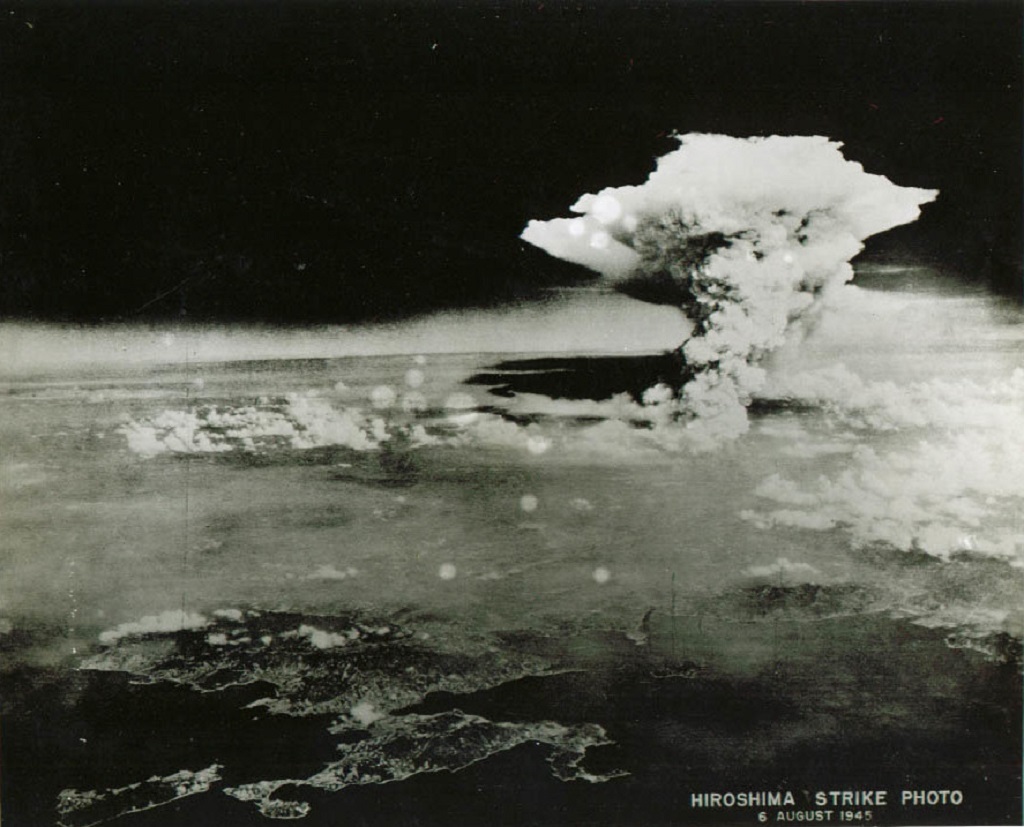
This month marks the 75h anniversary of the U.S. atomic bombings of Hiroshima and Nagasaki. While proponents of the bombings have long justified them on the basis that they shortened World War II, the fact is that they were war crimes. The only reason why President Truman and the pilots who dropped the bombs were not prosecuted as war criminals is because the United States ended up winning the war.
It has long been pointed out that Japan had expressed a willingness to surrender. The only condition was that the Japanese emperor not be abused or executed.
President Truman refused to agree to that condition. Like his predecessor Franklin Roosevelt, Truman demanded “unconditional surrender.”
That was why Japan continued fighting. Japanese officials naturally assumed that U.S. officials were going to do some very bad things to their emperor, including torture and execution. In the minds of Japanese officials, why else would the United States not be willing to agree to that one condition, especially given that it would have meant the end of the war?
The dark irony is that Truman ended up accepting the condition anyway, only after he pulverized the people in Hiroshima and Nagasaki with nuclear bombs.
In an excellent op-ed in the Los Angeles Times today entitled “U.S. Leaders Knew We Didn’t Have to Drop Atomic Bombs on Japan to Win the War. We Did It Anyway” the authors point out:
Seven of the United States’ eight five-star Army and Navy officers in 1945 agreed with the Navy’s vitriolic assessment. Generals Dwight Eisenhower, Douglas MacArthur and Henry “Hap” Arnold and Admirals William Leahy, Chester Nimitz, Ernest King, and William Halsey are on record stating that the atomic bombs were either militarily unnecessary, morally reprehensible, or both.
Keep in mind that there is nothing in the principles of warfare that required Truman and Roosevelt to demand the unconditional surrender of Japan (or Germany). Wars can be — and often are — ended with terms of surrender. Both presidents were willing to sacrifice countless people on both sides of the conflict to attain their demand for unconditional surrender.
But Truman’s unconditional surrender demand is not why his action constituted a war crime. This bombings constituted war crimes because they targeted non-combatants, including children, women, and seniors with death as a way to bring about an unconditional surrender of the Japanese government.
It has long been considered a rule of warfare that armies fight armies in war. They don’t target non-combatants. The intentional killing of non-combatants is considered a war crime.
A good example of this principle involved the case of Lt. William Calley in the Vietnam War. Calley and his men shot and killed numerous non-combatants in a South Vietnamese village. The victims included women and children.
The U.S military prosecuted Calley as a war criminal — and rightly so. While the deaths of non-combatants oftentimes occurs incidentally to wartime operations, it is a war crime to specifically target them for death.
Truman justified his action by arguing that the bombings shortened the war and, therefore, saved the lives of thousands of American soldiers and Japanese people if an invasion had become necessary. It is a justification that has been repeated ever since by proponents of the bombings.
There are two big problems with that justification, however.
First, an invasion would not have been necessary. All that Truman had to do was to accept Japan’s only condition for surrender, and that would have meant the end of the war, without the deaths that would have come with an invasion and that did come with the bombings of Hiroshima and Nagasaki.
More important, the fact that lives of American soldiers would have been saved is not a moral or legal justification for targeting non-combatants. If Calley had maintained at his trial that his actions were intended to shorten the Vietnam War, his defense would have been rejected. He would have still be convicted for war crimes.
Soldiers die in war. That is the nature of war. To kill women, children, and seniors in the hopes of saving the lives of soldiers by shortening the war is not only a war crime, it is also an act of extreme cowardice. If an invasion of Japan would have become necessary to win the war, thereby resulting in the deaths of thousands of U.S. soldiers, then that’s just the way that war works.
It’s also worth pointing out that Japan never had any intention of invading and conquering the United States. The only reason that Japan bombed Pearl Harbor was in the hope of knocking out the U.S. Pacific fleet, not as a prelude to invading Hawaii or the continental United States but simply to prevent the U.S. from interfering with Japan’s efforts to secure oil in the Dutch East Indies.
And why was Japan so desperate for oil as to initiate war against the United States? Because President Franklin Roosevelt had imposed a highly effective oil embargo on Japan as a way to maneuver the Japanese into attacking the United States.
FDR’s plan, of course, succeeded, which ended up costing the lives of hundreds of thousands of American soldiers and millions of Japanese citizens, including those at Hiroshima and Nagasaki.
When I was five years old I could walk safely one mile to school and home by myself without my parents being arrested by Child Protective Services for child neglect and endangerment.
In school we could draw pictures of fighter planes, warships, and guns without being regarded as a danger to our classmates and sent for psychiatric evaluation. Fights were just a part of growing up. The police weren’t called, and we weren’t handcuffed and carted off to jail. Today kids who play cops and robbers or cowboys and Indians and point fingers at one another as pretend guns end up in police custody. A fight means an assault charge and possibly a felony record.
I received my new homeowners policy yesterday.It arrived with 89 pages of warnings, definitions, and liability explanations.One can’t really tell if one is insured or not.
I remember when there was no tamper-proof and child-proof packaging.That was before multiculturalism and Identity Politics when we could still trust one another and parents accepted responsibility for their children without fobbing it off on a company with a liability claim.
I remember also when there were no state income and sales taxes.States were able to meet their responsibilities without them.
A postage stamp cost one cent. A middle class house was $11,000 and an upper middle class house went fot $20,000.One million dollars was a large fortune. There were no billionaires.
The air museum on the naval base in Pensacola, Florida, has a street reconstructed from the 1940s. The restaurant’s memu offers a complete evening meal for 69 cents.
I was thinking about that as I reviewed a recent Publix supermarket bill:a loaf of bread $3.89, a dozen organic eggs $4.95, a package of 6 hot dogs $5.49, 8 small tomatos $5.19, a package of baby spinach $4.19, a half gallon of milk $4.59, a package of two paper towel rolls $5.99.When I was 5 or 6 years old, my mother would send me to the bakery with a dime for a loaf of bread or to the market with 11 cents for a quart of milk. The Saturday afternoon double-feature at the movie house was 10 cents.A case of Coca-Colas (24 bottles) was one dollar. Ten cents would get you a Pepsi Cola and a Moon Pie, lunch for construction crews. Kids would look for discarded Pepsi Cola bottles on construction sites. In those days there was a two cent deposit on soft drink bottles. One bottle was worth 4 pieces of Double Bubble gum.Five bottles paid for the Saturday double-feature.
Dimes, quarters, and half dollars were silver, and there were silver dollars. The nickle (five cent coin) was nickle, and the penny was copper. FDR took gold away in 1933. The silver coins disappeared in 1965.Our last commodity money, the copper penny, met its demise in 1983.Now they are talking about getting rid of the penny altogether.
Many of us grew up with paper routes for spending money.Other than a paper route, my first employment was the high school summer when I worked the first shift in a cotton mill for $1 an hour.And work it was.After the withholding tax my takehome pay for the 40 hour week was $33.
When I was five years old I could walk safely one mile to school and home by myself without my parents being arrested by Child Protective Services for child neglect and endangerment.
In school we could draw pictures of fighter planes, warships, and guns without being regarded as a danger to our classmates and sent for psychiatric evaluation.Fights were just a part of growing up. The police weren’t called, and we weren’t handcuffed and carted off to jail. Today kids who play cops and robbers or cowboys and Indians and point fingers at one another as pretend guns end up in police custody. A fight means an assault charge and possibly a felony record.
The kind of freedom I had as a child no longer exists except in remote rural areas. When I think about this I wonder if kids today even notice.They live in the virtual world of the video screen and do not know the real world.Catching crawfish in the creek while watching out for cottonmouth moccasins, playing capture the flag over acres of expanse without getting a bad case of poison ivy, organizing a neighbohood ball game, damning up a creek and making a swimming hole. Today these are unknown pleasures.
When it rained we read books. I remember reading Robert Heinlein’s Puppet Masters when I was 12 years old. Do 12 year olds read books today?Can science fiction compete with video games?
I remember when a deal rested on a handshake.Today lawyers tell me even contracts are unenforceable.
We were taught to behave properly so that “you can look yourself in the mirror.”Today you can’t look yourself in the mirror unless you have upstaged or ripped off someone.Character is a thing of the past, as are habits that are today regarded as inappropriate.An older person hoping to get a point across to a younger one would put his or her hand on the younger person’s arm or thigh for attention purposes.Do this today and you get a sexual charge. Both of my grandmothers would probably be locked up as sexual offenders.
Being a tattle-tale was an undesirable and discouraged trait. Today we are encouraged to be tattle-tales.You will hear the encouragement several dozen times while awaiting your flight to be called.Neighbors on quiet cul-de-sacs will call Child Protective Services to report one another’s unsupervised children at play.
I remember when black Americans said they just wanted to be treated like everyone else.That was before racial set-asides in federal government contracts that only black-owned firms can bid on. Once you have special privileges, you don’t want to be like everyone else.Blacks say being white is a privilege.If so, it wasn’t enough privilege for Celeste Bennett’s firm Ultima.Her white privilege and her gender privilege were trumped by black set-aside privilege.
If my parents and grandparents were to be resurrected, they would require a year’s training before it would be safe for them to go about with being arrested.They would have to be educated out of their customary behavior patterns and taught the words and phrases that are today impermissable.They would have trouble comprehending that there are no-go areas in cities.Reading Diana Johnstone’s masterful book, Circle in the Darkness, I remembered the safety of my own youthful years as I read that as a 12 year old she could walk alone around the wharfs of southwest Washington, D.C., in the 1940s unmolested.
I received my new homeowners policy yesterday.It arrived with 89 pages of warnings, definitions, and liability explanations.One can’t really tell if one is insured or not.
I have a 54-year old Jaguar that I have had for 47 years. The owner’s manual tells how to operate and repair the car. A friend showed me the owner’s manual on his 21-year old Porsche. It has more pages of warnings to protect the manufacturer from liability claims than the Jaguar manual has pages of instruction. Today any tool or gadget you buy has more pages of warnings than instruction.
My AARP Medicare supplement insurance policy arrived explaining my meager and expensive covering.It came with a notice letting me know that language assistance services are available for the policy in Spanish, Vietnamese, Tagalog, Russian, Arabic, Haitian Creole, French, Polish, Portuguese, Italian, German, Japanese,Hmong, Llocano, Somali, Greek, Gujarati, and that there is no discrimination because of sex, age, race, color, disability or national origin. The notice provides access to a Civil Rights Coordinator in the event I feel discriminated against.AARP even provides a number to call for help with filing a discrimination complaint.
I do feel discriminated against. But it is not a covered discrimination. I feel like my country has been stolen or that I have been kidnapped and placed in some foreign unknown place that I don’t recognize as home.
I feel the same when I get fundraising appeals from Georgia Tech and Oxford University. Georgia Tech was an all male school consisting primarily of in-state Georgia boys.The Oxford colleges were segregated according to gender—male and female—and the vast majority of the members were British.Today all the colleges except the women’s are gender integrated. White males seldom appear in the photos in the fundraising materials that arrive from Oxford and Georgia Tech.I see lots of women and racial diversity and wonder what university it is.An improvement or not, they are not the schools of which I have memories.The schools I knew have simply been taken away.Something else is there now.
Perhaps it has always been true, but today if you live very long you outlive your world. As your friends die off, no one remembers it correctly but you as you watch your world disappear in misrepresentations to serve present day agendas.
Mussolini, who did not allow his work as dictator to interrupt his prolific journalism, wrote a glowing review of Roosevelt’s Looking Forward. He found “reminiscent of fascism … the principle that the state no longer leaves the economy to its own devices”; and, in another review, this time of Henry Wallace’s New Frontiers, Il Duce found the Secretary of Agriculture’s program similar to his own corporativism (pp. 23-24).
Critics of Roosevelt’s New Deal often liken it to fascism. Roosevelt’s numerous defenders dismiss this charge as reactionary propaganda; but as Wolfgang Schivelbusch makes clear, it is perfectly true. Moreover, it was recognized to be true during the 1930s, by the New Deal’s supporters as well as its opponents.
When Roosevelt took office in March 1933, he received from Congress an extraordinary delegation of powers to cope with the Depression.
The broad-ranging powers granted to Roosevelt by Congress, before that body went into recess, were unprecedented in times of peace. Through this “delegation of powers,” Congress had, in effect, temporarily done away with itself as the legislative branch of government. The only remaining check on the executive was the Supreme Court. In Germany, a similar process allowed Hitler to assume legislative power after the Reichstag burned down in a suspected case of arson on February 28, 1933. (p. 18).
The Nazi press enthusiastically hailed the early New Deal measures: America, like the Reich, had decisively broken with the “uninhibited frenzy of market speculation.” The Nazi Party newspaper, the Völkischer Beobachter, “stressed ‘Roosevelt’s adoption of National Socialist strains of thought in his economic and social policies,’ praising the president’s style of leadership as being compatible with Hitler’s own dictatorial Führerprinzip” (p. 190).
Nor was Hitler himself lacking in praise for his American counterpart. He “told American ambassador William Dodd that he was ‘in accord with the President in the view that the virtue of duty, readiness for sacrifice, and discipline should dominate the entire people. These moral demands which the President places before every individual citizen of the United States are also the quintessence of the German state philosophy, which finds its expression in the slogan “The Public Weal Transcends the Interest of the Individual”‘” (pp. 19-20). A New Order in both countries had replaced an antiquated emphasis on rights.
Mussolini, who did not allow his work as dictator to interrupt his prolific journalism, wrote a glowing review of Roosevelt’s Looking Forward. He found “reminiscent of fascism … the principle that the state no longer leaves the economy to its own devices”; and, in another review, this time of Henry Wallace’s New Frontiers, Il Duce found the Secretary of Agriculture’s program similar to his own corporativism (pp. 23-24).
Roosevelt never had much use for Hitler, but Mussolini was another matter. “‘I don’t mind telling you in confidence,’ FDR remarked to a White House correspondent, ‘that I am keeping in fairly close touch with that admirable Italian gentleman'” (p. 31). Rexford Tugwell, a leading adviser to the president, had difficulty containing his enthusiasm for Mussolini’s program to modernize Italy: “It’s the cleanest … most efficiently operating piece of social machinery I’ve ever seen. It makes me envious” (p. 32, quoting Tugwell).
Why did these contemporaries sees an affinity between Roosevelt and the two leading European dictators, while most people today view them as polar opposites? People read history backwards: they project the fierce antagonisms of World War II, when America battled the Axis, to an earlier period. At the time, what impressed many observers, including as we have seen the principal actors themselves, was a new style of leadership common to America, Germany, and Italy.
Once more we must avoid a common misconception. Because of the ruthless crimes of Hitler and his Italian ally, it is mistakenly assumed that the dictators were for the most part hated and feared by the people they ruled. Quite the contrary, they were in those pre-war years the objects of considerable adulation. A leader who embodied the spirit of the people had superseded the old bureaucratic apparatus of government.
While Hitler’s and Roosevelt’s nearly simultaneous ascension to power highlighted fundamental differences … contemporary observers noted that they shared an extraordinary ability to touch the soul of the people. Their speeches were personal, almost intimate. Both in their own way gave their audiences the impression that they were addressing not the crowd, but each listener as an individual. (p. 54)
But does not Schivelbusch’s thesis fall before an obvious objection? No doubt Roosevelt, Hitler, and Mussolini were charismatic leaders; and all of them rejected laissez-faire in favor of the new gospel of a state-managed economy. But Roosevelt preserved civil liberties, while the dictators did not.
Schivelbusch does not deny the manifest differences between Roosevelt and the other leaders; but even if the New Deal was a “soft fascism”, the elements of compulsion were not lacking. The “Blue Eagle” campaign of the National Recovery Administration serves as his principal example. Businessmen who complied with the standards of the NRA received a poster that they could display prominently in their businesses. Though compliance was supposed to be voluntary, the head of the program, General Hugh Johnson, did not shrink from appealing to illegal mass boycotts to ensure the desired results.
“The public,” he [Johnson] added, “simply cannot tolerate non-compliance with their plan.” In a fine example of doublespeak, the argument maintained that cooperation with the president was completely voluntary but that exceptions would not be tolerated because the will of the people was behind FDR. As one historian [Andrew Wolvin] put it, the Blue Eagle campaign was “based on voluntary cooperation, but those who did not comply were to be forced into participation.” (p. 92)
Schivelbusch compares this use of mass psychology to the heavy psychological pressure used in Germany to force contributions to the Winter Relief Fund.
Both the New Deal and European fascism were marked by what Wilhelm Röpke aptly termed the “cult of the colossal.” The Tennessee Valley Authority was far more than a measure to bring electrical power to rural areas. It symbolized the power of government planning and the war on private business:
The TVA was the concrete-and-steel realization of the regulatory authority at the heart of the New Deal. In this sense, the massive dams in the Tennessee Valley were monuments to the New Deal, just as the New Cities in the Pontine Marshes were monuments to Fascism … But beyond that, TVA propaganda was also directed against an internal enemy: the capitalist excesses that had led to the Depression… (pp. 160, 162)
This outstanding study is all the more remarkable in that Schivelbusch displays little acquaintance with economics. Mises and Hayek are absent from his pages, and he grasps the significance of architecture much more than the errors of Keynes. Nevertheless, he has an instinct for the essential. He concludes the book by recalling John T. Flynn’s great book of 1944, As We Go Marching.
Flynn, comparing the New Deal with fascism, foresaw a problem that still faces us today.
But willingly or unwillingly, Flynn argued, the New Deal had put itself into the position of needing a state of permanent crisis or, indeed, permanent war to justify its social interventions. “It is born in crisis, lives on crises, and cannot survive the era of crisis…. Hitler’s story is the same.” … Flynn’s prognosis for the regime of his enemy Roosevelt sounds more apt today than when he made it in 1944 … “We must have enemies,” he wrote in As We Go Marching. “They will become an economic necessity for us.” (pp. 186, 191)
Did you ever realize that WWII was started because England was obligated by treaty to defend Poland (from Hitler in this case) but FDR and Churchill gave away Poland to Franklin’s “Papa Joe” at Yalta? It seems to have defeated the whole purpose.
Roosevelt stands for the national government as we know it today: a vast, unfathomable bureaucratic apparatus that recognizes no limits whatsoever to its power, either at home or abroad. Internationally, it gives every evidence of intending to run the whole world, of extending its hegemony — now that the Soviet Union is no more — to every corner of the globe.
In the two centuries or so of our history, it has happened that a few of our leaders — a very few — became symbols of some powerful idea, one that left a permanent imprint on the life of our country. Thomas Jefferson is one such symbol. With Jefferson, it is the idea of a free, self-governing people, dedicated to the enjoyment of their God-given natural rights, in their work, their communities, and the bosom of their families. Abraham Lincoln symbolizes a rather different idea — of America as a great, centralized nation-state, supposedly dedicated to individual freedom, but founded on the unquestioned authority and power of the national government in Washington.
And now Franklin Roosevelt, too, has come to represent a certain conception of America, one that is worlds apart from Jefferson’s vision, and different from anything that even Lincoln could have imagined. Roosevelt stands for the national government as we know it today: a vast, unfathomable bureaucratic apparatus that recognizes no limits whatsoever to its power, either at home or abroad. Internationally, it gives every evidence of intending to run the whole world, of extending its hegemony — now that the Soviet Union is no more — to every corner of the globe.
Domestically, it undertakes, through an annual budget of close to $2 trillion, to assuage every real or invented social ill and thus enters into every aspect of the people’s lives. In particular, it is engaged in what even a couple of decades ago would have seemed fantastic — a campaign to annihilate freedom of association, subjecting the American people to a program of radical social engineering, in order to transform their voluntarily held traditional beliefs and values and way of life.
More than anyone else, Franklin Roosevelt is responsible for creating the Leviathan state that confronts us today.
In his own time, FDR had many influential enemies in business, politics, and the press, men and women who recognized what he was doing to the republic they loved and who fought him tenaciously. They were proud to be known as “Roosevelt haters.” Today, however, practically the whole of the political class in the United States has been converted into idolaters of Franklin Roosevelt.
This state of affairs was epitomized last May, when the Franklin Delano Roosevelt Memorial was dedicated in Washington, DC. Situated on a 7.5-acre site by the Tidal Basin, it includes an 800-foot wall, six waterfalls, outdoor galleries, and nine sculptures. Congress voted $42.5 million to fund the memorial, Republicans (those wild revolutionaries) joining Democrats with equal enthusiasm. No one breathed a word about Roosevelt’s failure to end the Depression, his lying us into war, his warm friendship with Joseph Stalin, and similar milestones in his long career — the major controversy was over whether or not he should be shown with his signature jaunty cigarette-holder. (In deference to the forces of political correctness, he wasn’t.)
Most revealing was that self-styled conservative organs such as the National Review and the American Spectator joined in the hosannas. It is a sign of how far things have moved that abject adulation of Franklin Roosevelt is now the order of the day even at the Wall Street Journal. The Journal has long been supposed to be the voice of American business, a quality paper that stood for the market economy and limited government, and so was the counterpart to the New York Times in the American press. On the occasion of the dedication of the FDR memorial, the Journal expressed its opinion through an article by one of its editors, a certain Dorothy Rabinowitz (who used to review movies). Rabinowitz was outraged that Ed Crane, president of the Cato Institute, had dared to refer to her hero as “a lousy president.” No, she insisted, Roosevelt was a great one.
Why? Well, because of “the depth of his hold on minds and hearts,” because in the midst of the Depression he gave the people hope, because he stood firm against Hitler, because when he died even Radio Tokyo called him a “great man.” Roosevelt’s many enemies, in his time and even now, never had any good reason to condemn this man who changed America so radically; they were merely “maddened by hatred of him.” In all of Rabinowitz’s effusion there were no hard facts, no analysis, no argument (and certainly no mention of FDR’s great friend Joseph Stalin). It was all sentimental gush. And so the Wall Street Journal enters the age of Oprah Winfrey journalism.
Such productions by FDR’s devotees are by no means mere exercises in historical myth-making. They perform a vital political function for the antifreedom forces in contemporary America. Simply put: the glorification of Franklin Roosevelt means the validation of the Leviathan state. Thus it is of great importance to those on the side of freedom to understand who this man really was, what he really stood for, and what, as a matter of historical truth, he inflicted on the American republic.
Franklin Roosevelt was born in 1882, in the family mansion overlooking the Hudson River, on the 1,300-acre estate that came to be known as Hyde Park. On his father, James’s, side, Franklin could trace his ancestry back to the middle of the 17th century, when a forebear immigrated from Holland to what was then New Amsterdam. Part of the family settled in Oyster Bay, Long Island, eventually producing Franklin’s distant cousin, Theodore.
The Hudson Valley Roosevelts tended to marry well, mainly into affluent families of English descent — by the time Franklin came on the scene he was, despite his name, of nearly purely English heritage. His mother, Sara, was from an equally prominent family, the Delanos. Franklin was his doting parents’ only child. While by no means fabulously rich, the family was of the sort that mingled freely with the Astors and the Vanderbilts and the rest of the high society of nearby New York City.
Until the age of 14, Franklin was tutored at home. Not at all a bookish boy, he loved nature and, above all, boating on the Hudson and at the family summer home in Campobello, Maine. He developed a passion for stamp collecting, which he pursued all his life. His admirers later claimed that this hobby gave him great insight into the geography, resources, and character of all the world’s nations — more pro-Roosevelt blather. He often visited New York and toured Europe every year with his parents. The inevitable word to describe the Roosevelts and their lifestyle is patrician.
Franklin’s prep school was Groton, near New London, Massachusetts, as close to an English “public” (i. e., private) school as one could get on this side of the Atlantic. The whole ethos of the place was “Old English,” an attempt to copy the educational experience of schools such as Eton and Harrow, whose job it was to shape the future ruling class of the great world empire. At Groton, Franklin lived and studied among the progeny of his own class, those who felt themselves to be the fated future leaders of American business, education, religion, and, above all, politics. Ironically, a fellow Grotonian in Franklin’s day was the young Robert McCormick, whose father owned the Chicago Tribune — ironically, because Colonel McCormick, as he was known in later life (after his service in the First World War), went on to become the greatest and best-known “Roosevelt hater” of them all.
Franklin was a mediocre student at Groton in every respect. His top grades were no better than B; he did not stand out in debating or sports, nor was he particularly popular with the other boys. In 1900, he went on to Harvard, where he showed as little interest in studies or ideas as he had at prep school. Franklin coasted through college with the traditional “gentleman’s C” average that was perfectly acceptable in the sons of the elite at that time.
His social life, however, improved dramatically. Franklin was already beginning to display the affability and charm that so bedazzled politicians and the press in the years ahead. Of course, his popularity was helped along by his family name. Cousin Theodore had been elected vice president, and then, in 1901, through the assassination of William McKinley, had become president of the United States.
It was only natural that Franklin, already toying with the idea of a career in politics, should pay close attention to the doings of his presidential relation. Theodore was the first president in the distinctively modern mold: he had a sense of drama and timing and a natural grasp of how to exploit the press to create a persona for himself in the eyes of the people. Beyond that, TR, as he was commonly known, had a rare ability to make personal use of popular causes and resentments. It was the age of “progressivism,” a vague term, but one that connoted a new readiness to use the power of government for all sorts of grand things. H.L. Mencken, the great libertarian journalist and close observer and critic of presidents, compared him to the German kaiser, Wilhelm II, and shrewdly summed him up: “The America that [Theodore] Roosevelt dreamed of was always a sort of swollen Prussia, truculent without and regimented within.”
Particularly fascinating to Franklin must have been the way TR was able to turn his patrician background to his advantage. After all, in the past, the Americans had shown themselves wary of upper-class leaders, who were suspected of being insufficiently “democratic” and not in tune with the people. What TR did brilliantly was to introduce caesarism into American politics. This term refers to the political strategy adopted by Julius Caesar to gain power. Although himself from a wealthy and high-born family, Caesar castigated his fellow patricians and appealed instead to the lower classes for support. They, in turn, loved the favors they received from on high, and, perhaps even more, the sight of Caesar trouncing and humbling his fellow blue bloods.
Julius Caesar was thus one of history’s great demagogues; and ever since his time the tactic of a politician from society’s elite pandering to the “have-nots” against the upper classes has been known by his name. In fabricating his persona as the great “trustbuster,” Theodore Roosevelt’s form of American caesarism proved wildly successful.





 MCViewPoint
