MCViewPoint

Opinion from a Libertarian ViewPoint

Posts Tagged ‘gold’

Sorry, You Can’t Have Your Gold 

Posted by M. C. on February 13, 2024

by Jeff Thomas

As the economic crisis gets ever closer, they understand that the day will soon come when a banking emergency is declared and the banks will shut their doors for an as-yet-unknown period of time (presumably until a solution is found). What will the new rules be? No one knows. Will the banks and storage facilities be obligated to deliver in full if the doors open once again? No one knows.

Therefore, in the final stretch of this race to the bottom, they want to be holding as much of your money and metals as they can.

Whether you own gold or not it is wise to know who and what you are up against.
In this publication, we warn regularly of the risk involved in storing wealth in banks. They’ve made the removal of your deposits increasingly difficult in addition to colluding with governments to allow them to legally freeze or confiscate your money. To add insult to injury, they’re creating reporting requirements with regard to the contents of  safe deposit boxes and restricting what can be stored in them – again, at risk of confiscation.

More and more, banks are becoming one of the more risky places to store wealth in any form. Not surprising, then, that many people are returning to those facilities that treat wealth storage the way the first banks did millennia ago – vault facilities that store your wealth for a fee but engage in no other banking activities.

But, in suggesting to our readers that such facilities are a better bet, I’ve also repeatedly warned readers that many such facilities don’t store actual, physical gold. They instead provide a contract to you that states that they will deliver an agreed-upon amount of gold upon demand. The trouble with this idea is that it becomes tempting for such facilities to sign such a contract with you and collect the purchase price but never actually purchase and store any gold. It’s been estimated that the total worldwide value of such contracts equals 150 times the amount of gold in existence in the world.

Uh-oh.

This is why it’s imperative that you purchase only physical, allocated gold.

And another caution: I’ve repeatedly stated that, although many of the most secure facilities in the world are located in North America and Europe, these jurisdictions are on the cusp of economic crisis, a fact that suggests that, if and when the crisis arrives, the rule book will be thrown out the window. Governments and facilities alike may prove untrustworthy and, at some point, you may drop by the facility to withdraw your gold and be told, “Sorry, we’re unable to provide delivery.” There could be a multitude of reasons given, hoops to jump through, and endless red tape to deal with. And still, in the end, you may never be able to take delivery.

It’s for these reasons that we advise that, although nothing in life is guaranteed, you should always protect your wealth by choosing the least risky option.

This means that you should follow two simple rules – Rule #1: Select the jurisdiction with the best laws and reputation. Rule #2: Make sure there’s a reputable storage facility in that jurisdiction that has a Class III vault and a contract that meets your needs.

But am I being overly cautious when I so frequently offer this advice? Unfortunately, no. I’ve predicted that, in the future, as we get closer to a monetary crisis, banks and storage facilities that are located in countries that are likely to be heavily affected will work ever harder to avoid releasing either money on deposit (in the case of banks) and precious metals (in the case of storage facilities).

See the rest here

Be seeing you

Posted in Uncategorized | Tagged: , | Leave a Comment »

9 Reasons Why Gold Will Soon Replace Treasuries As The Ultimate Store-Of-Value Asset

Posted by M. C. on August 4, 2023

In short, we are on the verge of a paradigm shift in international finance as gold replaces Treasuries as the world’s premier store-of-value asset.

Then, gold skyrocketed from $35 per ounce to $850 in 1980—a gain of over 2,300% or more than 24x.

I expect the percentage rise in the price of gold to be at least as significant as it was during the last paradigm shift.

https://www.zerohedge.com/personal-finance/9-reasons-why-gold-will-soon-replace-treasuries-ultimate-store-value-asset

Tyler Durden's Photo

by Tyler Durden

Authored by Nick Giambruno via InternationalMan.com,

In the age of fiat currency, the distinct concepts of saving and investing have become conflated and confused.

Saving is producing more than you consume and then setting it the difference aside.

Investing is allocating capital to a productive business to create more wealth. Investing has more risk—and potential reward—than saving.

Today, however, what most people think of as saving is actually investing.

That’s because most people take the excess of their production over consumption and put it into the stock or bond market.

Most people understand that it’s not optimal to simply hold fiat currency, which the central banks continuously debase. So they put their money into other assets, primarily bonds and stocks.

In other words, fiat currency and inflation have ruined saving for most people. It has forced them further down the risk curve into stocks, bonds, and other investments in a struggle to maintain their purchasing power.

However, there is no guarantee those investments will even keep up with inflation. But suppose they do. They will then be subject to a capital gains tax, even if it’s only a nominal gain, not a real one.

That means savers face the daunting task of not only keeping up with inflation but also outpacing the capital gains tax on the nominal gain just to maintain their purchasing power.

That’s made saving an impossible task for most.

Before the era of easy-to-produce fiat currency, people could simply save in money, which was either gold or a derivation of it.

There was no need for a dentist, construction worker, or taxi driver also to become a hedge fund manager to try to keep their head above water.

That’s how the fiat era monetized stocks, bonds, real estate, and other assets that wouldn’t have otherwise been.

For example, 50 years ago, the market cap of all the gold in the world was roughly equal to the market cap of all the stocks in the world. Today, the market cap of gold is about 10% of the world’s equities.

It’s an indication of how capital that used to be allocated to saving in gold became allocated to the stock market instead.

That doesn’t mean there isn’t a legitimate place for stocks, bonds, and real estate—there certainly is. It’s just that people would use them for investing—or, in the case of real estate, its utility value—and not as savings vehicles.

Bonds in general and Treasuries in particular, became the “go-to” savings vehicles to store wealth in the fiat era.

However, I think that will change soon as bonds will be incapable of storing value in the face of financial repression.

With 2022 being the worst year for Treasuries in American history, the shift away from bonds has probably already begun.

That means a lot of the capital parked in bonds will be looking for a new home that functions as a better store of value.

Gold: Make Saving Great Again

See the rest here

Be seeing you

Posted in Uncategorized | Tagged: , , , , | Leave a Comment »

Will a New BRICS Currency Change Anything? Maybe | Mises Wire

Posted by M. C. on May 6, 2023

Unless the BRICS are willing to give up the power to create money out of thin air and create a currency that is backed 100 percent by gold or other commodities, any new currency will likely suffer the same problems as the dollar and other fiat currencies.

https://mises.org/wire/will-new-brics-currency-change-anything-maybe

Jon Wolfenbarger

Money first originated through the voluntary exchange of commodities, such as gold and silver, in order to eliminate the inefficiencies of barter.

As Austrian school of economics founder Carl Menger explained:

Money is not an invention of the state. It is not the product of a legislative act. Even the sanction of political authority is not necessary for its existence. Certain commodities came to be money quite naturally, as the result of economic relationships that were independent of the power of the state.

However, governments quickly learned that they could gain enormous wealth and power by taking control of money. Ludwig von Mises detailed in his magnum opus Human Action how this control has harmed human progress and noted that “For two hundred years the governments have interfered with the market’s choice of the money medium. Even the most bigoted étatists [statists] do not venture to assert that this interference has proved beneficial.”

Murray N. Rothbard further elaborated in What Has Government Done to Our Money? that

government meddling with money has not only brought untold tyranny into the world; it has also brought chaos and not order. It has fragmented the peaceful, productive world market and shattered it into a thousand pieces, with trade and investment hobbled and hampered by myriad restrictions, controls, artificial rates, currency breakdowns, etc. It has helped bring about wars by transforming a world of peaceful intercourse into a jungle of warring currency blocs. In short, we find that coercion, in money as in other matters, brings, not order, but conflict and chaos.

We see this chaos every day, with the economy bouncing from inflation to deflation and boom to bust. How did we reach this point and could it change going forward?

Devolution Of Money from Gold to Fiat Currencies

Prior to World War II, the British pound was the world’s “reserve currency.” However, after the war, the United States had the strongest economy and largest amount of gold reserves in the world.

At the Bretton Woods Conference in 1944, the US dollar was tied to gold at thirty-five dollars per ounce, and all other currencies were tied to the US dollar at fixed exchange rates. That made the dollar the “world reserve currency,” which means it was the only currency accepted throughout the world for the settlement of international trade accounts.

In the 1960s and early 1970s, the US government’s out-of-control spending spurred a run on US gold reserves by foreign governments. In response, President Richard Nixon ended all ties between the US dollar and gold in 1971. Since then, there has been no commodity backing for any currencies in the world. This led to higher inflation and lower living standards than would have otherwise occurred.

Following the Arab oil embargo of 1973, the US government agreed to provide military support to Saudi Arabia in exchange for Saudi Arabia agreeing to sell oil only in US dollars. This “petrodollar” arrangement helped solidify the dollar as the world’s reserve currency for the past fifty years.

What can compete with the US dollar now?

Rise of the BRICS

“BRICS” is an acronym for five of the largest emerging countries: Brazil, Russia, India, China, and South Africa. The BRICS countries comprise about 42 percent of the global population and 32 percent of global gross domestic product (GDP). By contrast, the US has only 4 percent of the global population and 16 percent of global GDP.

In addition, several countries are rumored to be joining the BRICS alliance in the future, including Saudi Arabia, the United Arab Emirates, Egypt, Turkey, Thailand, and Indonesia.

See the rest here

Be seeing you

Posted in Uncategorized | Tagged: , , , | Leave a Comment »

Doug Casey on How Inflation Destroys Civilization… and What You Can Do About It

Posted by M. C. on November 17, 2022

Doug Casey: I’ve always been a hard-money person, a gold bug. Gold is money in its most basic form. Only a fool trusts a government with money, especially when the writing on the wall is so clear.

https://internationalman.com/articles/doug-casey-on-how-inflation-destroys-civilization-and-what-you-can-do-about-it/

by Doug Casey

International Man: According to a recent Newsweek poll, 63% of Americans “strongly support” new government stimulus checks to combat inflation.

In other words, let’s fight the effects of money printing by doing even more money printing.

What’s your take on this?

Doug Casey: The nature of the US has been transformed. Americans have come to see the government as a cornucopia that can kiss everything and make it better—especially since the bailouts of the Biden Administration.

That attitude has become a cultural value and very hard to change. “Panem et circenses,” as the Romans said, has become necessary for both the government and its subjects. Remember that the prime directive of any entity—whether it’s an amoeba, an individual, a corporation, or a government—is to survive. The present government can’t survive without supporting more than half the population, which has become parasites. But the government itself is the biggest parasite of all. Can parasites live on each other forever? No. To use an overly fashionable word, it’s “unsustainable.”

Where will the US government get the money it needs to survive? It can no longer even remotely survive on its tax receipts; deficits of one to two trillion per year lie ahead for the indefinite future. It can no longer borrow adequate amounts from either American citizens or foreign governments—just rolling over the $32 trillion of existing debt, forget about trillions of new debt, at anything near current interest rates is hard enough. So there’s no alternative left for them but to print more money. And print they will (electronically, of course). The thousands of “economists” at the Federal Reserve and the Treasury Department have no more of a grip on sound economics than government economists in Argentina or Zimbabwe.

Disaster is absolutely written into the government’s DNA at this point. There’s no realistic way out.

International Man: As many Americans are now realizing, inflation has a way of perpetuating itself. However, many countries have been down this path before.

For example, Argentina has infamously been trapped in a perpetual cycle of hyperinflation and socialism from which it cannot escape.

Is the US now entering that same inescapable cycle?

Doug Casey: Money printing makes you think that you’re getting something for nothing. It’s dishonest, criminal actually, and leads to a moral collapse. It causes a war of all against all, as everyone in the country attempts to get his share of government money—which is to say, stolen money—before the next guy. It’s hard to see how you break the cycle short of defaulting on the national debt, cutting government spending very radically, disengaging from foreign wars, eliminating regulations wholesale, and replacing paper with gold as the national currency, among other things.

If those things happened, the economy would boom after a short albeit extremely deep adjustment. But the chances of all that happening are about zero. What we’ll likely get is a long-lasting and dismal depression overlaid with a police state and general chaos.

The US became the world’s freest and most prosperous country because it was a middle-class society. Middle-class people tend to be conservative, self-sufficient, and family-oriented. They’re future-oriented workers and savers. The problem is that the US middle class is being squeezed, as Lenin predicted, between the millstones of taxation and inflation. They’re being wiped out.

What’s left are the upper and lower classes. Very wealthy politically-connected types live in enclaves far above the plebs, viewing themselves as masters of the universe. These wannabe globalists essentially despise American values and traditions. Meanwhile, the lower classes basically live hand to mouth, assisted by numerous types of welfare. They think they can vote for a living. For that reason, I expect a Guaranteed Annual Income to be a major theme in the ’24 elections. “Something for nothing” will become official policy.

International Man: Historically, the government has fought the effects of excessive money printing by raising interest rates.

Today, however, the government’s debt load is much higher than in the past.

If interest rates were to rise to the level needed to combat today’s rising prices, it could bankrupt the US government—and everyone else.

What is going on here?

See the rest here

Be seeing you

Posted in Uncategorized | Tagged: , , , , | Leave a Comment »

The Most Inflation-Resistant Money the World Has Ever Known

Posted by M. C. on August 17, 2022

In other words, Bitcoin is the first—and only—monetary asset with a supply that is entirely unaffected by increased demand.

That is an astonishing and game-changing characteristic.

by Nick Giambruno

Hardness is the most important characteristic of a good money.

Hardness does not mean something that is necessarily tangible or physically hard, like metal. Instead, it means “hard to produce.”

By contrast, “easy money” is easy to produce.

The best way to think of hardness is “resistance to inflation,” which helps make it a good store of value—an essential function of money.

Would you want to put your savings into something that somebody else can create with no effort or cost?

Of course, you wouldn’t.

It would be like storing your life savings in Chuck E. Cheese arcade tokens or airline frequent flyer miles.

Unfortunately, putting your savings into government currencies isn’t that much different.

What is desirable in a good money is something that someone else cannot make easily.

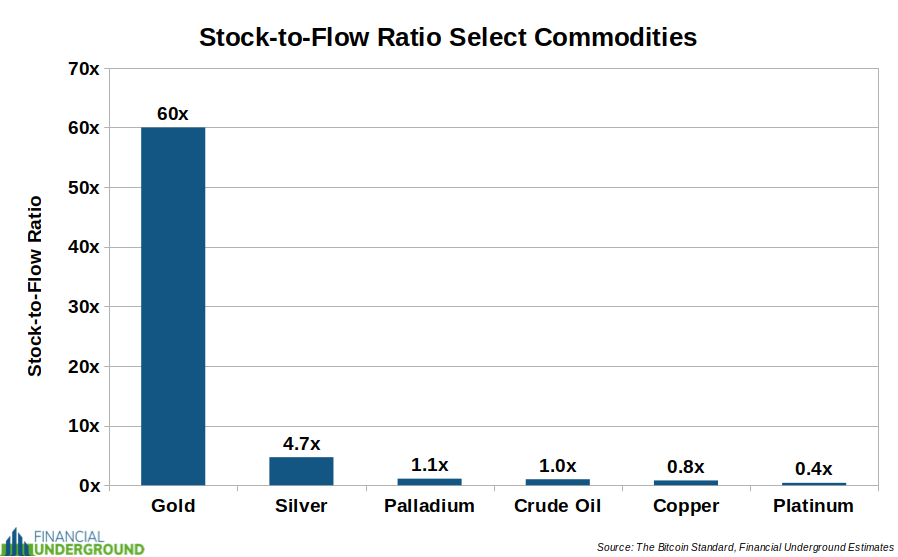
The stock-to-flow (S2F) ratio measures an asset’s hardness.

S2F Ratio = Stock / Flow

The “stock” part refers to the amount of something available, like current stockpiles. It’s the supply already mined. It’s available right away.

The “flow” part refers to the new supply added from production and other sources each year.

A high S2F ratio means that annual supply growth is small relative to the existing supply, which indicates a hard asset resistant to inflation.

A low S2F ratio indicates the opposite. A low S2F ratio means that new annual supply can easily influence supplies—and prices. That’s not desirable for something to function as a store of value.

In the chart below, we can see the hardness of various physical commodities.

Monetary commodities such as gold and silver have higher S2F ratios. Industrial commodities have low S2F ratios, typically around 1x.

See the rest here

Be seeing you

Posted in Uncategorized | Tagged: , , , , , | Leave a Comment »

“A Paradigm Shift Western Media Hasn’t Grasped Yet” – Russian Ruble Relaunched, Linked To Gold & Commodities

Posted by M. C. on April 4, 2022

Buyers would then scramble to buy physical gold to pay for Russian oil exports, which in turn would create huge strains in the paper gold markets of London and New York where the entire ‘gold price’ discovery is based on synthetic and fractionally-backed cash-settled unallocated ‘gold’ and gold price ‘derivatives.

https://www.zerohedge.com/commodities/paradigm-shift-western-media-hasnt-grasped-yet-russian-ruble-relaunched-linked-gold-and

BY TYLER DURDEN

MONDAY, APR 04, 2022 – 05:44 AM

By Ronan Manly of Bullionstar.com

With Russia’s central bank having just profoundly altered the international trade and monetary system by linking the Russian ruble to both gold and commodities, journalists in Moscow asked me to write a Q and A article on what these developments mean, and the ramifications of these changes on the Russian ruble, the US dollar, the gold price and the global system of currencies. This article has been published on the RT.com website here

Since RT.com is now blocked and censored in many Western locations such as the EU, UK, US and Canada, and since many readers may not be able to access the RT.com website (unless using a VPN), my Questions and Answers that are in the new RT.com article are now published here in their entirety.

Who would have thought that citizens of ‘free speech’ Western countries would need a VPN to read a Russian news site?

Why is setting a Fixed Price for Gold in Rubles significant?

By offering to buy gold from Russian banks at a fixed price of 5000 rubles per gram, the Bank of Russia has both linked the ruble to gold and, since gold trades in US dollars, set a floor price for the ruble in terms of the US dollar.

We can see this linkage in action since Friday 25 March when the Bank of Russia made the fixed price announcement. The ruble was trading at around 100 to the US dollar at that time, but has since strengthened and is nearing 80 to the US dollar. Why? Because gold has been trading on international markets at about US$ 62 per gram which is equivalent to (5000 / 62) = about 80.5, and markets and arbitrage traders have now taken note, driving the RUB / USD exchange rate higher.

So the ruble now has a floor to the US dollars, in terms of gold. But gold also has a floor, so to speak, because 5000 rubles per gram is 155,500 rubles per troy ounce of gold, and with a RUB / USD floor of about 80, that’s a gold price of around $1940. And if the Western paper gold markets of LBMA / COMEX try to drive the US dollar gold price lower, they will have to try to weaken the ruble as well or else the paper manipulations will be out in the open.

Additionally, with the new gold to ruble linkage, if the ruble continues to strengthen (for example due to demand created by obligatory energy payments in rubles), this will also be reflected in a stronger gold price.

Gazprom – Natural gas powerhouse and Russia’s largest company

What does this mean for Oil?

Russia is the world’s largest natural gas exporter and the world’s third largest oil exporter. We are seeing right now that Putin is demanding that foreign buyers (importers of Russian gas) must pay for this natural gas using rubles. This immediately links the price of natural gas to rubles and (because of the fixed link to gold) to the gold price. So Russian natural gas is now linked via the ruble to gold.

The same can now be done with Russian oil. If Russia begins to demand payment for oil exports with rubles, there will be an immediate indirect peg to gold (via the fixed price ruble – gold connection). Then Russia could begin accepting gold directly in payment for its oil exports. In fact, this can be applied to any commodities, not just oil and natural gas.

What does this mean for the Price of Gold?

See the rest here

Be seeing you

Posted in Uncategorized | Tagged: , , , | Leave a Comment »

#GotGoldorRubles? Russia Just Broke the Back of the West

Posted by M. C. on March 29, 2022

Instead of using physical men to subjugate the locals through superior weaponry and bribes to get them to extract the mineral wealth which the colonialists take back home, today we use the post-WWII institutions to run that same system through debt issuance for capex and the interest payments (in this case pure economic rent – unearned wealth).

Author: Tom Luongo

I don’t think everyone has yet caught the significance of Russia announcing they are putting a floor under the price of gold.  But, to be clear, Russia just broke the paper gold suppression scheme.

On Friday the Bank of Russia announced:

RUB5000 to the ounce at an exchange rate of 100 RUB/USD implies a $1550 per ounce gold price.

For a few days previous to this announcement, which they knew was coming, The West was running around with multiple bits of legislation to try and keep the Russians from selling their gold.

The G7 think the sanctions are hitting so hard that Putin will be forced to sell his gold to evade sanctions to pay for things.  They are literally running a script in their heads that is not actually playing out in the real world.

But, whatever, Neocons never met an ugly stick that they didn’t want to use to beat someone over the head with.  Too bad all they’re doing is hitting a rubber tire.

Boing!

Because here’s the gig, Russia won’t be selling any gold. They’re buying it.

See the rest here

Be seeing you

Posted in Uncategorized | Tagged: , , | Leave a Comment »

Who’s Got the Gold?

Posted by M. C. on February 22, 2022

One school of thought has it that, although the US has long claimed that it possesses roughly 8,000 tonnes of gold in Fort Knox, there has not been an audit of Fort Knox since 1953. (That’s not encouraging.) Is it 8,000 tonnes? 4,000? None? We’re unlikely to ever get a truthful answer on this question.

by Jeff Thomas

In 1971, the US abruptly went off the gold standard, and in making the public announcement, US President Richard Nixon looked into the television camera and said, “We’re all Keynesians now.”

I was a young man at the time and had previously bought gold, albeit on a very small scale, but I recall looking into the face of this delusional man and thinking, “This is not good.”

However, the world at large apparently agreed with Mister Nixon, and within a few years, the other countries also went off the gold standard, which meant that, from that point on, no currency was backed by anything other than a promise.

Party Time

It didn’t take long before countries began playing with their currencies. At one time, the German mark, the French franc, the Italian lire, and the British shilling had all been roughly equivalent in value, and four or five of any one of them was worth about a dollar.

That had already begun to change prior to 1971, but following the decoupling from gold, the governments of the world really began to see the advantages of manipulating their own currencies against the currencies of other nations.

From that point on, a currency note from any country, which was already no more than an “I owe you,” was increasingly degraded to an “I owe you an undetermined and fluctuating amount.”

This fixation with monetary manipulation began much like the 1960s youths’ experimentation with drugs, and by the millennium, had morphed into something more akin to heroin addiction. Unfortunately, those who had become the addicts were the national leaders in finance and politics.

Well, here we are, in the second decade of the millennium. The party has deteriorated and is soon to come to a bad end.

As we get closer, those of us who have, for many years, predicted an eventual realisation that Mister Keynes and Mister Nixon were dead wrong and that the world will once again look to gold are, at this late date, gaining a bit of traction.

We’re seeing an increase in the number of people who recognise that all fiat currencies eventually come to an end and gold will continue to shine.

But there are two remaining questions that have even the best of prognosticators puzzling.

1. What Will the Role of Gold Be in the Future?

When currencies collapse, will there be an immediate and complete switch to gold? Unlikely.

Will further fiat currencies be put forward as solutions to paper money? Almost definitely.

Will future currencies be backed by gold? Probably, especially as so many governments and banking institutions are quietly scrambling to buy gold whilst trying not to let on the extent of their stockpiling.

Will gold-backed currencies stabilise money for the rest of our lives? Quite unlikely.

Even those countries who may agree to audits to demonstrate they own the gold they claim to own will, at some point in the future, look for ways to “do a Nixon” and once again get off the gold standard. (The short-term benefits of fiddling with currency is too tempting.)

2. Who’s Got the Gold?

Currencies come and go in the world with remarkable frequency (the last hundred years has been witness to over twenty hyperinflations worldwide).

In that quiet scrambling we were talking about, no one is being really truthful about how much gold they have. In addition, even between the foremost experts on the subject (and here, I refer not to the pundits on television, but to those economists that I personally hold in the highest regard), there is broad speculation as to who holds what.

One school of thought has it that, although the US has long claimed that it possesses roughly 8,000 tonnes of gold in Fort Knox, there has not been an audit of Fort Knox since 1953. (That’s not encouraging.) Is it 8,000 tonnes? 4,000? None? We’re unlikely to ever get a truthful answer on this question.

In addition, the US has held roughly 6,000 tonnes of gold for European countries since the Cold War.

Now that the US has become the world’s foremost debtor nation, Europe is getting a bit antsy, and some are asking to have it back. In response, the Federal Reserve has sent Germany a small portion of their gold but avoids shipping the remainder and denies them even the ability to inspect the remainder. (Again, not encouraging.)

On the other hand, we have equally astute economists—US government insiders—who state that they are fairly certain the gold is there—in both Fort Knox and the New York Federal Reserve Bank’s underground vault. In the latter case, they state that, although much or all of the gold has been leased to the bullion banks, it has never left the building.

What does this mean to the rightful owners? There are multiple legitimate claims on the very same bars of gold.

See the rest here

Be seeing you

Posted in Uncategorized | Tagged: , , , | Leave a Comment »

Understanding the inflation problem

Posted by M. C. on January 21, 2022

More difficult, perhaps, will be the discipline sound money imposes on government spending. From the state’s point of view, the purpose of inflation is to permit it to spend more than it raises in taxes. For money in the form of gold coin to back a fully exchangeable currency requires abandoning inflation as a source of finance.

https://www.goldmoney.com/research/goldmoney-insights/understanding-the-inflation-problem

By Alasdair Macleod

In recent weeks inflation has become a major economic concern. Nearly all the commentary emanating from monetary policy makers, economists, and the media is misguided, believing inflation is rising prices and must be addressed accordingly.

They are only the symptoms of inflation. The true cause is the expansion of currency and bank credit, which, reflected in the US dollar’s M2 money supply has increased substantially since March 2020, and now stands at nearly three times the level when Lehman failed.

After defining the differences between money, currency, and credit which together make up the media of exchange, this article explains how changes in the quantities of currency and credit translate into prices.

The solution to the inflation problem is not price controls, which are always counterproductive, but to return to a regime of sound money. This article shows what must be done to achieve this outcome and concludes that it is impossible to do so without a sufficiently serious financial and economic crisis to discredit government intervention in markets and to then allow governments to stabilise their currencies and reduce their spending to a bare minimum.

Defining inflation, money, currency, and credit[i]

A resolution of the inflation problem requires an understanding of inflation itself. It is an increase in the quantity of the media of exchange, whether it be money, currency, credit, or a combination of any or all of them. It is not a rise in the general price level. That is the consequence of inflation when the media of exchange loses purchasing power.

To avoid misunderstanding, it is important in any discussion about money to provide an accurate definition of what is money and what is not money. Let us clarify this at the outset:

That which is commonly referred to as money is more correctly any form of circulating media used for the payment of goods and services in an economy based on the division of labour. The term “circulating media” or “media of exchange” more accurately represents the common concept of money as the term is used today.

The amount of circulating media is never fixed. Indeed, the quantity of metallic money — gold, silver, and copper, but particularly gold, which we can simply define as pure money with no counterparty risk, has increased over the millennia since weights of these metals first evolved to replace barter. The population of active users of metallic money has also increased. Throughout history, the pace of increases of above ground gold stocks and the human population have been similar. The quantity of gold has therefore broadly kept pace with the population increase.

Over the long term, therefore, money proper has ensured a stable purchasing power despite the increase in above-ground stocks. An important advantage of gold as money is that its use is dominated by the twin functions of ornamentation and as the medium of exchange — unlike silver and copper it is never consumed. Gold’s utility is set by its users, who collectively decide how much circulates as money and how much is used for ornamentation. Its use switches between these two functions as its possessors collectively impose their needs, and gold’s purchasing power is determined by the quantity circulating as money. As well as the flows between its use as money and ornamentation, the quantity of money can also be affected by variations in mine supply from its general correlation with global population growth.

Gold’s purchasing power is stable due to these self-correcting factors. Currency is a different matter, always bearing in mind the counterparty risk of the issuer and its propensity to inflate its quantity. Today, these are central banks. A central bank’s balance sheet always shows currency in circulation as a liability of the bank, along with deposits owed by it to its depositors, normally confined to licenced commercial banks. The quantity of currency in circulation is set not by its users, but by the central bank managing its balance sheet.

In accordance with their monetary policies, Central banks can and do vary the amount of currency and the deposits recorded on their balance sheets, the latter more normally termed the reserves of commercial banks. Setting the level of these reserves in addition to a commercial bank’s shareholder capital used to be the means of regulating the quantity of credit that a commercial bank could issue. But today, central banks actively buy financial assets, payment being credited to the reserve accounts of the commercial banks. It is now the principal source of central bank inflation, and the regulation of a commercial bank’s lending capacity is now controlled more by other forms of regulation.

A commercial bank is a dealer in credit. It lends money to borrowers at a higher rate than it pays to its depositors. By lending money, it creates an asset on its balance sheet, and at the same time a counterbalancing liability is credited to the borrower, representing the amount of credit that the borrower has available to draw upon. The borrower’s bank statement will not usually reflect the counter-deposit, but double-entry bookkeeping demands that it exists. By a few strokes of a bookkeeper’s pen, credit which is indistinguishable from currency is created out of thin air and put into circulation.

We therefore have three types of circulating media: money, currency, and credit. A central bank sets the quantity of currency, and the commercial banks the quantity of bank credit and therefore deposit money, which is bank credit’s counterpart. The only circulating media whose use-value is set by its users is money. For the modern state which demands control over what circulates as the circulating media, money is actively discouraged in favour of its own substitutes, currency and bank credit issued by its licenced commercial banks, which it controls. Even under a gold coin standard, very few transactions involved money, being almost entirely settled by currency and credit.

The consequences of inflation

See the rest here

Be seeing you

Posted in Uncategorized | Tagged: , , , | Leave a Comment »

Why Does Money Have Value? Not Because the Government Says It Does. | Mises Wire

Posted by M. C. on October 10, 2021

Contrary to the popular way of thinking, the value of a paper dollar originates in its link to gold—and not government decree or social convention. Following Ludwig von Mises’s regression theorem, money must have originated as a commodity. Furthermore, the fact that an entity has established a purchasing power with respect to various goods and services does not automatically qualify it as money, i.e., as the general medium of exchange. For the entity to become money, it must have wide acceptance.

https://mises.org/wire/why-does-money-have-value-not-because-government-says-it-does

Frank Shostak

Why does the dollar bill in our pockets have value? According to some commentators, money has value because the government in power says so. For other commentators the value of money is on account of social convention. What this implies is that money has value because it is accepted, and why is it accepted? … because it is accepted! Obviously, this is not a good explanation of why money has value.1

The difference between Money and Other Goods

Now, demand for a good arises from its perceived benefit. For instance, people demand food because of the nourishment it offers them once consumed. This is not so with respect to money. According to Murray N. Rothbard,

Money, per se, cannot be consumed and cannot be used directly as a producers’ good in the productive process. Money per se is therefore unproductive; it is dead stock and produces nothing.2

Why, then, is there demand for money? Why do individuals desire to have something which cannot be consumed and produces nothing? To provide an answer to this one must go back in time to establish how money emerged.

In trying to improve their lives and well-being, individuals discovered that by replacing direct exchange, where individuals exchange one good for another good, with indirect exchange they could enhance the marketability of their produce. The introduction of indirect exchange means that the produce of an individual is exchanged for some more marketable good and then this good is exchanged for the produce of another individual.

The key to a good’s emergence as a mediator of indirect exchange is that it must be widely accepted. On this, Ludwig von Mises observed that, over time,

there would be an inevitable tendency for the less marketable of the series of goods used as media of exchange to be one by one rejected until at last only a single commodity remained, which was universally employed as a medium of exchange; in a word, money.3

Similarly, Murray Rothbard wrote that,

See the rest here

Author:

Contact Frank Shostak

Frank Shostak‘s consulting firm, Applied Austrian School Economics, provides in-depth assessments of financial markets and global economies. Contact: email.

Be seeing you

Posted in Uncategorized | Tagged: , , | Leave a Comment »