Can you cite one speck of hard evidence of the benefits of “diversity” that we have heard gushed about for years? Evidence of its harm can be seen — written in blood — from Iraq to India, from Serbia to Sudan, from Fiji to the Philippines. It is scary how easily so many people can be brainwashed by sheer repetition of a word.
So, with no advantage to offer India, or even Europe, other than weapons to protect against fantasy or generated enemies, the United States is in a real pickle. And the worse things get, the more mainstream media, the think tanks, and puppet leaders holler “Democratic Values!”
You’ll find an important Russia-India story on page 28 of the Google News results, to care about what’s really happening between the two BRICS nations. Many reading this may not know that India’s Prime Minister Narendra Modi congratulated Vladimir Putin on his re-election as the President of the Russian Federation and announced the deepening of a strategic partnership between the two countries. Russia and India – strategic partners – isn’t that page one New York Times stuff? Well, no.
Naturally, the Western propaganda machine revved up its gears to do damage control. The United States Institute of Peace, which is really a warmongering glee club, claimed back in February the Russia-India situation is fragile. The relationship is so fragile, in fact, that PM Modis quote from News 18 in New Delhi (taken from Modi’s Tweet on X) reads:
“I Spoke with President Putin and congratulated him on his re-election as the President of the Russian Federation. We agreed to work together to further deepen and expand the India-Russia Special & Privileged Strategic Partnership in the years ahead.”
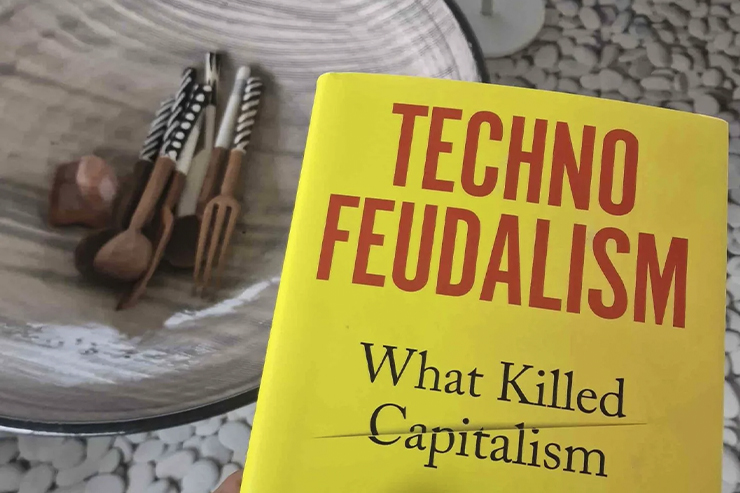
I know the quote does not relay any fragility between nations that have been in good standing for decades. Still, the elites running our feudal/capitalistic system in the West – well, they can still dream. And speaking of neo-feudalism, a new book by the brilliant (if sometimes quirky) Yanis Varoufakis, speaks mightily on what’s really going down in the West vs. East geopolicy wars we’re in. The book, entitled “Techno-feudalism: What Killed Capitalism” proclaims capitalism as dead amid “an epochal shift” backwards in time. Varoufakis argues, his points about the technocrats and their fiefdoms by creating the parable below. Insert the first name “Mark” where Jeff is mentioned, and you’ll see the truth of the Greek economist’s theory:
“Imagine the following scene straight out of the science fiction storybook. You are beamed into a town full of people going about their business, trading in gadgets, clothes, shoes, books, songs, games and movies. At first everything looks normal. Until you begin to notice something odd. It turns out all the shops, indeed every building, belongs to a chap called Jeff. What’s more, everyone walks down different streets and sees different stores because everything is intermediated by his algorithm… an algorithm that dances to Jeff’s tune.”
The man who should have been Greece’s Prime Minister years ago uses Jeff (Bezos, the owner of Amazon) to illustrate how we peons and surfs produce value for technology companies simply by tweeting or posting. In Bezos’s case, Varoufakis points out that the Amazon founder does not produce capital, but he simply charges rent. He says this isn’t capitalism, but feudalism, exacted upon a citizenry unaware of what’s happening. I suggest you read The Guardian story about the book here.
Returning to the Russia-India situation, it’s easy to understand how the West, run by technocrats and old money who create only wealth without value, fear any system where real capital is created. Russia’s various industries, China’s, and especially India’s scare the hell out of those running the Western shell game. When all is said and done, Washington and its allies just talk or bomb, real competition has been eliminated.
If the Indians sat down and decided to make world class porridge, then of course it would be child’s play for them. Just as it is child’s play for the Indians to make whiskey.
Although NATO has essentially delivered Russia’s whiskey market to India on a platter, the damage will not stop there as Indian producers of Amrut and Paul John, together with their Russian and Chinese partners, have been given a golden opportunity to use Russia to go after the premium whiskey market, to replace top quality brands like Jameson, Bushmills, and Glenfiddich with their own no less perfect offerings.
A recent Russia Today news story about Russia’s whiskey market NATO’s sanctions stop me linking to puts me in mind of a favourite old joke, as well as an article on Indian tourism I read very many moons ago.
The joke is that Irish monks taught the Scots how to make whiskey 1500 years ago but that the Scots are still learning. Although there is much truth in that, as regards the Russian whiskey market, the joke is now very much not only on both the Scots and the Irish but also on the Americans who previously sold hundreds of thousands of litres of their whiskies to the Russkies before this latest trade war in support of the Kiev Nazis began.
As regards India, I had been reading the travel supplement in one of the upmarket Sunday broadsheets, when I was told of some hotel or other in the Himalayan foothills that made the best porridge in India. Now, as the Irish, as well as the Scots, are as much known for their porridge as for their whiskey, that struck me as a bit presumptuous before I got down to think about it. If the Indians sat down and decided to make world class porridge, then of course it would be child’s play for them.
Just as it is child’s play for the Indians to make whiskey. Not only are the Indians the world’s third largest whiskey producers but some of their products are, by all accounts, quite good. I speak here as an Irish purist, who regards Irish whiskey, along with some Scottish single malts, as the world’s best and who regards most Scottish whiskey as little more than overpriced cough mixture, fit only for putting into Irish coffees for gullible tourists. American whiskies you can keep and the Polish, Japanese, Canadian, Mexican and South East Asian whiskies I have sampled in my time have, shall we say, left a lot to be desired. Not quite up there with a Bushmills Black in front of a blazing winter’s turf fire.
Though tastes do differ, the fact is that Irish whiskies and their Scottish and American near equivalents do enjoy a brand premium. And this stupid Russian turbulence shows just how vulnerable to Indian and Chinese attack that premium is.
It is not as if we were not down this road before. During the 1930s’ economic war between Britain and Ireland, Irish whiskey was side-lined so much that many undiscerning drinkers now refer to whiskey as Scotch, not knowing that whiskey is an Irish drink and that the quality of Scotch whiskey ranges from the smoothly sublime to rot gut that is little better than paint remover.
Although the Koreans, for example, down Scotch whiskey by the gallon, they tend to go for brand names like Johnny Walker rather than the true, top shelf stuff that is distilled in Scotland’s western islands. To understand the difference in quality, just ask a German beer drinker what he thinks of Heineken or any similar Dutch excuse for beer.
Although Irish mixed martial arts champion Conor McGregor made a tidy packet developing and then on-selling his own Proper No Twelve brand of whiskey, his was a market niche of no great consequence to the overall whiskey market. This Russian madness is in a very different league as it threatens to leave the West with nothing but niche markets as India, China and other competitors steam-roll their way to global dominance.
NATO’s sanctions have allowed China, rather than Ireland, Japan or Scotland, to now sell over 400,000 litres of whiskey a year to Russia. That is serious money NATO is flushing down the toilet.
And then there are the Indians, who are now selling a quarter of a million litres of whiskey a year to the Russians, who have seen a staggering 36 new local brands emerge to cater to their needs.
As if that was not bad enough for NATO’s Irish and Scottish lapdogs, Indian company Allied Blenders & Distillers (ABD), which produces Officer’s Choice, the world’s third-most-popular whiskey, has now got the Russian whiskey market firmly in its cross hairs, with Russian vodka manufacturer Alcohol Siberian Group (ASG) lined up to be ABD’s sole distributor.
India produces 60% of the world’s (loosely defined) whiskey, with ABD already being firmly established in more than 20 countries. Although ABD’s revenue currently stands at a relatively modest $765 million, this can be expected to grow as NATO continues to shoot its own producers in the foot with these stupid sanctions and needless trade wars.
Although NATO has essentially delivered Russia’s whiskey market to India on a platter, the damage will not stop there as Indian producers of Amrut and Paul John, together with their Russian and Chinese partners, have been given a golden opportunity to use Russia to go after the premium whiskey market, to replace top quality brands like Jameson, Bushmills, and Glenfiddich with their own no less perfect offerings.
Finally, outside some BBC cheerleading of the “accomplishments” of the recent Biden-Modi meetup in Washington and TIME Magazine harping about human rights detente failures, all the U.S. came away with were a microchip manufacturing investment deal and a U.S. jet engine promise for India made planes. Meanwhile, Russia remains the dominant supplier of Indian arms,
The United States leadership is squirming to resolidify ties with parts of the world that either bombed, invaded, or marginalized in recent decades. The prime example of marginalization is India. However, without the current gigantic trade surpluses boosting Indian confidence in America, Prime Minister Narendra Modi will have to do much less tightrope-walking between Washington and the emerging multipolar world. Since the end of the Cold War, India has practiced a multi-aligned foreign policy. This may soon change.
It’s no secret that Indian businesses are raking in billions on discounted Russian crude oil. According to the latest reports, Indian refiners saved over $7.17 billion in foreign exchange in the 14 months which ended in May 2023. Russian tankers flood India’s Gulf of Kutch, home to the world’s biggest refining operation. Ironically or poetically, India then ships refined oil to markets like the European Union at a hefty value-added price. If the trend goes unchecked, India will surpass Saudi Arabia as the largest oil exporter to the EU.
Changing gears. Russian Foreign Minister Sergey Lavrov said recently that Iran will be formally approved as a member of the regional Shanghai Cooperation Organization with China, Russia, and Central Asian countries. Iran also has sights on becoming a member of the BRICS. India is a member of both organizations. This organization represents about 40% of the world’s population, 20% of the world’s GDP, and 60% of the Eurasia landmass. This quote from a CBS News report frames what’s taking place:
Unforeseen by the warparty wizards, the pentagram and their puppet, NATO.
The point of trade sanctions is to make the intended victims (civilian men, women and children) suffer so much that they rise up against their government. Didn’t work, again.
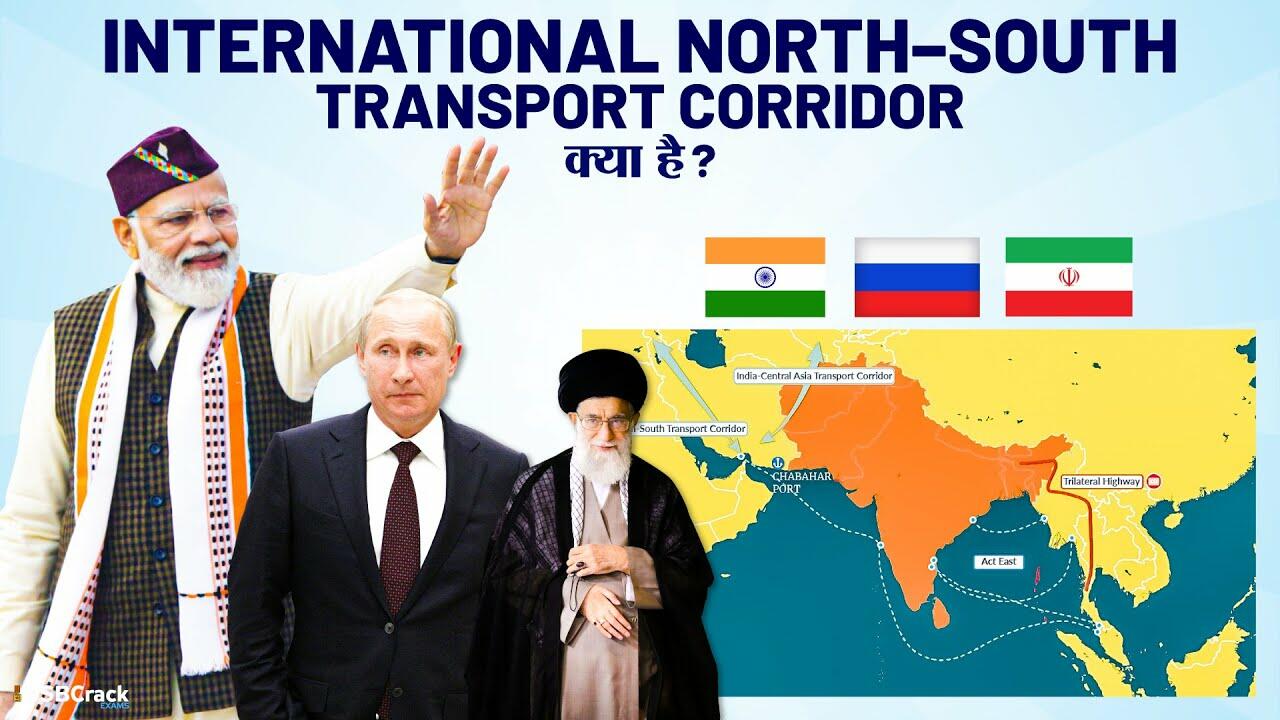
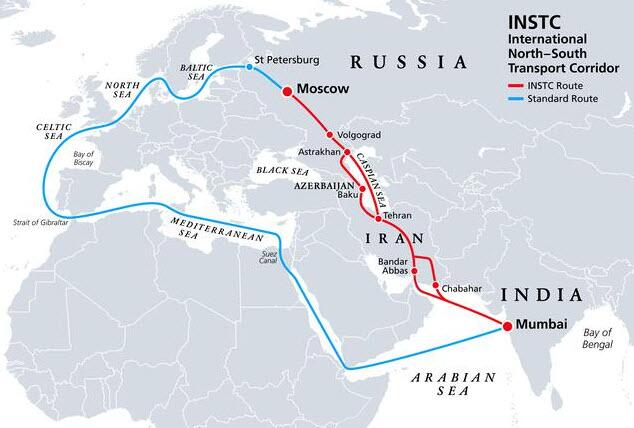
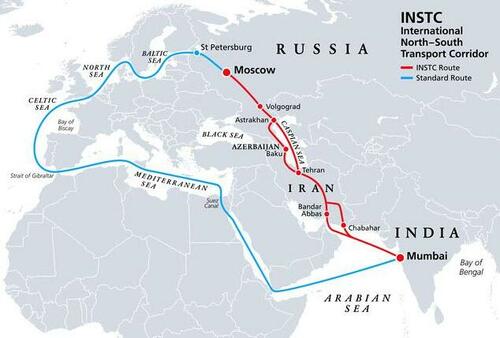
Russia, Iran, and India are speeding up efforts to complete a new transport corridor that would largely cut Europe, its sanctions, and any other threats out of the picture.
The International North-South Transport Corridor (NSTC) is a land-and sea-based 7,200-km long network comprising rail, road and water routes that are aimed at reducing costs and travel time for freight transport in a bid to boost trade between Russia, Iran, Central Asia, India.
For Russia, the “sanction-proof” corridor provides a major export channel to South Asia without needing to go through Europe. But Brussels and Washington, frustrated by their losing in Ukraine and inability to put much of a dent in the Russian economy, could lead them to take more desperate measures.
Lately, Estonia, which has a population smaller than Russia’s armed forces, has been making noise about causing problems in the Gulf of Finland, Estonian Minister of Defense Hanno Pevkur is talking about how Helsinki and Tallinn will integrate their coastal missile defense, which he says would allow the countries to close the Gulf of Finland to Russian warships if necessary. Estonia is also floating the possibility of trying to inspect Russian ships. From Asia Times:
It is unlikely Estonia can carry out any inspections given that it only has two patrol vessels (EML-Roland and EML-Risto) and no other warships except some mine layers. But if Estonia even tried, it would create another friction point that Russia could exploit if it chose.
There is also a strategic element. With Finland joining NATO and already a de facto member, the Gulf of Finland becomes significantly more hostile for Russia and there will be growing pressure on Russian political leaders to take action against a rising threat to Russian security.
While Ukraine is far away, the Russians see NATO’s “ganging up” on Russia as a key issue for Russian security and stability. This brings the Baltic region into sharper focus because Russians see NATO trying to surround them and undercut their economic and military advantages.
It’s hard to take Estonia’s bluster seriously but equally difficult to put anything past the neocons in Washington and their adherents in the Baltics. Regardless, Russia would prefer a trade route with India that saves time and money and avoids Europe.
While NATO’s war against Russia has sped up the cooperation between Moscow, Tehran, and New Delhi, India and Iran are coming under various types of pressure that could delay full implementation of the corridor. And Azerbaijan, a key nexus in the INSTC, is a wildcard as it grows increasingly confrontational with both Iran and Armenia.
First the recent developments on the INSTC:
India is helping to develop the Shahid Beheshti Terminal at Iran’s Chabahar Port in cooperation with the Iranian government.
Iran and Russia recently signed a contract for Russia to build a cargo vessel for Iran to be used at the Caspian port of Solyanka, which is being developed jointly by the two nations as part of efforts to strengthen the Caspian Sea transportation network.
RZD Logistics, a subsidiary of Russian railway monopoly RZD, has begun regular container train services from Moscow to Iran to serve growing trade with India by transloading.
Rezaul Hasan Laskar, the foreign affairs editor at Hindustan Times, says the strategic Chabahar Port in southeastern Iran has “become more important following its growing use” but that “it needs to be connected to Iran’s railway network.” Iran has accelerated that project, and with an investment boost from Russia, is speeding up the completion of the Astara-Rasht-Qazvin railway, another transport corridor that will connect existing railways of Russia, Azerbaijan and Iran to the INSTC.
In the meantime, most of the goods that Russia normally transported across the Baltic Sea to reach the North Sea port of Rotterdam now sail instead to India. Oilprice reports:
Russian crude oil loadings from Baltic ports are on track for a 50% hike from December to January, Reuters reports, citing its own data combined with trader insights.
Russian Urals and KEBCO crude oil loadings specifically from the ports of Primorsk and Ust-Luga will experience the increase, Reuters said, adding that the bulk of those loadings (some 70%) will head to India.
In December, Russia loaded 4.7 million tonnes of Urals and KEBCO from the Baltic ports, Reuters said, citing Refinitiv data.Russia now accounts for approximately 25% of India’s crude purchases, while some sources put it closer to 30%.
The increased trade with Russia is a primary driver bringing New Delhi and Tehran closer together – largely a result of Europe severing itself from Russia. According to Reuters, at the end of November Moscow sent India a list of more than 500 products it wants India exporting to Russia, “including parts for cars, aircraft and trains.” The report added:
Indian imports from Russia have grown nearly five times to $29 billion between Feb. 24 and Nov. 20 compared with $6 billion in the same period a year ago. Exports, meanwhile, have fallen to $1.9 billion from $2.4 billion, the source said. India is hoping to boost its exports to nearly $10 billion over coming months with Russia’s list of requests, according to the government source.
And with all the increased trade, New Delhi and Moscow are looking for more efficient supply lines.
India has stood firm in its position of not being pulled from a multipolar world into the US led unipolar world. If the US cannot use divisions with China to pull India from Russia onto its side, it may face a large and muscular competitor in the global tug of war.
In the global tug of war between a US led unipolar world and a Russia-China nurtured multipolar world, whichever side India throws its massive size behind will likely prevail, or at least not be defeated.
On the one side of the rope is the US with all its political, economic and military muscle. On the other is Russia and its massive and growing strategic partner, China. In the middle is India, the second largest country in the world and a growing power.
India maintains a friendly foot in both worlds. Long a partner of the US in containing China, India long played that same role for Russia, with whom it has long been a key friend. India is a member of the US led QUAD, whose purpose is to contain and deflate China while asserting US leadership over the management of Asia. There have been times in the twenty-first century when the US plan for pressing China back down has included nurturing India’s ascent to a major world power so it could be deputized as a reliable hegemon in the region. Today, still, the key to the QUAD is bringing India over to the US side.
But India is also a long and very close partner of Russia, and its relations with China have been improving for decades. It is a member of the QUAD but has restrained that organization. It has participated in it and supported it but maintained, unlike its American, Japanese and Australian partners, that the QUAD is “not against somebody.” Though India has regional concerns about China over which it opposes it, it lacks America’s global concerns about China and may not be “against” it. India has its own concerns about its giant neighbor but does not share American concerns of containing it.
Instead, India is also a member of important international organizations in which it joins Russia and China in containing, or balancing, US hegemony. India is an important and enthusiastic member of both the BRICS and the Shanghai Cooperation Organization (SCO), whose purpose is to act as an economic and foreign policy counterweight to the US in an attempt to re-balance the US led unipolar world into a multipolar one.
India is not only a member of BRICS, which includes Brazil and South Africa, it is also a member of the core RIC group along with Russia and China. In a recent landmark Joint Statement, Russia and China announced that they “intend to develop cooperation within the ‘Russia-India-China’ format.” India, too, has said that they would join Russia and China in discussing “further strengthening of RIC trilateral cooperation.” Russian foreign minister Sergei Lavrov has noted that part of the role of RIC is “in promoting trust and confidence between India and China.” That role is the antithesis of the US goal of exploiting divisions between India and China to bring India over to the US side.
The current template the US has imposed on the world no longer allows for neutrality.
Since India won’t go along with the US in boycotting Russia, it has suddenly been discovered that there are human rights violations in India. I suspect all the concern about Chinese people being locked in their domiciles is also driven by the Chinese refusal to cut off Russian oil. The Chinese might be doing everything alleged, but I have no way of knowing and I have no doubt the US wouldn’t care what they’re doing if they would line up against Russia.
It is interesting to note that the content of several web links to news articles and reports included in the notice served upon Dr Swaminathan, which was visible before issuing the notice, has either been removed or deleted.
It seems that the vaccine manufacturers and many governments are desperate to protect their pro-vaccine agenda and will attempt to censor information and news regarding the efficacy of Ivermectin.
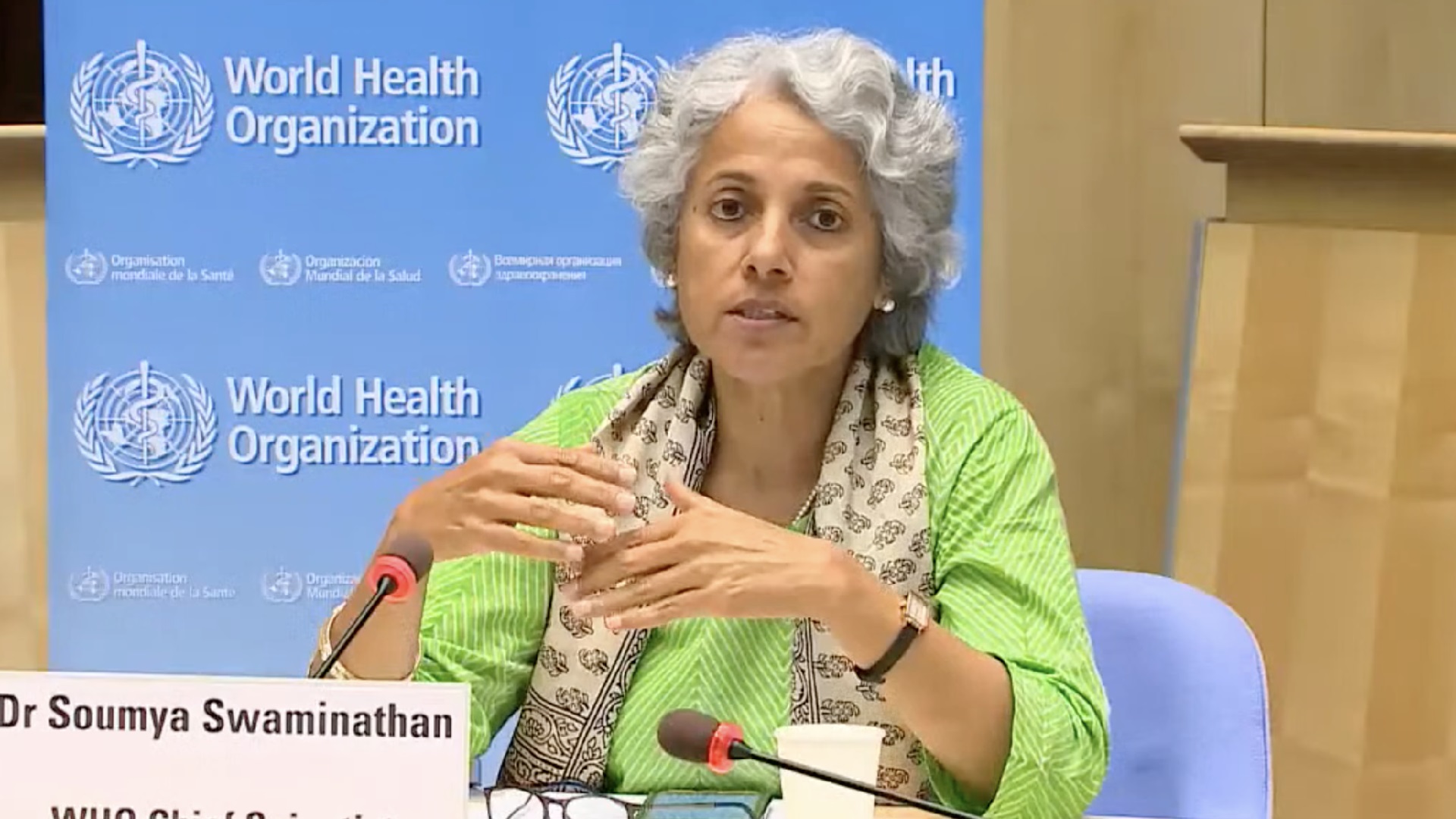
On 25 May 2021, the Indian Bar Association (IBA) served a 51-page legal notice on Dr Soumya Swaminathan, the Chief Scientist at the World Health Organisation (WHO), for:
[H]er act of spreading disinformation and misguiding the people of India, in order to fulfil her agenda.”
The Mumbai-based IBA is an association of lawyers who strive to bring transparency and accountability to the Indian justice system. It is actively involved in the dissemination of legal knowledge and provides guidance and support to advocates and ordinary people in their fight for justice.
The legal notice says Dr Swaminathan has been:
Running a disinformation campaign against Ivermectin by deliberate suppression of effectiveness of drug Ivermectin as prophylaxis and for treatment of COVID-19, despite the existence of large amounts of clinical data compiled and presented by esteemed, highly qualified, experienced medical doctors and scientists,”
And:
Issuing statements in social media and mainstream media, thereby influencing the public against the use of Ivermectin and attacking the credibility of acclaimed bodies/institutes like ICMR and AIIMS, Delhi, which have included ‘Ivermectin’ in the ‘National Guidelines for COVID-19 management’.”
The IBA states that legal action is being taken against Dr Swaminathan in order to stop her from causing further damage to the lives of citizens of India.
The IBA says that Dr Swaminathan has ignored these studies and reports and has deliberately suppressed the data regarding the effectiveness of Ivermectin, with an intent to dissuade the people of India from using it.
However, two key medical bodies, the Indian Council for Medical Research (ICMR) and the All India Institute of Medical Sciences (AIIMS) Delhi, have refused to accept her stand and have retained the recommendation for Ivermectin, under a ‘May Do’ category, for patients with mild symptoms and those in home isolation, as stated in ‘The National Guidelines for COVID-19 management’.
It is interesting to note that the content of several web links to news articles and reports included in the notice served upon Dr Swaminathan, which was visible before issuing the notice, has either been removed or deleted.
It seems that the vaccine manufacturers and many governments are desperate to protect their pro-vaccine agenda and will attempt to censor information and news regarding the efficacy of Ivermectin.
Colin Todhunter is an independent journalist who writes on development, environmental issues, politics, food and agriculture. In August 2018 he was named as one of 400 Living Peace and Justice Leaders and Models by Transcend Media Services, in recognition of his journalism.
Widely described as “the sick man of Europe” after three decades of socialism, the United Kingdom underwent an economic revolution in the 1970s and 1980s because of one remarkable person—Prime Minister Margaret Thatcher.
Distinguished Fellow in Conservative Thought Lee Edwards is a leading historian of American conservatism and the author or editor of 25 books.
Israel, India, and the United Kingdom all adopted socialism as an economic model following World War II.
Socialism is guilty of a fatal conceit: It believes its system can make better decisions for the people than they can for themselves.
Socialism has failed in every country in which it has been tried.Copied
Socialists are fond of saying that socialism has never failed because it has never been tried. But in truth, socialism has failed in every country in which it has been tried, from the Soviet Union beginning a century ago to three modern countries that tried but ultimately rejected socialism—Israel, India, and the United Kingdom.
While there were major political differences between the totalitarian rule of the Soviets and the democratic politics of Israel, India, and the U.K., all three of the latter countries adhered to socialist principles, nationalizing their major industries and placing economic decision-making in the hands of the government.
The Soviet failure has been well documented by historians. In 1985, General Secretary Mikhail Gorbachev took command of a bankrupt disintegrating empire. After 70 years of Marxism, Soviet farms were unable to feed the people, factories failed to meet their quotas, people lined up for blocks in Moscow and other cities to buy bread and other necessities, and a war in Afghanistan dragged on with no end in sight of the body bags of young Soviet soldiers.
The economies of the Communist nations behind the Iron Curtain were similarly enfeebled because they functioned in large measure as colonies of the Soviet Union. With no incentives to compete or modernize, the industrial sector of Eastern and Central Europe became a monument to bureaucratic inefficiency and waste, a “museum of the early industrial age.” As the New York Times pointed out at the time, Singapore, an Asian city-state of only 2 million people, exported 20 percent more machinery to the West in 1987 than all of Eastern Europe.
And yet, socialism still beguiled leading intellectuals and politicians of the West. They could not resist its siren song, of a world without strife because it was a world without private property. They were convinced that a bureaucracy could make more-informed decisions about the welfare of a people than the people themselves could. They believed, with John Maynard Keynes, that “the state is wise and the market is stupid.”
Israel, India, and the United Kingdom all adopted socialism as an economic model following World War II. The preamble to India’s constitution, for example, begins, “We, the People of India, having solemnly resolved to constitute India into a Sovereign Socialist Secular Democratic Republic . . .” The original settlers of Israel were East European Jews of the Left who sought and built a socialist society. As soon as the guns of World War II fell silent, Britain’s Labour Party nationalized every major industry and acceded to every socialist demand of the unions.
At first, socialism seemed to work in these vastly dissimilar countries. For the first two decades of its existence, Israel’s economy grew at an annual rate of more than 10 percent, leading many to term Israel an “economic miracle.” The average GDP growth rate of India from its founding in 1947 into the 1970s was 3.5 percent, placing India among the more prosperous developing nations. GDP growth in Great Britain averaged 3 percent from 1950 to 1965, along with a 40 percent rise in average real wages, enabling Britain to become one of the world’s more affluent countries.
But the government planners were unable to keep pace with increasing population and overseas competition. After decades of ever declining economic growth and ever rising unemployment, all three countries abandoned socialism and turned toward capitalism and the free market. The resulting prosperity in Israel, India, and the U.K. vindicated free-marketers who had predicted that socialism would inevitably fail to deliver the goods. As British prime minister Margaret Thatcher observed, “the problem with socialism is that you eventually run out of other people’s money.”
Israel Israel is unique, the only nation where socialism was successful—for a while. The original settlers, according to Israeli professor Avi Kay, “sought to create an economy in which market forces were controlled for the benefit of the whole society.” Driven by a desire to leave behind their history as victims of penury and prejudice, they sought an egalitarian, labor-oriented socialist society. The initial, homogeneous population of less than 1 million drew up centralized plans to convert the desert into green pastures and build efficient state-run companies.
Most early settlers, American Enterprise Institute scholar Joseph Light pointed out, worked either on collective farms called kibbutzim or in state-guaranteed jobs. The kibbutzim were small farming communities in which people did chores in exchange for food and money to live on and pay their bills. There was no private property, people ate in common, and children under 18 lived together and not with their parents. Any money earned on the outside was given to the kibbutz.
A key player in the socialization of Israel was the Histadrut, the General Federation of Labor, subscribers to the socialist dogma that capital exploits labor and that the only way to prevent such “robbery” is to grant control of the means of production to the state. As it proceeded to unionize almost all workers, the Histadrut gained control of nearly every economic and social sector, including the kibbutzim, housing, transportation, banks, social welfare, health care, and education. The federation’s political instrument was the Labor party, which effectively ruled Israel from the founding of Israel in 1948 until 1973 and the Yom Kippur War. In the early years, few asked whether any limits should be placed on the role of government.
Israel’s economic performance seemed to confirm Keynes’s judgment. Real GDP growth from 1955 to 1975 was an astounding 12.6 percent, putting Israel among the fastest-growing economies in the world, with one of the lowest income differentials. However, this rapid growth was accompanied by rising levels of private consumption and, over time, increasing income inequality. There was an increasing demand for economic reform to free the economy from the government’s centralized decision-making. In 1961, supporters of economic liberalization formed the Liberal party—the first political movement committed to a market economy.
The Israeli “economic miracle” evaporated in 1965 when the country suffered its first major recession. Economic growth halted and unemployment rose threefold from 1965 to 1967. Before the government could attempt corrective action, the Six-Day War erupted, altering Israel’s economic and political map. Paradoxically, the war brought short-lived prosperity to Israel, owing to increased military spending and a major influx of workers from new territories. But government-led economic growth was accompanied by accelerating inflation, reaching an annual rate of 17 percent from 1971 to 1973.
For the first time, there was a public debate between supporters of free-enterprise economics and supporters of traditional socialist arrangements. Leading the way for the free market was the future Nobel Prize winner Milton Friedman, who urged Israeli policymakers to “set your people free” and liberalize the economy. The 1973 war and its economic impacts reinforced the feelings of many Israelis that the Labor party’s socialist model could not handle the country’s growing economic challenges. The 1977 elections resulted in the victory of the Likud party, with its staunch pro-free-market philosophy. The Likud took as one of its coalition partners the Liberal party.
Because socialism’s roots in Israel were so deep, real reform proceeded slowly. Friedman was asked to draw up a program that would move Israel from socialism toward a free-market economy. His major reforms included fewer government programs and reduced government spending; less government intervention in fiscal, trade, and labor policies; income-tax cuts; and privatization. A great debate ensued between government officials seeking reform and special interests that preferred the status quo.
Meanwhile, the government kept borrowing and spending and driving up inflation, which averaged 77 percent for 1978–79 and reached a peak of 450 percent in 1984–85. The government’s share of the economy grew to 76 percent, while fiscal deficits and national debt skyrocketed. The government printed money through loans from the Bank of Israel, which contributed to the inflation by churning out money.
Finally, in January 1983, the bubble burst, and thousands of private citizens and businesses as well as government-run enterprises faced bankruptcy. Israel was close to collapse. At this critical moment, a sympathetic U.S. president, Ronald Reagan, and his secretary of state, George Shultz, came to the rescue. They offered a grant of $1.5 billion if the Israeli government agreed to abandon its socialist rulebook and adopt some form of U.S.-style capitalism, using American-trained professionals.
The Histadrut strongly resisted, unwilling to give up their decades-old power and to concede that socialism was responsible for Israel’s economic troubles. However, the people had had enough of soaring inflation and non-existent growth and rejected the Histadrut’s policy of resistance. Still, the Israeli government hesitated, unwilling to spend political capital on economic reform. An exasperated Secretary Schulz informed Israel that if it did not begin freeing up the economy, the U.S. would freeze “all monetary transfers” to the country. The threat worked. The Israeli government officially adopted most of the free-market “recommendations.”
The impact of a basic shift in Israeli economic policy was immediate and pervasive. Within a year, inflation tumbled from 450 percent to just 20 percent, a budget deficit of 15 percent of GDP shrank to zero, the Histadrut’s economic and business empire disappeared along with its political domination, and the Israeli economy was opened to imports. Of particular importance was the Israeli high-tech revolution, which led to a 600 percent increase in investment in Israel, transforming the country into a major player in the high-tech world.
There were troubling side effects such as social gaps, poverty, and concerns about social justice, but the socialist rhetoric and ideology, according to Glenn Frankel, the Washington Post’s correspondent in Israel, “has been permanently retired.” The socialist Labor party endorsed privatization and the divestment of many publicly held companies that had become corrupted by featherbedding, rigid work rules, phony bookkeeping, favoritism, and incompetent managers.
After modest expansion in the 1990s, Israel’s economic growth topped the charts in the developing world in the 2000s, propelled by low inflation and a reduction in the size of government. Unemployment was still too high and taxes took up 40 percent of GDP, much of it caused by the need for a large military. However, political parties are agreed that there is no turning back to the economic policies of the early years—the debate is about the rate of further market reform. “The world’s most successful experiment in socialism,” Light wrote, “appears to have resolutely embraced capitalism.”
India Acceptance of socialism was strong in India long before independence, spurred by widespread resentment against British colonialism and the land-owning princely class (the zamindars) and by the efforts of the Communist Party of India, established in 1921. Jawaharlal Nehru adopted socialism as the ruling ideology when he became India’s first prime minister after independence in 1947.
For nearly 30 years, the Indian government adhered to a socialist line, restricting imports, prohibiting foreign direct investment, protecting small companies from competition from large corporations, and maintaining price controls on a wide variety of industries including steel, cement, fertilizers, petroleum, and pharmaceuticals. Any producer who exceeded their licensed capacity faced possible imprisonment.
As the Indian economist Swaminathan S. Anklesaria Aiyar wrote, “India was perhaps the only country in the world where improving productivity . . . was a crime.” It was a strict application of the socialist principle that the market cannot be trusted to produce good economic or social outcomes. Economic inequality was regulated through taxes—the top personal income tax rate hit a stifling 97.75 percent.
Some 14 public banks were nationalized in 1969; six more banks were taken over by the government in 1980. Driven by the principle of “self-reliance,” almost anything that could be produced domestically could not be imported regardless of the cost. It was the “zenith” of Indian socialism, which still failed to satisfy the basic needs of an ever expanding population. In 1977–78, more than half of India was living below the poverty line.
At the same time, notes Indian-American economist Arvind Panagariya, a series of external shocks shook the country, including a war with Pakistan in 1965, which came on the heels of a war with China in 1962; another war with Pakistan in 1971; consecutive droughts in 1971–72 and 1972–73, and the oil price crisis of October 1973, which contributed to a 40 percent deterioration in India’s foreign trade.
Economic performance from 1965 to 1981 was worse than than at any other time of the post-independence period. As in Israel, economic reform became an imperative. Prime Minister Indira Gandhi had pushed her policy agenda as far to the left as possible. In 1980, the Congress party won a two-thirds majority in the Parliament, and Gandhi adopted, at last, a more pragmatic, non-ideological course. But as with everything else in India, economic reform proceeded slowly.
An industrial-policy statement continued the piecemeal retreat from socialism that had begun in 1975, allowing companies to expand their capacity, encouraging investment in a wide variety of industries, and introducing private-sector participation in telecommunications. Further liberalization received a major boost under Rajiv Gandhi, who succeeded his mother in 1984 following her assassination. As a result, GDP growth reached an encouraging 5.5 percent.
Economics continued to trump ideology under Rajiv Gandhi, who was free of the socialist baggage carried by an earlier generation. His successor, P. V. Narasimha Rao, put an end to licensing except in selected sectors and opened the door to much wider foreign investment. Finance minister Manmohan Singh cut the tariff rates from an astronomical 355 percent to 65 percent. According to Arvind Panagariya, “the government had introduced enough liberalizing measures to set the economy on the course to sustaining approximately 6 percent growth on a long-term basis.” In fact, India’s GDP growth reached a peak of over 9 percent in 2005–8, followed by a dip to just under 7 percent in 2017–18.
A major development of the economic reforms was the remarkable expansion of India’s middle class. The Economist estimates there are 78 million Indians in the middle-middle and upper middle-class category. By including the lower middle class, Indian economists Krishnan and Hatekar figure that India’s new middle class grew from 304.2 million in 2004–5 to an amazing 606.3 million in 2011–12, almost one-half of the entire Indian population. The daily income of the three middle classes are lower middle, $2–$4; middle middle, $4–$6; upper middle, $6–$10.
While this is extremely low by U.S. standards, a dollar goes a long way in India, where the annual per capita income is approximately $6,500. If only half of the lower middle class makes the transition to upper-class or middle income, that would mean an Indian middle class of about 350 million Indians—a mid-point between The Economist and Krishnan and Hatekar estimates. Such an enormous middle class confirms the judgment of the Heritage Foundation, in its Index of Economic Freedom, that India is developing into an “open-market economy.”
In 2017, India overtook Germany to become the fourth-largest auto market in the world, and it is expected to displace Japan in 2020. That same year, India overtook the U.S. in smartphone sales to become the second-largest smartphone market in the world. Usually described as an agricultural country, India is today 31 percent urbanized. With an annual GDP of $8.7 trillion, India ranks fifth in the world, behind the United States, China, Japan, and Great Britain. Never before in recorded history, Indian economist Gurcharan Das has noted, have so many people risen so quickly.
All this has been accomplished because the political leaders of India sought and adopted a better economic system—free enterprise—after some four decades of fitful progress and unequal prosperity under socialism.
United Kingdom Widely described as “the sick man of Europe” after three decades of socialism, the United Kingdom underwent an economic revolution in the 1970s and 1980s because of one remarkable person—Prime Minister Margaret Thatcher.







 MCViewPoint