MCViewPoint

Opinion from a Libertarian ViewPoint

Posts Tagged ‘inflation’

Biden Economic Adviser Asserts That More Government Spending Will Solve Inflation Crisis

Posted by M. C. on June 24, 2022

By Tyler Durden

Zero Hedge

Biden’s “Build Back Better” efforts have been a phenomenal failure so far, but maybe that’s because Americans just don’t understand a good thing when they see it?

This has been Biden’s argument on the state of the economy lately, as he persistently argues that there is no threat of recession because the US jobs market still “strong.”  There is no mention from the White House regarding the fact that covid stimulus spending artificially drove up retail demand and created a temporary spike in jobs.  If they were to admit that layoffs are about to ramp up because the covid checks are gone and people’s credit cards are maxed out because of inflation, then Biden would have nothing left to brag about.

Biden economic adviser Cecilia Rouse responded to media question on the inflation situation in particular this week and offered even more propaganda, rather than an honest assessment of the dangers ahead.  Remember, this is the same administration that was still saying only a year ago that inflation was “transitory” despite all evidence to the contrary.  Yet, we’re now supposed to trust their opinions on the potential for recession and solving inflation?

One of the key obstacles to “Build Back Better” is the reality of high inflation.  If Biden gets what he wants, which is at bottom an infrastructure renewal plan similar to the New Deal plan under FDR during the Great Depression.  Whether or not the New Deal actually saved the US economy is up for debate (the destruction caused by WWII left the US as one of the only major manufacturing nations still intact, and this was the main reason for the explosion in wealth and the national escape from poverty), but even if it made a difference the circumstances today are not the same.

The problem is that FDR was facing a deflationary crash in which the US dollar remained viable and strong.  Today, we are dealing with a stagflationary crash in which price inflation is rampant and the dollar’s buying power is growing ever weaker.  One of the main reasons for this inflation is due to government spending and massive Federal Reserve stimulus created from thin air.

See the rest here

Be seeing you

Posted in Uncategorized | Tagged: , , , | Leave a Comment »

Elites’ solution to inflation: impoverish you

Posted by M. C. on June 24, 2022

https://mailchi.mp/tomwoods/fateofchildren-323017?e=fa1aba8cd8

They can’t just turn off the printing presses to keep prices from rising. Oh, no. No, no, no. Let’s punish the proles with unemployment instead.

If Covid and the deranged response to it have had a silver lining, it’s this:

A lot more people are a lot more skeptical of a lot more official b.s. than ever before.

They realize that the elites do not have their interests at heart, to say the least.

I hope this encouraging trend continues, and extends into economics, where the mainstream is absolutely full of you-know-what.

In a speech in London on Monday, former U.S. Treasury Secretary Larry Summers said: “We need five years of unemployment above 5% to contain inflation—in other words, we need two years of 7.5% unemployment or five years of 6% unemployment or one year of 10% unemployment.”

This is truly how the lizard people think: let’s make the proles suffer. That ought to bring prices down!

Rising prices can be stopped by less economic activity, according to them.

Back on planet Earth, less economic activity means less production, which means more scarcity, which means higher prices.

They can’t just turn off the printing presses to keep prices from rising. Oh, no. No, no, no. Let’s punish the proles with unemployment instead.

Summers evidently still believes in the long-exploded Phillips Curve, which purported to show a trade-off between price inflation and unemployment. It never made sense, and then beginning in the 1970s it was empirically refuted several times.

On Twitter, our heroic friend Saifedean Ammous responded to Summers’ remarks by posting them along with this comment: “Your periodic reminders that Keynesians are deranged sociopaths who genuinely think you can lower inflation by raising unemployment among poor people and ruining their lives instead of just not printing money and handing it to rich bankers.”

Saifedean went on, in a series of Tweets:

Keynesians think money printing doesn’t cause inflation, but a decrease in unemployment does. Their ideal economic system should oscillate between inflationary booms that enrich the rich and deflationary crashes that impoverish the poor.

The trade-off between unemployment and inflation is one of the most ridiculous and utterly refuted pieces of Keynesian economic fiction. The 1970s were just a global falsification of this stupidity, and only a completely corrupt criminal could still believe in it today.

Yes, Keynesian criminals truly think that putting poor people out of work, lowering their wages, and making them destitute will help keep prices down, but no government spending or bank bailout is ever too much.

Once the fiat scam is finally unwound, there really ought to be economic Nuremberg trials for everyone involved in promoting Keynesian propaganda. Being a complete moron who actually believes this criminal garbage is not an acceptable defense.


Exactly right.

Every last elite project works against the interests of the common person. Lockdowns, vaccine passports, energy and “climate” policy, nutrition (remember, don’t eat eggs but have 11 servings of grain per day!), and economic and specifically monetary policy, for starters.

Now that we’re in this mess, it might be a good time to figure out how to protect ourselves and what to do with our money.

So I hope you enjoyed the Money 2022 docuseries I referred you to a few weeks ago. They’re just about to put it in the vault, so if you’d like to own a copy, along with the large bonus package they’ve tacked on, have a look before it’s gone:
 

http://www.tomwoods.com/moneyseries


Tom Woods

Posted in Uncategorized | Tagged: , , , | Leave a Comment »

Even When There Is Inflation, the Fed STILL Fights Falling Prices

Posted by M. C. on June 15, 2022

 Instead, the central scenario is surely that the Fed has flooded the system with so much money (only some of the excess removed during the period of hawkish turn and taking account of cumulative price rises) that the natural downward rhythm of prices will not show up in outward reality. Rather, the Fed will use the relief from symptoms of inflation in the consumer price data to double down on monetary inflation. This would show up at first in a new episode of asset inflation.

The more government helps…

https://mises.org/wire/even-when-there-inflation-fed-still-fights-falling-prices

Brendan Brown

Under any remotely sound money regime the aftermath of war and/or pandemic is highly likely to feature a sharp decline in the prices of goods and services on average. Even under unsound money regimes there are powerful forces operating towards lower prices once the war/pandemic recedes. Strong injections of monetary inflation, however, can overpower them.

The Fed and all the foreign central banks which follow its lead and/or doctrines are apparently of the intention that this time the decline in prices will not take place. Instead, they state the aim of their monetary policies, to be achieved within two years, as a decline of the inflation rate from present near-term highs to 2 percent.

In combatting the powerful “natural rhythm” of prices downwards in the aftermath of pandemic and war we should expect the Fed and foreign central banks to marshal a tremendous amount of monetary power. That will occur beyond an intermission where central banks are ostensibly trying to rein back the monetary inflation which has reached its peak virulence in 2021–22. 

Precise measurement of monetary inflation, including its stages, is impossible under the present monetary regime where the supply and demand conditions for monetary base—and the attributes of base money—have been deeply corrupted. In thinking about the next monetary inflation injections, history provides considerable insight.

The aftermaths of supply shocks are full of inflation danger, even though recession intervenes and mitigates this for some time. Monetary inflation has accompanied all the great supply shocks and sometimes preceded them as in the present case of pandemic and war. Here monetary inflation stretches all the way back to 2012/13.

In the aftermath of World War I and the Spanish flu pandemic (1918–19), US consumer prices fell by around 20 percent (from mid-1920 to end-1921). The fall in prices stemmed both from deliberate monetary deflation (starting in late 1919 as the Benjamin Strong–dominated Fed sought to reverse the monetary inflation in the half-year following the armistice) and the easing of supply restraints (with huge gluts developing for many primary commodities). 

After World War II there was an almost 5 percent decline in CPI from mid-1948 to the end of 1949, overlapping the recession of November1948 to October 1949. There was no sudden substantial monetary policy tightening during that time. But the around 30 percent rise of consumer prices during 1946–47 coupled with the constancy in outstanding supply of high-powered money stock meant this shrunk far in real terms. Accordingly, the overhang of excess money supply dwindled. 

Towards the end of the Korean War (1950–53) and into its aftermath consumer prices were relatively flat (mid-1952–55), having risen by almost 12 percent between mid-1950 and the end of 1951. That was despite the McChesney Martin Fed following an inflationary monetary policy as evident first in asset inflation and later in an eruption of consumer price inflation (the second half of the 1950s). In effect the “natural rhythm” downward of prices as wartime constraints eased and a sustained leap in productivity growth got under way meant that monetary inflation did not produce at first the symptom of consumer price inflation.

See the rest here

Be seeing you

Posted in Uncategorized | Tagged: , , , | Leave a Comment »

The Broken Window Fallacy Reapplied

Posted by M. C. on June 14, 2022

Both Bastiat and Hazlitt saw that the government is the great window breaker, that destroyer of wealth that drives the economy backwards. The engine of creativity, recovery, and expansion is the private sector, completely unencumbered by state intervention. Ron Paul’s newest book is called Pillars of Prosperity: Free Markets, Sound Money, and Private Property. The title nicely sums up the message of the economics of freedom.

https://mises.org/library/broken-window-fallacy-reapplied

Llewellyn H. Rockwell Jr.

The claim of the Austrian School that has scandalized members of other schools for 150 years is the following. The propositions of economics are universal. The principles apply in all times and all places, because they derive from the structure of reality and human action.

What brought about economic growth, inflation, or the business cycle in China in 300 BC are the same institutions that drive phenomena in the United States in AD 2008. The circumstances of time and place change, but the underlying economic reality is identical.

That claim has made other economists—to say nothing of sociologists, historians, and politicians—scatter like pigeons. The Historical School poured scorn on this idea, and Carl Menger, the founder of the Austrian School, fought them tooth and nail. The Chicago School of positivists found the claim preposterous, and Mises and Hayek and Rothbard battled them. The Keynesians have long been outraged, and the postwar Austrian generation reasserted the truth. The socialists, who posit that rearranging property titles will transform all of reality, say that the claim is absurd, capitalistic nonsense.

But there it stands. No matter where or when, the essential prerequisite for economic growth is capital accumulation in a framework of freedom and sound money. The consequence of price control is shortage and surplus. The effect of money expansion is inflation and the business cycle. The effect of every form of intervention is to make society less prosperous than it would otherwise be.

The list of universals is endless, which is why every age needs good economists to explain and articulate the truth.

Well, I would like to add that there are universal fallacies too.

Frédéric Bastiat pointed to one: the belief that the destruction of wealth fuels its creation. He explains this by means of an allegory that has come to be known as the story of the broken window. Most famously it was retold as the opening of Henry Hazlitt’s Economics in One Lesson, which is probably the bestselling economics book of all time.

A kid throws a rock at a window and breaks it, and everyone standing around regrets the unfortunate state of affairs. But then up walks a man who purports to be wise and all knowing. He points out that this is not a bad thing after all. The man fixing the window will get money for doing so. This will then be spent on a new suit, and the tailor too will get money. The tailor will spend money on other items, and the circle of rising prosperity will expand without end.

What’s wrong with this scenario? As Bastiat put it, “It is not seen that as our shopkeeper has spent six francs upon one thing, he cannot spend them upon another. It is not seen that if he had not had a window to replace, he would, perhaps, have replaced his old shoes, or added another book to his library. In short, he would have employed his six francs in some way which this accident has prevented.”

You can see the absurdity of the position of the wise commentator when you take it to absurd extremes. If the broken window really produces wealth, why not break all windows up and down the whole city block? Indeed, why not break doors and walls? Why not tear down all houses so that they can be rebuilt? Why not bomb whole cities so construction firms can get busy rebuilding?

It is not a good thing to destroy wealth. Bastiat puts it this way: “Society loses the value of things which are uselessly destroyed.”

It sounds like an unexceptional claim. But herein rests the core case against everything the government does. Perhaps, then, we can see why the allegory is not better known. If we took it seriously, we would dismantle the whole apparatus of American economic intervention.

See the rest here

Be seeing you

Posted in Uncategorized | Tagged: , , , , , | Leave a Comment »

Watch “Don’t Blame “Corporate Profits” or Rising Wages For Inflation — Blame The Fed!” on YouTube

Posted by M. C. on June 11, 2022

Every excuse in the book is given for inflation. But inflation has a single source: The Fed and the immoral fractional-reserve banking system. Why waste time on the periphery? Perhaps it’s to make sure that the “system” continues? That’s unacceptable. Go to the source!

https://youtu.be/zxxqQvnGAzY

Be seeing you

Posted in Uncategorized | Tagged: , , , | Leave a Comment »

Will Punch-Drunk Biden Take America Down with Him?

Posted by M. C. on June 9, 2022

But, regardless of how often Biden flees back to Delaware, he is in the limelight far more than during the campaign. He struggled to find his way off stage after a speech, and the video of him attempting to shake hands with invisible people on stage was jolting.

https://mises.org/wire/will-punch-drunk-biden-take-america-down-him

James Bovard

President Biden often looks like a punch-drunk old fighter sent into the ring once too often. At this point, the only thing lower than Biden’s approval numbers is his energy level. Is Uncle Joe too old to rebound?

At this point, Biden is running on little more than fumes and righteousness. In his televised antigun speech Thursday night, Biden proclaimed that he expected most people “to turn your outrage into making this issue [assault weapons] central to your vote.” Biden’s histrionic spiel was far more likely to turbo-charge gun owners than gun banners and could be another coffin nail for Democratic candidates in middle America. Biden perennially tells audiences that banning assault weapons is justified because the Second Amendment didn’t permit Americans to own cannons—a falsehood that even the Washington Post has repeatedly derided.

Inflation is the top issue by a wide margin for Americans nowadays. Biden’s inflation will soon have inflicted a 10 percent cut in the purchasing power of Americans’ paychecks. But Biden is indignant at criticism of his policies. When Peter Doocy of Fox News asked about the impact in January, Biden called him “a stupid son of a bitch.” In a March speech to Democratic members of Congress, Biden raged at being blamed for inflation: “I’m sick of this stuff! … We have to talk about it because the American people think the reason for inflation is the government spending more money. Simply. Not. True.”

Biden first tried to blame greedy corporations for inflation and then began railing about “Putin’s price hikes.” Didn’t work. Last week, the Washington Post revealed that Biden now blames White House aides who “were not doing a good job explaining the causes of inflation and what the administration is doing about it.” But his aides have a hell of a challenge when Biden boasts “a gallon of gas is down 14 percent today”—as he claimed based solely on a happy fantasy on March 9. Even wackier? Last Friday, Biden boasted that Americans feel more “financially comfortable,” thanks to his policies.

Biden won in 2020 in part because he promised in the final debate: “I’m going to shut down the virus.” Biden bet his presidency on covid vaccines. When their efficacy faded, Biden dictated a “jab or job” ultimatum to more than a hundred million Americans. The Supreme Court rebuffed most of that mandate but not before the omicron variant was causing a million new cases a day and obliterating Biden’s covid victory boasts. Last month, the White House predicted up to a hundred million new covid cases this fall—after the Centers for Disease Control and Prevention admitted that almost half of covid fatalities now are among the fully vaxxed. In lieu of more reliable vaccines, Team Biden is pressuring social media companies to crack down on “disinformation” that casts doubts on presidentially ordained injections.

Biden has a long DC reputation for trampling the facts. His first presidential bid collapsed in the late 1980s, thanks to his brazen plagiarism of a British politician. But the Democrats in 2020 were desperate to find someone who could defeat Donald Trump. Their verdict: “He’s a pathological liar, but he’s our pathological liar.” During the 2020 presidential campaign, Biden was shielded by a phalanx of media allies and former government honchos who helpfully buried issues such as the damning revelations of Hunter Biden’s laptop (first exposed by the New York Post).

See the rest here

Be seeing you

Posted in Uncategorized | Tagged: , , , | Leave a Comment »

Don’t Be Fooled: The World’s Central Bankers Still Love Inflation

Posted by M. C. on June 4, 2022

  • lagarde

Ryan McMaken

The Bank of Canada on Wednesday increased its policy interest rate (known as the overnight target rate) from 1.0 percent to 1.5 percent. This was the second fifty–basis point increase since April and is the third target rate increase since March of this year. Canada’s target rate had been flat at 0.25 percent for twenty-three months following the bank’s slashing of the target rate beginning in March 2020.

As in the United States and in Europe, price inflation rates in Canada are at multidecade highs, and political pressure on the central bank to be seen as “doing something about inflation” is mounting.

The bank is following much the same playbook as the Federal Reserve when it comes to allowing the target rate to inch upward in response to price inflation. The bank’s official position is that it could resort to very aggressive rate increases in the future in order to hit the 2 percent inflation target.

As in the US, it’s important for central bankers to sound hawkish, even if their actual policy moves are extremely tame.

The World’s Central Banks Are Still Committed to Monetary Inflation

In spite of their lack of any real action, however, Canada’s central bankers are comparatively hawkish when we look at the world’s major central banks. At a still very low target rate of 1.5 percent, Canada’s central bank has set a higher rate than the central banks in the US, the UK, the eurozone, and Japan. Indeed, in the case of the European Central Bank and the Bank of Japan, rising inflation has still not led to an increase in the target rate above zero.

  • Federal Reserve: 1.0 percent
  • European Central Bank: –0.5 percent
  • Bank of England: 1.0 percent
  • Bank of Japan: –0.1 percent

Moreover, the ECB and the BOJ haven’t budged on their subzero target rates in many years. Japan’s rate has been negative since 2016, and the EU’s has been negative since 2014.

banks

The Bank of England recently increased its target rate to 1 percent, which is the highest rate for the BOE since 2009.

In the US, the Federal Reserve has increased the target rate to 1 percent, the highest rate since March 2020.

However, it’s clear that none of these central banks are prepared to depart from the policies of the past twelve years or so, during which ultralow interest rate policy and quantitative easing became perennial policy.

The Federal Reserve has talked tough on inflation but has so far only dared to hike the target rate to 1 percent while inflation is near a forty-year high.

The Bank of England apparently suffers from the same problem, as Andrew Sentence of the UK’s The Times pointed out this week:

There is a serious mismatch between inflation and the level of interest rates in Britain. The rate of consumer prices inflation measured by the CPI is now 9 per cent—four-and-a-half times the official target rate of 2 per cent. The Bank of England is forecasting that CPI inflation will reach double-digit levels by the end of the year…. The older measure—the Retail Prices Index (RPI), which is still widely used—is already showing a double-digit inflation rate (over 11 per cent).

See the rest here

Be seeing you

Posted in Uncategorized | Tagged: , , , , | Leave a Comment »

New York Times just let the truth slip

Posted by M. C. on June 4, 2022

When Jane Fonda said Covid was “God’s gift to the Left,” she gave everything away.

In case you doubted it before, doubt no longer. There are people who will exploit, or indeed in some cases even create, crises they can take advantage of to bring about the kind of radical social changes they favor.

If you read, for instance, what so many left-wing intellectuals in the United States were saying about the urgency of entering World War I, much of it had to do with the opportunity it would provide to create precedents involving the domestic use of political power, so as to acclimate Americans to a more vigorous and interventionist government at home.

It’s all right there in the New Republic magazine from those years. “Why should not the war serve as a pretext to be used to foist innovations upon the country?” the magazine demanded to know.

Then, too, there are people who want artificially high gas prices, because they think those high prices can pave the way for their so-called green future.

It is time to consider the possibility that the people in charge aren’t fools who don’t know what they’re doing, and are causing suffering by accident. They know very well what they are doing.

Woods, you say, that’s too cynical.

But if it were just stupidity, wouldn’t they occasionally, if even just by accident, do something sensible that doesn’t hurt the average person?

Mere stupidity isn’t this consistent.

Now we get this from the New York Times, just yesterday, letting us know that in fact price inflation can have a beneficial effect because it will lead us to the kind of society they want:

“Inflation has the potential to drive welcome change for the planet if Americans think differently about the way they eat. Climate change has motivated some to eat less resource-intensive meat and more vegetables, grains and legumes, but this movement has not reached the scale necessary to bring needed change—yet.”

Who thinks like that?

“Inflation has the potential to drive welcome change”? Get bent.

One of the worst parts about price inflation, though, is that most Americans have no idea what causes it. Some think it’s because of greedy corporations (which doesn’t explain why the price inflation didn’t start three years ago — were those corporations less “greedy” then?). Or they’ve bought into the nonsense that it’s a sign of a strong economy. Or some people just have an inchoate sense that it’s natural for things to get gradually more expensive over time, as if this is some law of the universe.

To the contrary, before the Federal Reserve took over, the general trend was for things to get less expensive over time.

The more we can shine a light on the Fed, the better. It thrives in darkness.

So remember, coming up very soon is the world premiere of the Money 2022 docuseries — which features normal people, rather than the lizard creatures who rule us.

You can watch the whole series for free if you register in advance. After that, they start charging for it.

What we are supposed to do in the current circumstances is a darn good question, and this series seeks to answer it.

The company making it is full of friends of mine, and has featured me in their documentaries as well. They have to deal with Big Tech censorship, so they rely on friends like me to spread the word about their important work.

Please click here to register for free:

http://www.tomwoods.com/moneyseries
Tom Woods

Be seeing you

Posted in Uncategorized | Tagged: , , | Leave a Comment »

Let Them Eat Bugs… How Out of Touch Elites Reveal Their Contempt and What Comes Next

Posted by M. C. on May 19, 2022

Example #3: Let Your Pets Die

Example #4: Gas Is Too Expensive? Buy a Tesla

by Nick Giambruno

Recently, Bloomberg published an article titled “Inflation Stings Most If You Earn Less Than $300K. Here’s How to Deal.”

It recommended rethinking providing medical treatment to your pets:

“If you’re one of the many Americans who became a new pet owner during the pandemic, you might want to rethink those costly pet medical needs.”

Upon being told that the people had no bread, Marie Antoinette reportedly responded, “let them eat cake.”

These infamous words were a stark illustration of the French elite’s careless indifference to the plight of ordinary people. Moreover, they likely fueled the anger that sparked a revolution that overturned the French ruling system.

Had Marie Antoinette not been so out of touch, she might have had a better choice of words.

Although history doesn’t repeat itself, it does rhyme.

I am bringing this up because recently, modern political, financial, and media elites have made numerous “let them eat cake” remarks.

They similarly reveal how oblivious they are to the average person’s problems as inflation spirals out of control, shortages spread, the stock market crashes, and economic prospects look dimmer by the day.

Let’s look at them and examine what they could mean for the social and political environment in the future… and what you can do about it.

Example #1: Inflation Is Good

First central bankers, the mainstream media, and academia tell you there is no inflation.

Then, when inflation becomes undeniable, they tell you not to worry because inflation is only “transitory.”

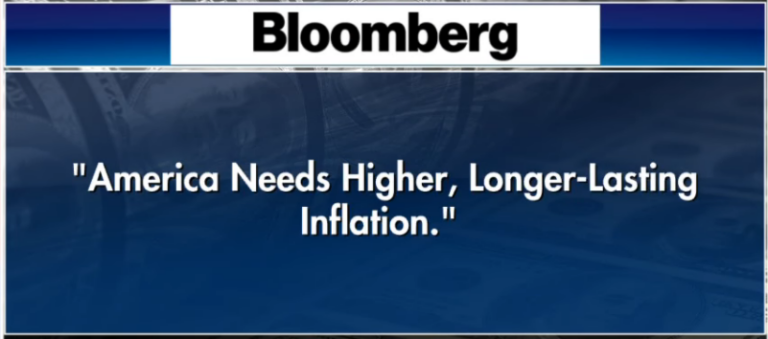
Then, when it becomes apparent that it’s not merely transitory, they tell you not to worry because inflation is actually a good thing.

It’s not uncommon to see ridiculous headlines like this:

Example #2: No More Turkey at Thanksgiving

After inflation broke through multi-decade highs, it’s no longer possible to maintain the farce that “inflation is good.”

So the elite’s messaging has pivoted to ways the plebs can cope with ever-decreasing living standards.

Last Thanksgiving, it was impossible for the Federal Reserve to ignore the soaring costs of turkey. So, instead, the St. Louis branch had a helpful suggestion for those struggling—substitute delicious turkey for cheaper heavily-processed industrial sludge.

See the rest here

Be seeing you

Posted in Uncategorized | Tagged: , , , , | Leave a Comment »

Forget What the “Experts” Claim about Deflation: It Strengthens the Economy

Posted by M. C. on May 10, 2022

Nonproductive Activities Come from Lending Fake Money

https://mises.org/wire/forget-what-experts-claim-about-deflation-it-strengthens-economy

Frank Shostak

For most experts, deflation is bad news since it generates expectations for a continued decline in prices, leading consumers to postpone the purchases of present goods, since they expect to purchase them at lower prices in the future. Consequently, this weakens the overall flow of current spending and this, in turn, weakens the economy. Economic activity, believe the experts, is a circular flow of money. Spending by one individual becomes the earnings of another individual, and spending by another individual becomes a part of the previous individual’s earnings.

If people have become less confident about the future decide to reduce their spending, this weakens the circular flow of money. Once an individual spends less, this worsens the situation of some other individual, who in turn also cuts his spending.

According to the former Federal Reserve chairman Ben Bernanke,

Deflation is in almost all cases a side effect of a collapse of aggregate demand—a drop in spending so severe that producers must cut prices on an ongoing basis in order to find buyers. Likewise, the economic effects of a deflationary episode, for the most part, are similar to those of any other sharp decline in aggregate spending—namely, recession, rising unemployment, and financial stress.

Murray Rothbard, however, held that in a free market the rising purchasing power of money (shown by declining prices) makes goods more accessible to people. He wrote:

Improved standards of living come to the public from the fruits of capital investment. Increased productivity tends to lower prices (and costs) and thereby distribute the fruits of free enterprise to all the public, raising the standard of living of all consumers. Forcible propping up of the price level prevents this spread of higher living standards.

Economist Joseph Salerno adds: 

Historically, the natural tendency in the industrial market economy under a commodity money such as gold has been for general prices to persistently decline as ongoing capital accumulation and advances in industrial techniques led to a continual expansion in the supplies of goods. Thus throughout the nineteenth century and up until the First World War, a mild deflationary trend prevailed in the industrialized nations as rapid growth in the supplies of goods outpaced the gradual growth in the money supply that occurred under the classical gold standard. For example, in the US from 1880 to 1896, the wholesale price level fell by about 30 percent, or by 1.75% per year, while real income rose by about 85 percent, or around 5 percent per year.1

Money and Money out of “Thin Air”

Money emerged because it could support the market economy more efficiently than barter. The distinguishing characteristic of money is its role as general medium of exchange, evolving from the most marketable commodity. On this Ludwig von Mises wrote

See the rest here

Be seeing you

Posted in Uncategorized | Tagged: , , , , , | Leave a Comment »