


Facing a fight for his political life, UK Prime Minister Boris Johnson has announced an abrupt end to England’s vaccine passport, mask mandates including in schools, and work-from-home orders as the Omicron “scare” fizzles. In Israel, Finance Minister Avigdor Liberman is demanding an end to that country’s vax pass. The bricks are falling from this Berlin Wall. Also today: New footage of Ashli Babbitt will NOT please the Jan 6th Committee and a new study out of Brazil will not please Fauci.
Posts Tagged ‘Israel’
Narrative Collapse! From England To Israel, Governments Race To Abandon Vaccine Passports!
Posted by M. C. on January 19, 2022
Posted in Uncategorized | Tagged: Ashli Babbitt, Avigdor Liberman, Boris Johnson, England, Israel, Jan 6th Committee, vaccine passports | 1 Comment »
Israel Confirms Vaccine Fail Against Omicron: All Vaccine Mandates Must End Now – LewRockwell LewRockwell.com
Posted by M. C. on January 19, 2022
We also ask that all Covid passports schemes be revoked. Covid health passes do not serve any legitimate purpose since the vaccinated are not protected against infection, and, in fact, the data show that they are getting infected more readily than their unvaccinated counterparts. For some reason, Omicron seems to target the vaccinated especially.
“The bottom line is that the vaccine is excellent against the Alpha and Delta [variants], for Omicron it’s not good enough” said Prof. Gili Regev-Yochay who led an Israeli experiment of assessing the effectives of the vaccine against corona’s latest variant.
Do you realize what this implies?
Given the fact that the vaccines do not work against Omicron and that Omicron is now the globally dominant Covid strain, it makes no logical or medical sense to continue with vaccinating and boostering at this time.
After all, why would anyone in their right mind needlessly inject people with failed protections that carry a risk of severe adverse reactions.
At this point we are out of vaccine options. No vaccine that is currently at our disposal can protect people from contracting and transmitting Omicron infection or reduce the severity of its symptoms.
We have seen that the opposite is actually the case: the vaccinated and the boostered are contracting omicron at higher rates than the unvaccinated.
This means that there is nothing we can do by way of vaccinal intervention with the shots that are available to us at the moment.
Here is the reality of our situation: We have come – at least for now – to the end of the vaccine road as far as Covid-19 is concerned. At this time, we simply possess no effective vaccine with which to tackle this disease.
This may change in the future, but for now this is the reality of our situation, and it is imperative that we clearly grasp and accept it so that we do not inflict any unnecessary injury or death.
Since the vaccines are ineffective against the prevailing variant, all Covid injectioneering has to stop. To give out any more shots of these vaccines – which we know do not work – is senseless and medically irresponsible.
Continuing vaccination under current circumstances can bring no benefit and will only result in needless harm. To pointlessly expose healthy people to potential injury would constitute medical malfeasance.
We, therefore, call upon health authorities, politicians, employers and schools to follow science and common sense.
The science and common sense clearly show that all vaccine and booster mandates need to be suspended.
We ask that this be done immediately and without delay.
We also ask that all Covid passports schemes be revoked. Covid health passes do not serve any legitimate purpose since the vaccinated are not protected against infection, and, in fact, the data show that they are getting infected more readily than their unvaccinated counterparts. For some reason, Omicron seems to target the vaccinated especially.
All throughout this pandemic we have been told by our politicians and health officials to follow the science. It is time for them to finally live up to their own teaching.
We ask them to do what is right in this situation: End all vaccine mandates and health pass schemes.
In the wake of the vaccinal failure, doing anything other would be medically negligent and scientifically unjustifiable.
Vasko Kohlmayer (email) was born and grew up in former communist Czechoslovakia. You can follow his writings by subscribing to his Substack newsletter ’Notes from the Twilight Zone’. He is the author of The West in Crisis: Civilizations and Their Death Drives.
Be seeing you
Posted in Uncategorized | Tagged: Israel, Omicron, unvaccinated, Vaccine Fail, Vaccine Mandates | Leave a Comment »
Biden’s efforts to appease Israel on Iran have failed on all fronts – Responsible Statecraft
Posted by M. C. on December 16, 2021
It’s not the nuclear deal that’s the problem for Tel Aviv, but the very idea that Washington and Tehran would reach any detente at all.
What Israel doesn’t want they won’t get.
Written by
Trita Parsi
The New York Times Friday published an important analysis of ongoing U.S.-Israeli tensions over Washington’s efforts to revive the 2015 nuclear deal with Iran, the Joint Comprehensive Plan of Action, which had succeeded in curbing Tehran’s nuclear program. As helpful as it is in understanding where things stand between Washington and Tel Aviv, however, the article misses a more fundamental takeaway from recent developments: Biden’s immense efforts to appease Israel in hopes of tempering the latter’s opposition to the JCPOA have not only failed but were likely based on faulty assumptions and were thus a mistake from the outset.
Diverging Israeli and American views on the JCPOA is nothing new. But senior officials on the Biden team thought President Obama could have handled the Israelis better by coordinating more closely with Prime Minister Benjamin Netanyahu and actually heeding some of his hawkish advice. This belief, however, is unfounded.
The fundamental question is this: Are Israel and America’s views on a negotiated settlement with Iran ultimately reconcilable or not? Was there— and is there now — a way to clinch a lasting deal with Iran on its nuclear program that also satisfies Israel?
The answer lies in understanding that the details of the deal are not the real problem. It’s rather the very idea of Washington and Tehran reaching any agreement that not only prevents Iran from developing a bomb, but also reduces U.S.-Iran tensions and lifts sanctions that have prevented Iran from enhancing its regional power.
Many of Washington’s partners in the Middle East worry more about a U.S.-Iranian rapprochement and its geopolitical implications — a likely tilt in the regional balance of power in Iran’s favor, especially given the widespread perception the United States is eager to extricate itself from the neighborhood — than Iran’s nuclear advances. “So long as the United States works to contain Iran’s political influence and undermine its economy,” I wrote in Foreign Affairs in February, “the balance of the region will artificially tilt in favor of these states — a tilt that their own power cannot sustain.”
Indeed, Obama’s fruitless efforts to persuade Washington’s regional partners and their allies in Washington to go along with the JCPOA had demonstrated that no amount of deference or consultation could change their categorical opposition to a deal with Iran. To the great frustration of some former Obama officials who had gone through this experience, the Biden team thought they could square this circle.
In December 2020, Obama’s deputy national security adviser, Ben Rhodes publicly implored Biden not to repeat this mistake: “I plead with [Biden],” he said on the PodSaveAmerica podcast. “Do not think there is any ounce of good faith that will be coming your way from Bibi Netanyahu, from MBS, and from the Tom Cottons of this world. These people have no interest in a deal. They’ve never had an interest in a deal,” he declared. “How many times do we have to go through this play? This is in the hands of the Biden people to say: ‘We don’t need to listen to these people.’”
But Biden chose to listen to them. Instead of returning to the JCPOA in the first days and weeks of his administration, critical time and effort were spent trying to persuade Israel, Saudi Arabia and the UAE to get onboard with diplomacy.
Be seeing you
Posted in Uncategorized | Tagged: Benjamin Netanyahu, Israel, Israel Lobby, JCPOA | Leave a Comment »
You will NEVER be “fully vaccinated” – OffGuardian
Posted by M. C. on December 16, 2021
It’s time everyone realised they are chasing an intentionally impossible goal that will be pushed back over the horizon, forever.
https://off-guardian.org/2021/12/14/you-will-never-be-fully-vaccinated/
Kit Knightly
Yesterday, in a statement to Parliament on the UK’s planned “vaccine passport”, Health Secretary Sajid Javid admitted the NHS Pass would require three shots for you to be considered “fully vaccinated”.
“Once all adults have had a reasonable chance to get their booster jab, we intend to change this exemption to require a booster dose,”
While many of us predicted this would be the case, it is the first time any British politician has actually said it out loud, and in front of parliament too.
This incredibly cynical “evolving definition” of “fully vaccinated” is not a new phenomenon, and is not isolated to the UK either.
Israel changed their definition of “fully vaccinated” to include the booster months ago. New Zealand’s ministry of health is “considering” doing the same, as is Australia.
The EU isn’t far behind either, with proposals in place to make travel dependent on having a third dose.
The US hasn’t formally adopted a new definition yet, but you’d have to be blind not to see the signs. Just yesterday the LA Times headlined:
Should the definition of ‘fully vaccinated’ be changed to include a booster shot?
An article on Kaiser Health News asks the same thing.
Tony Fauci is quoted in the Independent as saying it’s only a matter of time before the definition is updated:
“It’s going to be a matter of when, not if” getting a booster shot will be considered being “fully vaccinated,” Dr Fauci said.
Opinion pieces are already appearing asking “is it safe to hangout with the unboosted”?
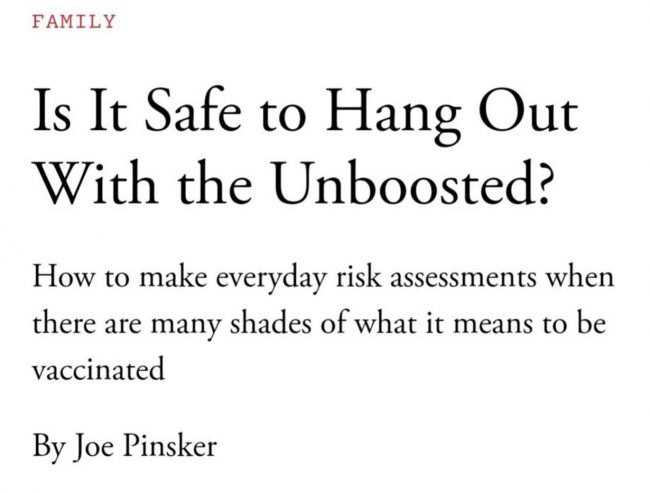
(This headline was so unpopular, the Atlantic changed it only a couple of hours after it was published, and even the archived version appears to have been scrubbed).
All in all it seems pretty clear that, by the time 2022 rolls around, most of the Western world will require three shots in order to qualify as “fully vaccinated”.
It’s also clear that this won’t stop at three. Already, just last week, Pfizer were claiming they may need to “move up the timeline” for a fourth vaccine dose.
This change is being blamed on Omicron, with articles warning the “new variant” can “hit” the vaccinated. Fortune reports:
Omicron is making scientists redefine what it means to be ‘fully vaccinated’ against COVID
So, the third (and maybe fourth) doses are (allegedly) for Omicron…but that model can extend to perpetuity. In order to go to five, six or seven they’ll only need to “discover” more “new variants”.
It will just keep going and going.
But there is good news in all this, every time the powers-that-shouldn’t-be change the rules in the middle of the game, it’s a chance to knock people out of their media-induced hypnosis.
There are promising signs that millions of already-vaccinated will reject the booster. We can build on that.
So tell your single and double jabbed friends, try to open their eyes to the path they are starting down.
They may consider themselves “fully vaccinated”, but the government doesn’t, and never will.
Be seeing you
Posted in Uncategorized | Tagged: Anthony Fauci, Australia, Austria, boosters, coronavirus, Fortune, Independent, Israel, LA Times, mandatory vaccines, media watch, New Zealand, NHS, Sajid Javid, UK, United States, vaccine passports, Vaccines | 1 Comment »
Opinion | I Live in Arkansas. Why is My State Telling Me Not to Boycott Israel? – The New York Times
Posted by M. C. on November 24, 2021
Because AIPAC owns Congress and Congress owns education grants.
By Alan LeverittMr. Leveritt is the founder and publisher of The Arkansas Times. His lawsuit against Arkansas’s anti-boycott law is being reviewed by the U.S. Court of Appeals for the Eighth Circuit.At The Arkansas Times, a publication I founded 47 years ago, our pages focus on small-scale local issues, like protecting Medicaid expansion from the predations of our state legislature and other elements of Arkansas politics, history and culture. So I was surprised when in 2018 I received an ultimatum from the University of Arkansas’s Pulaski Technical College, a longtime advertiser: To continue receiving its ad dollars, we would have to certify in writing that our company was not engaged in a boycott of Israel. It was puzzling. Our paper focuses on the virtues of Sims Bar-B-Que down on Broadway — why would we be required to sign a pledge regarding a country in the Middle East?I understood the context of that email. In 2017, Arkansas pledged to enforce support for Israel by mandating that public agencies not do business with contractors unless those contractors affirm that they do not boycott Israel. The idea behind the bill goes back 16 years. In 2005, Palestinian civil society launched a campaign calling for “boycott, divestment and sanctions against Israel until it complies with international law and universal principles of human rights.” Around the world, Boycott, Divestment and Sanctions, or B.D.S., as it became known, gained momentum. In response, Israel and lobbyists have used multiple strategies to quash the movement. In the United States, one such strategy took the form of anti-B.D.S. bills. Currently, more than 30 states have provisions on the books similar to Arkansas’s.It soon became clear that The Arkansas Times had to answer our advertiser. Though boycotting Israel could not have been further from our minds and though state funding is a significant source of our income, our answer was no. We don’t take political positions in return for advertising. If we signed the pledge, I believe, we’d be signing away our right to freedom of conscience. And as journalists, we would be unworthy of the protections granted us under the First Amendment.And so, instead of signing, we sued to overturn the law, represented by the American Civil Liberties Union, on the grounds that it violates the First and 14th Amendments. We are still fighting it.
 MCViewPoint