MCViewPoint

Opinion from a Libertarian ViewPoint

Posts Tagged ‘Jim Crow’

Supreme Court Finally Acknowledges That Racial Preferences Have Always Been Wrong – The American Spectator | USA News and Politics

Posted by M. C. on June 30, 2023

It has struck down affirmative action in the Harvard case.

https://spectator.org/supreme-court-finally-acknowledges-that-racial-preferences-have-always-been-wrong/

by MARK R. WEAVER

Today, the U.S. Supreme Court rejected the substitution of race for merit when it ruled against Harvard University’s use of racial preferences in admissions. “I write,” Justice Clarence Thomas states in his concurring opinion, “to clarify that all forms of discrimination based on race—including so-called affirmative action—are prohibited under the Constitution.”

The landmark decision is squarely at odds with figures like Bull Connor, George Wallace, Robert Byrd, and their modern-day counterparts who advocate for different treatment based on skin color. More importantly, it confirms what most Americans already understand: Treating people differently based on their race is always wrong.

In America, judging people based on race reached its nadir with the scourge of slavery. Despite its continued practice around the world, this vile practice wasn’t easily erased here. Hundreds of thousands of Union soldiers bled and died to advance the bold Christian witness of abolitionists in the U.S. and England

Jim Crow–era laws and their stubborn vestiges took even longer to defeat. Early in my career, as spokesman for the Civil Rights Division of the U.S Department of Justice, I saw the ugly sneer of racism in case after case. Here’s what I learned there: Every illegal racist act must be confronted, and our justice system provides many ways to do so.

The True Drive Toward Equality

Despite the depraved hearts of a small cohort of our countrymen, the dream of Rev. Martin Luther King Jr. — that each of us be judged by the content of our character rather than by the color of our skin — is more tangible now than ever before. Indeed, the World Values Survey indicates that America is among the least racist countries on earth.

Rejecting racial preferences has been an American ideal ever since Thomas Jefferson wrote, “We hold these truths to be self-evident, that all men are created equal.” That God-ordained notion took a long time to take hold, especially since Jefferson himself incorrectly thought his slaveholding deserved a pass. But just because someone gets his math wrong doesn’t mean the truth of the equation changes.

The consistent forward drive toward achieving equality has been detoured by modern-day segregation within American universities, even as the Constitution requires “equal protection of the laws” from the government and entities — like most colleges — that accept government funds. Sadly, like a miser greedily gripping his last dollar, those obsessed with racial preferences refuse to let go.

Perhaps now, with a majority opinion from the highest court in the land, we can obliterate this insidious inequity, often glossed over with the Orwellian label of “affirmative action” — an idea that doesn’t even work, as a Stanford Law Review study shows. Black law students accepted though race-conscious admissions processes are worse off than at schools where race isn’t a factor.

See the rest here

Be seeing you

Posted in Uncategorized | Tagged: , , | Leave a Comment »

Rents and Race – A Great Weekend Read

Posted by M. C. on November 19, 2022

https://www.independent.org/publications/tir/article.asp?id=947

Rents and Race
Legacies of Progressive Policies
By William L. AndersonDavid Kiriazis

This article appeared in the Summer 2013 issue of The Independent Review.


Could it be that the institutional racism of Jim Crow occurred not despite the Progressive era but because of it? Not only did the Progressive reforms create new economic rents that could be exploited by whites and by the politicians who enacted those reforms, but many leading Progressives espoused views on racial purity and segregation that put them in the vanguard of the American apartheid system.

Download PDF (19 pages)

Be seeing you

Posted in Uncategorized | Tagged: , , | Leave a Comment »

‘‘Ed-exit’ to Protect Your Kids from Critical Race Theory’ – Ron Paul’s 19 July Column

Posted by M. C. on July 19, 2021

https://mailchi.mp/ronpaulinstitute/edexit?e=4e0de347c8

‘Ed-exit’ to Protect Your Kids from Critical Race Theory

Written by Ron Paul Monday July 19, 2021
undefined

Parents across the country are fighting to stop government schools from indoctrinating their children with Critical Race Theory. Critical Race Theory is a form of Marxism that focuses on the “oppression” of racial minorities. Central to Critical Race Theory is the belief that free markets are a tool of racial oppression that must be abolished and replaced with socialism.

This is dangerous nonsense. History shows that governments, not free markets, are and always have been the instruments of racial oppression. For example, legislators passed Jim Crow laws because private businesses refused to voluntarily segregate their customers.

Numerous scholars have documented how the welfare state and the war on drugs, as well as minimum wage laws, occupational licensing laws, and other anti-liberty laws, disproportionately harm minorities. Some of these laws were passed with the explicit goal of protecting white workers from competition with minorities.

Public outrage over teaching children that the only way to overcome racism is to sacrifice liberty helped build efforts to pass laws banning the teaching of Critical Race Theory. Some of these efforts are accompanied by advancing mandates that schools promote a “positive” or “patriotic” view of America. This can replace one form of indoctrination with another.

A “patriotic” curriculum could teach children that the change from a constitutional republic to a welfare-warfare state was a victory for liberty. It could also teach that the American government is morally justified in, and capable of, managing the economy at home and spreading democracy abroad. It could teach children lies like capitalism caused the Great Depression.

Instead of arguing over what form of statism government schools should indoctrinate children in, liberty activists should work to replace government control of education with parental control.

The key to this is to restore parental control of education dollars though education tax credits and tax-free education savings accounts. This can enable parents to afford to “ed-exit” from government schools by sending their children to private schools. It can also help parents afford the costs associated with homeschooling. Increased charitable deductions can help fund private education for low-income families. Tax credits can be implementing without increasing the deficit by tying them to legislation closing the Department of Education.

Homeschooling is an increasingly attractive option for many parents. Parents interested in providing their children with a quality education should consider my homeschooling curriculum. The Ron Paul Curriculum provides students with a well-rounded education that includes rigorous programs in history, mathematics, and the physical and natural sciences. The curriculum also provides instruction in personal finance. Students can develop superior communication skills via intensive writing and public speaking courses. Another feature of my curriculum is that it provides students the opportunity to create and run their own businesses.

The government and history sections of the curriculum emphasize Austrian economics, libertarian political theory, and the history of liberty. However, unlike government schools, my curriculum never puts ideological indoctrination ahead of education.

Interactive forums ensure students are engaged in their education and that they have the opportunity to interact with their peers outside of a formal setting.

I encourage all parents looking at alternatives to government schools — alternatives that provide children with a well-rounded education that introduces them to the history and ideas of liberty without sacrificing education for indoctrination — to go to RonPaulCurriculum.com for more information about my homeschooling program.


Copyright © 2021 by RonPaul Institute. Permission to reprint in whole or in part is gladly granted, provided full credit and a live link are given.
Please donate to the Ron Paul Institute

Be seeing you

Posted in Uncategorized | Tagged: , , , | Leave a Comment »

Today and Yesterday – LewRockwell

Posted by M. C. on September 10, 2020

The poverty we have today is spiritual poverty. Spiritual poverty is an absence of what traditionally has been known as various human virtues. Much of that spiritual poverty is a result of public and private policy that rewards inferiority and irresponsibility. Chief among the policies that reward inferiority and irresponsibility is the welfare state.

https://www.lewrockwell.com/2020/09/walter-e-williams/today-and-yesterday/

By

In matters of race and other social phenomena, there is a tendency to believe that what is seen today has always been. For black people, the socioeconomic progress achieved during my lifetime, which started in 1936, exceeded anyone’s wildest dreams. In 1936, most black people lived in gross material poverty and racial discrimination. Such poverty and discrimination is all but nonexistent today. Government data, assembled by Robert Rector of the Heritage Foundation, shows that “the average American family … identified as poor by the Census Bureau, lives in an air-conditioned, centrally heated house or apartment … They have a car or truck. (Indeed, 43% of poor families own two or more cars.)” The household “has at least one widescreen TV connected to cable, satellite, or a streaming service, a computer or tablet with internet connection, and a smartphone. (Some 82% of poor families have one or more smartphones.” On top of this, blacks today have the same constitutional guarantees as everyone else, which is not to say that every vestige of racial discrimination has been eliminated.

The poverty we have today is spiritual poverty. Spiritual poverty is an absence of what traditionally has been known as various human virtues. Much of that spiritual poverty is a result of public and private policy that rewards inferiority and irresponsibility. Chief among the policies that reward inferiority and irresponsibility is the welfare state. When some people know they can have children out of wedlock, drop out of school and refuse employment and suffer little consequence and social sanction, one should not be surprised to see the growth of such behavior. Today’s out-of-wedlock births among blacks is over 70%, but in the 1930s, it was 11%. During the same period, out-of-wedlock births among whites was 3%; today, it is over 30%. It is fashionable and politically correct to blame today’s 21% black poverty on racial discrimination. That is nonsense. Why? The poverty rate among black husband-and-wife families has been in the single digits for more than two decades. Can anyone produce evidence that racists discriminate against black female-headed families but not black husband-and-wife families?

For most people, education is one of the steppingstones out of poverty, and it has been a steppingstone for many black people. Today, decent education is just about impossible at many big-city public schools where violence, disorder, disrespect and assaults on teachers are routine. The kind of disrespectful and violent behavior observed in many predominantly black schools is entirely new. Some have suggested that such disorder is part of black culture, but that is an insulting lie. Black people can be thankful that double standards, and public and private policies rewarding inferiority and irresponsibility, were not broadly accepted during the 1920s, ’30s, ’40s and ’50s. There would not have been the kind of intellectual excellence and spiritual courage that created the world’s most successful civil rights movement.

Many whites are ashamed, saddened and guilt-ridden by our history of slavery, Jim Crow and gross racial discrimination. They see that justice and compensation for that ugly history is to hold their fellow black Americans accountable to the kind of standards and conduct they would never accept from whites. That behavior and conduct is relatively new. Meet with black people in their 70s or older, even liberal politicians such as Charles Rangel (age 90), and Reps. Eddie Bernice Johnson (85), Alcee Hastings (83) and Maxine Waters (82). Ask them whether their parents would have tolerated their assaulting and cursing of teachers or any other adult. I bet you the rent money their parents and other parents of that era would not have accepted the grossly disrespectful behavior seen today among many black youngsters who use foul language and racial epithets at one another. These older blacks will tell you that, had they behaved that way, they would have felt serious pain in their hind parts. If blacks of yesteryear would not accept such self-destructive behavior, why should today’s blacks accept it?

Black people have made tremendous gains over the years that came as a result of hard work, sacrifice and a no-nonsense approach to life. Recovering those virtues can provide solutions to many of today’s problems.

Be seeing you


Posted in Uncategorized | Tagged: , , , , | Leave a Comment »

Black Lives Matter Gives Revolution A Bad Name

Posted by M. C. on August 17, 2020

But more alarming than their Marxist tendencies is the organization’s insistence that their plans will create paradise for black Americans through force.

How, you might ask? By abolishing prisons, transforming all schools into multicultural institutes, and providing all black Americans reparations regardless of their proximity to historical injustices—all through the government, of course.

But as history shows us, governments do not create harmony or paradise—only actual cooperation can help us achieve that vision.  But cooperation always fails when force enters the equation, which makes Black Lives Matter’s stated goals untenable for a free society. 

Black Lives Matter Gives Revolution A Bad Name

By Christian Watson

The word “Revolution” is among the most consequential gems in the english language.

History has associated the word with images of musket-wielding, ash-faced frenchmen or battle-hardened colonists soon-to-be Americans fighting for higher-order ideals of freedom. But similar to most illustrious historical concepts, contemporary politics rarely does them justice.

Enter Black Lives Matter.

The New York Times, for instance, noted that overall American support for Black Lives Matter increased “nearly as much as it had in the two preceding years.”

Of course, novelty often brings excitement. Think of the crowds that flood the streets of major cities around the world whenever a new iPhone is released– Black Lives Matter is no exception to this rule.

Indeed, TeenVogue urged Black Lives Matter activists not to allow their “revolution” to succumb to those nasty, grubby general political interests.

And the ever-so hip-to-the-left publication Vox’s Black Lives Matter apologism tied the movement’s activities to a long tradition of “American radicalism.”

The article incorrectly associates Black Lives Matter with the struggle against Jim Crow laws that resulted in the Civil Rights Movement.

Oh, yes: some actors in left-wing media are likening the goals of Black Lives Matter, the organization, with the Civil Rights Movement. And if one attacks anything resembling the struggle for Civil Rights, they can quite easily be written-off as a bad person, a racist, and so on. All while attaching Black Lives Matter to “American radicalism.”

Oh, how far we are from the promised land.

The premise of this argument quite boldly fails to understand the point of the American Revolution. The American Revolution—which had a clear, overarching principle—was both new and unique as the world hadn’t seen anything like it before. Thus, they set their own example for others to follow.

Unlike the American Revolution, Black Lives Matter, the organization, lacks a clear goal beyond their disjointed policy proposals.

Also unlike the American Revolution, Black Lives Matter rehashes old Marxist revolutionary tactics, such as the pumped fist symbolism, the goal to pour government funds into “community based” alternatives to policing, and the organization’s now redacted desire to overturn “US imperialism and capitalism.”

The list is endless. These goals would find a home among the manifestos of communist revolutionaries like Mao Zedong or Che Guevera. But in the American tradition? Not a chance.

But more alarming than their Marxist tendencies is the organization’s insistence that their plans will create paradise for black Americans through force.

How, you might ask? By abolishing prisons, transforming all schools into multicultural institutes, and providing all black Americans reparations regardless of their proximity to historical injustices—all through the government, of course.

But as history shows us, governments do not create harmony or paradise—only actual cooperation can help us achieve that vision.  But cooperation always fails when force enters the equation, which makes Black Lives Matter’s stated goals untenable for a free society.

And in this instance, the American Revolution, too, distinguishes itself from Black Lives Matter: The colonists goals addressed a legitimate danger to individual freedom. And that gave the colonists an obvious direction take their revolution.

For example, the American Revolution had a clear goal: To redress the actions of the British crown. In pursuance of this goal, seismic speeches and pamphlets like Patrick Henry’s Give Me Liberty or Give Me Death or Thomas Paine’s Common Sense saturated the colonies and provided an intellectual framework for the impending American government.

Indeed, letters and correspondence between the founders and the legislative bodies of the colonies provided many of the ideas that constitute the Constitution. All of this, of course, at a time when questioning the crown was strictly forbidden.

But Black Lives Matter exists in the 21st century, in a time where African Americans are represented in media, politics, law, and other fields in large numbers. They don’t face a king trying to muffle them,  nor the inconveniences of organizing with just paper, pamphlets, and speeches—they have the internet and social media.

And yet, with all of their advantages, they lack an overarching principle which justifies their revolution. That’s a shame.

One thing is for certain: the goals of the organization Black Lives Matter, summed up, are simply anti-freedom. In contrast, the American Revolution had an overarching goal: to preserve freedom for everyone.

Even if that goal didn’t happen immediately, they gave their descendants the necessary tools to work with. Which one do you think reflects “American radicalism” better?

The rallying cry “Black Lives Matter,” which is different from the organization, has brought to light many issues pertinent to the preservation of individual liberty, such as the desperate need for policing and sentencing reform.

But the phrase’s power is lost amid the noise of a raucous Marxist militia which is concerned about fulfilling its agenda to the detriment of black lives.

If  black lives truly do matter, let’s focus on respecting individual rights, embracing freedom, and kicking Marxism to the curb.

In this era of wokeness, that would truly be revolutionary.

Christian Watson is a political writer based in Georgia and host of the Pensive Politics podcast. He can be found on Twitter at @OfficialCWatson.

Posted in Uncategorized | Tagged: , , , , | Leave a Comment »

The Disastrous Legacy of Woodrow Wilson | Mises Wire

Posted by M. C. on July 3, 2020

The reason for discouragement is not that the university where Wilson served as president before becoming president of the United States has “canceled” him for his racism—something that no one ever sought to hide when discussing Wilson’s legacy—but rather the stubborn insistence that despite his racial policies Wilson’s record of pushing progressive legislation as well as his role in bringing the United States into World War I should be considered as pluses for his presidency.

It is hard to know where to begin here. First, and most important, “industrial titans” were not “crushing” small businesses. They made their fortunes through mass production of iron, steel, petroleum, railroad locomotives, and farm implements, along with making automobiles affordable for those people they allegedly were “crushing.”

https://mises.org/wire/disastrous-legacy-woodrow-wilson?utm_source=Mises+Institute+Subscriptions&utm_campaign=b35a2a84b3-EMAIL_CAMPAIGN_9_21_2018_9_59_COPY_01&utm_medium=email&utm_term=0_8b52b2e1c0-b35a2a84b3-228343965

Princeton University has made it official: Woodrow Wilson’s name no longer will have any place on campus. The former president, or at least his memory, now is part of cancel culture, which is sweeping the nation. The Woodrow Wilson School of Public and International Affairs will replace the former president’s name with “Princeton,” and Wilson College now will be called First College.

This hardly is surprising but in many ways discouraging, but not for reasons that many people might assume. Wilson did, after all, leave a sorry legacy of Jim Crow racial segregation and actively sought to damage if not destroy race relations in the United States, so the drive to remove his name is not a surprise given the wave of renaming and destruction of statues and monuments that has dominated the headlines ever since Minneapolis police killed George Floyd.

The reason for discouragement is not that the university where Wilson served as president before becoming president of the United States has “canceled” him for his racism—something that no one ever sought to hide when discussing Wilson’s legacy—but rather the stubborn insistence that despite his racial policies Wilson’s record of pushing progressive legislation as well as his role in bringing the United States into World War I should be considered as pluses for his presidency. Declares Princeton president Christopher L. Eisgruber:

Wilson remade Princeton, converting it from a sleepy college into a great research university. Many of the virtues that distinguish Princeton today—including its research excellence and its preceptorial system—were in significant part the result of Wilson’s leadership. He went on to the American presidency and received a Nobel Prize. People will differ about how to weigh Wilson’s achievements and failures. Part of our responsibility as a University is to preserve Wilson’s record in all of its considerable complexity.

Translation: Wilson’s record is complex, as he did many positive things both for Princeton and for the USA when he was in the White House. In fact, the “complex” review of Wilson is quite common with historians and journalists, many of whom seem to believe that if it were not for his fealty to Jim Crow and institutionalized racism Woodrow Wilson would have been a great president. That is the legacy that we need to reexamine, and as we do, we find that Wilson’s presidency was a complete disaster, one that reverberates to the present time and still inflicts great harm to our body politic. There is nothing complex at all when examining the cataclysmic aftermath of those eight years Wilson spent in office.

Dick Lehr of The Atlantic seems to be typical of journalists, as he condemns Wilson’s racism but portrays him positively when it comes to his imposition of a progressive legislative and social agenda:

Wilson might have bumbled, and worse, on civil rights, but he was overseeing implementation of a “New Freedom” in the nation’s economy—his campaign promise to restore competition and fair labor practices, and to enable small businesses crushed by industrial titans to thrive once again. In September 1914, for example, he had created the Federal Trade Commission to protect consumers against price-fixing and other anticompetitive business practices, and shortly after signed into law the Clayton Antitrust Act. He continued monitoring the so-called European War, resisting pressure to enter but moving to strengthen the nation’s armed forces.

It is hard to know where to begin here. First, and most important, “industrial titans” were not “crushing” small businesses. They made their fortunes through mass production of iron, steel, petroleum, railroad locomotives, and farm implements, along with making automobiles affordable for those people they allegedly were “crushing.” These industries required large-scale capital, not backyard furnaces, and this was a time when the American standard of living was rising rapidly. It is one thing to write about how “price fixing” allegedly was cheating American consumers but quite another to provide credible examples.

Most historians and journalists writing about this period take it on faith that antitrust laws and other so-called reforms brought on by progressives actually improved the lot of most people in this country. Finding proof that these “reforms” did what supporters claim can be a bit more quixotic.

Let us look at some of the actions that Wilson and his progressive Democratic Congress accomplished during his presidency. For example, most historians and journalists see the Sixteenth Amendment, which provided the legal base for a national income tax, as a “reform” that made the lives of most Americans better. How a tax that takes a significant share of individuals’ earnings has been spent such that those paying are better off having the government spend those monies than they would be by directing their own resources requires creative thinking. Given that most federal employees receive better pay and benefits than the people who work to create the wealth those federal workers consume, one is hard-pressed to explain why the taxpayers are getting a better deal than if they hadn’t paid those taxes at all.

Then there was the creation of the Federal Reserve System in 1914. It is the rare journalist, historian, and even economist who does not lavish praise upon the Fed even though one can effectively argue that it is often responsible for the very conditions that breed financial crises in the first place. Most people would not praise an arsonist who throws fuel on a fire he started, but somehow Federal Reserve governors who provide “liquidity” for financial institutions that acted irresponsibly—often with government and Fed encouragement—are seen as economic saviors.

There is much more. During Wilson’s first term, Democrats pushed through law after law that bolstered the Jim Crow system of racial segregation in the federal government system, which up until then had not followed the lead of many states that were instituting an apartheid system for whites and African Americans. While the federal government was not directly involved in medical care, nonetheless progressives such as Wilson were also firmly behind the guiding principles of the Flexner Report of 1910, which according to Murray N. Rothbard created and maintained the medical cartel that even now deprives Americans of many healthcare options. (Note that very few, if any, journalists and historians have any problem with the cartelization of medical care despite their supposed love affair with competition and their uncritical endorsement of antitrust laws.) Furthermore, the Flexner Report and its aftermath doomed medical education for black Americans and women and left the country woefully short of physicians.

Yet the “crowning achievement” of Wilson’s presidency is American involvement in World War I and its role in the disastrous “peace process” that followed Germany’s surrender. Not surprisingly, journalists and historians see Wilson’s manipulation of this country into the war as being something both inevitable and necessary, a move that launched the USA as a “great power” in world affairs.

Germany posed no danger to the United States, the infamous Zimmerman Telegram notwithstanding. Its armies could not have invaded our shores, and had the Americans not turned the tide in favor of Great Britain and France, almost certainly the belligerents would have entered into a negotiated settlement that would not have laid the conditions for the rise of Adolph Hitler and what turned out to be an even more cataclysmic World War II and its warring aftermath.

Wilson’s contempt for black Americans extended into military service. Like other Americans, they were conscripted into the armed forces and forced into subservient roles, as the prejudices of the day held that blacks were cowards in battle despite their fighting records in previous American wars. Those who did carry a rifle mostly did so under French leadership, where they excelled on the battlefield but also were slaughtered like so many others in the hellish trenches that came to define that war.

On the home front, Wilson’s Congress pushed through laws that turned the USA into a virtual police state, such as the Espionage Act of 1917 (used to prosecute people who dissented against US involvement in the war) and the Trading with the Enemy Act of 1917 (which Franklin Roosevelt used as the “basis of authority” for his executive order to seize gold from Americans). The legacy of both laws continues to this day, as the Obama administration used the Espionage Act to prosecute Julian Assange and Edward Snowden.

If one defines “greatness” as dragging a country into a disastrous war, promoting legislation that hamstrung the economy, vastly increasing taxation, and leaving a racial legacy that wreaks havoc to this very day, then Woodrow Wilson was a “great president.” However, if one sees “greatness” in the Oval Office as someone, according to Robert Higgs, “who acts in accordance with his oath of office to ‘preserve, protect, and defend the Constitution of the United States,’” then Wilson is neither great nor “near great” (the ranking bestowed on him by progressive historians).

Woodrow Wilson does not have a “mixed” legacy. The America that existed before Wilson took office was a very different and less free country after his second term ended in 1921. The dictator-like military organization of the economy that was used to direct war production would form part of the basis for FDR’s attempts to further cartelize the US economy during the New Deal. Wilson pushed through laws to eviscerate the First Amendment and to imprison dissenters, and his racial policies speak for themselves. He did not “lead” the nation during crises; he drove the country into crisis, and this nation never has recovered.

Author:

Contact William L. Anderson

William L. Anderson is a professor of economics at Frostburg State University in Frostburg, Maryland.

Be seeing you

Posted in Uncategorized | Tagged: , , , , | Leave a Comment »

Democrats & Jim Crow: A Century of Racist History the Democratic Party Prefers You’d Forget | The Libertarian Institute

Posted by M. C. on June 20, 2020

https://libertarianinstitute.org/articles/democrats-jim-crow-a-century-of-racist-history-the-democratic-party-prefers-youd-forget/

by

In the last Presidential electionDonald Trump was lauded for his performance among black voters – he scored 4 percent of female black voters and a whopping 13 percent of black male voters, the highest since Richard Nixon. This isn’t shocking. Black voters have voted en masse for the Democratic Party since the mid-60s and the passage of the 1964 Civil Rights Actthe Voting Rights Act and the social welfare programs of the Great Society. This solidified black voters behind the Democratic Party, but they had been moving there since the New Deal.

However, it’s a historical anomaly in the United States. The traditional home of the black voter was the Republican Party, due to its historical role in ending slavery and introducing Reconstruction Acts and Amendments to the Constitution. It also did not help that the Democratic Party was the party of Jim Crow, a system of legally enforced segregation present throughout the American South in the aftermath of the Civil War.

What Do We Mean When We Say “Jim Crow?”

Democrats & Jim Crow: A Century of Racist History the Democratic Party Prefers You'd ForgetBefore delving further into the topic, it is important to define precisely what we mean by Jim Crow and why it is a distinct form of legal codes in United States history. While Northern and Western cities were by no means integrated, this integration was de facto, not de jure. In many cases, the discrimination in the North was a discrimination of custom and preference, discrimination that could not be removed without a highly intrusive government action ensuring equality of outcome. Northerners and Westerners were not required to discriminate, but nor were they forbidden from doing so.

Compare this to the series of laws in the American South known for mandating segregation at everything from public schools to water fountains.

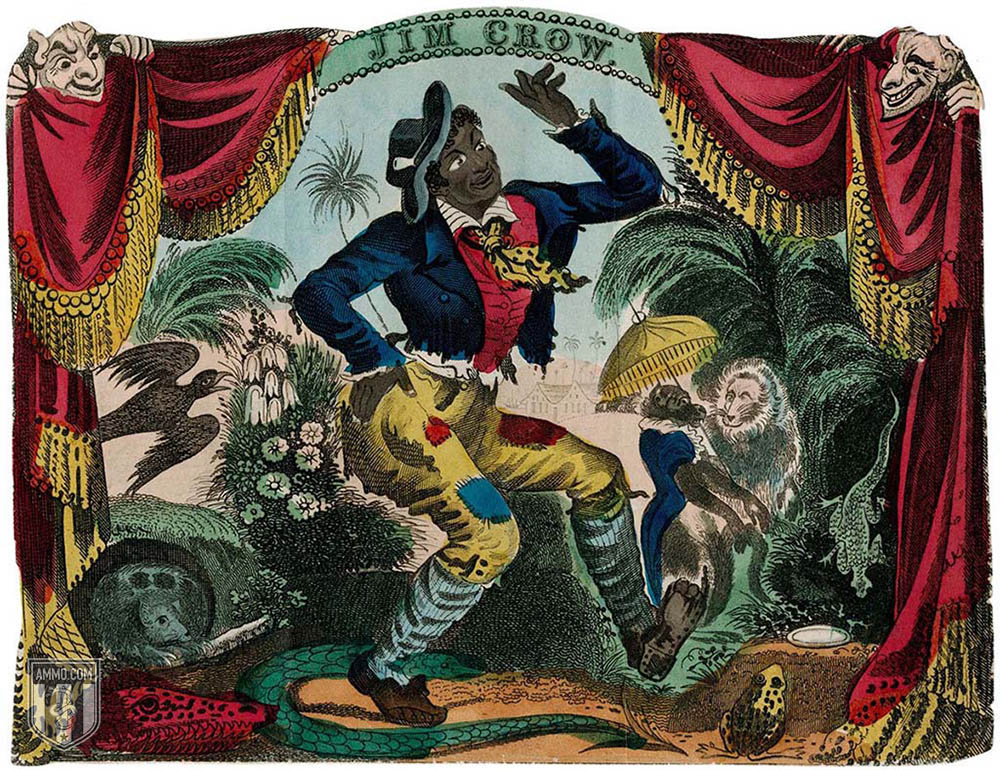
No one is entirely sure where the term “Jim Crow” came from, but it’s suspected that it comes from an old minstrel show song and dance routine called “Jump Jim Crow.” Curiously, the first political application of the term “Jim Crow” was applied to the white populist supporters of President Andrew Jackson. The history of the Jim Crow phenomenon we are discussing here goes back to the end of Reconstruction in the United States.

The Reconstruction Era

Briefly, Reconstruction was the means by which the federal government reasserted control over the Southern states that had previously seceded to form the Confederate States of America. This involved military occupation and the disenfranchisement of the bulk of the white population of the states. The results of the Reconstruction Era were mixed. Ultimately, Reconstruction ended as part of a bargain to put President Rutherford B. Hayes into the White House after the 1876 election. The lasting results of Reconstruction are best enumerated for our purposes as the Reconstruction Amendments:

  • The 13th Amendment abolished involuntary servitude for anyone other than criminals. It was once voted down and passed only through the extensive political maneuvering on behalf of President Abraham Lincoln himself and the approval of dubious Reconstruction state governments in the South. It became law in December 1865.
  • The 14th Amendment includes a number of provisions often thought to be part of the Bill of Rights, such as the Equal Protection Clause and the Due Process Clause, which are, in fact, later innovations. Birthright citizenship’s advocates claim that the Constitutional justification can be found in this sprawling Amendment, which also includes Amendments barring former Confederate officials from office and addresses Confederate war debts. This Amendment became law in July 1868.
  • The 15th Amendment prevents discrimination against voters on the basis of race or skin color. This law was quickly circumvented by a number of laws discriminating against all voters on the basis of income (poll tax) or education (literacy tests). The Southern states eventually figured out how to prevent black citizens from voting while allowing white ones through grandfather clauses.

The Reconstruction Amendments were the first amendments to the Constitution passed in almost 60 years, and represented a significant expansion of federal power.

Perhaps the most important thing to know about the Reconstruction Amendments is that they were largely ineffective. Ranking public officials of the Confederacy were elected to federal government, blacks were disenfranchised as quickly as they were elected to the Senate, and Jim Crow, an entire system of legal discrimination, was erected to return black Americans to their subservient status. With the exception of citizenship for blacks and an end to involuntary servitude, the substance of the rest of the Amendments were largely discarded.

Black Disenfranchisement as a Prologue to Jim Crow

Read the rest of this entry »

Posted in Uncategorized | Tagged: , , , , , , , | Leave a Comment »

Eugenics and the Racist Underbelly of the American Left | Mises Wire

Posted by M. C. on October 2, 2019

For progressives, a legal minimum wage had the useful property of sorting the unfit, who would lose their jobs, from the deserving workers, who would retain their jobs. Royal Meeker, a Princeton economist who served as Woodrow Wilson’s U.S. Commissioner of Labor, opposed a proposal to subsidize the wages of poor workers for this reason. Meeker preferred a wage floor because it would disemploy unfit workers and thereby enable their culling from the work force.

https://mises.org/wire/eugenics-and-racist-underbelly-american-left

The New York Times has created a huge stir with its 1619 Project , which claims that the real founding of the United States was not the American Revolution, but rather slavery and racism. One might mistake the concept as one that said America’s political founders did not hold enlightened racial views, but still helped to create a country with the kind of ideals that finally led to the end of slavery and even undercut racism itself. After all, during the Civil Rights Era, Martin Luther King, Jr., himself appealed to founding documents such as the Declaration of Independence and the Bill of Rights in urging Americans to “live up to the ideals” of the nation.

Instead, the NYT, using academics that represent the New History of Capitalism viewpoint, is claiming that racism, brutality, and slavery were the basis of the founding of the country. This is not a case of saying that the founders were racist, but rather that the legal, social, and economic foundations of the USA were racism. Capitalism in this country, the NHC and NYT allege, came about because of slavery, and that everything related to capitalism here exists solely from slavery. Without slavery, the United States as we know it would not exist.

Double-entry bookkeeping and modern accounting methods? Forget their origins in late Medieval Italy; they were developed on the slave plantation to further the institution of slavery. Modern human resources management did not come about in the late 1800s as a way improve workplace productivity and improve worker welfare. No, human resources was born on the southern slavery plantation and without the institution of slavery, it never would have existed.

Although a number of economists and historians such as Phil Magness, Robert Murphy, and others have effectively contradicted the NYT accounts, American progressives simply are accepting the slavery-as-fundamental-to-American-capitalism as true on its face. Sojourners, for example, declared that the only reason one could disagree with the NYT narratives was racism on behalf of those taking issue with these accounts. Thus, even people who agree that slavery was immoral but question the NYT narrative do so because they are racists who “fear black power.”

While I have written my own disagreements with the NYT narrative, I propose this time of pursuing something similar to what the NYT is claiming, but changing the time and circumstances. I ask the following question: What if racism really is at the roots of the creation of modern America, and what if the NYT has played a major role in promoting structural racism? That is what I intend to show. Furthermore, I hold that the year 1896 is the founding of the America that exists today, and that includes the legacies of Jim Crow and the modern dystopian urban culture of murder and violence.

To understand the points I am making, one first must understand what we call the Progressive Era and the vast intellectual and social changes that it brought. Thomas Leonard of Princeton University writes :

American economics transformed itself during the Progressive Era. In the three to four decades after 1890, American economics became an expert policy science and academic economists played a leading role in bringing about a vastly more expansive state role in the American economy. By World War I, the U.S. government amended the Constitution to institute a personal income tax, created the Federal Reserve, applied antitrust laws, restricted immigration and began regulation of food and drug safety. State governments, where the reform impulse was stronger still, regulated working conditions, banned child labor, instituted “mothers’ pensions,” capped working hours and set minimum wages.

Academic historians (who mostly fall in the progressive camp) would present these changes as uniformly positive, the general narrative being that before the progressive reformers began to reshape the economic and social landscape, Americans – and especially American workers – lived a near-hellish existence. The historians, however, also tend to ignore the darker side of the so-called reformers, who believed that the application of science could help them do away with “inferior” races of people and transform humanity into some sort of super-race. Writes Leonard:

Less well known is that a crude eugenic sorting of groups into deserving and undeserving classes crucially informed the labor and immigration reform that is the hallmark of the Progressive Era (Leonard, 2003). Reform-minded economists of the Progressive Era defended exclusionary labor and immigration legislation on grounds that the labor force should be rid of unfit workers, whom they labeled “parasites,” “the unemployable,” “low-wage races” and the “industrial residuum.” Removing the unfit, went the argument, would uplift superior, deserving workers.

Leonard continues:

…the professional economists who wrote on immigration increasingly emphasized not the quantity of immigrants, but their quality. “If we could leave out of account the question of race and eugenics,” Irving Fisher (1921, pp. 226–227) said in his presidential address to the Eugenics Research Association, “I should, as an economist, be inclined to the view that unrestricted immigration . . . is economically advantageous to the country as a whole . . ..” But, cautioned Fisher, “the core of the problem of immigration is . . . one of race and eugenics,” the problem of the Anglo-Saxon racial stock being overwhelmed by racially inferior “defectives, delinquents and dependents.”

While academic historians tend to see the Jim Crow era, which began in the late 1800s and early 1900s, as a logical extension of the racial turmoil of the South following the end of the Civil War and the ending of slavery, history tells a different account. For example, South Carolina, which in later years produced one of the most infamous race-baiting politicians of all time, Ben “Pitchfork” Tillman, for many years was governed by Wade Hampton, a former Confederate general who also was a racial moderate.

While racial discrimination and strife existed in the South (and much of the rest of the country, for that matter) post-Civil War, racial discrimination did not become institutionalized through the vast network of Jim Crow laws until later. For example, in 1898, the Charleston (South Carolina) News and Courier editorialized against a proposed law to segregate railroad passenger cars:

As we have got on fairly well for a third of a century, including a long period of reconstruction . . . we probably can get on as well hereafter without it [the proposed law], and certainly so extreme a measure should not be adopted and enforced without added and urgent cause.

The editorial went on to say that such a law probably would require “Jim Crow eating cars” and the “Jim Crow Bible for colored witnesses to kiss” and so on. In other words, a leading South Carolina newspaper declared such laws ridiculous. Yet, within a short time, there were Jim Crow eating cars on trains, Jim Crow sleeping cars, Jim Crow Bibles, and a host of other measures enforcing racial segregation until well into the 1960s.

Enactment and enforcement of Jim Crow policies were mostly the product of the Democratic Party post-Grover Cleveland, who left the White House in 1897. Cleveland was a racial moderate and one who believed strongly in individual rights, free markets, and individual responsibility , along with “hard” money. He would be the last Democrat president who believed that way, and the Democrats’ rejection of the Founders’ ideals began even before Cleveland left office, as the party in 1896 fully embraced progressivism, nominating free silver advocate William Jennings Bryan , who had electrified party delegates with his “Cross of Gold” speech at the party’s convention that year .

Bryan’s campaign would be the most radical in U.S. History up to that point. His campaign promoted progressive “reforms,” business regulation, and a silver-based monetary inflation. Had he lived long enough, he most likely would have supported Franklin Roosevelt’s New Deal just as he supported pretty much every progressive legislative measure in the early 20 th Century. Likewise, the political heirs of Tillman and other southern Democrats that made race the central focus of their legislative policies became the staunchest supporters of the New Deal.

Although Bryan lost the 1896 election to William McKinley, his campaign platform would become America’s future, and it is safe to say that modern America is much more the product of the Democrats’ 1896 progressivism than the southern plantation system that the Civil War destroyed more than three decades before.

In 1896, despite the creeping political centralism that had come with the northern victory in the Civil War, the United States still was a constitutional republic. In 20 years, thanks to progressive governance, the USA was well on its way to becoming a progressive democracy. The Democrats’ wide electoral victory in 1912 gave way to what Thomas DiLorenzo has called the Revolution of 1913 . In that year, the Democrats created the Income Tax, the Federal Reserve System, direct election of U.S. Senators, and a host of legislation that bolstered the Jim Crow system. What began in 1896 began to bear fruit with Woodrow Wilson’s 1912 election to the presidency.

Jim Crow policies and the racial purity theories behind them were at the heart of progressivism, something that few progressives today are willing to acknowledge. Leonard writes that eugenics dominated progressive thinking, and one can seriously doubt that people would impose policies that mysteriously violated their racial beliefs, something that modern progressives want us to believe. Take the minimum wage, for example, for which progressives claim that opposition to it is based in racism . Writes Leonard :

Progressive economists, like their neoclassical critics, believed that binding minimum wages would cause job losses. However, the progressive economists also believed that the job loss induced by minimum wages was a social benefit, as it performed the eugenic service ridding the labor force of the “unemployable.” Sidney and Beatrice Webb put it plainly: “With regard to certain sections of the population [the “unemployable”], this unemployment is not a mark of social disease, but actually of social health.” “[O]f all ways of dealing with these unfortunate parasites,” Sidney Webb opined in the Journal of Political Economy, “the most ruinous to the community is to allow them to unrestrainedly compete as wage earners.” A minimum wage was seen to operate eugenically through two channels: by deterring prospective immigrants (Henderson, 1900) and also by removing from employment the “unemployable,” who, thus identified, could be, for example, segregated in rural communities or sterilized.

He continues:…

Be seeing you

Margaret Sanger and the Forced Sterilization of Americans ...


Posted in Uncategorized | Tagged: , , , , , , | Leave a Comment »

The Left’s Latest Demand – LewRockwell

Posted by M. C. on February 26, 2019

One need not be a cynic to suspect Warren’s motivation. Her claim to be an American Indian angered Native Americans, and she would like to mollify them, and ingratiate herself with African-Americans, who constitute more than 60 percent of all Democratic voters in the crucial South Carolina Primary.

By pushing for compensatory reparations, Warren and Harris may be helping themselves, but they are further splitting their party along the lines of ethnicity and race and elevating an issue certain to divide their country more than it already is.

https://www.lewrockwell.com/2019/02/patrick-j-buchanan/the-lefts-latest-demand/

By

Having embraced “Medicare-for-all,” free college tuition and a Green New Deal that would mandate an early end of all oil, gas and coal-fired power plants, the Democratic Party’s lurch to the left rolls on.

Presidential candidates Kamala Harris and Elizabeth Warren both called last week for race-based reparations for slavery.

“Centuries of slavery, Jim Crow, legal discrimination and segregation, and discrimination that exist today have led to a systemic wealth gap between black and white Americans,” Harris told The New York Times. “I’m serious about taking an approach that would change policies and structures and make real investments in black communities.”

Echoed Sen. Warren: “We must confront the dark history of slavery and government-sanctioned discrimination in this country.” This history has crippled “the ability of black families to build wealth in America for generations.”…

Are the Democrats going to say this in their national platform in 2020? And how much will be the rest of America be forced to pay, and for how long? Read the rest of this entry »

Posted in Uncategorized | Tagged: , , , | 1 Comment »

Global Warming As A Wealth Redistribution Tool and The Anti-Trinity

Posted by M. C. on March 17, 2015

Wealth redistribution: Stealing money you worked hard to earn and giving it to someone who didn’t.

Environmentalism sprung from the early 20th century progressive movement. The same people who gave us the minimum wage, Jim Crow and family “planning”. See here.

Progressivism was designed to put the screws to those deemed a threat. First it was the low wage tolerant immigrant who would take work and prosperity away from WASPs. Minimum wage was to take care of that problem. Jim Crow specifically targeted the black man.. Parallel to this was family planning as espoused by Margret Sanger. Those whom we call challenged today were considered a drain on society. Abortion and sterilization were cures to that societal malady.

Out of this evolved the environmental movement where man in general was the bad guy. Man, the earth’s parasite according to David Attenborough.

Walter Williams reminds us here of the “settled” science of global warming where not so long ago the great fear was the coming ice age. Read the rest of this entry »

Posted in Uncategorized | Tagged: , , , , , , , | Leave a Comment »