MCViewPoint

Opinion from a Libertarian ViewPoint

Posts Tagged ‘John Maynard Keynes’

TGIF: The Economic Way of Thinking Can Save Lives | The Libertarian Institute

Posted by M. C. on January 21, 2023

https://libertarianinstitute.org/articles/tgif-thinking-save-lives/

by Sheldon Richman

The Cambridge economist Joan Robinson (1903-1983) wisely said, “The purpose of studying economics is not to acquire a set of readymade answers to economic questions, but to learn how to avoid being deceived by economists.”

Excellent point, though I would both broaden and narrow her category of suspects. I would include most politicians, bureaucrats, pundits, and social-science and humanities professors in the suspect group. And I would exclude the economists — spoiler alert: primarily those of the Austrian school, although others stand out — who paint a much more realistic picture of the world than the others do.

For the record, Robinson was sympathetic to John Maynard Keynes and, later in life, communist China’s Mao Zedong, and North Korea’s Kim Il Sung. Obviously, her study of economics did not teach her how to avoid being deceived by all who represented themselves as economists. (I heard once that Che Guevera became head of Cuba’s national bank in 1959 because when Fidel Castro asked his cadre, “Who here is a good economist?” Guevara, thinking he heard, “Who here is a good communist?” raised his hand. But that’s apparently apocryphal.)

At any rate, mankind would have been spared a good deal of misery had people learned at an early age to engage in the economic way of thinking. If I were to sum it up in a short phrase, I would say: in a world in which the law of identity, causality, and scarcity rule, you can’t do just one thing. Human action has consequences. This apparently is also the first law of ecology, but oddly, environmentalists (as opposed to humanists) seem ignorant of it.

The point is that all human action has rippling consequences across society and across time. The economist who called his textbook The Economic Way of Thinking, the late Paul Heyne, wrote, “All social phenomena emerge from the choices of individuals in response to expected benefits and costs to themselves.” (Happily, Peter J. Boettke and David L. Prychitko keep updating the book. It’s in its 10th edition.)

Heyne’s maxim applies to the choices of politicians and bureaucrats also. So before proposing or endorsing a government policy, one ought to wonder about the social phenomena that are likely to emerge from it. Economics is an indispensable tool in this respect.

Henry Hazlitt’s classic, Economics in One Less, is a great way to get started. Hazlitt wrote, “The art of economics consists in looking not merely at the immediate but at the longer effects of any act or policy; it consists in tracing the consequences of that policy not merely for one group but for all groups.” Hazlitt’s book elaborated an important message of his intellectual ancestor, Frédéric Bastiat, the 19th-century French laissez-faire liberal, in the classic essay “That Which Is Seen and That Which Is Unseen.”

Individuals who adopt this way of thinking are better equipped to judge the promises of politicians, etc. who support taxes, minimum-wage laws, rent control, general wage-and-price controls, and the rest of the program of political authority over contractual freedom and other peaceful conduct. Even well-intended regulations will have unintended bad secondary consequences. Good intentions are never enough.

Any good introduction to the economic way of thinking will introduce readers to concepts like opportunity cost, the unseen, sunk costs, the margin, and tradeoffs. Most people seem to intuit some of these in their own lives. But they fail to do so when it comes to society as a whole. They are encouraged by politicians and pundits to think that common sense in private life does not apply to the big picture.

Opportunity cost refers to the fact when you choose a course of action, you necessarily foreclose another course of action. The true cost, then, is the (subjectively judged) next-best choice forgone. If you buy something for two dollars, your cost isn’t really two dollars. It’s what you regard as the next best use of those two dollars — the future not chosen. You might decide afterward that you made a mistake: “I could’ve had a V-8!” Good economists do not regard people as omniscient robots.

Opportunity cost is another way of looking at trade-offs. If you do or choose A you can’t do or choose B. Thus you trade B for A. Trade-offs are inescapable. Thomas Sowell, for whom the word genius is woefully inadequate, dramatically drew attention to this feature of life when he wrote, “There are no solutions. There are only trade-offs.” Today’s problems, he adds, may well be the result of yesterday’s solutions. We’d do well to bear this in mind, especially in deciding what the government should be doing (if anything).

See the rest here

Be seeing you

Posted in Uncategorized | Tagged: , , , , | Leave a Comment »

Keynes Thought Scarcity Would Disappear in the Near Future. Boy, Was He Wrong. | Mises Wire

Posted by M. C. on May 11, 2021

Keynes fails to see this because of his invincible conviction of his own superiority to the common lot. Plebian businessmen may be baffled by the future; not so him and his ilk. If they control money and guide investment, all will be well.

https://mises.org/wire/keynes-thought-scarcity-would-disappear-near-future-boy-was-he-wrong

David Gordon

The Price of Peace: Money, Democracy, and the Life of John Maynard Keynes
by Zachary D. Carter
Random House, 2021 [2020]
xxii + 628 pages

For many people, though not, to be sure, readers of The Austrian, John Maynard Keynes ranks as the greatest economist of the twentieth century; but for Zachary D. Carter, this is a restrained understatement. Carter, a writer on economics at the HuffPost, says this about Keynes:

No European mind since Newton had impressed himself so profoundly on both the political and intellectual development of the world. When the [London] Times wrote Keynes’ obituary, it declared him ”the greatest economist since Adam Smith.” But even praise so high as this sold Keynes short, for Keynes was to Smith as Copernicus was to Ptolemy—a thinker who replaced one paradigm with another. In his economic work he fused psychology, history, political theory, and observed financial experience like no economist before or since. (p. 368)

Those who make their way through this long book will likely come away puzzled with Carter’s enthusiasm. Keynes held bizarre beliefs, far stranger than the familiar underconsumptionist fallacy that the government needs to bolster insufficient aggregate demand. Though he wrote his most famous book about economic theory in the midst of the Great Depression, he thought that scarcity was no longer a problem. The potential for abundance was at hand, or soon would be; the real economic problem was to distribute this abundance so that selfish speculators would not take it all for themselves, leaving the masses in poverty.

This sounds unbelievable, but Keynes really did claim this. Summarizing Keynes’s position, Carter says,

Prior to The General Theory, economics was almost exclusively concerned with scarcity and efficiency. The very word for the productive output of society—economy—was a metaphor for making do with less. The root cause of human suffering was understood to be a shortage of resources to meet human needs…. This was the worldview of what Keynes called the “classical economists.”… But the sheer productive power of modern capitalism and the “miracle of compound interest” had rendered the portrait obsolete. Technological advances now allowed people to produce so much more with so much less effort than they had in the past that scarcity was no longer the overriding problem of humanity. (pp. 258–59)

What stands in the way of abundance for all? In essence, the problem is money. People hoard money because they fear an uncertain future, and if they hoard money, businessmen will be reluctant to invest. Attempts to cut costs by reducing wages exacerbate the problem, since this lessens consumers’ spending. The classical economists wrongly assumed that adjustments in relative prices suffice to take care of shortages and surpluses. “Say’s law” ensured that there could not be a “general glut” or depression. Keynes rejects Say’s law, arguing that it ignores the cumulative power of pessimistic expectations. It does not help matters that Keynes misstates the law: “For Keynes, the soft underbelly of the classical theory was Say’s Law, which he summarized as the maxim that ‘supply creates its own demand.’” (p. 261) The law in fact says that the supply of a commodity is demand for other commodities.

The technical difficulties of Keynesian theory have been covered amply and in depth by, among others, Henry Hazlitt, W.H. Hutt, and Murray Rothbard, and I do not propose to deal with them at further length here. What is important for our purposes is the mindset with which Keynes addresses the problems he alleges exist for the free market. For him the underlying problem is that an elite of official experts is not in control of money and investment. If only our betters, quintessentially Keynes himself, were in charge, then money creation and governmentally controlled investment would generate prosperity for all.

Money does not arise, as the classical economists, here followed by the Austrian school, thought, as a way to overcome the difficulties of barter. It is a creation of the state, and Keynes developed a peculiar theory of history according to which the continued expansion of the money supply drives historical progress.

In The Wealth of Nations, Smith had presented markets for trade as a primordial force that came into being long before the development of the political state…. The market was natural, while the state was a relatively recent artifice that intervened in or distorted the independent rhythms of trade … Keynes concluded that this history was all wrong. Capitalism itself was an ancient creation of government, dating back at least as far as the Babylonian Empire of the third millennium B.C.…. Inflation—viewed by orthodox economists of the 1920s as an underhanded sovereign’s subversion of the natural order—had instead been a near-constant condition ”throughout all periods of recorded history.” (pp. 167–69)

In his Treatise on Money, Keynes argued that government expansion of the money supply would by itself lead to abundance, but he changed his mind. Government control of investment is needed as well. In The General Theory, he calls for a “somewhat comprehensive socialization of investment,” and in an article for the Quarterly Journal of Economics in February 1937, Keynes speculated on what would happen after a European war. He hoped that a program of government control of investment would enable most fluctuations in employment to be eliminated. “Keynes thought that the government would need to control about two-thirds of all investment in the economy for his idea to work” (p. 402).

Readers of Ludwig von Mises will recognize a familiar pattern. Government control of the economy, while preserving the outward forms of private ownership of the means of production, exactly describes the economic system of Nazi Germany. Carter calls to our attention many critical remarks by Keynes about Hitler, but he nowhere mentions Keynes’s notorious foreword to the German translation of The General Theory. In it he says,

See the rest here

Author:

Contact David Gordon

David Gordon is Senior Fellow at the Mises Institute and editor of the Mises Review.

Posted in Uncategorized | Tagged: , , , , | 1 Comment »

What Is Fascism? It’s the System We’ve Been Living under for Decades. | Mises Wire

Posted by M. C. on January 16, 2021

Fascism is the system of government that cartelizes the private sector, centrally plans the economy to subsidize producers, exalts the police state as the source of order, denies fundamental rights and liberties to individuals, and makes the executive state the unlimited master of society.

This describes mainstream politics in America today. And not just in America. It’s true in Europe, too. It is so much part of the mainstream that it is hardly noticed anymore.

It is ever more widely known that statism does not and cannot work. Statism is the great lie. Statism gives us the exact opposite of its promise. It promised security, prosperity, and peace; it has given us fear, poverty, war, and death. If we want a future, it is one that we have to build ourselves. The fascist state will not give it to us. On the contrary, it stands in the way.

https://mises.org/wire/what-fascism-its-system-weve-been-living-under-decades

Llewellyn H. Rockwell Jr.

[Editor’s Note: In 2011, Lew Rockwell penned this thorough explanation of what fascism really is and what must be done to combat it. Fascism, unlike what the dominant media narrative asserts, has virtually nothing to do with people expressing politically incorrect opinions, or people refusing to wear masks, or a group of disorganized rioters smashing windows in the US Capitol. Fascism, rather, is an ideology of state control, and one that has been immensely successful over the past seventy years in the United States. As Rockwell explains below, the “eight marks of fascism” are all clear and powerful trends within the United States regime today.]

Fascism is the system of government that cartelizes the private sector, centrally plans the economy to subsidize producers, exalts the police state as the source of order, denies fundamental rights and liberties to individuals, and makes the executive state the unlimited master of society.

This describes mainstream politics in America today. And not just in America. It’s true in Europe, too. It is so much part of the mainstream that it is hardly noticed anymore.

If fascism is invisible to us, it is truly the silent killer. It fastens a huge, violent, lumbering state on the free market that drains its capital and productivity like a deadly parasite on a host. This is why the fascist state has been called the vampire economy. It sucks the economic life out of a nation and brings about a slow death of a once thriving economy.

The talk in Washington about reform, whether from Democrats or Republicans, is like a bad joke. They talk of small changes, small cuts, commissions they will establish, curbs they will make in ten years. It is all white noise. None of this will fix the problem. Not even close.

The problem is more fundamental. It is the quality of the money. It is the very existence of 10,000 regulatory agencies. It is the whole assumption that you have to pay the state for the privilege to work. It is the presumption that the government must manage every aspect of the capitalist economic order. In short, it is the total state that is the problem, and the suffering and decline will continue so long as the total state exists.

The Origins of Fascism

To be sure, the last time people worried about fascism was during the Second World War. There can be no question of its origins. It is tied up with the history of post–World War I Italian politics. In 1922, Benito Mussolini won a democratic election and established fascism as his philosophy. Mussolini had been a member of the Italian Socialist Party.

All the biggest and most important players within the fascist movement came from the socialists. It was a threat to the socialists because it was the most appealing political vehicle for the real-world application of the socialist impulse. Socialists crossed over to join the fascists en masse.

This is also why Mussolini himself enjoyed such good press for more than ten years after his rule began. He was celebrated by the New York Times in article after article. He was heralded in scholarly collections as an exemplar of the type of leader we needed in the age of the planned society. Puff pieces on this blowhard were very common in US journalism all through the late 1920s and the mid-1930s.

In Italy, the Left realized that their anticapitalistic agenda could best be achieved within the framework of the authoritarian, planning state. Of course our friend John Maynard Keynes played a critical role in providing a pseudoscientific rationale for joining opposition to old-world laissez-faire to a new appreciation of the planned society. Recall that Keynes was not a socialist of the old school. As he himself said in his introduction to the Nazi edition of his General Theory, National Socialism was far more hospitable to his ideas than a market economy.

Flynn Tells the Truth

The most definitive study on fascism written in these years was As We Go Marching by John T. Flynn. Flynn was a journalist and scholar of a liberal spirit who had written a number of best-selling books in the 1920s. It was the New Deal that changed him. His colleagues all followed FDR into fascism, while Flynn himself kept the old faith. That meant that he fought FDR every step of the way, and not only his domestic plans. Flynn was a leader of the America First movement that saw FDR’s drive to war as nothing but an extension of the New Deal, which it certainly was.

As We Go Marching came out in 1944, just at the tail end of the war, and right in the midst of wartime economic controls the world over. It is a wonder that it ever got past the censors. It is a full-scale study of fascist theory and practice, and Flynn saw precisely where fascism ends: in militarism and war as the fulfillment of the stimulus spending agenda. When you run out of everything else to spend money on, you can always depend on nationalist fervor to back more military spending.

The Eight Marks of Fascist Policy

Flynn, like other members of the Old Right, was disgusted by the irony that what he saw, almost everyone else chose to ignore. After reviewing this long history, Flynn proceeds to sum up with a list of eight points he considers to be the main marks of the fascist state.

As I present them, I will also offer comments on the modern American central state.

Point 1. The government is totalitarian because it acknowledges no restraint on its powers.

If you become directly ensnared in the state’s web, you will quickly discover that there are indeed no limits to what the state can do. This can happen boarding a flight, driving around in your hometown, or having your business run afoul of some government agency. In the end, you must obey or be caged like an animal or killed. In this way, no matter how much you may believe that you are free, all of us today are but one step away from Guantanamo.

No aspect of life is untouched by government intervention, and often it takes forms we do not readily see. All of healthcare is regulated, but so is every bit of our food, transportation, clothing, household products, and even private relationships. Mussolini himself put his principle this way: “All within the State, nothing outside the State, nothing against the State.” I submit to you that this is the prevailing ideology in the United States today. This nation, conceived in liberty, has been kidnapped by the fascist state.

Point 2. Government is a de facto dictatorship based on the leadership principle.

I wouldn’t say that we truly have a dictatorship of one man in this country, but we do have a form of dictatorship of one sector of government over the entire country. The executive branch has spread so dramatically over the last century that it has become a joke to speak of checks and balances.

The executive state is the state as we know it, all flowing from the White House down. The role of the courts is to enforce the will of the executive. The role of the legislature is to ratify the policy of the executive. This executive is not really about the person who seems to be in charge. The president is only the veneer, and the elections are only the tribal rituals we undergo to confer some legitimacy on the institution. In reality, the nation-state lives and thrives outside any “democratic mandate.” Here we find the power to regulate all aspects of life and the wicked power to create the money necessary to fund this executive rule.

Point 3. Government administers a capitalist system with an immense bureaucracy.

The reality of bureaucratic administration has been with us at least since the New Deal, which was modeled on the planning bureaucracy that lived in World War I. The planned economy—whether in Mussolini’s time or ours—requires bureaucracy. Bureaucracy is the heart, lungs, and veins of the planning state. And yet to regulate an economy as thoroughly as this one is today is to kill prosperity with a billion tiny cuts.

So where is our growth? Where is the peace dividend that was supposed to come after the end of the Cold War? Where are the fruits of the amazing gains in efficiency that technology has afforded? It has been eaten by the bureaucracy that manages our every move on this earth. The voracious and insatiable monster here is called the Federal Code that calls on thousands of agencies to exercise the police power to prevent us from living free lives.

It is as Bastiat said: the real cost of the state is the prosperity we do not see, the jobs that don’t exist, the technologies to which we do not have access, the businesses that do not come into existence, and the bright future that is stolen from us. The state has looted us just as surely as a robber who enters our home at night and steals all that we love.

Point 4. Producers are organized into cartels in the way of syndicalism.

Syndicalist is not usually how we think of our current economic structure. But remember that syndicalism means economic control by the producers. Capitalism is different. It places by virtue of market structures all control in the hands of the consumers. The only question for syndicalists, then, is which producers are going to enjoy political privilege. It might be the workers, but it can also be the largest corporations.

In the case of the United States, in the last three years, we’ve seen giant banks, pharmaceutical firms, insurers, car companies, Wall Street banks and brokerage houses, and quasi-private mortgage companies enjoying vast privileges at our expense. They have all joined with the state in living a parasitical existence at our expense.

Point 5. Economic planning is based on the principle of autarky.

Autarky is the name given to the idea of economic self-sufficiency. Mostly this refers to the economic self-determination of the nation-state. The nation-state must be geographically huge in order to support rapid economic growth for a large and growing population.

Look at the wars in Iraq, Afghanistan, and Libya. We would be supremely naive to believe that these wars were not motivated in part by the producer interests of the oil industry. It is true of the American empire generally, which supports dollar hegemony. It is the reason for the North American Union.

Point 6. Government sustains economic life through spending and borrowing.

This point requires no elaboration because it is no longer hidden. In the latest round, and with a prime-time speech, Obama mused about how is it that people are unemployed at a time when schools, bridges, and infrastructure need repairing. He ordered that supply and demand come together to match up needed work with jobs.

Hello? The schools, bridges, and infrastructure that Obama refers to are all built and maintained by the state. That’s why they are falling apart. And the reason that people don’t have jobs is because the state has made it too expensive to hire them. It’s not complicated. To sit around and dream of other scenarios is no different from wishing that water flowed uphill or that rocks would float in the air. It amounts to a denial of reality.

As for the rest of this speech, Obama promised yet another long list of spending projects. But no government in the history of the world has spent as much, borrowed as much, and created as much fake money as the United States, all thanks to the power of the Fed to create money at will. If the United States doesn’t qualify as a fascist state in this sense, no government ever has.

Point 7. Militarism is a mainstay of government spending.

Have you ever noticed that the military budget is never seriously discussed in policy debates? The United States spends more than most of the rest of the world combined. And yet to hear our leaders talk, the United States is just a tiny commercial republic that wants peace but is constantly under threat from the world. Where is the debate about this policy? Where is the discussion? It is not going on. It is just assumed by both parties that it is essential for the US way of life that the United States be the most deadly country on the planet, threatening everyone with nuclear extinction unless they obey.

Point 8. Military spending has imperialist aims.

We’ve had one war after another, wars waged by the United States against noncompliant countries, and the creation of even more client states and colonies. US military strength has led not to peace but the opposite. It has caused most people in the world to regard the United States as a threat, and it has led to unconscionable wars on many countries. Wars of aggression were defined at Nuremberg as crimes against humanity.

Obama was supposed to end this. He never promised to do so, but his supporters all believed that he would. Instead, he has done the opposite. He has increased troop levels, entrenched wars, and started new ones. In reality, he has presided over a warfare state just as vicious as any in history. The difference this time is that the Left is no longer criticizing the US role in the world. In that sense, Obama is the best thing ever to happen to the warmongers and the military-industrial complex.

The Future

I can think of no greater priority today than a serious and effective antifascist alliance. In many ways, one is already forming. It is not a formal alliance. It is made up of those who protest the Fed, those who refuse to go along with mainstream fascist politics, those who seek decentralization, those who demand lower taxes and free trade, those who seek the right to associate with anyone they want and buy and sell on terms of their own choosing, those who insist they can educate their children on their own, the investors and savers who make economic growth possible, those who do not want to be felt up at airports, and those who have become expatriates.

It is also made of the millions of independent entrepreneurs who are discovering that the number one threat to their ability to serve others through the commercial marketplace is the institution that claims to be our biggest benefactor: the government.

How many people fall into this category? It is more than we know. The movement is intellectual. It is political. It is cultural. It is technological. They come from all classes, races, countries, and professions. This is no longer a national movement. It is truly global.

And what does this movement want? Nothing more or less than sweet liberty. It does not ask that the liberty be granted or given. It only asks for the liberty that is promised by life itself and would otherwise exist were it not for the Leviathan state that robs us, badgers us, jails us, kills us.

This movement is not departing. We are daily surrounded by evidence that it is right and true. Every day, it is more and more obvious that the state contributes absolutely nothing to our well-being; it massively subtracts from it.

Back in the 1930s, and even up through the 1980s, the partisans of the state were overflowing with ideas. This is no longer true. Fascism has no new ideas, no big projects—and not even its partisans really believe it can accomplish what it sets out to do. The world created by the private sector is so much more useful and beautiful than anything the state has done that the fascists have themselves become demoralized and aware that their agenda has no real intellectual foundation.

It is ever more widely known that statism does not and cannot work. Statism is the great lie. Statism gives us the exact opposite of its promise. It promised security, prosperity, and peace; it has given us fear, poverty, war, and death. If we want a future, it is one that we have to build ourselves. The fascist state will not give it to us. On the contrary, it stands in the way.

In the end, this is the choice we face: the total state or total freedom. Which will we choose? If we choose the state, we will continue to sink further and further and eventually lose all that we treasure as a civilization. If we choose freedom, we can harness that remarkable power of human cooperation that will enable us to continue to make a better world.

In the fight against fascism, there is no reason to be despairing. We must continue to fight with every bit of confidence that the future belongs to us and not them.

Their world is falling apart. Ours is just being built. Their world is based on bankrupt ideologies. Ours is rooted in the truth about freedom and reality. Their world can only look back to the glory days. Ours looks forward to the future we are building for ourselves. 

Their world is rooted in the corpse of the nation-state. Our world draws on the energies and creativity of all peoples in the world, united in the great and noble project of creating a prospering civilization through peaceful human cooperation. We possess the only weapon that is truly immortal: the right idea. It is this that will lead to victory.

This article is adapted from a longer version published in 2011. Author:

Contact Llewellyn H. Rockwell Jr.

Llewellyn H. Rockwell, Jr., is founder and chairman of the Mises Institute in Auburn, Alabama, and editor of LewRockwell.com.

Be seeing you

Posted in Uncategorized | Tagged: , , , , , | Leave a Comment »

Keynes Called Himself a Socialist. He Was Right. | Mises Wire

Posted by M. C. on April 12, 2020

The very same Milton Keynes that Occasional-Cortex admires.

Keynes held Vladimir Lenin in high regard. On July 6, 1922, he declared that “[Lenin’s] political control of affairs was of a high intellectual competence.

https://mises.org/wire/keynes-called-himself-socialist-he-was-right?utm_source=Mises+Institute+Subscriptions&utm_campaign=0fa8519812-EMAIL_CAMPAIGN_9_21_2018_9_59_COPY_01&utm_medium=email&utm_term=0_8b52b2e1c0-0fa8519812-228343965

In 1997 Ralph Raico published an article titled “Keynes and the Reds.” Raico’s article highlighted John Maynard Keynes’s review of a 1936 book by the British socialists Sidney and Beatrice Webb called Soviet Communism. In his review, Keynes discusses Joseph Stalin’s USSR and concludes: “The result is impressive.” For Raico, a historian in the classical liberal tradition, this statement contradicts the conventional idea that Keynes was a model liberal.

Unfortunately, Keynes’s defenders still portray him as a model liberal. For example, Robert Skidelsky claims, “Keynes was a lifelong liberal” and “He was not a socialist.”1 Roger Backhouse and Bradley Bateman insist: “He was a classical liberal in his politics, being as attached to individual freedom as the most ardent libertarian, who throughout his life repudiated socialism.”2

This article is a sequel to “Keynes and the Reds.” It presents further evidence that shows that Keynes was sympathetic to Soviet socialism and not a genuine liberal.

The Bolshevik Revolution

Keynes was highly enthusiastic about socialism in Russia from the very beginning. He celebrated the Bolshevik Revolution of 1917. The Russian Revolution broke out on March 8, 1917, and Czar Nicholas II abdicated on March 15. The prospect of a socialist revolution in Russia elated Keynes, and he wrote to his mother:

I was immensely cheered and excited about the Russian news. It’s the sole result of the war so far worth having. An acute and even struggle is now going on between the Socialists and the Milyukov constitutionalists. I see not the remotest chance, however, of any pro-Tsar counter-revolution.3

Vladimir Lenin and the Bolsheviks took power on November 7, 1917. Keynes happily announced, “The only course open to me is to be buoyantly bolshevik.”4 In December, he cofounded the 1917 Club in London.5 Of course, the club was named in commemoration of the year of the Bolshevik Revolution. The membership of Keynes’s 1917 Club reads like a who’s who of twentieth-century British socialists: G.D.H. Cole, Hugh Dalton, J.A. Hobson, Ramsay MacDonald, Oswald Mosley, John Strachey, H.G. Wells, and Leonard Woolf.

Again in February 1918, Keynes admitted to “being a Bolshevik.”6 The famous journalist Clarence W. Barron, founder of Barron’s magazine, met Keynes in 1918 and recorded: “Lady Cunard says Keynes is a kind of socialist and my judgment is that he is a Socialist of the type that does not believe in the family.”7

Keynes described himself as a Bolshevik, but what was the nature of this revolution? As Sean McMeekin writes, “In their first two months in power, the Bolsheviks had not so much won over the Russian people as harassed and bludgeoned them into submission.”8 Tragically, Keynes’s Bolshevik comrades killed over one hundred thousand Russians in the months that followed their takeover.

The 1920s

From 1919 to 1923, Keynes devoted most of his energy to postwar financial problems, but he remained enthusiastic about the socialist experiment in Russia. He proclaimed on April 26, 1922: “An extraordinary experiment in socialism is in course of development. I think there may be solid foundations on which to build a bridge.”9

Keynes held Vladimir Lenin in high regard. On July 6, 1922, he declared that “[Lenin’s] political control of affairs was of a high intellectual competence. The histories of revolution contain nothing more remarkable or more coldly and splendidly glittering than the career of Lenin.”10

Certainly, no genuine liberal can agree with Keynes’s endorsement of Lenin. As Robert Service writes, “Lenin relied on dictatorship and terror.”11 Lenin’s government killed over 4 million of its own people, making him the fifth-bloodiest megamurderer of the twentieth century.12 By 1923, Lenin’s regime had opened over 350 concentration camps across the USSR. These camps were the foundation of the gulag system that eventually “chewed up almost 40 million lives.”13

Keynes’s enthusiasm for the socialist experiment in Russia united him with his future wife, the Russian ballerina Lydia Lopokova. As her biographer admits, Lopokova had “natural sympathies for socialism.”14 Lopokova wrote to Keynes in April 1922, “I see you have sympathy for Russia.”15

Keynes impressed Lopokova with his involvement in Russian, or “USSRian,” societies. He wrote her on February 24, 1924, “I enclose a paper for you to look through about the new USSRian Society I have agreed to join.”16 And on May 10: “I enclose a prospectus of the new society I have joined for getting into intellectual touches with Russians!”17

What was this new USSRian society? In July 1924, Keynes was a founding vice-president of the Society for Cultural Relations with the USSR (SCR).18 The SCR was a pro-Soviet society controlled and financed by VOX (All-Union Society for Cultural Relations with Foreign Countries).19 VOX was the Soviet government’s international propaganda agency; it was essentially a front for socialist propaganda outside the Soviet Union. Keynes’s vice-presidency of the SCR means that he had been working in conjunction with the Soviet government’s propaganda machine for more than a decade before he published The General Theory.

Keynes married Lopokova on August 4, 1925, and the couple honeymooned in the USSR with the SCR. Keynes spoke to the Soviet politburo on September 14, 1925. Leon Trotsky attended, as he was the chairman of the technical and scientific board of industry. Trotsky identified Keynes as a socialist: “Even the more progressive economist, Mr. Keynes told us only the other day that the salvaging of the English economy lies in Malthusianism! For England, too, the road of overcoming the contradictions between city and country leads through socialism.”20 When Keynes returned, Virginia Woolf recorded that “Maynard has a [Soviet] medal set in diamonds.”21

Keynes addressed the SCR after his trip to the Soviet Union. He declared, “During the next fifty years the U.S.S.R. would make larger contributions to the world than any other European country.”22 At the time of this statement, the Soviets had already killed 5 million of their own people.

Keynes was certainly aware of the Soviets’ brutality. In fact, he attributed the brutality to the “beastliness” in the “Russian and Jewish natures.” He wanted to “achieve its [the USSR’s] goal” but “not in that [beastly] way”:

The mood of oppression…is the fruit of Red revolution—there is much in Russia to make one pray that one’s own country may achieve its goal not in that way. In part, perhaps, it is the fruit of some beastliness in the Russian nature—or in the Russian and Jewish natures when, as now, they are allied together. But in part it is one face of the superb earnestness of Red Russia, of the high seriousness, which in its other aspect appears as the spirit of elation….beneath the cruelty and stupidity of New Russia some speck of the ideal may lie hid.23

Keynes grew increasingly close to Sidney and Beatrice Webb in the mid-1920s. In 1926 Virginia Woolf recorded, “The Keynes’, Lydia and Maynard, are both completely under the sway of the Webbs….The great Keynes…is at her [Beatrice’s] feet.”24 That year he attended the Socialist Summer School, and Beatrice recorded: “I see no other man that might discover how to control the wealth [or means of production] of nations in the public interest.” 25

On the political spectrum, Keynes put himself as far to the left as one could possibly be. In fact, he viewed himself as even farther to the left than Sidney Webb: “I have played in my mind with the possibilities of greater social changes than come within the present [socialist] philosophies of, let us say, Mr Sidney Webb….The republic of my imagination lies on the extreme left of celestial space.”26 This statement led Rod O’Donnell to correctly conclude that “[Keynes’s] vision lay beyond the Fabian Socialism of Webb.”27

The Soviets reciprocated Keynes’s esteem. In 1927 the Soviet government invited him to the USSR to celebrate the tenth anniversary of the Bolshevik Revolution. He wrote to his wife on October 16, 1927: “I was much flattered last night by getting the enclosed invitation from the Bolsheviks to go to Russia next month to celebrate the tenth year of the Republic. My first impulse was to accept (assuming that the invitation covers you too)….The idea is very attractive.”28

Keynes visited the Soviet Union in 1928. On his return he observed the Soviet Union is “much more normal than anyone here thinks.”29 The Soviet government had already killed 7 million of its own.30

1930–The General Theory

Keynes was closely connected with the British socialist movement in the early 1930s. He was an associate member of the New Fabian Research Bureau.31 This was Britain’s leading socialist think tank, run by fellow 1917 Club and SCR member G.D.H. Cole. Keynes was also involved with its sister organization, the Society for Socialist Inquiry and Propaganda. On December 13, 1931, he gave a speech to this society titled “A Survey of the Present Position of Socialism.”32

Keynes was an important economic advisor to Britain’s first socialist prime minister, his old friend Ramsey MacDonald from the 1917 Club. Indeed, Keynes viewed himself as a more radical socialist than MacDonald and Hugh Dalton, another 1917 Club member. In June 1930, at a meeting with those men, Keynes described himself as the “only socialist present.”33 Beatrice Webb agreed and said, “[Keynes is] certainly more advanced than MacDonald.”34

In 1923 Keynes bought Nation and Athenaeum, a weekly political newspaper. By early 1931, he had merged it with the New Statesman, Britain’s leading socialist newspaper. That paper was founded in 1913 by his close friends the Webbs. The combined paper was called the New Statesman and Nation, and Keynes was the new chairman of the board. From February 1931 until his death in April 1946, Keynes was chairman of Britain’s leading socialist newspaper.

Robert Skidelsky admits that Keynes’s newspaper had “sympathy for Soviet communism.”35 However, to distance Keynes from the bad name of Stalinism, Skidelsky blames the paper’s pro-Soviet stance on its editor, Kingsley Martin. Like Roy Harrod, Keynes’s official biographer, Skidelsky insists that “the New Statesman was unmistakably Kingsley Martin’s.”36

First, Keynes himself demanded that the socialist Martin be the editor during the merger negotiations.37 Second, Keynes asked Martin if he would make the newspaper socialist in policy, and Martin told him he would. “As it happened this was the right answer: Keynes was a Socialist in policy.”38 Finally, Martin himself contradicted Skidelsky’s claim that Keynes was just an aloof chairman of a pro-Soviet newspaper:

Maynard was the only active director of the N.S.&N. Right up until his death in 1946 we met frequently at his Sussex home at Tilton or his house in Gordon Square.…His biographer, Sir Roy Harrod [like Skidelsky], mentions his intimate connection with the Nation and then says that as the years went by he fell out of sympathy with the N.S.&N. policy. This does not tell the story.39

Keynes’s magnum opus, The General Theory of Employment, Interest and Money, was published on February 4, 1936. E.S. Goller wrote in the Daily Worker on April 16 of that year: “With little to gain and a lot to lose, Keynes was one of the chief organisers of the Congress of Peace and Friendship with the U.S.S.R. in Cambridge. Where Keynes’s sympathies are, it is easy to judge.”40 The Congress of Peace and Friendship with the USSR that Keynes helped organize was a “British Soviet front organisation.”41 A.L. Rowse wrote in his review of the General Theory:

At every single point, without a single exception, it is in full agreement with Labour [socialist] policy….No wonder Mr. Cole, in a vociferous welcome, has acclaimed the books as “the most important theoretical economic writing since Marx’s Capital”…Mr. Cole is justified…It may be described as, for the first time in this country, laying the foundations of a Socialist economics.42

John Buchan and Keynes were members of a dinner club called the Other Club, and they dined together regularly for over a decade. Just after The General Theory was published, Buchan described Keynes as a “gentlemanly communist.”43 Buchan recorded that “his line is that he despises capitalism.”44 Keynes affirmed, “Private capitalism is an out-of-date institution.”45

Keynes declared only 119 days after The General Theory was published: “Until recently events in [Stalinist] Russia were moving too fast and the gap between the paper professions and the actual achievements was too wide for a proper account to be possible. But the new system is now sufficiently crystallised to be reviewed. The result is impressive.”46

No genuine liberal can agree with Keynes that Stalinist Russia was “impressive.” The period of collectivization in the USSR coincided with the development and publication of The General Theory. In this period, Stalin “enslave[d]…100 million people” and 11.5 million of his own people were killed.47 Further, during this period Stalin rapidly expanded his gulag system of concentration camps. By the time he died in 1953, Stalin had killed approximately 55 million, making him the bloodiest megamurderer in human history.48 As Raico has insisted, Keynes’s 1936 claim that Stalinist Russia is “impressive” shows that he was not a true liberal.

Keynes’s Later Years

In 1939, Keynes praised the Left Book Club. He exclaimed, “How foolish, too, to decry the Left Book Club! It surely is one of the finest and most living movements of our time.”49 What was the Left Book Club? “The Communist Party and the Left Book Club” was published in May 1938, and it reads: “The Communist Party of Great Britain uses the Left Book Club as a channel for revolutionary propaganda and activity.”50

Moreover, this document shows that Keynes’s SCR was connected to the Left Book Club. As noted, Keynes was a founding vice-president of the SCR in 1924, and it was financed and controlled by the Soviet government. The flow chart in the document shows that the Left Book Club had connections to the “Propaganda Depts. of the Soviet Government and Communist International.”51 In short, Keynes’s endorsement of the Left Book Club was an endorsement of the British Communist Party and, by extension, the Soviets.

Stafford Cripps was the Webbs’ nephew, and in 1950 he became president of the Fabian Society. In the early 1930s he was assistant secretary of the New Fabian Research Bureau and a major funder of the Society for Socialist Inquiry and Propaganda. In the late 1930s Cripps attempted to unite the socialist Labour Party with the Communist Party. Keynes exclaimed in 1939, “I am all for Sir Stafford Cripps, and I would join his movement.”52 He told Cripps, “I am in full sympathy with what you are doing.”53 Keynes stated around this time, “The question is whether we are prepared to move out of the nineteenth century laissez-faire into an era of liberal socialism.”54

In 1939 Keynes praised “the splendid material of the young amateur communists.”55 Here he was praising the communists in the Cambridge Apostles, a society at Cambridge that he joined on February 28, 1903. By the 1930s, “Keynes was plainly the intellectual leader and the most active member of the Society,” and “he acted as a father figure for the Apostles.”56 Keynes controlled entry into the society, and a socialist orientation was “a prerequisite for election to the Apostles at this time.”57

The Cambridge Five was a notorious Soviet spy ring at Cambridge. All of the Cambridge Five were members of Keynes’s Apostles, and at least eight of the Apostles were confirmed Soviet spies: Guy Burgess, Kim Philby, Michael Straight, Anthony Blunt, Donald Maclean, Guy Lidell, John Cairncross, and Leo Long. Beyond these eight, there were at least forty more Soviet spies operating around Cambridge. As yet, scholars have been unable to link some forty code names (including Poet, Chaffeur, and Professor) to specific individuals.58

Keynes ran the British treasury during the Second World War. As Skidelsky reports, “He was the treasury.”59 In July 1944 Keynes went to the Bretton Woods Conference to design the postwar world monetary system. His American counterpart was the US Treasury official Harry Dexter White. Keynes and White are the two individuals most responsible for the postwar monetary system that emerged.

Today it is well known that White was a Soviet spy.60 And while collaborating with White in 1944 at Bretton Woods, Keynes was vice-president of the SCR.61 This means that the postwar monetary system was designed by two men with connections to the socialist government of the USSR. Of course, the Keynes-White monetary system devolved into the current world monetary system.

Conclusion

Ralph Raico challenged the idea that Keynes was a genuine liberal.62 No doubt, Raico was correct. Contrary to sympathetic commentators, Keynes was not in the tradition of genuine liberalism. Rather, as O’Donnell states, “Keynes envisaged and espoused a particular form of socialism” and “it is clear, explicit and unambiguous; he used the term socialism to characterise his own views.”63


Posted in Uncategorized | Tagged: , , , , , | Leave a Comment »

EconomicPolicyJournal.com: Alexandria Ocasio-Cortez Displays Total Keynesian Stupidity of a Special Sort

Posted by M. C. on February 9, 2020

Our future could rest in her hands.

Economics major and BU is proud of it.

https://www.economicpolicyjournal.com/2020/02/alexandria-ocasio-cortez-displays-total.html

Ok, now AOC is going way out of her way to prove she knows nothing of what she speaks.

In a video, she referred to John Maynard Keynes as the famous economist “Milton Keynes.”

Milton Keynes is actually a town 50 miles north of London.

She also pronounced Keynes wrong. When pronounced correctly it sounds like canes, she pronounced it keenz.

AOC has a degree in economics from Boston University. In the past, BU economics professors have told me they are very proud of her and the economics they have taught her.

She has since walked back her embarrassing flub by claiming she meant Milton Friedman but this explanation does not wipe out her error. She would never make the equivalent when referencing a communist. That is you are never going to hear AOC call Karl Marx, Groucho Max.

RW

Be seeing you


Posted in Uncategorized | Tagged: , , , , | Leave a Comment »

David Stockman on What an Audit of the Federal Reserve Could Reveal

Posted by M. C. on January 4, 2020

The point is, inflation targeting is one of the greatest efforts at misdirection that a government agency has ever concocted. This gives them a license to constantly intervene and meddle in the financial markets—pointlessly fiddling with the whole price structure of debt and equity assets.

There’s about $1.5 trillion of excess reserves in the banking system.

So, they’re paying out to the banks upwards of $23 billion a year in order to keep excess funds on deposit at the Fed, rather than putting it to work in the macroeconomy.

How stupid is that?

https://internationalman.com/articles/david-stockman-on-what-an-audit-of-the-federal-reserve-could-really-reveal/

by David Stockman

International Man: Trump is calling for a weaker dollar and negative interest rates. What does this tell you about Trump’s understanding of economics?

David Stockman: It tells you that he has no understanding of economics at all!

I think Trump is not even a primitive when it comes to economic comprehension. His views are just plain stupid when it comes to exchange rates. He seems to think it’s some grand game of global golf, where the strongest player gets the lowest score.

What sense does it make tweeting as he did recently in attacking the Fed?

According to Trump, the US economy is so much better than the rest of the world’s economies, and therefore we should have the lowest interest rate as a result. It has nothing to do with economic logic or with principles related to sound money. I think he’s just thrashing about trying to create a warning that if things go badly, it’s the Fed’s fault.

The whole narrative on the economy is wrong…

Even John Maynard Keynes himself said that you ought to try to balance the budget and even generate a surplus at the top of the cycle.

We’re right in the middle of the worst kind of economic policy in my lifetime, anyway—going back to the 1960s.

Trump is completely clueless about how we got here, how he got here, and where we’re going…

International Man: The Fed recently said it could increase its tolerance for inflation before it considers raising interest rates. It would be a major policy shift. What’s really going on here?

David Stockman: I think what’s going on is that they’re looking for another excuse to capitulate to Wall Street next time it has a hissy fit because it believes the Fed owes them another shot of stimulus and more liquidity.

Let’s address the underlying issue now. The 2% inflation target is absurd to begin with. There is no historical or theoretical evidence to suggest that inflation at 2% is better for growth and prosperity than inflation at 1.5%, 1%, or even -1%.

This is just made up, just like the money they created that’s been snatched from thin air, adopted as official policy in January 2012.

It becomes a rolling excuse for running the printing press and accommodating both the politicians in Washington, D.C., who want low interest rates so that debts are cheap to finance and the gamblers on Wall Street who want low interest rates because they result in higher asset values and cheaper costs for carry trade speculators.

The idea that we haven’t had enough inflation as it’s measured by one indicator—the Personal Consumption Expenditure (PCE) deflator—is kind of crazy for two reasons.

First, there’s a lot of other inflation measures that say we easily achieved 2% inflation.

The 16% trimmed-mean CPI is a very handy tool. It has the same CPI data at the product code level as that in the regular CPI, but in order to smooth out the monthly figure, it takes out the lowest and highest 16% of individual prices.

It’s probably more accurate than CPI because it removes the outliers but puts them back in as soon as they reach the center of the distribution.

The trimmed-mean CPI has averaged 2% since January 2012. During the last 12 months, it’s reached 2.34%, way over the Fed’s 2% target.

There are lots of issues here…

International Man: There are increasing calls for central banks to combat climate change. The IMF, the European Central Bank, and several others have chimed in. What does this mean, and why are central bankers suddenly so keen on this topic?

David Stockman: This is beyond stupid. What could the central banks possibly do to help the global economies adjust to climate change? Climate change may or may not be happening, and if it is, it’s due to planetary forces that central banks have absolutely no power to impact or counteract…

International Man: If Rand Paul finally gets his audit of the Federal Reserve, what do you think they’ll find?

David Stockman: What he’s going to find is just more detail on the absurdities of what they’re doing already.

I think one that you would look into is this policy called Interest on Excess Reserves (IOER). They targeted that number at 1.55% right now. There’s about $1.5 trillion of excess reserves in the banking system.

So, they’re paying out to the banks upwards of $23 billion a year in order to keep excess funds on deposit at the Fed, rather than putting it to work in the macroeconomy.

How stupid is that?…

Be seeing you

END the FED Rally planned for OKC – Nationwide Nov 22nd ...


Posted in Uncategorized | Tagged: , , , , , , , | 1 Comment »

The Great Criticism of Keynes That Every Economist Should Read

Posted by M. C. on December 21, 2019

Almost no one has ever read the book. There is good reason for this. Keynes’ book is unreadable. Its arguments are incoherent. This is why we rarely see direct quotes from the book.

https://www.economicpolicyjournal.com/

By Gary North

In 1959, Henry Hazlitt’s book, The Failure of the “New Economics, was published by D. Van Nostrand Company, a reputable but midsized publishing company. The book was subtitled An Analysis of the Keynesian Fallacies.
This was Hazlitt’s magnum opus. That is to say, it was his great work. Yet it was narrowly focused. It was a monograph. In clear prose, he took apart John Maynard Keynes’s magnum opus, The General Theory of Employment, Interest, and Money (1936), the book that indirectly reshaped economic theory in the second half of the twentieth century.

The Book Almost Nobody Has Read

Almost no one has ever read the book. There is good reason for this. Keynes’ book is unreadable. Its arguments are incoherent. This is why we rarely see direct quotes from the book. Keynesianism did not become a major factor in the thinking of most economists until 1945. The Keynesian movement accelerated in 1948 because of the first edition of Paul Samuelson’s textbook Economics. I own a reprint of that original edition. Keynes is not quoted in the book. Samuelson mentioned him on pages 253 and 303. The book and its later editions have sold something in the range of four million copies. It was the most successful economics textbook of the twentieth century. It shaped the thinking, or rather the non-thinking, of millions of students for seventy years. Yet almost none of these students has ever read The General Theory cover to cover.
Samuelson in 1946 wrote a laudatory assessment of the impact of The General Theory. It was published in Econometrica, an academic journal not noted for its clarity.
In any case, it bears repeating that the General Theory is an obscure book, so that would be anti-Keynesians must assume their position largely on credit unless they are willing to put in a great deal of work and run the risk of seduction in the process. The General Theory seems the random notes over a period of years of a gifted man who in his youth gained the whip hand over his publishers by virtue of the acclaim and fortune resulting from the success of his Economic Consequences of the Peace.
A reprint of his article is here.
The General Theory was not well received at the time of this publication. Richard Ebeling, a Misesian economist, wrote in 2004,
Except for some of Keynes’s young protégés at Cambridge University, most of the reviewers of the book were highly critical of many of its theoretical “innovations,” as well as its inflationary prescriptions for unemployment. Even some economists who later became proponents of Keynes’s “new economics” were initially highly critical of his work. For example, Alvin Hansen, who was one of the leading advocates of Keynesian economics in the United States in the 1950’s and 1960’s, wrote in late 1936 that The General Theory “is not a landmark in the sense that it lays the foundation for a ‘new economics.’ … The book is more a symptom of economic trends than a foundation stone upon which a science can be built.”
Yet within a few years, and most certainly by the end of World War II, Keynes’s ideas had virtually pushed aside every other explanation of the causes and cures of economic depressions. Keynes’s book became the foundation stone for the new “macroeconomics.”
In contrast to Keynes’s book, Hazlitt’s book is readable, although not so readable as all of his other books. That is because he had to spend his time trying to make sense out of Keynes’s convoluted prose and shifting definitions. But the book is coherent, and his explanations are lucid, as long as he was not directly citing Keynes.
I read the book in the summer of 1963. I know this because I used to write the date on which I had bought a book on the front inside cover page. I did not read Economics in One Lesson until 1971, when I became a senior staff member at the Foundation for Economic Education (FEE). The first book spoiled me. It really is a tour de force. I realize that the second book was his bestseller and is a fine introductory book for people who know nothing about economic theory, but his book on Keynes outshines it. Unfortunately, almost nobody has read it. It remains an unread book that demolishes an equally unread book.
In 1960, Van Nostrand published a follow-up volume edited by Hazlitt, The Critics of Keynesian Economics. It is a compilation of scholarly articles written by critics of Keynes.
The Mises Institute has done yeoman service in making certain that both of these books remain in print, and both of them remain available in PDF format free of charge.

The Memory Hole

Hazlitt’s book was not the first full-length book to criticize Keynes or the longest. That honor belongs to Arthur Marget, who was the first economist to devote a book to critiquing a narrow aspect of Keynes’s General Theory. It is a two-volume behemoth of over fourteen hundred pages, The Theory of Prices. It also covered Keynes’s earlier book, Treatise on Money (1930). The first volume was published in 1938; the second volume was published in 1942. It was unknown when it was published, and it remained unknown after it was republished in 1966. It is not as incoherent as Keynes’s book, but it is turgid, prolic, and unread. Almost no economist has ever heard of Marget. That was true in his day, too. There is no Wikipedia entry on him. His book did not go down the memory hole. It was published at the bottom of the memory hole, and it remained there. John Egger wrote a detailed review of it in 1995, which gives you some indication of just how obscure it is. It took over half a century to get a detailed review. Egger concluded, “Labels aside, Marget’s work offers scholarship in the history of monetary doctrine that is unmatched, and an analysis of processes that is in some respects unmatched, in explicitly Austrian works. ‘Prolixity’ or not, it deserves to be recognized as an exciting and significant contribution to the tradition of the methodologically individualistic analysis of monetary processes.” The use of the adjective “exciting” to describe this book I regard as exaggerated. The Mises Institute has made a PDF available of each volume.
Hazlitt in 1959 was a well-known economist. He had a regular column in Newsweek from 1946 to 1966. The Mises Institute has reprinted those articles in a massive 800-page book, Business Tides. Yet despite his name identification, the economic guild successfully blacked out references to Hazlitt’s book on Keynes. I never recall seeing a footnote to the book in any academic economic article other than those published in Austrian school journals.
The economists’ academic guild never took Hazlitt seriously. After all, Hazlitt did not go to college. Keynes did go to college, but he did not major in economics. He majored in mathematics. That certainly did not in any way hamper his capture of the academic guild after 1945.

Read the rest of this entry »

Posted in Uncategorized | Tagged: , , , | Leave a Comment »

Central Bankers Have Declared War on Your Savings | Mises Wire

Posted by M. C. on December 2, 2019

Recently, European Central Bank (ECB) President Christine Lagarde bemoaned their surpluses, complaining that they would be better off spending the money on infrastructure and education. Desperate for a modicum of growth, Lagarde is of the philosophy that the only way to grow an economy is through government intervention.

https://mises.org/wire/central-bankers-have-declared-war-your-savings?utm_source=Mises+Institute+Subscriptions&utm_campaign=adfd4f6c6d-EMAIL_CAMPAIGN_9_21_2018_9_59_COPY_01&utm_medium=email&utm_term=0_8b52b2e1c0-adfd4f6c6d-228343965

…Lagarde is a proponent of the NIRPs , championing the unconventional mechanism to achieve growth. Since the eurozone has barely cracked 2% GDP, many are anticipating that Lagarde will deepen negative rates during her term as president. Anytime she has mused on the subject, Lagarde has usually dismissed concerns about the saver, noting that they are also consumers, borrowers, and workers.

Unfortunately, this contempt for savers is commonplace because it is antithetical to the Keynesian approach of spending. Disciples of John Maynard Keynes will contend that consumption over saving should only happen during the bust phase of the business cycle, but if you peruse any opinion pieces by individuals subscribing to this ideology, you will only come across spending prescriptions for every type of economy – boom or bust. They dismiss the fact that capital accumulation, not consumption, creates wealth.

This myth originates from Keynes’ The General Theory and Treatise on Money, in which he posits that a saver is reducing the income of another person because he or she is not consuming the goods or services extended by somebody else. Put simply, he considered saving a self-defeating act.

“Saving is the act of the individual consumer and consists in the negative act of refraining from spending the whole of his current income on consumption,” he wrote.

The crusade against savers has been prevalent in the Democratic primary. The likes of Sen. Elizabeth Warren (D-MA) and Sen. Bernie Sanders (I-VT) have grieved about hoarders , particularly those who are the top 0.1% (no longer just the 1% anymore; likely because these two people are the 1%, too). The presidential candidates are perturbed that the supposed capital hoarders are not putting their fortunes into the economy. This is nonsense talk to justify their wealth confiscation policies, since the affluent are saving and investing, not just stuffing their money under mattresses.

Negative rates, higher taxes, and inflation – the statists are employing every measure to gain access to the fruits of your labor…

If you don’t like it, then you are out of luck. You have nowhere to go. The globalists have declared war on mom and pop savers, pillaging bank accounts and conquering our lives. Is there a chance for victory? As long as the omnipotent and iniquitous institutions remain in charge, optimism over sound economics can only fade to black.

Originally published by Liberty Nation.

Be seeing you

Younger Generation Will Probably End Up Poorer Than Their ...


Posted in Uncategorized | Tagged: , , , , , , , | Leave a Comment »

Keynes on Eugenics, Race, and Population Control | Mises Wire

Posted by M. C. on November 16, 2019

Eugenics…it back.

In September 1925, he traveled with the SCR to the Soviet Union and he lectured to the Soviet Politburo. He said, “There is no more important object of deliberate state policy than to secure a balanced budget of population.”

https://mises.org/wire/keynes-eugenics-race-and-population-control?utm_source=Mises+Institute+Subscriptions&utm_campaign=a66cb00eae-EMAIL_CAMPAIGN_9_21_2018_9_59_COPY_01&utm_medium=email&utm_term=0_8b52b2e1c0-a66cb00eae-228343965

The literature on John Maynard Keynes’s life and ideas is enormous. However, his defenders have neglected his views on population. Why? His ideas in this area are highly problematic. This article provides documentation that shows Keynes advocated extensive government controls on the size and quality of the population.

Keynes was interested in eugenics from the very beginning of his academic career. His first major academic project was his fellowship dissertation, submitted in December 1907. In the dissertation, he refers to Sir Francis Galton’s essay Probability: The Foundation of Eugenics. This shows that Keynes was already interested in eugenics by 1907.1

fuller1.PNG
Image published with permission from ProQuest. Further reproduction is prohibited without permission.

The famous British economist Alfred Marshall was extremely close to the Keynes family. Keynes’s biographers note that he and Marshall debated Karl Pearson in 1910, but they suppressed the debate’s relation to eugenics.2 Marshall wrote to Keynes on July 14, 1910, “I am keeping as clear as I can of your ground & urging every one interested in Eugenics to read your paper. It is splendid.”3 In 1911, Keynes became treasurer of the Cambridge University Eugenics Society. On May 18, Marshall sent Keynes payment for lifetime membership in the society.4

On May 2, 1914, Keynes gave a speech called “Population.” This is perhaps his most important work on population. Unfortunately, this inaccessible speech was not included in The Collected Writings of John Maynard Keynes. A full transcript of the speech is included in the appendix below. After praising Malthus, he declares,

That degree of populousness in the world, which is most to be desired, is not to be expected from the working of natural order. … The natural degree of populousness is likely to exceed the ideal. … In most places the material condition of mankind is inferior to what it might be if their populousness were to be diminished. … In many, if not in most, parts of the world there actually exists at the present time a denser population than is compatible with a high level of economic wellbeing.5

To Keynes’s mind, “there would be more happiness in the world if the population of it were to be diminished.”6 Thus, he advocated government violence to restrict the size of the population. He wanted government to “mould law and custom deliberately to bring about that density of population which there ought to be.”7

Keynes was especially concerned about overpopulation in the East: “India, Egypt and China are gravely overpopulated.”8 He thought his race was facing a “race struggle.”9 He advocated the use of imperialistic government violence against Eastern races to protect the “white population.”

Almost any measures seem to me to be justified in order to protect our standard of life from injury at the hands of more prolific races. Some definite parceling out of the world may well become necessary; and I suppose that this may not improbably provoke racial wars. At any rate such wars will be about a substantial issue.10

fuller2.PNG
Image published with permission from ProQuest. Further reproduction is prohibited without permission.

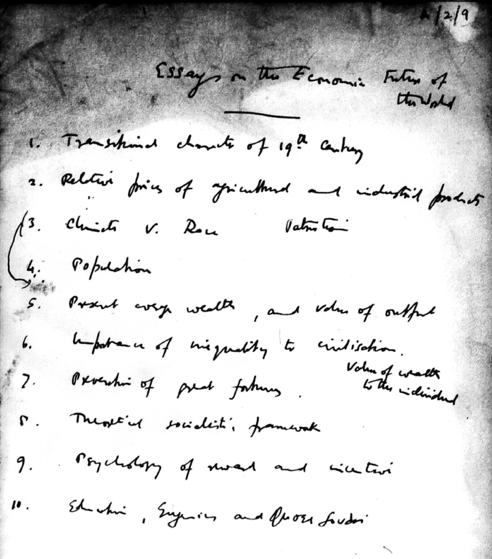
In the early 1920s, Keynes wrote an outline for a book called Essays on the Economic Future of the World. The fourth essay was on “Population” and the tenth essay was on “Education, Eugenics.” Interestingly, the eighth essay was on Keynes’s “Theoretical socialist framework.”

fuller3.PNG
Image published with permission from ProQuest. Further reproduction is prohibited without permission.

On January 4, 1923, Keynes wrote an article in the press called “The Underlying Principles.” He advocates restricting the number of births with government violence. But this may be insufficient. He imagines “positive policy” to reduce the population.

In the light of present knowledge I am unable to see any possible method of materially improving the average human lot which does not include a plan for restricting the increase in numbers [of population]. … It may prove sufficient to render the restriction of offspring safe and easy. … Perhaps a more positive policy may be required. … [I] would like to substitute [government] schemes conceived by the mind in place of the undesigned outcome of instinct and individual advantage playing within the pattern of existing institutions.11

On June 8, 1924, Keynes wrote an outline for a book called Prolegomena to a New Socialism. As shown below, he lists “Eugenics, Population” as “Chief Preoccupations of the State.” Clearly, government control over the quantity and quality of the population was key to his new socialism, or “rightly conceived socialism of the future.”12

fuller4.PNG
Image published with permission from ProQuest. Further reproduction is prohibited without permission.

In July 1924, Keynes was a founding vice president of the Society for Cultural Relations with the USSR (SCR for short). This socialist society was financed and controlled by VOKS, the Soviet government’s international propaganda agency. In September 1925, he traveled with the SCR to the Soviet Union and he lectured to the Soviet Politburo. He said, “There is no more important object of deliberate state policy than to secure a balanced budget of population.”13 He exclaimed,

I believe that there are many other matters, left hitherto to individuals or to chance, which must become in future the subject of deliberate state policy and centralised state control. Let me mention two — (1) the size and quality of the population and (2) the magnitude and direction of employment of the new national savings year by year [that is, socialization of investment].14

Leon Trotsky attended Keynes’s speech, and he observed: “Even the most progressive economist Keynes told us only the other day that the salvation of the British economy lies in Malthusianism! And for England, too, the road of overcoming the contradiction between city and country leads through Socialism.”15

Keynes was the chairman of the Malthusian League. He declared in his 1927 address to the league: “We of this society are neo-Malthusians,” and “I believe that for the future the problem of population will emerge in the much greater problem of Hereditary and Eugenics. Quality must become the preoccupation.”

fuller5.PNG
Image published with permission from ProQuest. Further reproduction is prohibited without permission.

Keynes was vice president of the British Eugenics Society from 1937 to 1944. Just 66 days before his death in 1946, he endorsed “the most important, significant and, I would add, genuine branch of sociology which exists, namely eugenics.”16

Keynes’s views on population are central to his politico-economic vision. No doubt, he viewed population as one of the most important problems facing humankind: “The question of population is the first and perhaps the most urgent and important of the problems facing those who seek to improve the material condition of mankind.”17 Keynes’s ideas on population must serve as a warning about Keynesian theory and policy. His Malthusianism indicates that he had a defective understanding of the division of labor and the law of returns. Beyond that, his population policies reveal the totalitarianism inherent in the Keynesian vision.

Appendix: “Population” by John Maynard Kenyes (1914)

Robert Malthus, the first of the Cambridge economists, came up to Jesus [College at Cambridge University] in 1784. He is said to have been fond of cricket and skating, obtained prizes for Latin and English Declamations, graduated as ninth wrangler in 1788 and was admitted Fellow of Jesus in 1793. He resided irregularly up to his marriage in 1804, and had the pleasure of signing an order to cut Coleridge off the kitchens for non-payment of his college bill, an indignity not unavenged afterwards by various members of the Lake School. The grandfather or great-grandfather, in his intellectual associations, of some of our own, Malthus was an original member of that Political Economy Club whose dinners still enliven the first Wednesday of every month, and of the Royal Statistical Society whose teas depress the first Tuesday.

In later life Malthus engaged in the controversy with Ricardo, out of which was hatched the Ricardian law of Rent; and the loss of his fellowship through marriage was the occasion of his becoming the first occupant of the first chair of Political Economy established in this country, the Professorship of History and Political Economy in the East-India College at Haileybury.

What we know of Malthus’s father Daniel must be added to these few details relating to Jesus and Haileybury, to complete a picture of ease, reflection, and gentleness. Daniel Malthus had been a friend and correspondent of Rousseau, and, it is alleged, one of his executors. He spent his life at the Rookery, ‘a small but beautiful estate’ between Guildford and Dorking, and is described as ‘a gentleman of good family and independent fortune attached to a country life, but much occupied in classical and philosophic pursuits, and with a strong bias towards foreign literature.’ Diffidence or idleness had prevented his bringing his powers to fruition; he was conscious of this; and anxious that his son should not suffer a like fate. He spent, therefore, peculiar pains on his son’s education, choosing for one of his instructors Gilbert Wakefield, and kept him under his own immediate supervision, until the time came for him to go to Wakefield’s college Jesus; — a course of action commented on thus by Malthus’s biographer Otter — ‘From some peculiar opinions which his father seems to have entertained respecting education, he was never sent to any public school; and in this respect, is one, amongst many other remarkable instances in the present time, of men who have risen into eminence under the disadvantage of an irregular and desultory education.’

A few letters, which have been preserved, written by Daniel Malthus to his son, when the latter was an undergraduate at Jesus, present the father’s character in a strong and amiable light. I will quote from a letter written by his father to Robert Malthus on his election to a fellowship: —

I heartily congratulate you upon your success; it gives me a sort of pleasure which arises from my own regrets. The things which I have missed in life, I should the more sensibly wish for you. Alas! my dear Bob, I have no right to talk to you of idleness, but when I wrote that letter to you with which you were displeased, I was deeply impressed with my own broken purposes and imperfect pursuits; I thought I foresaw in you, from the memory of my own youth, the same tendency to lose the steps you had gained, with the same disposition to self-reproach, and I wished to make my unfortunate experience of some use to you. It was, indeed, but little that you wanted it, which made me the more eager to give it you, and I wrote to you with more tenderness of heart than I would in general pretend to, and committed myself in a certain manner which made your answer a rough disappointment to me, and it drove me back into myself. You have, as you say, worn out that impression, and you have a good right to have done it; for I have seen in you the most unexceptionable character, the sweetest manners, the most sensible and the kindest conduct, always above throwing little stones into my garden, which you know I don’t easily forgive, and uniformly making everybody easy and amused about you. Nothing can have been wanting to what, if I were the most fretful and fastidious, I could have required in a companion; and nothing even to my wishes for your happiness, but where they were either whimsical, or unreasonable, or most likely mistaken. I have often been on the point of taking hold of your hand and bursting into tears at the time that I was refusing you my affections: my approbation I was precipitate to give you.

Write to me, if I could do anything about your church, and you want any thing to be done for you, such as I am, believe me, dear Bob, yours most affectionately,

Daniel Malthus

Malthus’s first essay in authorship, The Crisis, a View of the Recent Interesting State of Great Britain by a Friend to the Constitution, written in 1796, in his thirtieth year, in criticism of Pitt’s administration, failed to find a publisher. Extracts quoted by Otter and by Empson indicate that his interest was already aroused in the social problems of political economy, and even in the question of population itself:

On the subject of population [he wrote] I cannot agree with Archdeacon Paley; who says, that the quantity of happiness in any country is best measured by the number of people. Increasing population is the most certain possible sign of the happiness and prosperity of a state; but the actual population may be only a sign of the happiness that is past.

In 1798, when Malthus was thirty-two years old, there was published anonymously An Essay on the Principle of Population, as it affects the future improvement of Society: with remarks on the speculations of Mr Godwin, M. Condorcet, and other writers.

It was in conversation with Daniel Malthus that there occurred to Robert Malthus the generalization which has made him famous. The story is well known on the authority of Bishop Otter who had it from Malthus himself. In 1793 Godwin’s Political Justice had appeared. In frequent discussion the father defended, and the son attacked, the doctrine of a future age of perfect equality and happiness.

And when the question had been often the subject of animated discussion between them, and the son had rested his cause, principally upon the obstacles which the tendency of population, to increase faster than the means of subsistence, would always throw in the way; he was desired to put down in writing, for maturer consideration, the substance of his argument, the consequence of which was the Essay on Population. Whether the father was converted or not we do not know, but certain it is that he was strongly impressed with the importance of the views and the ingenuity of the argument contained in the MS., and recommended his son to submit his labours to the public.

The first edition, an octavo volume of about 50,000 words, is an almost completely different, and for posterity a superior book, to the second edition of five years later in quarto, which by the fifth edition had swollen to some 250,000 words in three volumes. 250,000 by an elaboration of proof and historical research, without any substantial improvement in the author’s clear and striking statement of the fundamental principles involved. Just as the fruitfulness and originality of Cambridge is largely preserved by the deficiencies of the University library, so the first edition of this book is not really the worse from having been written, as Malthus explains in the preface to the second edition, ‘on the impulse of the occasion, and from the few materials which were then within my reach in a country situation.’

Malthus’s Essay is a very great book. The author was deeply conscious of the bigness of the ideas he was elaborating. It is no case of a man of second-rate powers hitting, more by good fortune than desert, on an unexpectedly important generalisation. Indeed his leading idea had been largely anticipated in a clumsier way by other eighteenth century writers without attracting attention.

The high-spirited rhetoric of a young man writing in the last years of the Directory disappears from the late editions, which are quieter, more businesslike, more strictly attentive to the duties of a scientific pioneer in the study of sociological history.

This is how he begins —

the rest here

Be seeing you

Policy Science Kills - Foundation for Economic Education


Posted in Uncategorized | Tagged: , , , | Leave a Comment »