MCViewPoint

Opinion from a Libertarian ViewPoint

Posts Tagged ‘leftists’

Leftists Still Want to Abolish the Family

Posted by M. C. on August 12, 2025

The reduction of individuals to impotent, isolated units—who interact primarily with state agents—is the ultimate outcome of the Left’s efforts, regardless of what its stated goals may be. Instead of independent family groups, bonded by biology and ancient, natural modes of human affection and loyalty, we are instead to have, as the “norm,” state-regulated sex workers and state-apportioned children, conceived by IVF and grown in surrogate wombs. This, the left tells us, will free us from the “slavery” of marriage and family,

“The only real difference between marriage and prostitution is the price and the duration of the contract.” 

08/07/2025 • Mises WireRyan McMaken

Early last month, the Democratic Socialists of America (DSA)sponsored a panel on the family at the organization’s Socialism Conference 2025. The organization described the topic this way: “How should the left relate to the family? Socialist analysis makes clear that the nuclear family form is an inherently repressive, racist, and hetero-sexist institution that functionally reinforces and reproduces capitalism.”

The roundtable featured Olivia Katbi, the co chair of Portland DSA;  Eman Abdelhadi, an assistant professor and sociologist at the University of Chicago; and Katie Gibson, a Teaching Fellow at the University of Chicago. 

Key observations from the panelists included: 

  • “When we talk about family abolition, we’re talking about the abolition of the economic unit… all of our material needs taken care of by the collective.”
  • “We argue for abolition of the family in general… the institution of the family acts as part of the carceral system.”

Naturally, these leftists partly want to abolish the family because they agree with Marx that the family is a “bourgeois” institution that must be destroyed in order to clear the way for the socialist utopia. Another element of opposition to the family comes from the Left’s bizarre preoccupation with commodifying sex. It is ironic that these “anti-capitalists” seek so vehemently to turn sex into an economic commodity, but this appears to be a key tenet of leftist thinking in recent decades. Thus, they seek to normalize sex work. This is partly because the Left views marriage as a type of sex work itself. After all, the family is “inherently repressive,” and all sex within marriage is essentially rape. It is therefore “progress” to abolish marital sex and replace it with “sex work.” 

A couple of quotations from the roundtable that capture this attitude include: 

  • “Sex work and marriage can’t exist without each other—they’re two sides of the same coin.”
  • “The only real difference between marriage and prostitution is the price and the duration of the contract.” 

These leftists also believe that the rearing of children ought to be managed and controlled by the state. That is, the raising of children should be collectivized and the parent-child bond replaced with the child-collective relationship. 

This idea is certainly familiar to Sophie Lewis, another presenter at the conference, who has written a book pushing for the widespread use of surrogacy in the birthing of children. Specifically, Lewis contends that surrogacy is a helpful tool in breaking the biological bond between parents and children, and destroying traditional notions of gender and family. 

(Lewis is partly correct. Surrogacy does indeed undermine the family as an institution and widespread surrogacy will prove to be a key building block for the post-humanist dystopian nightmare that people like Elon Musk are trying to build.)  

At the core of all of this is opposition to the family as an independent institution, and the leftist contention that the family must be placed totally under the control of the state. 

Whatever the Left might have to say about the economic mechanisms supposedly underlying the family, the fact is the Left’s hatred for the family mostly stems from the fact that the family is an obstacle to state power. 

As I noted in this lecture last year, the family is an institution that predates all states and which is natural to the human condition and to all human societies. 

Leftists such as those at the DSA conference seek to abolish any remaining vestiges of non-state independent governance. Although they deny it, “democratic socialists” are at the forefront of pushing for untrammeled state power, to be administered by an “enlightened” ruling oligarchy. The democratic socialists, therefore, seek to refocus all human loyalties toward the state, creating a direct state-citizen relationship for all, and setting up the state as the institution that meets all human needs. Unlike every particular family, which is relatively weak in its exercise of power, and is always temporary, the state’s power, in the Left’s vision, is to be overwhelming and permanent.  

This idea of the family as an obstacle was central to advocates of state-building throughout the nineteenth and twentieth centuries. The Marxists, being extreme advocates for state power, also saw the “problem” of the family.

See the rest here

Be seeing you

Posted in Uncategorized | Tagged: , , , | Leave a Comment »

Dailywire Article

Posted by M. C. on November 23, 2022

Elon Musk And Dinesh D’Souza Explain Why Leftists Aren’t Being Let Back On Twitter

By  Virginia Kruta

Elon Musk And Dinesh D’Souza Explain Why Leftists Aren’t Being Let Back On Twitter

https://www.dailywire.com/news/elon-musk-and-dinesh-dsouza-explain-why-leftists-arent-being-let-back-on-twitter

…“We don’t hear much about Democrats and leftists being let back on Twitter. Why? Because they were never kicked off in the first place. Their lies and misinformation simply escaped all scrutiny. Censorship has been deployed as a one-way operation against conservatives,” D’Souza tweeted, tagging Musk in his post…

See the rest here

Be seeing you

Posted in Uncategorized | Tagged: , , , | Leave a Comment »

Why We Need Secession – LewRockwell LewRockwell.com

Posted by M. C. on February 14, 2022

The Federalists thought they knew better, and they gave us such nonsense as Madison’s claim that an extended government was a “cure” for faction, not one of its main causes. The tragic result of their efforts was the terrible War Between the States. Let’s not make that mistake again. Let’s try peaceful secession while there is still time.

https://www.lewrockwell.com/2022/02/lew-rockwell/why-we-need-secession/

By Llewellyn H. Rockwell, Jr.

The leftists who control Washington, D.C., with brain-dead Biden as their figurehead, want to impose a totalitarian dictatorship on America. The tyranny of Covid vaccines, mask mandates, and lockdowns, and preparations for war in the Ukraine are the latest signs of this, but the leftist plans have long been in the making.

Ordinary Americans don’t want this, and their resistance has generated to so-called split between Red and Blue States. Actually, the leftists control a few big cities through corrupt machine politics and pandering to minority and immigrants mobs, and the rest of the country resists them. The leftists are determined to crush this resistance. As Bill Sardi explains: “Democrats ‘own’ the cities (New York, Chicago, Los Angeles, Seattle, Portland, Philadelphia, Boston, etc.); Republicans ‘own’ the space (rural land).  That is maybe why fires razed through rural areas in California as the Red zones were burnt to the ground.  This may have been a covert attempt to force Republicans to move into cities.”

The federal government’s agenda to impose its draconian measures on the Red States goes far beyond this. Mike Adams supplies the details: “With illegitimate occupier-in-chief Joe Biden waging outright war and economic terrorism against red states (see examples below), the leaders of those red states must now nullify federal government overreach in order to prevent their own citizens from being mass murdered by D.C. swamp policies that are intentionally designed to achieve depopulation.

Some of the ways the Biden regime is waging war on red states include:

  • Economic terrorism: Unleashing OSHA to destroy all businesses that won’t enforce vaccine mandates by levying fines of $70,000 per day or even higher.
  • Engineered medicine shortages: Biden recently announced restrictions on shipping monoclonal antibodies to red states in order to maximize covid fatalities in those states.
  • Vaccine mandates: Through vaccine mandates, Biden is committing medical genocide against every American, working to achieve a mass die-off that will leave states in a worsening economic crisis (and humanitarian crisis) as the deaths unfold.
  • Border invasion: The Biden regime and its corrupt DOJ are actively fighting against sensible border security, openly allowing a land invasion of states like Texas and Arizona in order to flood the nation with replacement Democrat voters.
  • Money printing madness: Every dollar printed by the Fed and distributed by the Treasury is actually an instrument of debt that steals purchasing power from the hard-working Americans who produce things. Those producers tend to live in red states, while blue states are the welfare states where more people get handouts that were essentially stolen from the producers in the red states.
  • Election rigging: Biden and other Democrats like Newsom are now institutionalizing never-ending election rigging in order to make sure the will of the people is never honored in any election. Although their own disastrous policies are wildly unpopular they can continue to maintain power by cheating in elections, just like they cheated in 2020.
  • Outlawing of medicine that works: Notice how the D.C. swamp has attacked ivermectin and made sure no hospital prescribes it to patients? This is also part of the medical genocide agenda, and it’s a war on humanity.
  • Punitive taxation: Under the Biden regime (which is actually run by Obama), the IRS will be handed a mandate to raise taxes on productive American workers, punishing them for having jobs, all while handing out more welfare and entitlements to the illegals who are allowed to invade America by the hundreds of thousands each month.”

Even if we succeed in rolling back the current totalitarians, this won’t be enough. There is a structural problem in the American government that won’t go away, even if the current mob in Washington is replaced with “good guys.” The government is too big. The American population is around 330,000,000. States like California and Texas are bigger than many countries. How can a nation that vast be governed by a few people? The situation is even worse if we think about the division between the Reds and the Blues that I mentioned before. As Stephen Marche puts it, “Each side accuses the other of hating America, which is only another way of saying both hate what the other means by America…. On both sides, the sense of being under occupation dominates…. Every political faction operates under a siege mentality…. Everyone wants to build a wall of one kind or another. The geographical divide between the competing American Utopias means that, in every election, whoever loses comes to feel like they’ve been dominated by a foreign power.”

Clearly, we have a disunion, not a union, today, and we would do better to recognize this and act accordingly. The problem is nothing new. When the Constitution was up for ratification, the Anti-Federalists pointed to the danger. In the fifth volume of Conceived in Liberty, Murray Rothbard quotes one of the most eloquent of them, Patrick Henry: “Shall we imitate the example of those nations who have gone from a simple to a splendid government? Are those nations more worthy of our imitation? What can make an adequate satisfaction to them for the loss they have suffered in attaining such a government—for the loss of their liberty? If we admit this consolidated government, it will be because we like a great, splendid one. Some way or other we must be a great and mighty empire; we must have an army, and a navy … When the American spirit was in its youth, the language of America was different: liberty, sir, was then the primary object. … But now, sir, the American spirit, assisted by the ropes and chains of consolidation, is about to convert this country into a powerful and mighty empire. … Such a government is incompatible with the genius of republicanism. There will be no checks, no real balances, in this government. What can avail your specious, imaginary balances, your rope-dancing, chain-rattling, ridiculous ideal checks and contrivances? But, sir, we are not feared by foreigners; we do not make nations tremble. Would this constitute happiness or secure liberty.”

The Federalists thought they knew better, and they gave us such nonsense as Madison’s claim that an extended government was a “cure” for faction, not one of its main causes. The tragic result of their efforts was the terrible War Between the States. Let’s not make that mistake again. Let’s try peaceful secession while there is still time.

Llewellyn H. Rockwell, Jr. [send him mail], former editorial assistant to Ludwig von Mises and congressional chief of staff to Ron Paul, is founder and chairman of the Mises Institute, executor for the estate of Murray N. Rothbard, and editor of LewRockwell.com. He is the author of Against the State and Against the Left. Follow him on Facebook and Twitter.

Be seeing you

Posted in Uncategorized | Tagged: , , , , , , | Leave a Comment »

Leftists Have It Wrong on Rights

Posted by M. C. on February 7, 2022

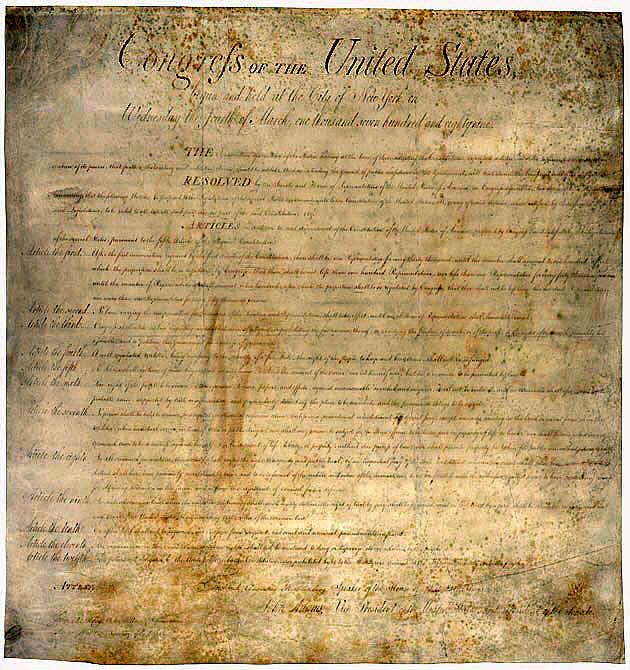
Not even the crafters of the Bill of Rights believed that. A careful reading of the First Amendment reveals that it doesn’t purport to give any rights to anyone. Instead, the wording states that Congress (and implicitly the rest of the federal government) is prohibited from infringing on people’s right of free speech. 

Thus when the government enacts a law or adopts a measure that infringes on freedom of speech, leftists are relegated to saying, “We understand that you have given us this important privilege but please be nice and don’t infringe on it.” Libertarians, on the other hand, say, “You have no legitimate authority to do that and so stop it immediately or else we will alter you or abolish you!”

by Jacob G. Hornberger

One of the central defects among leftists (that is, “liberals,” progressives, socialists, or interventionists) is their wrong-headed view of the nature of people’s rights. Their belief on this issue is one of the distinguishing characteristics between leftists and libertarians.

Leftists believe that people’s rights come from the government or from the Constitution. As such, they view rights not so much as rights but rather more as government-granted privileges.

Libertarians, on the other hand, believe that people’s rights are endowed in them by nature and God and, therefore, that people’s rights preexist government and the Constitution. We hold that the main purpose of government is to serve as our servant whose job is to protect the exercise of our natural, God-given rights. 

A good example of this leftist mindset was recently expressed in a fundraising letter I received from a leftist group called the Daily Kos. The letter stated that freedom of speech is “one of those rights granted to us in Bill of Rights.” It went on to refer to “our First Amendment rights.”

Not even the crafters of the Bill of Rights believed that. A careful reading of the First Amendment reveals that it doesn’t purport to give any rights to anyone. Instead, the wording states that Congress (and implicitly the rest of the federal government) is prohibited from infringing on people’s right of free speech. 

In other words, unlike American leftists today, our American ancestors didn’t believe that people’s rights come from the Constitution, the Bill of Rights, or from the government. They believed in what the Declaration of Independence stated — that man’s rights come from nature and God and that it is the responsibility of government to protect, not destroy, the exercise of such rights.

We are not just talking about a semantical difference here. The difference between how leftists and libertarians view the nature of rights has profound consequences. 

Given that leftists believe that their rights come from the government, they necessarily put themselves in a position of pleading, or perhaps even begging, that government go easy on them — that is, that government officials give them more latitude in exercising their “rights.” 

Thus, leftists view freedom as living on a leash — they just want the government to let them have a longer leash. What happens when the government begins reining in the leash? Leftists have no principled argument to make against what the government is doing. Since people’s rights come from government, leftists believe, then government can legitimately rein in the leash whenever it wants. 

Not so with libertarians. Unlike leftists, we are not relegated to pleading with or begging the government to treat us nicely. That’s because for us our rights don’t come from government. They preexist government. Government officials are nothing more than our servants whose job is to protect our rights. If they fail or refuse to do so — or if they use their power to destroy or infringe our rights — we have the right to alter or even abolish government and restore its rightful responsibility — the responsibility to behave as our servants whose job is to protect the exercise of our preexisting natural, God-given rights.

Thus when the government enacts a law or adopts a measure that infringes on freedom of speech, leftists are relegated to saying, “We understand that you have given us this important privilege but please be nice and don’t infringe on it.” Libertarians, on the other hand, say, “You have no legitimate authority to do that and so stop it immediately or else we will alter you or abolish you!”

The leftist view of the nature of rights is one reason why you can never count on leftists to protect our rights and liberties. Anyone who wants a genuine defense of our rights and liberties needs to join up with us libertarians. 

EMAIL

Be seeing you

Posted in Uncategorized | Tagged: , , , , , , , | Leave a Comment »

For Leftists, Your Freedom Is Their Misery – Your Slavery Is Their Joy | ZeroHedge

Posted by M. C. on January 17, 2022

WordPress is not Zerohedge friendly yet again. Hit the link.

https://www.zerohedge.com/political/leftists-your-freedom-their-misery-your-slavery-their-joy

Authored by Brandon Smith via Alt-Market.us,

by Tyler DurdenSaturday, Jan 15, 2022 – 11:30 PM

See the rest here

Be seeing you

Posted in Uncategorized | Tagged: , , , , | Leave a Comment »

The Left’s Conquest of the Church – LewRockwell

Posted by M. C. on April 5, 2021

We must look at the common denominator in all of left-wing Christianity’s policies. And it comes down to this- all of them require more government control. This is true whether it involves the environment, gay “rights”, racial diversity, or welfare. Thus, the Left is using Christianity as a tool for tyranny, a tool to gain more control

https://www.lewrockwell.com/2021/04/derek-dobalian/the-lefts-conquest-of-the-church/

By Derek Dobalian

For the first time in history, the Christian Church has been hijacked by Leftists. Of course, the Left has had influence on the Church before, but they are getting closer and closer to a total takeover. Why is this happening? Well, for a few reasons, chiefly among them that our current Church leaders are intellectually weak. However, the main reason is that the Left has control over every major institution in America and saw that the last one yet to be conquered, and not coincidentally the strongest one, was the Church. They decided they must have that too. And the Church’s leaders were all too ready to oblige.

Why is this so dangerous? Well it’s dangerous for the Christian faith for the obvious reason that it represents a total corruption of the Bible and the morality it teaches. But it’s dangerous for American society and liberty because it adds “Thus saith the Lord” to all of the Left’s commands. And as CS Lewis stated in God on the Dock, when the State “adds to its commands ‘Thus saith the Lord,’ it lies, and lies dangerously.” The intent is to give the people the impression that by complying with their rules, they are obeying God.

One question that comes to mind when witnessing this takeover is how was the Left able to convince so many Christians? The reason for this success is because, just like Lewis said in The Problem of Pain, we are living at a time when society has confused God’s goodness with simple kindness. Thus, we all now believe that if it seems kind, it is good. So, they tell us it is kind for a baker to make a cake for a gay marriage, and thus bakers ought to be required to do so. They tell us it is kind to subsidize those among us who are less fortunate, and thus that money ought to be taken from others. They tell us it is kind to protect the environment, and thus we must ban certain convenient and affordable things. Unfortunately, many laypersons have fallen for these traps. Many of the Church leaders have done so as well, while the remaining are either too cowardly to fight it or not equipped well enough intellectually to do so.

We must look at the common denominator in all of left-wing Christianity’s policies. And it comes down to this- all of them require more government control. This is true whether it involves the environment, gay “rights”, racial diversity, or welfare. Thus, the Left is using Christianity as a tool for tyranny, a tool to gain more control. The Left has bullied Christian leaders into Marxist thinking- if someone is successful, someone is being oppressed. In order to help the “oppressed,” we are told we must punish others who have never known such oppression. Hence, the recent embrace of Critical Race Theory by many leaders on the Church. This theory tells us that certain groups owe something to other less fortunate groups, but it doesn’t stop there. Advocates of CRT say in order for that obligation to be fulfilled, the State must use force and target the “privileged.”

What is the solution? Teach what Scripture actually says and equip people intellectually with arguments against the Left’s distortions of God’s Word. Leaders in the Church cannot cower in fear, they must recognize what is going on and learn to use God’s Word effectively and accurately. Christians must forcefully reject left-wing policies that demand we sacrifice more of our liberty and grant the government more control. The Left’s influence in the Church will continue to grow if we do not. And if the Left completes its takeover of the Church, it will have finalized its conquest of the civil society and of Western Civilization.

The Best of Derek Dobalian Derek W. Dobalian [send him mail] is a licensed attorney in Los Angeles, CA. His writing focuses on Christianity and political philosophy.

Be seeing you

Posted in Uncategorized | Tagged: , , | Leave a Comment »

What “Capitalism” Really Means | Mises Institute

Posted by M. C. on December 16, 2020

This is the fundamental principle of capitalism as it exists today in all of those countries in which there is a highly developed system of mass production: Big business, the target of the most fanatic attacks by the so-called leftists, produces almost exclusively to satisfy the wants of the masses. Enterprises producing luxury goods solely for the well-to-do can never attain the magnitude of big businesses. And today, it is the people who work in large factories who are the main consumers of the products made in those factories. This is the fundamental difference between the capitalistic principles of production and the feudalistic principles of the preceding ages.

https://mises.org/library/what-capitalism-really-means

Ludwig von Mises

Descriptive terms which people use are often quite misleading. In talking about modern captains of industry and leaders of big business, for instance, they call a man a “chocolate king” or a “cotton king” or an “automobile king.” Their use of such terminology implies that they see practically no difference between the modern heads of industry and those feudal kings, dukes or lords of earlier days. But the difference is in fact very great, for a chocolate king does not rule at all; he serves. He does not reign over conquered territory, independent of the market, independent of his customers. The chocolate king—or the steel king or the automobile king or any other king of modern industry—depends on the industry he operates and on the customers he serves. This “king” must stay in the good graces of his subjects, the consumers; he loses his “kingdom” as soon as he is no longer in a position to give his customers better service and provide it at lower cost than others with whom he must compete.

Two hundred years ago, before the advent of capitalism, a man’s social status was fixed from the beginning to the end of his life; he inherited it from his ancestors, and it never changed. If he was born poor, he always remained poor, and if he was born rich—a lord or a duke—he kept his dukedom and the property that went with it for the rest of his life.

As for manufacturing, the primitive processing industries of those days existed almost exclusively for the benefit of the wealthy. Most of the people (90 percent or more of the European population) worked the land and did not come in contact with the city-oriented processing industries. This rigid system of feudal society prevailed in the most developed areas of Europe for many hundreds of years.

However, as the rural population expanded, there developed a surplus of people on the land. For this surplus of population without inherited land or estates, there was not enough to do, nor was it possible for them to work in the processing industries; the kings of the cities denied them access. The numbers of these “outcasts” continued to grow, and still no one knew what to do with them. They were, in the full sense of the word, “proletarians,” outcasts whom the government could only put into the workhouse or the poorhouse. In some sections of Europe, especially in the Netherlands and in England, they became so numerous that, by the 18th century, they were a real menace to the preservation of the prevailing social system.

Today, in discussing similar conditions in places like India or other developing countries, we must not forget that, in 18th-century England, conditions were much worse. At that time, England had a population of 6 or 7 million people, but of those 6 or 7 million people, more than 1 million, probably 2 million, were simply poor outcasts for whom the existing social system made no provision. What to do with these outcasts was one of the great problems of 18th-century England.

Another great problem was the lack of raw materials. The British, very seriously, had to ask themselves this question: What are we going to do in the future, when our forests will no longer give us the wood we need for our industries and for heating our houses? For the ruling classes it was a desperate situation. The statesmen did not know what to do, and the ruling gentry were absolutely without any ideas on how to improve conditions.

Out of this serious social situation emerged the beginnings of modern capitalism. There were some persons among those outcasts, among those poor people, who tried to organize others to set up small shops which could produce something. This was an innovation. These innovators did not produce expensive goods suitable only for the upper classes; they produced cheaper products for everyone’s needs. And this was the origin of capitalism as it operates today. It was the beginning of mass production, the fundamental principle of capitalistic industry. Whereas the old processing industries serving the rich people in the cities had existed almost exclusively for the demands of the upper classes, the new capitalist industries began to produce things that could be purchased by the general population. It was mass production to satisfy the needs of the masses.

This is the fundamental principle of capitalism as it exists today in all of those countries in which there is a highly developed system of mass production: Big business, the target of the most fanatic attacks by the so-called leftists, produces almost exclusively to satisfy the wants of the masses. Enterprises producing luxury goods solely for the well-to-do can never attain the magnitude of big businesses. And today, it is the people who work in large factories who are the main consumers of the products made in those factories. This is the fundamental difference between the capitalistic principles of production and the feudalistic principles of the preceding ages.

When people assume, or claim, that there is a difference between the producers and the consumers of the products of big businesses, they are badly mistaken. In American department stores you hear the slogan, “the customer is always right.” And this customer is the same man who produces in the factory those things which are sold in the department stores. The people who think that the power of big business is enormous are mistaken also, since big business depends entirely on the patronage of those who buy its products: the biggest enterprise loses its power and its influence when it loses its customers.

Fifty or 60 years ago it was said in almost all capitalist countries that the railroad companies were too big and too powerful; they had a monopoly; it was impossible to compete with them. It was alleged that, in the field of transportation, capitalism had already reached a stage at which it had destroyed itself, for it had eliminated competition. What people overlooked was the fact that the power of the railroads depended on their ability to serve people better than any other method of transportation. Of course it would have been ridiculous to compete with one of these big railroad companies by building another railroad parallel to the old line, since the old line was sufficient to serve existing needs. But very soon there came other competitors. Freedom of competition does not mean that you can succeed simply by imitating or copying precisely what someone else has done. Freedom of the press does not mean that you have the right to copy what another man has written and thus to acquire the success which this other man has duly merited on account of his achievements. It means that you have the right to write something different. Freedom of competition concerning railroads, for example, means that you are free to invent something, to do something, which will challenge the railroads and place them in a very precarious competitive situation.

In the United States the competition to the railroads—in the form of buses, automobiles, trucks, and airplanes—has caused the railroads to suffer and to be almost completely defeated, as far as passenger transportation is concerned.

The development of capitalism consists in everyone’s having the right to serve the customer better and/or more cheaply. And this method, this principle, has, within a comparatively short time, transformed the whole world. It has made possible an unprecedented increase in world population.

In 18th-century England, the land could support only 6 million people at a very low standard of living. Today more than 50 million people enjoy a much higher standard of living than even the rich enjoyed during the 18th-century. And today’s standard of living in England would probably be still higher, had not a great deal of the energy of the British been wasted in what were, from various points of view, avoidable political and military “adventures.”

These are the facts about capitalism. Thus, if an Englishman—or, for that matter, any other man in any country of the world—says today to his friends that he is opposed to capitalism, there is a wonderful way to answer him: “You know that the population of this planet is now ten times greater than it was in the ages preceding capitalism; you know that all men today enjoy a higher standard of living than your ancestors did before the age of capitalism. But how do you know that you are the one out of ten who would have lived in the absence of capitalism? The mere fact that you are living today is proof that capitalism has succeeded, whether or not you consider your own life very valuable.”

In spite of all its benefits, capitalism has been furiously attacked and criticized. It is necessary that we understand the origin of this antipathy. It is a fact that the hatred of capitalism originated not with the masses, not among the workers themselves, but among the landed aristocracy—the gentry, the nobility, of England and the European continent. They blamed capitalism for something that was not very pleasant for them: at the beginning of the 19th century, the higher wages paid by industry to its workers forced the landed gentry to pay equally higher wages to their agricultural workers. The aristocracy attacked the industries by criticizing the standard of living of the masses of the workers.

Of course, from our viewpoint, the workers’ standard of living was extremely low; conditions under early capitalism were absolutely shocking, but not because the newly developed capitalistic industries had harmed the workers. The people hired to work in factories had already been existing at a virtually subhuman level.

The famous old story, repeated hundreds of times, that the factories employed women and children and that these women and children, before they were working in factories, had lived under satisfactory conditions, is one of the greatest falsehoods of history. The mothers who worked in the factories had nothing to cook with; they did not leave their homes and their kitchens to go into the factories, they went into factories because they had no kitchens, and if they had a kitchen they had no food to cook in those kitchens. And the children did not come from comfortable nurseries. They were starving and dying. And all the talk about the so-called unspeakable horror of early capitalism can be refuted by a single statistic: precisely in these years in which British capitalism developed, precisely in the age called the Industrial Revolution in England, in the years from 1760 to 1830, precisely in those years the population of England doubled, which means that hundreds or thousands of children—who would have died in preceding times—survived and grew to become men and women.

There is no doubt that the conditions of the preceding times were very unsatisfactory. It was capitalist business that improved them. It was precisely those early factories that provided for the needs of their workers, either directly or indirectly by exporting products and importing food and raw materials from other countries. Again and again, the early historians of capitalism have—one can hardly use a milder word—falsified history.

One anecdote they used to tell, quite possibly invented, involved Benjamin Franklin. According to the story, Ben Franklin visited a cotton mill in England, and the owner of the mill told him, full of pride: “Look, here are cotton goods for Hungary.” Benjamin Franklin, looking around, seeing that the workers were shabbily dressed, said: “Why don’t you produce also for your own workers?”

But those exports of which the owner of the mill spoke really meant that he did produce for his own workers, because England had to import all its raw materials. There was no cotton either in England or in continental Europe. There was a shortage of food in England, and food had to be imported from Poland, from Russia, from Hungary. These exports were the payment for the imports of the food which made the survival of the British population possible. Many examples from the history of those ages will show the attitude of the gentry and aristocracy toward the workers. I want to cite only two examples. One is the famous British “Speenhamland” system. By this system, the British government paid all workers who did not get the minimum wage (determined by the government) the difference between the wages they received and this minimum wage. This saved the landed aristocracy the trouble of paying higher wages. The gentry would pay the traditionally low agricultural wage, and the government would supplement it, thus keeping workers from leaving rural occupations to seek urban factory employment.

Eighty years later, after capitalism’s expansion from England to continental Europe, the landed aristocracy again reacted against the new production system. In Germany the Prussian Junkers, having lost many workers to the higher-paying capitalistic industries, invented a special term for the problem: “flight from the countryside”—Landflucht. And in the German Parliament, they discussed what might be done against this evil, as it was seen from the point of view of the landed aristocracy.

Prince Bismarck, the famous chancellor of the German Reich, in a speech one day said, “I met a man in Berlin who once had worked on my estate, and I asked this man, ‘Why did you leave the estate; why did you go away from the country; why are you now living in Berlin?'” And according to Bismarck, this man answered, “You don’t have such a nice Biergarten in the village as we have here in Berlin, where you can sit, drink beer, and listen to music.” This is, of course, a story told from the point of view of Prince Bismarck, the employer. It was not the point of view of all his employees. They went into industry because industry paid them higher wages and raised their standard of living to an unprecedented degree.

Today, in the capitalist countries, there is relatively little difference between the basic life of the so-called higher and lower classes; both have food, clothing, and shelter. But in the 18th century and earlier, the difference between the man of the middle class and the man of the lower class was that the man of the middle class had shoes and the man of the lower class did not have shoes. In the United States today the difference between a rich man and a poor man means very often only the difference between a Cadillac and a Chevrolet. The Chevrolet may be bought secondhand, but basically it renders the same services to its owner: he, too, can drive from one point to another. More than 50 percent of the people in the United States are living in houses and apartments they own themselves.

The attacks against capitalism—especially with respect to the higher wage rates—start from the false assumption that wages are ultimately paid by people who are different from those who are employed in the factories. Now it is all right for economists and for students of economic theories to distinguish between the worker and the consumer and to make a distinction between them. But the fact is that every consumer must, in some way or the other, earn the money he spends, and the immense majority of the consumers are precisely the same people who work as employees in the enterprises that produce the things which they consume. Wage rates under capitalism are not set by a class of people different from the class of people who earn the wages; they are the same people. It is not the Hollywood film corporation that pays the wages of a movie star; it is the people who pay admission to the movies. And it is not the entrepreneur of a boxing match who pays the enormous demands of the prize fighters; it is the people who pay admission to the fight. Through the distinction between the employer and the employee, a distinction is drawn in economic theory, but it is not a distinction in real life; here, the employer and the employee ultimately are one and the same person.

There are people in many countries who consider it very unjust that a man who has to support a family with several children will receive the same salary as a man who has only himself to take care of. But the question is not whether the employer should bear greater responsibility for the size of a worker’s family.

The question we must ask in this case is, Are you, as an individual, prepared to pay more for something, let us say, a loaf of bread, if you are told that the man who produced this loaf of bread has six children? The honest man will certainly answer in the negative and say, “In principle I would, but in fact if it costs less I would rather buy the bread produced by a man without any children.” The fact is that, if the buyers do not pay the employer enough to enable him to pay his workers, it becomes impossible for the employer to remain in business.

The capitalist system was termed “capitalism” not by a friend of the system, but by an individual who considered it to be the worst of all historical systems, the greatest evil that had ever befallen mankind. That man was Karl Marx. Nevertheless, there is no reason to reject Marx’s term, because it describes clearly the source of the great social improvements brought about by capitalism. Those improvements are the result of capital accumulation; they are based on the fact that people, as a rule, do not consume everything they have produced, that they save—and invest—a part of it. There is a great deal of misunderstanding about this problem and—in the course of these lectures—I will have the opportunity to deal with the most fundamental misapprehensions which people have concerning the accumulation of capital, the use of capital, and the universal advantages to be gained from such use. I will deal with capitalism particularly in my lectures about foreign investment and about that most critical problem of present-day politics, inflation. You know, of course, that inflation exists not only in this country. It is a problem all over the world today.

An often-unrealized fact about capitalism is this: savings mean benefits for all those who are anxious to produce or to earn wages. When a man has accrued a certain amount of money—let us say, $1,000—and, instead of spending it, entrusts these dollars to a savings bank or an insurance company, the money goes into the hands of an entrepreneur, a businessman, enabling him to go out and embark on a project which could not have been embarked on yesterday, because the required capital was unavailable.

What will the businessman do now with the additional capital? The first thing he must do, the first use he will make of this additional capital, is to go out and hire workers and buy raw materials—in turn causing a further demand for workers and raw materials to develop, as well as a tendency toward higher wages and higher prices for raw materials. Long before the saver or the entrepreneur obtains any profit from all of this, the unemployed worker, the producer of raw materials, the farmer, and the wage earner are all sharing in the benefits of the additional savings.

When the entrepreneur will get something out of the project depends on the future state of the market and on his ability to anticipate correctly the future state of the market. But the workers as well as the producers of raw materials get the benefits immediately. Much was said, 30 or 40 years ago, about the “wage policy,” as they called it, of Henry Ford. One of Mr. Ford’s great accomplishments was that he paid higher wages than did other industrialists or factories. His wage policy was described as an “invention,” yet it is not enough to say that this new “invented” policy was the result of the liberality of Mr. Ford. A new branch of business, or a new factory in an already existing branch of business, has to attract workers from other employments, from other parts of the country, even from other countries. And the only way to do this is to offer the workers higher wages for their work. This is what took place in the early days of capitalism, and it is still taking place today.

When the manufacturers in Great Britain first began to produce cotton goods, they paid their workers more than they had earned before. Of course, a great percentage of these new workers had earned nothing at all before that and were prepared to take anything they were offered. But after a short time—when more and more capital was accumulated and more and more new enterprises were developed—wage rates went up, and the result was the unprecedented increase in British population which I spoke of earlier.

See then rest here

Author:

Ludwig von Mises

Ludwig von Mises was the acknowledged leader of the Austrian school of economic thought, a prodigious originator in economic theory, and a prolific author. Mises’s writings and lectures encompassed economic theory, history, epistemology, government, and political philosophy. His contributions to economic theory include important clarifications on the quantity theory of money, the theory of the trade cycle, the integration of monetary theory with economic theory in general, and a demonstration that socialism must fail because it cannot solve the problem of economic calculation. Mises was the first scholar to recognize that economics is part of a larger science in human action, a science that he called praxeology.

Be seeing you

Posted in Uncategorized | Tagged: , , | Leave a Comment »

The West Coast burns, and leftists blame climate change, but they’re wrong – American Thinker

Posted by M. C. on September 12, 2020

Others wiser than Obama have pointed out that climate change is not the problem.  Instead, the problem is environmentalism.

These unusual weather phenomena will have nothing to do with the left’s favorite explanation of Gaia in crisis due to evil people.  Instead, they will reflect normal weather patterns around the globe, including in California.  The only unusual thing will have been the California greenies’ failure to take steps that could protect their state from predictable weather events.

https://www.americanthinker.com/blog/2020/09/the_west_coast_burns_and_leftists_blame_climate_change_but_theyre_wrong.html

By Andrea Widburg

The West Coast is aglow but not in a good way.  Instead, fires are raging throughout California, Oregon, and Washington.  The property damage is appalling, and ten people have already died.  Leftists, predictably, have announced that their goddess, Mother Gaia, is again crying out from the horrors of anthropogenic climate change.

The reality is that there’s something bigger and more real going on, which is the actual climate. La Nina is afoot in the northern hemisphere, and she’s having some extra fun in the West because the environmentalists have prevented California from protecting against fires.

The data from the fires is appalling.  In California, at least 2.5 million acres have burned.  In Oregon, 900,000 acres have burned, with one of the worst fires being attributed to arson.  In a nod to the cliché that everything that happens hits women and minorities the hardest, the Washington Post reports that “[i]n a small Oregon town, a wildfire devastates a Latino community.”  In Washington State, 480,000 acres have burned.

Leftists know what’s to blame — it’s Anthropogenic Climate Change, which is the nearest thing they have to a religion.  Religions are unfalsifiable because faith ties all events to a deity.  In that vein, climate change is the answer to all weather and climate events.  Whether it’s too hot or cold, too still or windy, too wet or dry, it doesn’t matter.  The blame always falls on humans and their love affair with fossil fuel.

Therefore, it’s unsurprising that one of the high priests of leftism, Barack Obama, would weigh in on the admittedly disturbing orange sky in California.  In his usual pompous way, he announced that humankind is at fault:


Others wiser than Obama have pointed out that climate change is not the problem.  Instead, the problem is environmentalism.

Environmentalism is why California stopped grooming forests or doing controlled burns to get rid of deadwood (AKA tinder).  It was because of environmentalism that PG&E poured all of its money into building renewable energy facilities, such as the solar facilities that failed during California’s recent heat wave, and stopped repairing old power lines (some going back 90 years) or trimming back tinder around those power lines.  All this misbegotten environmentalism has controlled California even as more people have moved into fire zones over the past several decades.

Even those awful environmental policies do not tell the entire story.  There are two bigger things at play.  First, there’s California’s actual climate.  For all the hysteria about the epic heat wave this year, back in 1913, the hottest temperature ever recorded on earth was 134 degrees in California’s Death Valley.

That doesn’t even mean it was the hottest temperature ever.  It was just the hottest temperature ever recorded.  People have been recording temperatures in a consistent way only since the Victorian era.  That means that, long before the last 150 years, the earth has almost certainly been setting all sorts of records about which we know nothing.

Second, the leftists are ignoring the most significant thing of all about California’s furnace-like conditions.  This is a La Niña year, and it’s going to wreak havoc all over America:

La Nina — a phenomenon that occurs when the surface of the Pacific Ocean cools — has officially formed, the U.S. Climate Prediction Center said Thursday. It triggers an atmospheric chain reaction that stands to roil weather around the globe, often turning the western U.S. into a tinder box, fueling more powerful hurricanes in the Atlantic and flooding parts of Australia and South America.

“We’re already in a bad position, and La Nina puts us in a situation where fire-weather conditions persist into November and possibly even December,” said Ryan Truchelut, president of Weather Tiger LLC. “It is exacerbating existing heat and drought issues.”

The effects are already evident. Rising temperatures and an extreme mega-drought across the U.S. West are fueling fires from Washington to Arizona. California is having its worst fire season on record, torching an unprecedented 2.5 million acres. And in the Atlantic, a record number tropical storms have formed by September, including Hurricane Laura, which killed more than a dozen people across the Caribbean and the U.S. last month.

No matter where you are, you’d better batten down the hatches, because anything that can go wild and dangerous with the weather will.  These unusual weather phenomena will have nothing to do with the left’s favorite explanation of Gaia in crisis due to evil people.  Instead, they will reflect normal weather patterns around the globe, including in California.  The only unusual thing will have been the California greenies’ failure to take steps that could protect their state from predictable weather events.

Be seeing you

Posted in Uncategorized | Tagged: , , , , , | Leave a Comment »

The “Try-Hard” Club: Limp-Wristed Marxists Need Not Apply

Posted by M. C. on August 21, 2020

I think the Marxist ideal is leading these kids down a path of brutal delusion, because they are never going to achieve the Utopian society that they seek. The world will never be “fair”, and the idea that you can force such conditions upon a culture without serious consequences is childish and mentally unstable.

Leftists in particular have always had a problem with competition and it stems from the Marxist roots of their philosophy. There is this notion among lefties that the world is supposed to be “equal”. Now, there are different types of equality, and I think the majority of Americans agree with the idea of equal opportunity.

http://www.alt-market.com/index.php/articles/4310-the-try-hard-club-limp-wristed-marxists-need-not-apply

Brandon Smith

Memes are a dominant force in popular culture today, and there is good reason for this; they allow people to inject an argument into discussion without having to actually compose that argument. In other words, by sharing a meme, everyone already knows what you are saying without an explanation. We all do this from time to time.

When I refer to a woman screaming at a man on the sidewalk for not wearing a mask as a “Karen”, most people immediately understand why this woman is a problem. She fits an archetypal mold, she has made herself into a walking, talking stereotype. The meme describes a thing everyone has experienced and is tired of dealing with. Memes make debate easier – They take on a life of their own.

That said, problems arise when dishonest people try to hijack a meme for their own agenda. For example, how many times have you seen crazed leftists call a conservative a “snowflake” because he/she is criticizing crazy leftist behavior? The meme refers to people who let their emotions get in the way of reason and they have “meltdowns” when faced with facts that disagree with their feelings. It also refers to people who fear competition and discomfort so much that they are trying to reshape the world so that it is “more fair” and less threatening to their self esteem. It does not apply to people who are logically debunking terrible behavior and terrible arguments.

To be fair, the term “snowflake” can be abused as a way to dismiss a younger person out of hand when they are expressing discontent with problems in the world. Memes can be misused by both sides of the political spectrum.

By the same token, a “Karen” is grown adult (not always a woman) who is aggressively uppity and unreasonable and who throws temper tantrums when they don’t get their way. It’s a person who acts like a spoiled toddler, and they do this because it has worked many times in the past in our “customer is always right” retail world. No one has ever smacked them upside the head and taught them a lesson in humility.

A “Karen” is NOT someone who is simply complaining or criticizing over a legitimate problem in a logical way. Yet, I have seen this meme misused as well to attack and shut down people who are doing exactly that.

And what about the “Okay Boomer” meme? The idea being that older people are disconnected from the “changing times” and that they have nothing to contribute anymore to the discussion because the planet has left them behind. This is one of the few purely leftist memes I’ve seen in the past few years.  It’s a futurist meme which comforts children in their common false notion that they have the world all figured out and advice from “old people” is useless. It’s a way for people with zero life experience and zero success to dismiss people with decades of life experience along and an array of successes and failures to draw knowledge from.

Being told you are a “newbie” is not always fun, but it’s sometimes necessary.  The Boomer meme is a tool for young people to feel better about themselves and their lack of wisdom or education.  These days, anyone who is over 30 years of age and disagrees with leftist politics or aspects of Zennial culture is called a “boomer” by default.

Memes can be entertaining, but the fact that they are so easy to exploit also leaves them open to abuse by narcissists and sociopaths. Leftists in particular are guilty of hijacking memes and twisting them for their own ends. They see memes as part of a culture war they are desperate to win. For them, controlling the meaning of words is paramount.

The newest meme trend I’m seeing these days is called the “try-hard” meme, i.e. “Stop acting like such a try-hard…” Now, this is another case where a phrase is being co-opted to fit a false narrative. Originally, a “try hard” was someone who takes recreational things much too seriously and turns fun into war. For example, a guy who plays a game of volleyball with his family and starts pummeling spikes down into their faces like he’s in a professional match. In other words, people who beat their chests and act overtly competitive in situations that don’t call for it.

These days, I’m seeing the meme used to describe ANYONE who excels at anything. That’s right, if you push yourself to be the best, if you are competitive and win often, if you are focused on self improvement as an individual, then there’s something “wrong” with you.

Leftists in particular have always had a problem with competition and it stems from the Marxist roots of their philosophy. There is this notion among lefties that the world is supposed to be “equal”. Now, there are different types of equality, and I think the majority of Americans agree with the idea of equal opportunity. Meaning, (at least in the West) we think every person regardless of their circumstances should be given the CHANCE to PROVE they can work hard and succeed. People should not be stopped from pursuing that chance merely because of who they are.

However, leftists and Marxists think that equality of opportunity is not enough. They think that there should also be equality of outcome.

This one delusion sits at the core of all Marxist thinking. Equality of outcome is impossible because not all people are born equal. Some people are, frankly, born superior to others. Some people are born smarter. Some people are born stronger, taller and faster. Some people are born with innate musical or artistic talent. Some people are born with innate mathematical understanding. Some people are born extroverted and are good at making friends. Some people are born introverted and are better at self reflection and awareness. Some people are born to be basketball players and some are born to be engineers.

The psychological reality of mankind is that we are not born as blank slates; we are born with inherent qualities and the seeds of unique individual talents.  Marxists suffer from a complete mental disconnect with this concept.  If they were to admit that people are born with individual qualities and advantages and are not blank slates, then the foundation of their philosophy falls apart.  They rationalize their social engineering agenda under the premise that all people need to be “molded” into equal units.  They think people must be reeducated to reject bad beliefs and bad habits they were taught as blank slate children and learn to accept that everyone starts life out exactly the same.  Therefore, the majority of people who succeed are those that were given an unfair advantage, and success should be treated with disdain and suspicion.

But if people have inherent psychological characteristics and inherent advantages, then their personalities and qualities cannot be reformed.  Those “bad beliefs and habits” might actually be completely natural and necessary.  You might be able to hold them back through force or fear, but you can’t change the core of who they are.  If our biological and genetic imperatives prevail, Marxists become obsolete and useless.

The secret is to discover what your innate strengths are in life and take advantage of them to succeed. If you do not have innate talent, then you must at least have an innate ability to work hard. If you don’t have the ability and drive to work hard to become good at a thing, then you don’t deserve to get recognition for that thing.  You are not entitled to feel like a winner merely because you exist.  It’s really as simple as that.

The try-hard meme is basically the equivalent of excellence-shaming; you are supposed to feel ashamed of being better than others at a certain task or talent. I’m not sure where this hatred for competition comes from, but I suspect it has something to do with leftists and their early childhoods. Many of them are “late bloomers” who did not have many experiences winning, or they were never pushed by their parents to mature and excel. They grew to despise the idea that winning and success are so elevated in our society, while at the same time they still crave that feeling of being the best at something.

So, they adopt the Marxist creed, which tells them that yes, they are losers, but it’s not because they are lazy and they suck; no, they are losers because they are victims of a society that is holding them back from their true potential. Marxism tells them that the people who succeed were actually given special treatment because of their class or the color of their skin. The winners are actually very bad people who don’t deserve success. If only the system was forced to be more fair, then THEY would be the winners.  Thus, in order for losers to “win”, they must join a mob of other losers and gain power through collective control.  The successful people must be given an extreme handicap by the mob to “level the playing field”.

I think the Marxist ideal is leading these kids down a path of brutal delusion, because they are never going to achieve the Utopian society that they seek. The world will never be “fair”, and the idea that you can force such conditions upon a culture without serious consequences is childish and mentally unstable. Make no mistake, we are entering an era in which the facade propping up limp-wristed and weak people is falling away. When it comes to economic strife, crisis and survival, there is no appeal to equality.  You’re in the jungle, baby, and if you have no merit, you’re gonna die.

The people willing to work hard and the people who seek to self improve are going to do well. The people that want a trophy just for participating are not going to make it.

By extension, trying to socially engineer our country to cater to the lowest common denominator would grind all progress to a standstill and make the crisis even worse. If “trying hard” becomes something to be ashamed of, or something that is punished, then there is no more incentive to improve or innovate or go beyond that which has already been accomplished. Our evolution ceases, and humanity stagnates.

While human competition has its ugly moments in history, at the very least it must be encouraged among individuals. It must continue to be rewarded. For if we start rewarding mediocrity it will be the exact opposite of the biological drives that keep us alive. It will lead to self destruction of the entire species.

You can contact Brandon Smith at:

brandon@alt-market.com

Be seeing you

Posted in Uncategorized | Tagged: , , , , , | Leave a Comment »

How the Left Exploits Antiracism to Attack Capitalism | Mises Wire

Posted by M. C. on July 8, 2020

For example, in an article titled “Black Politics and the Neoliberal Racial Order” authors Michael C. Dawson and Megan Ming Francis are quite clear that an attack on neoliberalism is no mere limited attack on an international elite of central bankers:

We define neoliberalism as a set of policies and ideological tenets that include the privatization of public assets; the deregulation or elimination of state services; macroeconomic stabilization and the discouragement of Keynesian policies; trade liberalization and financial deregulation.

Neoliberalism is any movement in the direction of less government intervention in the everyday lives of business owners, entrepreneurs, and households. To be a “non-neoliberal”—and thus ideologically correct—is to be in favor of Keynesian policies, trade controls, and more government regulation.

https://mises.org/wire/how-left-exploits-antiracism-attack-capitalism?utm_source=Mises+Institute+Subscriptions&utm_campaign=b8b3373a63-EMAIL_CAMPAIGN_9_21_2018_9_59_COPY_01&utm_medium=email&utm_term=0_8b52b2e1c0-b8b3373a63-228343965

Joseph Schumpeter once observed, “capitalism stands its trial before judges who have the sentence of death in their pockets.” Capitalism is to be condemned no matter what, even if the executioners have yet to settle on the specific reason for its condemnation.

The forces of anticapitalism have long morphed into whatever form best suits them for taking advantage of the zeitgeist. Whatever the latest injustice may be—from a polluted environment to poverty to racism—the solution is always the same: the destruction of markets and market freedom. As Ralph Raico has noted:

In earlier times, they [i.e., the anticapitalists] indicted capitalism for the immiseration of the proletariat, inevitable depressions, and the disappearance of the middle classes. Then, a little later, it was for imperialism and inevitable wars among the imperialist (capitalist) powers….

Capitalism was charged with being unable to compete with socialist societies in technological progress (Sputnik); with promoting automation, leading to catastrophic permanent unemployment; both with creating the consumer society and its piggish affluence and with proving incapable of extending such piggishness to the underclass; with “neo-colonialism”; with oppressing women and racial minorities; with spawning a meretricious popular culture; and with destroying the earth itself.

At the moment, the Left has apparently settled on racism as the justification for the latest round of anticapitalist invective. Indeed, if we delve into the Left’s narrative underpinning of the current Black Lives Matter movement we find a sizable undercurrent of anticapitalism. This isn’t to say antiracism has nothing to do with the controversy. Clearly it is an element of the movement. Moreover, it may certainly be the case that most of the movement’s rank and file—those who demonstrate in the streets—are animated simply by a desire to end mistreatment by government police. But when it comes time to formulate policy responses to the current crises of police abuse, we’re likely to discover that the Left is demanding a “solution” that goes far beyond merely holding abusive cops accountable and will focus instead on further dismantling what’s left of the market economy.

“Neoliberalism” as White Supremacy

While the connection between police abuse and the evils of capitalism may not be readily apparent to some, the indictment of capitalism as the ultimate culprit will flow naturally from the fact that the Left has long attempted to connect racism to market economies. We find the evidence in countless leftist-authored books and articles which claim capitalism and racism are inseparable. The vocabulary used here employs the usual pejorative term for capitalism employed by the Left: neoliberalism.

Although many free market liberals (i.e., “classical” liberals) and conservatives have tried to reassure themselves that attacks on neoliberalism are merely benign attacks on globalist elites, this is a naïve view. The Left has consistently used the term “neoliberal” to describe nearly any ideology or policy agenda that is even moderately procapitalist. In their minds, neoliberalism is simply market capitalism.

For example, in an article titled “Black Politics and the Neoliberal Racial Order” authors Michael C. Dawson and Megan Ming Francis are quite clear that an attack on neoliberalism is no mere limited attack on an international elite of central bankers:

We define neoliberalism as a set of policies and ideological tenets that include the privatization of public assets; the deregulation or elimination of state services; macroeconomic stabilization and the discouragement of Keynesian policies; trade liberalization and financial deregulation.

Neoliberalism is any movement in the direction of less government intervention in the everyday lives of business owners, entrepreneurs, and households. To be a “non-neoliberal”—and thus ideologically correct—is to be in favor of Keynesian policies, trade controls, and more government regulation.

The anticapitalism is apparent when researcher Felicia Rose Asbury concludes: “Black Lives Matter…operates as both a byproduct and site of resistance to the material and ideological manifestations of neoliberal projects.” This, of course, makes perfect sense if neoliberalism is inextricably linked with racism, and thus Asbury goes on to describe neoliberalism as being characterized by “exclusion and erasure” of nonwhite groups, which its “structural manifestations of violence” perpetuate. Consequently, it becomes necessary to “create a black future beyond the neoliberal paradigm.”

Dawson and Francis similarly lament the “the intertwined history of white supremacy and capitalist economic structures,” and this is especially alarming to them, because, in the anticapitalist narrative, free market capitalism is the dominant ideology in the world today. The story behind this is a familiar one for anyone well-versed in the Left’s historical narrative around neoliberalism. Specifically, as Dawson and Francis describe it:

Neo-liberalism is a set of policies and an ideology that has led to the transformation of government, starting under President Ronald Reagan, from New Deal – type social policies to policies that not only would be dictated by market principles but also would seek to have market values dominate every sphere of human existence from entertainment to science, from education to the arts. Reagan and his contemporaries Prime Minister Margaret Thatcher of Great Britain and Chancellor Gerhard Schröder of Germany were mostly successful in waging war on the Keynesian social contract by attacking the social safety net, labor and its organizations, and any argument or policy that favored, even if ever so slightly, those who were not members of “the 1 percent.”

Moreover, in the mind of the typical anticapitalist intellectual, the story of the 1980s and 1990s is one in which capitalists moved from victory to victory in overturning the old paradigm of the New Deal, which valued egalitarianism and social justice. An almost laissez-faire economic order has been the rule ever since.

Yet to anyone who has been paying attention, this narrative is clearly absurd. Whether we look at tax receipts, government spending, government employment, or the regulatory burden, state control of the economy—at least in the United States—is far larger today than at any time in the past. The economy has not been “deregulated” and the Keynesian paradigm has not been scaled back. Yet the narrative remains immensely powerful. Both leftists and conservatives believe it, which is why even conservatives will claim that “market fundamentalists” dominate the the entire government apparatus.

“Racial Capitalism”

The centrality of racism to capitalism is further reinforced by the relatively recent term “racial capitalism.” The term is employed by Dawson and Francis, who define racial capitalism as “the system that is produced by the mutually constitutive hierarchical structures of capitalism and race in the United States.” This sentence may be difficult to understand for those unfamiliar with the Left’s view of capitalism: capitalism is inherently hierarchical and characterized by top-down and bottom-up conflict between the social classes. In this view, capitalism is fundamentally inseparable from state coercion, which must must be employed by capitalists to keep workers in their place. Capitalists then employ racial divisions to reinforce this hierarchy.

Numerous examples of this theory are fleshed out in Walter Johnson’s new book The Broken Heart of America: St. Louis and the Violent History of the United States. Although Johnson focuses on the city of Saint Louis, the book is really his history of how capitalists nationwide have used racism to exploit the middle and working classes over the past two centuries. It is a history of how “racial capitalism has been one in which white supremacy justified the terms of…capitalist exploitation.” Johnson makes it clear he views the promotion of racism as a necessary tactic in perpetuating capitalism at the expense of the workers. For Johnson, it is possible to control racial and ethnic minorities with shows of physical force. But the numerically superior white workers require a different strategy: specifically, “white supremacy is necessary to control the white people.”1

Consequently, in Johnson’s view, we find that capitalism rests on a shaky foundation in which racism is not just part of the capitalist framework. Racism must be perpetuated by capitalists in order to maintain the capitalist status quo. The conclusion becomes obvious: destroy capitalism and we destroy racism.

It’s easy to see, then, how a well-meaning opponent of bigotry might conclude that the cause of decency must necessary demand the destruction of capitalism. According to the Left’s intellectuals, not only is neoliberalism (i.e., capitalism) inextricably linked with racism, but the neoliberal order is the dominant one. We might then conclude that the injustices we see around us—presumably a product of the status quo—can only be fixed by overturning that dominant ideology. Moreover, the current ruling class—the ascendant capitalists—employ racism to prop themselves up at the expense of everyone else.

Who wouldn’t want to strike at the capitalists after accepting this narrative?

The problem with all this, of course, is that capitalism is certainly not the dominant ideology of the status quo. If it were, Paul Krugman would not be a media darling, and the US would not be running trillion-dollar deficits each year, funded with government-printed money. Moreover, capitalism has long been the enemy of caste systems, which tend to find the most support in noncapitalist traditionalist systems of privilege and protectionism. It’s no coincidence, of course, that the slave drivers of old vehemently slandered capitalism at every opportunity.

But even if we were to win that argument, the anticapitalist narrative would simply switch to environmentalism or the moral turpitude of consumerism. This year, the popular anticapitalist narrative is about race. Next year, it may be something else entirely. The evidence presented at capitalism’s trial will change. But the presumed death sentence will remain.

  • 1. It should be noted that Johnson did not invent this theory, although he employs it extensively. Martin Luther King, Jr., hinted at a similar theory in 1965 when he claimed: “The segregation of the races was really a political stratagem employed by the emerging Bourbon interests in the South to keep the southern masses divided and southern labor the cheapest in the land.” The “Bourbon interests” were the Bourbon Democrats of the late nineteenth century, who were notable for their support of hard money, decentralization, and market capitalism in general. The most famous Bourbon Democrat was Grover Cleveland of New York, probably the last true economic liberal in the White House.
Author:

Contact Ryan McMaken

Ryan McMaken (@ryanmcmaken) is a senior editor at the Mises Institute. Send him your article submissions for the Mises Wire and The Austrian, but read article guidelines first. Ryan has degrees in economics and political science from the University of Colorado and was a housing economist for the State of Colorado. He is the author of Commie Cowboys: The Bourgeoisie and the Nation-State in the Western Genre.


Be seeing you

Posted in Uncategorized | Tagged: , , , , , | Leave a Comment »