[Review of Stephen Kinzer, Poisoner in Chief: Sidney Gottlieb and the CIA Search for Mind Control (New York: Henry Holt and Company, 2019)]
The Central Intelligence Agency (CIA) has a fearsome reputation. The author and executor of countless coups and political assassinations, the CIA is notorious for waterboarding, “extraordinary rendition,” regime change, kidnapping, narcotics smuggling, financing of guerrilla wars, and many other unsavory activities around the world, including against Americans, even inside the United States.
But “fearsome” does not mean “flawless.” The CIA has failed at least as often as it has succeeded, and sometimes the failures are so flagrant—such as sending thousands of anticommunist guerrilla fighters behind enemy lines in Korea, Eastern Europe, China, and Southeast Asia during the Cold War, where nearly all of them died—that CIA insiders wryly refer to their organization as “Clowns In Action.”
Which is it? Is the CIA a dastardly menace or a hotbed of horrible mistakes? If Stephen Kinzer’s new book, Poisoner in Chief, is any indication, the answer is both.
A veteran reporter on foreign conflicts such as those in Rwanda, Guatemala, Nicaragua, and Iran, Kinzer is a former New York Times correspondent and, most famously, the author of the 2006 bestseller Overthrow: America’s Century of Regime Change from Hawaii to Iraq. In his latest effort he brings his analytical skills to bear on perhaps the most disturbing CIA project of them all: MKULTRA, the top-secret, long-running effort to find a method for controlling the human mind.
“History’s most systematic search for techniques of mind control,” Kinzer writes, was a by-product of World War II. At the end of 1942, a University of Wisconsin bacteriologist named Ira Baldwin—“America’s first bio-warrior” and a part-time Quaker preacher—was loaned to Washington (with the blessing of the University of Wisconsin president) in order to set up and run a bioweapons program for the United States military (p. 16). Based out of Camp Detrick in Maryland, the Baldwin lab cranked out bioweapons for possible use against Allied enemies. In one of Baldwin’s bigger projects, shipment of tons of anthrax spores, ordered by Winston Churchill for potential use against the Nazis, was approved by President Franklin D. Roosevelt and almost ready for delivery when the Germans surrendered on May 7, 1945 (p. 19).
For many, even for Quaker preachers, World War II cleared away the last of the psychological hurdles against unleashing bioweapons against an enemy. Kinzer’s book tells the tale of how the targeting of unsuspecting populations was later justified by the bigger war, the Cold War, which followed the demise of the Third Reich.
The ruined Third Reich provided much of the original brainpower for MKULTRA. Immediately after World War II, the CIA—formed out of the Office of War Information in 1945—was faced with a choice. The Germans and the Japanese had been conducting advanced experiments on germ warfare and other forms of biological weaponry. Should the Allies prosecute as war criminals the scientists involved with such projects, or hire them as expert advisors? With the Cold War starting and the Soviets looming as an unpredictable enemy, the CIA, with the tacit approval of the few members of the United States Congress who were allowed to know even the existence of the Central Intelligence Agency, decided to make use of the bioweapon expertise of erstwhile foes in order to counter the new adversary in Moscow.
For example, Kurt Blome, the Nazis’ director of biowarfare research and development whose work had been championed by Heinrich Himmler, was acquitted, by American political fiat, at the Doctors’ Trial in Nuremberg in 1947 and sent to work—as part of Operation Paperclip designed mainly to bring German rocket scientists to the US—at Camp Detrick (pp. 20–24).
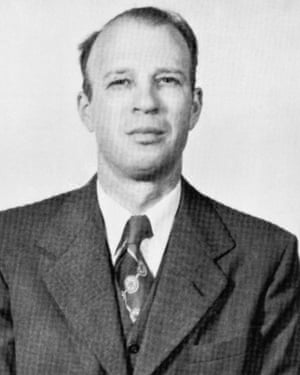
It was at Camp Detrick that Blome encountered a rising star in the CIA, Sidney Gottlieb. Gottlieb, a bacteriological specialist who had been a star student of Ira Baldwin’s at Wisconsin, is the main figure in Kinzer’s book. His career is virtually synonymous with MKULTRA. Under the direction of Gottlieb, the CIA’s laboratories at Camp Detrick transitioned from R&D on bioweapons—often using unwitting American subjects, such as in 1950 when a US Navy minesweeper “specially equipped with large aerosol hoses” spent six days spraying the Serratia marcescens bacterium into the San Francisco fog, infecting some eight hundred thousand people (pp. 37–38)—to drugs which could be used for mind control. (MKNAOMI, MKULTRA’s sister CIA project, was also tasked with finding poisons and biotoxins which the CIA and the US government could use in various operations.) Gottlieb provided the big ideas into which to fit Blome’s nefarious knowledge of mass murder by bacillus. Gottlieb became, virtually overnight and with the help of former Nazi doctors, America’s “poisoner in chief.”
The CIA’s mind control program, which was assuming a bigger and bigger importance as fears of Soviet brainwashing grew in the US, was originally called Operation Bluebird and was personally overseen by CIA higher-up Allen Dulles. (47) At first, the Bluebird team experimented with “hypnosis, electroshock, and sensory deprivation,” along with drugs like sodium amytal, at CIA sites in “secret prisons in Germany and Japan,” looking for a way to extract information out of POWs and captured spies (pp. 44, 48–49). But Dulles was unsatisfied with the results and decided to give the young CIA recruit Sidney Gottlieb control of Bluebird’s updated iteration: Operation Artichoke (pp. 51–52). The goal of Artichoke was to do whatever it took to get prisoners to divulge military and state secrets to the CIA. The Cold War would brook nothing short of full-scale war against the human mind.
Dulles became deputy director of central intelligence three days after launching Artichoke in 1951, and Gottlieb, invisible to the outside world, was given virtually unlimited rein to carry out any experiments thought necessary to achieve mind control (p. 51). This drive to achieve total operational control over the human psyche eclipsed all reality and tactical limitation. If the US didn’t win the race to the mind control method, many in the CIA thought, the entire American population lay vulnerable to mental enslavement by the Soviets. Dulles, Kinzer writes, despite a disastrously unsuccessful three-year “Artichoke” attack on a Bulgarian political prisoner named Dmitri Dimitrov, “had convinced himself not only that mind control techniques exist but that Communists had discovered them, and that this posed a mortal threat to the rest of the world” (pp. 52–53).
Mind control was the pressing need, but nothing brought it within reach. Technique after technique, drug after drug, was tried on prisoners, but to no avail. In frustration, Artichoke agents under Gottlieb upped the ante, turning to marijuana, cocaine, and then heroin as possible catalysts of CIA-directed, anti-Soviet brainwashing. As part of Artichoke, a University of Rochester psychology professor was given a grant by the US Navy to test heroin on his students. The control of the mind remained as elusive as ever, despite the massive dosing of the Rochester student population with opiates. Nothing seemed to have the potential to crack open the mind for the CIA (p. 59).
Someone in Artichoke suggested using mescaline after the other narcotics failed, and this gave Sidney Gottlieb an idea. He remembered hearing about a drug called LSD which Dr. Albert Hofmann had discovered during an experiment at Sandoz laboratories in Basel, Switzerland, in 1943. Lysergic acid diethylamide (LSD), an ergot enzyme, produced extraordinary and disturbing psychological effects, Dr. Hofmann found when he ingested some and recorded the drug’s effects. Washington learned of Hofmann’s discovery in 1949, and one of the chemical specialists in the US military complex told Gottlieb of the new substance (pp. 34–35) In 1951, Gottlieb asked Harold Abramson, who had been a physician in the Chemical Warfare Service during World War II, to administer LSD to him. Gottlieb experienced the same psychedelic state as Dr. Hofmann had described. Other subjects were tested, as well, not all of them wittingly, and all seemed to exhibit similar reactions. LSD most definitely altered the mind (pp. 60–61). Gottlieb was convinced that he had found the magical drug which would allow the CIA to control the psyche, and therefore to beat the Soviets at (what Allen Dulles, Gottlieb, and many others at CIA thought, at least, was) the Soviets’ own game.
The experiments on human subjects followed rapidly after Gottlieb’s conversion to belief in the powers of LSD. These experiments often ended in death, often by murder. One study quoted by Kinzer reports that










 MCViewPoint