Biden recently acknowledged the balloon was blown off course and was not intentionally flown over the US
“The pentagram said”!!! The pentagram tells the truth? This must be a PSYOP. Or maybe letting the balloon fly over the entire country, after having seen it early in it’s approach, for political purposes, ws about to backfire.
The Pentagon said Thursday that the Chinese balloon that wound up over the US in February did not collect data while it flew over US territory.
“We believe that it did not collect while it was transiting the United States or flying over the United States, and certainly the efforts that we made contributed, I’m sure,” said Pentagon spokesman Brig. Gen. Pat Ryder.
Ryder made the comments when asked about a Wall Street Journal report that said the balloon contained US-made equipment. “I don’t have any specifics to provide as it pertains to the [People’s Republic of China] high altitude balloon and any potential US components,” he said.
For their part, Beijing has said the balloon was a civilian weather research device, while the Biden administration says it was a surveillance device. At this point, it has become clear that China did not intend to fly the balloon over the US, something President Biden recently acknowledged.
“That wasn’t supposed to be going where it was. It was blown off course up through Alaska and then down through the United States,” Biden said.
A Pentagon official has told Congress that controversial cluster munitions Ukraine has been seeking from the US would be “useful” to Ukrainian forces on the battlefield.
Cluster bombs scatter small submunitions over large areas, making them especially hazardous to civilians. Because of their indiscriminate nature, cluster munitions have been banned by more than 100 nations.
Ukraine has been asking the US to send cluster munitions that are in Pentagon stockpiles, and the Biden administration has been under growing pressure from Republicans in Congress to oblige the request.
Japanese leaders chose war rather than capitulation, even though some of them, including Admiral IsorokuYamamoto, the architect of the attack on Pearl Harbor, suspected that their country could not win a war against the United States.
It has become increasingly apparent that any notion of U.S. “strategic ambiguity” with respect to Taiwan is dead. Both the Joe Biden administration’s rhetoric and U.S. military deployments in the western Pacific indicate that the United States will come to Taiwan’s defense if the People’s Republic of China (PRC) uses force against the island. The logic underlying this more confrontational stance is that it will deter Beijing from taking rash actions. It is far more likely to produce a potentially catastrophic military collision between the United States and China.
The reliability and credibility of any U.S. security assurances to Taipei are based on the assumption that U.S. forces would prevail if fighting broke out. However, it is most unclear whether that would be the case. Simulations run by the Pentagon and think tanks in recent years have produced mixed results. Some of them indicate that the United States would lose such a war; others point to a hard-fought U.S. victory. Both scenarios entail a horrific cost in lives and treasure. Looming in the background is the worry that either country might conclude that an escalation to the use of nuclear weapons was necessary to avoid a humiliating defeat.
The Pentagon and its supporters increasingly focus on ways to strengthen the U.S. military presence in the western Pacific to maximize the credibility of deterrence. A recent article by Rear Admiral Mark Montgomery (ret.) and Bradley Bowman is typical. They recommend five steps to prevent defeat: enhancing the ability to strike attacking PRC forces; strengthening Taiwan’s ability to defend itself; bolstering the survivability of forward deployed U.S. units; improving the capabilities of U.S. and allied forces to fight together; and building more cyber resilient infrastructure to support military mobility.
Such analyses focus on only one element of deterrence—the balance of military forces. Even with that narrow focus, U.S. prospects are not bright. Over the past two decades, the PRC has dedicated itself to an extraordinarily ambitious military modernization program. The focus of that effort has been on air and naval weapons systems that would make a U.S. intervention to defend Taiwan prohibitively problematic and costly. Beijing may already have achieved that capability. If not, it is just a few years away.
Lotifi Hassan Misto was going about his business herding sheep in Syria’s Idlib province May 18 when a US drone strike blew him to smithereens.
Pentagon officials immediately announced we killed an al-Qaeda leader bent on terrorizing the homeland. That could well have been a recorded response that has been played hundreds, maybe thousands of times since the War of Terror began 22 years ago this September.
But the Pentagon fable quickly fell apart when family members came forward to defend Misto and grieve for his 10 kids now without a dad. They were backed up by terrorism experts who told the Washington Post Misto was likely not affiliated with al-Qaeda.
A Pentagon official offered an “oops” stating “We are no longer confident we killed a senior AQ official.”
US military officials are walking back claims that a drone strike Central Command (CENTCOM) launched on May 3 in northwest Syria killed a senior al-Qaeda leader after evidence emerged that a civilian was killed.
When the strike was first launched in Syria’s northwest Idlib province, reports immediately emerged that the strike killed a sheep herder with no ties to any militant groups. The Associated Pressspoke with family members and neighbors of the victim, Lotfi Hassan Misto, who insisted he was innocent.
According to The Washington Post, Misto was a 56-year-old father of 10, and the paper spoke with terrorism experts who said it was unlikely he was affiliated with al-Qaeda.
“We are no longer confident we killed a senior AQ official,” an unnamed military official told the Post. Another official claimed the person they killed was al-Qaeda but offered no evidence. “Though we believe the strike did not kill the original target, we believe the person to be al-Qaeda,” the official said.
CENTCOM’s initial press release on the strike did not name the person they killed. Since then, the command has refused to share any details of the operation or say why they could have targeted the wrong person.
The US military is notorious for undercounting civilian casualties or lying about them. The Pentagon is also known for investigating itself and finding no wrongdoing, even in instances of significant civilian deaths, such as the August 2021 Kabul drone strike that killed 10 civilians, including seven children.
Not a confidence builder…And the acknowledged leader in Hypersonic Missiles has grown quite friendly of late with the acknowledged leader in Carrier Killer Missiles.
The United States Department of Defense (DOD) is seeking nearly $30 billion in its $680 billion Fiscal Year 2024 (FY24) budget request for missile defeat and defense programs across all branches of the military.
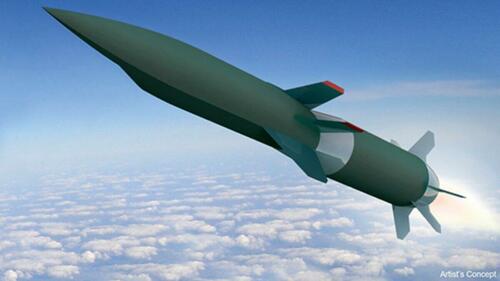
Artist’s concept of the DARPA and Lockheed Martin Hypersonic Air-Breathing Weapon Concept (HAWC). (Courtesy of Defense Advanced Research Projects Agency)
Right now, the DOD is in a race to develop its own hypersonic missiles and engineer effective defenses against the high-velocity, maneuverable missiles being developed by Russia and, particularly, by the Peoples Republic of China (PRC).
During questioning by Senate Armed Services Committee’s Strategic Forces Subcommittee Chair Sen. Angus King (I-Maine) in a May 9 budget hearing, four flag officers said some existing systems have “capabilities” against hypersonic weapons but did not know for sure until they are tested against the evolving missile systems.
King was not happy. “It seems to me that we are spending a lot more money to developing hypersonic missiles than we are developing capabilities to defend against them,” he said.
King asked Missile Defense Agency Director Vice Adm. Jon A. Hill if an aircraft carrier could be defended against a hypersonic missile attack.
“We have the capability to stop it in two places, in the boost-glide phase” and when the missile re-enters the atmosphere, Hill said, noting the Navy’s SM-6 missiles are “cruise missile killers” designed to track and kill fast-moving, maneuverable targets that can fly high and skim the surface. “It would be defeated by a destroyer defending a carrier.”
Noting Ukrainians claim they shot down a Russian hypersonic weapon last week with a Patriot anti-air missile provided by the U.S., Hill said the Patriot systems, Terminal High Altitude Area Defense missiles (THAAD), and Aegis ballistic defense system all have “capability” demonstrated in tests against hypersonics.
“THAAD operates on the edge of the atmosphere,” he said. “We haven’t tested it against hypersonic, but I’m willing to bet there are capacities that we can leverage there.”
The new approach has “balanced that tension very well between let’s make sure we have what we need for national security access to space and, as best we can, help to foster and take advantage of growth in the commercial market,” Thompson said.
The one thing we can count on is a universe size opportunity for the right people to pocket your taxes while making no one but themselves safer.
Ukraine’s use of commercial satellites to help repel the Russian invasion has bolstered the U.S. Space Force’s interest in exploiting the capabilities of the private sector to develop new technologies for fighting a war in space.
But the possible reliance on private companies, and the revolution in technology that has made satellites smaller and more powerful, is forcing the Defense Department to wrestle with difficult questions about what to do if those privately owned satellites are targeted by an adversary.
White House and Pentagon officials have been trying to determine what the policy should be since a top Russian official said in October that Russia could target the growing fleet of commercial satellites if they are used to help Ukraine.
Konstantin Vorontsov, deputy director of the Russian Foreign Ministry’s department for nonproliferation and arms, called the growth of privately operated satellites “an extremely dangerous trend that goes beyond the harmless use of outer-space technologies and has become apparent during the latest developments in Ukraine.”
He warned that “quasi-civilian infrastructure may become a legitimate target for retaliation.”
In response, White House press secretary Karine Jean-Pierre reiterated earlier comments from her counterpart at the Pentagon that “any attack on U.S. infrastructure will be met with a response, as you’ve heard from my colleague, in a time and manner of our choosing.”
But what that response will be is unknown, as officials from a number of agencies try to lay out a policy framework on how to react if a commercial company is targeted.
In a recent interview, Gen. David Thompson, the Space Force’s vice chief of operations, said that while expanding the partnership with the commercial space industry is one of his top priorities, it has also led to a host of unanswered questions.
“The Ukraine conflict has brought it to the forefront,” he said. “First, commercial companies are thinking very clearly and carefully about, can we be involved? Should we be involved? What are the implications of being involved? … And on our side, it’s exactly the same thing. Should we depend on commercial services? Where can we depend on commercial services?”
The Pentagon has long relied on the private sector, he said. But the proliferation of small satellites has created a more resilient system that has provided real-time imagery of the Ukraine battlefield from space, allowing nations to track troop movements, assess damage and share intelligence. Communication systems, such as SpaceX’s Starlink constellation, has kept the internet up and running at a time when Ukraine’s infrastructure has been decimated.
So, the government of the United States, while decrying “fake news,” was itself creating fake news to foist on people turning to Twitter for unfiltered news.
Of particular interest on the list is a section called “Advanced technologies for use in Military Information Support Operations (MISO),” interpreted by the The Intercept as “a Pentagon euphemism for its global propaganda and deception efforts.” Here’s how The Intercept described the contents of that disturbing part of the procurement request:
United States Special Operations Command (SOCOM) is “gearing up to conduct internet propaganda and deception campaigns online using deepfake videos,” according to contracts with the federal government reviewed by The Intercept.
In what many would attribute to the likely behavior of rogue regimes targeting the United States, the activities that SOCOM is carrying on overseas include “hacking internet-connected devices to eavesdrop in order to assess foreign populations’ susceptibility to propaganda,” the Intercept article reports.
The information revealed in the report is taken from a procurement document published by the Department of Defense, a sort of wish list of technological tools the Pentagon is looking to secretly deploy throughout the world.
Of particular interest on the list is a section called “Advanced technologies for use in Military Information Support Operations (MISO),” interpreted by the The Intercept as “a Pentagon euphemism for its global propaganda and deception efforts.” Here’s how The Intercept described the contents of that disturbing part of the procurement request:
The added paragraph spells out SOCOM’s desire to obtain new and improved means of carrying out “influence operations, digital deception, communication disruption, and disinformation campaigns at the tactical edge and operational levels.” SOCOM is seeking “a next generation capability to collect disparate data through public and open source information streams such as social media, local media, etc. to enable MISO to craft and direct influence operations.”
While you’d be surprised to see SOCOM — an organization comprised of elite military units renowned for their ability to work secretly and under the cover of darkness — allowing its disinformation designs to be obtained and publicized by The Intercept, the Pentagon has been hiding it in plain sight for years now.
In December, The Intercept revealed some very troubling tactics used by SOCOM to manipulate social media:
SOCOM had convinced Twitter, in violation of its internal policies, to permit a network of sham accounts that spread phony news items of dubious accuracy, including a claim that the Iranian government was stealing the organs of Afghan civilians. Though the Twitter-based propaganda offensive didn’t use deepfakes, researchers found that Pentagon contractors employed machine learning-generated avatars to lend the fake accounts a degree of realism.
So, the government of the United States, while decrying “fake news,” was itself creating fake news to foist on people turning to Twitter for unfiltered news.
Just so it’s clear and there’s no misplaced worry that the document is somehow less sinister than The Intercept’s depiction of it, here’s one a paragraph from the “Advanced technologies for use in Military Information Support Operations (MISO)” section that should remove all doubt about the purpose for the procurement. MISO will seek for technologies to:
influence operations, digital deception, communication disruption, and disinformation campaigns at the tactical edge and operational levels … seeking a next generation capability to collect disparate data through public and open source information streams such as social media, local media, etc. to enable MISO to craft and direct influence operations.
And these few paragraphs from the document are no less unnerving:
The US empire has been frantically ramping up propaganda and censorship because the “great power competition” it has been preparing against Russia and China is going to require economic warfare, massive military spending, and nuclear brinkmanship that no one would consent to without lots of manipulation. Nobody’s going to consent to being made poorer, colder, and less safe over some global power struggle that doesn’t benefit them unless that consent is actively manufactured.
An article by The Washington Post titled “Pentagon looks to restart top-secret programs in Ukraine” contains some interesting information about what US special ops forces were doing in Ukraine in the lead-up to the Russian invasion last year, and what they are slated to be doing there in the future.
“The Pentagon is urging Congress to resume funding a pair of top-secret programs in Ukraine suspended ahead of Russia’s invasion last year, according to current and former U.S. officials,” writes the Post’s Wesley Morgan. “If approved,the move would allow American Special Operations troops to employ Ukrainian operatives to observe Russian military movementsand counter disinformation.”
Much further down in the article we learn the specifics of what those two top-secret programs were. One of them entailed US commandos sending Ukrainian operatives “on surreptitious reconnaissance missions in Ukraine’s east” to collect intelligence on Russia. The other entailed secretly administering online propaganda, though of course The Washington Post does not describe it as such.
“We had people taking apart Russian propaganda and telling the true story on blogs,” WaPo was told by a source described as “a person in the Special Operations community.”
US special ops forces “employing Ukrainian operatives” to “take apart Russian propaganda” and “tell the true story on blogs” is just US special ops forces administering US propaganda online. Whether or not they actually see themselves as “telling the true story” or “taking apart Russian propaganda” does not change the fact that they are administering US government propaganda. A government circulating media which advances its information interests is precisely the thing that state propaganda is.
The Pentagon on Thursday claimed that it is tracking a spy balloon that has been spotted over the US for several days.
A senior Pentagon official told reporters that the US has “high confidence” the surveillance balloon belongs to China, but the claim hasn’t been confirmed, and Beijing has yet to respond to the accusation.
Like the US, China has sophisticated satellite capabilities that make deploying something like a spy balloon over US territory redundant, something the senior Pentagon official who spoke to reporters acknowledged.
“First, our best assessment at the moment is that whatever the surveillance payload is on this balloon, it does not create significant value added over and above what the PRC (People’s Republic of China) is likely able to collect through things like satellites in Low Earth Orbit,” the official said.
The Pentagon decided not to shoot the balloon down due to the risk of harming people on the ground. Pentagon spokesman Brig. Gen. Pat Ryder said in a statement that the balloon was “currently traveling at an altitude well above commercial air traffic and does not present a military or physical threat to people on the ground.”
Ryder claimed the US has tracked similar balloons in recent years. The senior Pentagon official said the balloon was over Montana at one point, a state that houses nuclear weapons silos.
The claim about the alleged Chinese spy balloon comes amid heightened tensions with Beijing and as Secretary of State Antony Blinken is preparing to visit China, where he is due to arrive on February 5. In recent weeks, the US has been announcing a series of steps it’s taking to increase its presence in the Asia Pacific as part of a military buildup aimed at China.







 MCViewPoint