MCViewPoint

Opinion from a Libertarian ViewPoint

Posts Tagged ‘QE’

Of Two Minds – What Could Go Wrong? Plenty

Posted by M. C. on October 9, 2020

https://www.oftwominds.com/blogoct20/go-wrong10-20.html

Charles Hugh Smith

Quite a lot of things can go wrong, especially if the mainstream’s rose-tinted sunglasses induce a delusional confidence in fantasy.

The conventional assumptions are remarkably rosy: the “recovery” is V-shaped in all the ways that count (i.e. the top 10% are once again doing well), the Federal Reserve will never let stocks go down or interest rates rise ever again (never never ever!), and the Federal government will borrow and blow endless trillions in stimulus ($2 trillion every six months seems about right, but since there’s no limit, we’ll double it if that’s needed to bail out every zombie corporation, bloated bureaucracy, skim and scam in the land).

what could go wrong? Gordon Long and I considered the question and came up with: quite a lot of things can go wrong, especially if the mainstream’s rose-tinted sunglasses induce a delusional confidence in fantasy.

What Could Go Wrong? (43 min. video)

1. A key part of the happy story is the US dollar (USD) will continue its decline, which is wunnerful for stocks and exporters: dollar down, stocks up, yea!

The official explanation for this free-fall is the USD will weaken as the Fed eases / prints. The mainstream thinking is that Japan and the Euro bloc are farther along in their socialization of debt (i.e. their central banks are monetizing fiscal deficits) and so the US will have to play catch-up, weakening the USD.

What could go wrong?

US-centric analysts forget the USD is the primary reserve currency and due to Triffin’s Paradox, it doesn’t just serve the US economy, it serves the global economy. You will never hear a Fed representative admit this publicly, because the PR / fantasy is that the Fed only cares about the American public (awww, gosh-darn it, aren’t they sweet?) and keeping inflation low and employment high.

In reality, the Fed’s core interests are enriching and protecting private banking globally, and maintaining U.S. global hegemony via a strong dollar. Recall that geopolitically, no empire ever got stronger by weakening its currency.

The Fed never addresses the USD’s global role and so conventional pundits ignore geopolitical forces: capital flows, the global need for dollars to service debt denominated in USD and reserves, etc.

Also recall that China pegs its currency to the US dollar, not the other way around. That alone tells you the role each currency plays in the global economy.

For the USD to weaken, the yen and the euro would need to significantly strengthen. But there’s a problem with this thesis.

Rather than being stronger, Japan and the EU are weaker than the US. Credit impulse is essentially zero in both Japan and the EU, both their banking sectors are insolvent, their economies have been stagnant for years (EU) or decades (Japan) and their demographic declines are accelerating. Both are export-dependent, an Achilles Heel as world trade / globalization enters a secular decline that could easily gather momentum.

The US needs capital flows into the US economy, so negative rates are a non-starter. Non-US borrowers have USD denominated debts of around $3 trillion, so demand for USD is not optional, it is a function of credit, commerce and reserves.

Simply put, the US is not about to sacrifice the euro-dollar / petro-dollar and its commercial hegemony just to satisfy domestic pleading for negative rates. Furthermore, Japan and Europe have proven that negative rates only weaken the private banking sector–the exact opposite of the Fed’s Prime Directive.

If the USD strengthens substantially, which it tends to do in crises, that will be very negative for equities. (No, no, no, the Fed has our backs! The Fed will never let my precious portfolio drop a single dollar!)

So sorry, but the Fed’s Prime Directives are not related to your portfolio at all. The Fed’s PR is all about domestic stocks, implicitly or explicitly, but when push comes to shove, your portfolio will be sacrificed without any hesitation to protect private banking and USD hegemony. The empire eats first, and only the tragically misguided believe US stocks are all that matters to the Fed.

2. The Fed’s easing, QE, etc. will spark a new round of credit expansion.

What could go wrong?

Credit expansion is on life support. There are very few investment opportunities, which is one reason why corporations have poured earnings into stock buybacks. The Fed can’t create low-risk, high-profit investment opportunities, not can it make poor credit risks into good credit risks.

Banks can’t afford to lend to insolvent households, zombie corporations or small businesses. The credit expansion impulse is impaired by the overhang of bad debt, excessive leverage, zombie corporations, etc. and there’s nothing the Fed can do about it. The Fed is pushing on a string.

Furthermore, the Fed is now encountering political resistance to its “enrich the wealthy and bail out zombie corporations” monetary policies. Its room to bail out the super-wealthy is increasingly constrained politically. The Fed is signaling that its focus is shifting from free money for financiers to funneling new money directly to households.

3. The federal government will borrow and spend trillions, sparking renewed growth.

What could go wrong?

As noted, banks cannot lend to poor credit risks, nor can they force those who don’t want to borrow more to take on new loans. Federal spending doesn’t magically create good credit risks or well-collateralized creditors.

Small businesses cannot lower their fixed costs enough to survive, and many of these costs such as taxes and fees will be rising as cash-starved local governments seek more revenues.

The free money will flow not into productive investments but into demand for goods and services which are constrained by declines in trade, high fixed production costs, retirement of key workers, etc.

Inflation will leap, surprising everyone who believed the “low inflation forever” story. As inflation soars, the purchasing power of the federal spending will plummet accordingly.

As UBI, Fed helicopter money, etc. becomes institutionalized, the working poor will exit low-paying, high-stress jobs, creating labor shortages. Small business won’t be able to pay higher wages and survive, and low-margin corporations will be squeezed as well.

There’s much more in our discussion: What Could Go Wrong? (43 min. video)


My new book is available! A Hacker’s Teleology: Sharing the Wealth of Our Shrinking Planet 20% and 15% discounts (Kindle $7, print $17)

Read excerpts of the book for free (PDF).

The Story Behind the Book and the Introduction.


Recent Podcasts:

What Could Go Wrong? (43 minutes, with Gordon Long)

AxisOfEasy Salon #24: It’s Not a Conspiracy. It’s a Culture. (1 hr)


My COVID-19 Pandemic Posts


My recent books:

A Hacker’s Teleology: Sharing the Wealth of Our Shrinking Planet (Kindle $8.95, print $20, audiobook coming soon) Read the first section for free (PDF).

Will You Be Richer or Poorer?: Profit, Power, and AI in a Traumatized World
(Kindle $5, print $10, audiobook) Read the first section for free (PDF).

Pathfinding our Destiny: Preventing the Final Fall of Our Democratic Republic ($5 (Kindle), $10 (print), ( audiobook): Read the first section for free (PDF).

The Adventures of the Consulting Philosopher: The Disappearance of Drake $1.29 (Kindle), $8.95 (print); read the first chapters for free (PDF)

Money and Work Unchained $6.95 (Kindle), $15 (print) Read the first section for free (PDF).


If you found value in this content, please join me in seeking solutions by becoming a $1/month patron of my work via patreon.com.

Be seeing you

Posted in Uncategorized | Tagged: , , , , , | Leave a Comment »

Climate Change at Fox News – LewRockwell

Posted by M. C. on April 25, 2020

Drowning in the swamp. Holding hands with Trump on the way down.

https://www.lewrockwell.com/2020/04/no_author/climate-change-at-fox-news/

By Steve Hall

There has been a drastic change in the climate at Fox News.  We used to think of them as a counter-balance to the “mainstream media”; an alternative perspective, with “balance” and yes, with a healthy dose of skepticism about all things government.  Then suddenly, inexplicably, Fox News jumped on the hysteria bandwagon.

– – – – –

Imagine this:  an old white guy is elected President, with AOC as his running mate.  The old guy can no longer do the job, perhaps perishes, and AOC becomes President.  She immediately sounds the alarm:  the threat from climate change, the destruction of the earth, is imminent.  She shows the models and presents the science.  The media shouts “armageddon” day after after day, incessantly, with a parade of experts who agree.

AOC says that we knew this was coming and yet we did not prepare.  That we had ten years, but now there is no time left.  The public is whipped into fear and mass hysteria.  AOC declares a national emergency and a “War on Climate Change” and the people acquiesce.  She orders temporary measures to cut the use of carbon-based fuel: shuts down oil production; shuts down cruise ships; restricts airline flights; orders people not to drive unless it is essential; and shuts down all frivolous activities.  But the two-week “temporary” shutdown quickly turns into another month, and then another, with no end in sight.

People comply voluntarily.  “Everyone agrees” that this must be done.  But voluntary soon turns to mandatory.  Guidelines, when administered by bureaucrats, become arbitrary laws.  Because the economy is so interconnected, because all workers are essential, the economic impact begins to grow and spread.  Hundreds of thousands of workers are unemployed.  Businesses are bankrupted.  The effects ripple through the entire economy and cause a deep recession.  AOC promises to make everyone whole and initiates massive Federal spending, with Congress happily agreeing (it buys them votes, and would be so politically incorrect to question, let alone dissent).

The Federal government has no money except which it first takes from the people; the shutdown drastically reduces the money coming in.  The Federal government has no savings; they were already deep in debt.  The “Fed” was out of “ammunition”; interest rates had been held artificially low for years and they had already been doing bailouts and QE to keep the economy propped up.  So all of the AOC stimulus and Federal aid has to come from additional, excessive debt, or from what amounts to printing money out of thin air.  America wobbles on the verge of an unprecedented depression, perhaps total economic collapse.

– – – – –

Now try to imagine Fox News jumping on board with AOC in that scenario.  Not questioning the models.  Not presenting other perspectives and alternative views.  Not considering the consequences.  In fact, doing just the opposite – sounding the alarm and promoting the panic, actually encouraging the shut downs!   Unimaginable?  Many of us thought so.  Yet that is exactly what they did with this virus!

Tucker Carlson was one of the very first, sensationalizing how dangerous this could be, urging Federal action.  Within weeks, every Fox News anchor was on board, not only agreeing with the unprecedented step of shutting down the nation, but also with the dangerous, dictator-like experiment of quarantining people who were not sick!

That was, in fact, pretty much what communist China did.  Except in America it was to be  “guidelines”?  Voluntary?  Temporary?  No, it’s turning out to be mandatory.  And once that hysteria was in place, the momentum is to remain shutdown, especially from those who have acquired new powers.  “Flatten the curve” we did, but now the new goal seems to be “no new cases” (an impossible goal in any realistic time frame) or “until there is a vaccine.”  A vaccine, by the way, is no silver bullet; we have had seasonal flu vaccines for years and people still die.

Today at Fox, they repeat, “We all know that we had to do it” while at the same time scrambling to address how we avoid the inevitable economic consequences (which would have been so obvious to anyone who bothered to think about that before taking the leap).  But just like the AOC story, we have shut down oil production; shut down cruise ships; and restricted air travel and driving.  But we went even further, locking down a majority of the population, shuttering most businesses.  Now we have the unemployment and the bankruptcies.  And the politicians are making the ludicrous promise that no one will suffer financially.

So now Fox News folks are resorting to the CNN approach – attacking – complaining about a Governor who makes arbitrary rules, how awful that is.  Do you really expect any different when you make such a leap toward authoritarianism?  That’s what always happens when you replace the Rule of Law with the Laws of Rulers.  Why has Fox News not been interviewing Rush Limbaugh and Judge Napolitano and Lieutenant Dan Patrick and Doctor Ron Paul from the very outset?  Why are they arguing that some are “taking it too far” when they never should have been allowed to “take it” in the first place?

It was a mistake to shut down the country.  Because of economic repercussions, of course.  But also in our loss of liberties, another huge step toward an authoritarian America.  Not to mention that the deaths that result long-term are very likely to far exceed the death toll from the virus.  Especially if our economy collapses.  Or if we experience hyperinflation.  Or we we engage in a huge new hot war to “pull us out of the depression”.

What is so sad and disheartening now is the refusal of Fox News to admit that the shutdown was a mistake, or to even entertain the idea that it might have been.  I guess they are in CYA mode, just like so many politicians.  Instead, they continue to straddle the fence – “we all agree that we had to do it, but now we need to decide how best to open up.”  They continue to promote the theory that “if we hadn’t done it, it would have been much worse” – – when there is no valid data to support that (we’ll likely, eventually, prove that theory to be false).

Where are the models and the what-ifs and the projections about what might have happened if we had not shut down?  If we had Instead just issued the guidelines and encouraged people to act responsibly?  Even on Fox, that discussion seems to be off limits.

We were never going to stop this virus, because it is so contagious; they told us that from the beginning.  The bottom line is this:  if someone is afraid, has underlying health issues – in fact for for any reason at all – they have the option of self-isolating.  If they do, and if they sanitize incoming, wash their hands, and don’t touch their face, then they will not get the virus!  (Or at least the chances are so slim as to be statistically negligible.)  No one is stopping them!

But many people are willing to take the small risk.  After contact, there’s maybe a 50/50 chance of contracting the virus.  Of those that do get infected, only 4% will get seriously ill.  In other words 96% – ninety-six percent – will experience mild symptoms, or none at all.  The risk of dying from Covid-19 looks to be about the same as from the flu just a few years ago.  Less total deaths than from driving automobiles.

It is pure irony to see the “awful mainstream media” and Fox News on the same page!  Promoting mass hysteria, crazy models, and un-vetted “science”.  Let alone supporting a national lock down and lock up.  Ironic, too, that it is the Washington Post, of all people, now questioning these trillions of dollars of spending and debt.  Maybe their objectives really are no different?  This pandemic, and our response, is revealing the crumbling infrastructure of the American experiment and our Constitutional Republic.  Perhaps we were unprepared do defend against this latest virus (it is, after all, one of about 200), but neither was Fox News prepared to defend our liberty.

Be seeing you

Posted in Uncategorized | Tagged: , , , , , , | Leave a Comment »

Here Is The Real Reason The Fed Restarted QE | Zero Hedge

Posted by M. C. on October 20, 2019

I don’t pretend to understand all this but it appears to me it didn’t help the first couple times.

https://www.zerohedge.com/markets/here-real-reason-fed-restarted-qe

In the past month, a feud has erupted in the financial media and across capital markets between defenders of the Fed, who praise the return of its unprecedented easing in the form of $60BN in monthly T-Bill purchases, by refusing to call it by its real name, and instead the Fed’s fanclub calls it “not QE” (just so it doesn’t appear that ten years after the Fed first launched QE, we are back to square one), and those who happen to be intellectually honest, and call the largest permanent expansion in the Fed’s balance sheet, meant to ease financial conditions and boost liquidity across the financial sector, for what it is: QE.

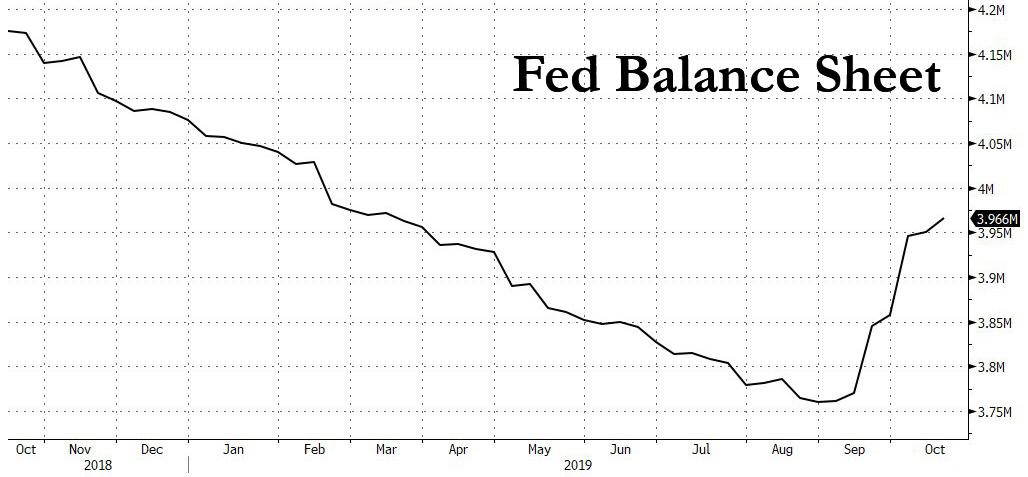
It is this same “not QE” that has boosted the Fed’s balance sheet by $200BN in one month, the fastest rate of increase since the financial crisis.

Yet while the Fed’s desire to purchase Bills instead of coupon Treasuries was dictated by its superficial desire to distinguish the current “Not QE” from previous “True QEs”, even though both tends to inject the same amount of liquidity into the system, which as a reminder is what the Fed’s bailout role in the past 11 years has all been about, and only true Fed sycophants are unable to call a spade a spade, the Fed’s choice raises a rather thorny question of where the Fed will source those T-bills, because as JPMorgan calculates, the net supply of Bills in 4Q19 and 1Q20 is around $115-$130bn while JPM’s economists estimate that at least $200-$250bn of purchases could be required to return reserves to around $1.5tr where they were in early September this year.

That means the Fed might need to source purchases from money-market funds and foreign central banks – which paradoxically would serve to further drain liquidity out of the system. As such, given the limited alternatives, JPM’s Nikolas Panagirtzoglou believes that the Fed may be reluctant to do so and if they do, some may chose to leave cash in the Fed’s ON RRP facility which would represent a drain on reserves and make T-bills a less efficient vehicle for reserve creation.

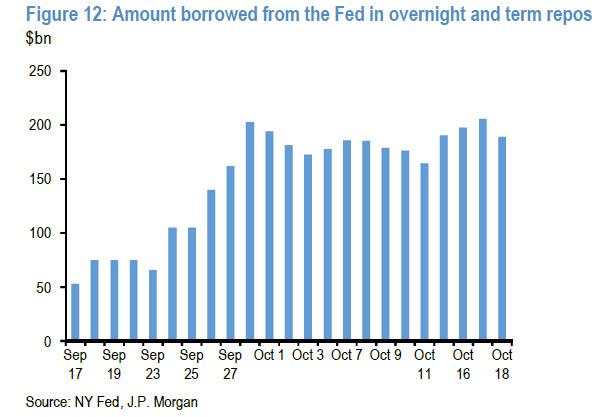
Another key question: what if just returning to the previous reserve baseline is not sufficient, and the Fed needs to return reserves to a higher level than $1.5tr? Indeed, with close to $200bn of reserves injected via overnight and term repos for much of this week…

… helping to return reserves to around $1.5tr on a temporary basis from less than $1.4tr in mid-September, money markets appear especially vulnerable to volatility.

Indeed, in a week when the Treasury’s General Account with the Fed increased by $60bn, depleting reserves, both Fed Funds and the broader OBFR rates median rates rose again to 10bp above IOER on Tuesday Oct 15th after having settled at around 3bp above IOER and at IOER respectively after the quarter-end hurdle had been cleared. And the SOFR median rate rose to 20bp above IOER after having settled at 2-5bp above IOER after the quarter-end effects had settled.

There is another reason why the Fed’s stated intention to only buy Bills will soon have to be adjusted to incorporate short-maturity (at first) Treasury bonds, and it has to do with the total open market purchases planned by the Fed. If the Fed would need to return reserves to a higher level, say to around the $1.7tr level in Dec 2018 when the 75th percentile of the Fed funds market began to persistently print above IOER, this could imply a further $200bn of purchases. JPM finds that “in principle” this could be completed in 2Q20 if the Fed were to sustain T-bill purchases at a pace of $60bn per month, which it set as the initial pace, but it would still imply a longer period of reserves being at a relatively tight level than if $1.5tr would be a sustainable level. But that would assume purchases at a continuous (rather than initial) pace of $60bn/m pace are sustainable, and ignores the prospect that purchases from MMFs and foreign central banks could prompt them leaving cash in the Fed’s ON RRP facility thereby draining some of the intended reserve injection.

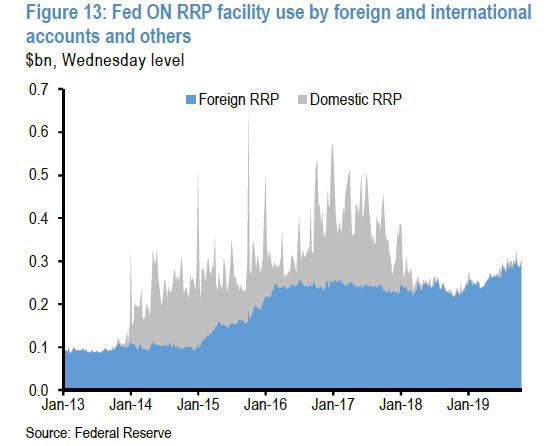
Currently, close to $300bn of cash has been deposited with the Fed via the ON RRP facility, primarily by foreign RRP counterparties for whom the nearly $300bn is close to its recent highs. By contrast, other, largely domestic,  counterparties’ use of the ON RRP facility has collapsed to just $2bn, well below a high of nearly $450bn in late 2015, as institutions have a far more pressing needs for cash (liquidity) than collateral securities (“collateral shortage” was the big story in 2014-2017, just ask Zoltan Pozsar).

If T-bill purchases start to put upward pressure on ON RRP facility use, the Fed may eventually need to extend purchases to shorter-maturity Treasury bonds….

Be seeing you

Quantitative Easing….Forever! - Verified Tasks

Posted in Uncategorized | Tagged: , , , | Leave a Comment »

Larry Summers Comes Clean Ahead Of J-Hole, Admits Central Planners Are Impotent | Zero Hedge

Posted by M. C. on August 22, 2019

https://www.zerohedge.com/news/2019-08-22/larry-summers-comes-clean-ahead-j-hole-admits-central-planners-are-impotent

by Tyler Durden

Larry Summers is not one to be shy about sharing his opinion on any and every media channel about just how bad President Trump’s policies are, and how much better everything was in the world under President Obama.

However, in an epic thread of apparent honesty, the former director of the National Economic Council for President Obama took to Twitter to dispel any myths about the omnipotence of central planners and to confirm there’s nothing anyone can do to save the world from doom (especially Jay Powell’s speech tomorrow).

Mea Culpa? Or partisan political pandering to reinforce the “recession is imminent and there’s nothing to stop it and it’s Trump’s fault and that means Trump’s unelectable” narrative?

You decide…

Summers begins his diatribe by addressing the big imminent issue ahead of us:

“Coming into Jackson Hole, economists are grappling with a major issue: Can central banking as we know it be the primary tool of macroeconomic stabilization in the industrial world over the next decade?

His worry – they are running out of ammo and what ammo they have is losing its mojo…

This limited space for interest rate cuts is true of the US, which has the highest interest rates in the industrialized world. It is even more true of Europe and Japan. 3/

QE and forward guidance have been tried on a substantial scale. We are living in a post QE and forward guidance world. It is hard to believe that changing adverbs here and there or altering the timing of press conferences or the mode of presenting projections is consequential. 4/

Then, Summers goes after central planner over-confidence…

Black hole monetary economics – interest rates stuck at zero with no real prospect of escape – is now the confident market expectation in Europe & Japan, with essentially zero or negative yields over a generation. The United States is only one recession away from joining them. 6/

Everywhere in the industrial world, the risks of a sharp upturn in unemployment appear greater than the risks of a sharp upturn in inflation (even though market expectations of inflation are clearly below 2 percent targets). 7/

The one thing that was taught as axiomatic to economics students around the world was that monetary authorities could over the long term create as much inflation as they wanted through monetary policy. This proposition is now very much in doubt. 8/

Wait, what!!!??

Call it the black hole problem, secular stagnation, or Japanification, this set of issues should be what central banks are worrying about. 10/

In our forthcoming paper, we argue that it minimizes our predicament to see it – as is current consensus – simply in terms of a falling neutral rate, low inflation, and the effective lower bound on nominal rates. Secular stagnation is a more profound issue. 12/

Limited nominal GDP growth in the face of very low interest rates has been interpreted as evidence simply that the neutral rate has fallen substantially. There may well be more to it than that. 13/

We believe it is at least equally plausible that the impact of interest rates on aggregate demand has declined sharply, and that the marginal impact falls off as rates fall. 14/

And then Summers drops the real hammer – rate cuts are useless… or worse, are actually worsening the situation.

It is even plausible that in some cases interest rate cuts may reduce aggregate demand: because of target saving behavior, reversal rate effects on fin. intermediaries, option effects on irreversible investment, and the arithmetic effect of lower rates on gov’t deficits. 15/

If the central problem for macroeconomic stabilization is a falling neutral real interest rate – what might be called “old new Keynesian” economics – monetary policy can achieve full employment if it can get the interest rate low enough. 17/

In contrast under the secular stagnation view we have outlined – what might be called “new old Keynesian” economics – interest rate cuts, even if feasible, may be at best only weakly effective at stimulating aggregate demand and at worst counterproductive.  18/

First, financial instability. The financial crisis had roots in bubbles & excessive leverage caused by efforts to maintain demand after the 2001 recession. Japan’s late 1980s bubble had roots in a low interest rate tight fiscal environment after the 1987 stock market crash. 20/

Second, risks of zombification of firms. Firms that do not face debt service payments are like students who do not have to take tests. They can drift along complacently & ultimately unsuccessfully. And low rates may contribute to increased monopoly power and reduced dynamism. 21/

Third, risks of bank failures. Low rates crowd bank profits and franchise value, making them more vulnerable to adverse shocks at any given level of regulatory capital. 22/

Fourth, risks of further reducing monetary policy effectiveness. To the extent to which rate cuts now “borrow” demand from the future as firms and consumers bring forward investment and durable purchases, low rates now may imply less effective monetary policy in the future. 23/

Summers then goes further – blasting Central planners for claiming they can “contain” the issues…

Obviously fiscal policy needs to be a major focus, especially given what low or negative interest rates mean for the sustainability of deficits. 25/

But the level of demand is also influenced by structural policies: e.g. pay-as-you-go social security, higher retirement ages, improved social insurance, support for private infrastructure investment, redistribution from the high-saving rich to the liquidity-constrained poor. 26/

The high inflation and high interest rates of the 1970s generated a revolution in macroeconomic thinking, policy and institutions. The low inflation, low interest rates and stagnation of the last decade has been longer and more serious and deserves at least an equal response. 27/

But at least he ends on an upbeat note ahead of Jay Powell’s speech tomorrow…NOT!

So, after that 28 tweet thread of self-flagellation, wouldn’t it have been more interesting if Summers had said all that oh, ten years ago?

Be seeing you

Cartoon of the Day: Central Planning #Failure


Posted in Uncategorized | Tagged: , , , , , | Leave a Comment »

What Has QE Wrought? [TRANSCRIPT]

Posted by M. C. on January 8, 2018

You wanted big government, you got it.

http://www.ronpaullibertyreport.com/archives/what-has-qe-wrought-transcript

 It is my opinion that the QE bubble is bigger than the Housing Bubble and the Dot Com Bubble combined. It is no easy task to correct for all the mal-investments and excessive debt and provide for all the unfunded liabilities. In the process of paying the piper, the country is destined to become much poorer, especially since a miraculous increase in productivity is unlikely in spite of the hoped-for benefits from the recently passed tax law. Economic, psychological and political pressure will prevent the changes in policy needed to deal with the huge complicated mess that the QE’s have generated. What we are experiencing is the climactic end of gigantic experiment with a fiat currency inflation, the size of which was never tried before.

Posted in Uncategorized | Tagged: , , | Leave a Comment »