
It is too bad the wise founding fathers did not foresee the military-industrial-bankster-congressional complex.
Be seeing you

Enemy of the State-Read the Book-Know the Man
This is not a Safe Space but Baby, I don't care.

"I am not a number, I am a Free Man" - No. 6
 Information Liberation Alex Jones’ Prison Planet Gary North Specific Answers Antiwar The Daily Bell Tenth Amendment Center Economics Policy Journal The American Thinker The New American Lew Rockwell
Posted by M. C. on August 28, 2024
It is too bad the wise founding fathers did not foresee the military-industrial-bankster-congressional complex.
Be seeing you
Posted in Uncategorized | Tagged: Democracy, Military Industrial Complex, Prager U, Republic | Leave a Comment »
Posted by M. C. on August 13, 2024
OFF GRID with DOUG & STACY I love REAL History… See you in 1 hour LIVE right here ….
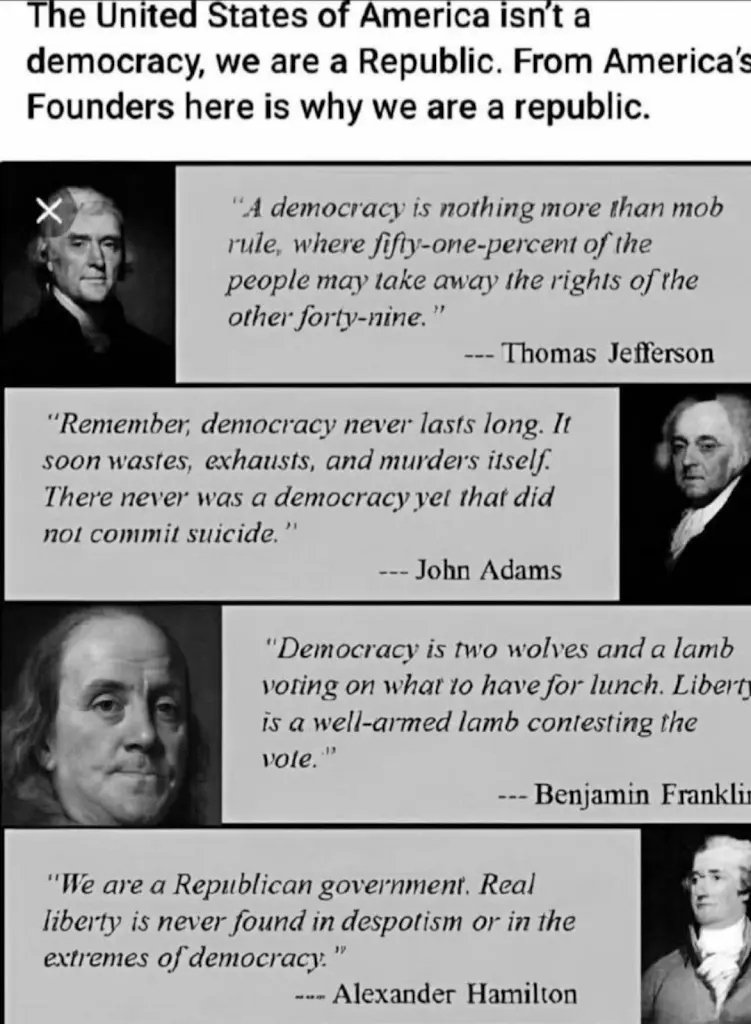
Posted in Uncategorized | Tagged: America, Democracy, Republic | Leave a Comment »
Posted by M. C. on October 10, 2023
John Dickinson pushed that kind of message forward during the ratification debates as well. He argued that enforcement of the Constitution ultimately comes down to the “supreme sovereignty of the people.”
“It is their duty to watch, and their right to take care, that the Constitution be preserved; or in the Roman phrase on perilous occasions – to provide that the Republic receive no damage.”
That’s a “Constitution Day” message we all need to be aware of.
By: Michael Boldin
A Republic, if you can keep it.
We’ve all heard this phrase – it’s almost legendary. People have used it in campaigns, slogans, as a book title, in support or against all kinds of things.
First of all, considering the fact that we live under the largest government in history, it should be obvious the Republic wasn’t kept. But there’s a lot more to the story – and Benjamin Franklin’s speech in the Philadelphia convention on the first “Constitution Day” – September 17, 1787 – has a lot more.
“Well Doctor, what have we got, a republic or a monarchy?”
A Republic, madam, if you can keep it.
There’s certainly a historical debate over whether it even happened – or if the conversation with the highly influential Elizabeth Willing Powel was elsewhere.
But all that is far less important than the message, which is part of what Dr. Franklin gave in the first speech of the last day of the Philadelphia Convention.
In the opening words of his speech, Franklin laments that “there are several parts of this constitution which I do not at present approve.”
He didn’t mention – at that point – any structural problems he had with the Constitution. Delegates were already well-aware of his areas of concern, such as his warning on June 4th that “The executive will be always increasing here, as elsewhere, till it ends in a monarchy.”
While we don’t live under an hereditary monarchy, we certainly see an executive branch with an extremely dangerous amount of power today. It’s just what other founders, such as Thomas Jefferson and Richard Henry Lee called “an elective despotism”
Back to Franklin’s speech. He did express his chief worry – that the people wouldn’t do their part to support it. His words were eerily prophetic.
“In these sentiments, Sir, I agree to this Constitution with all its faults, if they are such; because I think a general Government necessary for us, and there is no form of Government but what may be a blessing to the people if well administered, and believe farther that this is likely to be well administered for a course of years, and can only end in Despotism, as other forms have done before it, when the people shall become so corrupted as to need despotic Government, being incapable of any other.”
Franklin understood human nature. He suspected the government created by the Constitution would eventually fail. But not because of any specific structural defect that may exist in the document itself. He said that the Constitution would be “well administered for a course of years.”
But he predicted it would go off the rails if the people did not do their job in keeping that government within its limits. At that point, it would become incapable of operating under anything other than despotism.
Be seeing you
Posted in Uncategorized | Tagged: Benjamin Franklin, Constitution, constitution-day, Republic | Leave a Comment »
Posted by M. C. on September 7, 2022
The weaponization of the federal government has become complete with the creation of 87,000 armed IRS agents trained to kill, and with the Biden Administration’s open policy of criminalizing political opposition for the crime of wanting to Make America Great Again.

https://josephsansone.substack.com/p/the-republic-has-flatlined
The comparison of America to ancient Rome is routine for a few reasons. Western civilization and culture are largely an extension of ancient Roman civilization. Even our Judeo-Christian heritage was shaped by Rome with Emperor Constantine and the Council of Nicaea. Specifically, the American republic is a reincarnation of the ancient Roman republic. Although, the ancient Roman influence was present throughout the Dark Ages and Middle Ages, the Italian Renaissance created a cultural identification with the ancient Roman republic and inspired classical education for centuries in Western Europe.
The Italian Renaissance was the epitome of Charles Dicken’s immortal words “it was the best of times; it was the worst of times”. An age of enlightenment that produced Michele Angelo and Leonardo Davinci, and city state republics creating a short lived new golden age (i.e. Renaissance) in Italy that riveled that of ancient Greece. It also produced Machiavelli’s The Prince and was marked by constant violence and assassinations.
This rebirth of civilization tapped into an energy that laid dormant for a thousand years. The Romans had three distinct political periods. The kings, the republic, and then of course, the empire. The American founding fathers modeled the American republic after the Roman republic and started an experiment that changed the world. The Roman republic lasted approximately 450 years. That is uncommon. The truth is that most republics don’t last that long. The elected representatives’ degree of corruption usually reaches a boiling point, which leads to a dictatorship.
When Julius Caesar crossed the Rubicon, he was cheered as he was actually rescuing the citizens from the tyranny of the senators, as their level of corruption and oppression reached a pain threshold that could no longer be endured. The Roman senators were the technocrats of the age. The senate’s brutal assassination of Julius Caesar was arguably not to save the republic, it was to save the gravy train. Civil war followed and then Rome had an emperor Augustus and pax Romana began a new golden age for Rome.
This pattern of republics becoming corrupt and failing is maybe best exemplified by Poland. In the late 1700s Poland’s republic, weakened after civil conflict, had became so corrupt that its legislators gradually sold off partitions of the country to Russia, Prussia, and Austria, and eventually, the country ceased to exist. This was partly due to corruption and partly due to intimidation. Napoleon attempted to create a Polish area of self government, and there was another brief attempt, but essentially, Poland was not a sovereign state again until it was reinstated after World War I in the early 20th century.
America’s republican roots run deeper than Rome. They actually trace back to the Etruscans. The Etruscans were considered the holy people of the ancient world. Unique from all other cultures, the Etruscans prophesized and knew their distinct culture would only last a thousand years. Although, it did not actually die, as much of it was absorbed by Roman culture. The original twelve cities were on hilltops spreading across northern central Italy from coast to coast. The cities were originally ruled by the Lucumo, the god king. The Lucumoni eventually waned in power and were replaced by kings and then republics sprung up among the city states.
Etruscan culture was decentralized, however, and the cities were a confederacy. The fasces, made up of twelve rods and a double headed ax, represented the twelve original cities. This symbol was later bastardized by 20th century fascists. Arguably Etruria was the most advanced civilization at the time. The Etruscans were so wealthy that their slaves owned property and operated businesses and woman had equal rights. The next time you go out to dinner with another couple, recognize that this tradition started with the Etruscans. As a navel power the Etruscans riveled ancient Greece and the Phoenicians.
The wealth and power that accumulated in Etruria may be partly credited to its decentralized confederacy and open society. In fact, this distribution of power was evident in Etruscan cosmology, Tinia, the Etruscan equivalent to Jupiter Optimus Maximus and Zeus, had to consult with his committee of gods before striking you dead with a thunderbolt. Due process. An interesting concept. Although fierce in combat, it has also been argued that the Etruscans were too decentralized, and this hampered military coordination. The original American articles of confederacy may have resembled the Etruscan system more so than the Romans. This thinking that too much decentralization leads to weakness from external threats led to the U.S. Constitution and the creation of a more centralized system.
Caveat. The more centralized system of government envisioned by the American founding fathers is nothing like we see today. It is safe to say that if General Washington were alive today, he would have formed a continental army and replaced our current government in the past two and a half years.
Be seeing you
Posted in Uncategorized | Tagged: American Republic, Empire, Flatlined, Republic, Roman civilization | Leave a Comment »
Posted by M. C. on February 1, 2022
-cracy: From Greek; Rule, Government
Non-: From French; No. English; not, nothing
Nonocracy
Throughout the plandemic this has proven to be the future of government if we are to live as free peoples.
https://thegoodcitizen.substack.com/p/nonocracy-and-the-montgomery-brewster
-cracy:From Greek; Govern, Rule, Government
What is the Best form of Government?
One of the strongest natural proofs of the folly of hereditary right in kings, is, that nature disapproves it, otherwise, she would not so frequently turn it into ridicule by giving mankind an ass for a lion. – Thomas Paine
Monarchy
History is replete with critiques of monarchy that could fill a million essays and still leave no room for the kind words, so I will try and focus on the good here. It was consistently proficient in being the dominant form of governance through most of post-antiquity. Despite methods employed, there must be something to be said for that, and perhaps it’s also in the willingness of subjects toward subjugation, something we’ve seen too frequently during the pandemic.
Monarchy gets a bad wrap from historians and democracy sycophants. It wasn’t so bad, so long as you were the monarch or were within the royal court, though you never wanted to be too close to the monarch, nor too distant. Somewhere between dutifully obedient and forgettable was a fine balance to keep your head. Literally.
Hereditary monarchs could be temperamental, cruel, abrasive, impulsive, demanding and indifferent, though many were well educated, thoughtful, wise and measured. The problem with monarchs is you never knew what you would get next. Perhaps with advances in DNA and medical technology we could try this again to make sure syphilitic princes never became kings, who over-taxed overseas colonies into revolt.
The more interesting question we should be compelled to ask given our recent suffered tyrannies is how would a monarch have behaved the past two years aside from complete self isolation and abandonment of his subjects? Would they have done any worse by not doing anything at all? Or worse than five dozen governors, presidents and prime ministers did in locking up healthy people who were never in any harm and forcing them to be injected to enrich corporations that owned them? Would the monarch have told Pfizer and Moderna executives and his health advisors, the minute he knew their products were a travesty and deadly for his subjects, to line up in the town squares across his land to be pelted to death with rocks? Maybe we should be rethinking this one.
Democracy
The historical model for this form of government is Athens, Greece, and unlike Monarchy it often gets too much praise. It’s deficiencies are plenty, with the ‘tyranny of the majority’ the most obvious. Look around at public polling data about the pandemic lately and you’ll see this in action first hand. 81 million votes for Brandon Ice Cream Dementia? Even if it was true, which it’s likely not, this is the primo historical example of the tyranny of the majority in action. Elections have consequences and as those entrusted with counting the votes in elections know in Langley, it is only they who really matter.
The word democracy today is nothing more than a rhetorical political weapon to wield in justifying tyrannies whenever rulers need to gaslight their constituents. The assumption always being that whatever is a threat to their tyranny is a threat to democracy itself. It’s a protective shield to hide from the blowback of their own atrocious incompetency. Where the media lies, alternative media that dares tell the truth is “disinformation”. Where the media are stenographers for power, alternative media that exposes their corruption are a “threat to democracy.” This rhetoric can be weaponized for any ends today. Substack is the latest target du jour of the blue check managerial mid wits crying about the unwashed people seeking the truth from alternative sources. These cretins really detest the people, and only love one type of democracy, where the outcome can be arranged through algorithmic manipulation, censorship of the truth and mass coercion between corporate and state powers. This is called Sophisticated Democracy.
Republic
The Roman republic was truly a masterful exercise in measured and balanced governance for the time and an example for many in the future to build upon, though like all forms, not without worthy criticisms. Plato’s version would never work today. The most wise among society are ostracized or outright ignored. Even if the most worthy of the role of ‘ruler’ knew it was he who should pursue the challenge, imagine all the compromises of conscience required to fundraise, ass kiss, simplify their thoughts for the commoners and debase their moral principals to participate in such a lowly system. Plato addresses the consequences of refusing this ‘duty’: “The heaviest penalty for declining to rule is to be ruled by someone inferior to yourself.” And so we are constantly ruled by the most corrupt, compromised and least worthy.
The most worthy are always kept so far from power that the idea of a thoughtful and wise ruler would be impossible to realize today. Picture a campaign rally, with thousands on their phones hardly able to focus on anything longer than a goldfish can, and they’re gathered before someone like a modern-day Abraham Lincoln giving his Peoria speech against slavery. Most people would be incapable of comprehending much of it, let alone focusing on content and taking it all in for…three hours.
When Netflix documentaries (grade A propaganda), Young Turks episodes and Joe Rogan podcasts are the “deepest” philosophical engagements of a minority of the people, while the majority dance on TikTok and try to “get in her DMs”, than the majority are ill equipped to identify the wisest and most competent in society, so where democracy fails in tyranny of the majority, Plato’s republic fails in incapacity of the majority. The arrogance of the thesis is only outdone by the ignorance of its antithesis, the wisdom of the ruler collapses at the feet of the ignorant ruled. In short, the people would fail to recognize the most worthy if she destroyed all the others on a debate stage in a white pantsuit while saying “Aloha”, or he dared to say that the invasion of Iraq constituted a war crime in 2008 AND had the title of Doctor.

That leaves the greatest constitutional Republic and the greatest founding governing document ever in limbo for at least a century. One could point to the Federal Reserve Act or Income Tax Act or National Security Act and Patriot Act and two dozen other nails in this republic’s coffin, a futile exercise in historical squabbling. All of it had such tremendous potential, and still carries so much promise for so many, if only it could ever be restored.
Be seeing you
Posted in Uncategorized | Tagged: Democracy, Monarchy, Montgomery Brewster, Nonocracy, Republic | Leave a Comment »
Posted by M. C. on December 19, 2021
The design of our constitutional republic, for better or worse, was to protect individual liberties and private property by limiting the power of government. That’s why leftists hate it.
Late-night political hack and former comedian Stephen Colbert doesn’t usually warrant any notice, but he stumbled onto an important truth recently. Lamenting the possibility that the Supreme Court may overturn Roe v. Wade, he whined that if only 27 percent of Americans (according to a Washington Post/ABC News poll) support such a move, and the court doesn’t vote the way he and a majority of Americans prefer, “We don’t live in a democracy.”Democracy or a republic? I say: Let’s restore our founding system — a republic — to our land. That would be something to celebrate.
[Click to Tweet]
But we weren’t supposed to live in a democracy. We were supposed to live in a republic.
A story, probably apocryphal, is told that upon exiting the Pennsylvania statehouse at the conclusion of the Constitutional Convention in 1787, Ben Franklin was approached by a passerby. “What have you given us,” the woman asked him. “A republic, if you can keep it,” he replied. While the word “republic” to a Democrat is like a cross to a vampire, it is unquestionably the type of government the Founders created in our Constitution. The design of our constitutional republic, for better or worse, was to protect individual liberties and private property by limiting the power of government. That’s why leftists hate it.
The word “democracy” does not even appear in the Constitution, nor does it appear in that document’s philosophical antecedent, the Declaration of Independence, which stated boldly the revolutionary idea that everyone is “endowed” with unalienable rights – to life, liberty, and the pursuit of happiness. This assertion upended the idea that individuals were mere “subjects” beholden to their betters, cogs in a machine worthy of consideration only insofar as they served the purposes of the elite. The Framers wanted regular elections, but that was simply a peaceful means to eject recalcitrant politicians acting against the interests of the people.
Anti-democratic mechanisms were consciously built into the Constitution. Inspired by an eighteenth-century French political philosopher named Baron de Montesquieu, a system of checks and balances was established. The executive, legislative, and judicial branches were created, each with the ability to stymie the others. Members of the U.S. House of Representatives, elected directly by the people, could pass legislation, but it could die in the Senate; a bill passed through both chambers faces a potential veto from the president, chosen via an Electoral College, not popular vote, and a super majority is required to override that veto. Finally, despite overwhelming support, courts can strike down any law that violates the Constitution.
Interestingly, in a recent report that could easily have been written by a member of the Democratic Party, the Chinese Foreign Ministry specifically highlighted this as proof of our system’s alleged failure. It read in part, “The U.S. political system has far too many checks and balances, raising the cost of collective action and in some cases making it impossible altogether. . . . There is an entrenched political paralysis in the U.S.” [Emphasis added]
This analysis, meant as a criticism, is actually very revealing. Afterall, when Communists are upset about something, it’s likely good for individual freedom! Leftists get misty-eyed when talking about “democracy,” claiming they simply want to “empower” the “common people,” but the truth is they despise voters and are happy with the electoral process only when things go their way. Witness their reaction to the recent election in Virginia, which leftwing commentators denounced as “racist” – despite the victory of a female black immigrant (!) in her run for lieutenant governor. The long-serving president of the state senate in New Jersey was defeated by a truck driver, in his first bid for public office. The left-wing Atlantic smeared his victory as “populist moonshine.” Arch-“progressive” Hillary Clinton claims – oblivious to the irony – that a Trump victory in the 2024 election will spell “the end of our democracy.”
The Framers wanted it to be difficult to pass laws. They also wanted the sphere in which government acted to be quite small, enumerating the limited powers of Congress in Article I, Section 8, of the Constitution. Further protections are found in the Bill of Rights—the 10 amendments to the Constitution forbidding government from infringing the rights of Americans -– even with majority approval. For example, the First Amendment shields unpopular speech from criminal prosecution – no matter what; the Sixth Amendment guarantees that a criminal defendant will be tried by an impartial jury – not by popular opinion or by vengeful government officials; the Eighth Amendment protects the worst offender against “cruel and unusual punishment,” even if the mob wants his head on a pike.
Democracy or a republic? I say: Let’s restore our founding system — a republic — to our land. That would be something to celebrate.
This post was written by: Scott McPherson
Scott McPherson is a policy adviser at the Future of Freedom Foundation, and author of Freedom and Security: The Second Amendment and the Right to Keep and Bear Arms. An advocate of the Free State Project, he lives in Portsmouth, New Hampshire.
Be seeing you
Posted in Uncategorized | Tagged: Constitution, Declaration Of Independence, Democracy, Republic | Leave a Comment »
Posted by M. C. on June 24, 2021
We can be sure however that radical de-centralization at home can only reduce the matters with which U.S. foreign policy deals, and hence increase the likelihood that they be dealt with soberly.
https://americanmind.org/salvo/to-rescue-a-nation/
Peoples become nations by following those who lead them to worship the same God or idols, and to act habitually as they do. The Greeks called these habits “ethics.” These change for good and ill as prominent persons change, or develop new ways of life, or foreign influences impose themselves. The general population tends to follow. Plato and Aristotle led subsequent generations to note that peoples tend to take on their leaders’ character.
Some see such changes as betrayal. If these alienate a large enough proportion of people, the body politic itself loses the capacity to act as a whole. Enough disarticulation, and the body politic ceases to exist for practical purposes. Serious changes, regardless of their sources, lead some to want a resetting the country on what they regard as its proper basis—or outright resuscitation.
Machiavelli wrote that doing that amounts to re-founding a nation, and that this is considerably more difficult than founding one in the first place.
What does it take to re-found a nation? The question is lively for twenty-first century Americans because the changes that have taken place in the bipartisan ruling class that controls nearly all our institutions have explicitly denied and denigrated what had made America itself. Today’s ruling class leads and even forces Americans to act, speak, and think as if all that they had thought good were bad, and vice versa. Almost as if a vengeful power had conquered the country. At least half the country yearns for some kind of rescue.
Though history does not lack examples of nations rescued and refounded, most rescues involve overthrowing the dominion of foreigners rather than of mutated ruling classes. But as the Book of Exodus shows, the removal of foreign influence is almost always much less than half the battle. Reference to foreign oppression is often a necessary, but always an insufficient factor. Charles de Gaulle’s success against the Germans was not enough to overcome resistance to his efforts to restore France’s corrupt body politic. Without a foreign focus however, refounding can only be a civil war of variable temperatures. Abraham Lincoln’s failure to avoid the Civil War is as clear an example as there is.
Machiavelli’s near equation of reform with re-founding mostly abstracts from the fact that, for nations and regimes founded on and tailored for the people’s characteristics, repeating something like the founding is not possible once these have changed. Peoples are far less malleable than regimes.
On the one hand, successive generations of Romans were able to re-set Rome more or less on the basis on which Romulus had set it by killing his brother, Remus, who had trespassed on what became the Urbe’s fundamental law: war against outsiders. Successive Fathers of the Fatherland reaffirmed that law. And when Cleomenes judged that Sparta’s ephors had violated Lycurgus’s constitution, he deftly re-established it by killing the ephors and their followers. The Soviet regime’s fundamental law was the Communist General Secretary’s murderous discipline of the Party, which suffused society with fearful uncertainty. When Mikhail Gorbachev tried to rescue tyranny from the feudalism into which it had fallen under Brezhnev, he might well have succeeded had he been willing to kill as Lenin and Stalin had done.
Doubtless, rescuing disrespected constitutions has always required and will always require undoing any number of enemies.
But there is little historical evidence that peoples who had constituted themselves nations on the basis of freedom can convert that nationhood’s lively memory into rebirth.
Self-government ever reflects self, and lost civic virtue is almost as unrecoverable as lost virginity.
Divisive leadership
The political conflict in which we are engaged pits some Americans who revere the legacy and memory of the Republic founded in 1776-1789 against those who despise it and have corrupted the Republic’s institutions into an oligarchy.
See the rest here
Angelo Codevilla is a Senior Fellow of the Claremont Institute and professor emeritus of International Relations at Boston University.
Be seeing you
Posted in Uncategorized | Tagged: de-centralization, ethics, Machiavelli, re-founding, Republic, ruling classes | Leave a Comment »
Posted by M. C. on December 24, 2020
Trump, however, doesn’t represent the future of America. He’s weighed down with the mythology of an America that never really existed.
That mythology, however, is something worth building on not allowing Obama and The Vandals to tear down. I believe Gabbard understands this.
I also believe at least 75 million Americans understand this.
For the American people to not be frog-marched into the dystopian nightmare of Klaus Schwab’s dreams it will be the revealed character of the Gabbards, Massies and Pauls to lead once the violence reaches a crescendo.
https://tomluongo.me/2020/12/16/republic-dies-next-generation-must-rise-gabbard-paul/
Author: Tom Luongo
The first rule of screenwriting, or in fact any fiction writing, is, “Conflict doesn’t create character, it reveals it.” People are who they are and we only find out what they are made of when tested to their limit.
This is the essence of all good storytelling — create characters who rise to be role models for us as we navigate our way through a Universe hostile to our very existence.
While I hesitate to ascribe such noble ideas as ‘character’ to any politician there are a few out there who have shown great potential. I’ve written about all of them at various times in the past few years.
Matteo Salvini in Italy, Hungarian Prime Minister Viktor Orban, Russian President Vladmir Putin, Nigel Farage in the UK and even a flawed figure like Donald Trump are all examples of men who history will remember as having stood up when needed.
At times each of them tried to move heaven and earth to stop the degradation of society, culture and the human condition in the face of an implacable enemy – communist ideologues bent on forcing humanity into submission to their will.
But with the Supreme Court abdicating its primary responsibility under the Constitution last week citing itself in an unconstitutional ruling from 1925 (H/T Martin Armstrong for this) means it is over for Trump and the U.S. to stop the final transformation of the U.S. into an oligarchy in reality if not in spirit.
There is no mechanism for states to redress grievances of any import now. What was left of the compact between equal sovereign states died with a whimper in the halls of the SCOTUS and to thunderous applause by the BlueCheckMarked Sneetches on Twitter.
This means that a stolen election will in all probability stand up come Inauguration Day. The entrenched oligarchy has won this round.
Fine. But it doesn’t mean the efforts of the men I just listed will have been in vain. In fact, quite the opposite.
Because what it has done is revealed the character of everyone involved. What they do next now that they have the power they’ve always craved to transform America will determine what people who have principles other than raw power will do.
We’re beginning to see that response form up. This election isn’t over but the positioning for the future a post-republic America has already begun.

Since election day Tulsi Gabbard, a tweener between Gen-X and a Millennial, has been a non-stop source of, admittedly, Quixotic bills to put paid her insurgent campaign in the Democratic primaries as someone interested in fixing real foundational problems with the country and the bipartisan corruption in Washington.
She continues to reach across party lines introducing legislation which form the basis for a populist election strategy targeting the 2022 and 2024 elections.
From whistleblower protection to repealing Section 230 of the CDA to the bill in the tweet above co-sponsored with libertarian Thomas Massie, Gabbard is an example of what the future holds for the political future once this meta-stable, oligarchic rule-by-men period of America is over.
It’s clear that Gabbard wants no part of being a part of the Democratic Party that’s in power now. That’s why she didn’t run for re-election and I suspect these moves are all laying the groundwork for a return to politics in 2024 as an independent or Sanders-like outsider.
I’ve been writing for years now that our problems stem from an unwillingness of the older generations of politicians to give up power. If anything, they persist because they are owned by the forces that put them there in the first place to pull off this betrayal of the people that has been in the works for decades.
And they will stay in place until they are no longer needed. Just ask Diane Feinstein who is now being sacrificed to make way for the transition team to finish the job she started.
I always saw Trump as Gen-X’s moment to pull a Ronald Reagan and say, “Mr. Trump, tear down this Swamp!” but the real story is that Gen-X is allowing Obama to do that tearing down and hand what’s left back to the old monied elites.
The fight now is between the cross-currents within Gen-X. Equal parts commie and libertarian the one uniting principle is a desire to reform the old order.
It is my read that people like Gabbard, Massie, Sen. Rand Paul and a few others see the problem. Gabbard’s a leftist, but she’s no doctrinaire commie. That makes her and interesting pivot figure around which a coalition to retake control or build back better the U.S. can be formed. This will be necessary once Obama’s incoming crew of vandals overreaches and are thrown out on their asses.
Regardless of the outcome in the coming months and years the changing of the guard is close at hand. Post-Trump America will look very different than pre-Trump. Trump was the apotheosis of the Boomers.
His legacy will be forcing the Deep State into the open, bringing the fight against them out of the shadows.
Trump, however, doesn’t represent the future of America. He’s weighed down with the mythology of an America that never really existed.
That mythology, however, is something worth building on not allowing Obama and The Vandals to tear down. I believe Gabbard understands this.
I also believe at least 75 million Americans understand this.
For the American people to not be frog-marched into the dystopian nightmare of Klaus Schwab’s dreams it will be the revealed character of the Gabbards, Massies and Pauls to lead once the violence reaches a crescendo.
Make no mistake, there will be violence. It is inevitable because the people who voted for Trump will not be placated with UBI or settle down as their voices are silenced.
The fraudsters will forever be looking over their shoulders, lashing out at minor opposition as traitors who need to be put down.

Here we are presented with a staged picture with three white privilege guys straight out of central casting for the latest Obama-produced ‘documentary’ on equality coming to Netflix in the spring.
This is your “Unity” agenda from the most statist of state house organs, NPR, the echo chamber of choice for the low-information ‘informed’ shitlib. This is the face of the Biden/Harris administration.
This is just the beginning of what we can look forward to when the GOP loses both seats in the Georgia run-off and the Democrats, despite historically-low support and engagement with actual voters, run the table.
Once ensconced they will persecute their political enemies in ways only Alex Jones has contemplated to this point. And it will be this escalation that will reveal the quality of the character of these next-generation politicians.
They will have the choice, leader of men or cowards. The republic we’ve known is dead. Maybe that’s a good thing. But what comes after won’t be up to the people who just destroyed it. That job is the next generation’s job. Their moment is coming in the next couple of years. They will have to be ready.
Be seeing you
Posted in Uncategorized | Tagged: Constitution, Rand Paul, Republic, Supreme Court, Thomas Massie, Tulsi Gabbard | Leave a Comment »
Posted by M. C. on November 9, 2018
Snowden said. “Even if you’re not doing anything wrong, you’re being watched and recorded. You simply have to eventually fall under suspicion from somebody, even by a wrong call, and then they can use the system to go back in time and scrutinize every decision you’ve ever made, every friend you’ve ever discussed something with.”
https://www.lewrockwell.com/2018/11/l-reichard-white/democracy/
Remember this?
“I pledge allegiance to the flag of the United States of America and to the Republic for which it stands. …” –The Pledge of Allegiance
And how about this – – –
“We gave you a Republic if you can keep it.” –Benjamin Franklin
So we’ve pledged allegiance to the Republic the founders left for us. Not the democracy.
What’s the difference? Does it matter?
Despite the Pledge and the founders’ intentions, if you listen to “our” current U.S. politicos and main-stream media, you rarely hear “republic” mentioned. Instead we’re constantly barraged with “democracy.” Like this for example – – –
Clinton declares ‘crisis in our democracy,’ –Fox News
Noam Chomsky: Neoliberalism Is Destroying Our Democracy –The Nation
“These companies must do more than take down one website. The survival of our democracy depends on it.” –Senator Chris Murphy August 6, 2018
How Wobbly Is Our Democracy? –The New York Times
Many think our democracy won’t survive Trump. –The Washington Post
Posted in Uncategorized | Tagged: agitation, demagogism, Democracy, discontent, license, mobocracy, Republic | Leave a Comment »
 MCViewPoint