


Be seeing you
Posts Tagged ‘sanctions’
Weekly Update — Foreign Policy Fail: Biden’s Sanctions are a Windfall For Russia!
Posted by M. C. on July 8, 2022
Posted in Uncategorized | Tagged: Foreign policy, Russia, sanctions | Leave a Comment »
Coal Emerges Victorious As Sanctions And Green Policies Backfire Spectacularly
Posted by M. C. on July 7, 2022
By Tyler Durden
Shipments are soaring as the region scrambles to replace missing Russian product amid fears of continued declines in Russian nat gas exports – and a freezing winter- said Matthew Boyle, lead analyst for dry bulks, gas and LNG at Kpler Insight. Helping to fill the gap is more coal from the US, Colombia and Australia — countries that tend to produce better-quality or so-called high-calorific value material that releases more heat and energy when burned. Of course, the high quality product is also priced accordingly, and as shown in the chart above, Australian coal just hit a record high price, something which has led to Europe’s record 29.1% PPI.
When historians look back on this chaotic and turbulent period, they will find that few individuals inflicted as much damage on the environment and promoted the interests of the “dirty fossil fuel” lobby as Greta Tunberg, who by shaming and forcing “serious” politicians to pivot toward green energy at a time when there was nowhere near enough green capacity to replace existing sources of energy, sparked what may be the most spectacular self-own in history. And today, the WSJ, Bloomberg and Reuters all wrote about it.
We start with the WSJ which concedes what was obvious to most long ago (see “Will ESG Trigger Energy Hyperinflation” from last June), namely that “an energy-starved world is turning to coal as natural-gas and oil shortages exacerbated by Russia’s war against Ukraine lead countries back to the dirtiest fossil fuel.”
Yes, contrary to the intentions of Green fanatics everywhere, their push to accelerate away from “dirty” fossil fuel has not only backfired spectacularly, but also exposed the hypocrisy and empty promises of so many virtue-signalers, as “from the U.S. to Europe to China, many of the world’s largest economies are increasing short-term coal purchases to ensure sufficient supplies of electricity, despite prior pledges by many countries to reduce their coal consumption to combat climate change.”
Adding insult to injury, the global competition for coal which is now also in short supply after years of declining investment in new mines and resources, has driven benchmark prices to new records this year. Spot coal prices at Australia’s Newcastle port, a key supplier to Asia, topped $400 a ton for the first time last month.

Hilariously, the push for coal is being led by Europe, ground zero of the “green movement” which finally realized that one can’t burn fake virtue or melt posing in front of camera in the winter to keep warm, and is boosting coal purchases to ensure it can keep power flowing to homes and factories after Russia cut gas supplies to the continent. Germany, which not long ago promised to eliminate coal as a power source by 2030, is among the nations now importing more. Economy Minister Robert Habeck called the increased reliance on coal bitter but necessary. Spoiler alert: Germany will not eliminate coal as a power source by 2030, if anything it will be more reliant on it than ever unless it also restarts its nuclear power plants which it, idiotically, shut down not long ago.
Never one to admit it was dead wrong, however, Europe has a response to everything: “Right now the sentiment is that more coal is better than more Russia,” said Alex Msimang, a London-based partner at law firm Vinson & Elkins LLP specializing in the energy sector.
Whatever dude.
Be seeing you
Posted in Uncategorized | Tagged: Coal, Green Policies, sanctions | Leave a Comment »
Why Sanctions Always Fail
Posted by M. C. on June 27, 2022
The Enemy Always Adapts.

The misplaced belief in the efficacy of sanctions as a weapon may partly be traced to what is generally considered to have been their greatest triumph, the British blockade of Germany in world war 1 that supposedly starved the Germans into submission, a “very perfect instrument” in Keynes’ words. But as the late great Norman Stone pointed out, German food shortages were almost entirely due to government mismanagement, although the blockade, as usual, provided a convenient scapegoat.
https://spoilsofwar.substack.com/p/why-sanctions-always-fail
Early in the Ukraine war, President Biden boasted on twitter that thanks to “unprecedented” sanctions, the “Russian economy is on track to be cut in half” and the ruble had been reduced to “rubble.” All instruments of economic warfare had been deployed against Ukraine’s invader, from the freezing of central bank reserves to sanctions on Russian cats. Today, the cats may be still at home, but the ruble is at a seven year high, Russian interest and inflation rates are headed downwards, and industrial production is ticking up. Meanwhile Russian forces steadily advance in Ukraine.
Objective: “Hunger, Desperation, Overthrow of Government.”
All this represents a much larger defeat for sanctions than is usual in such offensives. In a memo on Cuban sanctions back in 1960 a state department official named Lestor Mallory described the purpose of such measures with unusual frankness (the memo was of course secret.) The aim, he wrote, was “..to bring about hunger, desperation and overthrow of government.” Twenty years later, again cloaking honesty in classification, the CIA intelligence directorate studied the record and concluded that “economic sanctions…have not met any of their objective” and had furthermore strengthened the regime, providing Castro with “a scapegoat for all kinds of domestic problems.” That pattern has endured: hardship for the sanctioned population, as exemplified by the half-million toll on Iraqi children during the 1990s, or the ongoing mass hunger in Afghanistan, while the ruling elite escapes unscathed and diverts any possible local disaffection among the immiserated populace in the direction of the sanctioning powers. This time around, the effect of sanctions has of course been double-edged. Not only has the Russian economy not collapsed, the sanctioneers, principally the Europeans, are themselves in an accelerating economic downslide, marked by rising inflation, in particular the catastrophic energy costs consequent on sanctions against Russian oil and gas.
Sanctions Work Just Like Bombing – Badly.
Be seeing you
Posted in Uncategorized | Tagged: Desperation, Hunger, Overthrow of Government, Russia, sanctions, Ukraine | Leave a Comment »
Russia Is Winning the Financial War
Posted by M. C. on June 24, 2022
The ending of the petrodollar era
https://www.goldmoney.com/research/russia-is-winning-the-financial-war
Sanctions have backfired on those described by Vladimir Putin as the unfriendly nations. It is setting in train a series of events likely to undermine the whole Western financial system, as prices rise driving interest rates higher, and economic activity shrinks. These developments alone are leading to contracting bank credit, crashing stock markets, and sharply higher bond yields.
Last week, I wrote about the impact on the banking system and the likely consequences. Russia, China, and associated nations who depend upon them for trade and economic development are now moving to protect themselves from what is emerging as a full scale systemic and fiat currency crisis for the dollar and the entire Western financial system.
These developments are hastening the end of the petrodollar era and the dollar’s role as a reserve currency. A central Asian replacement is planned to be a new super-currency used for cross-border payments, based on an index of a basket of commodities and currencies of the participating nations. Including currencies is a mistake, but otherwise the proposition has merit.
This article explains why and how a properly constructed scheme would work. I demonstrate why it could act as a de facto gold standard.
Its designers intend this new trade currency to appeal to other important nations, such as Saudi Arabia, into using a commodity-linked currency for settling their trade payments, replacing the dying petrodollar. But its success could prove to be fatal for the fiat dollar and other Western currencies. With the demise of the dollar, the new super-currency can be expected to lead eventually to some national currencies adopting gold standards.
The ending of the petrodollar era
Put Ukraine to one side, it’s not the major issue. We should realise what really matters to us all is the real war, which is Russia’s attempts to banish American hegemony in Europe. While in the West we have an image of President Putin as an evil despot determined to take Ukraine back under Russian control, in a speech at St Petersburg’s International Economic Forum this week, Putin’s diagnosis of the West’s problems was more to the point than anything you will hear from our own Dear Leaders: Joe, Boris, Emmanuel, Olaf, et al. It is worth citing relevant extracts from the official English translation of Putin’s speech to highlight his economic understanding of the pickle we in the West have got ourselves into:
“Surging inflation in product and commodity markets had become a fact of life long before the events of this year. The world has been driven into this situation, little by little, by many years of irresponsible macroeconomic policies pursued by the G7 countries, including uncontrolled emission and accumulation of unsecured debt. These processes intensified with the onset of the coronavirus pandemic in 2020, when supply and demand for goods and services drastically fell on a global scale…
“Because they could not or would not devise any other recipes, the governments of the leading Western economies simply accelerated their money-printing machines. Such a simple way to make up for unprecedented budget deficits…
“I have already cited this figure: over the past two years, the money supply in the United States has grown by more than 38 percent. Previously, a similar rise took decades, but now it grew by 38 percent or 5.9 trillion dollars in two years. By comparison, only a few countries have a bigger gross domestic product. The EU’s money supply has also increased dramatically over this period. It grew by about 20 percent, or 2.5 trillion euros.
“Lately, I have been hearing more and more about the so-called – please excuse me, I really would not like to do this here, even mention my own name in this regard, but I cannot help it – we all hear about the so-called ‘Putin inflation’ in the West. When I see this, I wonder who they expect would buy this nonsense – people who cannot read or write, maybe. Anyone literate enough to read would understand what is actually happening.
“The rising prices, accelerating inflation, shortages of food and fuel, petrol, and problems in the energy sector are the result of system-wide errors the current US administration and European bureaucracy have made in their economic policies. That is where the reasons are, and only there.”[i]
Putin shows that he has at least a superficial understanding of where the West has erred with its neo-Keynesian monetary and economic policies. While some of the economic and monetary elements in his address can be criticised, Putin’s grasp of these subjects puts him head and shoulders above his opposite numbers in the G7.
It is from this disadvantage that the US is trying to impose dollar hegemony on Russian interests in the financial and currency war. We must consider the geopolitics of the matter.
Be seeing you
Posted in Uncategorized | Tagged: Financial War, petrodollar, Russia, sanctions, Vladimir Putin | Leave a Comment »
You Don’t Know Whether to Laugh or to Cry. The EU Now Has a Masterplan to Hit Putin Where It Hurts
Posted by M. C. on May 6, 2022
Given that some EU member states have made it pretty clear that they don’t have the means or resources to look for alternative sources of gas, for example, it’s hard to see how an EU directive is going to make any differences.
By Martin Jay
Strategic Culture
Hit Putin where it hurts? He’s more likely to hurt himself from laughing. Try harder, Ursula.
The EU is about to unveil its own sanctions plan to wean its own member states off Russian oil. But getting backing from all EU governments might be harder to push it through. Try not to laugh.
On the foreign policy circuit the EU doesn’t have an impressive track record. For anything. More, if anything, for leaving a trail of havoc in its wake when it dabbles in international politics. The problem is simply that the EU, while quite capable at agreeing on new directives for the size of your windscreen wipers, or the size or shape of a given piece of fruit, struggles with the big stuff. There simply isn’t the support from member states yet to hand over to Brussels how those same governments unilaterally deal with conflict around the world. The result is actually quite comical as who can forget Federica Mogherini’s offer to both President Assad of Syria and opposition fighters of cash from the EU to stop the war? Or for the same office to suggest using British frigates off the coast of Libya to literally blow out of the water smuggler boats laden with African migrants trying to get to Europe. Or that unforgettable foray into conflict resolution on the Chad border in 2001 where French officers under a so-called peacekeeping mission from the EU fled for their lives when rebels actually started firing live rounds at them? Imagine. Live rounds.
And then there was the EU police force in Afghanistan which was so terrified of the streets of Kabul that they simply decided it would be safer for them, even though they were armed, to stay in their barracks. And then the fiasco of Covid where the EU couldn’t even get an agreement from its own governments on how to proceed with a rescue plan and so did nothing, while thousands of its own citizens died. Even Brexit was a catastrophe for the EU, given that after all that drama over the negotiations and the empty threats by Brussels, Britain turns out to be not merely a survivor but a champion with economic growth the envy of the 26-member bloc.
The list just goes on and on. Someone really should write a book about the EU’s comical attempt to be a superpower and how it fails every single time.
And it will be the same with the latest escapade from the European Commission’s own President who seems to have set a new record for being especially ineffective – even for European Commission presidents. Ursula von der Leyen, an unremarkable German politician, bereft of any real dynamism and a particularly obscure foreign minister when she held the post, is grasping the nettle and facing Russia head on. Oh yes she is. Dear Ursula has a new draft directive which will ensure that all EU member states will abandon their deals with Russia oil, or at least phase them out over a period of time. We don’t know what the timeline is but the ambitious plan will have to have the support of all member states and this where it might run into some obstacles. Given that some EU member states have made it pretty clear that they don’t have the means or resources to look for alternative sources of gas, for example, it’s hard to see how an EU directive is going to make any differences. Some might argue that an EU directive is a by-product of a lack of unity in the first place and so the failed superstate needs to look to the bureaucrats to find a fix. But contrary to popular belief, the EU Commission isn’t as powerful as it likes to believe and cannot impose draft legislation on member states or the European parliament for that matter.
Realistically, the Russia move is an act of desperation following the EU’s grotesque support for U.S. and British objectives in Ukraine, i.e the toppling of Putin. The announcement shouldn’t therefore be taken seriously and given the recent Covid ordeal which lost von der Leyen considerable credibility it’s hard to see how she can galvanise opinion across 26 member states. What’s more likely is that this latest ruse will be a rod for her own back as more independently-minded EU member states who have made the headlines of late for not getting in line, will use it as a political tool to hit back at Brussels. And time is also a factor. If, say, it takes a year to be adopted – which is fast tracked – has the Commission president considered the present financial hardship that many EU citizens themselves are facing due to the Ukraine war and the political blowback that this directive would have, if adopted? While Joe Biden says remarkably stupid things like the U.S. is looking to Qatar for a solution to Europe’s energy dependency (they haven’t got any spare capacity to ship to Europe), it seems the EU is duty bound to follow the trend of talking nonsense and producing fake news. Hit Putin where it hurts? He’s more likely to hurt himself from laughing. Try harder, Ursula.
The views of individual contributors do not necessarily represent those of the Strategic Culture Foundation.
Copyright © Strategic Culture Foundation | Republishing is welcomed with reference to Strategic Culture online journal http://www.strategic-culture.org.
Be seeing you
Posted in Uncategorized | Tagged: EU, Masterplan, Putin, sanctions | Leave a Comment »
Biden Admits That Sanctions Don’t Work and They Make Us Poorer | Mises Wire
Posted by M. C. on March 30, 2022
“Hey, food shortages are just the price you little people gotta pay!”
https://mises.org/wire/biden-admits-sanctions-dont-work-and-they-make-us-poorer
President Biden on Thursday made two big admissions about the US-led economic sanctions on Russia. The first is that the sanctions will lead to food shortages for many countries other than Russia, and that this is simply the price that Americans ought to be forced to pay.
The second admission was that sanctions haven’t worked to change Moscow’s policies, and that “sanctions never deter” the targeted regime from carrying out aggression.
So, Biden has helpfully now explained this week not only that sanctions haven’t actually deterred Moscow, but that the people of the United States ought to pay more for food in order to maintain sanctions that don’t work.
These admissions come after repeated claims from the White House and Biden supporters claiming that sanctions would deter Russia from carrying out or sustaining an invasion of Ukraine.
Moreover, the White House has repeatedly downplayed the effect that sanctions would have on the cost of living for American households. (The fact that sanctions may have a devastating effect on poor countries is, of course, ignored.)
So, Biden has now made it clear: sanctions don’t work, and they’ll make you poorer. But we must keep them in place anyway.
What Exactly Did Biden Say about the Cost of Sanctions?
After attending a meeting of G7 and NATO leaders on Thursday, Biden said food shortages “are going to be real.” He then added “The price of these sanctions is not just imposed upon Russia, it’s imposed upon an awful lot of countries as well including European countries and our country as well.”
Of course, these “costs” extend beyond food into energy prices and the prices of many other goods as well. Oil prices remain near a ten-year high.
It is notable that Biden admits the sanctions themselves are a key factor in the coming shortages. On the other hand, it has been common practice for supporters of sanctions to claim that it is only the Russian invasion that has curtailed food availability. Yes, the invasion naturally lowered food production in Ukraine, but it’s clear the US-led sanctions will diminish food availability for dozens of African countries, many of which are heavily dependent on Russian grain.
Fortunately for Americans, North America is a food exporting region, and the US itself is a net food exporter, even in spite of the fact that Americans consume more calories than any other country. In other words, Americans are a long way from subsistence levels when it comes to their diets. Obesity, not malnutrition, is the order of the day in America. But the American cost of living will nonetheless be negatively affected. We should expect food prices to increase beyond even what we might have expected due to the central banks inflationary policy which drove overall price increases—pre-Ukraine War—up to nearly eight percent.
This is because even though Americans are food exporters, the sanctions will further drive up global prices of food commodities while ensuring that many of our trading partners must devote more of their resources to acquiring food. That means lowered productivity and investment for trading partners in the goods that Americans buy. In turn, that means lowered supply and rising prices for American consumers.
If Sanctions Don’t Work, Why Bother?
Biden’s admission that sanctions “never deter” contradicts weeks of claims by White House officials who have insisted that sanctions would force Russia out of Ukraine. For example, Kamala Harris claimed “the deterrence effect of these sanctions is still a meaningful one” and Deputy National Security adviser “Daleep Singh said “Sanctions are not an end to themselves. They serve a higher purpose. And that purpose is to deter and prevent.”
Moreover, in February, National Security adviser Jake Sullivan said, “The president believes that sanctions are intended to deter…. [a]nd in order for them to work—to deter, they have to be set up in a way where if Putin moves, then the costs are imposed.”
The fact that White House has been forced to change it’s story has highlighted in a short period of time how the sanctions have already failed to achieve their goals. In an effort to explain away the failure, Biden then claimed in a rambling response that he never said sanctions deter anything:
Let’s get something straight. If you remember, if you have covered me from the beginning, I did not say that in fact the sanctions would deter him. Sanctions never deter. You keep talking about that…. Sanctions never deter. The maintenance of sanctions. The maintenance of sanctions. The increasing the pain, and that’s why I asked for this NATO meeting today, is to be sure after a month we will sustain what we’re doing not just month, the following month, but for the remainder of this entire year. That’s what will stop him.
So, the new party line is that sanctions didn’t deter Russia from anything, but they’ll some day cause enough pain to force Russia out of Ukraine. This is just more wishful thinking from the White House, and the abysmal success record of economic sanctions makes this clear.
As we noted here at mises.org, sanctions have a terrible record of achieving the stated goals of forcing policy changes in targeted regimes. This is because targeted regimes tend to double down on sanctions rather than comply with sanctioning states. In other words, nationalism is more powerful than the economic hardship imposed on the targeted states. A second barrier to success is this: if the US wants to impose truly effective sanctions, it will need to get nearly universal cooperation from other states. Without that sort of cooperation, other states will provide multiple lifelines to the targeted regime.
In the case of Russia, we’ve already seen this in spades. Germany has refused to cut off Russian energy exports. Mexican legislators from the ruling party are forging a new “Mexico-Russia friendship” caucus. India is now in the process of working out a new rupee-ruble trade arrangement to get around US sanctions. China, of course, says it will do what it wants.
This all follows the usual script of economic sanctions and helps illustrate why they fail. What is remarkable is that the White House has been so quickly forced to admit both that sanctions have failed to achieve the clearly stated goal of deterrence, and that the White House thinks it’s fine to shrug and say, “Hey, food shortages are just the price you little people gotta pay!” Given the impotence of sanctions, and the damage being done to third parties, it’s time to admit the reality and move on.
If Washington really wanted to end the bloodshed—instead of actively discouraging peace as it is now doing—it would be aggressively pursuing a negotiated settlement and ceasefire.
Author:
Ryan McMaken (@ryanmcmaken) is a senior editor at the Mises Institute. Send him your article submissions for the Mises Wire and Power and Market, but read article guidelines first. Ryan has a bachelor’s degree in economics and a master’s degree in public policy and international relations from the University of Colorado. He was a housing economist for the State of Colorado. He is the author of Commie Cowboys: The Bourgeoisie and the Nation-State in the Western Genre.
Be seeing you
Posted in Uncategorized | Tagged: Food Shortages, Russia, sanctions | Leave a Comment »
Surprise! Biden Says Sanctions Will Cause Food Shortages
Posted by M. C. on March 26, 2022
President Biden alerted us that, as a result of sanctions on Russia, food shortages for Americans are “going to be real.” So, for a fight on the other side of the world, that doesn’t threaten American interests in the least bit, the American people are supposed to suffer from a lack of food? Does that sound like a good foreign policy to you?
Be seeing you
Posted in Uncategorized | Tagged: Food Shortages, Russia, sanctions | Leave a Comment »
Sanctions against Russia Are the Lockdowns of 2022 | Mises Institute
Posted by M. C. on March 9, 2022
As Austrian economists have long pointed out, it is no coincidence that the century of total war rose at the same time as the era of central banking. By relying on debt and the printing press rather than direct taxation, nations could hide from the public the immediate costs of war. Over time, global powers have turned central banks into weapons themselves. America’s abuse of its power has even forced longtime allies to speak out.
https://mises.org/power-market/sanctions-against-russia-are-lockdowns-2022
Russia’s invasion of Ukraine is nearing its second week. Vladimir Putin’s military continues its push west, with clear attempts to encircle Kyiv. To date, thankfully, America and its North Atlantic Treaty Organization (NATO) allies have held off pleas from President Volodymyr Zelenskyy to enforce a no-fly zone, which would risk the eruption of a new hot world war. So instead, along with supplying arms, intel, and—potentially—runways and planes to Ukraine, the focus of the West has been economic warfare.
What is not clear is whether the West is prepared to deal with the actual consequences of this approach.
It seems that with every passing day, America and its allies find tools to escalate financial pressure on Putin. What began with targeted sanctions on the Russian leaders and oligarchs has expanded to cutting off Russian banks from SWIFT, broad attacks on Russian industries, and now complete bans on Russian oil and other exports by some—though not all—NATO countries. Moreover, Western corporations have reinforced these policies by indiscriminately banning Russian customers from various services.
This coordinate blanket canceling of Russia is not a tool crafted by the necessity of the situation, but rather a new application of the form of warfare that the West has become the most comfortable with. America’s weaponization of the dollar-backed financial system began with the war on terror, utilized against rogue state actors like North Korea, Iran, and Venezuela (the latter two Washington is now seeking assistance with for oil) and is increasingly used against domestic enemies.
Even the Swiss historical tradition of neutrality has failed to hold in an era of financial war.
Unfortunately for the West, Vladimir Putin is a far shrewder adversary than Kim Jong Un or Nick Fuentes. Russia is not only a major energy provider to global—and, in particular, European—markets but is a globally important exporter of wheat, fertilizer, metals, and other strategically important resources. To add to these concerns, the West has become increasingly frustrated by the refusal of other global powers—including India, Brazil, Mexico, and China—to follow their lead.
None of this should be particularly surprising. China’s interest in using Russia as a foil against American global hegemony has been clearly illustrated for years—even prior to Trump-era escalation and the covid outbreak. Nations like India, Brazil, and Mexico have seen the rise of nationalist political parties that have echoes Putin’s critiques of the globalist West.
Already Putin has demonstrated a willingness to wield his natural resources as a wedge to pull traditionally subversive global actors away from America’s leadership. The Russian government has made a list of countries that have been hostile to its military actions and has directed trade to favor countries that have remained neutral. Meanwhile, Russian nationalists have celebrated the West’s economic response to the Ukraine invasion, identifying the possibility of shifting consumer trends away from America- and Europe-based companies toward Eurasian products.
As a result, it is precisely the Russians that are the most culturally aligned with the West that are the most penalized by the American response to Putin’s actions. This is similar to the way American sanctions against Iran most victimized the most liberal members of their society.
While the West has made vividly clear its sense of moral self-righteousness in imposing this financial warfare, it is less obvious whether there are any planned off-ramps to deal with the shock back home. In America, gas has already hit all-time highs, while market signals indicate that the cost of food, energy, and other vital resources is soon to follow. In response, the Biden White House and its allies have lectured Americans on the virtues of electric vehicles and other forms of “green energy.” Not even Tesla’s Elon Musk believes this line of logic holds up.
Ultimately any attempts by Western governments to soothe the concerns of their citizens depend upon convincing them that the very same expert class that believed preconflict inflation was “transitory” is intellectually equipped to handle this new conflict. It is uncertain how successful they will be.
The question largely left unasked as firefights continue to play out on Ukrainian streets is what the long-term consequences of the West’s financial war on Russia will be. If peace were to break out tomorrow, what would that mean for market actors?
Many of the same leaders that have engaged in an increasingly vicious economic conflict with Russia supported debilitating lockdowns in the face of covid. In the case of the latter, many seemed to act as if the economy could simply be turned on and off with relative ease—like a computer suffering from an operating malfunction. The world is still dealing with the consequences. How long will the scars from this last?
What if Russia and China are serious about undermining America, the dollar, and its subservient allies? What if Putin recognizes that the economy of the debt-saturated West is far weaker than our policy makers believe it is? Is there any reason for Americans to question the judgment of the decision-makers at the Fed or Treasury?
As Austrian economists have long pointed out, it is no coincidence that the century of total war rose at the same time as the era of central banking. By relying on debt and the printing press rather than direct taxation, nations could hide from the public the immediate costs of war. Over time, global powers have turned central banks into weapons themselves. America’s abuse of its power has even forced longtime allies to speak out.
In 2020, global powers ignored the economic consequences of lockdowns in order to “boldly” respond to the perceived risks of covid. The damage done was catastrophic, and the impact of the policies was minimal.
In 2022, many of those same global powers are destroying the lives of innocent Russians to signal their virtuous opposition to invasion. Unfortunately, when the dust settles, the underlying damage done to their nations may be far worse.
Be seeing you
Posted in Uncategorized | Tagged: Austrian economists, central banking, lockdowns, Russia, sanctions, Ukraine, Vladimir Putin | Leave a Comment »
Psaki Claims Biden “Didn’t Mean It” When He Said “No One Expected Sanctions To Prevent Anything”
Posted by M. C. on February 25, 2022
Biden and the democrat voters have done the impossible. Make Trump look like a genius.
Just go to the link. WordPress and Zerohedge aren’t playing well together.

by Tyler Durden
Friday, Feb 25, 2022 – 08:45 AM
Authored by Steve Watson via Summit News,
In a grimly ridiculous moment Thursday, White House Press Secretary Jen Psaki claimed that Joe Biden wasn’t being serious when he said that “No one expected the sanctions to prevent anything from happening,” with Russia and Ukraine, moments after announcing more sanctions.
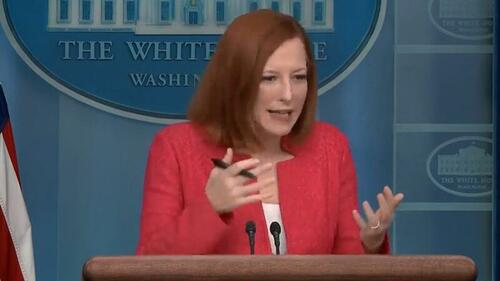
Psaki claimed “That’s not exactly what he meant,” without providing a better explanation for what the hell Biden was talking about:
Extended video of Biden from the presser reveals that a reporter asked him if he thought Putin was threatening the use nuclear weapons, to which he responded “I have no idea what he’s threatening.”
It is tempting to laugh at Biden’s utter incompetence, but then you also get stark reminders that this guy has NO CLUE what is going on, so you have to ask who on earth is running things?
It has become a daily impossibility for Psaki trying to lie and paper over Biden’s bumbling senility, and perhaps that is why the establishment media networks are in a war to hire her.
In any case, Vladimir Putin is laughing his head off.
Be seeing you
Posted in Uncategorized | Tagged: Jen Psaki, Joe Biden, sanctions | 1 Comment »
The Crisis in Ukraine is not about Ukraine. It’s about Germany, by Mike Whitney – The Unz Review
Posted by M. C. on February 14, 2022
Sanctions are not going to work, so Uncle Sam has flipped to Plan B: Create a big enough external threat that Germany will be forced to block the opening of the pipeline. Frankly, the strategy smacks of desperation, but you have to be impressed by Washington’s perseverance.
https://www.unz.com/mwhitney/the-crisis-in-ukraine-is-not-about-ukraine-its-about-germany/

“The primordial interest of the United States, over which for centuries we have fought wars– the First, the Second and Cold Wars– has been the relationship between Germany and Russia, because united there, they’re the only force that could threaten us. And to make sure that that doesn’t happen.” George Friedman, STRATFOR CEO at The Chicago Council on Foreign Affairs
The Ukrainian crisis has nothing to do with Ukraine. It’s about Germany and, in particular, a pipeline that connects Germany to Russia called Nord Stream 2. Washington sees the pipeline as a threat to its primacy in Europe and has tried to sabotage the project at every turn. Even so, Nord Stream has pushed ahead and is now fully-operational and ready-to-go. Once German regulators provide the final certification, the gas deliveries will begin. German homeowners and businesses will have a reliable source of clean and inexpensive energy while Russia will see a significant boost to their gas revenues. It’s a win-win situation for both parties.
The US Foreign Policy establishment is not happy about these developments. They don’t want Germany to become more dependent on Russian gas because commerce builds trust and trust leads to the expansion of trade. As relations grow warmer, more trade barriers are lifted, regulations are eased, travel and tourism increase, and a new security architecture evolves. In a world where Germany and Russia are friends and trading partners, there is no need for US military bases, no need for expensive US-made weapons and missile systems, and no need for NATO. There’s also no need to transact energy deals in US Dollars or to stockpile US Treasuries to balance accounts. Transactions between business partners can be conducted in their own currencies which is bound to precipitate a sharp decline in the value of the dollar and a dramatic shift in economic power. This is why the Biden administration opposes Nord Stream. It’s not just a pipeline, it’s a window into the future; a future in which Europe and Asia are drawn closer together into a massive free trade zone that increases their mutual power and prosperity while leaving the US on the outside looking in. Warmer relations between Germany and Russia signal an end to the “unipolar” world order the US has overseen for the last 75 years. A German-Russo alliance threatens to hasten the decline of the Superpower that is presently inching closer to the abyss. This is why Washington is determined to do everything it can to sabotage Nord Stream and keep Germany within its orbit. It’s a matter of survival.
That’s where Ukraine comes into the picture. Ukraine is Washington’s ‘weapon of choice’ for torpedoing Nord Stream and putting a wedge between Germany and Russia. The strategy is taken from page one of the US Foreign Policy Handbook under the rubric: Divide and Rule. Washington needs to create the perception that Russia poses a security threat to Europe. That’s the goal. They need to show that Putin is a bloodthirsty aggressor with a hair-trigger temper who cannot be trusted. To that end, the media has been given the assignment of reiterating over and over again, “Russia is planning to invade Ukraine.” What’s left unsaid is that Russia has not invaded any country since the dissolution of the Soviet Union, and that the US has invaded or toppled regimes in more than 50 countries in the same period of time, and that the US maintains over 800 military bases in countries around the world. None of this is reported by the media, instead the focus is on “evil Putin” who has amassed an estimated 100,000 troops along the Ukrainian border threatening to plunge all of Europe into another bloody war.
All of the hysterical war propaganda is created with the intention of manufacturing a crisis that can be used to isolate, demonize and, ultimately, splinter Russia into smaller units. The real target, however, is not Russia, but Germany. Check out this excerpt from an article by Michael Hudson at The Unz Review:
“The only way left for U.S. diplomats to block European purchases is to goad Russia into a military response and then claim that avenging this response outweighs any purely national economic interest. As hawkish Under-Secretary of State for Political Affairs, Victoria Nuland, explained in a State Department press briefing on January 27: “If Russia invades Ukraine one way or another Nord Stream 2 will not move forward.” (“America’s Real Adversaries Are Its European and Other Allies”, The Unz Review)
There it is in black and white. The Biden team wants to “goad Russia into a military response” in order to sabotage NordStream. That implies there will be some kind of provocation designed to induce Putin to send his troops across the border to defend the ethnic Russians in the eastern part of the country. If Putin takes the bait, the response would be swift and harsh. The media will excoriate the action as a threat to all of Europe while leaders around the world will denounce Putin as the “new Hitler”. This is Washington’s strategy in a nutshell, and the whole production is being orchestrated with one goal in mind; to make it politically impossible for the German Chancellor Olaf Scholz to wave NordStream through the final approval process.
Given what we know about Washington’s opposition to Nord Stream, readers may wonder why earlier in the year the Biden administration lobbied Congress NOT to impose more sanctions on the project. The answer to that question is simple: Domestic politics. Germany is currently decommissioning its nuclear power plants and needs natural gas to make up for the energy shortfall. Also, the threat of economic sanctions is a “turn-off” for Germans who see them as a sign of foreign meddling. “Why is the United States interfering in our energy decisions,” asks the average German. “Washington should mind its own business and stay out of ours.” This is precisely the response one would expect from any reasonable person.
Then, there’s this from Al Jazeera:
“Germans in the majority support the project, it is only parts of the elite and media who are against the pipeline…
“The more the US talks about sanctioning or criticizes the project, the more it becomes popular in German society,” said Stefan Meister, a Russia and eastern Europe expert at the German Council on Foreign Relations.” (“Nord Stream 2: Why Russia’s pipeline to Europe divides the West”, AlJazeera)
So, public opinion is solidly behind Nord Stream which helps to explain why Washington settled on a new approach. Sanctions are not going to work, so Uncle Sam has flipped to Plan B: Create a big enough external threat that Germany will be forced to block the opening of the pipeline. Frankly, the strategy smacks of desperation, but you have to be impressed by Washington’s perseverance. They might be down by 5 runs in the bottom of the 9th, but they haven’t thrown in the towel just yet. They’re going to give it one last shot and see if they can make some headway.
Be seeing you
Posted in Uncategorized | Tagged: Germany, Nord Stream 2, Russia, sanctions, Ukraine | Leave a Comment »
 MCViewPoint