


Be seeing you
Posts Tagged ‘Saudi Arabia’
The Looming Collapse of Saudi Arabia | Thomas Sowell
Posted by M. C. on March 14, 2025
Posted in Uncategorized | Tagged: Saudi Arabia, Thomas Sowell | Leave a Comment »
Seven Countries in Five Years
Posted by M. C. on December 16, 2024
The Arabs have always been their own worst enemy, and now they have managed to destroy the Arab world with only Saudi Arabia remaining. Recently, the Israeli Zionist government added a large part of Saudi Arabia to the map of Greater Israel.
Paul Craig Roberts
he media brothel has presented the HTS terrorist/democratic opposition as Syria’s rescuer promising peace and friendship. But videos emerging reveal a campaign of violence, hangings and machine-gunning of people. It is Muslims killing Muslims, Arabs killing Arabs. The reason Arabs are powerless is that they had rather kill each other than fight against their common enemies. The borders of Arab countries were created by European colonists like the countries in Africa that combined hostile tribes into a country. So Middle Eastern countries contain Shia and Sunni populations. The two sects have been at sword’s point for centuries, enabling the West to use one against the other. Here are a few of the videos of the democratic opposition’s brutal violence.
The truth is in the videos, not in the media staged scenes of Syrians celebrating the downfall of Assad:
Iran is largely Persian, not Arab and more unified. But there are progressive, pro-Western elements, and among the young there is desire for lessening of religious restraints. There are always those who prefer sin to righteousness. The US works on the progressive elements and now Iran has a reform government.
Be seeing you
Posted in Uncategorized | Tagged: HTS, Persian, Saudi Arabia, Syria | Leave a Comment »
Defending Big Oil, MIC, Israel and 9/11 instigators Saudi Arabia
Posted by M. C. on January 20, 2024
You? Not so much.


Be seeing you
Posted in Uncategorized | Tagged: Big Oil, Israel, MIC, Saudi Arabia | Leave a Comment »
How A Deeply Controversial White House Adviser Is Running The Agenda On Gaza
Posted by M. C. on December 4, 2023
Brett McGurk has sought to put a Saudi-Israeli relationship “at the forefront” of the U.S.’s Middle East policy — downplaying Palestinian concerns and human rights.
Brett’s theory of the region is that it’s a source of instability but also resources,” the former official said. “It’s a very old-school, colonialist mentality: People need strong rulers to control them, and we need to extract to our benefit what we need while minimizing the cost to ourselves and others we see as like us, in this case Israelis.”
“This approach always fails,” the official continued, saying it’s “short-sighted” and forces the U.S. to reinvest in the Middle East every few years.
“Here’s a clear example before you: they wanted to bypass the Palestinians” in Saudi-Israel normalization, the former official said.
Bowing and scraping to people who attack and control us in the hope they might be nice to US.
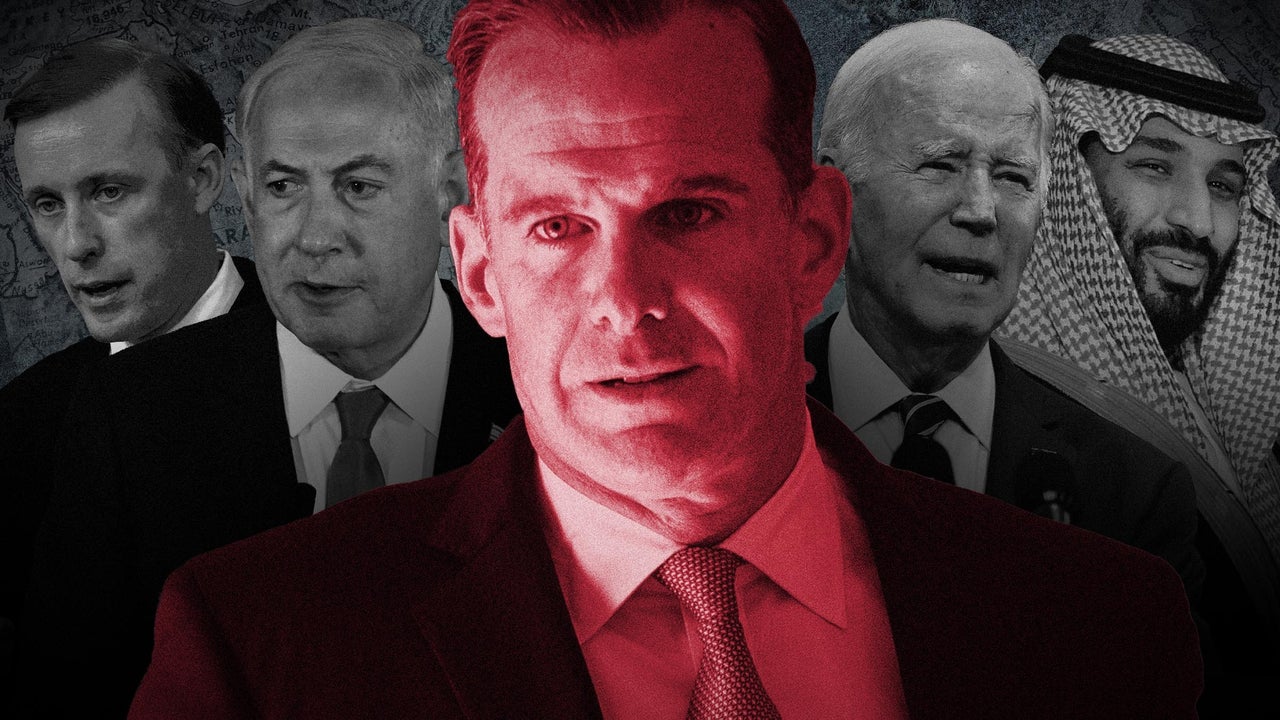
Four men in Washington shape America’s policy in the Middle East. Three are obvious: President Joe Biden, Secretary of State Antony Blinken and national security adviser Jake Sullivan. The fourth is less well-known, despite his huge sway over the other three ― and despite his determination to keep championing policies that many see as fueling bloodshed in Gaza and beyond.
His name is Brett McGurk. He’s the White House coordinator for the Middle East and North Africa, and he’s one of the most powerful people in U.S. national security.
McGurk crafts the options that Biden considers on issues from negotiations with Israel to weapon sales for Saudi Arabia. He controls whether global affairs experts within the government ― including more experienced staff at the Pentagon and the State Department ― can have any impact, and he decides which outside voices have access to White House decision-making conversations. His knack for increasing his influence is the envy of other Beltway operators. And he has a clear vision of how he thinks American interests should be advanced, regarding human rights concerns as secondary at best, according to current and former colleagues and close observers.
“It’s tremendous power that is completely opaque and non-transparent and non-accountable,” a former U.S. official told HuffPost.
Comparing McGurk’s extremely centralized approach in the Biden era to the more consultative way in which past administrations made decisions, a representative of a civil society group said McGurk is “able to drive things with [Sullivan] and the president in a process that is not a process.”
It’s a stunning degree of authority for a 50-year-old operative with a deeply controversial career. One current U.S. official said McGurk’s dominance has rendered the top Middle East official at the State Department ― a former ambassador who, unlike McGurk, was confirmed to her post by the Senate ― merely “a fig leaf.”
“The State Department essentially has no juice on [Israel-Palestine] because Brett is at the center of it,” the official said.
Meanwhile, McGurk’s primary focus, a deal between Israel and Saudi Arabia, has come to dominate American diplomacy in the region. “He consistently pushed for engagement with the Saudis and sought to put that relationship at the forefront of what we’re trying to do in the Middle East,” the U.S. official said.
A State Department spokesperson declined to comment for this story. The agency has experienced internal uproar in recent weeks. On Thursday, a State Department official told HuffPost that staff have submitted at least six formal letters of dissent regarding Biden’s Gaza policy to Blinken through a protected channel.
Amid the crisis that erupted Oct. 7, when the Gaza-based Palestinian militant group Hamas killed 1,200 Israelis and Israel responded by launching an ongoing offensive that has now killed more than 14,000 Palestinians, McGurk has maintained his importance. He’s deeply involved in the negotiations between Israel, Hamas and regional governments that have let more than 100 Israeli hostages come home and boosted the amount of humanitarian aid flowing into Gaza. His team is tightly managing what U.S. officials say about the conflict, and he is in regular contact with foreign officials who say America’s largely unrestrained support for Israel is spurring huge resentment worldwide.
Now there’s growing concern that despite the shock of the Hamas attack and the sweeping Israeli response, McGurk will stand by priorities and tactics that many officials and analysts see as deeply unhelpful.
Be seeing you
Posted in Uncategorized | Tagged: Agenda, Brett McGurk, Gaza, Israel, Saudi Arabia | Leave a Comment »
TGIF: Thinking about Israel and Palestine
Posted by M. C. on October 10, 2023
https://libertarianinstitute.org/articles/tgif-thinking-about-israel-and-palestine/
When a sealed pot of boiling water explodes, no one should be surprised. With no excusing of Hamas’s indiscriminate violence intended, I think that’s how we ought to view recent events in Israel/Palestine. We can condemn what the fighters have done and point out the century or more of provocation. There is a category that could be labeled inexcusable-and-provoked.
Another thing to watch for is the ex-post justification; to wit: the defense of an earlier set of actions in terms of the later consequence of those same actions.
Iran, no provocation? Abraham accords, Saudi Arabia
Be seeing you
Posted in Uncategorized | Tagged: Abraham Accords, Israel, Palestine, Saudi Arabia | Leave a Comment »
A security pact with Saudi Arabia would be a disaster for US interests
Posted by M. C. on August 22, 2023
For one, desperately giving into demands will mean that the Kingdom — and Israel — will soon be asking for more.
Written by
Daniel Larison
As the Biden administration continues to pursue a normalization deal with Israel and Saudi Arabia, supporters of a U.S. security guarantee for the Saudis have started making their case in public.
The Israeli foreign minister, Eli Cohen, took to the opinion page of The Wall Street Journal earlier this week to sell a U.S. defense commitment to Riyadh as “the foundation upon which true regional harmony can be built” and used the example of Washington’s treaty with South Korea as a model.
A new formal security commitment is one of the biggest Saudi demands as part of their steep price for normalizing relations with Israel, and recent reports suggest that the Biden administration is seriously entertaining the idea.
President Biden should shut this down now. The U.S. does not need and cannot afford any additional security commitments. It certainly shouldn’t be pledging to send its soldiers to fight on behalf of a despotic monarchy that has been waging an aggressive war against its poorer neighbor for most of the last ten years. The U.S. has already put its military personnel in harm’s way too many times on behalf of the Saudis, and there should be no guarantee to do so in the future.
A formal defense commitment to Saudi Arabia is unacceptable and contrary to U.S. interests, and it is far too large of a bribe to give Riyadh just so that it will establish relations with Israel.
The case for a U.S. commitment to fight for the Saudis is weak on the merits. The U.S. does not have vital interests at stake that would warrant making a pledge to defend the kingdom. It is also unnecessary. Iran isn’t about to invade or even attack Saudi Arabia. Aside from the strikes on the ARAMCO facility at Abqaiq in 2019, which were themselves a reaction to the Trump administration’s economic war, Iran and Saudi Arabia have no history of direct clashes.
Cohen’s comparison with Korea is bizarre. For one thing, the animosity between Iran and Saudi Arabia is nothing like the decades-long hostility between North and South Korea. Iran has no interest in conquering the kingdom, and it lacks the means to do it even if it wanted to try. Unlike North Korea, Iran does not have nuclear weapons, and despite the best efforts of the U.S. and Israeli governments in the last few years their government has still not decided to pursue them.
Creating a stronger U.S.-Saudi security relationship in opposition to Iran would likely make regional tensions worse and might encourage hardliners in Iran to pursue more confrontational policies. Far from fostering “true regional harmony,” this would stoke conflict by expanding the U.S. role in the Persian Gulf.
Be seeing you
Posted in Uncategorized | Tagged: Iran, Israel, Saudi Arabia, security pact | Leave a Comment »
Saudi Arabia Welcomes Blinken
Posted by M. C. on June 9, 2023
But the Saudi’s don’t give a fark about US national security! Many have claimed the US attempts smell of ‘desperation’. Israel wants cooperation with Saudi Arabia for one reason – to annihilate Iran.
Blinken is adamantly opposed to any peace initiative. This is NOT a positive outcome in any alternate universe.
HELENA
The Nationalist Voice
The U.S. has been working with the Saudis to end the war in Yemen and mediate between two rival generals in Sudan. ~NPR
Reuters refers to Prince Salman of Saudi Arabia as the ‘de-facto’ ruler: De facto describes practices that exist in reality, whether or not they are officially recognized by laws or other formal norms.
A HIT!~
Blinken’s mission in Saudi Arabia is described as follows: “The aims of the trip include regaining influence with Riyadh over oil prices, fending off Chinese and Russian influence in the region and nurturing hopes for an eventual normalization of Saudi-Israeli ties.”
In English that parlays to – Blinken intends to threaten Prince Salman to follow the International Order of the US – or suffer.
in 2019 during President Joe Biden’s then campaign, he said he would treat Riyadh like “the pariah that they are”. I wonder what Prince Salman thinks of Biden?
WSJ: Blinken wants to pressure Bin Salman to lift travel sanctions on US/Saudi citizens.
Earlier in May, Jake Sullivan met with Prince Salman declaring that Saudi-Israel normalization was in the US national security interest. But the Saudi’s don’t give a fark about US national security! Many have claimed the US attempts smell of ‘desperation’. Israel wants cooperation with Saudi Arabia for one reason – to annihilate Iran. But in March, Crown Prince Salman reestablished ties with Iran in a deal brokered by China. The War Mongers are in a frenzy!
Prince Salman has been brutalized by the Biden Regime. Blinken is Jewish giving his appearance in the House of Saud a difficult strain. Sullivan is a Clintonite – which also puts a negative spin on any Prince Salman negotiations. Bribing Salman with money is obviously not feasible – so Blinken has to be prepared to give Prince Salman something he wants desperately. Should that route be denied, Blinken will do what the Cabalists do best – threaten ramifications.
What Blinken fails to understand is that monarchy’s do not react well to being told what to do. And the loss of yet another ally is more probable. But there is yet another boulder of fodder:
In 2013, the Obama administration had secretly contacted with Iranian officials about the feasibility of an agreement over the Iranian nuclear program which ultimately resulted in the money laundering drop off of billions for Iran. Sullivan was directly involved in that tossled fiasco.
Saudi Arabia has no intention of supporting Israel until Israel embraces Palestine. Israel has no intention of embracing Palestine – so the entire sequester is moot.
Saudi Arabia is one of the 19 countries expressing a potential interest in joining the BRICS. Iran and Argentina have already begun the process of joining the BRICS with Saudi Arabia, Turkey and Egypt close behind. The BRICS demand peace in Ukraine. Blinken is adamantly opposed to any peace initiative. This is NOT a positive outcome in any alternate universe. Much less the Matrix we are suffering thru today!
Be seeing you
Posted in Uncategorized | Tagged: Blinken, Prince Salman, Saudi Arabia | Leave a Comment »
The Biden Administration’s Latest Tone-Deaf Foreign Policy Positions
Posted by M. C. on June 6, 2023
Worse, Washington’s boorish behavior is alienating countries whose support the United States may want or need with respect to other issues. The recent episodes provide further evidence of the administration’s intellectual bankruptcy regarding foreign affairs.
U.S. leaders rarely have been noted for being able to gauge changing sentiment in the international arena and adjusting their foreign policy accordingly. The Biden administration, however, may be setting new records for the tone-deaf quality of its policies. Three incidents in the past few weeks illustrate the problem.
There has been obvious movement in recent months on the part of leading Arab powers to temper their feud with Syrian leader Bashar al-Assad. Only a few years ago, Saudi Arabia, the United Arab Emirates, and other countries were in a partnership with Turkey and the United States to unseat Assad – largely because of his close alliance with Iran. Now, those same powers have changed course dramatically, seeking a rapprochement with both Damascus and Tehran. Important signals of the new political environment were Saudi Arabia’s restoration of diplomatic relations with Iran and Syria’s re-entry to the Arab League.
Instead of going along with the new diplomatic and geopolitical realities in the region, the Biden administration chose this moment to escalate its increasingly futile attempts to isolate Assad. On May 30, Washington imposed new economic sanctions on Syria. As Dave DeCamp noted, the businesses were targeted using the Caesar Act, a law the US has used to impose sanctions on Syria that are specifically designed to prevent the country’s reconstruction.” One could scarcely imagine a more ill-timed move, given the powerful, contrary diplomatic trends in the region.
Be seeing you
Posted in Uncategorized | Tagged: Bashar al-Assad, Foreign Policy, Saudi Arabia, Syria, United Arab Emirates | Leave a Comment »
What Happens When You Talk? Peace Breaks Out! | The Libertarian Institute
Posted by M. C. on April 20, 2023
https://libertarianinstitute.org/articles/saudi-arabia-when-being-neutral-isnt-neutral-anymore/
by Ted Snider

After decades of stewardship of the Middle East, during which the United States pursued the absurd policy of not talking to its enemies and creating and enforcing blocs to oppose and isolate those enemies, the predictable outcome occurred. The region was left with blocs and enemies who were not talking to each other. The result was horrid wars and the threat of even worse wars.
It has long been known that a key to opening those blocs and initiating diplomacy would be a negotiated peace between the heads of the two main rivals, Saudi Arabia and Iran. It has also long been known that the United States withheld that key. Unlocking the blocs is not in American interest. Hegemony in the region requires punishing and isolating countries that won’t follow you. That requires sanctions, threats of war, and isolation. Iran is such a country. So, the establishment and maintenance of a coalition against Iran is a key feature of U.S. policy in the region. At the heart of that coalition is Saudi Arabia, firmly in the U.S.-led anti-Iran camp.
But the emergence of China as diplomatic power has “blindsided” the United States and changed the diplomatic environment in the Middle East. China chose peace instead of sides and brought Saudi Arabia and Iran together for talks. Having the blocs talk to each other instead of enforcing their isolation shook the U.S. world order. On March 10, those talks resulted in an agreement between Saudi Arabia and Iran.
And the key to opening talks, ending wars, and bringing peace to the Middle East is already showing its promise. After years of region destabilizing enmity, Saudi Arabia and Iran signed “an agreement to resume diplomatic relations between them and re-open their embassies and missions within a period not exceeding two months.”
The agreement is showing signs of working. True to their word, on April 6 the foreign ministers of Saudi Arabia and Iran met in Beijing where they signed an agreement to reopen their embassies and consulates in each other’s countries. And Saudi King Salman bin Abdulaziz Al Saud has invited Iranian President Ebrahim Raisi for an official visit. Raisi has accepted the invitation and “stressed Iran’s readiness to expand co-operation.” The two countries have also agreed to hold a meeting of their foreign ministers. Peace is breaking out.
But the potential for peace is bleeding beyond the two countries.
The first to feel the effect of the change in environment was Syria. President Bashar al-Assad survived the war against Saudi-backed rebels in large part because of the support of his Iranian allies. Peace in Syria would also require peace between Saudi Arabia and Iran.
China’s facilitation of talks between Saudi Arabia and Iran opened the door for Russia to facilitate talks between Saudi Arabia and Syria. Within two weeks of the Saudi-Iran breakthrough, Saudi Arabia and Syria agreed to reopen their embassies.
The entire Arab world is ending its isolation of the Assad regime.
Be seeing you
Posted in Uncategorized | Tagged: American peace, Assad, Iran, Middle East, Saudi Arabia | Leave a Comment »
Oil To Face “Serious” Supply Problem In 2024 As Production Capacity Runs Out, Goldman Warns | ZeroHedge
Posted by M. C. on February 6, 2023
Yah but, sacrificing recent oil independence for the sake of windmills and solar panels on windless, overcast days is worth it. Ask the Germans.
Begging missions to SA only to be publicly put down…So much for building a global empire.

BY TYLER DURDEN
Heading into 2023, Goldman was bearish on most asset classes, except commodities where the bank forecast a 43% gain as “supply shortages bite.” Since then the commodity picture has ebbed and flowed, and after commodities experienced a modest bounce following China’s unexpected reopening, they have resumed sinking with oil trading just above the Biden admin’s (supposed) SPR refill floor of $72, despite a near consensus that Chinese oil demand will hit record highs in 2023.
So has the recent setback dented Goldman’s optimism? Not at all: in fact, according to Goldman chief commodity strategist, not only will oil rise back above $100 a barrel this year, it will rise much more in 2024 when it will face a serious supply problem as spare production capacity runs out.
Speaking on the sidelines of a conference in Riyadh, Saudi Arabia, on Sunday, Goldman chief commodity strategist Jeff Currie said that with sanctions likely to cause Russian oil exports to drop and Chinese demand expected to recover as the country ends its Covid Zero policy, prices will rise above $100 from their current level of around $80. Meanwhile, doubling down on his key long-term thesis, Currie said that a lack of spending in the industry on production needed to meet demand will also be a driver of higher prices, and this lack of capacity may become a big issue by 2024.
“The commodity super cycle is a sequence of price spikes with each high higher and each low higher,” said Currie, who predicted that by May, oil markets should flip to a deficit of supply compared to demand. That could use up much of the unused capacity global producers have, which will send prices higher.
Be seeing you
Posted in Uncategorized | Tagged: oil, Production Capacity, Riyadh, Saudi Arabia | Leave a Comment »
 MCViewPoint