
$4B US dollars automatically every year…for starters
They run the show.
Be seeing you

Enemy of the State-Read the Book-Know the Man
This is not a Safe Space but Baby, I don't care.

"I am not a number, I am a Free Man" - No. 6
 Information Liberation Alex Jones’ Prison Planet Gary North Specific Answers Antiwar The Daily Bell Tenth Amendment Center Economics Policy Journal The American Thinker The New American Lew Rockwell
Posted by M. C. on November 1, 2024
Posted in Uncategorized | Tagged: HUMILIATES, Israel, U.S. | Leave a Comment »
Posted by M. C. on April 4, 2024
Posted in Uncategorized | Tagged: Rule the World, U.S. | Leave a Comment »
Posted by M. C. on January 10, 2023
“highly sensitive information obtained from intelligence sources”…”that the White House’s counsel’s office immediately notified the National Archives and the material was retrieved the next day”
Highly sensitive, the next day! Too bad they weren’t on a hard drive, Biden could have wiped it (with a rag like HRC).
Attorney General Merrick Garland has reportedly assigned U.S. Attorney for the Northern District of Illinois John Lausch to review classified material from President Joe Biden’s time as vice-president that was discovered at a Biden think tank.
CBS News reported that the approximately 10 documents were found at the Penn Biden Center for Diplomacy and Global Engagement in Washington.
The files were discovered by Biden’s personal attorneys when they “were packing files housed in a locked closet to prepare to vacate office space at the Penn Biden Center in Washington, D.C.”
The attorneys said that the information was found in a box with other materials that were not classified.
CNN reported that some of the classified materials that were discovered included top-secret files designated as “sensitive compartmented information,” which means that the materials include highly sensitive information obtained from intelligence sources.
Richard Sauber, special counsel to the president, said that the moment the material was found – on November 2nd – that the White House’s counsel’s office immediately notified the National Archives and the material was retrieved the next day.
Upon learning about the classified material, the National Archives alerted the DOJ. The FBI is also involved in the investigation.
“The discovery of these documents was made by the President’s attorneys,” Sauber said. “The documents were not the subject of any previous request or inquiry by the Archives. Since that discovery, the President’s personal attorneys have cooperated with the Archives and the Department of Justice in a process to ensure that any Obama-Biden Administration records are appropriately in the possession of the Archives.”
The DOJ review of the material is the first step in determining what further actions could be warranted, the report said, including the possibility of a criminal investigation and appointment of a special counsel.
Lausch was appointed by former President Donald Trump and is one of only two remaining U.S. attorneys from the Trump administration, the report noted. The other holdover is David Weiss, who is conducting a criminal investigation into Biden’s son, Hunter Biden.
This report has been updated to include additional information.
Be seeing you
Posted in Uncategorized | Tagged: executive, FBI, Joe Biden, Merrick Garland, U.S. | Leave a Comment »
Posted by M. C. on January 9, 2023
https://internationalman.com/articles/decline-of-empire-parallels-between-the-us-and-rome-part-i/
by Doug Casey
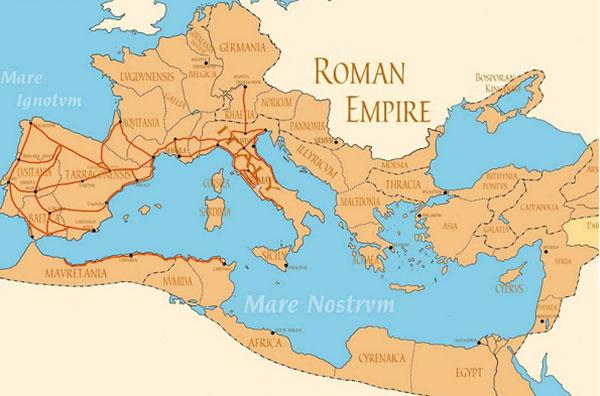
As some of you know, I’m an aficionado of ancient history. I thought it might be worthwhile to discuss what happened to Rome and based on that, what’s likely to happen to the U.S. Spoiler alert: There are some similarities between the U.S. and Rome.
But before continuing, please seat yourself comfortably. This article will necessarily cover exactly those things you’re never supposed to talk about—religion and politics—and do what you’re never supposed to do, namely, bad-mouth the military.
There are good reasons for looking to Rome rather than any other civilization when trying to see where the U.S. is headed. Everyone knows Rome declined, but few people understand why. And, I think, even fewer realize that the U.S. is now well along the same path for pretty much the same reasons, which I’ll explore shortly.
Rome reached its peak of military power around the year 107, when Trajan completed the conquest of Dacia (the territory of modern Romania). With Dacia, the empire peaked in size, but I’d argue it was already past its peak by almost every other measure.
The U.S. reached its peak relative to the world, and in some ways its absolute peak, as early as the 1950s. In 1950 this country produced 50% of the world’s GNP and 80% of its vehicles. Now it’s about 21% of world GNP and 5% of its vehicles. It owned two-thirds of the world’s gold reserves; now it holds one-fourth. It was, by a huge margin, the world’s biggest creditor, whereas now it’s the biggest debtor by a huge margin. The income of the average American was by far the highest in the world; today it ranks about eighth, and it’s slipping.
But it’s not just the U.S.—it’s Western civilization that’s in decline. In 1910 Europe controlled almost the whole world—politically, financially, and militarily. Now it’s becoming a Disneyland with real buildings and a petting zoo for the Chinese. It’s even further down the slippery slope than the U.S.
Like America, Rome was founded by refugees—from Troy, at least in myth. Like America, it was ruled by kings in its early history. Later, Romans became self-governing, with several Assemblies and a Senate. Later still, power devolved to the executive, which was likely not an accident.
U.S. founders modeled the country on Rome, all the way down to the architecture of government buildings, the use of the eagle as the national bird, the use of Latin mottos, and the unfortunate use of the fasces—the axe surrounded by rods—as a symbol of state power. Publius, the pseudonymous author of The Federalist Papers, took his name from one of Rome’s first consuls. As it was in Rome, military prowess is at the center of the national identity of the U.S. When you adopt a model in earnest, you grow to resemble it.
A considerable cottage industry has developed comparing ancient and modern times since Edward Gibbon published The Decline and Fall of the Roman Empire in 1776—the same year as Adam Smith’s Wealth of Nations and the U.S. Declaration of Independence were written. I’m a big fan of all three, but D&F is not only a great history, it’s very elegant and readable literature. And it’s actually a laugh riot; Gibbon had a subtle wit.
There have been huge advances in our understanding of Rome since Gibbon’s time, driven by archeological discoveries. There were many things he just didn’t know, because he was as much a philologist as an historian, and he based his writing on what the ancients said about themselves.
There was no real science of archeology when Gibbon wrote; little had been done even to correlate the surviving ancient texts with what was on the surviving monuments—even the well-known monuments—and on the coins. Not to mention scientists digging around in the provinces for what was left of Roman villas, battle sites, and that sort of thing. So Gibbon, like most historians, was to a degree a collector of hearsay.
And how could he know whom to believe among the ancient sources? It’s as though William F. Buckley, Gore Vidal, H. L. Mencken, Norman Mailer, and George Carlin all wrote about the same event, and you were left to figure out whose story was true. That would make it tough to tell what really happened just a few years ago… forget about ancient history. That’s why the study of history is so tendentious; so much of it is “he said/she said.”
In any event, perhaps you don’t want a lecture on ancient history. You’d probably be more entertained by some guesses about what’s likely to happen to the U.S. I’ve got some.
Let me start by saying that I’m not sure the collapse of Rome wasn’t a good thing. There were many positive aspects to Rome—as there are to most civilizations. But there was much else to Rome of which I disapprove, such as its anti-commercialism, its militarism and, post-Caesar, its centralized and increasingly totalitarian government. In that light, it’s worth considering whether the collapse of the U.S. might not be a good thing.
Be seeing you
Posted in Uncategorized | Tagged: Fall of the Roman Empire, Rome, U.S. | Leave a Comment »
Posted by M. C. on August 6, 2019
The space race didn’t bother China much. They spent their time figuring out how to defend themselves from space. They can blow up satellites. They have few carriers but a reportedly fine carrier killer cruise missile.
https://theintercept.com/2019/07/21/ai-race-china-artificial-intelligence/
Perhaps because it lies at the perfect nexus of genuinely-very-complicated and impossibly-confounded-by-marketing-buzzword-speak, the term “AI” has become a catchall for anything algorithmic and sufficiently technologically impressive. AI, which is supposed to stand for “artificial intelligence,” now spans applications from cameras to the military to medicine.
One thing we can be sure about AI — because we are told it so often and at so increasingly high a pitch — is that whatever it actually is, the national interest demands more of it. And we need it now, or else China will beat us there, and we certainly wouldn’t want that, would we? What is “there,” exactly? What does it look like, how would it work, and how would it change our society? Irrelevant! The race is on, and if America doesn’t start taking AI seriously, we’re going to find ourselves the losers in an ever-widening Dystopia Gap.
A piece on Politico this week by Luiza Ch. Savage and Nancy Scola exemplifies the mix of maximum alarm and minimum meaning that’s become so typical in our national (and nationalist) discussion around artificial intelligence. “Is America ceding the future of AI to China?” the article asks.
We’re meant to take this possibility as not only very real but as an unquestionably bad thing. One only needs to tell the public that the country risks “ceding” control of something — literally anything — to the great foreign unknown for our national eyes to grow wide.
“The last time a rival power tried to out-innovate the U.S. and marshaled a whole-of-government approach to doing it, the Soviet Union startled Americans by deploying the first man-made satellite into orbit,” the article says. “The Sputnik surprise in 1957 shook American confidence, galvanized its government and set off a space race culminating with the creation of NASA and the moon landing 50 years ago this month.”
Our new national dread, the article continues, is “whether another Sputnik moment is around the corner” — in the form of an AI-breakthrough from the keyboards of Red China instead of Palo Alto.
Forget that Sputnik was not actually a “surprise” for the powers that be, or that Sputnik itself was basically a beeping aluminum beach ball — “barely more than a radio transmitter with batteries,” the magazine Air & Space once said. There’s a bigger problem here: Framing the Cold War as a battle of innovators conveniently avoids mentioning that the chief innovation in question wasn’t Sputnik or the Space Shuttle or any peacetime venture, but the creation of an arsenal for instant global nuclear holocaust at the press of a button.
Sure, yes, it’s doubtful we could have “marshaled a whole-of-government approach” to space travel without having first “marshaled a whole-of-government approach” to rocket-borne atomic genocide, but to highlight the eventual accomplishments of NASA without acknowledging that it entailed a very close dance with a worldwide apocalypse is ahistoric and absurd. To use this comparison to goad us into another nationalist tech race with a global military power is outright dangerous — if only because the victory remains completely undefined. How would we “beat” China, exactly? Beat them at what, exactly? Which specific problems do we hope to use AI to fix? At a point in history when cities are beginning to scrutinize and outright ban “AI” technologies like facial recognition, are we sure the fixes aren’t even worse than the problems? Nationalists caught in an arms race have no time to answer questions like these or any others; they’ve got a race to win!
All anyone can manage to do is bark that we need more, more, more AI, more investments, more R&D, more collaborations, more ventures, more breakthroughs, simply more AI. Maybe we’ll worry about what we needed all of this for in the first place once we’ve beaten China there. Or maybe an algorithm will explain it to us, along with the locations of all our family members and a corresponding score that quantifies their social utility and biometric trustworthiness.
The Politico piece is full of worried voices cautioning that we can’t let Americans fall behind in the global invasive-surveillance race, completely unable to explain why this would be a bad thing. “The city of Tianjin alone plans to spend $16 billion on AI — and the U.S. government investment still totals several billion and counting,” despairs Elsa Kania of the technology and national security program at the Center for a New American Security. “That’s still lower by an order of magnitude.” Amy Webb, a New York University business school professor, told Politico, “We are being outspent. We are being out-researched. We are being outpaced. We are being out-staffed.”
Of course, it’s not just these researchers, nor is it just Politico: The necessity of absolute American dominance in an extremely unpredictable, deeply hazardous, and altogether hard to comprehend field has made the great leap from think-tank anxiety nightmare to political talking point…
Given the deceptive, reckless, and at times downright vampiric way the likes of Facebook and Google already behave, who could possibly think that the “many legal and ethical issues” Sherman worries about could be properly addressed in the middle of a race? Are we really ready to grapple with Amazon once it’s been handed the mantle of Sputnik and Apollo 11?
Careful consideration demands a slower pace — and a slower pace means, yes, potentially losing a race to the bottom against a national adversary that clearly has no qualms making the bottom as technologically impressive as possible. Rather than clamoring for a dead sprint toward some sort of national AI supremacy, defined however and by whomever, our time might be better spent worrying in earnest about what lies at the finish line.
Be seeing you

Go To Mars…I Guess.
Posted in Uncategorized | Tagged: AI Race, China, Sputnik moment, U.S. | Leave a Comment »
 MCViewPoint