MCViewPoint

Opinion from a Libertarian ViewPoint

Posts Tagged ‘USDA’

The USDA’s War on Small Farms | Mises Wire

Posted by M. C. on August 25, 2023

These regulations were not there to provide “safety” to consumers but rather to keep competition out of the marketplace by fiat. Rothbard states that the only meaningful definition of monopoly is an exclusive legal right granted by the state.

However, if the free-market USDA fails to stop an illness from arising, through their own inspection failures, they may lose their credibility with both consumers and the producers that pay them. Profit and loss provide greater incentives for success than a bureaucracy that theoretically cannot “go under.”

https://mises.org/wire/usdas-war-small-farms

David Brady, Jr.

Most students in America are introduced to the writings of Upton Sinclair. While they aren’t shown his incredible cover-up of the Holodomor or his other Soviet apologisms, they are presented with his most famous work: The Jungle. This work tells the tale of Sinclair’s investigation into the wretched working conditions of the meat-packers of its age. Between lost limbs and failed inspections, Sinclair writes about the meat being contaminated and barbarously prepared.

This tale is meant to show the supposed failures of laissez-faire capitalism, with its disregard for workers and health. Readers are supposed to walk away with a firm belief in the need for the regulation of these firms. Hurrah! Here comes the mighty state to provide safety to the masses that would otherwise be made sick by crony corporations. That’s far from the truth.

Murray Rothbard himself documents in The Progressive Era the truth of the United States Department of Agriculture (USDA) regulation. Rothbard observed that nearly every inspection passed in any form of legislature or bureaucracy was fueled by protectionism from existing firms. These regulations were not there to provide “safety” to consumers but rather to keep competition out of the marketplace by fiat. Rothbard states that the only meaningful definition of monopoly is an exclusive legal right granted by the state. Perhaps then, the only meaningful definition of so-called monopoly powers is a firm’s ability to push regulation that harms their competition through the state.

Even today, the USDA—and its regulations—threaten to crush small farmers under its heel. A small hobby farm, or even one that simply isn’t a factory farm, can hardly stand up to the regulations.

Meat processing in the United States must be done under the supervision of a USDA inspector if the goal is to sell the animal product to another person. A farmer cannot simply butcher his or her own animal, cut it into the usual meat products, and sell it at a farm stand. That would violate USDA regulations. Regardless of the ability of farmers to inspect and keep their own animals healthy or of their own skill in butchering livestock, they must have a USDA inspector to sell the product on the market.

This inspector is not provided, though, free of charge by the USDA through taxpayer dollars.

See the rest here

Be seeing you

Posted in Uncategorized | Tagged: , , , , | Leave a Comment »

Just How Big Is America’s ‘Strategic Cheese Reserve’?

Posted by M. C. on October 26, 2022

Gadzooks! The government solution isn’t working! The market solution to excess stocks is letting prices naturally dip forcing farmers to shift something that is actually needed. Possibly more corn or grain to replace the shortages caused by government forced diversion to low energy, low mileage alcohol production.

Don’t know how true this may be but when cheese stuffed crusts were introduced it was believed to be a government / Pizza Hut plan to use up cheese reserves. To anyone paying attention it does not seem far fetched.

Tyler Durden's Photo

BY TYLER DURDEN

https://www.zerohedge.com/commodities/just-how-big-americas-strategic-cheese-reserve

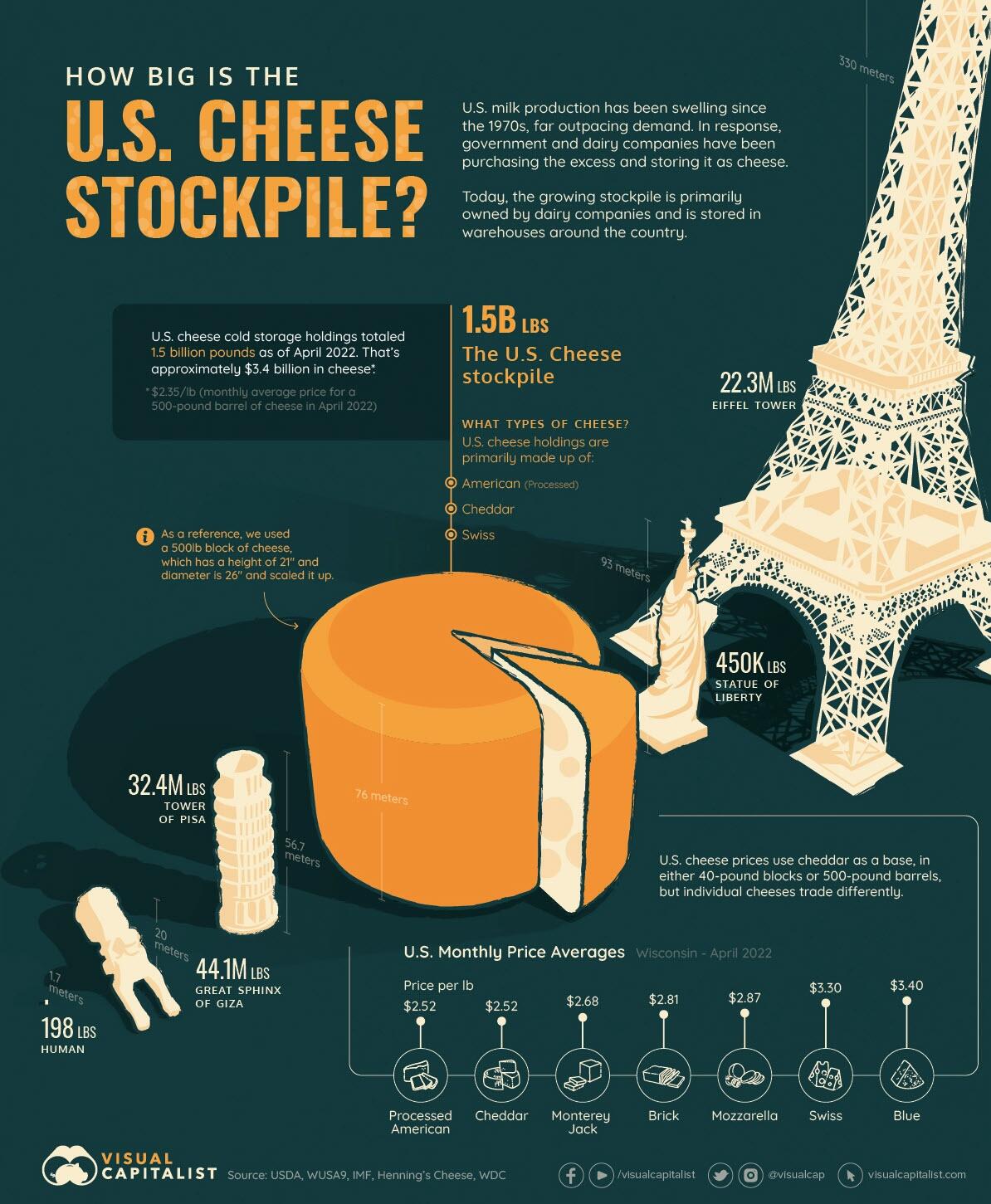
As of August 2022, the U.S. had 1.5 billion pounds of cheese in cold storage across the country. That’s around $3.4 billion worth of cheese.

Using data from USDA, this graphic looks at just how big the U.S. cheese stockpile has gotten over the last few years, and compares it to notable landmarks to help put things into perspective.

But before diving into the data, Visual Capitalist’s Omri Wallach and Carmen Ang take a step back to quickly explain why America’s cheese stockpile has gotten so big in the first place.

Why So Much Cheese?

Over the last 30 years, milk production in the U.S. has increased by 50%.

Yet, while milk production has climbed, milk consumption has declined. In 2004, Americans consumed the equivalent of about 0.57 cups of milk per day. By 2018, average milk consumption had dropped to 0.33 cup-equivalents.

In response to this predicament, the U.S. government and dairy companies have been purchasing the extra milk and storing it as cheese for years.

See the rest here

Be seeing you

Posted in Uncategorized | Tagged: , | Leave a Comment »

What Will You Do When Inflation Forces U.S. Households To Spend 40 Percent Of Their Incomes On Food?

Posted by M. C. on May 11, 2021

All that “free money” the Fed spews is not so free.

http://theeconomiccollapseblog.com/what-will-you-do-when-inflation-forces-u-s-households-to-spend-40-percent-of-their-incomes-on-food/

by Michael Snyder

Did you know that the price of corn has risen 142 percent in the last 12 months?  Of course corn is used in hundreds of different products we buy at the grocery store, and so everyone is going to feel the pain of this price increase.  But it isn’t just the price of corn that is going crazy.  We are seeing food prices shoot up dramatically all across the industry, and experts are warning that this is just the very beginning.  So if you think that food prices are bad now, just wait, because they are going to get a whole lot worse.

Typically, Americans spend approximately 10 percent of their disposable personal incomes on food.  The following comes directly from the USDA website

In 2019, Americans spent an average of 9.5 percent of their disposable personal incomes on food—divided between food at home (4.9 percent) and food away from home (4.6 percent). Between 1960 and 1998, the average share of disposable personal income spent on total food by Americans, on average, fell from 17.0 to 10.1 percent, driven by a declining share of income spent on food at home.

Needless to say, the poorest Americans spend more of their incomes on food than the richest Americans.

According to the USDA, the poorest households spent an average of 36 percent of their disposable personal incomes on food in 2019…

As their incomes rise, households spend more money on food, but it represents a smaller overall budget share. In 2019, households in the lowest income quintile spent an average of $4,400 on food (representing 36.0 percent of income), while households in the highest income quintile spent an average of $13,987 on food (representing 8.0 percent of income).

Needless to say, the final numbers for 2020 will be quite a bit higher, and many believe that eventually the percentage of disposable personal income that the average U.S. household spends on food will reach 40 percent.

That would mean that many poor households would end up spending well over 50 percent of their personal disposable incomes just on food.

At one time that would have been unimaginable, but now everything is changing.  As I noted above, the price of corn his increased 142 percent since this time last year…

Corn prices have jumped roughly 142% over the past year to $7.56 per bushel, the highest price seen in eight years for the crop.

A drought in Brazil and increased demand in China have put pressure on global suppliers.

In other areas we are seeing more moderate inflation, but overall we just witnessed the largest increase in food inflation “in almost nine years”

The average prices in March of 2021 for pork chops and chicken breasts are both up more than 10% compared to March of 2020. Eggs and cheddar cheese are both up 6%.

Looking at all consumer goods as a whole, the latest inflation data in the Consumer Price Index from the U.S. Bureau of Labor Statistics shows the largest month-to-month increase in almost nine years.

Meanwhile, the price of lumber just continues to shoot even higher.

In New Jersey, one man says that the total cost of lumber used in building his new home will reach $70,000

Tom McCarthy can’t finish building a home in Bergen County, New Jersey because of the lumber shortage.

“There are pieces of wood that we can’t find,” said McCarthy, a real estate broker with the Chen Agency who also builds homes with his father on the side.

McCarthy estimates the cost of lumber for the home will hit $70,000, nearly double the cost of building the exact same home in a nearby town just eight months ago.

Isn’t that nuts?

Instead of building a new home, you could try buying an existing one instead, but real estate prices in many areas have gotten completely insane.

In northern California, one house recently sold for more than a million dollars over listing price

When a house in Berkeley sold for more than $1 million over its list price in late March 2021, it was covered in media outlets across the Bay Area, including this one.

While the Berkeley sale was particularly sensational — it sold for double its list price and received 29 offers — these individual stories are becoming more common in today’s real estate market, according to recent data and anecdotes from real estate professionals.

I never imagined that I would see such a thing happen.

But one real estate agent says that such wild bidding wars are becoming increasingly common

And that’s especially true in the East Bay. “People are not surprised when a home goes $1 million over,” said Josh Dickinson, the founder of real estate agency Zip Code East Bay. “When my clients see a house for $1.9 million they’re almost conditioned to think it’ll go over $3 million in Piedmont or North Berkeley.”

This is what the beginning stages of hyperinflation look like, but Federal Reserve officials insist that we have nothing to be concerned about.

In fact, Eric Rosengren just told the press that the crazy inflation we are seeing now “is likely to prove temporary”

Boston Federal Reserve President Eric Rosengren in an interview with MarketWatch on Wednesday dismissed talk of scaling back asset purchases as premature, and said temporary factors pushing up inflation this spring won’t last.

“My view is that this acceleration in the rate of price increases is likely to prove temporary,” Rosengren said Wednesday.

Do you believe him?

I don’t.

As Simon Black has pointed out, the federal government is just going to continue to borrow and spend trillions upon trillions of dollars…

This is the big one. The US federal government is hoping to spend a whopping $11 TRILLION this year, between the regular budget, COVID stimulus already passed, and all the new legislation they’re proposing.

And it’s only May.

See the rest here

About the Author: My name is Michael Snyder and my brand new book entitled “Lost Prophecies Of The Future Of America” is now available on Amazon.com.  In addition to my new book, I have written four others that are available on Amazon.com including The Beginning Of The EndGet Prepared Now, and Living A Life That Really Matters. (#CommissionsEarned)  By purchasing the books you help to support the work that my wife and I are doing, and by giving it to others you help to multiply the impact that we are having on people all over the globe.  I have published thousands of articles on The Economic Collapse BlogEnd Of The American Dream and The Most Important News, and the articles that I publish on those sites are republished on dozens of other prominent websites all over the globe.  I always freely and happily allow others to republish my articles on their own websites, but I also ask that they include this “About the Author” section with each article.  The material contained in this article is for general information purposes only, and readers should consult licensed professionals before making any legal, business, financial or health decisions.  I encourage you to follow me on social media on FacebookTwitter and Parler, and any way that you can share these articles with others is a great help.  During these very challenging times, people will need hope more than ever before, and it is our goal to share the gospel of Jesus Christ with as many people as we possibly can.

Be seeing you

Posted in Uncategorized | Tagged: , , | Leave a Comment »

How soon will the Left eat their own? « Jon Rappoport’s Blog

Posted by M. C. on January 19, 2021

The Organic Consumers Association writes [1] (see also [2], [3], [4]): “If, like us, you dream of an organic, regenerative food system led by independent family farmers, then news that Joe Biden has asked Tom Vilsack to return to his Obama Era post as Secretary of Agriculture should be a real cause for concern.”

“…when you look behind the curtains to see what Vilsack was really doing at USDA from 2009 through 2017, it’s not pretty.”

Nor is it coincidental that two of the Obama’s biggest supporters, Bill Gates and George Soros, purchased 900,000 and 500,000 shares of Monsanto, respectively, in 2010.

https://blog.nomorefakenews.com/2021/01/18/how-soon-will-the-left-eat-their-own/

by Jon Rappoport

Hey. I’m always here to offer advice to the Left, to make their road smoother, to point them in the direction of fellow travelers they should cancel for deficiencies of “wokeness.”

Let’s start with the issue of GMOs, poisonous Roundup, and Monsanto (now swallowed up by Bayer).

Joe Biden is going to appoint Mr. Monsanto, Tom Vilsack, as his Secretary of Agriculture. Tommy boy held that post under Obama.

The Organic Consumers Association writes [1] (see also [2], [3], [4]): “If, like us, you dream of an organic, regenerative food system led by independent family farmers, then news that Joe Biden has asked Tom Vilsack to return to his Obama Era post as Secretary of Agriculture should be a real cause for concern.”

“…when you look behind the curtains to see what Vilsack was really doing at USDA from 2009 through 2017, it’s not pretty.”

“He pushed through a corporate agribusiness agenda that began with his approval of more new genetically modified crops than any other Secretary, culminated in his shepherding of a bill to kill GMO labels through Congress, and included his racist firing of African American land trust hero Shirley Sherrod and his distortion of data to conceal decades of discrimination against black farmers. Between 2006 and 2016, the USDA [US Dept. of Agriculture] was six times more likely to foreclose on a black farmer than a white farmer.”

“But, Biden doesn’t care about any of this. Vilsack is Biden’s buddy and that’s all that matters to him. As the American Prospect reports, Vilsack has had ‘a decades-long relationship with Joe Biden, going back to when he endorsed him for president while mayor of Mt. Pleasant, Iowa, in 1988’.”

“Vilsack has remained very loyal to Biden. In the last year, he gave Biden more than $8,000 in campaign contributions (excluding money from his wife or to Democratic Party committees).”

“This support didn’t just get him a job in the cabinet, he wrote Biden’s campaign platform on agriculture issues, stuffing it full of false solutions like corn ethanol and methane digesters run on factory farm dairy waste.”

“We need a USDA Secretary of Agriculture who will be a hero, steering our food and farming system toward a brighter, regenerative future—not a Secretary who will continue to be a pawn for the same corporate interests that are causing, and profiting from, the mess we are in.”

Good luck with that dream under Biden.

Let’s go further. Here’s a piece I wrote during the Obama years—you know, when we were all living in paradise—about the president’s GMO program.

Keep in mind that Biden’s new secretary of agriculture, Tom Vilsack, was on board every step of the way, with Obama. Vilsack was enabler, expert, political operative, cheerleader—

MEET MONSANTO’S MAN IN WASHINGTON, BARACK OBAMA

Obama? A warrior against corporations on behalf of the people? It’s long past the time for ripping that false mask away.

During his 2008 campaign for president, Barack Obama transmitted signals that he understood the GMO/Roundup issue. Several key anti-GMO activists were impressed. They thought Obama, once in the White House, would listen to their concerns and act on them.

These activists weren’t just reading tea leaves. On the campaign trail, Obama said: “Let folks know when their food is genetically modified, because Americans have a right to know what they’re buying.”

Making the distinction between GMO and non-GMO was certainly an indication that Obama, unlike the FDA and USDA, saw there was an important line to draw in the sand.

Beyond that, Obama was promising a new era of transparency in government. He was adamant in assuring that, if elected, his administration wouldn’t do business “the old way.” He would be “responsive to people’s needs.”

Then came the reality.

After the election, people who had been working to label GMO food and warn the public of its huge dangers were shocked to the core. They saw Obama had been pulling a bait and switch.

After the 2008 election, Obama filled key posts with Monsanto people, in federal agencies that wield tremendous force in food issues, the USDA and the FDA:

At the USDA, as the director of the National Institute of Food and Agriculture, Roger Beachy, former director of the Monsanto Danforth Center.

As deputy commissioner of the FDA, the new food-safety-issues czar, the infamous Michael Taylor, former vice-president for public policy for Monsanto. Taylor had been instrumental in getting approval for Monsanto’s genetically engineered bovine growth hormone.

As commissioner of the USDA, Iowa governor, Tom Vilsack. Vilsack had set up a national group, the Governors’ Biotechnology Partnership, and had been given a Governor of the Year Award by the Biotechnology Industry Organization, whose members include Monsanto.

As the new Agriculture Trade Representative, who would push GMOs for export, Islam Siddiqui, a former Monsanto lobbyist.

As the new counsel for the USDA, Ramona Romero, who had been corporate counsel for another biotech giant, DuPont.

As the new head of the USAID, Rajiv Shah, who had previously worked in key positions for the Bill and Melinda Gates Foundation, a major funder of GMO agriculture research.

We should also remember that Obama’s secretary of state, Hillary Clinton, once worked for the Rose law firm. That firm was counsel to Monsanto.

Obama nominated Elena Kagan to the US Supreme Court. Kagan, as federal solicitor general, had previously argued for Monsanto in the Monsanto v. Geertson seed case before the Supreme Court.

The deck was stacked. Obama hadn’t simply made honest mistakes. Obama hadn’t just failed to exercise proper oversight in selecting appointees. He wasn’t just experiencing a failure of short-term memory. He was staking out territory on behalf of Monsanto and other GMO corporate giants.

And now let us look at what key Obama appointees have wrought for their true bosses. Let’s see what GMO crops have walked through the open door of the Obama presidency.

Monsanto GMO alfalfa.

Monsanto GMO sugar beets.

Monsanto GMO Bt soybean.

Coming soon: Monsanto’s GMO sweet corn.

Syngenta GMO corn for ethanol.

Syngenta GMO stacked corn.

Pioneer GMO soybean.

Syngenta GMO Bt cotton.

Bayer GMO cotton.

ATryn, an anti-clotting agent from the milk of transgenic goats.

A GMO papaya strain.

And perhaps, soon, genetically engineered salmon and apples.

This is an extraordinary parade. It, in fact, makes Barack Obama the most GMO-dedicated politician in America.

You don’t attain that position through errors or oversights. Obama was, all along, a stealth operative on behalf of Monsanto, biotech, GMOs, and corporate control of the future of agriculture.

From this perspective, Michelle Obama’s campaign for gardens and clean, organic, nutritious food is nothing more than a diversion, a cover story floated to obscure what her husband has actually been doing.

Nor is it coincidental that two of the Obama’s biggest supporters, Bill Gates and George Soros, purchased 900,000 and 500,000 shares of Monsanto, respectively, in 2010.

We are talking about a president who presented himself, and was believed by many to be, an extraordinary departure from politics as usual.

Not only was that a wrong assessment, Obama was lying all along. He was, and he still is, Monsanto’s man in Washington.

To those people who fight for GMO labeling and the outlawing of GMO crops, and against the decimation of the food supply and the destruction of human health, but still believe Obama is a beacon in bleak times:

Wake up.

—end of 2014 article—

Well, well. Tom Vilsack is back. Biden is about to betray the Left on a key issue.

Dear Lefties: Are you going to sit still for this?

Start tweeting and FBing.

I wonder whether you’ll get censored by your comrades in Big Tech…


SOURCES:

[1] https://advocacy.organicconsumers.org/page/25412/action/1

[2] https://www.organicconsumers.org/news/tom-vilsack-agriculture-secretary-everything-thats-wrong-democratic-party

[3] https://www.organicconsumers.org/blog/back-future-tom-mr-monsanto-vilsack-part-i

[4] https://www.theguardian.com/commentisfree/2020/dec/21/joe-biden-tom-vilsack-agriculture-secretary

Jon Rappoport

The author of three explosive collections, THE MATRIX REVEALED, EXIT FROM THE MATRIX, and POWER OUTSIDE THE MATRIX, Jon was a candidate for a US Congressional seat in the 29th District of California. He maintains a consulting practice for private clients, the purpose of which is the expansion of personal creative power. Nominated for a Pulitzer Prize, he has worked as an investigative reporter for 30 years, writing articles on politics, medicine, and health for CBS Healthwatch, LA Weekly, Spin Magazine, Stern, and other newspapers and magazines in the US and Europe. Jon has delivered lectures and seminars on global politics, health, logic, and creative power to audiences around the world. You can sign up for his free NoMoreFakeNews emails here or his free OutsideTheRealityMachine emails here.

Be seeing you

Posted in Uncategorized | Tagged: , , , , , , | Leave a Comment »

Why Do the Postal Service, USDA, EPA, And Department of Agriculture Need SWAT Teams?

Posted by M. C. on September 24, 2019

Don’t be surprised if you find the link doesn’t work. Facebook and and don’t like Copblock.

https://www.copblock.org/?s=epa+swat

Military-Style Units From Government Agencies That Have No Association with National Security are Wreaking Havoc on Non-Violent Citizens

Kristan T. Harris | The Rundown Live 

All throughout the United States there are government agencies who have no association with national security acquiring military-like equipment, according to news talk KFLD.

Many agencies are also receiving SWAT teams including the Department of Agriculture, the Railroad Retirement Board, the Tennessee Valley Authority, the Office of Personnel Management, the Consumer Product Safety Commission, the U.S. Fish and Wildlife Service and the Education Department.

In almost prophetic fashion Ron Paul in a 1997 warned about the militarization of federal bureaucrats; including the BLM, which was not yet armed.

“All government power is ultimately gun power and serves the interests of those who despise or do not comprehend the principles of liberty,” said Dr. Paul.  “The gun in the hands of law-abiding citizens serves to hold in check arrogant and aggressive government. Guns in the hands of the bureaucrats do the opposite. The founders of this country fully understood this fact.”

Which is exactly what we are seeing today with the over militarization of government agencies that have no reason to be armed.

The USDA has used its new military power to threaten people who grow lemon trees; force large fines on people for selling bunnies; confiscate grapes for no real reason; and ruin the livelihoods of small farmers.

One USDA SWAT team even seized bees privately owned that were proven resistant to Monsanto’s GMO Roundup and killed all remaining Queens. This shows the incestuous relationship between crooked corporations like George Soro’s Monsanto and government agencies.

The USDA is not alone in it’s abuse of power. The Bureau of Land Management (BLM) and Environmental Protection Agency (EPA) have recently used their swat teams to bully Americans for lobbyist interests or to punish political enemies.

Given the nations current debt, which approaching 20 trillion dollars, it seems like a foolish investment and wasteful to tax payers to buy all these unnecessary military equipment.

Why does US Department of Agriculture (USDA) need submachine guns? The agency’s Office of Inspector General (OIG) is requesting .40 Caliber semiautomatic submachine guns along with 320,000 rounds of hollow point ammo.

Why is the US Postal Service soliciting proposals for assorted small arms ammunition?

Why has the Social Security Administration requested 174,000 rounds of hollow-point bullets?

Why does the National Oceanic and Atmospheric Administration (NOAA), which oversees the National Weather Service, need 46,000 rounds of hollow point ammo?

For what purpose does the EPA need a SWAT team?

Why do colleges need MRAPS and militarized campus police?

Why are government agencies raiding non-violent citizens? Al Armendariz, the regional administrator who was video-taped saying the EPAs “philosophy” is to “crucify” and “make examples” of US energy producers.

Be seeing you
Drip, Drip, Drip


Posted in Uncategorized | Tagged: , , , , | Leave a Comment »

Why Not Eliminate Both Departments? – LewRockwell

Posted by M. C. on August 14, 2019

https://www.lewrockwell.com/2019/08/laurence-m-vance/why-not-eliminate-both-departments/

By

The U.S. Department of Agriculture (USDA) has announced plans to move its Economic Research Service and National Institute of Food and Agriculture out of Washington, D.C., to the Kansas City metropolitan area.

The USDA, established in 1862, “is made up of 29 agencies and offices with nearly 100,000 employees who serve the American people at more than 4,500 locations across the country and abroad.” It provides “leadership on food, agriculture, natural resources, rural development, nutrition, and related issues based on public policy, the best available science, and effective management.” Its vision is “to provide economic opportunity through innovation, helping rural America to thrive; to promote agriculture production that better nourishes Americans while also helping feed others throughout the world; and to preserve our Nation’s natural resources through conservation, restored forests, improved watersheds, and healthy private working lands.”

The U.S. Department of the Interior (DOI) has announced plans to move the headquarters of its Bureau of Land Management (BLM) out of Washington, D.C., to Grand Junction in western Colorado.

The DOI, established in 1849, “conserves and manages the Nation’s natural resources and cultural heritage for the benefit and enjoyment of the American people, provides scientific and other information about natural resources and natural hazards to address societal challenges and create opportunities for the American people, and honors the Nation’s trust responsibilities or special commitments to American Indians, Alaska Natives, and affiliated island communities to help them prosper.” It “manages the Nation’s public lands and minerals, including providing access to more than 480 million acres of public lands, 700 million acres of subsurface minerals, and 1.7 billion acres of the Outer Continental Shelf.” It “is the steward of 20 percent of the Nation’s lands, including national parks, national wildlife refuges, and other public lands; manages resources that supply 30 percent of the Nation’s energy; supplies and manages water in the 17 Western States and supplies 15 percent of the Nation’s hydropower energy.”

I have a better idea. Instead of moving agencies of the USDA and the DOI, why not eliminate both departments?

The existence of the USDA cannot be justified in any way by the Constitution. The Constitution nowhere authorizes the federal government to have anything to do with agriculture, food, farm subsidies, food stamps, loans to farmers, agricultural price supports, food distribution, food inspection, nutrition guidelines, or school breakfast and lunch programs.

Farming is an occupation and a business. It comes with risks and uncertainties just like any other business. There is nothing special about agriculture that necessitates that the federal government be involved in it in any way.

The DOI includes a diverse number of agencies:

  • Bureau of Indian Affairs
  • Bureau of Indian Education
  • Bureau of Land Management
  • Bureau of Ocean Energy Management
  • Bureau of Reclamation
  • Bureau of Safety and Environmental Enforcement
  • National Park Service
  • Office of Surface Mining Reclamation and Enforcement
  • U.S. Fish and Wildlife Service
  • U.S. Geological Survey

There is no constitutional authority for the federal government to have anything to do with fish and wildlife, minerals and mining, operating parks, or supplying water and power. The main problem is simply that the federal government still owns too much land…

  • 28.6% of Washington
  • 29% of Montana
  • 35.4% of New Mexico
  • 38.7% of Arizona
  • 45.9% of California
  • 53% of Oregon
  • 61.3% of Alaska
  • 61.6% of Idaho
  • 63.1% of Utah
  • 79.6% of Nevada…

Republicans used to talk about eliminating federal departments, agencies, bureaus, commissions, and corporations. But when they gained control of the White House and a majority in the House and Senate they did absolutely nothing to limit the size or scope of government. They actually made things worse with their creation of the monstrous Department of Homeland Security.

The Departments of Agriculture and the Interior don’t need some of their agencies moved, they need to eliminated in their entirety.

Be seeing you

Trail of Trouble - Bureau Of Indian Affairs - Magazine ...


Posted in Uncategorized | Tagged: , , , | Leave a Comment »

Agriculture Is Only a Tiny Part of America’s Economy — And That’s a Good Thing | Mises Wire

Posted by M. C. on July 17, 2019

A century later, 3 million were employed on farms, while the USDA employed 105,000 workers. This increase in agency size represents the Federal government’s increasingly regulatory stance in the US economy.

https://mises.org/wire/agriculture-only-tiny-part-americas-economy-%E2%80%94-and-thats-good-thing

For decades, politicians and pundits in political media alike have said that the American farming and ranching industries are vital to our nation and must be protected from “unfair” competition and the threat of going out of business. This belief often materializes in the form of legislative or executive action undertaken by the government.

The federal government has long sought to promote the health of these industries, employing pro-farming policies since the days of FDR’s New Deal. These programs survive to this day, being expanded from their initial scope or their original sentiments reimposed through new acts of Congress. Strangely enough, this bureaucratic expansion occurs despite American agriculture output declining over the course of America’s existence.

Output Declines, Government Grows

Since 1900, the number of American farms in operation has fallen 63 percent. In 1930, agricultural GDP as a share of total GDP sat at a sizeable 7.7 percent — by 2002, agricultural GDP as a share of total GDP was a mere 0.7 percent. This 7 percent decrease signals the adoption of a new role in the world economy by the US.

The US now imports a large percentage of the fresh vegetables and produce it sells — while in 1975 the proportion of fresh fruit sold in the United States that was imported was 23 percent, it reached 51.3 percent in 2016.

ndri1.png

Source: New York Times

Domestic vegetable and fruit producers are being supplanted in the market by producers from countries such as Argentina, Chile, and Mexico. The City University of New York’s Urban Food Policy Institute reports: “…since the NAFTA Trade Agreement in 1994, U.S. consumption of tomatoes, peppers, cucumbers, limes, berries, avocados and mangos imported from Mexico is way up and still rising.”

Clearly, increased trade is impacting America’s agriculture sector. Surely then, the government’s relationship with the industry must be changing as well. Logic would suggest that the USDA and its subordinate agencies are laying off employees and reducing their size and scope in response to the decline of America’s beloved industry.

In reality, this is not the case. In 1900, 11 million Americans were employed on farms and 2,900 employed by the USDA. A century later, 3 million were employed on farms, while the USDA employed 105,000 workers. This increase in agency size represents the Federal government’s increasingly regulatory stance in the US economy.

Agriculture’s Death is Good News

How could an industry’s death spell prosperity for a nation? While the number of people employed in farming and similar occupations dwindled from 11 million in 1900 to 2.6 million in 2017, employment in STEM (science, technology, engineer, and math) occupations has grown 79 percent between 1990 and 2016 — increasing from 9.7 million to 17.3 million. The US economy is transitioning away from producing in primary and secondary level industries like agriculture and related enterprises such as food processing and packaging.

The reduction in the number of people employed in agriculture and related jobs shows that America is actually abandoning low paying jobs. Compared to STEM jobs, occupations in the primary or secondary sectors of the economy tend to pay a very low wage. Farm hands and field laborers, who are often poor immigrants, are paid below minimum wage to perform tasks that take a significant toll on their bodies. Difficult manual labor poses both short-term and long-term risks to workers’ health, compared to the almost complete lack of health detriments presented by jobs in STEM fields. These agricultural jobs tend also to be seasonal. Workers will only have a secure source of income for between 3 and 6 months per year, depending on where they work, due to the fact that crops cannot be grown year round.

As the economy sheds the last remnants of its agricultural-centric past, new jobs are being created in new industries at a rapid pace. Occupations in the tertiary and quaternary sectors are far more beneficial to society and individuals, as they provide higher wages, a more stable source of income, and employment year round. In a bid to attract workers to fill positions, companies often offer benefits such as childcare and healthcare plans as part of an offer of employment. It is very obvious that we should seek to employ as many people as possible in tertiary and quaternary sector industries.

Primary and secondary products will never lose value. Humans will always have a need to consume agricultural products and build devices and structures from raw materials that are finished through secondary sector activities. As the US economy begins to be largely constructed of tertiary and quaternary economic activities, these lower-level processes will simply be outsourced to less developed countries.

Outsourcing: Oppression or Opportunity?

Since their ideology became a force in the mainstream a decade ago, the rallying cry of political leftists has been to stand for those being oppressed, exploited, or victimized by the status quo. The advancement of technology has meant that industrialization, combined with other factors, has left certain nations behind. Third world economies are not nearly as developed as their first world counterparts, with a bulk of their economic activity taking place in the primary and secondary sectors. These leftists take an anti-trade stance, positing that the outsourcing of production to less developed nations is capitalistic exploitation.

“Exploitation” Actually Benefits All Parties Involved

While it is true that a business owner may outsource simple manufacturing processes to countries where they may hire workers at cheaper wages, it is also true that the workers hired benefit from this self-interested move. The reason workers choose to work in these plants and industries is that they provide the best possible way to make money to the worker. If a corporation goes to a less developed nation and is able to hire 5,000 workers to work for them, it means that the firm is now offering the best employment opportunity in the country to 5,000 workers. Prior to the company’s arrival, laborers were likely making less money than they now do and working in worse conditions. Otherwise, why would they choose to work for the new company? Their condition has obviously been improved by the opening of a plant by a foreign capitalist…

Be seeing you

economics | The Rule of Freedom


Posted in Uncategorized | Tagged: , , , , , | Leave a Comment »

What Would Happen If Government Didn’t Handle That? – Foundation for Economic Education

Posted by M. C. on July 26, 2018

https://fee.org/articles/what-would-happen-if-government-didn-t-handle-that/

Gary M. Galles

Those who defend liberty are often challenged to supply exhaustive descriptions of what would happen were some aspect of our increasingly government-dictated lives returned to individuals’ voluntary arrangements. What would happen if government didn’t educate our children? If Social Security didn’t provide for retirement? If Medicaid and Medicare didn’t provide health care? If the USDA, FDA, FAA, etc., didn’t ensure our safety? If the EPA didn’t deal with pollution?

Anyone put on the spot with such questions must recognize that they are rhetorical traps. They are used to put an impossible burden of proof on voluntary arrangements, to allow proponents to dodge having to defend against criticisms of coercive policies… Read the rest of this entry »

Posted in Uncategorized | Tagged: , , , , , | Leave a Comment »

Strawberries Still the Dirtiest of the Dirty Dozen

Posted by M. C. on April 26, 2018

Scrubba dub dub or else you will look like this

Gollum

https://articles.mercola.com/sites/articles/archive/2018/04/24/strawberries-top-dirty-dozen-produce-list.aspx

By Dr. Mercola

Story at-a-glance

  • EWG analyzed tests from the U.S. Department of Agriculture (USDA), which revealed close to 70 percent of conventionally grown produce samples contained pesticide residues
  • In all, 230 different pesticides and pesticide breakdown products were identified in more than 38,800 nonorganic samples
  • Strawberries ranked No. 1 in terms of pesticide residues, with up to 22 different pesticides found on a single berry; nearly all of the strawberry samples (99 percent) contained at least one detectable pesticide residue, while 20 percent contained 10 or more
  • More than 98 percent of samples of the top six “dirtiest” produce items (strawberries, spinach, peaches, nectarines, cherries and apples) contained at least one pesticide, while spinach contained 1.8 times more pesticide residue by weight than any other crop
  • The best way to avoid pesticide residues in your food is to choose those that haven’t been exposed to them to begin with, i.e., go organic

Read the rest of this entry »

Posted in Uncategorized | Tagged: , , , | Leave a Comment »

Watch Out For Those Terrorist Farmers

Posted by M. C. on May 16, 2014

The USDA is buying machine guns and body armor.

I don’t really think farmers are the primary target.  Every department of the government is buying guns and ammunition.  The government is spreading the wealth.  No one department is buying a large volume except the DHS.

The definition of terrorist has quickly evolved to include radicals.  Who are radicals?

The definition of radical hasn’t changed for a thousand years.  Radicals are anyone that does not conform to what the rulers want.  Antiwar activists, freedom lovers, anti-government types and anyone that doesn’t do or act as they told.

Terrorism is one crisis that is not being wasted.

The government has bought enough ammo to have a couple magazine’s worth for everyone.  That includes you.

What have you done lately to stop the madness?  Nothing?  Better get your own body armor.

The “I haven’t done wrong” excuse won’t cut it.  Not when the man decides he needs a better arrest/kill ratio.  The cops can arrest, kill or make you forfeit your money at will in many areas now.

I can see it getting worse fast, especially when the current bubble bursts.

You should have voted for Ron Paul.

Be seeing you.

Posted in Uncategorized | Tagged: , , | 1 Comment »