Well, maybe not YOU, but you might run into someone who can.
https://youtube.com/shorts/G7yXspa8xp4?feature=share
Be seeing you

Enemy of the State-Read the Book-Know the Man
This is not a Safe Space but Baby, I don't care.

"I am not a number, I am a Free Man" - No. 6
 Information Liberation Alex Jones’ Prison Planet Gary North Specific Answers Antiwar The Daily Bell Tenth Amendment Center Economics Policy Journal The American Thinker The New American Lew Rockwell
Posted by M. C. on August 23, 2021
Well, maybe not YOU, but you might run into someone who can.
https://youtube.com/shorts/G7yXspa8xp4?feature=share
Be seeing you
Posted in Uncategorized | Leave a Comment »
Posted by M. C. on August 23, 2021
Apple should admit that the problem with their phones isn’t just what people might store on them, it’s the phones themselves.
Be seeing you
Posted in Uncategorized | Tagged: Apple, Bill Maher | Leave a Comment »
Posted by M. C. on August 23, 2021
Alas, even that was news to the US president – at least until he is replaced by Kamala Harris in a few weeks – who was shocked when confronted about criticism over the planning for the withdrawal of U.S. troops.
“I have seen no question of our credibility from our allies,” Biden told reporters after a speech from the White House on Friday. “As a matter of fact, the exact opposite … we’re acting with dispatch, we’re acting, committing to what we said we would do.”
 by Tyler Durden
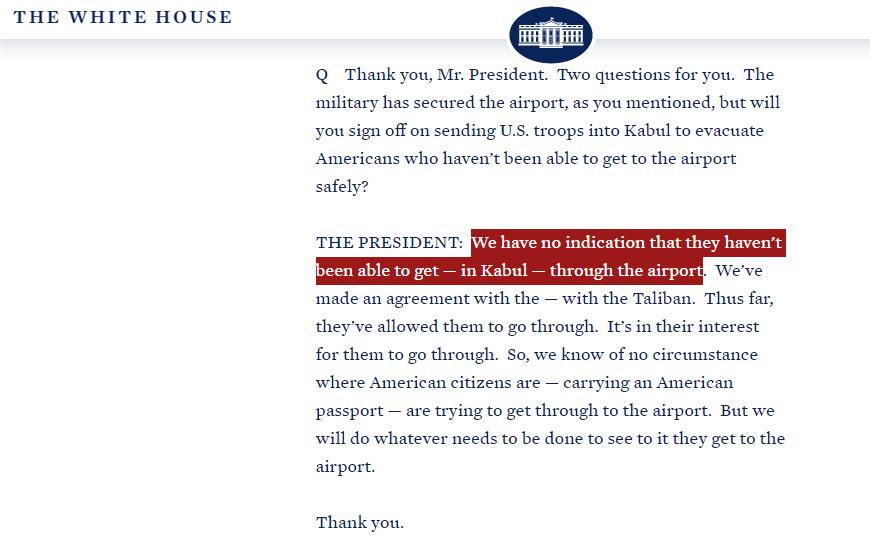
One day after the dementia-ridden president lied to Americans and billions watching around the world that he has “no indication that [Americans] haven’t been able to get, in Kabul, through the airport,” when asked about evacuating Americans who were unable to reach the only safe place in the Taliban-overrun caliphate…

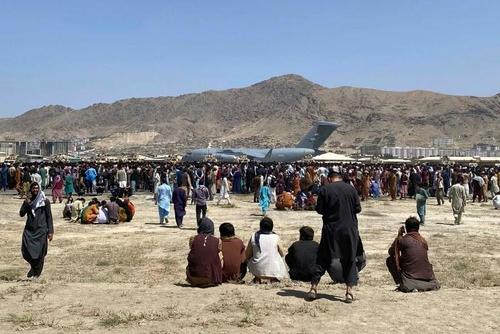
… just 12 hours later (or 2-3 days in Biden time) on Saturday the US embassy in Kabul, or rather what’s left of it as it is now officially located at the airport having handed over the actual embassy building to the millitant Suunis, advised Americans in Afghanistan to avoid traveling to Kabul airport, adding that authorities will contact all registered U.S. citizens with further instructions as the situation updates.
“Because of potential security threats outside the gates at the Kabul airport, we are advising U.S. citizens to avoid traveling to the airport and to avoid airport gates at this time unless you receive individual instructions from a U.S. government representative to do so,” the embassy posted Saturday morning.
To the thousands of desperate US citizens gathered trying to flee the country the instructions to wait – perhaps until General Milley is finished reading the collected works of Mao Zedong – will come as merely the latest slap in the face by an administration that has rightfully earned international scorn and mockery for its unprecedented botching of the Afghan withdrawal.
The scene at Kabul airport several hours ago per source from an NGO who is trying to get people out. Main problem is that it’s impossible to pass the gates and get to the planes even if you are on an evacuees list pic.twitter.com/b3bZn5B34Z — Barak Ravid (@BarakRavid) August 21, 2021
Images circulated on social media this week of Afghans rushing towards a U.S. C-17 transport plane and clinging to its side. A separate video showed what appeared to be two people falling from a military plane as it flew out of Kabul. Since then, crowds have grown at the airport where armed Taliban have urged those without travel documents to go home. At least 12 people have been killed in and around the single runway airfield since Sunday, NATO and Taliban officials said.
The chaos was not the responsibility of the Taliban, an official of the group told Reuters. “The West could have had a better plan to evacuate.”
Be seeing you
Posted in Uncategorized | Tagged: evacuating Americans, Kabul, Taliban | Leave a Comment »
Posted by M. C. on August 23, 2021
At the risk of being accused of cherry-picking, I will point out that one expert on the matter, by no means unfriendly to the IPCC, Roger Pielke Jr. of the University of Colorado, writes, “Instead of apocalyptic warnings about ‘immediate risk’ a top line message of this report should be: Great News! The Extreme Scenario that IPCC Saw as Most Likely in 2013 is Now Judged Low Likelihood. I am actually floored that this incredible change in such a short time apparently hasn’t even been noticed, much less broadcast around the world.”
Instead, Pielke notes, UN Secretary General António Guterres said the report is “a code red for humanity” and that “billions of people [are] at immediate risk.” To which Pielke replies: Not only is this wrong, it is irresponsible. Nowhere does the IPCC report say that billions of people are at immediate risk.”
https://libertarianinstitute.org/articles/tgif-thinking-energy/
The UN’s Intergovernmental Panel on Climate Change (IPCC) issued its sixth “assessment report” earlier this month. As usual it generated its share of alarmist headlines. The report is several thousand pages long, and I’m certainly not qualified to digest, much less judge, it. I do think it’s wise, however, to view the headlines and politicians’ statements about it critically. The poppycock quotient of rhetoric about the supposedly looming environmental catastrophe is extremely high, not to mention toxic.
At the risk of being accused of cherry-picking, I will point out that one expert on the matter, by no means unfriendly to the IPCC, Roger Pielke Jr. of the University of Colorado, writes, “Instead of apocalyptic warnings about ‘immediate risk’ a top line message of this report should be: Great News! The Extreme Scenario that IPCC Saw as Most Likely in 2013 is Now Judged Low Likelihood. I am actually floored that this incredible change in such a short time apparently hasn’t even been noticed, much less broadcast around the world.”
Instead, Pielke notes, UN Secretary General António Guterres said the report is “a code red for humanity” and that “billions of people [are] at immediate risk.” To which Pielke replies: Not only is this wrong, it is irresponsible. Nowhere does the IPCC report say that billions of people are at immediate risk.”
That’s from a guy who says if the IPCC didn’t exist, we’d need to invent it. (Pielke has a follow-up article here, and Nick Gillespie of Reason interviews him here.)
I don’t want to leave the impression that we nonspecialists should be agnostic on the climate question. The most prominent of the political solutions to the problems (real or imagined) associated with climate change would be unimaginably expensive for the world. So new problems–associated with poverty and liberty–would thereby arise. As Thomas Sowell points out, in our world, there are no solutions, only trade-offs. This is woefully unappreciated. I recall hearing an environmentalist say that the first law of ecology is: you can’t do just one thing. But he apparently forgot it in the next moment. That’s also a fundamental law of economics–and indeed all of life.
We face choices, and we must always ask those who propose “solutions”: at what cost–not just in money terms but in terms of human life and well-being?
Enter Alex Epstein, author of The Moral Case for Fossil Fuels and founder of the Center for Industrial Progress. (He has a sequel on the way, Our Fossil Future: Why Global Human Flourishing Requires More Oil, Coal, and Natural Gas–Not Less.) Epstein’s work is in the tradition of Julian Simon, author of The Ultimate Resource, whom Epstein acknowledges in his book. See a summary of Epstein’s book here.)
What I want to draw attention to is not his case for fossil fuels per se, which I find persuasive, but his “framework”–a word he is appropriately fond of–for thinking about energy and the environment. The importance of how one frames an issue may seem obvious, but how many people actually ask what the right framework is? Because of its dubious framework, Epstein sees the campaign against fossil fuels as riddled with bias, sloppiness (or vagueness), and an animus toward human beings. The last seems to account for the others.
Before we can decide whether something is good or bad, we need a standard. Good for what or whom? Moreover, in environmental matters it makes a difference whether you see mankind as an invader and destroyer of benignly stable nature or as a species that flourishes by taming often dangerously volatile nature, that is, making it a safer, more hospitable place.
In this regard, Epstein stresses the basic Simonian point that human beings don’t find and then deplete natural resources; rather they create them out of mere stuff, which does not come with a user manual. That makes human intelligence the “ultimate resource” (Simon’s term), a fact that an astounding corollary: as technology increases our efficiency in creating and using resources–as we learn to make more with a smaller quantity of resources–we in effect increase the supply of those resources, which we can use to make new things we couldn’t afford yesterday. In a way, human intelligence frees us from physical limitations. That takes the bite out of scary depletion scenarios.
You can see the implications for the controversy over energy. It is not enough to say that a given type of power has risks. We must be unbiased, meaning that we must look at the pros as well as the cons and compare them to other forms of energy; we must be specific about the magnitudes and probabilities of any actual risks; and, most important, we must judge the energy form by what it does on net for human welfare, not whether it interferes with nature. To live is to “interfere” with nature. For human beings, to live is to transform nature. What matters is whether change improves the prospects of human flourishing or undermines them.
Within this context Epstein goes on to the vindicate fossil fuels and argue that we need more (as well as nuclear and hydroelectric energy, which, oddly, are also opposed by most CO2-phobes). Oil, natural gas, and coal have provided abundant, inexpensive, and reliable energy that has been and remains life-saving. After all, energy underlies all production. The biggest challenge is to get them to the billions of people in the world who have no electricity or very little energy.
But what about the predicted apocalypse? We need to realize that the environmental alarmists’ record of predictions, which stretches back to antiquity, is pathetic. Moreover, the current state of the world does not support the dire scenarios. I’ll pick just two examples that Epstein emphasizes. First, deaths from the climate (extreme temperatures and extreme events) have been plummeting: a “98% decrease in the rate of climate-related deaths since significant CO2 emissions began 80 years ago.” Second, CO2, the most-feared greenhouse gas, is plant food not pollution. The earth is greening.
In summary, he writes, “Fossil fuel use doesn’t take a safe climate and make it dangerous, it takes a dangerous climate and makes it safe.” As a result, billions of people are alive today who otherwise could not be. Cutting back on fossil fuels would require an enormous human die-off. Who wants to volunteer? (No, unreliable and unscalable wind and solar apparently won’t fill the gap.)
This doesn’t mean that particular problems can’t arise: remember, there are no solutions, only trade-offs. The problems, however, should be addressed specifically (tort law has a role), while understanding that individual rights and freedom, private property, competitive markets, entrepreneurship, and the profit motive are the best ways to discover the best remedies.
Sheldon Richman is the executive editor of The Libertarian Institute, senior fellow and chair of the trustees of the Center for a Stateless Society, and a contributing editor at Antiwar.com. He is the former senior editor at the Cato Institute and Institute for Humane Studies, former editor of The Freeman, published by the Foundation for Economic Education, and former vice president at the Future of Freedom Foundation. His latest books are Coming to Palestine and What Social Animals Owe to Each Other.
Be seeing you
Posted in Uncategorized | Tagged: Antonio Guterres, Center For Industrial Progress, CO2, IPCC | Leave a Comment »
Posted by M. C. on August 22, 2021
Posted in Uncategorized | Leave a Comment »
Posted by M. C. on August 22, 2021
Posted in Uncategorized | Leave a Comment »
Posted by M. C. on August 22, 2021
By Adam Schrader For Dailymail.Com and Reuters
Be seeing you
Posted in Uncategorized | Tagged: booster shots, breakthrough, Dr. Fauci, fully vaccinated, immune systems | Leave a Comment »
Posted by M. C. on August 22, 2021
https://www.lewrockwell.com/2021/08/fred-reed/despair-in-the-empire-of-graveyards/
Forty-six years ago in a previous comedy I was in Saigon, recently having been evacuated from Phnom Penh in an Air America—CIA—Caribou carrying, in addition to me, several ARVN junior officers and perhaps a dozen BUFEs (Big Ugly Fucking Elephants, the ceramic pachyderms much beloved of GIs). America had already embarked on its currently standard policy of forcing small countries into wars and then leaving them in the lurch. In Cambodia this led to the reign of Pol Pot, the ghastly torture operation at Toul Sleng, and a million or so dead. In the unending fight for democracy, casualties are inevitable.
At the time Saigon was tense because Ban Me Thuot had fallen and the NVA roared down Route One toward Saigon. To anyone with the brains of a doorknob, the American adventure in Vietnam was coming to an end, but the embassy was studiedly unconcerned. Embassies do not have the brains of a doorknob, but are keenly aware of public relations. Acknowledging the inescapable is not their way. As usual, Washington would rather lie than breathe, and did. As in Cambodia, so in Nam, and so later in Afghanistan.
Apparently a genius at State realized that a lot of gringo expats lived in Nam—the number six thousand comes to mind, but may be wrong—and that six thousand hostages taken when Saigon fell would be bad PR. So the embassy in Kabul—Saigon, I meant to say, Saigon—quietly announced that expats could fly out on military aircraft from Ton Son Nhut. They didn’t, or at least many didn’t. The NVA continued its rush toward Saigon.
The expats didn’t fly out because they had Vietnamese wives and families and were not going to leave them, period. These wives may not have had the trappings of pieces of paper and stamps and maybe snippets of ribbon. These things do not seem important in Asian war zones. But the expats regarded them as wives. Period. The family went, or nobody did. Period.
The embassy didn’t understand this because embassies are staffed by people from Princeton with names like Derek who wear pink shirts and don’t know where they are. The ambassador is usually a political appointee being rewarded for campaign contributions and probably doesn’t speak the language as few gringos spikka da Pushto or Vietnamese or Farsi or Khmer. For example, nobody at all in the embassy in Cambodia spoke Khmer. The rank and file of State are better suited to a high-end Rotarian barbecue than a Third World city teeming with strange people in funny clothes eating God knows what horrible things in winding frightening alleys. And so the State people could not understand why an American would marry one “of them,” as in the embassy I once heard a gringa put it. It was a good question. Why would a man marry a pretty, sleek, smart, self-reliant woman who wanted family and children? It was a great mystery.
The Taliban—NVA, I mean–NVA kept coming closer. A PR disaster loomed.
Meanwhile the PR apparatus insisted that the sky wasn’t really falling even as it did and no, no, no the US had not gotten its sit-down royally kicked by a ratpack of rice-propelled paddy maggots, as GIs described the opposition. Many in government seemed to believe this. This was an early instance, to be repeated in another part of Asia, of inventing a fairyland world and then trying to move into it.
Finally State faced reality, a novel concept. It allowed quietly that expats and their families could fly out, military. It was getting late, but better than nothing.
The comedic value of this goat rope grew, becoming more amusing by the hour. I was trying to get a young Vietnamese woman out as she had worked for the embassy and we suspected things might not go well with her under the NVA. Call her Linda. Linda and I took the bus to Tan Son Nhut. The Viet gate guards gave her a hard time, envying her for getting out while they could not, but we got in. I was going to tell the State people that we were married but that while I was in Can Tho, by then in VC hands, see, the marriage papers had slipped from my carrying case. This was obvious bullshit, but I guessed that if I made a huge issue of it they would bend rather than get in a megillah with a reporter, no matter how unimportant.
We found ourselves in a long line of expats with their families leading to the door of a Quonset hut, inside of which a State official was checking papers. Some of the expats had around them what appeared to be small villages of in-laws, brothers of wives, sisters, everything but the family dog. An official with a bull horn told us to write down all their names and the relationships on clipboards being passed around. Tran Thi Tuyet Lan, sister, for example.
Then a genius at the embassy or Foggy Bottom realized that something resembling a third of Viet Nam was about to come out, listed as in-laws. Policy changed, at least in Washington which was as usual blankly ignorant of reality on the ground. At Tan Son Nhut this meant telling men that they had to leave parts of their families behind, which they weren’t going to do. This would not look good above the fold in the Washington Post. Dozens of Americans taken captive because the State Department would not let their families out.” All was confusion because the US had spent years telling itself that the disaster couldn’t happen. What to do?
Be seeing you
Posted in Uncategorized | Tagged: Afghanistan, CIA, Empire of Graveyards, Kabul, NVA, Saigon | 1 Comment »
Posted by M. C. on August 21, 2021
The deflationary effects of increased productivity can obscure the negative effects of monetary expansion, but inflation becomes much more visible when looking at relatively more scarce goods such as real estate, education, and equities. These are all things that are pivotal in our lives but severely underrepresented in CPI and becoming progressively harder for middle-class workers to obtain.
https://mises.org/wire/two-percent-inflation-lot-worse-you-think
With June 2021 CPI growth being at a thirteen-year high, inflation has been on a lot of people’s minds lately. You can’t blame them, seeing as over 23 percent of all dollars in existence were created in 2020 alone. Although future inflation is certainly an important concern, in this article I instead focus on the chronic inflation this country has faced for over a century.
Under normal circumstances, when most people think about inflation, they likely think of a gradual rise in prices averaging out to 2 percent per year. Most people think nothing of this inflation and simply consider it a part of life, or a necessary part of a growing economy. I am here to argue that not only is this 2 percent inflation number a lie, but also that a more harmful aspect of inflation is often ignored: the price deflation that never comes to be.
For the past few decades, the Fed has historically sought to achieve a 2 percent yearly inflation target. They measure this target through the Consumer Price Index (CPI), a weighted basket of consumer goods used to estimate overall price levels for the “average” consumer. There are several problems with using CPI as a metric.
First, the items composing CPI are by nature subjective and arbitrary, as there is no objective way to measure a single value of money, since money is necessarily expressed in terms of other goods. Additionally, the components of CPI comprise consumer goods people can afford, so if a good becomes too expensive for consumers to purchase, it will no longer be included in the CPI. This is called substitution bias. When the price of a good rises, people will find substitutes, meaning it is likely this good will be phased out of the CPI basket. This means the goods that are increasing in price at a substantial rate (and would indicate a higher inflation rate) are taken out of the weighting. Additionally, monetary expansion often leads to shrinkflation in goods, whereby the quantity or quality of a good is reduced in lieu of a price increase, rather than outright price increases. It is much harder for CPI to incorporate discrete changes in quality or quantity of a good compared with simply an increase in price.
Even if you were to ignore these issues and take CPI numbers at face value, it is still illuminating to look at the differences in price change in the different industries comprising CPI.
The following are a graph and table measuring percent price change by industry from 1997 to 2017. Overall CPI increased by approximately 43 percent over this period, but industries such as education, childcare, and medical care increased by far more, and industries such as software and TV decreased in nominal price over this period.

| Industry Price Changes, 1997–2017 | ||
| Industry | Total % Change | Avg. % Yearly Change |
| College Tuition | 170.1% | 8.5% |
| Education | 151.1% | 7.6% |
| Childcare | 110.2% | 5.5% |
| Medical Care | 99.7% | 5.0% |
| Household Energy | 68.4% | 3.4% |
| Housing | 58.0% | 2.9% |
| Food | 56.5% | 2.8% |
| New Cars | 2.1% | 0.1% |
| Clothing | –3.9% | –0.2% |
| Software | –67.2% | –3.4% |
| Toys | –68.9% | –3.4% |
| TVs | –96.0% | –4.8% |
| CPI | 42.9% | 2.1% |
Although yearly CPI growth averaged 2.1 percent over this twenty-year period, college tuition increased at over four times this rate, at 8.5 percent per year. Prices in industries such as childcare and medical care also increased far faster than overall CPI.
What is interesting to note about the industries that saw decreased prices is that they are sectors where either increases in technology have caused huge growth in productivity or where the US has outsourced production to other countries such as China. Not only is inflation decreasing our overall purchasing power in a chronic fashion, but this overall CPI increase exists even despite the issue of substitution bias and the massive price deflation in certain industries. If CPI did not include these massively deflationary industries, we would better see the true harm from inflation.
The industries with large price increases are precisely the industries that have seen less growth in productivity, so they give better insight into the effects of monetary inflation. Education, childcare, and medical care are all well established, labor-intensive industries, meaning that an increase in capital and technology generally has less of a deflationary effect on the prices of their products. Compare these industries to the relatively new TV industry, where improvements in production are occurring at a rapid pace.
The question then arises: If CPI does not do an adequate job of measuring inflation, how should we measure it?
The original meaning of inflation, and the one that Ludwig von Mises used, was defined as an increase in the supply of money. This leads to a decrease in the purchasing power of money (PPM), but this decrease in PPM is a result of inflation, not inflation itself.
In Austrian theory we know that the purchasing power of money is determined by 1) the total demand for money to be held as cash balances and 2) the stock of money in existence. Based on this knowledge, measuring the change in the money supply can give us important insight into one of the two factors that determine PPM. In this case, M2 is used, which includes cash, checking deposits, and highly liquid money substitutes such as saving deposits and money market securities.
Using BLS data we find that the M2 money supply grew from $3.83 trillion in 1997 to $13.22 trillion in 2017, for an average yearly increase of 12.25 percent.
This 12.25 percent is far higher than the 2 percent inflation we are repeatedly told to believe is occurring. The large disparity between M2 growth and CPI inflation can be partially accounted for based on the increased productivity that comes about from an increase in capital per person and the existence of new technologies. These factors contribute to an increase in quality of life for all people in a progressing economy in the form of lower prices, but current monetary expansion not only stifles these positive deflationary forces, but also brings about nominal price inflation.
Additionally, since money is not neutral, new money entering the economy will not raise prices or wages uniformly. The recipients of new money creation benefit, while everyone else tends to lag behind. Empirical data support this conclusion, seeing as real wage rates of nonmanagement private sector workers have been practically stagnant since the 70s, even with large increases in productivity. Regardless, the Cantillon effect tells us that the first to receive and spend newly created money benefit at the expense of the rest of society, since they get to buy goods at their original prices and by the time this new money is received by others, the prices of goods have already increased.
In addition to causing distortion in the economic structure and setting off the boom-bust cycle, monetary expansion causes a tangible negative effect in the lives of all consumers. It harms saving, eliminates the increase in the purchasing power of money that would come from economic growth, and siphons resources away from the private sector.
The deflationary effects of increased productivity can obscure the negative effects of monetary expansion, but inflation becomes much more visible when looking at relatively more scarce goods such as real estate, education, and equities. These are all things that are pivotal in our lives but severely underrepresented in CPI and becoming progressively harder for middle-class workers to obtain.
We should avoid the misconception that inflation has largely been “mild” for the past several decades and realize the full consequences that central bank policy has in our everyday lives.
Author:
Be seeing you
Posted in Uncategorized | Leave a Comment »
Posted by M. C. on August 21, 2021
Don’t be confused. The original vaccine still works, says the New York Times. This supplementary injection is merely necessary to boost the good the first two shots are already doing. Of course, that’s just what an addict would say, isn’t it? The next fix is necessary. Vital. Non-negotiable.
https://www.theamericanconservative.com/state-of-the-union/just-one-more-shot-please/
I’m no expert, but I think I can tell an addict when I see one. By all the usual earmarks—erratic behavior, a different story every time you speak with them, and a trance-like fixation on the subject of their addiction—the corporate media is hooked on Covid-19.
Apparently, a double shot of the Covid-19 vaccine wasn’t enough to assuage their mania over a virus that is already an insignificant threat to most healthy people. When the Biden administration announced Wednesday it will roll out “booster shots” for the Covid vaccine in September, the media jumped to be the first in line for a fresh dose.
Don’t be confused. The original vaccine still works, says the New York Times. This supplementary injection is merely necessary to boost the good the first two shots are already doing. Of course, that’s just what an addict would say, isn’t it? The next fix is necessary. Vital. Non-negotiable.
The corporate media is a delicate creature. It gets a little cagey when you question it about its obsession—when you say things like, “I already have antibodies” or “why do I have to wear a mask if I’ve been vaccinated?” and “do I really need another shot?” It starts to sweat when it sees Covid-19 cases declining, is quick to insist this doesn’t mean the pandemic is over, and latches onto every viral variant the Greek alphabet has a letter for.
Experts have identified a phenomenon characteristic of an addict’s behavior: self-deception.
The American Addiction Centers writes:
Doublethink is a form of self-deception that involves the ability to believe and live contradictory beliefs. The term “doublethink” comes from George Orwell’s great novel, 1984. Simply put; doublethink is being able to tell deliberate lies while still believing them and forgetting any facts that are inconvenient. Doublethink isn’t just believing a contradiction (which never can be true) but having that contradiction drive actions and behavior. All of these tactics become necessary for living, according to Orwell.
How are these tactics necessary for living with an addiction? Firstly, they help to manufacture a reality in which one’s use is not disordered or addictive. Even if on some level a person believes she is becoming addicted, she can appeal to the always ready at hand belief that she is just fine.
We should pray for our brothers and sisters in their fight against this debilitating disease. They’ll be boosting the booster to their booster shot, with more stamps in their vaccine passports than their real ones, before they’ll accept the pandemic is done.
Carmel Richardson is the 2021-2022 editorial fellow at The American Conservative. She received her B.A. from Hillsdale College in political philosophy with a minor in journalism. She firmly believes that the backroads are better than the interstate, and though she currently resides in Northern Virginia, her home state will always be Tennessee.
Be seeing you
Posted in Uncategorized | Tagged: booster shots, corporate-media, Vaccine | Leave a Comment »