The said war is discussed either in emotional terms by idiots or in purely naval terms by those familiar with such things, so we hear of the First Island Chain and the Second Island Chain and whose missiles against the other’s missiles and so on. This would be appropriate if we were fighting World War Two again. Which we aren’t. Let’s take a quick-and-dirty look at how such a war might go.
The Correlation of Armed Forces: U.S. goods and services trade with China totaled an estimated $634.8 billion in 2019. Exports were $163.0 billion; imports were $471.8 billion. The U.S. goods and services trade deficit with China was $308.8 billion in 2019. Trade in services with China (exports and imports) totaled an estimated $76.7 billion in 2019. Services exports were $56.5 billion; services imports were $20.1 billion. The U.S. services trade surplus with China was $36.4 billion in 2019.
There is talk within the Washingtoniat of a possible war with China. Steve Bannon, who apparently was dropped on his head as a child, actually favors such a war. We hear the usual shoo-the-boobs alarm about how the Chinese are doing something terrible and we must gird our loins and American values and show them what for, bow wow, woof. The danger is that the current game of who-blinks-first in Asian waters might actually provoke a shooting war. You know the kind of thing: One warship refuses to get out of the way of another, a collision ensues, some retard lieutenant who signed up on waivers opens fire, and we’re off and running. It is not a good idea to let children play with matches.
The said war is discussed either in emotional terms by idiots or in purely naval terms by those familiar with such things, so we hear of the First Island Chain and the Second Island Chain and whose missiles against the other’s missiles and so on. This would be appropriate if we were fighting World War Two again. Which we aren’t. Let’s take a quick-and-dirty look at how such a war might go.
To begin the war, America would overestimate itself and underestimate China. This is doctrine in the Pentagon. There is probably a manual on it. Inside the DC Bubble, fern-bar Napoleons would assure us that it would be a short war, a cakewalk, a matter of days, not weeks. You know, like Vietnam, Laos, Cambodia, Afghanistan, Iraq, Syria. When it turned out that the Chinese had other ideas, among which surrendering was not, and the months dragged on, various fascinating things would happen.
Rand, a thinktank wholly owned by the Pentagon, at least mentally, has wargamed both the Taiwan Strait and the South China Sea, concluding that the war could be both very long and a loss for America. We no longer live in 1960.
OK, the war: On day one, all the multitudinous American factories in China shut down. Example: Apple loses its factories, products from those factories, and the Chinese market of 1.4 billion consumers. Its stores close. Tim Cook’s gratitude will know no bounds. American auto manufacturers sell googolplexes of cars in China (or at least lots), mostly made in China. Overnight they will lose factories, cars, and Chinese customers. Overall, China buys many more cars than does the US. This analysis, if anything so obvious may be called analysis, can be repeated for industry after industry after industry. Goodbye, business vote.
Within weeks, Walmart’s shelves go bare. Walk down the aisles and read the “Made in” labels. We are not talking only plastic buckets and mops but chain saws, pharmaceuticals, motorcycles, and blood-pressure cuffs. So much for the blue-collar vote. The US buys 472 billion in goods annually from China, high-tech, low-tech, consumer goods, manufacturing components. No more.
China buys over $163 billion annually in American goods: petroleum, semiconductors, airline engines, soybeans, airliners, on and on. No more. It is hard to underestimate the joy this will cause in influential boardrooms. And of course the American workers who would have produced these things for China will be laid off. As electoral politics, this will prove suboptimal.
China produces a great majority of the rare earth elements crucial to the manufacture of electronics, such as semiconductors. No quick substitute is in sight. Just about everything in America uses these, to include the computers that run the electrical systems of cars. Though I haven’t checked, it is quite possible that the computers themselves are made in China. If you want a new and deeper understanding of the word “hostile,” check the influential CEOs of businesses on their second chipless day.
In a real war, it is likely that China, having thought of the foregoing, would (intelligently) destroy Taiwan’s semiconductor fabs, notably those of TSMC, as well as other factories of electronics. This would hardly be difficult since the Taiwan Strait is only a hundred or so miles wide. Losing these industries would be exceedingly painful for the US since its high-end chips come from Taiwan. It would take America years to replace this capacity domestically. Some of the necessary equipment, extreme ultraviolet lithography machines, is not made in America and in any event cannot be stamped out like beer cans.
In America it would quickly be discovered that the country is rather more dependent on China than some might think. If I may make up an example: The automotive industry finds that its sparkplugs come from China. While America could certainly make spark plugs, it turns out that a decade back the industry found that China could make them for forty percent less. In the cooperative commercial world pre-Trump, this was no problem. Not now. So much for sales of cars. And for the jobs of the workers who make them.
I will bet you all my diamond mines in South Africa and cattle lands in Argentina, that if you went through a parts list for, say, Boeing’s airliners, you would find lots of them made in China. Sure, the US could manufacture most of them, eventually. But companies need parts now, not eventually.
The effects on other countries of a large war against China would be catastrophic if not worse. Other countries also get many things, from China or Taiwan, such as semiconductors. Google on “country x largest trading partner.” A strong pattern quickly becomes clear: China is huge in trading with practically everybody. “Everybody” includes Germany, Japan, Australia, Russia, and South America as a whole. The world economy in its entirety would collapse.
How smart would this be? The United States is already in serious trouble, what with a currency rapidly being debased, a sinking middle class, businesses dying of Covid, jobs disappearing abroad, people living paycheck to paycheck, and social unhappiness resulting in continent-wide riots. Do you suppose the public will gladly support an unfathomably stupid war causing an instant, profound, and murderous economic depression? If so, you probably already have a collection of bridges.
This can be inflicted on the entire earth by a half-dozen loons in or circling around the White House unhindered by a worthless Congress. Six loons. Yes, I know, Trump is unlikely deliberately to start a Third world War, even as a publicity stunt. No, the generals in the Pentagon are not nearly stupid enough. (They might even refuse, pointing out that starting a war requires a declaration by Congress.) The problem is that for years America has been, if not actually looking for a fight, at least daring other countries to start one. For example, murdering Iranian officials, pulling out of arms-control treaties, pushing NATO ever closer to Russia, sanctioning countries far beyond anything that can be called a trade war, and playing chicken with China in the South China Sea. Under these circumstances you can get a fight without quite looking for one.
Write Fred at jet.possum@gmail.com. Put the letters pdq anywhere in the subject line to avoid heartless autodeletion.
As the first African-American to take charge of the Pentagon, the Austin pick is celebrated as a great victory for “diversity.” However, if we move beyond the color of a person’s skin, Biden’s selection is not all that diverse. Gen. Austin was head of the US Central Command under an Obama Administration that launched a brutal war on Libya under false pretenses and pursued a regime-change policy in Syria that involved arming and training jihadists. Upon retirement, as is all too common with military leaders, he cashed in on his service with a position on the board of military contractor Raytheon.
Austin will be “business as usual” for Washington’s warmongers and the military contractors who make a fortune inventing endless conflicts overseas.
Libertarian educator Tom Woods famously quipped that “no matter who you vote for you end up with John McCain.” Unfortunately Woods was proven right for about the thousandth time this past week, as Washington again showed us that it is all about war.
First, we learned that if Joe Biden ends up in the White House next month he intends to put a deep state member of the military-industrial complex in charge of the Pentagon. General Lloyd Austin will be only the second Defense Secretary in decades to require a special Senate waiver to serve in that position. Gen. James Mattis under President Trump also needed a waiver, as he had been out of the military less than the required seven years before becoming Defense Secretary.
But the revolving door between active military service and civilian leadership of the Pentagon is perhaps less troubling than the revolving door between the military-industrial complex and leadership of the Defense Department.
As the first African-American to take charge of the Pentagon, the Austin pick is celebrated as a great victory for “diversity.” However, if we move beyond the color of a person’s skin, Biden’s selection is not all that diverse. Gen. Austin was head of the US Central Command under an Obama Administration that launched a brutal war on Libya under false pretenses and pursued a regime-change policy in Syria that involved arming and training jihadists. Upon retirement, as is all too common with military leaders, he cashed in on his service with a position on the board of military contractor Raytheon.
Austin will be “business as usual” for Washington’s warmongers and the military contractors who make a fortune inventing endless conflicts overseas.
Then things went from bad to worse, as the yearly monstrosity called the National Defense Authorization Act (NDAA) was passed with an amendment severely restricting the US president’s ability to remove troops from Afghanistan and Europe. Offered by neoconservative Congresswoman Liz Cheney, daughter of the warmongering Dick Cheney, the amendment all but guarantees that America’s longest war in history will continue pointlessly onward.
A coalition of warmongering Democrats and Republicans have been furious with President Trump for his last minute effort to draw troops down from Afghanistan and elsewhere, and they appear to have a veto-proof majority to tie the president’s hands.
Congress has for decades believed that the president can go to war whenever or wherever he pleases without a declaration, but if the president dares attempt to end a war their belief in a “unitary executive” is thrown out the window. What hypocrisy.
The Constitution is clear that the president is the commander in chief of the military and as such should have the authority to move troops as he sees fit. The Founders understood that 535 Members of Congress trying to micromanage troops on the battlefield is not a good idea.
Congress has it backward. It should be very difficult for a president to take the country to war and easy for that war to be ended.
Time after time, the “peace” candidate usually wins the election. But no matter how sick the American people are of endless war, the war machine finds a way to keep chugging along. What will it take to return to a policy of peace and prosperity?
“I’m afraid that that’s how I’m gonna die 30 years from now. I’ll be sitting there arguing why we gotta get out of Afghanistan, and drop dead of a damn heart attack.”
The joke is in reference to Richard Holbrook, who actually dropped dead of a heart attack while arguing to get out of Afghanistan in front of Hillary Clinton and Jake Sullivan. Listen to the Interview Jake Sullivan is Biden’s new national security advisor. He worked with Clinton on the Libyan war, and he sent a notorious email revealing that the U.S. was fighting on the same side as Al Qaeda in Syria.
A provocative new study claims the steady upward creep in the age at which states mandate that children use car seats is prompting women to either postpone or opt out of having a third child.
The paper, published on the Social Science Research Network, by finance professors Jordan Nickerson of MIT and David Solomon of Boston College, argues that most vehicles can fit only two car seats in the back row, necessitating the purchase of a larger car to accommodate three young children at once. That added cost, they argue, disincentivizes some women from having a third child.
“We find that when a woman has two children below the car seat age, her chances of giving birth that year decline by 0.73 percentage points” below where they’d be if only one or none of her existing children were required to be in a car seat, write Nickerson and Solomon. “This represents a large decline, as the probability of giving birth for a woman age 18-35 with two children already is 9.36 [percent] in our sample.”
The nationwide average minimum age at which children are allowed to ride in cars with just seat belts has risen from less than 3 in the mid-1980s to just under 8 today. This steady increase, the paper suggests, could help explain why fertility rates have declined in the last decade despite a long-running economic recovery that would normally encourage more childbirths. To tease out the impact of car seat laws, the paper controls for variables such as urban density, household income, and whether a male parent is present.
While these laws are intended to save children’s lives in the event of an automobile accident, Nickerson and Solomon argue that the effect on birthrates is much bigger. The changes “prevented only 57 car crash fatalities of children nationwide in 2017,” it says. “Simultaneously, they led to a permanent reduction of approximately 8,000 births in the same year, and 145,000 fewer births since 1980, with 90 [percent] of this decline being since 2000.”
There are reasons one might be skeptical of Nickerson and Solomon’s conclusion. They may not have controlled for all the variables that could account for the correlation they found, for example. And a commenter at the rationalist blog LessWrong questions the paper’s underlying premise, noting that parents could avoid the cost of buying a larger vehicle by instead using narrower safety seats that make it possible to fit three children even in small cars.
FDA decided to hide information about their use of tumor cells and omit it from package inserts.
Dr. Marion Gruber proposed this deception when he said: “The minute you describe something in the package insert in terms of potential clinical safety concerns, I think that really precludes using these cell substrates.”
“If the American people knew some of the things that went on at the FDA, they’d never take anything but Bayer aspirin.” — Len Lutwalk, FDA scientist
“The FDA, by spinelessly knuckling under to every whim of the drug companies, has thrown away its high reputation, and in doing so, forfeited our trust.” — Drummond Rennie, deputy editor of JAMA
“[The] honest employee fears the dishonest employee. There is also irrefutable evidence that managers at CDER (Center for Drug Evaluation and Research of the FDA) have placed the nation at risk by corrupting the evaluation of drugs and by interfering with our ability to ensure the safety and efficacy of drugs. While I was at FDA, drug reviewers were clearly told not to question drug companies and that our job was to approve drugs … If we asked questions that could delay or prevent a drug’s approval — which of course was our job as drug reviewers — management would reprimand us, reassign us, hold secret meetings about us or worse … When you are able to dig in, if you found issues that would make you turn down a drug, you could be pressured to reverse your decision, or the review would then be handed off to someone who would simply copy and paste whatever claims the company made in the summary document … I believe I also have documentation of falsification of documents, fraud, perjury and widespread racketeering, including witnesses tampering and witness retaliation.” — Ronald Kavanagh, Ph.D., pharmacist who reviewed medications for the FDA from 1998 to 2008
Vaccines and related biological products advisory committee today
Today — Thursday, Dec. 10 — the Vaccines and Related Biological Products Advisory Committee (VRBPAC), which is the U.S. Food and Drug Administration’s (FDA) internal panel that licenses new vaccines as “safe and effective,” will meet to consider Pfizer’s COVID vaccine. VRBAC will meet in one week, Dec. 17, to consider approval of the Moderna vaccine.
The damning safety studies in Pfizer’s late release clinical trial data dump, and the severe (life-threatening) allergic reactions that bedeviled the vaccine’s UK rollout, have raised red flags and public anxiety about the safety of the companies’ mRNA vaccines. Anthony Fauci has addressed growing skepticism about COVID vaccines and the Operation Warp Speed program, by reassuring the public that “VRBPAC” is an “independent panel of leading experts” whom the public can absolutely trust to assure vaccine safety.
In order to help you make your own conclusion about how reliably VRBPAC will protect your health, I excerpt below the transcripts from the cavalier, ignorant and astonishingly unethical deliberations during the 2012 VRBPAC meeting where panelists voted unanimously to allow use of human tumor cells in vaccines. I urge you to read and make up your own mind whether you want to place your health — and perhaps your life — in the hands of these reckless charlatans and irresponsible clowns.
How FDA originally approved use of fetal cells in vaccines
FDA allows both human fetal cells and adult human tumor cells in vaccines. Both types have cancer risks. While both Pfizer and Moderna tested their mRNA vaccine using fetal cells, there are no fetal cells, cell debris or DNA in their final products.
However, according to company documents, Johnson and Johnson (Janssen) and Altimmune’s COVID vaccines are manufactured in the human fetal cell line PER-C6, and thus the final vaccine products will contain cellular debris and DNA fragments from these cells. Researchers harvested these cell lines from the eyeball of an 18-week-old human fetus aborted in 1985, and then rendered them immortal by making them cancerous.
The AstraZeneca, Cansino, Gamayela, Vaxart, LongComm and Upitt vaccines are manufactured in the human fetal cell line HEK293, and thus the final vaccine products will contain cellular debris and DNA fragments from the fetal HEK-293 cell line. Scientists harvested this cell line from the kidney of a female Dutch fetus legally aborted in 1973 and then immortalized the cells by rendering them cancerous.
Normal primary cells, which are unable to replicate indefinitely, ultimately die. Immortalized cell lines are derived from known malignant cancer cells such as those obtained from Henrietta Lacks (HeLa) or created in the laboratory by introducing viral oncogenes or chemical exposures capable of mutating normal primary cells into immortal tumor cells.
According to FDA’s “The Pink Sheet” dated Nov. 29, 1999, for two decades the agency has been acutely aware of the inherent risks of using immortalized cell lines for vaccine development. The FDA CBER Director Dr. Peter Patriarca, M.D. explained that continuous cell lines are used for their ability to self-propagate, making them an ideal substrate on which to grow viruses, “the worst thing we are concerned about is … malignancy, because some of these continuous cells have the potential for growing tumors in laboratory animals.”
Patriarca further conceded that “the technology to make these vaccines actually exceeds the science and technology to understand how these vaccines work and to predict how they will work.” This dire “black box” conundrum that Patriarca described in 1999 is even more acute today with the urgent pressure to develop COVID vaccines before manufacturers have tested them in animals or subjected them to long-term safety studies.
We call vaccines “biologics” because vaccinologists have traditionally grown their antigens on biological substrates — usually animal tissue. Competing companies culture COVID vaccines on a variety of animal strata. The Merck and IAVA COVID vaccines are manufactured in vero monkey cells, and thus contain cellular debris and DNA fragments from vero monkeys in the final product. The Sanofi, GSK, and Novavax COVID jabs are manufactured in insect cells and thus contain insect cellular debris and DNA fragments in the final products.
Public health advocates criticize the use of animal tissues in vaccines due to risks that they carry endogenous viruses, microbes, parasites and lack safety testing. (Plague of Corruption, Mikovits 2020).The first use of human fetal cells in vaccines occurred around 60 years ago, but the practice is increasingly popular. It was always controversial. Immunologists long considered using cells from aborted human fetuses in vaccines to be a high-risk gambit; human DNA debris is much more likely to infiltrate cells in vaccinated individuals than insect or monkey DNA.
Researchers and regulatory agencies have worried for more than 50 years about the potential for injected DNA to cause cancer. According to Dr. Theresa Deisher, a research scientist, primitive (unmethylated) DNA chains from human fetuses have the ability to 1) activate immune receptors that could lead to autoimmune attacks in susceptible individuals who have genetic predispositions that cause their own DNA to be under-methylated, or 2) insert into cells where they could combine with host DNA and cause mutations.
Regulators have in the past predicted that the odds of that happening were less than 1 in a trillion. However, in early gene therapy trials this event did indeed occur in 4 of 9 boys, 1 of whom died from the leukemia the insertions caused.
“Researchers have long observed that when introduced DNA enters a cell, it chooses a region of the cell that gives it a survival advantage. These could be the regions that are most likely to produce long-living cancer cells,” Dr. Deisher told me. FDA has never made any effort to test the safety of this practice or to determine whether the epidemic of soft-tissue cancers is “vaccine-generation” children is related to the use of cancerous fetal cells in vaccines. Even worse, in 2002, FDA green-lighted vaccine companies to use cancerous tumor cells from adults in vaccines.
FDA as an arm of Big Pharma
Before reviewing the shocking transcript of the FDA meeting that approved this dubious practice, we need to understand the conflicts and corruption that pervade this rogue agency. If we are to ever develop safe, effective COVID vaccines, we need first to stop thinking of the FDA as a regulatory agency; it is an arm of the notoriously corrupt pharmaceutical industry.
According to a 2017 Emory University study entitled “Thick as Thieves? Big Pharma Wields Its Power with the Help of Government Regulation,” FDA bureaucrats act as “enablers, or perhaps worse still, [they are] complicit in questionable or ethically unsound activity as a result of being driven by self-serving motives ….” A 1992 law that allows drugmakers to buy fast-track approvals for new products from FDA has poured concrete on a regulatory dynamic already corrupted by all the ubiquitous mechanisms of “agency capture.”
The most accomplished engineers and technical intelligence analysts in the intelligence community knew that the aluminum tubes story was BS. In the finest tradition of intelligence analysis, they remained impervious to the political winds. They insisted that associating those aluminum tubes with nuclear weapons development was wrong and they could not be persuaded to go along. And yet that bogus information got into Powell’s February 2003 speech at the UN.
Gross manipulation of CIA analysis under George W. Bush pushed a new generation of “yes men” into the agency’s top ranks and now one of them is being considered by Joe Biden for the top job, writes ex-CIA analyst Ray McGovern.
As President-elect Joe Biden names his cabinet and other chief advisers, what has escaped wide attention is the fact that none of his hawkish national security advisers — except for his nominee for defense secretary, Gen. Lloyd Austin — has served in the military.
Former CIA Deputy Director Michael Morell, who is reportedly on Biden’s short list for CIA director, shares that non-veteran status, one of the reasons along with other skeletons from Morell’s past that make him singularly unfit to lead the CIA.
During my 27 years at the CIA, I worked under nine CIA directors — three of them (Stan Turner, Bill Colby, and George H.W. Bush) at close remove — and served in all four of the agency’s main directorates.
Having closely followed the past-two-decade corruption of my profession — in particular, what the chair of the Senate Intelligence Committee called the “uncorroborated, contradicted, or even non-existent” intelligence manufactured to “justify” the attack on Iraq, I have on occasion offered an suggestions for remediation, particularly during transition periods like this one. (Links to five such efforts in the past appear below.)
Whiz Kids
Decades of unfortunate experience show that over-dependence on bright, but inexperienced “best and brightest” can spell disaster. War gaming and theorizing at Princeton and Johns Hopkins have yielded knights with benightedly naive, politics-drenched decisions that get U.S. troops killed for no good reason.
Even if Gen. Lloyd Austin is confirmed as secretary of defense, the whippersnappers already appointed by Joe Biden will probably be able to outmaneuver the general and promote half-baked policies and operations bereft of needed military input — not to mention common sense from the likes of Gen. Austin who knows something of war.
The current generation of “whiz kids” — the well-heeled, politically astute chickenhawks Biden has appointed — will always “know better” and — if past is precedent — are likely to pooh pooh what Gen. Austin may advise, assuming he is able to get a word in edgeways.
Moreover, ambitious former generals like David Petraeus — many of them now on the outside of the proverbial revolving door making big bucks in the MICIMATT (Military-Industrial-Congressional-Intelligence-Media-Academia-Think-Tank) complex — will not hesitate to weigh in with their own self-interested support to the chickenhawks, fostering the notion that military threats from notional enemies warrant still more funding for the defense contractors on whose boards so many alumni generals sit.
Who does not remember the braggadocio accompanying the criminal attack on Iraq, the full-throated support of journalists like David Sanger of The New York Times, and the chest-thumping of Bush/Cheney neocons saying “Real men go to Tehran?” (Sanger is still at it, sitting on the “Judith Miller Chair for Journalism”.)
Clearly, one does not have to go as far back as Vietnam for noxious examples of the harm that can be done by these “best and brightest,” albeit inexperienced advisers — whether out of the myth of American exceptionalism, ignorance of post-WWII military history, or pure arrogance.
It may be helpful to recall that Vice President Dick Cheney, the archdeacon of the chickenhawks, acquired five draft deferments during Vietnam. (So did his successor as vice president, the president-elect.)
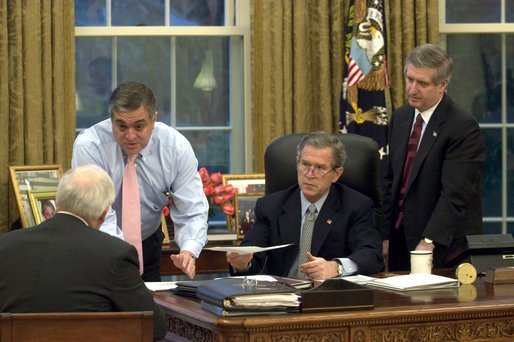
Cheney, of course, was the driving force behind the attack on Iraq. He had appointed himself Bush’s principal intelligence officer (usurping the role of CIA Director George Tenet who made not a murmur of protest) and went first and biggest with the Big Lie on (ephemeral) weapons of mass destruction in Iraq. Here’s Cheney in his kick-off speech to the Veterans of Foreign Wars on Aug. 26, 2002: “Simply stated, there is no doubt that Saddam Hussein now has weapons of mass destruction.”
Simply stated, Tenet dutifully followed White House orders to “fix” the intelligence to support Cheney’s accusations against Iraq. Tenet did so formally in the deceitful National Intelligence Estimate of Oct. 1, 2002 — which earned the sobriquet “The Whore of Babylon.”
It was successfully used to get Congress to enable Bush/Cheney to make war on Iraq, and eventually create havoc in the whole region. In his memoir Tenet gave the laurels to Morell for “coordinating the CIA review” of Secretary of State Colin Powell’s UN speech that let slip the dogs of war. (Details on that below)
Cakewalks and Cubbyholes
Cheney, the quintessential chickenhawk, surrounded himself with advisers of the same bent. One pitiable example was armchair warrior Kenneth Adelman, who had been director of the U.S. Arms Control and Disarmament Agency under President Reagan. In a Washington Post op-ed of Feb. 13, 2002, Adelman wrote: “I believe demolishing Hussein’s military power and liberating Iraq would be a cakewalk.”
Two years later, Adelman wrote an equally pathetic op-ed, insisting that he and his neoconservative friends had been right on everything except Iraq possessing WMD, Iraqi factions cooperating after Saddam Hussein was deposed, and “probably” on close ties between Saddam and al-Qaeda.
Please Contribute to Consortium News During its 2020 Winter Fund Drive
As for Cheney himself, he did memorize some weapons nomenclature vocabulary, but could not avoid an occasional faux pas betraying his lack of familiarity with things on the ground. Nine months after the attack on Iraq, when WMD were still nowhere to be found, NPR asked Cheney whether he had given up on finding them.
“No, we haven’t,” he said. “It’s going to take some additional, considerable period of time in order to look in all the cubbyholes and ammo dumps and all the places in Iraq where you’d expect to find something like that.” (The continued, quixotic search cost not only a billion dollars but the lives of U.S. troops.).
The amateur but opinionated Cheney was the largest fly in the intelligence ointment. Four months into the war it got so blatantly bad that we Veteran Intelligence Professionals for Sanity (VIPS) sent a Memorandum to President Bush entitled “Intelligence Unglued”, recommending that he “ask for Cheney’s immediate resignation.”
Naiveté on War
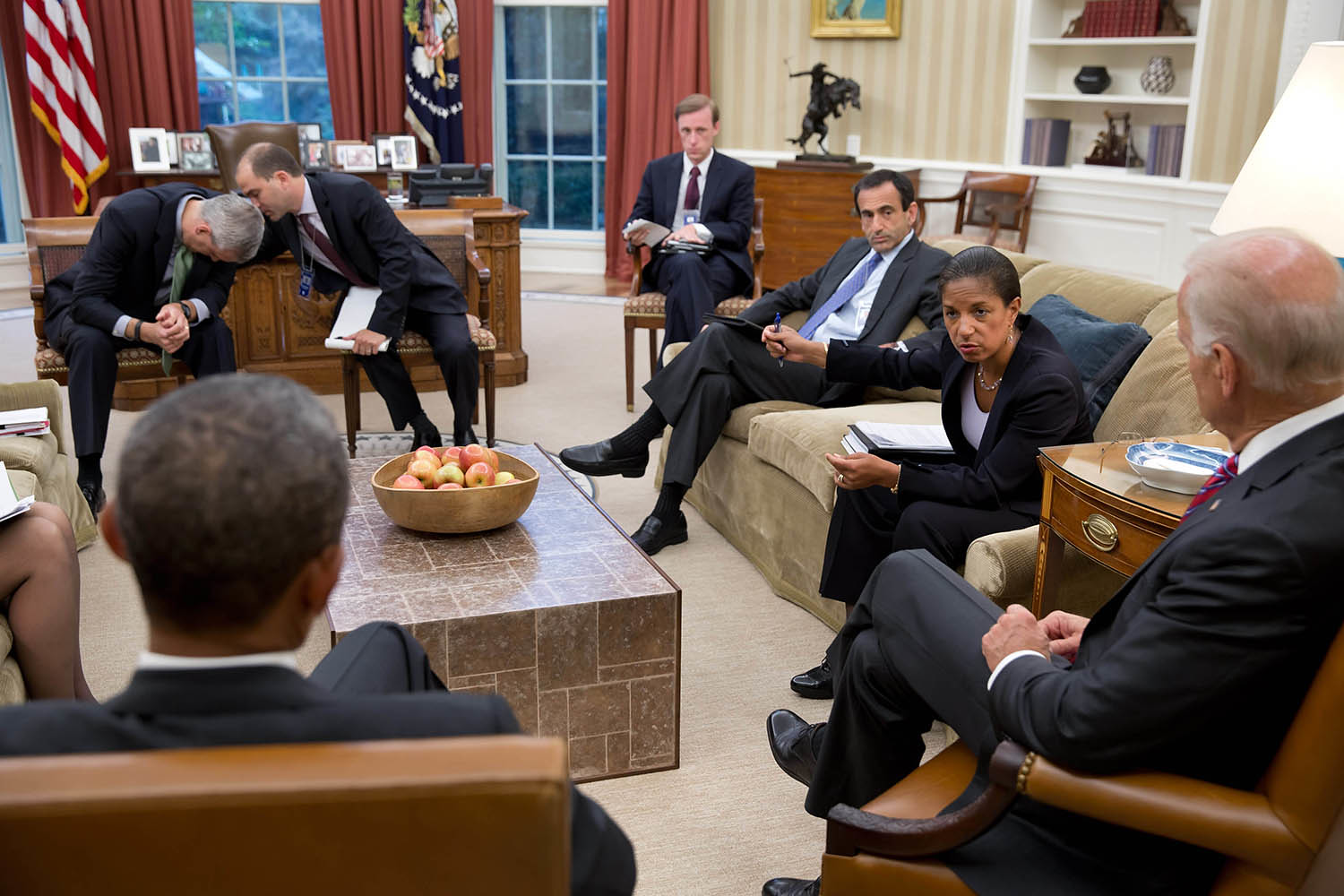
Jake Sullivan, seated farthest back, as national security advisor to vice president, in a meeting with President Barack Obama and advisers, Aug. 29, 2013. (White House, Pete Souza)
In a recent, disturbingly graphic article entitled “Biden’s young Hawk: The Case Against Jake Sullivan,” retired Army Maj. Danny Sjursen broadly hinted that President Biden’s national security adviser should at least look at the photos. (An editor’s note in the piece explained that such photos are almost totally absent from Establishment media: “Graphic images of war and suffering are included with this text. We believe it is important for the world to witness what their taxes, votes and apathy may be supporting.” )
In his article Sjursen finds himself wondering “whether Sullivan’s ever seen a dead child, gazed upon the detritus of American empire, waded through the sights and smells of our indecency. And, worse still, I wondered whether it’d matter much if he had. …”
The national security adviser is gatekeeper to the president, with the gate strong or weak depending — at least in concept — on what the president wants. In the normal course of business, the CIA director and the director of national intelligence would go through the security adviser to get to the president. Cabinet secretaries in the national security arena and, when appropriate, FBI directors often use the same channel.
What seems important here, though widely overlooked, is that no Biden national security appointee/nominee except Gen. Austin has apparently served a day in the military. Not Sullivan, not DNI nominee Avril Haines, not secretary of state nominee Antony Blinken, and not FBI Director Christopher Wray.
This is just one factor that should disqualify Morell for director of Central Intelligence (DCI). There are already far too many fledgling warhawks-without war experience. In Morell’s case, though, there are many other factors — some even more important — that disqualify him. His playing fast and loose regarding the legality and effectiveness of torture has been in the headlines recently, thanks to Senate Intelligence Committee member Ron Wyden (D-OR), who called Morell a “torture apologist.”
It has been a challenge to record Morell’s many artful dodges, but Consortium News did publish “On Iraq/Torture, Still in Denial”,as Morell began to peddle his memoir in May 2015.
Two of Morell’s tours de force with Charlie Rose in 2016, in which Morell advocates killing Russians and Iranians in Syria, were covered by CN.
More revealing still — and damning of his chances for another try at CIA — is an article, “Rise of Another CIA Yes Man.” That piece was written when Morell was picked to be Gen. David Petraeus’s deputy at CIA; it ends with personal comments by intelligence professionals who knew Morell well.
The article also includes citations from Tenet’s own memoir, including encomia he threw in Morell’s direction, one of which should actually be enough to bar Morell from any future role in intelligence.
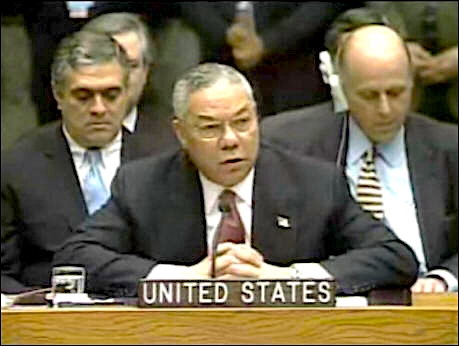
Tenet to the left of Powell at the United Nations on Feb. 5. 2003. (Wikimedia Commons)
In Tenet’s book, At the Center of the Storm, he writes that Morell “coordinated the CIA review” of the intelligence used by Secretary of State Colin Powell in his infamous Feb. 5, 2003 speech to the UN Security Council on the threat from (non-existent) WMD in Iraq.
Tenet, who sat directly behind Powell on that day, pointed out that Morell had served as regular briefer to President George W. Bush. It has been reported that, of the CIA’s finished intelligence product on Iraq, it was The President’s Daily Brief delivered by Morell that most exaggerated the danger from Iraq.
Morell fluttered quickly up CIA ranks as the yes-sir protege of two CIA directors who were, arguably, the worst of them all — “Slam-Dunk” Tenet and the-Russians-hacked-so-Trump-won John Brennan. During the presidential campaign of 2016, as Brennan and his accomplices in the National Security State worked behind the scenes to sabotage candidate Donald Trump, Morell dropped any pretense of nonpartisanship — which used to be the hallmark of an intelligence professional.
From retirement (but with eyes on the big prize he coveted in a new Democratic administration), Morell openly backed the Democratic candidate in a highly unusual op-ed in The New York Times on August 5, 2016: “I Ran the C.I.A. Now I’m Endorsing Hillary Clinton.”
Iraq: the Crucible
In my view, the key gauge in weighing qualifications for a national security position like CIA director is whether a candidate showed good judgment before the misbegotten, calamitous attack on Iraq.
Morell flunks that test outright. Accordingly, he can hardly be expected to be one of the calmer voices in a room of still less experienced fledgling hawks who, to quote Maj. Sjursen, have never “waded through the sights and smells of our indecency” in killing and maiming abroad. With Morell in the room, there would be greater risk of the U.S. getting sucked into still more misadventures overseas.
What did Morell tell Bush about Iraq? In Tenet’s memoir, he describes Morell as “the perfect guy” to brief President Bush, noting that Morell and Bush hit it off “almost immediately”. Morell added later: “I was President Bush’s first intelligence briefer, so I briefed him kind of the entire year of 2001.”
‘The Entire Year 2001’
So, was Iraqi President Saddam Hussein trying to acquire “weapons of mass destruction” during 2001? The first (and honest) answer was ”No” — if Powell and National Security Adviser Condoleezza Rice are to be believed. Here’s what they said at the time — Powell publicly during a speech in Cairo and Rice to CNN five months later.
Powell on Feb. 24, 2001:
“He [Saddam Hussein] has not developed any significant capability with respect to weapons of mass destruction. He is unable to project conventional power against his neighbors.”
Rice told CNN’s John King on July 29, 2001:
“We are able to keep arms from him [Saddam Hussein]. His military forces have not been rebuilt.”
Is this what Morell told Bush just six weeks before 9/11? Did Morell ever explain how Iraq could have developed, purchased, or stolen copious WMD in one year’s time?
Rice. (Wikipedia)
And when Morell briefed Bush right after 9/11, was the president fixated on Saddam Hussein, as counterterrorism chief Richard Clarke describes him in his book Against All Enemies? According to Clarke, on 9/12 Bush told him “to go back over everything, everything. See if Saddam did this. See if he’s linked in any way.”
Clarke says he was incredulous, replying, “But, Mr. President, al-Qaeda did this.” In later interviews Clarke added that he felt he was being intimidated to find a link between the attacks and Iraq.
Did Morell play it straight and tell Bush (as Clarke did) that Iraq had nothing to do with al-Qaeda or the attacks of 9/11? Did Clarke share that vignette at the time with Tenet and Morell?
And what about those notional Weapons of Mass Destruction in Iraq? After 9/11, did Morell take his cue from Cheney, Defense Secretary Donald Rumsfeld, and Tenet and give President Bush the impression that Iraq already had all manner of WMD and was on the threshold of acquiring a nuclear weapon?
Sham Dunk
Later, in December 2002 when Morell’s boss Tenet assured Bush and Cheney that CIA could prove, slam-dunkedly, the existence of WMD in Iraq, did Morell ever ask himself how both Powell and Rice could have been so far off base the year before?
Far more likely, Morell knew what the game was, as he watched Rice do a fancy pirouette, telling CNN’s Wolf Blitzer on Sept. 8, 2002 that “Saddam Hussein is actively pursuing a nuclear weapon. We do know that there have been shipments into Iraq of aluminum tubes that really are only suited to nuclear weapons programs.”
The most accomplished engineers and technical intelligence analysts in the intelligence community knew that the aluminum tubes story was BS. In the finest tradition of intelligence analysis, they remained impervious to the political winds. They insisted that associating those aluminum tubes with nuclear weapons development was wrong and they could not be persuaded to go along. And yet that bogus information got into Powell’s February 2003 speech at the UN.
In Morell’s memoir he wrote that he wanted to apologize to Powell. Morell says, “We said he [Saddam Hussein] has chemical weapons, he has a biological weapons production capability, and he’s restarting his nuclear weapons program. We were wrong on all three of those.”
But not my fault, wrote Morell, who tried to shift the blame by claiming he was not a senior official at the time.
How does that square with Tenet writing that Morell “coordinated the CIA review” of Powell’s speech? Whom to believe? However begrudging must be any trust given “slam-dunk” and “we-do-not-torture”Tenet, he presumably would have less reason to dissimulate than Morell in this particular case.
Assuming Morell did “coordinate the CIA review” of Powell’s speech, did Morell know about the strong dissent on the infamous aluminum tubes?
More important, did he know that CIA operators had recruited and “turned” Naji Sabri, the Iraqi foreign minister (who Saddam Hussein continued to believe was still working for him) and, with the help of British intelligence, had “turned” the chief of Iraqi intelligence, Habbush, as well.
After the reporting from these two sources on other issues and after their access to secret information was evaluated and judged to be genuine, President Bush was told that Sabri and Habbush both said there were no weapons of mass destruction in Iraq. Sabri’s information was given to the president by Tenet on Sept. 18, 2002; Habbush’s in late Jan. 2003.
Did Tenet not share that with Morell before he coordinated CIA input into Powell’s speech?
Clearly, this first-hand intelligence from proven sources with excellent access did not suit the Cheney/Bush narrative for war on Iraq. The president’s staff told CIA operatives not to forward additional reporting on this issue from these sources, explaining that Bush did not want more information about weapons of mass destruction; rather, it was now about “regime change.”
McGovern questions Clapper at Carnegie Endowment in Washington. (Alli McCracken)
Did Morell know about this when he was “coordinating” input into Powell’s disastrous speech? It is a safe bet that Morell was fully aware of the con job he was “coordinating” — as did other senior intelligence officials.
In his own memoir, former Director of National Intelligence (and, during Iraq, director of imagery analysis), James Clapper takes a share of the blame for the Iraq WMD fiasco. Clapper puts the blame for “the failure” to find the (non-existent) WMD “squarely on the shoulders of the administration members who were pushing a narrative of a rogue WMD program in Iraq and on the intelligence officers, including me, who were so eager to help that we found what wasn’t really there.”(emphasis added) .
Regarding Morell’s “I-confess-they-did-it” apology to Powell, the still-youngish Morell has not stopped lusting for an eventual seat at the table, so he apparently thought it a smart move politically. Typically, Powell did not react — as far as is known. Nor has the conflict-averse Powell summoned the cohones to say clearly what he thinks of how Tenet, Morell, et al. sold him a bill of goods on Iraq.
In the “where-are-they-now?” department, Tenet quit in July 2004 and fled to Wall Street to be joined the following year by Jami Miscik, who was deputy director for intelligence during the Iraq fiasco. She “lucked into” a nice job at Lehman Brothers before it went bust.
Note to readers: If you know someone advising the Biden team on selecting a director for CIA, please pass this along.
Finally, those interested in suggestions from the experience of previous transition teams, please click on one or two of the links below. The key issues tend to remain the same. Above all, integrity counts.
Additional Readings
1 — A Compromised Central Intelligence Agency: What Can Be Done?
By Ray McGovern, 2004
Chapter 4 in “Patriotism, Democracy, and Common Sense: Restoring America’s Promise at Home and Abroad”, Rowman & Littlefield, 2004
Ray’s chapter follows chapters by Alan Curtis (editor), Gary Hart, and Jessica Mathews.
Ray McGovern was an Army Infantry/Intelligence officer before serving as a CIA analyst. A specialist on Russia, he also prepared and delivered The President’s Daily Brief for Nixon, Ford, and Reagan. In retirement, he co-founded Veteran Intelligence Professionals for Sanity (VIPS). Ray works with Tell the Word, a publishing ministry of the ecumenical Church of the Saviour in inner-city Washington.
The Texas Republican Party chairman has blasted the Supreme Court for establishing a “precedent that says states can violate the US Constitution and not be held accountable,” and proposed a new “union of law-abiding states.”
State GOP chair Allen West floated the idea on Friday following a decision by the nation’s highest court to throw out a lawsuit brought by the Texas attorney general, which alleged that mail-in voting measures introduced in a number of states before the 2020 race were unconstitutional.
The Supreme Court… has decreed that a state can take unconstitutional actions and violate its own election law,” West said of the ruling, noting that the lawsuit was “joined by 17 states and 106 US congressmen.”
This decision establishes a precedent that says states can violate the US Constitution and not be held accountable… Perhaps law-abiding states should bond together and form a union of states that will abide by the Constitution.
Brought by Texas AG Ken Paxton, the suit looked to bar four key battleground states – Georgia, Pennsylvania, Michigan and Wisconsin – from casting their electoral votes, asking the court to shift the selection of new electors to the state legislatures. Seven out of nine justices ruled to dismiss the case on Friday, however, stating that Paxton had not “demonstrated a judicially cognizable interest in the manner in which another State conducts its elections.” Though Justices Samuel Alito and Clarence Thomas issued a dissenting opinion, they, too, said they would not have granted relief to the case, only suggesting that the court should hear the complaint.
WASHINGTON — Hackers broke into the networks of federal agencies including the Treasury and Commerce departments in attacks revealed just days after U.S. officials warned that cyber actors linked to the Russian government were exploiting vulnerabilities to target sensitive data.
The FBI and the Department of Homeland Security’s cybersecurity arm are investigating what experts and former officials said appeared to be a largescale penetration of U.S. government agencies.
“This can turn into one of the most impactful espionage campaigns on record,” said cybersecurity expert Dmitri Alperovitch.
The hacks were revealed just days after a major cybersecurity firm disclosed that foreign government hackers had broken into its network and stolen the company’s own hacking tools. Many experts suspect Russia is responsible for the attack against FireEye, a major cybersecurity player whose customers include federal, state and local governments and top global corporations.
The apparent conduit for the Treasury and Commerce Department hacks — and the FireEye compromise — is a hugely popular piece of server software called SolarWinds. It is used by hundreds of thousands of organizations globally, including most Fortune 500 companies and multiple U.S. government agencies who will now be scrambling to patch up their networks, said Alperovitch, the former chief technical officer of the cybersecurity firm CrowdStrike.
The attacks were disclosed less than a week after a National Security Agency advisory warned that Russian government hackers were exploiting vulnerabilities in a system used by the federal government, “allowing the actors access to protected data.”
The U.S. government did not publicly identify Russia as the culprit behind the hacks, first reported by Reuters, and said little about who might be responsible.
National Security Council spokesperson John Ullyot said in a statement that the government was “taking all necessary steps to identify and remedy any possible issues related to this situation.”
The government’s Cybersecurity and Infrastructure Security Agency said separately that it has been working with other agencies “regarding recently discovered activity on government networks. CISA is providing technical assistance to affected entities as they work to identify and mitigate any potential compromises.”
President Donald Trump last month fired the director of CISA, Chris Krebs, after Krebs vouched for the integrity of the presidential election and disputed Trump’s claims of widespread electoral fraud.
In a tweet Sunday, Krebs said “hacks of this type take exceptional tradecraft and time” and raised the possibility that it had been underway for months.
“This thing is still early, I suspect,” Krebs wrote.
Federal government agencies have long been attractive targets for foreign hackers.
Hackers linked to Russia were able to break into the State Department’s email system in 2014, infecting it so thoroughly that it had to be cut off from the internet while experts worked to eliminate the infestation.
Reuters earlier reported that a group backed by a foreign government stole information from Treasury and a Commerce Department agency responsible for deciding internet and telecommunications policy.
The Treasury Department deferred comment to the National Security Council. A Commerce Department spokesperson confirmed a “breach in one of our bureaus” and said “we have asked CISA and the FBI to investigate.” The FBI had no immediate comment.
The Washington Post reported Sunday, citing three unnamed sources, that the two federal agencies and FireEye were all breached through the SolarWinds network management system.
Austin, Texas-based SolarWinds confirmed Sunday in an email to The Associated Press that it has a “potential vulnerability” related to updates released earlier this year to its Orion products, which help organizations monitor their online networks for problems or outages.
“We believe that this vulnerability is the result of a highly-sophisticated, targeted and manual supply chain attack by a nation state,” said SolarWinds CEO Kevin Thompson in a statement.
The comprise is critical because SolarWinds would give a hacker “God-mode” access to the network, making everything visible, said Alperovitch.
Last Tuesday, FireEye said that foreign government hackers with “world-class capabilities” broke into its network and stole offensive tools it uses to probe the defenses of its thousands of customers. Those customers include federal, state and local governments and top global corporations.
The hackers “primarily sought information related to certain government customers,” FireEye CEO Kevin Mandia said in a statement, without naming them. He said there was no indication they got customer information from the company’s consulting or breach-response businesses or threat-intelligence data it collects.
Former NSA hacker Jake Williams said it seemed clear that both the Treasury Department and FireEye were hacked using the same vulnerability.
“The timing of the release here is, I think, not at all a coincidence,” said Williams, the president of the cybersecurity firm Rendition Infosec.
He said FireEye surely told the FBI and other federal partners how it had been hacked and they determined that Treasury had been similarly compromised.
“I suspect that there’s a number of other (federal) agencies we’re going to hear from this week that have also been hit,” Williams added.
FireEye responded to the Sony and Equifax data breaches and helped Saudi Arabia thwart an oil industry cyberattack — and has played a key role in identifying Russia as the protagonist in numerous aggressions in the burgeoning netherworld of global digital conflict.
Neither Mandia nor a FireEye spokesperson said when the company detected the hack or who might be responsible. But many in the cybersecurity community suspect Russia.
The U.S. Treasury Department building viewed from the Washington Monument, Sept. 18, 2019, in Washington.
The philosophical thesis of existentialism has no normative content—even morality is an undecided issue. Libertarianism, in contrast, champions what is sometimes characterized as the non-aggression principle (NAP) as its most fundamental tenet: initiating or threatening forceful interference with individuals and their property is wrong. In existentialism, everything is permitted. In libertarianism, in contrast, everything is permitted except violation of the NAP. Libertarianism, therefore, exemplifies moral absolutism, which existentialism does not.
I self-identify only as myself but have long been sympathetic with both libertarianism and existentialism. Having dealt throughout 2020 with an array of restrictions on my liberty imposed by local authorities everywhere I have been (Europe, the UK, and now in the US), the primary effects of which have been not to save lives but to control how people behave, I have been thinking about existentialism, which naturally raises questions about the proper scope and role of government, bringing me back, also, to libertarianism. Both outlooks prioritize human liberty, dignity and personal responsibility above all else. I have seen nearly nothing written about existentialism in recent years, perhaps because its most famous adherent in the twentieth century, Jean-Paul Sartre, was politically aligned with socialist and even communist movements. To suggest that existentialism and libertarianism are somehow related might seem prima facie odd because the latter is typically regarded as politically conservative, a right-wing, not a left-wing, view of the proper role of government. The mere mention of the word libertarian may incite ire among progressives of the “social justice warrior” stripe, and some leftists appear to derive untold delight from sardonically ridiculing libertarians as “pot-smoking Republicans”.
Another common stereotype is that libertarians must be white male land owners (why else would they care about protecting private property?!), which is of course just as simpleminded as Joe Biden’s claim that “You ain’t black!” if you have to think about whether to support him. In fact, nothing could be more racist than to assume that “authentic” black people have no real choice but to support the Democratic party. Biden’s claim was all the more disturbing given that he himself helped to author the 1994 crime bill which put thousands of people behind bars for nonviolent offenses, including many African Americans. Biden also rallied vigorously for the disastrous 2003 invasion of Iraq, which is relevant not only because a disproportionately high percentage of racial minorities serve in the military, but also because the lives of millions of persons of color were destroyed or degraded as a result of arguably the worst foreign policy blunder in U.S. history. In 2011, the Obama-Biden administration went on to offensively attack the country of Libya, which resulted in a resurgence of African slave markets. In that same year, they used lethal drones to execute brown-skinned U.S. citizens without indictment, much less trial. But who really cares about Biden’s policies? At least he is not Orange Man Bad!
Speaking of labels, Jean-Paul Sartre famously praised Che Guevara as “l’homme le plus complet de notre époque [the most complete human being of our age]” which, again, might lead some readers to scoff at my claim that existentialism and libertarianism have anything whatsoever in common. It would be a mistake, however, to confuse Sartre’s political views with the higher-order philosophical thesis of existentialism, which was most appealingly articulated by nineteenth-century thinkers Friedrich Nietzsche, Søren Kierkegaard and Fyodor Dostoevsky, who are not coincidentally some of my favorite authors. Albert Camus, another twentieth-century intellectual, wrote a number of works which arguably reflect an existentialist outlook—including his most famous novels, L’étranger [The Stranger] and La peste [The Plague]—but Camus himself resisted that label. He certainly wasn’t the first independent thinker throughout history to have refused to accept such labels, for a variety of different reasons. Some among them simply do not like club-like organizations, which do on occasion transmogrify into religious cults of sorts, even when their memberships comprise what to all appearances are intellectuals.
Jean-Paul Sartre followed the lead of his nineteenth-century predecessors in famously propounding that “l’existence précède l’essence,” which is an explicit rejection of the essentialism of ancient Greek thinkers such as Plato and Aristotle. We become what we do, but that is never fully determined by the circumstances of our birth. That said, it was not entirely insane for twentieth-century existentialists to champion left-wing political causes, so long as they were convinced (as they seem to have been) that the conditions for human liberty, dignity and personal responsibility were not available to the vast majority of persons. Sartre rejected not only Aristotle’s essentialism but also his belief (apparently common in ancient Greece) that women and non-Greeks (barbarians!) were not full-fledged persons. As pretty much everyone owns today, individuals denied the opportunity to educate themselves may appear to be illiterate, but that has nothing whatsoever to do with their inherent intellectual capacities. Along those lines, left-wing existentialists may insist that before anyone can make free choices, they need to have not only the potential but also the power, at least in principle, to do so. People who are scrounging around for their next meal or a roof over their head for the night may not have the energy or time to do much else.
As a result of the political activities and fame of Sartre and Camus, the existentialist waters were muddied for decades to follow, with some of those claiming Sartre as a personal hero more or less on a par with the twenty-somethings who wear Che Guevara t-shirts but never bother to read any books about him. Those who adore the iconic stenciled image of “Che”, and the implied “coolness” of anyone who agrees, might be stunned to learn, among other things, that Che Guevara personally oversaw the execution of more than 500 human beings, most of whom had been going along to get along with the Batista regime. Then again, given what might be termed “the authoritarian turn” taken in recent years by leftists keen to impose their values on everyone else, perhaps they would not be bothered in the least by Che’s homicidal creds.
The division between left-leaning and right-leaning existentialists turns most obviously on their interpretation of potential. Few would deny that it can be difficult for a person born into poverty to break out of his conditions, but it is nonetheless possible, as we know from the many people throughout history who have done just that. It is precisely the inherent dignity of human beings which drives some of them to achieve great things, and, although some will roll their eyes or snicker at this, one may with equal reason point out that many a person with a good deal of potential ended up squandering it in part as a result of the privileged conditions into which he was born. Ultimately, in a free society, the answer to the question what persons should do with their lives comes back to themselves, regardless of whether they were disadvantaged or spoiled, encouraged or oppressed.
The philosophical thesis of existentialism has no normative content—even morality is an undecided issue. Libertarianism, in contrast, champions what is sometimes characterized as the non-aggression principle (NAP) as its most fundamental tenet: initiating or threatening forceful interference with individuals and their property is wrong. In existentialism, everything is permitted. In libertarianism, in contrast, everything is permitted except violation of the NAP. Libertarianism, therefore, exemplifies moral absolutism, which existentialism does not. An existentialist may adopt non-aggression as a personal principle, and he may or may not exhort others to do the same. He may or may not find fault with those who neither agree with him nor follow his lead. The existentialist may skeptically regard the NAP as an article of faith, for it must be chosen by an individual himself for himself and for his own reasons. But to claim that normative principles such as NAP are articles of faith is not to deny their importance in how some people choose to shape their own lives.
What should we do? is not a question which can be settled by appeal to the deliverances of science, because science trades only in facts, while normative prescriptions for action are based in values, which cannot be read off of empirical reality. The paradox of morality is that you cannot argue someone into acting morally, if he does not already believe that he should, because what one ought to do can never be deduced from the way things happen to be. Instrumental rationality is a matter of fashioning means to ends, but setting those ends is up to individuals themselves—an idea championed not only by skeptics such as eighteenth-century Scottish philosopher David Hume, but also the existentialists.
The open-ended, contentless quality of existentialism is perhaps why much of what has been written by existentialists is literally literature—assuming the standard division between philosophy and literature. (I myself reject that division, but many philosophers do not.) However one distinguishes one type of writing from another, it is up to each person to decide how to interpret everything. If you choose to follow anyone else’s rules (those of your parents, teachers, the state, a religion or other group, a philosophical “school”), that is something which you choose to do—or not. “Ne pas choisir, c’est encore choisir [not to choose is still to choose],” as Sartre famously put it. Common criminals and protagonists such as Raskolnokov (in Dostoevsky’s Crime and Punishment) or Meursault (in Camus’ L’étranger) may be viewed by many as miscreants, but their comportment arises out of their individual decisions to adopt their own principles for living. They are free agents, and no one else is responsible for what they do. Yes, forces of nature and nurture act upon everyone, but we alone choose what to do and bear the primary credit or blame for the consequences which ensue.
Western democracy is generally regarded as the best available system for free persons, for it permits them to carve out their own destinies, based on their own beliefs. Everyone faces obstacles and struggles along the way, but with sufficient initiative, drive and ingenuity, some people manage to make something of themselves. The laws of modern societies prohibiting violence against other people effectively affirm the libertarian’s NAP (which is not however to deny that the state is itself the primary violator of the NAP, above all through war). An individual may lead his life as he wishes, provided that he does not prevent others from doing the same. If your concept of “The Good Life” requires the destruction of other human beings and/or their property, then your liberty will be restricted by the government, if you are caught. Some people do not embrace the NAP, choose to rape and murder, pillage and plunder, and some among them end up in prison next to the nonviolent pot-smokers and others locked up as a result of the 1994 crime bill and related NAP-hostile legislation.
Now that recreational marijuana has been legalized in many of the United States, and medical marijuana in even more, there are plenty of pot smokers roaming free, even while others continue to languish behind bars. We also know that, although some murderers are locked up, others remain at large: one out of every three homicide cases in the United States is never solved. That may seem to be an alarming statistic to some, but it is the price that must be paid for the much worse alternative of judging everyone guilty until proven innocent. The presumption of innocence protects many more innocent than guilty people. No one should be locked up (much less executed) for their mere potential to commit crimes, and anyone who thinks otherwise is a tyrant, tout court. Some of the best works of dystopic fiction underscore the horror of a world in which everyone is constantly under suspicion and subject to arbitrary detention for whatever reason any authority may deem sufficient, solely at his caprice.
In 2020, people are currently being denied the freedom needed to determine their own destinies and to conduct themselves with the dignity which distinguishes them from the members of other species. In this way, COVID-World offers libertarians a glimpse into the twentieth-century existentialists’ concerns about the material prerequisites which must first be satisfied in order for persons to be able to choose what to do with their lives. Before COVID-19, people in Western liberal societies were largely held responsible for their own deficiencies and failure to fashion a good life for themselves. Now, however, people are being denied the opportunity to do what they would choose to do, left to their own devices. Effectively, those being prevented from earning a livelihood and forced to stay home are the equivalent of innocent persons erroneously convicted and sentenced to prison terms. Incarcerated persons are severely hampered in their ability to start and run businesses, and to act in other ways which might prevent them from resorting to crime in the future. They are also strictly limited in their choices of how best to flourish and thrive while inhabiting a cage.
Just as innocent persons should not be incarcerated, healthy people should not be quarantined. From the perspective of both existentialism and libertarianism, this arbitrary detention of innocent persons can be viewed as an affront to humanity. People are being told how they must live by their government, which claims to be acting for the public good but in reality is destroying countless lives. It is not the case that persons are forbidden by the government only from harming other people and their property, as an NAP-based society would prescribe. Citizens are in fact being ordered, effectively, to harm themselves, under the pretext that acting in ordinary ways may lead to the deaths of other people. How so many compliant citizens have come enthusiastically to embrace this Orwellian Covidystopia as “the new normal” is beyond me. Perhaps it is simply the logical consequence of stringent behavioral conditioning initially implemented by appeal to what we now know to have been the false claim that millions of compatriots would otherwise die. Many months later, having already accepted the endless and mercurial decrees of the Covid czars, people still terrified of the virus are willing to do whatever they are told to do without posing any objections whatsoever. Nine months of habits die hard, so when gurus in white lab coats such as Anthony Fauci tell them to jump, they answer “How high?”
Governments allegedly of, by, and for the people have imposed many restrictions on liberty in countries all over the planet, the primary effects of which have been to harm millions of people in the name of the small percentage of those who are vulnerable to COVID-19. It may be tempting to ascribe underhanded or ulterior motives to those who wave their science flags in defense of the new Nurse Ratched state, but there is no real need to do so, for the phenomenon can be more simply explained as fully analogous to the enthusiastic drum-beaters for wars from which they themselves have nothing to gain and, indeed, much to lose. The problem at this point in time is that people reside on one or the other side of the COVID-19 divide, but the policymakers are for the most part aligned, claiming the authority to dictate behaviors for all of society by appeal to the opinions of a few select scientific experts, no matter how many times they have been wrong in the past. Recall that Anthony Fauci sincerely proclaimed in a 60 Minutes program interview that masks were not necessary, and in fact caused more problems than they prevented because people wearing them tend touch their faces more often than they might otherwise do. (And of course it is quite evident by now to any observant person that most people wear the same mask over and over again—pulling it out and putting it into the same pocket or purse, making the exercise purely a matter of show.) We were also told “fifteen days to flatten the curve,” but then the goalposts were changed again and again, until now, nine months later, Pennsylvanians have been ordered to wear masks whenever they leave their home and also within their residence, if anyone should happen to visit. Travel continues to be restricted and has been condemned by government authorities the world over, both at the national and state level, despite the IATA’s (International Air Transport Association’s) calculation that the chances of contracting COVID-19 on a plane this year were one in twenty-seven million. Although some disputed that claim, the U.S. government abandoned its own health screening of persons on incoming flights because the positive cases were so low that the program was deemed cost ineffective.
Citizens stepped onto a slippery slope when, back in March 2020, they agreed to stay home, and, if necessary, not to work. They agreed to wear masks wherever and whenever this was deemed necessary by the authorities that be. But one restriction and rule leads to another, with progressively more absurd implicatios, as is nowhere better illustrated than in the State of Pennsylvania’s requirement that people wear facemasks within their own homes. Who will be enforcing such laws? (Perhaps Amazon’s Alexa can be brought on board, given that she already resides in millions of homes.) This invasion of policymakers into the private lives of their constituents, and the fact that people have not risen up in response, is a dangerous turn in the already surreal series of events constitutive of the COVIDystopic year 2020, and it must be resisted, while it is still possible to do so. Beyond prohibiting domestic violence (which is one instance of enforcing the NAP), the state has no business whatsoever in any private residence. It is not the government’s business to tell human beings how they ought to live or who they should be. People need to take personal responsibility for their own health and well-being. No one denies anyone the right to choose not to smoke or to drink alcohol and eat fatty foods, and no one is preventing anyone afraid of the virus from donning hazmat suits. As for the rest of us, we should be permitted to shoulder the inevitable risks associated with leading what we freely choose to make of our own lives.
Laurie Calhoun is the author of We Kill Because We Can: From Soldiering to Assassination in the Drone Age, War and Delusion: A Critical Examination, You Can Leave, and Philosophy Unmasked: A Skeptic’s Critique.
Yes, Janet Yellen’s husband, despite a claim to favor free markets, hates them. You see, according to Akerlof, free markets influence people and he prefers that he control all the people instead.
Joe Biden’s nominee for Treasury Secretary, Janet Yellen, is a typical over the top Keynesian in favor of mad money printing by the Federal Reserve but a bigger problem might be the influence of her husband, George Akerlof, on her thinking.
You can’t get much more authoritarian in your thinking than Akerlof does.
In Phishing for Phools, a 2015 book that George Akerlof co-authored with Robert Shiller, the authors wrote without even a hint of irony that people “do not do what is really good for them, they do not choose what they really want.” Please think about the previous bit of absurdity from the two economists. Maybe think a while.
If they’re to be believed, we’re all just a collection of idiots. That’s what their allegedly careful economic analysis concludes…
In a short book that remarkably took the authors five years to write, Shiller and Akerlof even made time to go after Cinnabon. It’s hard to type this without laughing, but apparently Cinnabon controls us too! If the authors are to be believed, this rather minor shopping mall tenant has long had a knack for making us do what we shouldn’t by expertly placing its stores “in the track of people who would be vulnerable to that smell.”…
Important about all this is that Akerlof, the co-author of what might be one of the most ridiculous books on “economics” ever written, is married to Treasury secretary nominee Janet Yellen. Much more important, Akerlof recently told the New York Times that he and Yellen have “always been in all but perfect agreement about macroeconomics.” If so, it might be useful for the senators questioning Yellen at her Treasury confirmation if near “perfect agreement” between her and her husband includes admiration for Phishing for Phools?
Yes, Janet Yellen’s husband, despite a claim to favor free markets, hates them. You see, according to Akerlof, free markets influence people and he prefers that he control all the people instead.