
Jekyll
Hyde
Enemy of the State-Read the Book-Know the Man
This is not a Safe Space but Baby, I don't care.

"I am not a number, I am a Free Man" - No. 6
 Information Liberation Alex Jones’ Prison Planet Gary North Specific Answers Antiwar The Daily Bell Tenth Amendment Center Economics Policy Journal The American Thinker The New American Lew Rockwell
Posted by M. C. on June 27, 2020
Jekyll
Hyde
Posted in Uncategorized | Tagged: Jekyll and Hyde, Tommy Emmanual | Leave a Comment »
Posted by M. C. on June 27, 2020
Oh my! We are all gonna die!
Not. What the CNN article completely failed
to mention is the number of deaths from COVID-19 taking place during
this rise in new cases. Are you curious why? Could it be because, though
the number of people now infected with the virus has skyrocketed, the
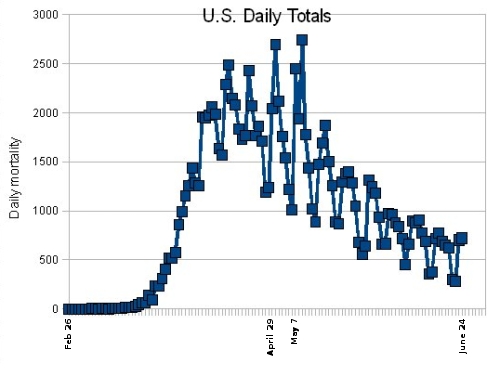
number of deaths has remained largely flat, as shown by the graph above (data source here)
They just won’t stop lying: If you have been reading the mainstream leftist press, you are probably now under the impression that the COVID-19 epidemic is once again raging across the land, destroying whole communities while spreading out-of-control everywhere because some Republican governors thought it was now okay to come out of hiding.
The CNN article at the link above is typical, reporting in lurid detail how multiple states across the country are now experiencing record levels of new coronavirus cases.
Oh my! We are all gonna die!
Not. What the CNN article completely failed to mention is the number of deaths from COVID-19 taking place during this rise in new cases. Are you curious why? Could it be because, though the number of people now infected with the virus has skyrocketed, the number of deaths has remained largely flat, as shown by the graph above (data source here). The past two days has seen a slight uptick, but that is entirely within the range of the weekly ups and downs caused apparently by low numbers recorded over the weekends.
I am not the only one to notice this strange dishonest reporting, Nor is CNN the only culprit. This article at Just News noticed the same thing in a Washington Post report.
On Wednesday evening, the Washington Post issued a breaking news email alert headlined “New coronavirus cases in the U.S. soar to highest single-day total.”
“Across the United States,” reported the Post, “more than 36,000 new infections were reported by state health departments on Wednesday — surpassing the previous single-day record of 34,203 set on April 25.”
Yet the article failed to mention that even while new infections are on the rise, new COVID-19 deaths are not.
This vital information gap in the media is causing some health policy experts to worry that fear about the coronavirus — evidenced, for example, by Wednesday’s sharp stock market drop — is not founded in facts, particularly about how the virus disparately impacts different age groups. The spreading of unfounded alarm, the experts fear, could risk deep harm to Americans’ livelihoods and mental health due to a prolonged, widespread shutdown. [emphasis mine]
This dishonest reporting however is par for the course from mainstream leftist outlets like CNN and the Washington Post. Having failed to overthrow Trump with the Russian collusion hoax and the Ukraine phonecall hoax, they are now working hard to gin up more panic and fear about COVID-19, thus allowing their partners in the fascist Democratic Party to use that fear to justify further power grabs, such as in Oregon, where Democratic governor Kate Brown has convened her Democratically-controlled legislature into emergency session for the sole purpose of suspending due process for up to sixty days.
It is all despicable and evil. That the number of actual cases is not rising in any significant way should be a sign of relief and hope. Not only are lots of people easily throwing off the virus with no problems, these flat death numbers combined with the rising new cases strongly proves once again that the virus is simply not that lethal to the general population, and it likely very comparable to the flu.
Relief and hope cannot be allowed however. That might mean that things can go back to normal, that freedom will once again ring out across the land, and that Trump might actually win in November. Heaven forbid. Better to destroy the country with lies and fascist dictatorships then let things unfold as they should, in a free nation.
Be seeing you
Posted in Uncategorized | Tagged: covid-19, death rate, due process, Fear, Kate Brown | 1 Comment »
Posted by M. C. on June 27, 2020
If Biden emerges, then he will have to answer why all these
institutions where his party and people are predominant — the media,
Hollywood, the academic community, public schools, big-city governments,
the big foundations, the federal bureaucracy — are apparently shot
through with systemic racism after decades of Democratic dominance.
And, more precisely, what he intends to do about it.
Perhaps it’s better to shelter in place in the basement.
https://www.lewrockwell.com/2020/06/patrick-j-buchanan/bidens-basement-strategy-just-say-nothing/
Some polls now have Joe Biden running ahead of Donald Trump by 10 points and sweeping the battleground states of Michigan, Wisconsin and Pennsylvania. This vindicates the strategy Biden’s advisers have adopted:
Confine Joe to his basement, no press conferences. Trot him out to recite carefully scripted messages for the cameras. Then lead him back to his stall.
This enables Biden to avoid the blazing questions that are dividing not only Democrats and Republicans but liberals and leftists. And most of these issues touch on the explosive subject of race.
Consider. California’s legislature just voted to put to a statewide ballot in November a return to the racial preferences that were banned as discriminatory in a statewide referendum, 25 years ago.
The proposal would reverse the 1995 constitutional amendment, approved by 55% of voters, which outlawed “preferential treatment” based on “race, sex, color, ethnicity, or national origin.”
If the measure carries, California returns to a racial spoils system.
Race preferences are being pushed because they are needed to bring about greater representation of Blacks and Hispanics in the student bodies of elite schools of the state university system like UCLA and the University of California, Berkeley.
Asian students are today “overrepresented” in these prestigious schools, because of their superior test scores.
Where does Biden stand on anti-Asian discrimination?
Earlier this June, the California Assembly voted to establish a task force to make recommendations for reparations for slavery.
Now, California did not enter the Union until 1850, and slavery was outlawed in the state constitution, though several thousand slaves were brought there during the 1849 Gold Rush.
Where does Biden stand on reparations for slavery?
Many of the recent protests in the wake of George Floyd’s death have involved the desecration and destruction of monuments.
What does Biden think about tearing down statues of Christopher Columbus and Robert E. Lee? Where does Biden stand on destroying statues of Presidents Washington, Jefferson, Andrew Jackson, Lincoln, Grant and Theodore Roosevelt?
What did Biden think of the removal of the statue of Caesar Rodney, Delaware statesman and slave owner, who, despite a grave illness, rode to Philadelphia to sign Jefferson’s Declaration of Independence and cast his lot with the American Revolution?
Understandably, Biden would prefer not having to choose between Caesar Rodney and BLM.
Black men are arrested and incarcerated more often than whites because of the systemic racism of law enforcement officials, we are told.
Does Biden believe white cops are congenital racists?
In the great cities where the killing of Black men is today all too common, the regimes that have ruled them for decades have been almost wholly Democratic.
Does Biden believe there is systemic racism in the ruling circles of all these Democratic-run cities?
Over the last month, there has been an explosion of shootings and killings. In Chicago, over Memorial Day, 84 people were shot, 24 mortally.
Last weekend in Chicago, 106 people were shot and 14 killed. New York City is experiencing the worst shooting violence in a quarter century.
Is there systemic racism in the police departments of our great cities? Again, who has been running those cities, if not Democrats?
Is there inequality in wealth between Black and white America because of systemic racism? If so, why did that inequality persist through two terms of our first Black president, with Biden as his VP?
Does Biden believe, with Elizabeth Warren, in wealth taxes on the rich and wealth transfers to close the Black-white wealth gap?
Is there systemic racism in American media?
Our dominant media institutions include The Washington Post, New York Times, ABC, CBS and NBC. All are controlled by liberals.
Is there systemic racism in our great universities and colleges? Yet, Harvard, Yale, Princeton, Columbia, and the rest of the Ivy League have long been run by an entrenched liberal elite.
Is our huge federal workforce permeated by racism?
 Though African Americans are 13% of the U.S. population, they occupy 18% of all federal jobs.
Is there systemic racism in our public schools? Who controls the teachers unions? Who fills almost all of the teaching positions?
Is there systemic racism in California? If so, who is at fault? The governor, both senators, both houses of the legislature, all statewide offices, and 46 of 53 U.S. House seats in California are held by Democrats.
If Biden emerges, then he will have to answer why all these institutions where his party and people are predominant — the media, Hollywood, the academic community, public schools, big-city governments, the big foundations, the federal bureaucracy — are apparently shot through with systemic racism after decades of Democratic dominance.
And, more precisely, what he intends to do about it.
Perhaps it’s better to shelter in place in the basement.
Posted in Uncategorized | Tagged: basement, Joe Biden, preferential treatment, racial spoils system, Reparations, systemic racism | Leave a Comment »
Posted by M. C. on June 27, 2020
The students obviously liked to make a mess; it was, so to speak, their
natural milieu, as maggots like carcasses. When, occupying offices, they
put their feet up on the antique desks of authority that they were soon
to sit behind, they thought that they were being revolutionary rather
than merely savage and insolent.
https://www.takimag.com/article/1968-again/
I have never been quite able to make up my mind whether there is no new thing under the sun or whether we live in completely unprecedented times. When we look at events close up and nearby in time and place, we are inclined to think that nothing like them has ever happened before; but with the passage of time, and a little calm reflection, we find analogies all over the place. I suppose the wise man is alive to both the similarities and the differences, but keeping both in mind at the same time is hard, like trying to see the old crones and the candlestick simultaneously in the famous diagram beloved of gestalt psychologists.
In light of the recent events in the United States and elsewhere (the elsewhere that has long imitated the United States in completely decerebrate fashion, while at the same time being anti-American), I flicked through a large picture book of May 1968 in Paris, the upheaval of spoilt brats, by spoilt brats, for spoilt brats. I hesitate to quote Georges Marchais, the leader of the Stalinist French Communist Party of the time, who was not in favor of the upheaval, but who said, with some prescience:
In general, it’s all about the sons of the haute-bourgeoisie who, disdaining the students of working-class background, will soon extinguish their “revolutionary flame” in order to go and manage Papa’s companies and exploit the workers in the best traditions of capitalism.
Spot-on, Georges, if one goes a little less hard on the poor capitalists and includes in the stricture the former Maoists who later joined the upper echelons of the French state apparatus!
Another Georges, this time the soon-to-be president of France, Pompidou, said something pertinent in the French National Assembly in the middle of May 1968:
At this stage, it is, believe me, no longer the government that is in question, nor the institutions, nor even France, it is our civilization itself.
One can’t help thinking that good old Georges was onto something, even if, in the 52 years that have so far elapsed since then, I have personally managed, as have millions of others, to lead a perfectly satisfactory and even fulfilling life, as no doubt did many Romans in the run-up to the collapse of the empire.
What is quite clear from the photographs is that the students who made a mess of Paris and threw up barricades that made the streets of the City of Light look temporarily like those of Port-au-Prince (where disposal of garbage is not very well-organized, if I recall correctly) were far from the horny-handed sons of labor. On the contrary, they were clearly the children of the bourgeoisie, and could not hide the fact, however casually (for the time) they dressed. Social class does not spare physiognomy in its effects, any more than it spares longevity.
The students obviously liked to make a mess; it was, so to speak, their natural milieu, as maggots like carcasses. When, occupying offices, they put their feet up on the antique desks of authority that they were soon to sit behind, they thought that they were being revolutionary rather than merely savage and insolent. They were privileged, but not privileged enough in their own estimation. They were earnest, but not serious; and earnestness combined with frivolity and armor-plated self-righteousness is not very attractive. Evidently, however, earnest frivolity is a permanent temptation of youth, which does not yet appreciate that deterioration as well as improvement is possible.
One reads the words of Daniel Cohn-Bendit, the student revolutionary and narcissistic apologist for pedophilia, who managed afterward to carve out a lucrative career for himself, with a certain rage:
The French flag is made to be torn up and to be transformed into the Red Flag.
Did he have any understanding of what he was saying or knowledge of what he was advocating? Did he, in fact, care? I think not. What he cared about was cutting a figure in public. Let the heavens fall, so long as I am in the newspapers, might have been his mission statement.
Of course, bogusness is a permanent temptation in political life. There is a wonderful photograph of the deputies to the French National Assembly in 1968 having a physical brawl, with punches thrown. Every onlooker, except two, appears concerned by the brawl, but one of the two sits with his arms folded, his expression that of contempt, while the other, actually Pierre Mendès France (though a French friend said he thought it was Roland Dumas, another experienced Machiavellian politician), smiles wickedly as if, having seen a great deal in his life (for example, having been imprisoned under Vichy and having escaped to England during the war, as well as having been twice prime minister), he knew playacting when he saw it.
There has always been playacting in political life, with simulation of strong emotions for their own sake, and so forth. There seem to be periods when these phenomena are at a minimum, as there are periods when they are at a maximum. Not every manifestation of mass feeling is bogus, of course: The million who turned out in May 1968 in support of de Gaulle and against the students were sincere enough (not that sincerity by itself is more than a necessary condition of political virtue, and certainly not a sufficient condition). But the temptation to act more passionately than one feels, and to pretend to believe strongly in principles of no conceivable application—for example, the May 1968 slogan that “It is forbidden to forbid”—is a recurrent one.
I don’t believe in cycles of history, let alone eternal recurrences, but some things really do change. For example, both Pompidou and the much younger Jacques Chirac, as well as many others, including demonstrators, have cigarettes in their mouths. Surely it is time for these shocking scenes to be photoshopped, so that they may not corrupt any youth who happens upon them? If two future Presidents of the Republic are portrayed with cigarettes sticking to their lower lips, who can say how many will die as a result of imitating them? It is high time that history were more carefully edited for the sake of public health.
Be seeing you
Posted in Uncategorized | Tagged: de Gaulle, French National Assembly, Georges Pompidou, Paris | Leave a Comment »
Posted by M. C. on June 27, 2020
Tony Fauci knows the con. He knows COVID-19 is old people. But he’s busy
giving advice to the NFL and Major League Baseball about how to play
their seasons, while people are dying from the fear he promotes. Fauci
has no shred of shame. He’s a mouthpiece turned out by Bill Gates and
David Rockefeller.
https://blog.nomorefakenews.com/2020/06/26/soylent-green-is-people-covid-19-is-old-people/
by Jon Rappoport
In the 1973 film, a NY police detective discovers the vastly overcrowded, poverty–stricken population of the city—who are being sustained on processed government food, called Soylent—are now eating humans who have died. That’s what Soylent Green is made of.
As I covered in my article (and spoke about) two days ago, open-source press reports reveal the “excess mortality” of 2020 is largely the result of elderly people dying in nursing homes.
This has nothing to do with a virus.
It has to do with patients who are ALREADY on a long downward health slide—then hit with the terror of an arbitrary and fake COVID-19 diagnosis, and then isolated and shut off from family and friends—in facilities where gross neglect and indifference are all too often the “standard of care.”
Death is the direct result.
The managers of pandemic information tell the big lie. They spin tales about “the virus” having a greater impact on the elderly.
No, the STORY about a virus has the impact. The terror has the deadly impact. The isolation has the deadly impact.
To an astounding extent, COVID-19 is a NURSING HOME DISASTER.
Mass murder by cruelty.
Memo to financial investigators: Calculate how much money government and private insurers are saving, because they don’t have to keep paying for the long-term care of all the old people who are dying premature deaths in nursing homes. The money number will be staggering.
Tony Fauci knows the con. He knows COVID-19 is old people. But he’s busy giving advice to the NFL and Major League Baseball about how to play their seasons, while people are dying from the fear he promotes. Fauci has no shred of shame. He’s a mouthpiece turned out by Bill Gates and David Rockefeller.
Evil permeates the COVID operation. The elderly in nursing homes are the primary target. Getting them to die earlier is the tactic, in order to pump up the fake COVID mortality numbers.
Without those phony numbers, the whole “pandemic” would be exposed in an hour.
I’ve said there were two key events in the foisting of the whole vicious COVID fiction—the Chinese regime locking down 50 million citizens overnight for no good medical reason, giving the green light to the World Health Organization and the CDC to “follow the new model”; and the Bill Gates-financed computer projection of deaths, put together by Neil Ferguson, who lied through his teeth when he claimed half a million people could die in the UK and two million in the US—thus supplying the final “rationale” for the lockdowns.
The third key event was and is the sustained attack on the elderly in nursing homes.
Kill these people with terror and isolation, and make the death numbers escalate.
Here are the open-source press reports I included in my article two days ago. There is an additional report at the end.
As of May 22, Forbes reports that, “…in the 43 states that currently report such figures, an astounding 42% of all COVID-19 deaths have taken place in nursing homes and assisted living facilities.”
Washington Post, May 18: “The World Health Organization said half of Europe’s covid-19 deaths occurred in such facilities.”
Headline of same Post article: “Canada’s nursing home crisis: 81 percent of coronavirus deaths [in the country] are in long-term care facilities.”
The Guardian, May 16: “About 90% of the 3,700 people who have died from coronavirus in Sweden were over 70, and half were living in care homes, according to a study from Sweden’s National Board of Health and Welfare at the end of April.”
“Spain—The country was shocked at the end of March when the defence minister revealed that soldiers drafted in to disinfect residential homes had found some elderly people abandoned and dead in their beds.”
“…the regional governments of Madrid and Catalonia have been publishing their own figures on people who have died in care homes from the virus, or while exhibiting symptoms consistent with it.” [AKA, absurd eyeball diagnosis]
“In Madrid, the total for Covid, or suspected Covid, deaths since 8 March stood at 5,886 on Thursday. In Catalonia, it was 3,375. Between them, care home deaths in the two regions account for more than a third of all the coronavirus deaths in the country.”
And there was a great deal of early warning on the subject, if anyone from public health agencies wanted to pay attention—The Guardian, 13 April: “About half of all Covid-19 deaths appear to be happening in care homes in some European countries…Snapshot data from varying official sources shows that in Italy, Spain, France, Ireland and Belgium between 42% and 57% of deaths from the virus have been happening in homes, according to the report by academics based at the London School of Economics (LSE).”
These nursing home figures only give a partial picture. Consider the HUGE NUMBER of elderly, already ill people who are basically in the same situation at home—terrified by COVID propaganda, locked down, isolated; and then die—and also those who manage to make it to a hospital, where they are put on breathing ventilators, heavily sedated, and killed.
The Hill, undated (late April 2020), reporting on “data…gathered at Northwell Health, New York state’s largest hospital system. The study, published in the Journal of the American Medical Association (JAMA) examines 5,700 patients hospitalized with coronavirus infections in the New York City region, with final outcomes recorded for 2,634 patients. The average patient age was 63 years old… For the next oldest age group, ages 66 years and older, patients receiving mechanical ventilation recorded a 97.2 percent mortality rate.”
COVID is old people. Pushed into death.
SOURCES:
* https://banned.video/watch?id=5ef3e20b672706002f2c43de
* https://twitter.com/realDonaldTrump/status/1274170611280068615
* https://blog.nomorefakenews.com/tag/lockdown/
* https://blog.nomorefakenews.com/tag/neil-ferguson/
Be seeing you
Posted in Uncategorized | Tagged: covid-19, NURSING HOME DISASTER, Soylent Green | 1 Comment »
Posted by M. C. on June 27, 2020
Today America’s presence looks ever more anachronistic. South Korea enjoys more than 50 times the GDP and has twice the population of North Korea. The South has one of the world’s largest economies and is known for its technological prowess. It is internationally engaged and respected. So why can’t it defend itself from the impoverished, backward, and isolated North?
Of course, many South Koreans want to keep their defense subsidy. Being protected by the world’s sole superpower has obvious advantages.
The U.S. doesn’t need to protect the south any longer.

Barely five years after World War II ended, the Korean War began. On June 25, 1950, the Democratic People’s Republic of Korea launched a full-scale invasion of the South, drawing in both the U.S. and China. The conflict ended essentially where it started, with an armistice. American troops still remain on station against the now nuclear North.
Until recently, U.S. involvement in a second Korean War would have meant horrendous conventional combat, but the damage would have been limited to forces on the Korean peninsula and nearby. Today, however, America’s homeland could be targeted by a nuclear attack. Nothing at stake is worth that risk. With the Republic of Korea capable of defending itself, Washington should formally end the conflict, drop its security guarantee, and bring home its forces.
As Japan surrendered in World War II, the allies viewed Korea’s status almost as an afterthought. Moscow and Washington split the Korean peninsula into occupation zones divided by the 38th Parallel. Two separate nations quickly evolved, threatening each other with war. But only the Soviet Union armed its protégé with heavy weapons. After securing support from Moscow and Beijing, the DPRK’s Kim Il-sung launched an invasion of the South.
The Truman administration won United Nations support, since the Soviets were then boycotting the Security Council—to protest the continued membership of Chiang Kai-shek’s government—and rushed U.S. troops to the ROK’s rescue. However, as allied forces neared the Yalu River and North Korea’s complete defeat loomed, the People’s Republic of China intervened, creating what U.S. commander Douglas MacArthur called “an entirely new war.” The battle lines soon settled near the original border and a couple years of static combat ensued. An armistice was signed in July 1953.
However, American forces remained to protect a devastated country ruled by the aging, irascible, unpopular, and authoritarian Syngman Rhee. He was ousted by a popular uprising that eventually led to a military takeover and Park Chung-hee’s ascension to the presidency. In the 1960s, Park oversaw the South’s economic takeoff, during which the ROK raced past the DPRK, removing an important justification for America’s continued presence on the peninsula.
After Mao Zedong’s death in 1976, China moderated its hostility toward Washington. Democracy came to South Korea in 1987. The Cold War ended as the 1980s closed; the Soviet Union formally dissolved in 1991, after which Russia, and then China, recognized Seoul. The case for a continuing American military presence on the peninsula dissipated, but Washington kept its forces in the ROK to advance its status as the world’s “unipower.”
Today America’s presence looks ever more anachronistic. South Korea enjoys more than 50 times the GDP and has twice the population of North Korea. The South has one of the world’s largest economies and is known for its technological prowess. It is internationally engaged and respected. So why can’t it defend itself from the impoverished, backward, and isolated North?
Of course, many South Koreans want to keep their defense subsidy. Being protected by the world’s sole superpower has obvious advantages. However, there are costs as well for the South: Washington does not treat its allies as equals, only as minor partners. The U.S. often finds it difficult to take no for an answer. Still, at only a modest sacrifice of its sovereignty, Seoul spent less on the military and devoted more to economic development, which proved highly profitable over the years.
America’s interest in turning the ROK into a defense dependent is less clear. Members of Washington’s foreign policy elite generally believe the U.S. should run the international system. Infantilizing allies enhances Washington’s dominance even while increasing the costs and risks faced by Americans, especially those serving in the military. Those who extoll the U.S.-South Korea alliance celebrate a system in which Washington, not Seoul, takes the lead in dealing with North Korea, decides on sending “the armada,” as President Trump called it, off the North’s coast, chooses to ban commerce with Pyongyang, and maintains operational control of the South Korean military in wartime.
And Washington, not Seoul, decides when South Korea will go to war to support other American objectives. At least, Washington imagines that it gets to make that decision. Only here is the alliance perhaps ready to break down. Americans routinely speak of the relationship having dual uses. That is, it defends against the North and other regional threats, which in practice means containing China.
However, South Korean officials seem unlikely to allow the U.S. to drag their nation into a war with China, turning it into a military target of a country with a very long memory, to back American objectives of little if any importance to the ROK. Which means anything other than defense of the South from a North Korean or Chinese attack.
Seoul has long been wary of U.S. aggressiveness. President Kim Young-sam claimed to have blocked Clinton administration plans to attack the North’s nuclear facilities. Roh Moo-hyun publicly insisted that his government’s approval was necessary for Washington to employ facilities in the South. Even a future conservative South Korean administration is unlikely to allow the U.S. to use ROK bases in a conflict with China over Taiwan or other East Asia-Pacific contingencies.
If not, then Washington is defending South Korea for nothing.
Some Americans imagine the military cost to be negligible, since Seoul contributes toward American basing costs. That issue, of course, is currently tied up in a bitter dispute over the so-called Special Measures Agreement. However, the main expense of the Korean commitment is not deploying units in the ROK but raising additional units for use to defend the South if necessary. Every additional security guarantee requires a larger military. Adding permanent force structure—men and materiel—is not cheap. If Washington didn’t promise to protect much of the known world in both Asia and Europe, it could rely on a much smaller military to protect America.
The U.S. is blessed with oceans east and west and pacific neighbors north and south. America’s missiles, navy, and air force ensure that no other nation can reach the U.S. without facing devastating retaliation. In fact, deterrence is relatively cheap. Power projection is far more costly. For this reason the bulk of the Pentagon’s efforts perversely are devoted to protecting other nations not essential to U.S. security, such as South Korea.
The ROK mattered during the Cold War: America faced a hegemonic threat, the Soviet Union, for a time allied with the newly created PRC. With a global contest for influence, even smaller conflicts could have outsize consequences.
That was then, however. Today the Korean peninsula has no particular security significance for America: a war would be disruptive and destabilizing, but of far greater concern to surrounding states. It would be a humanitarian tragedy, but not that much different than terrible conflicts involving the Democratic Republic of Congo, Rwanda, Liberia, Syria, and Sudan in recent decades. In none of them did Washington see any reason to intervene militarily. Most important, the ROK is well able to defend itself. Whatever its importance, there is no need for Washington to protect the South.
That was the case even before the North began developing nuclear weapons. Today Pyongyang is commonly estimated to possess 20 to 30 nuclear weapons and enough fissile material to make another 20 to 30 bombs. The DPRK almost certainly could hit American units stationed in South Korea and throughout the region, including on Guam and Okinawa. North Korea also has been developing ICBMs capable of targeting cities in the continental U.S. If it is successful, America’s defense commitment to the ROK will become prohibitively expensive. For nothing at stake in Korea is worth risking one or several U.S. cities.
And they would be in danger even in an initially conventional conflict. In 1950 American and South Korean units pursued the broken North Korean military toward the Yalu river, the border with China. Defeat seemed imminent, at which point the PRC intervened. Today Beijing almost certainly would not save the Kim dynasty. However, if faced with defeat Pyongyang would have an incentive to threaten nuclear war unless Washington pulled back. Of course, America could respond with ruinous retaliation. But since conventional defeat also would mean the end of the regime, it would have little to lose. A credible threat of nuclear war could save the regime without triggering nuclear war.
Which necessitates that the U.S. avoid involvement in any future Korean conflict. The South should develop a conventional deterrent capability and consider creating its own nuclear arsenal. The Park government began researching nuclear weapons in the 1960s, before abandoning the program under pressure from Washington. However, this time the U.S. should leave the decision with Seoul. Proliferation is not a good solution, but it still might be the best option. And it would offer another important benefit: helping to restrain China as well. Surely an independent ROK nuclear deterrent is better than having Americans promising to risk nuclear war on South Korea’s behalf.
The Korean War was a tragedy but perhaps an inevitable outgrowth of the Cold War. Today the ROK has won the competition between the two Korean states. Threats remain, but ones which Seoul is able to confront.
Washington should mark the anniversary of the Korean War by opening discussions with the South over returning defense responsibility to South Korea. America’s defense commitment is an anachronism. Equally important, the U.S. faces extraordinary challenges at home: it is time for Washington policymakers to focus attention and resources on meeting Americans’ needs.
Be seeing you
Posted in Uncategorized | Tagged: Kim Il-sung, Korean War, Park Chung-hee, Syngman Rhee | Leave a Comment »
Posted by M. C. on June 27, 2020
When loaning money to a fractional reserve financial institution, the customer must sign a disclosure in which they are fully informed that withdrawals are merely requests for the bank to consider and will be met only as long as there is enough cash on hand, at the discretion of the bank. Withdrawals may be denied if cash is not available, or even if the bank simply wishes to conserve equity to protect against loan losses or to purchase other assets.
What happens if a withdrawal is denied? By construction, the bank is allowed to do this and is not in default.
If one bank fails due to bad management, that will work. The systemic problem with fractional reserve banking is that banks have obligations to other banks through interbank clearing. A bank run on a single bank in an interdependent system creates a contagion through interbank liabilities, leading to a systemic banking failure.
The issue of fractional versus 100 percent bank reserves has been much debated. One of major disputes is whether fractional reserve banking (FRB) is inherently fraudulent, or whether the mix of cash and other assets to be held against liabilities is a business decision, to be made by banks and customers? This article will show that attempts to construct a nonfraudulent FRB result in assets that are not money.
The article starts from a world in which gold is the monetary commodity. One hundred percent reserve deposit banks accept gold in exchange for a bank deposit or banknotes. Credit banks are distinct from deposit banks. They are financial intermediaries that accept funds (not deposits) as loans, and then seek profits by lending the money out at a higher rate.
In his book on banking, Huerta de Soto argues that deposit banking is coherent from a legal standpoint when it is 100 percent reserve, and that before they became a standard feature of banking, fractional reserve banks were understood to be fraudulent by banks and customers alike.
We shall try to construct a fractional reserve financial institution that overcomes the problem of consumer fraud. Starting with a credit bank, where the customers supply loans to the bank which are liabilities on its balance sheet, a fraction are loaned out. The bank agrees to meet requests for withdrawals on a best-effort basis.
When loaning money to a fractional reserve financial institution, the customer must sign a disclosure in which they are fully informed that withdrawals are merely requests for the bank to consider and will be met only as long as there is enough cash on hand, at the discretion of the bank. Withdrawals may be denied if cash is not available, or even if the bank simply wishes to conserve equity to protect against loan losses or to purchase other assets.
What happens if a withdrawal is denied? By construction, the bank is allowed to do this and is not in default. However, to get some idea of how this might be handled, we will walk through the history of how fraudulent banks have handled defaults.
When a fraudulent bank runs out of gold and cannot meet the next customer withdrawal, it is bankrupt. What happens then? The bank would go into bankruptcy court. The depositors, as creditors of the bank, would become equity holders in its assets. The settlement would distribute the bank’s remaining assets to all creditors, with those depositors receiving a share of the equity, perhaps in the form of stock. If a bank held a portfolio consisting of bonds, home mortgages, credit card receivables, and small business loans, dividing them up among thousands or millions of depositors into equal assets would be difficult. The bankruptcy court might sell off the assets to a pension fund, insurance company, or a different (solvent) bank and distribute the proceeds as cash to the creditors.
If one bank fails due to bad management, that will work. The systemic problem with fractional reserve banking is that banks have obligations to other banks through interbank clearing. A bank run on a single bank in an interdependent system creates a contagion through interbank liabilities, leading to a systemic banking failure.
A number of models have been proposed, or tried out in practice, to prevent the contagion from infecting other banks when the legal system does not want to accept the reality of a bankruptcy. These approaches treat the inability to redeem deposits for gold as a bug, not a feature. The bank was merely suffering a bit of bad luck when too many depositors tried to redeem all at once, at a time when illiquid assets could not easily be sold. This view sees the redemption failure as a temporary “liquidity problem, not a solvency problem,” rather than an inherent flaw in fractional reserve. Mass psychology, a bit of herding behavior, perhaps reinforced by internet bloggers, is to blame.
One strategy for postponing redemptions is the euphemistically named bank holiday. Banks are open for business, accept deposits, buy and sell assets, but suspend withdrawals until a government bailout or some other means of injecting more equity into the banking system can be arranged. Another strategy is social pressure to discourage withdrawals. Rothbard in his critical review of White’s work on free banking describes this practice. A third possibility is an option clause, which Dowd describes as
a contract which allows an issuing bank to defer redemption under certain conditions. These conditions would normally specify a maximum period for which redemption could be deferred, and a compensation rate of interest that would be paid to noteholders whose demands for redemption were deferred.
A money market fund (MMF) serves a similar purpose. These funds invest in highly liquid short-term debt such as commercial paper or T-bills. The investor in an MMF holds an ownership stake in the fund’s portfolio. Unlike a bank deposit, a check written on an MMF instructs the fund to sell assets in its portfolio for cash in exactly the quantity needed to cover the liquidation and then to deposit the proceeds in a bank, when they can be transferred to the recipient of the check.
Shares in MMFs are issued at a nominal value of $1, however the value represents nothing other than a current quotation for the value of the fund’s loan portfolio. Although MMFs strive to maintain the value of the portfolio at or in excess of $1 per share, there is no guarantee that they will be able to do so under all conditions. Indeed, there have been cases where MMFs have broken the buck, but that is considered a normal business risk, not a default.
To return to our preceding discussion of how fractional reserve banks and depositors may respond to the inevitable event of a liquidity failure, in our hypothetical bank one or more of these methods would be contracted up front with the customer. This avoids the possibilities of fraud or of the customer being surprised when they cannot redeem their deposit at par.
The question is now, Are the fully disclosed fractional reserve bank accounts money? A 100 percent reserve account can at all times be redeemed for the nominal value in gold. A fully disclosed FRB account not so much. FRB accounts are not holdings of gold; they are complex credit securities. Their value is analyzed first by looking at the ability of the debtor to cover interest payments and, failing that criteria, at the fraction of the principal value of the debt that could be covered by sales of the assets in bankruptcy.
The analysis of an individual bond or debt can become quite complex. A bank’s portfolio can contain thousands of distinct assets valued in aggregate at billions of dollars. A simple example makes this point. Consider an account with a fractional reserve bank offering an option clause in which redemptions can be suspended for up to thirty days on payment of a 10 percent penalty rate. What is the value of $1,000 deposited into this financial institution’s account? To answer that question requires knowledge or estimate of the interest rate paid, the probability of a suspension, the 10 percent penalty (valued at $100) discounted to the present value, the chance of the financial institution going into bankruptcy, and the haircut that would be applied to the account during the liquidation. Securities analysis does offer analytical tools for the valuation of options, which involve higher mathematics.
This is the reason that accounts that are fractionally reserved are not money. It is inherent that money is one good, everywhere one and the same thing within the market where it is accepted. Money is the most marketable good in the economy:
Money is a medium of exchange. It is the most marketable good which people acquire because they want to offer it in later acts of interpersonal exchange. Money is the thing which serves as the generally accepted and commonly used medium of exchange. This is its only function.
Money prices must all be expressed in the same unit. Fractional reserve accounts are not uniform. They are complex financial instruments. Each one is a special snowflake which can only be fully understood in relation to the assets and liabilities of the fractional reserve bank where they are held. This analysis requires access to information that may not be disclosed, and it requires special skills. To accept fractionally reserved bank notes or checks in payment, sellers would have to have some idea of the discount to apply for each bank. The discount factor could possibly be provided by ratings agencies, but the further we go in that direction, the further away we go from a universal medium of exchange toward a complex barter system in which nonconvertible assets are traded at calculated values that require a specialist to obtain market value pricing. Imagine if you were selling a car and someone offered 2 percent of his assets consisting of some rental properties, shares of stocks, and mutual funds. How would you evaluate the offer compared to an all-cash offer? What if you ended up owning 1 percent of the buyer’s rental property?
Compare this to the simplicity of the 100 percent reserve banking system. With 100 percent reserves, money is everywhere the same thing, deposits are valued at par, banks function as warehouses, and deposits as bailmentsare the property of the depositor, not the property of the bank.1
Be seeing you
Posted in Uncategorized | Tagged: bank holiday, Credit Banks, Deposit Banks, Fractional Reserve, MMF | Leave a Comment »
Posted by M. C. on June 26, 2020
The Marsden Mersey variations
Missouri variant
Puerto Rican variant
Posted in Uncategorized | Tagged: Mersey beat | Leave a Comment »
Posted by M. C. on June 26, 2020
When money is printed—that is, created “out of thin air” by the central bank or through fractional reserve banking—it sets in motion an exchange of nothing for money and then money for something. This results in an exchange of nothing for something.
An exchange of nothing for something amounts to consumption that is not supported by production. When money “out of thin air” gives rise to consumption that is not supported by preceding production, it lowers the amount of real savings that supports a wealth producer’s production of goods.
This, in turn, undermines his production of goods, thereby weakening his effective demand for the goods of other wealth producers.
The US personal savings rate jumped to 33 percent in April from 12.7 percent in March and 8 percent in April last year. An increase in savings is regarded by popular economics as less expenditure on consumption. Since consumption expenditure is considered as the main driving force of the economy, obviously a rebound in savings, which implies less consumption, cannot be good for economic activity, so it is held. Saving and wealth—what is the relation?
To maintain their life and well-being, individuals require access to consumer goods. An increase in various consumer goods permits an increase in individuals’ living standards. What allows an increase in the production of consumer goods is the maintenance and the enhancement of the infrastructure of an economy. With better infrastructure, a greater quantity and better quality of consumer goods could be generated and more real wealth can be produced.
The enhancement and the maintenance of the infrastructure becomes possible because of the availability of final consumer goods that sustain the various individuals who are busy expanding and maintaining the infrastructure. It is the producers of final consumer goods who pay the various individuals engaged in maintenaning and enhancing the infrastructure. The producers of final consumer goods pay these individuals (i.e., the intermediary producers) out of the saved or unconsumed production of final consumer goods.
Note that when a producer of final consumer goods decides to save more, i.e., to consume less, the fall in his consumption is offset by the increase in the consumption of individuals who are engaged in the intermediary stages of production. This means that overall consumption is not declining because of an increase in saving—as popular thinking has it.
What keeps the flow of economic activity going is the fact that the producers of final consumer goods—the wealth generators—invest part of their wealth in the expansion and maintenance of the production structure. It is this that permits the increase in the production of consumer goods, which in turn makes it possible to increase the consumption of these goods. Out of a greater production of wealth more can be now consumed. So, the motor of the economy is actually not consumption but rather savings.
Since savings enable the production of capital goods, savings are obviously at the heart of the economic growth that raises people’s living standards.
Note that people do not want various means as such, but rather want final consumer goods. In order to sustain themselves people require access to consumer goods. Only once there has been a sufficient increase in the pool of consumer goods can people aim at enhancing their well-being by seeking other things such as entertainment- and service-related products such as medical treatment.
Saved goods support all the stages of production, from the producers of final consumer goods down to the producers of raw materials, services, and all other intermediate stages.
In the National Income and Product Accounts (NIPA), the saving rate is established as the ratio of personal saving to disposable income. Disposable income is defined as the summation of all personal money income less tax and nontax money payments to the government.
Personal income includes wages and salaries, transfer payments, income from interest and dividends, and rental income. Once we deduct personal monetary outlays from disposable money income, we get the personal saving.
The NIPA framework is based on the Keynesian view that spending by one individual becomes part of the earnings of another individual. Each payment transaction has two aspects—the spending of the purchaser is the income of the seller. From this it follows that spending = income.
So if people maintain their spending, this keeps overall income going—hence why consumer spending is the motor of the economy.
Observe that the total amount of money spent is driven by the increase in the supply of money. Consequently, the more money that is created out of “thin air,” the more of it will be spent and therefore the greater the NIPA’s national income is going to be. In the graph we see that the year-over-year change in the money supply tracks with the savings rate:
It shouldn’t be surprising that the so-called personal savings rate closely resembles the momentum of money supply. In this way of thinking there is no need to worry about savings, as the central bank can always boost them.
But contrary to the NIPA framework, increases in the money supply in fact lead to the destruction of savings. Here’s how it works.
In the real world, one has to become a producer before one can demand goods and services. It is necessary to produce some useful goods that can be exchanged for other goods.
For instance, when a baker produces bread, not everything he produces is for his own consumption. In fact, most of the bread he produces is exchanged for the goods and services of other producers, implying that through the production of bread, the baker generates an effective demand for other goods. In this sense, his demand is fully backed by the bread that he has produced.
When money is printed—that is, created “out of thin air” by the central bank or through fractional reserve banking—it sets in motion an exchange of nothing for money and then money for something. This results in an exchange of nothing for something.
An exchange of nothing for something amounts to consumption that is not supported by production. When money “out of thin air” gives rise to consumption that is not supported by preceding production, it lowers the amount of real savings that supports a wealth producer’s production of goods.
This, in turn, undermines his production of goods, thereby weakening his effective demand for the goods of other wealth producers. The other wealth producers are then forced to curtail their own production of goods, thereby weakening their effective demand for the goods of yet other wealth producers. In this way, money “out of thin air” that destroys savings sets up the dynamics of the consequent shrinkage of the production flow.
To conclude: what enables the expansion of the flow of production of goods and services is savings. It is through savings, which give rise to production, that demand for goods can be exercised. No effective demand can take place without prior production. If it were otherwise, then poverty in the world would have been eradicated a long time ago.
Now, even if there were any compelling reason to establish what the status of savings is, the relevant savings measure should be the real one—after all, it is real savings that grow the economy. To be able to calculate real savings one must first establish total real income and total real personal outlays. However, this cannot be done, since it is not possible to add potatoes and tomatoes into a meaningful total. All that one can establish is the amount of money spent, or total monetary expenditure.
It is tempting to suggest that we could ascertain real income and real expenditure if we could somehow establish an average price paid for various goods and services. Such an average, however, cannot be established—try and establish an average from dollars per liter of milk and dollars per ton of iron.
Various mathematical methods employed by government statisticians that supposedly provide the solution for separating the real total from total monetary expenditure are an exercise in wishful thinking.
On this Rothbard writes in Man, Economy, and State,
All sorts of index numbers have been spawned in a vain attempt to surmount these difficulties…arithmetical, geometrical, and harmonic averages have been taken at variable and fixed weights; “ideal” formulas have been explored—all with no realization of the futulity of these endeavors. No such index number, no attempt to separate and measure prices and quantities, can be valid.
According to Mises,
In the field of praxeology and economics no sense can be given to the notion of measurement. In the hypothetical state of rigid conditions there are no changes to be measured. In the actual world of change there are no fixed points, dimensions, or relations which could serve as a standard.
Even government statisticians admit that the whole thing is not real. According to J. Steven Landefeld and Robert P. Parker of the Bureau of Economic Analysis (BEA),
In particular, it is important to recognize that real GDP is an analytic concept. Despite the name, real GDP is not “real” in the sense that it can, even in principle, be observed or collected directly, in the same sense that current-dollar GDP can in principle be observed or collected as the sum of actual spending on final goods and services in the economy. Quantities of apples and oranges can in principle be collected, but they cannot be added to obtain the total quantity of “fruit” output in the economy.1
Now, since it is not possible to quantitatively establish the status of the total real goods and services, obviously various data like real income, real personal consumption expenditure, or real GDP that government statisticians generate shouldn’t be taken too seriously. The data that is generated by means of mathematical methods is just a fiction.
Be seeing you
Posted in Uncategorized | Tagged: Central Banks, personal savings | Leave a Comment »


