MCViewPoint

Opinion from a Libertarian ViewPoint

Archive for the ‘Uncategorized’ Category

The Solutions To Police Brutality Politicians Aren’t Giving You | The Libertarian Institute

Posted by M. C. on June 6, 2020

https://libertarianinstitute.org/articles/the-solutions-to-police-brutality-politicians-arent-giving-you/

by

Since the George Floyd protests began last week, they have since morphed into a much broader movement which is now exposing a problem this country has suffered from for a long time. The system of law enforcement in this country has morphed into a militarized standing army, preying on the poor, and rife with corruption. Naturally, people are pissed.

As we have stated from the beginning of the riots, this reaction was inevitable. Minorities and the poor have been pushed into a corner and ignored as the state preyed on them through a system of extortion and violence. One can only be ignored for so long before they eventually lash out.

Remember when football players were peacefully protesting by taking a knee, and the country—including the Commander in Chief—collectively lost their minds telling them to shut up and sit down? Trump even called for them to be fired for this. Now, because these folks were ignored and told to shut up during their peaceful protests, the inevitable non-peaceful protests have begun.

For decades there has been a perfect storm brewing in this country as minorities and poor people have their doors kicked in and are terrorized by cops during botched raids for substances deemed illegal by the state and watch helplessly as their family members die in video after video at the hands of cops. Now, we have record unemployment, lockdowns, cops murdering people on video and facing no immediate charges, and those in charge sit at the top and point fingers.

Because the system will always refuse to accept responsibility for the situation it has forced onto the people, the blame game always comes next. Instead of realizing the error of their ways, government is now blaming the riots on Antifa, White Nationalists, the Alt-right, “thugs,” and any other scapegoat they can find to blame besides taking responsibility. They are even blaming Russia now. You cannot make this up.

Naturally, this will never lead to any positive change. It will only prolong suffering, create more divide, and perpetuate a system of injustice for decades to come. Those who want to incite peaceful change, however, have been pushing these ideas out for a long time. Now, people may finally listen.

To lower the likelihood of future chaos, America’s system of law enforcement needs radical change. Instead of threatening to execute suspected looters with no due process—the discussion we should be having right now is how to fix this broken system. It is not difficult, it is based in logic and reason, and its effects would be significantly felt almost overnight.

Over the years, TFTP has been proposing these solutions and below we have compiled a list of five main actions that could affect this much needed change, right now.

The first and most significant solution to this pain and suffering would be to end the war on drugs—today. Legalize every substance out there.

Richard Nixon, in his effort to silence black people and antiwar activists, brought the War on Drugs into full force in 1973. He then signed Reorganization Plan No. 2, which established the Drug Enforcement Administration (DEA). Over the course of five decades, this senseless war has waged on. At a cost of over $1 trillion—ruining and ending countless lives in the process—America’s drug war failed, miserably, and has created a drug problem that is worse now than ever before.

This is no coincidence.

For years, those of us who’ve been paying attention have seen who profits from this inhumane war—the police state and cartels.

The reason why the drug war actually creates a drug and violence problem is simple. And those who profit most from the drug war—drug war enforcers and cartels—all know it. When the government makes certain substances illegal, it does not remove the demand. Instead, the state creates crime by pushing the sale and control of these substances into the illegal black markets. All the while, demand remains constant.

We can look at the prohibition of alcohol and the subsequent mafia crime wave that ensued as a result as an example. The year 1930, at the peak of prohibition, happened to be the deadliest year for police in American history. 300 police officers were killed, and innumerable poor people slaughtered as the state cracked down on drinkers.

Outlawing substances does not work.

Criminal gangs form to protect sales territory and supply lines. They then monopolize the control of the constant demand. Their entire operation is dependent upon police arresting people for drugs because this grants them a monopoly on their sale.

It is incredibly racist too. The illegality of drug possession and use is what keeps the low-level users and dealers in and out of the court systems, and most of these people are poor black men. As Dr. Ron Paul has pointed out, black people are more likely to receive a harsher punishment for the same drug crime as a white person.

This revolving door of creating and processing criminals fosters the phenomenon known as Recidivism. Recidivism is a fundamental concept of criminal justice that shows the tendency of those who are processed into the system and the likelihood of future criminal behavior.

The War on Drugs takes good people and turns them into criminals every single minute of every single day. The system is set up in such a way that it fans the flames of violent crime by essentially building a factory that turns out violent criminals.

It also creates unnecessary police interactions—disproportionately carried out on black people—which leads to resentment, harassment, civil rights violations, and even death. When drugs are legal, there are far fewer doors to kick in, fines to collect, profit prisons to fill, and money to steal.

Secondly, we need to end qualified immunity for police. Read the rest of this entry »
Posted in Uncategorized | Tagged: , , , , , , , , , | Leave a Comment »

Five Ways to Improve Social Media (and the Internet) | Mises Wire

Posted by M. C. on June 6, 2020

https://mises.org/wire/five-ways-improve-social-media-and-internet?utm_source=Mises+Institute+Subscriptions&utm_campaign=49ad395c1a-EMAIL_CAMPAIGN_9_21_2018_9_59_COPY_01&utm_medium=email&utm_term=0_8b52b2e1c0-49ad395c1a-228343965

There are two mainstream positions on Trump’s recent Executive Order on Preventing Online Censorship and section 230 of the 1996 Communications Decency Act (CDA): 1) the Electronic Frontier Foundation (EFF)/Techdirt liberal/libertarian view that Twitter, Facebook, etc. are private firms and can do what they want and 2) the Trump/Hawley/social conservative view that social media platforms should lose section 230 immunity and be regulated as public utilities with mandatory viewpoint neutrality. Position 1 is also supported by empirical claims that without section 230 protection the internet as we know it would never have developed (see The Twenty-Six Words That Created the Internet).

My propertarian libertarian view is close to position 1 but with caveats. Social media platforms are indeed private firms and can publish or edit (they cannot censor, a term that refers exclusively to state actors) whatever they like—subject of course to the terms of service between the platform and users who generate content. However, I think section 230 is bad policy on procedural or rule-utilitarian grounds. Congress should not give particular firms blanket immunity from common-law civil causes of action via statute. Rather, these issues should be handled by contract law as enforced by courts, not by legislation.

Without legislation, disputes between platforms and users about content moderation can be handled by reference to the terms of service. If Twitter says that it will remove posts that it considers against its community guidelines and those turn out to be disproportionately libertarian or conservative leaning, so be it. If Gab.com or some other site pledges not to moderate content but does anyway, then the user would have a cause of action against the platform for violating the terms of service. You don’t need Section 230 to protect against that; you just need contract law.

What about the claim that without 230 the internet would never have grown and flourished?

First, even if that were true, it wouldn’t make the statute just. And the claim may even be wrong. To me, these are like the Mazzucato-style arguments for NASA (or, closer to the subject at hand, DARPA [the Defense Advanced Research Projects Agency]). Remember the broken window fallacy? We don’t know what the counterfactual, non-230 internet would have looked like. Maybe the technology would have developed differently. Maybe there are no comment sections. Maybe no social media platforms. Maybe that’s terrible (or isn’t). Or maybe entrepreneurs would have found other solutions, e.g., decentralized encrypted P2P platforms that are impossible to sue. Maybe there would be a flood of defamation and copyright lawsuits against whatever sites and platforms existed, but courts would reject these claims because of the sheer difficulty of enforcing the claims. Maybe that would spur debate and legal reform toward a more libertarian position. Who knows? My point on this is simply that we should decide on rights-based, deontological grounds, not because of what we predict would happen, given the difficulty of anticipating entrepreneurial market outcomes.

Second, the claim that internet would not have developed into what it is without the section 230 provisions opens the door to critics saying “Okay, but we have some new legislation here that will make the internet even greater!” I don’t want to have an empirical debate about which (positivist) legal rules would give us more traffic or more reliable ISPs (internet service providers) or larger (or smaller) platforms or whatever. Let’s keep the discussion focused on property rights!

So what are my preferred policies? I haven’t worked through all the details, but to me the most obvious ones are:

  1. Repeal the CDA, the Digital Millennium Copyright Act (DMCA), the General Data Protection Regulation (GDPR), etc.
  2. Enforce contractual agreements between platforms and users.
  3. Avoid all attempts at viewpoint neutrality regulation.
  4. Remove government-created entry barriers for new entrants (see also no. 1).
  5. Don’t treat information as property (e.g., don’t act as if users “own” “their data” and don’t force platforms to make data “portable”).

Finally, as a practical matter, Trump’s executive order is unlikely to have any impact and is in my humble opinion a silly political stunt. What Trump should do is simply move to Gab.com or a similar platform. Many of his 85 million followers would follow, and this would do more to “punish” Twitter (and encourage new competitors) than any legal action.

Be seeing you


Posted in Uncategorized | Tagged: , , , | Leave a Comment »

New York: The Corona Crisis Shows the Benefits of Localism Yet Again | Mises Wire

Posted by M. C. on June 6, 2020

https://mises.org/wire/new-york-corona-crisis-shows-benefits-localism-yet-again?utm_source=Mises+Institute+Subscriptions&utm_campaign=afebb2e785-EMAIL_CAMPAIGN_9_21_2018_9_59_COPY_01&utm_medium=email&utm_term=0_8b52b2e1c0-afebb2e785-228343965

One unintended effect of the COVID-19 pandemic has been to highlight the state’s ineptitude in dealing with pandemics. Specifically, it shows the dramatic consequences that one-size-fits-all measures have for areas whose specific needs are not properly addressed by the approach or where the problems being addressed are not present. Federal government health officials have warned that states are “opening too early” from the lockdowns suggested by the Centers for Disease Control and Prevention (CDC). Yet states like Florida and Georgia have recently opened back up and removed their blanket lockdowns, but COVID-19 cases have (at least so far) not surged. Florida has instead opted to allow local communities to decide how to move forward, with denser, more affected areas like Miami continuing with safety precautions.

The willingness of states and local communities to open up, regardless of what federal government officials proclaim, shows us the benefits of localism. It has allowed for less hard-hit areas to adopt policies more similar to those of Sweden, which has been praised by the World Health Organization (WHO) for its long-term thinking, and which now serves as the de facto model for many jurisdictions. The localist strategy, though, is one that can be praised on other grounds. The adoption of a more localist mindset allows political jurisdictions that have a relatively low number of COVID-19 cases to avoid harsh lockdowns that have ended many small businesses and are threatening many more.

In the US, the contrast is not only between the federal and state governments, but also between the state and local governments. Several local governments have sued state governments over their blanket lockdowns. The urban-rural distinction has been made quite apparent by this dichotomy. Even in the most populous states, COVID-19 cases have often been concentrated in urban areas and their surroundings.

This problem is highlighted better than anywhere else in the state of New York. As of May 18, New York continues to be number one in cases, at 347,936 cases and 28,168 deaths. Downstate (the city and surrounding counties) represents 59 percent of coronavirus cases, while nearly all remaining cases are represented by Upstate New York’s few urban areas like Buffalo and Albany.

Despite this clear distinction in population density, cases, deaths, and the overall risk of opening, all of New York had been subject to the same policies as the city until recently. Governor Cuomo has set guidelines to allow New York counties to reopen. Meanwhile, New York has been splitting into regional councils to determine whether a certain area qualifies to reopen. Regions permitted to reopen have been central New York, the Finger Lakes, Mohawk Valley, North Country, Southern Tier, and Western New York, with Capital Region expected to reach the requirements to open up soon.

Compounding criticisms of Governor Cuomo’s handling of the pandemic and the more localist approach’s display of efficiency reminds us of a debate that had been occurring even before the pandemic, namely, splitting New York State between upstate and downstate. Although many proposals to do this have surfaced and failed in New York’s history, recent events may rekindle the conversation.

Talk of secession over COVID-19 will not be exclusive to New York State, however. Talk of secession was already floating around American discourse before the pandemic, not only at the state level, but on a local level relative to state governments as well. After battles over gun control in the Virginia legislature, some counties threatened to not enforce such measures and even split from the state. In highlighting this contrast between the federal, state, and local governments’ values and ways of administering their power, COVID-19 could become the crux of another nationwide conversation on the partitioning and even secession of states, especially since governments’ handling of the pandemic has further deepened the divide between urban and rural populations.

Although it is uncertain whether this will be a consequence of the current pandemic, what is certain is that localism has gained much legitimacy. Only time will tell whether the embrace of such attitudes will outlast the pandemic or fade away.

Be seeing you


Posted in Uncategorized | Tagged: , , , , | Leave a Comment »

Video: Buffalo Police Push 75-year-Old Man to the Ground During Protest, Leave Him Bleeding From His Head – Antiwar.com Blog

Posted by M. C. on June 6, 2020

His name is Martin Gugimo and he’s a lifelong peace activist. Thankfully, he’s in stable condition and likely to recover. He’s one of our own. I feel very strongly that anarcho- bulldaggers like myself need to defend our more dovish allies with our own bodies if necessary. These pigs target pacifists because bullies are always cowards. They shouldn’t be aloud to get away with this. Anarchists should be bodyguards, not looters.


https://www.antiwar.com/blog/2020/06/05/video-buffalo-police-push-75-year-old-man-to-the-ground-during-protest-leave-him-bleeding-from-his-head/

The police shove this elderly man to the ground for asking them a question, then has his head bleeds and he lies motionless, they walk off to hassle other protesters. He is currently in stable but serious condition at Erie County Medical Center.

Be seeing you


Posted in Uncategorized | Tagged: , , | Leave a Comment »

Why It’s Rational to Fear Cops | Mises Wire

Posted by M. C. on June 6, 2020

This example also illustrates Sowell’s observation that brands are substitutes for specific knowledge. We do not know whether any individual is trustworthy or not, but, ideally, a police uniform should be a consistent marker of trustworthiness. But the converse may also be true. Just as I avoid the McDonald’s arches because I don’t like their food, the information conveyed by a police uniform is not always consistent with the idealized vision of police.

https://mises.org/wire/why-its-rational-fear-cops?utm_source=Mises+Institute+Subscriptions&utm_campaign=dd4114620d-EMAIL_CAMPAIGN_9_21_2018_9_59_COPY_01&utm_medium=email&utm_term=0_8b52b2e1c0-dd4114620d-228343965

In economics, branding serves an important purpose. Brands allow people to economize on knowledge, a scarce resource. We make decisions with imperfect information, and brand labeling and trademarks help us navigate these decisions. As Thomas Sowell writes:

When you drive into a town you have never seen before and want to get some gasoline for your car or to eat a hamburger, you have no direct way of knowing what is in the gasoline that some stranger at the filling station is putting into your tank or what is in the hamburger that another stranger is cooking for you to eat at a roadside stand that you have never seen before. But, if the filling station’s sign says Chevron and the restaurant’s sign says McDonald’s, then you don’t worry about it.

He goes on to add that “brand names are substitutes for specific knowledge.”1

You don’t know much about the particular bottle of ketchup you may be buying—the quality of the factory it was produced in, the farmer who grew the tomatoes, or the recipe used—but if it says Heinz on the label, you have a good idea of what you’re going to get. The need to economize on knowledge is so important that in the Soviet Union, people began to learn how to read barcodes to know whether or not they were getting products from reliable factories.2

In customer service industries, this is also the purpose of a uniform. Customers can quickly identify the person they need to talk to in a retail environment, and the uniform conveys certain expectations. The electronic retailer Best Buy dresses its computer technicians, called the “Geek Squad,” in comically cliché “geek” uniforms—white shirts and black clip-on ties—in an attempt to help customers distinguish the employees with specialized computer knowledge from those who sell televisions.

But brand names, trademarks, and uniforms don’t always convey the information that companies want them to convey. For instance, if a customer had a bad experience with an incompetent Geek Squad agent, they may see the uniform as an indicator of somebody whose computer advice should not be trusted. Similarly, McDonald’s famous golden arches may inform a potential customer about the consistent quality of their hamburgers, as Sowell points out, but some consumers may see this as a sign of where not to eat. People always economize on information, but not necessarily in the way that companies hope.

This is why companies are so protective of their brand and trademarks. Any dilution of their reputation hurts the value of their product in the eyes of the consumer, not because the quality itself is lowered, but because when consumers face greater uncertainty in their economic decisions they are less likely to buy a given product.

As in the customer service industry, a police officer’s uniform conveys information to civilians. In the idealized vision of police, the uniform should convey security. Most of us were taught as children that if we get separated from our parents, we should avoid strangers but find a police officer. Even though the officer is also a stranger, children are taught to see the police uniform as an indicator of trustworthiness in the potentially dangerous uncertainty of human interaction.

This example also illustrates Sowell’s observation that brands are substitutes for specific knowledge. We do not know whether any individual is trustworthy or not, but, ideally, a police uniform should be a consistent marker of trustworthiness. But the converse may also be true. Just as I avoid the McDonald’s arches because I don’t like their food, the information conveyed by a police uniform is not always consistent with the idealized vision of police.

Any given police officer may be a kind, helpful person who only wants to serve and protect, as the police mantra claims, or he may be a scoundrel who enjoys asserting violent authority over others. This is the uncertainty that people face every time they interact with a police officer. But the uniform does convey some consistent, reliable knowledge that helps people know whether to feel safe or threatened.

For instance, thanks to the doctrine of qualified immunity, all police officers are immune from the consequences of excessive and unnecessary force, even in cases that result in the death of unarmed, nonresisting civilians. Certainly not all police take advantage of this immunity. Social media loves heartwarming stories of cops helping people or simply showing kindness. Many cops are not needlessly violent—in fact, it’s likely that the vast majority of them are not. But the uniform does not inform civilians of whether or not a cop will be gracious or abusive; it merely informs us that if they want to commit violence they can do so without fearing the consequences that the rest of us would face.

The result is that, in contradistinction to what we are taught as children, many people rationally feel unsafe interacting with a police officer than they do with a random civilian stranger. I stress the word “rationally” because their feeling of insecurity is not the product of a delusional prejudice or false propaganda, but rather of the reasonable weighing of possibilities in the face of uncertainty. They do not have knowledge of the specific officer’s temperament and character, but they do have knowledge of the legal immunity that will protect the cop if he abuses his authority.

Similarly, practices such as civil asset forfeiture become attached to the police uniform in the minds of civilians. Many cops, I’m sure, would never steal a person’s life savings or confiscate their legally owned property just because the law allows them to do so—but the law does allow them to. In the face of uncertainty, this is the knowledge that people have. If somebody has cash on their person or in their vehicle, as people often do when buying a used car off the internet or conducting a similar legitimate transaction, they don’t know whether a given cop will steal their money—they only know that the officer can.

And just as when a company hurts their brand by consistently providing poor service or a disappointing product, the frequent stories of police brutality and extrajudicial killings re-create the image of police conveyed by the uniform. The lack of accountability in these stories amplifies the effect. The actions of individual officers, even if we accept that they are anecdotal and not representative of the majority, convey information that people rationally attach to the uniform of all cops.

In short, people increasingly feel unsafe around police, because, frankly, it would be irrational to feel otherwise. It is impossible for anybody to know what a given cop will do, but thanks to the perverse incentive structures created by courts and tough-on-crime legislators, as well as the poor behavior of individual officers, who are virtually never brought to justice, people make their judgments of the police based on what officers can do. As long as we live in a world of imperfect information, it would be silly to expect people to make assumptions about police according to any other standard.

Be seeing you


Posted in Uncategorized | Tagged: , , , , , | Leave a Comment »

Police Militarization Has Fostered a Culture that Sees Protesters as ‘The Enemy’ – Defense One

Posted by M. C. on June 6, 2020

https://www.defenseone.com/ideas/2020/06/police-militarization-has-fostered-culture-sees-protesters-enemy/165834/

I served 27 years as a police officer, I have observed this militarization firsthand, and studied how it affects confrontations.

The unrest sparked by the death of George Floyd after being pinned to the ground by the knee of a Minneapolis police officer has left parts of U.S. cities looking like a battle zone.

Night after night, angry protesters have taken to the street. So too have police officers dressed in full riot gear and backed by an arsenal that any small military force would be proud of: armored vehicles, military-grade aircraft, rubber and wooden bullets, stun grenades, sound cannons and tear gas canisters.

The militarization of police departments has been a feature of U.S. domestic law enforcement since the 9/11 attacks. What is clear from the latest round of protest and response, is that despite efforts to promote de-escalation as a policy, police culture appears to be stuck in an “us vs. them” mentality.

As a former police officer of 27 years and a scholar who has written on the policing of marginalized communities, I have observed the militarization of the police firsthand, especially in times of confrontation.

I have seen, throughout my decades in law enforcement, that police culture tends to privilege the use of violent tactics and non-negotiable force over compromise, mediation, and peaceful conflict resolution. It reinforces a general acceptance among officers of the use of any and all means of force available when confronted with real or perceived threats to officers.

We have seen this play out during the first week of protests following Floyd’s death in cities from Seattle to Flint to Washington, D.C.

The police have deployed a militarized response to what they accurately or inaccurately believe to be a threat to public order, private property, and their own safety. It is in part due to a policing culture in which protesters are often perceived as the “enemy.” Indeed teaching cops to think like soldiers and learn how to kill has been part of a training program popular among some police officers.

Police militarization, the process in which law enforcement agencies have increased their arsenal of weapons and equipment to be deployed in an array of situations, began in earnest in the aftermath of the terrorist attacks on Sept. 11, 2001.

In the years that followed, domestic law enforcement in the United States began a strategic shift toward tactics and practices that employed militarized responses to even routine police activities.

Much of this was aided by the federal government, through the Defense Logistics Agency’s 1033 Program, which allows the transfer of military equipment to local law enforcement agencies, and the Homeland Security Grant Program, which gives police departments funding to buy military-grade weapons and vehicles.

Critics of this process have suggested that the message sent to police through equipping them with military equipment is that they are in fact at war. This to me implies that there needs to be an “enemy.” In cities and, increasingly, suburban and rural areas, the enemy is often those “others” who are perceived to be criminally inclined.

The consequences of this militarized police mentality can be deadly, especially for black Americans.

A study of police-involved deaths between 2012 and 2018 found that on average, police kill 2.8 men every day in the U.S. The risk of death at the hands of an officer was found to be between 3.2 and 3.5 times higher for black men compared to white men.

And there appears to be a correlation between militarization and police violence. A 2017 study analyzed spending by police departments against police-involved fatalities. Summarizing their results in The Washington Post, the authors of the study wrote: “Even controlling for other possible factors in police violence (such as household income, overall and black population, violent-crime levels and drug use), more-militarized law enforcement agencies were associated with more civilians killed each year by police. When a county goes from receiving no military equipment to $2,539,767 worth (the largest figure that went to one agency in our data), more than twice as many civilians are likely to die in that county the following year.”

And it isn’t just individuals who suffer. Behavioral scientist Denise Herd has studied the community effect of police violence. Writing in the Boston University Law Review earlier this year, she concluded that “violent encounters with police produce a strong ripple effect of diminishing the health and well-being of residents who simply live in areas where their neighbors are killed, hurt, or psychologically traumatized.”

The trauma from the video of George Floyd in clear distress while a uniformed officer knelt on his neck is evident in the reaction it has provoked.

The need to address the escalation of police confrontations – both during protests and in individual encounters – was a focus of the last big push for police reform, after the killing of a unarmed black man in Ferguson, Missouri, in 2014. As with the case of George Floyd, it led to violent scenes in which protesters confronted militarized officers.

Just months after the Ferguson unrest, President Obama set up his Task Force on 21st Century Policing. It recommended the implementation of training and policies that “emphasize de-escalation.” It also called on police to employ tactics during protests “designed to minimize the appearance of a military operation and avoid using provocative tactics and equipment that undermine civilian trust.”

By the evidence of the last few days, a number of police departments have failed to heed the message.

Be seeing you

Posted in Uncategorized | Tagged: , , , | 1 Comment »

People Are Overrated – Taki’s Magazine – Taki’s Magazine

Posted by M. C. on June 6, 2020

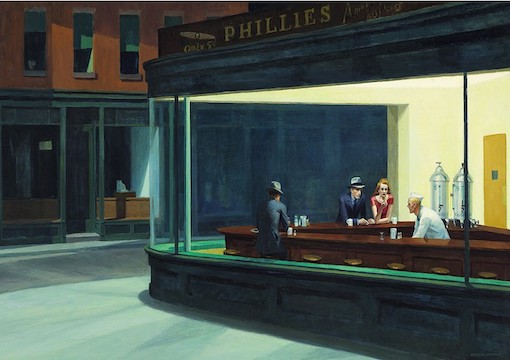
Creativity and solitude are as symbiotic as, say, Nancy Pelosi and Adam Schiff are to mendacity. No artist better captured the condition of solitude, and of course loneliness, than the great American Edward Hopper. He created a suspended narrative of solitude and loneliness with Nighthawks, his dramatic masterpiece of a New York late-night diner.

https://www.takimag.com/article/people-are-overrated/

Taki

People Are Overrated

Solitude is a blissful disengagement from the horrors of modern-day life, even if forced upon us by a government lockdown. The trouble with the present situation is the idiot box. The enforced solitude would be a blessing—it tends to breed spirituality—but for the escapism of television. The absolute rubbish, the vulgarity and violence that the networks put out nowadays and call entertainment, is far more dangerous than the virus we’re isolating against.

But this is about solitude, so I’ll skip the Hollywood horrors. We tend to derive as much good from time spent alone as we do from interpersonal relationships. It can, of course, have terrible effects, as in Conrad’s Nostromo, where a character expires after being stranded on a deserted island. He was said to have died of solitude, something I can understand. How would you like to be stranded on an island with, say, the Goldberg woman who writes a column for The New York Times and thinks everyone white or Christian is a Nazi? (Perish the thought.)

The Romantic poets praised solitude and lone ramblings, while wounded soldiers during World War I looked forward to the peace that comes when away from noise. Solitary pursuits such as fishing, reading, even smoking are guaranteed to satisfy because one indulges in them alone. And solitary confinement in prison surely is preferable to sharing a tiny cell with some ruffian going through his daily libations. Yet solitary confinement is considered to be a cruel and inhuman punishment by busybodies.

“Solitary lives are said to damage our physical health as much as smoking, but I don’t buy it.”

We’ve known since Aristotle that human beings are social animals and that no war, plague, or catastrophe will ever change that. (Well, Oprah Winfrey’s programs could do it in a jiffy, but there I go again.) Solitary lives are said to damage our physical health as much as smoking, but I don’t buy it. During normal times I go out almost every night of the week; I drink and smoke and stay up late, pursue women if possible, and live what’s called a social life. The past three months have given me time to think a bit, and I’ve come to the conclusion that the last intelligent thing I heard at a party was that the purity of the air in Palm Beach is due to the fact that the people who live there never open their windows. But the past three months have been eye-openers. I was stuck in my Swiss chalet high up in the mountains with some of the worst people, as far as manners are concerned, this side of Noo Yawk: mostly rich Eurotrash and Persian Gulf lowlife women abusers. I sent away my staff under full pay and remained alone with my wife and son. And was never happier. Mind you, the two of them cooked and cleaned up, but I hit the books while they beavered away. No hangovers, no regrets about wasted time, no embarrassment at stupidities uttered when under the influence. A new Taki was born.

They say that people are social animals and need the company of others, which in the present society we live in is obviously true. Which explains the nonstop blabber of utter rubbish one hears in the street nowadays. When I was a child—during the Homo neanderthalensis period 1.5 million years ago—I was told time and again not to speak unless I had something of value to dispense. Well, that was then, when people still had manners and women did not go on television and talk about the cream they use to shave their intimate parts.

What is definite is that solitude affects the brain in a positive way. Creativity and solitude are as symbiotic as, say, Nancy Pelosi and Adam Schiff are to mendacity. No artist better captured the condition of solitude, and of course loneliness, than the great American Edward Hopper. He created a suspended narrative of solitude and loneliness with Nighthawks, his dramatic masterpiece of a New York late-night diner. Hopper was what was known as an American gentleman, an artist who distinguished himself from his peers back at a time when total phonies like Warhol and Basquiat had not as yet surfaced from the gutters. Solitude and unnerving stillness were Hopper’s trademarks.

Actually, the enforced solitude was like being back in the ’50s again. A tidier, less frantic time, with less noise overhead, less traffic, and no toe-curling embarrassing chitchat in the streets. I heard less F-words than there are intellectuals in Hollywood, but then the cows that I live next to at my Gstaad farm are known for having better manners than most visitors, especially the Johnnys-come-lately. What makes me wonder now that we’re getting back on track—alas—is how many of the people who write for social media or appear on the idiot box knew how to spell the word “epidemiology” before they began to enlighten us with their rubbish. Mind you, this isolation that I praise has been bought at too great a price. The Donald, a man who doesn’t like to be alone, should have never shut the place down. He will have lots of time to regret it.

Be seeing you

Posted in Uncategorized | Tagged: , , , , , | Leave a Comment »

Guess What — It’s a Hustle – Kunstler

Posted by M. C. on June 6, 2020

No, this is a hustle, all right, perhaps the most obvious hustle in US history. It’s the Democratic Party’s last stratagem to get the monster of its own creation, Donald Trump, out of the White House.

https://kunstler.com/clusterfuck-nation/guess-what-its-a-hustle/

James Howard Kinstler

Of course, George Floyd didn’t deserve to die with a cop’s knee on his neck and his face mashed into the pavement, but after yesterday’s first of what will be several funerals for the now revered former armed robber and convict, you’d think he was the second coming (and going) of George Washington. Uh, check that… Washington was a slave-owner and, by definition, a racist. Make that Julius Caesar — based on the way that the Rev. Al Sharpton was bellowing at funeral No.1 Thursday in Minneapolis. Say, what? Julius Caesar owned slaves too? How about Abe Lincoln then? Naw, just another white man? And a secret racist (so they say).

Racist, racist racist! America is racist! Racism is systemic! Racism flows in the hallowed blood of the American system, going back all the way to 1619! All white people are racist. Get down on your bellies and crawl like a snake and beg forgiveness for your natural-born, inalienable racism! Anyway, that’s reality according to The New York Times, America’s premier journal of racism studies.

To prove that America is hopelessly racist, the nation has been treated to, what — ? — seven, or is it now eight nights of looting and burning by young black people acting out every racist stereotype from the Ku Klux Klan official manual of racism. The rest of the news media bent over backwards to avoid deploring the mayhem in the streets, rather, to invert the very looting, burning, and rioting as proof positive that America is racist to the bone. Look what you made us do! Steal sneakers and Rolex watches! Shoot cops, including an old retired black cop (uh, my bad) and run over several more cops with cars! Destroy businesses large and small that have been shut down for three months by corona virus to make sure they won’t ever dare to resume their racist trade in things that white people like!

Has anyone detected a hustle in the past week’s dire proceedings? Well, how would you define a hustle? How about: an attempt to gain advantage by deceitful means. What! Are you saying there was something dishonest about the reaction from sea to shining sea to George Floyd’s murder in Minneapolis? I am. For example, the massive protest marches. Who exactly was disputing that the death of George Floyd was a miscarriage of justice? Nobody. Did the cops get away with it? No, they’re all getting indicted for murder or being accessories to a murder by standing around watching it and doing nothing to stop it.

No, this is a hustle, all right, perhaps the most obvious hustle in US history. It’s the Democratic Party’s last stratagem to get the monster of its own creation, Donald Trump, out of the White House. RussiaGate didn’t do it (in fact, it’s backfiring rather horribly now), ImpeachmentGate was a dud. Welcome to GeorgeFloydGate! I know it’s hard to imagine at this moment of maximum televised sanctimony, but this gambit is going to flop, too. A lot of voters have probably noticed that the wholesale looting and burning of US cities is not in the national interest. And that the people who do it don’t deserve special favors.

Of course, this is also a moment of maximum collective acute psychosis in America. The nation is pretty badly shook-up after three months of corona virus lockdown.  Millions watched their careers, incomes, businesses, and futures wash down the drain. Upsetting as the killing of George Floyd was, these losses are monumental in comparison. 99 percent of the people in America are scared shitless about where all this economic damage is taking the nation — even as they watch the stock markets go up and up and up. By the way, the past week of looting, burning, and rioting was especially fruitful for Wall Street. D’ya think that might eventually tick off a few taxpayers who understand that the stock-pumping is being accomplished by the Federal Reserve brokering more national debt in their name?

Joe Biden’s campaign has announced that he will headline the next funeral in George Floyd’s hometown of Houston, the place where Mr. Floyd accomplished the home invasion and aggravated robbery of a woman in 2009 that sent him to state prison for five years. (He was turning his life around in Minneapolis where, ten days ago, he suffered a lapse of judgment while high on fentanyl and passed a counterfeit $20 bill in a corner store, leading to his arrest and unjust death.) I’m counting on Joe Biden to raise America’s awareness about systemic racism at that event — if he can remember where he is and what’s going on.

Also on Thursday this week, the Rev. Al Sharpton announced plans for a march on Washington in August, perhaps just before the Democratic convention in Milwaukee for maximum effect. You may be aware that Joe Biden has obliged himself (sort of) to put a woman-of-color on the ticket for vice-president. Though Stacey Abrams, the real governor of Georgia, seems like the inevitable choice, I have a better idea. Wouldn’t it be perfect to bring back Tawana Brawley for this historic role? She figured so decisively in establishing the Rev. Mr. Sharpton’s cred as leader in the long quest for social justice. She’s all growed-up now and ready to rock! Tawana Brawley, America turns its lonely eyes to you! #Tawana Brawley for veep! Spread the news far and wide!

Posted in Uncategorized | Tagged: , , , | Leave a Comment »

They Don’t Care About the Data, and They Never Have – LewRockwell

Posted by M. C. on June 6, 2020

https://www.lewrockwell.com/2020/06/allan-stevo/they-dont-care-about-the-data-and-they-never-have/

By

The number of viruses in you, or any other perfectly healthy human, at this moment outnumber your own cells by a factor of 100, as virologist Dr. John Mokili points out: “In the human holobiont, the 10^13 human cells are outnumbered 10-fold by bacteria and 100-fold by viruses.” Is the world really turning upside down over a virus?

Data Is Readily Available Today Like Never Before 

We live in the age of the Internet. That means with a few clicks, viewpoints that used to take hours of library work can be found in seconds.

Before the corona bans were put into place, there was vociferous opposition from all manner of perspectives as to why those bans were an awful idea.

Despite extensive datasets against lockdowns already existing, within weeks, the wrongheadedness of the lockdowns were being further demonstrated using the American datasets.

Belying the easy access to information, the useful demonstration of why the lockdowns were not effective was being censored from the internet. Introducing a new disappointing low in internet censorship, Medium quickly took down the above-linked piece by the pseudonymous Professor Hinkley. Its tech brethren from YouTube to Amazon, Google to Duck Duck Go followed suit censoring Covid-19 debate.

The Lockdown Took Place With Widespread Data Against The Lockdown 

Dozens of others have recounted the same experience with their Covid research, some using publicly available data to demonstrate the ineffectiveness of the lockdown and calling for more effective policies.

Among those dozens who made good faith efforts to perform research, provide data, and contribute to the discussion through sharing their informed perspectives were:

Dr Sucharit Bhakdi,

Dr Wolfgang Wodarg,

Dr Joel Kettner,

Dr John Ioannidis,

Dr Yoram Lass,

Dr Pietro Vernazza,

Frank Ulrich Montgomery,

Prof. Hendrik Streeck,

Dr Yanis Roussel et. al.,

Dr. David Katz,

Michael T. Osterholm,

Dr Peter Goetzsche,

Dr. Sunetra Gupta et al.,

Dr Karin Mölling,

Dr Anders Tegnell,

Dr Pablo Goldschmidt,

Dr Eran Bendavid and Dr Jay Bhattacharya,

Dr Tom Jefferson,

Dr Michael Levitt,

German Network for Evidence-Based Medicine,

Dr Richard Schabas,

Dr John Lee,

Dr. John Oxford,

Prof Knut Wittkowski,

Dr Klaus Püschel,

Dr Alexander Kekulé,

Dr Claus Köhnlein,

Dr Gérard Krause,

Dr Gerd Gigerenzer.

The New England Journal of Medicine ran a piece March 26, 2020 by Dr. Anthony Fauci, two weeks after the earliest lockdowns and before some lockdowns had been implemented, that claimed in its third paragraph a much lower death rate than was being reported: “This suggests that the overall clinical consequences of Covid-19 may ultimately be more akin to those of a severe seasonal influenza (which has a case fatality rate of approximately 0.1%)…”

The CDC itself has now demonstrated the death rate to be much lower than is being reported in the media, yet some states are increasing restrictions while others drag their feet in loosening them.

Large swaths of the media including Matt Drudge, CNN, the New York Times, and sadly a contributing editor at the Spectator report grossly inaccurate death rates of 5.9%, using weasel words to get away with continuing to use that scary number.

1 in 20 are not dying of Covid.

Some of these people may claim good intentions. Those who seek to control are aided by those who Mises in his 1947 essay “Planned Chaos,” described as “useful innocents,” who help them do their mischief, or “useful idiots,” as some call them. The time for permissible naïveté in aid of tyrants has passed.

Those Who Want To Control You Don’t Care About The Data, They Care About Controlling You  Read the rest of this entry »

Posted in Uncategorized | Tagged: , , , , , , , | Leave a Comment »

bionic mosquito: Natural Law and Anarcho-Capitalism

Posted by M. C. on June 6, 2020

https://bionicmosquito.blogspot.com/2020/06/natural-law-and-anarcho-capitalism.html#more

The purpose of this paper is to give an analysis and explication of the notion of a natural order of human affairs, which is logically independent of any metaphysical or theological system.

In this paper, Frank van Dun (FvD) offers an examination of Rothbardian anarcho-capitalism and its presupposition of a natural order – based on natural law and natural rights.

In short, anarcho-capitalism, in its Rothbardian form, stands or falls with its supposition that there is a natural order – a natural law – of the human world and that each human person has a place in that order that is delimited by his or her natural rights.

It is important that van Dun clarifies that he is dealing with a Rothbardian order, as others base their anarcho-capitalism or libertarianism on foundations other than natural law. Rothbard’s version is not driven by views on efficiency, but on views of human beings as human beings.

It is important, therefore to examine just what is meant by natural law – at least as van Dun sees it. As he notes, “‘Natural law’ is a controversial concept.” One reason it is controversial is that it is often connected to the metaphysical, or otherwise connected to a particular theology. While one cannot escape Aquinas when discussing natural law, this certainly does not make it a Catholic convention – or invention.

However, the fact that some theories of natural law are metaphysical or theological does not mean that natural law is something metaphysical or theological. A theory of mice and men can be metaphysical but the metaphysics is in the theory, not in the mice and not in the men.

FvD then dives into a very important point – one that I have often made, yet still find misunderstood. Natural law legal theory and natural law ethical theory need not be identical. Such thinking results in an unnecessary either / or situation:

…either all natural laws are mere moral admonitions or all of them are legally enforceable requirements. That ambiguity has plagued the interpretation of natural law theories ever since Thomas Aquinas identified natural law and reason.

Natural law: either suggestions for ethical behavior or a system by which to implement a theocracy. But neither extreme is necessary, and in any case not at all intended by Aquinas. Forgive the very long cite, but this is a tremendously important point:

…Thomas clearly distinguished between mere sins (that merit disapproval and repentance) and injustices (that merit ‘action in justice’ and redress). He also distinguished between vices of the sort no virtuous man would engage in and vices that threaten the existence of ‘society’ (not this or that particular society but ‘human society’ as a general form of conviviality or symbiosis): murder, arson, theft, fraud, robbery, assault and other crimes against persons and property. (Summa Theologica, IaIIae, question 96, art.2 (concl). Only with respect to injustice and especially crime can the coercive power of ‘human law’ intervene. In short, while all virtues are necessarily lawful (sanctioned by the rational appreciation of their agreement with divine providence), and all vices are consequently unlawful, only a few vices of a particular sort should be made illegal. ‘Legislating morality’ was not on Thomas’ agenda.

FvD uses the terms “unlawful” and “illegal” to make the distinction. Unlawful being a violation of natural law; illegal being a violation that gets you thrown in prison (or justifies violence in response).

This is consistent with my point that the non-aggression principle fits quite well as a theory of punishment, but not as a theory of ethics. Violations of the natural law that are also aggressions against person or property are subject to the “coercive power of human law.” Non-aggressive violations of the natural law are not, in my opinion, subject to this same coercive power.

I will leave aside, as it is rough around the edges and will be dictated by local custom as much as any other factor, the specific application of the word “aggression.” I don’t think the edges of this term are identifiable by evermore purifying attempts at applying libertarian theory. Human beings don’t work that way. Different societies will figure this out in a way that works for them.

FvD next looks at a comparison of natural law and artificial law. Whether in physics, biology, or chemistry, science attempts to identify the natural order of things. It is no different when working to identify the natural order of persons. This order exists, waiting to be discovered, based on the characteristics of human beings as human beings.


This as opposed to artificial law: “An artificial law is an order of artificial things. Here we shall consider it only as an order of artificial persons.” FvD offers as an example, the artificial person known as a “citizen.” States and corporations also qualify. These are defined by the relevant artificial law.

To find out about natural persons, go live among them; to find out about citizens, consult a lawyer!

A breakdown in artificial law happens when people refuse to play by the rules. This could be because they refuse to do so (including for reasons that the rules violate natural law) or when the rules are overly complex and ever-changing. A breakdown of natural law happens when people do not heed the distinction of one person from another. (Egalitarianism in all its forms, run amok.)

What of any obligation for a person to respect the natural law? This, van Dun suggests, is an open question requiring serious thought:

What a natural person can do does not translate into what he may do. What such a person ought to do does not translate into what he must do.

How I see this: A natural person can punch someone in the nose for no good reason; it does not follow that he may do this. A natural person ought not live in a drunken stupor; yet this says nothing about what he must do regarding the consumption of alcohol.

Such an is-ought question is not an issue at all for artificial persons and artificial law. Here, the law is whatever the law is, and the person is whatever the law makes him to be. This is positivism, and it is clear why positivism is anathema to anarcho-capitalists – and many libertarians. Positivism ignores, and even denies, the idea of natural law.

Conclusion

In this paper, van Dun is not attempting to justify natural law, only to examine it and its relationship to anarcho-capitalism. He concludes:

Anarcho-capitalism rests on the notion of natural law as an order of natural persons rather than a binding set of rules or commands. As a normative theory, it holds not only that we have good reasons to respect the natural order but also that we have no right not to respect it.

Building liberty on any other foundation is flawed; it is not sustainable. Only this foundation of natural law takes human beings as they are, not as someone wishes them to be.

Be seeing you

Posted in Uncategorized | Tagged: , , | Leave a Comment »