
MCViewPoint

Opinion from a Libertarian ViewPoint

Price Inflation Hits a 31-Year High as Janet Yellen Insists It’s No Big Deal | Mises Wire

Posted by M. C. on November 11, 2021

Nonetheless, it is entirely possible that inflation rates could quickly turn downward again in coming months. That could occur if recession sets in with businesses and households unable to pay off their debts. If that happens, monetary deflation will set in and demand will decline, leading to a real drop in price inflation. Of course, that won’t exactly do wonders for real wages, either.

https://mises.org/wire/price-inflation-hits-31-year-high-janet-yellen-insists-its-no-big-deal

Ryan McMaken

The Bureau of Labor Statistics reported Wednesday morning that prices rose 6.2% on a year-over-year basis in October. That’s the highest YOY rate since December 1990 when the CPI was also up 6.2 percent.

October’s rate was up from 5.3 percent in September, and remains part of a surge in the index since February 2021 when year-over-year growth was still muted at 1.6 percent.
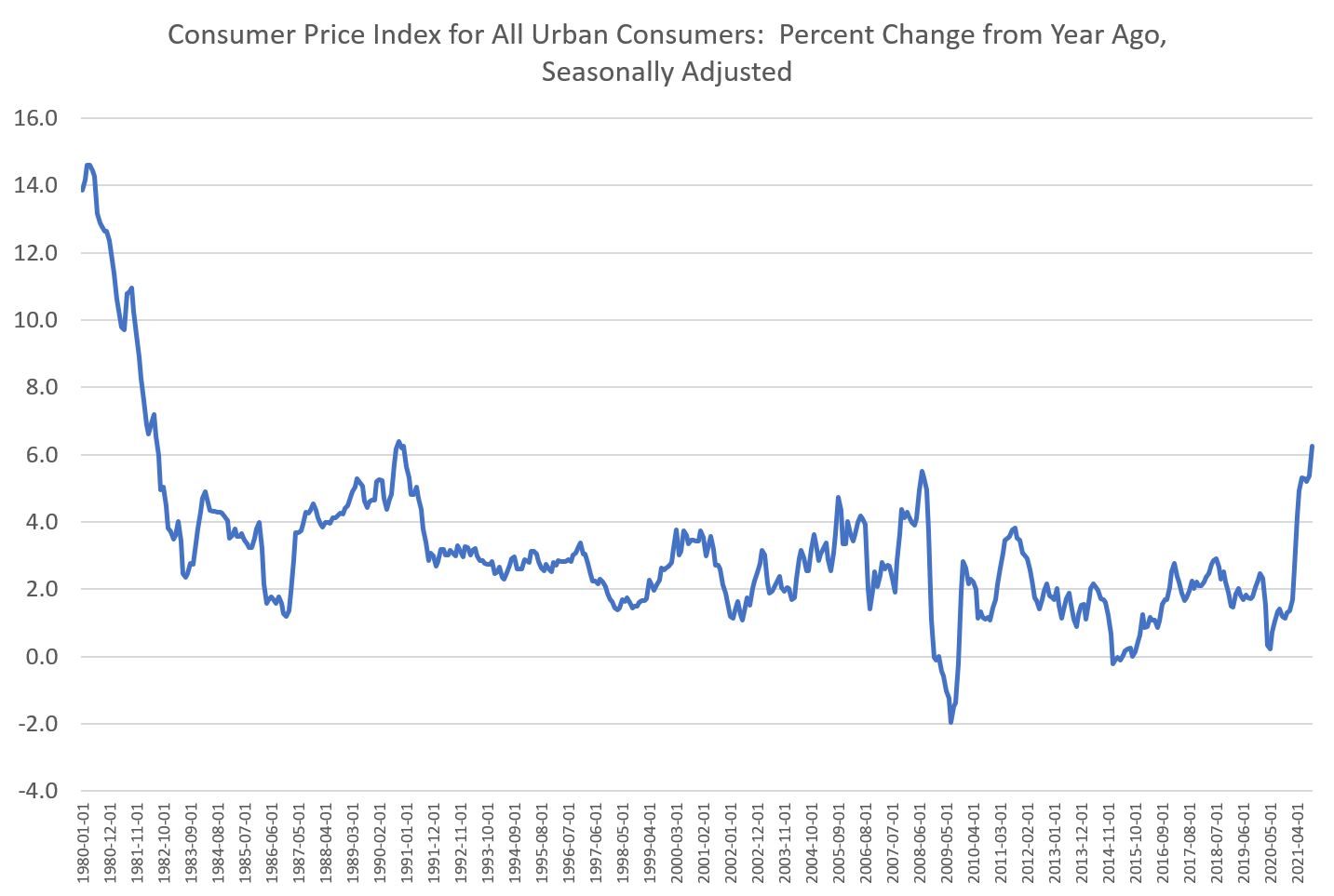
cpi

Not surprisingly, producer prices surged in October as well. The producer price index for commodities in October was up 22.2 percent, year over year, reaching a 48-year high. We must go back to November 1974 to find a higher PPI increase—at 23.4 percent.

Asset price inflation has naturally continued unabated at well, with the result being rising housing costs. In addition to the CPI’s 31-year high, home prices in the second quarter surged near to a 42-year high. According to the Federal Housing Finance Agency’s home price index, home price growth reached 11.9 percent in the second quarter of this year. Since 1979, only the second quarter of 2005—also with 11.9 percent growth—showed home-price growth as high.  

This is troubling information indeed, given that average real weekly earnings have turned negative this year, with inflation-adjusted earnings down 0.5 percent from September to October.  It is increasingly clear that wages are not keeping up with rising prices for a great many Americans.

None of this means policymakers will diagnose the problem properly, however. We should expect the discussion around inflation in Washington to keep missing the point and denying any connection to the central bank or to monetary inflation. 

For example, rising prices are so obvious now that not even the administration can ignore them anymore. Today, the White House released a statement in which President Biden admitted: “… today’s report shows an increase over last month. Inflation hurts Americans pocketbooks”

Yet the administration continues to be very much in denial about the causes of price inflation. The Biden statement continues:

I have directed my National Economic Council to pursue means to try to further reduce these costs, and have asked the Federal Trade Commission to strike back at any market manipulation or price gouging in this sector.

As if “price gouging” were the cause of nationwide price inflation!

If it were “gouging,” we’d be seeing increases only in the areas where so-called gouging is taking place. Moreover, that would mean a decline in spending—and thus price deflation—in areas where the gouging isn’t taking place. The overall effect would be price stability.

Similarly, the administration has also tried to blame inflation on a lack of childcare.  In an incoherent series of non sequiturs, Secretary of Transportation Peter Buttigieg this week claimed that paid family leave is “part of [the administration’s] tool kit to fight inflation.” Buttigieg simultaneously claimed that paid family leave means more people can take time off from work, and yet this somehow will also translate into more people going back to work. While it’s true more workers could help temper—to some extent—upward pressure on prices, more paid family leave would contribute nothing to this “solution” to price inflation.  Rather, it’s apparent the memo went out at the administration that every policy must now be tied into some kind of plan to fight inflation—no matter how tenuous the connection.

Yet we should expect more of this sort of blind grasping at excuses for our economic malaise as time goes on. The same strategy was used by the Ford administration in the dark days of the mid1970s and the “Whip Inflation Now” campaign. The administration then claimed that the American public should fight inflation through strategies such as planting a vegetable garden at home.

Then, as now, the regime refused to admit that rising monetary inflation had anything to do with rising prices. Instead, we’re told it must be a lack of daycare services or “price gouging.”

A Second Strategy: Total Denial

But some in the administration are sticking to their narrative that there’s nothing at all to see here. Janet Yellen, for example, declared on Tuesday that “I’d expect price increases to level off, and we’ll go back to inflation that’s closer to the 2% that we consider normal.” She insists the Fed is very much in control of the situation and won’t allow 1970’s style inflation to occur. 

What Yellen fails to mention is that even if inflation rates of, say, four to six percent, last only a year, middle class workers won’t make up these losses later just because inflation falls again at some point to “to the 2% that we consider normal.” After all, this year’s declines in real average weekly wages means real hardship for many people, even if Janet Yellen will be just fine with her private driver shuttling her from her luxury home to opulent cocktail parties all the while.

But not everyone is as uninterested in the effects of inflation as Janet Yellen. As MSNBC reports:  

“For now, inflation is going to continue to run above very solid wage growth,” said Joseph LaVorgna, chief economist for the Americas at Natixis and former chief economist for the National Economic Council during the Trump administration. “This is why when you look at consumer confidence, it’s really taking a beating. Households do not like the inflation story, and rightly so.”

For at least one MSNBC columnist, though, people don’t know how good they have it. On Monday, James Surowiecki insisted everyone is better off and discussion of inflation amounts to little more than fear mongering. He writes:

See the rest here

Be seeing you

Posted in Uncategorized | Tagged: , , | Leave a Comment »

Watch “Got Gas? Biden’s Big Oil Blunder!” on YouTube

Posted by M. C. on November 10, 2021

With gasoline and diesel prices at a seven year high and inflation raging, the Biden Administration’s plummet in the polls continues. The lofty aspirations of those pushing a “green agenda” – with shutdowns of pipelines – is meeting the hard reality of a country on the economic brink. Who will blink? Also today: Dissent within Fauci’s ranks, State Farm stands up for Aaron Rodgers, and MASSIVE Los Angeles protest against vax mandate.

https://youtu.be/ASHQyoT5a2k

Be seeing you

Posted in Uncategorized | Tagged: , , , | Leave a Comment »

Why There Is No Free Lunch | Mises Wire

Posted by M. C. on November 10, 2021

Opportunity cost, he tells us, “is the value of the alternative you sacrifice when you choose to pursue a goal—any goal. Put another way, opportunity cost is the flip side of any choice you make” (p. 22).

https://mises.org/wire/why-there-no-free-lunch

David Gordon

No Free Lunch: Six Economic Lies You’ve Been Taught and Probably Believe
by Caleb S. Fuller
Freiling Publishing, 2021. 110 pp.

Caleb Fuller, an economist who teaches at Grove City College, thinks that many people have a mistaken conception of economics. It is, they think, a dull and dry subject, the “dismal science,” of primary interest to specialists. Fuller disagrees. He says that “economics changed my life” (p. 11; all page references are to the Amazon Kindle edition), and in this wonderful short book, which can be read in an hour or so, he conveys his infectious enthusiasm for it.

What is the reason for his enthusiasm? Fuller says that he can provide readers with “a pair of eyeglasses that can extend our vision beyond where we’re accustomed to looking” (p. 12), and this is the “opportunity cost lens.” (One wonders how a pair of eyeglasses can be at the same time a lens, but this is a quibble.) By using this lens properly, readers will be able to unmask six common fallacies that exercise a malign influence on current thought. In carrying out his project, he follows Frédéric Bastiat and Henry Hazlitt, and he is a worthy successor of them, whom he calls “economics’ greatest communicators” (p. 12).

Before turning to opportunity cost and its use in exposing fallacies, I will note one point of usage. Fuller often calls the fallacies “lies,” meaning by this that they are untrue; but although some people use the word in this way, I think it better to reserve “lies” for deliberate misstatements, so that someone who wrongly believes one of the fallacies is true would not count as a liar if he stated his belief. But this is by the way.

Opportunity cost, he tells us, “is the value of the alternative you sacrifice when you choose to pursue a goal—any goal. Put another way, opportunity cost is the flip side of any choice you make” (p. 22). Fuller first uses opportunity cost to explain Bastiat’s famous “parable of the broken window.” In the story, a “teenage vandal” (could one say that today?) has thrown a brick through a shopkeeper’s window. A passerby suggests that he is really a public benefactor in that the shopkeeper will now have to pay a glazier to replace his window and the glazier will spend the money he receives, increasing the community’s prosperity. What the passerby overlooks is that had the window not been broken, the shopkeeper would have spent his money on other things. The passerby has ignored the shopkeeper’s opportunity cost. The community has not gained, but lost, because a resource, namely the window, has been destroyed. Few people would call the teenager a public benefactor, but many have been ensnared by the fallacy. It’s often claimed, for example, that government spending on weapons during World War II ended the Great Depression, but in the absence of war, the money would have been spent on other things, and the war in fact lowered the standard of living of civilians.

Fuller next applies opportunity cost to answer a fundamental question. Resources in an economy are scarce, “in limited supply and also desirable” (p. 32). How are they to be allocated? The price system is by far the best way to do this; it is “humankind’s greatest invention” (p. 33). If the quantity demanded of a good exceeds the available supply, its price will rise, and the good will go to those who value it the most, i.e., offer a higher price than competing buyers. Many people resent this system—why should scarce goods go to the rich rather than the poor?—and seek a “free lunch” by forcing prices down. Fuller says there is no such thing as a free lunch and, to illustrate his point, offers an excellent and detailed account of the failures of rent control. Often, for example, landlords will respond to laws that compel them to offer apartments at below the market price by refusing or delaying repairs. By reducing the quality of the apartment, they “simply let the housing quality adjust until it matches the new, lower price they are forced to charge” (p. 42). He says that the “fact that lunch isn’t free is an economic law that was true in 2021 B.C., around the time Hammurabi declared price controls” (p. 44). The date is a few hundred years off, but one gets what he means.

The behavior of the landlords in response to rent control is an instance of a more general principle. Good intentions by lawmakers often fail to achieve the desired outcomes, because “virtually all public policies alter the relationship between costs and benefits. When the benefits of an action change relative to an action’s opportunity cost, people’s actions also change. And when people change their actions, they may do so in a way that works at cross-purposes with a public policy’s noble intentions” (p. 48). As an example, after the 9/11 attacks, the Transportation Security Administration security measures raised the opportunity costs of flying, since people after that had to wait much longer in line. As a result, some shifted to automobile travel. But fatal accidents are much more likely to occur in cars than airplanes, and one estimate is that because of the TSA’s policies, “327 additional automobile deaths occurred monthly for the last quarter of 2001” (p. 52).

The price system, so much stressed by Fuller, depends on a fundamental principle, that exchange takes place only when both parties to it expect to benefit. “Thus every trade makes the world wealthier because both parties gain, even as exchange only switches who owns what property titles” (p. 60). Though the point seems when stated to be obvious—why else would you make an exchange if you did not expect to gain from it?—it has often been overlooked, and Aristotle among many others thought an exchange takes place when the good is equally valued by both parties. If you understand that exchange benefits both parties, you will see what is wrong with criticisms of agreements between owners of “sweatshops” and those workers who voluntarily work in them, under what seems to us harsh conditions and poor pay. The employers are not exploiting the workers; the conditions are to them an improvement. You do not exploit people by offering them jobs, even if you could have made them an offer they would have found even more desirable. It is worth noting, and in doing so I do not mean to suggest that Fuller has not seen this, that the view that in an exchange one party gains at the expense of another is inconsistent not only with the “both parties benefit” view but also with the “exchange as equality” position. The elaborate efforts of Karl Marx to reconcile labor exploitation and equality in exchange manifest the intellectual bankruptcy of his thought.

The mutual benefits of exchange apply to all exchanges, not just ones by the residents of one country, though many people find this extraordinarily hard to see. Foreign trade extends the advantages of specialization and the division of labor, and attempts to limit it reduce consumer welfare. If it is objected that workers displaced by foreign competition are worse off, Fuller’s reply is that to use this point in support of tariffs is an instance of the broken window fallacy. Tariffs raise production costs, leading employers to reduce offers of employment, and these unseen lost jobs need to be set against the losses to domestic workers that are so much emphasized in anti–free trade propaganda. Free trade also promotes peace because trading partners benefit from each other’s continued well-being. “If goods don’t cross borders, armies will,” an adage that comes not from Bastiat but from a “somewhat obscure nineteenth-century economist, Otto T. Mallery” (p. 86), but is true nonetheless.

Fuller concludes with a convincing rejoinder to the claim that the government needs to regulate markets. Otherwise, it is claimed, businesses would be tempted to take advantage of their customers through inferior service and fraud. If, for example, a restaurant serves you monkfish, the “poor man’s lobster” (p. 91), instead of the genuine article you had ordered, won’t it make a profit? Not it if wants you back as a customer. “The ‘shadow of the future’ looms over every exchange like a specter threatening to take away future profits. But you need to be wearing your economic eyeglasses to see that far ahead” (p. 93).

No Free Lunch is an ideal book for introductory economics classes and for anyone who wants to understand how the free market works. It would be a good test to see if you understand the book to explain why the lesson summarized in the book’s title is consistent with the fact that the book is, at least as of this writing, available on Amazon Kindle for free. Author:

Contact David Gordon

David Gordon is Senior Fellow at the Mises Institute and editor of the Mises Review.

Be seeing you

Posted in Uncategorized | Tagged: , , | Leave a Comment »

Where D.C. Goes From Here After Pelosi’s Big Day – Gold Goats ‘n Guns

Posted by M. C. on November 10, 2021

What will be terrible coming out of that bill is the new administrative powers, snooping, regulations on travel, cryptocurrencies, etc. which will continue to strangle the middle class and ensure the continued roll up of wealth in the U.S. from the middle and lower classes to major firms.

They will not only wind up with the lion’s share of the funds, but also operate in a landscape where the costs of the new rules fall disproportionately on smaller firms, increasing their competitive advantage.

https://tomluongo.me/2021/11/09/where-d-c-goes-from-here-after-pelosis-big-day/

Author: Tom Luongo

I was contacted over the weekend by Sputnik News to give them my thoughts on Nancy Pelosi’s announcement to force through votes on the two big spending bills she’s been stymied on for months now. The opposition to these bills, even the Infrastructure Bill she eventually got through the House at the midnight hour, is increasing because the perceived need for them is falling.

Sputnik published their article this morning and is worth your time (not just because some of my ideas are presented). Since this bill passed the realization that the “Build Back Better” Bill of Davos’ dreams is still in serious trouble.

The fact that Pelosi arm-twisted this hard so close to last week’s electoral shellacking should confirm for you just how desperate things look on Capitol Hill. There is a fight for the soul of the Democratic Party which is playing out both in Domestic and Foreign Policy. More on that later in the week.

Since Sputnik didn’t use all of my comments I’m publishing them here to keep things brisk and clarify any finer points.

Q:How will the “transformative” Build Back Better Act change the everyday lives of ordinary Americans?

That hasn’t passed yet, and if the moderate Democrats in the Senate were listening to the voters on Election Day, they should continue to hold out against it and kill it completely. Compared to the original text of the bill the BBB Act monetarily isn’t a big deal. Most of Trump’s tax cuts are still in place.

What will be terrible coming out of that bill is the new administrative powers, snooping, regulations on travel, cryptocurrencies, etc. which will continue to strangle the middle class and ensure the continued roll up of wealth in the U.S. from the middle and lower classes to major firms.

They will not only wind up with the lion’s share of the funds, but also operate in a landscape where the costs of the new rules fall disproportionately on smaller firms, increasing their competitive advantage.

Q: Six Democrats, known as The Squad, voted against the infrastructure bill. Do you expect more infighting within the Democratic party, which is soon set to vote on the $1.85 trillion climate, tax, and social policy bill?

Yes, I actually do.  The Democratic Party isn’t a political party per se.  Instead, it is best to think of it as a three-headed coalition of the aggrieved. 

They are in panic mode to ‘just sign anything’ and give their people something to run and fundraise on, even though they already know they’ve lost the mid-terms. 

What happened on Friday was more interesting from the Republican side of the aisle (as always) as enough of them caved to politically neuter “The Squad” on this vote.

These squishy RINOs did what they were supposed to do, betray their constituents at the last minute to serve whatever higher master, in my view the ones who just met at COP26, they answer to. 

By neutering “The Squad” over this vote with the help of RINOs, it will be easier for Pelosi and company to get The Squad to cave over the second bill.  The Progressives got their heads handed to them last night. 

See the rest here

Be seeing you

Posted in Uncategorized | Tagged: , , , , | Leave a Comment »

Gov. Newsom Injured by Moderna Booster Shot, Source Tells The Defender • Children’s Health Defense

Posted by M. C. on November 10, 2021

If true the spin will be interesting.

https://childrenshealthdefense.org/defender/gov-gavin-newsom-moderna-booster-vaccine/

By  Children’s Health Defense Team

A source close to California Gov. Gavin Newsom today told The Defender the governor experienced an adverse reaction to the Moderna COVID vaccine he received Oct. 27.

The source, who asked not to be identified, said Newsom’s symptoms were similar to those associated with Guillain–Barré syndrome (GBS), a known side effect of many vaccines.

GBS is a neurological disorder in which the body’s immune system mistakenly attacks part of its peripheral nervous system — the network of nerves located outside of the brain and spinal cord — and can range from a very mild case with brief weakness to paralysis to leaving the person unable to breathe independently.

The governor has not been seen in public since he was photographed Oct. 27 getting his COVID booster.ORDER TODAY: Robert F. Kennedy, Jr.’s New Book — ‘The Real Anthony Fauci’

On Oct. 29, Newsom’s office issued a statement referring to unspecified “family obligations” as the reason the governor canceled his scheduled appearances, including his planned meetings at the global COP 26 climate conference in Glasgow, Scotland.

A local ABC News outlet reported that when “the surprising announcement was made,” a spokesperson said Newsom planned to participate virtually in the climate conference. However, Newsom’s name was removed from the schedule and he did not participate.

The Defender reached out to Newsom’s office today by phone and email, but the office did not respond before publication.

According to Fox News, Newsom’s wife, Jennifer Siebel Newsom, on Sunday tweeted — then quickly deleted — a message urging people to “stop hating” while her husband has been out of the public eye.

Jennifer Siebel Newsom's tweet

Commenting on the situation, Robert F. Kennedy, Jr., chairman of Children’s Health Defense, today said he “prays for Newsom’s family” and wishes him a quick recovery.

Kennedy added:

“However, if it’s true the governor has suffered debilitating neurological injuries following vaccination, it raises grave ethical questions about his seemingly dishonest efforts to conceal his injuries while implementing aggressive policies to force the children and working people of California to endure similar risks.”

Newsom has been an outspoken advocate of COVID vaccines and mandates. On Oct. 1, he announced California’s schoolchildren will be required to get the COVID vaccine once it is fully approved by the FDA. It’s the first such mandate in the country.

In a Nov. 3 press release, the governor’s office said California was launching a “robust” vaccination program for 5- to 11-year-olds. The governor has allocated more than 1.2 million vaccines for the 5-11 age group and is setting up 4,000 vaccine sites throughout the state.

According to Times of San Diego, Newsom got the Johnson & Johnson (J&J) COVID vaccine in April 2021 when his age group became eligible. In July, the U.S. Food and Drug Administration added a warning to the J&J COVID vaccine noting the vaccine had been linked to GBS.

The latest data from the Vaccine Adverse Event Reporting System show that between Dec. 14, 2020, and Oct. 29, 2021, there were 705 reports of GBS following COVID vaccines, with 41% of cases attributed to Pfizer, 31% to Moderna and 28% to J&J.

In April, The Defender reported on a teen who was diagnosed with GBS after his first dose of a COVID vaccine. And last week, The Defender reported on a 63-year-old cancer survivor diagnosed with GBS after her second dose of the Pfizer vaccine.

GBS is included as a possible risk for many vaccines including Adacel, Afluria, Engerix-B, Fluarix, Flulaval, FluMist, Fluzone, Gardasil/Gardasil 9, Havrix, Menactra, Menomune, MMR-II, PedvaxHIB, Pneumovax-23, ProQuad, Recombivax, Tenivac, Vaqta and Varivax.

Since 1992, the National Vaccine Injury Compensation Program has paid approximately $500 million to 1,450 victims of post-vaccination GBS, The Defender reported.

be seeing you

Posted in Uncategorized | Tagged: , , , | Leave a Comment »

Federal Appeals Court Finds “Grave Statutory and Constitutional Issues” with Biden’s Vaccination Mandate – PaulCraigRoberts.org

Posted by M. C. on November 10, 2021

https://www.paulcraigroberts.org/2021/11/08/federal-appeals-court-finds-grave-statutory-and-constitutional-issues-with-bidens-vaccination-mandate/

A federal appeals court has blocked the corrupt Biden regime’s private employer “vaccine mandate” on the grounds that “there are grave statutory and constitutional issues with the mandate.” https://www.theepochtimes.com/mkt_breakingnews/federal-court-blocks-biden-administrations-private-business-covid-19-vaccine-mandate_4089942.html?utm_source=News&utm_medium=email&utm_campaign=breaking-2021-11-06-2&mktids=57c5b13448d3d96e931e87904b7ce8d8&est=4CTJyNPTctMThtj2eMjknqwWPbjP846BstSI5Diq0voyDPjrWTy09g%3D%3D

As I reported, OSHA does not have the authority to issue legislation any more than does Biden. The corrupt Biden regime’s effort to bypass Congress has failed for the nonce. Congress should impeach Biden for violating the separation of powers and his oath to uphold the Constitution.

The corrupt Biden regime’s order that the military and government employees must be vaccinated is also illegal. Under the Nuremberg Laws vaccination is a medical intervention requiring informed consent. German doctors who performed medical experiments on humans without their consent were executed for doing so. A person who coerces a vaccination is subject to the death penalty. Indeed, Fauci has in the past coerced experiments on children, causing many deaths as Robert Kennedy documents in his just published book, The Real Anthony Fauci — https://www.booksamillion.com/p/Real-Anthony-Fauci/Robert-F-Kennedy/9781510766808?gclsrc=aw.ds&gclid=EAIaIQobChMIuqPjsOWE9AIVEZfICh2dBgPoEAQYAyABEgIfGPD_BwE — The United States government has provided no explanation why it goes to such extremes to track down elderly former German camp guards but refuses to hold Fauci accountable for the murder of children.

At the current time, there are many hospital, university, and public school administrators who are subject to the death penalty for mandating vaccination. Hopefully there will be trials, conviction and all will be executed. Good riddance.

Biden, the Pentagon chief, and the Joint Chiefs of Staff are also subject to trial and execution for coercing vaccination on military and federal personnel. Hopefully they too will be tried, convicted and executed if found guilty.

Otherwise, it is the rule of law that will be executed as the executive branch morphs into a dictatorship.

Be seeing you

Posted in Uncategorized | Tagged: , , , | Leave a Comment »

The Poor Forgotten Baker – LewRockwell LewRockwell.com

Posted by M. C. on November 10, 2021

The libertarian position on discrimination has nothing to do with racism, sexism, prejudice, bigotry, hate, intolerance, homophobia, or xenophobia and everything to do with freedom.

Anti-discrimination laws are an attack on property rights, freedom of association, the free market, and freedom of thought.

https://www.lewrockwell.com/2021/11/laurence-m-vance/the-poor-forgotten-baker/

By Laurence M. Vance

Earlier this year, Colorado baker Jack Phillips got in trouble again for exercising what he thought was his right in a free country to discriminate. Some libertarians have been strangely quiet about his plight.

In 2013, Phillips, the owner of Masterpiece Cakeshop in Denver, was accused by Colorado’s Civil Rights Commission (CCRD) of discriminating against a homosexual couple because he refused to bake them a cake for their “wedding.” An administrative law judge found in favor of the couple, and this was affirmed by the Commission. The decision was appealed to the Colorado Court of Appeals, which again affirmed the Commission’s decision in 2015. A petition for a writ of certiorari was filed with the Supreme Court in 2016, and was granted in 2017. The Court, in the case of Masterpiece Cakeshop, Ltd. v. Colorado Civil Rights Commission (2018), in a 7-2 vote, ruled in favor of Phillips because “the Commission’s actions here violated the Free Exercise Clause.”

But the radical left wasn’t done with Phillips.

Soon after the Supreme Court decision, Autumn Scardina—who was born and remains a man no matter how many left-libertarians call him a woman—requested that Phillips bake him a cake pink on the inside and blue on the outside to celebrate his birthday and seventh anniversary of his “gender transition” from male to female.

Phillips refused, so Scardina filed a complaint with the CCRD.

CCRD director Aubrey Elenis concluded that there was probable cause that Phillips had unlawfully denied Scardina “equal enjoyment of a place of public accommodation,” and ordered the two to enter mediation. Phillips, represented again by the Alliance Defending Freedom (ADF), sued the state of Colorado in U.S. District Court in Denver for renewing its “crusade” again him because he again refused to bake a cake that would have violated his religious beliefs.

In March 2019, the state Attorney General’s office announced that it and Phillips’ attorneys had “mutually agreed to end their ongoing state and federal court litigation,” including the CCRD action against Phillips.

So Scardina filed a civil suit of his own in state court.

In June of this year, Denver District Court Judge A. Bruce Jones ruled that Phillips violated Colorado anti-discrimination law by refusing to bake the special cake and fined him $500. (I wonder if the judge would have likewise ruled that a Jewish baker who refused to bake a cake for Nazis in honor of Hitler’s birthday and a seamstress who refused to monogram robes for Klan members violated Colorado anti-discrimination law? Of course he wouldn’t.)

For months now I have been watching carefully the libertarian reaction to Phillips’ recent plight. It is almost non-existent from some quarters. And when the right of Phillips to discriminate is mentioned, it is usually tempered by some statement implying that his beliefs are wrong. As one prominent libertarian said back in June: “You may not agree with Phillips’ beliefs—I don’t—but a liberal, pluralistic society requires tolerance for people of different moral beliefs coexisting without using the state to crush dissent out of one another.”

CDC libertarians are so enamored with the Covid-19 vaccine that they have forgotten about the poor baker. They have been so busy telling us that private businesses have the right to require that their customers wear masks, social distance, and get the Covid-19 vaccine that they have ignored Jack Phillips. Never in their life have they talked as much about the right of businesses to discriminate as they have during the past year. But it is usually always in reference to the right of businesses to discriminate against the unmasked and the unvaccinated.

Since CDC libertarians rarely make an unequivocal case for the absolute freedom of discrimination, let me state the libertarian position on discrimination as clearly and succinctly as I can: Since discrimination—against anyone, on any basis, and for any reason—is not aggression, force, coercion, threat, or violence, the government should never prohibit it, seek to prevent it, or punish anyone for doing it.

The libertarian position on discrimination has nothing to do with racism, sexism, prejudice, bigotry, hate, intolerance, homophobia, or xenophobia and everything to do with freedom.

Anti-discrimination laws are an attack on property rights, freedom of association, the free market, and freedom of thought.

Be seeing you

Posted in Uncategorized | Tagged: , , , , , , , | Leave a Comment »

After Afghanistan, Military Spending on Track to Go Up

Posted by M. C. on November 10, 2021

The defeat in Afghanistan offers a chance to rethink America’s war machine, but Congress is on the verge of raising military spending to $740 billion.

https://theintercept.com/2021/11/07/military-spending-pentagon-afghanistan/

Peter Maass

Peter Maass

Around midday on August 15, the president of Afghanistan, Ashraf Ghani, was told by an adviser that Taliban fighters had entered the presidential palace and were looking for him room by room. This was not true, but Ghani, aware that ousted presidents do not have long lives in his country, hurried himself and his wife to a military helicopter and fled for Uzbekistan. Without time to fetch any personal belongings, he left Kabul in plastic sandals and a thin coat, according to a Washington Post account of that day.

Afghanistan was supposed to be the “good war” after 9/11, the one with a legitimate purpose and a happy ending. That also didn’t turn out to be true, but while the war’s momentum favored the Taliban for years, its final act had the suddenness of a guillotine, with a lot more pain. At Kabul’s airport, desperate Afghans clung to the sides of a departing U.S. cargo plane. Panicked families tried to get onto the diminishing number of evacuation flights. And 13 U.S. troops helping keep the airport open were killed in a suicide bombing. Just before midnight on August 30, the last U.S. aircraft and the last U.S. soldier got out of Kabul.

Guess what happened?

To understand the next step, you need to go back to April, when President Joe Biden proposed a $715 billion Pentagon budget for 2022, which represented a 1.6 percent increase from 2021. Progressives like Lee were not pleased — and were even less pleased in late July when the Senate Armed Services Committee added $25 billion to Biden’s proposal. This “plus-up,” as it’s called, raised the budget to $740 billion, a 5 percent increase over the previous year. At that rate, military spending over the next decade would easily exceed $7 trillion, or four times more than the $1.75 trillion Build Back Better program that Biden is trying to push through Congress.

See the rest here

Be seeing you

Posted in Uncategorized | Tagged: , , , , | Leave a Comment »

In a Free Economy, Prices Would be Going down, Not Up | Mises Wire

Posted by M. C. on November 9, 2021

Price indices cannot measure the consequences of monetary inflation because the downward pressure on prices that these innovations exert across the economy operates independently of the upward pressure on prices generated by credit expansion. In other words, the consequences of monetary expansion are far deeper than the rise in consumer prices suggests. When the CPI is low, we pay only a little more for consumer goods than we did the year before. But without monetary inflation, we would be paying significantly less.

https://mises.org/wire/free-economy-prices-would-be-going-down-not

Chris Calton

Whenever politicians and media outlets discuss inflation, they invariably use the Consumer Price Index (CPI) as their measure. The CPI is only one of several price indices on top of the various measures of the money supply that underlie aggregate price changes. Strictly speaking, the CPI does not measure inflation per se, but rather the consequences of monetary expansion on consumer products. In macroeconomics, the CPI is one of the key indicators of economic health, and it is this inflation measure that economists use to calculate real GDP. Naturally, the accuracy of the CPI as a measure of the consequences of credit expansion is critically important, yet the measure is controversial among investors. As Investopedia explains, the CPI is “a proxy for inflation,” and “from an investor’s perspective . . . is a critical measure that can be used to estimate the total return, on a nominal basis, required for an investor to meet their financial goals.”

But if the concern is the effect of monetary expansion, why are we using proxy variables to measure this phenomenon? Proxies are useful when we don’t have accurate data on the variable we want to measure, compelling us to find an imperfect substitute that (we assume) tends to follow from the variable we can’t measure. But we have very accurate measures of the money supply, going back more than a century. We know that other factors affect prices in the economy, so price indices cannot accurately capture the consequences of monetary expansion; they can, we are always told, “approximate” these consequences, but why approximate something we have precise measures of?

To put this into perspective, the average annual rate of change in the money supply (M1) since 1971 is 10.7 percent, while the annual rate of change in the CPI is only 3.9 percent. When we include other price indices, we see similar disparities, such as the dramatic differences between the Producer Price Index and CPI, which I’ve discussed elsewhere. The wide gap in these measures might strain our credulity about how usefully the CPI “approximates” the consequences of inflation, and it raises questions about how we can explain why an 11 percent annualized increase in the money supply over five decades only produced a 4 percent rise in consumer prices.

The Standard Logic of Price Indices

When explaining inflation measures to their students, the typical economics professor will emphasize that we measure a basket of goods—the average of the prices of several hundred items in a given category—in an attempt to capture the “underlying inflation” in the economy. As explained by the Cleveland Federal Reserve:

If a hurricane devastates the Florida orange crop, orange prices will be higher for some time. But that higher price will produce only a temporary increase in an aggregated price index and measured inflation. Such limited or temporary effects are sometimes referred to as “noise” in the price data because they can obscure the price changes that are expected to persist over medium-run horizons of several years—the underlying inflation rate.

The reasoning is superficially sound. Certain factors will affect the prices of specific items in the basket, but the only thing that affects the price of all the items in the basket is the money supply. This, at least, is the standard assumption. Given this assumption, the change in the CPI might lag somewhat behind changes in the money supply as prices take time to adjust, but the measures should track rather closely over long periods.

So why is the CPI so low?

Capital Accumulation and Aggregate Price Levels

Throughout history, we find many innovations in technology and business that lowered the price of entire baskets of goods. Transportation technologies provide the easiest example, from turnpikes, canals, railroads, and steam-powered vehicles in the nineteenth century to semitrucks and shipping containers in the twentieth century. For perspective, the cost of transporting goods from Buffalo to New York City in 1817 was 19.12 cents per ton-mile; by 1850, the cost had dropped to 1.68 cents per ton-mile.1 Because consumer goods (and the components used to make them) have to be transported from factory to warehouse to retailer, any reduction in transportation costs produces a compounding effect in prices across the entire economy.2

Other changes in technology and business organization have a similar economy-wide effect on price levels. Organizational innovations in shipping, such as packet lines and the hub-and-spoke distribution model, also lowered the costs of transporting goods. Communications technology, such as the telegraph and the internet, reduce transaction costs by making it easier to relay information and efficiently allocate resources.

Production innovations, by reducing the cost of manufacturing higher-order goods, similarly lower the price of goods across the economy. Ancient Romans knew how to produce steel, but the Bessemer method for mass producing steel allowed Andrew Carnegie to lower the price of steel so dramatically that steel products went from luxuries to banal household items (not to mention the use of steel in railroads, bridges, and machinery, which lowered the cost of producing and transporting even nonsteel goods). And as with transportation, organizational innovations in production methods, such as interchangeable parts and the assembly-line process, helped make mass production possible for all varieties of consumer goods.

Capital accumulation, of course, is necessary to extend the gains from these innovations across the economy. By delaying consumption and pouring savings into expanded lines of production, investors create a feedback loop that ensures continual gains from new technologies and organizational strategies. Delta may have conceived of the hub-and-spoke model of more cost-efficient transportation for air travel, for example, but it was the entrepreneurial endeavors of Frederick Smith and Sam Walton (founders of FedEx and Walmart, respectively) that adapted this idea to commodity transportation. It was only by slowly reinvesting the profits into their businesses (and compelling their competitors to do the same) that they were able to produce gradual but continuous economic gains.

Price indices cannot measure the consequences of monetary inflation because the downward pressure on prices that these innovations exert across the economy operates independently of the upward pressure on prices generated by credit expansion. In other words, the consequences of monetary expansion are far deeper than the rise in consumer prices suggests. When the CPI is low, we pay only a little more for consumer goods than we did the year before. But without monetary inflation, we would be paying significantly less.

This, in fact, is precisely what occurred through most of the nineteenth century, until the Federal Reserve charter mandated a monetary policy that would stabilize prices, which is a positive-sounding way of describing a policy of propping up prices that would otherwise fall as capital infrastructure expands and productivity increases. Roughly speaking, where we’ve seen a 4 percent annual increase in the CPI since 1971, we should have seen a 7 percent annual reduction in prices (without, it is worth noting, the corresponding reduction in wage rates that only accompanies deflation driven by monetary contraction).

Frédéric Bastiat taught us to consider not only that which is seen, but also that which is unseen when analyzing the consequence of policy. The CPI is merely the observable consequence of monetary expansion on prices, but it serves to mask the far greater unseen consequence: the foregone gains in living standards that should have come from the gradual reduction in prices that results from innovation and capital accumulation.

  • 1. George Rogers Taylor, The Transportation Revolution, 1815–1860 (New York: Harper Torchbooks, 1951), p. 137.
  • 2. When I describe this as a “compounding effect,” I mean that the roughly 2.76 percent annual reduction in transport costs applies to each component used in the manufacture of a single consumer good. The final product, therefore, enjoys the cumulative effect of reduced transportation costs throughout the production process.

Author:

Chris Calton

Chris Calton is an economic historian and a former Mises Research Fellow. He was the writer and host of the Historical Controversies podcast.

Be seeing you

Posted in Uncategorized | Tagged: , , | Leave a Comment »

Watch “The WORST messaging apps for PRIVACY” on YouTube

Posted by M. C. on November 9, 2021

https://youtu.be/47_3_vaUSIU

Be seeing you

Posted in Uncategorized | Tagged: , | Leave a Comment »