On Oct. 3, the International Consortium of Investigative Journalists (ICIJ) and its affiliates began publishing stories about the Pandora Papers—a trove of 2.94 terabytes of data comprising some 11.9 million records, reportedly exposing the finances of the world’s wealthy elite.
Merck’s new ‘not Ivermectin’ Covid-19 treatment, molnupiravir, costs $17.74 to produce – yet the company is charging the US government $712 for the treatment – a 40x markup, according to The Intercept, citing a report issued last week by the Harvard School of Public Health and King’s College Hospital in London.The pill, originally developed using US government funds as a possible treatment for Venezuelan equine encephalitis, cut the risk of hospitalization and death in half in a randomized trial of 775 adults with mild/moderate Covid who were considered at high risk for disease due to comorbidities such as obesity, diabetes and heart disease. The trial was stopped early so the company could apply for and emergency use authorization (EUA). The drug did not benefit patients who were already hospitalized with severe disease.
The reality, however, is quite something else. While a failure to raise the debt ceiling would no doubt cause short-term disruptions, the fact is the medium- and long-term effects would prove beneficial by reining in the regime’s chokehold on the American economy and financial system.
Ultimately, when a media pundit or Janet Yellen predicts the end of the world if debt doesn’t continue to skyrocket ever upward, they are simply calling for a continuation of the status quo.
The Biden administration’s rhetoric on the debt ceiling has become nothing short of apocalyptic. The Treasury Department has announced that a failure to increase the debt ceiling “would have catastrophic economic consequences” and would, as NBC news claims, constitute a “doomsday scenario” that would “spark a financial crisis and plunge the economy into recession.”
Apparently, the memo went out to the debt peddlers that they are not to hold back when sowing maximum fear over the thought that the U.S. might government might pause its incessant debt accumulation even for a few days.
The reality, however, is quite something else. While a failure to raise the debt ceiling would no doubt cause short-term disruptions, the fact is the medium- and long-term effects would prove beneficial by reining in the regime’s chokehold on the American economy and financial system.
This is explained in a recent column by Peter St. Onge in which he examines just how much of a problem default really is:
In 2021 the U.S. government plans to spend $6.8 trillion. Of which about half is borrowed—$3 trillion. So if they can’t raise the ceiling, they’d have to cut that $3 trillion.
Mainstream media, naturally, claims this is the end of the world. CBS estimates it would cost 6 million jobs and $15 trillion in lost wealth—comparable to the 2008 crisis, which was also caused by the federal government. CNN, more colorfully, claims cascading job losses and “a near-freeze in credit markets.” They conclude, falsely, that “No one would be spared.”
Considering the source, we can guess these predictions are overblown. So what would happen?
Well, $3 trillion is a lot of money—roughly 15% of America’s GDP. But we have to remember where that $3 trillion came from. The government, after all, doesn’t actually create anything, every dollar it spends came out of somebody else’s pocket. Whose pocket? Part of the $3 trillion was bid away from private borrowers like businesses, and the rest was siphoned from peoples’ savings by the Federal Reserve creating new money.
This means that, yes, GDP would decline sharply. But wealth would actually grow, perhaps substantially. The businesses would be able to buy things they need, while the savers keep their money that was doing useful things like paying their retirement.
So GDP drops, wealth soars.
Now, there will be near-term pain, simply because the GDP drop comes before the private borrowing ramps up, while those retirement savings are no longer being siphoned to pay for parties at strip clubs or, say, another trillion for farting cows.
So, yes, it will be a sharp drop in GDP. But so long as government stays out of the way, choosing the prudent 1920 response of doing nothing, the recovery will be very rapid. Why would they do nothing? After all, governments don’t like staying out of the way these days. Because a government that suddenly loses half it’s budget is going to find a lot of things not worth doing. Given a choice between defunding government workers’ pensions or defunding economy-crushing Green New Deals, governments will choose their own.
So that’s short-term: pain, but less than it seems. And that’s where the magic begins. Because ending deficits fundamentally reduces governments’ long-term ability to prey on the people’s wealth.
This is because debt and money printers are much less obvious than taxes, which are painful and make more enemies. So a default becomes a “back door” to move government back towards its traditional “parasite” role rather than the “predator” role it’s taken on since Nixon unleashed the money printers. Especially since COVID-19, when lockdowns were bought with fresh money and deficits. I wrote about this predatory evolution a few months ago, but the bottom line is government default is a tremendous investment in our future prosperity.
Ultimately, when a media pundit or Janet Yellen predicts the end of the world if debt doesn’t continue to skyrocket ever upward, they are simply calling for a continuation of the status quo.
And what does the status quo mean? It means a world in which the U.S. government continues to spent trillions of dollars it doesn’t have, made possible through monetizing massive amounts of debt and forcing taxpayers to devote ever more of their own wealth and income to paying off an ever-more-huge chunk of interest.
It also means more government spending, which—regardless of whether it’s funded by debt or by taxes—causes malinvestment and, through the redistribution of wealth, rewards the politically powerful at the expense of everyone else. In other words, its keeps Pentagon generals and Big Pharma executives living in luxury while the taxpayers are lectured about the need to “pay America’s bills.”
Rather, as Mark Thornton noted in 2011, the right thing to do is lower the debt ceiling. Thornton explains the many benefits, ranging from effective deregulation to freeing up capital for the private sector:
If Congress passed legislation that systematically reduced the debt ceiling over time, the economy could be rebuilt on a solid foundation. Entrepreneurs in the productive sectors would realize that an ever-increasing proportion of resources (land, labor, and capital) would be at their disposal, while companies that capitalized on the federal budget would have an ever-declining share of such resources.
Congress would have to cut the pay and benefits of its employees (FDR cut them by 25 percent in the depths of the Great Depression) as well as the number of such employees. Real wage rates would decline, allowing entrepreneurs to hire more employees to produce consumer-valued goods.
Congress would have to cut back on its far-flung regulatory operations, which are in fact one of the biggest drags on the economy due to the burden and uncertainty that Obama and Congress have created in terms of healthcare, financial-market, and environmental regulations. A recent study by the Phoenix Center found that even a small reduction of 5 percent, or $2.8 billion, in the federal regulatory budget would result in about $75 billion in increased private-sector GDP each year and the addition of 1.2 million jobs annually. Eliminating the job of even a single regulator grows the American economy by $6.2 million and creates nearly 100 private-sector jobs annually.
Under a reduced debt ceiling, the federal government would also have to sell off some of its resources. It has tens of thousands of buildings that are no longer in use and tens of thousands of buildings that are significantly underused—about 75,000 buildings in total. It also controls over 400 million acres of land, or over 20 percent of all land outside of Alaska, which is almost wholly owned by the government. There is also the Strategic Petroleum Reserve and many other assets that could be sold off to cover short-term budget shortfalls.
Of course, reducing the debt ceiling would force the government to stop borrowing so much money from credit markets. This would leave significantly more credit available for the private sector. The shortage of capital is one of the most often cited reasons for the failure of the economy to recover.
Lowering the debt ceiling would force federal-government budget cutting on a large scale, and this would free up resources (labor, land, and capital) and force a cutback in the federal government’s regulatory apparatus. This would put Americans back to work producing consumer-valued goods.
Unfortunately, the public has been fed a steady diet of rhetoric in which any reduction in government spending will bring economic Armageddon. But it’s all based on economic myths, and Thornton concludes:
Passing an increase in the debt ceiling merely perpetuates the myth that there is any ceiling or control or limit on the government’s ability to waste resources in the short run and its willingness to pass the burden of this squander onto future generations.
As a result, credit is centralized in the system of credit-expanding banks and investment decisions are dictated by the short-term logic of said system. Changing diets is just one consequence of the distortions engendered, albeit one that no one, pace Selgin, has investigated until now.
In my article on the gold standard published in the Journal of Libertarian Studies back in May, I suggested that the destruction of the gold standard led to changing consumption patterns, specifically to a drop in the consumption of beef. The eminent economist George Selgin was kind enough to suggest that this was a novel argument, although in truth, in that essay I did no more than hint en passant at a possible connection between fiat money and changing consumption patterns, without explaining what the causal factors at work are. Therefore, I think the thesis bears restating and expanding upon.
Changing Food Consumption Patterns in the Twentieth Century
The change in meat consumption was a global phenomenon, but for present purposes, I will focus on the American case, although the same causal factors are at work, and probably to a greater extent, in the rest of the world. The US Department of Agriculture’s Economic Research Service (ERS) compiles and publishes copious data on food availability, that is, how much of various foods are available to the American consumer. Various kinds of meat are partial substitutes for each other, as are, of course, other foodstuffs; however, it seems a fair assumption to say that, in general, people would consider beef, pork, and poultry (the top three meats) the closest substitutes. Only in extreme cases would one consider, say, soy a substitute for tasty beef.
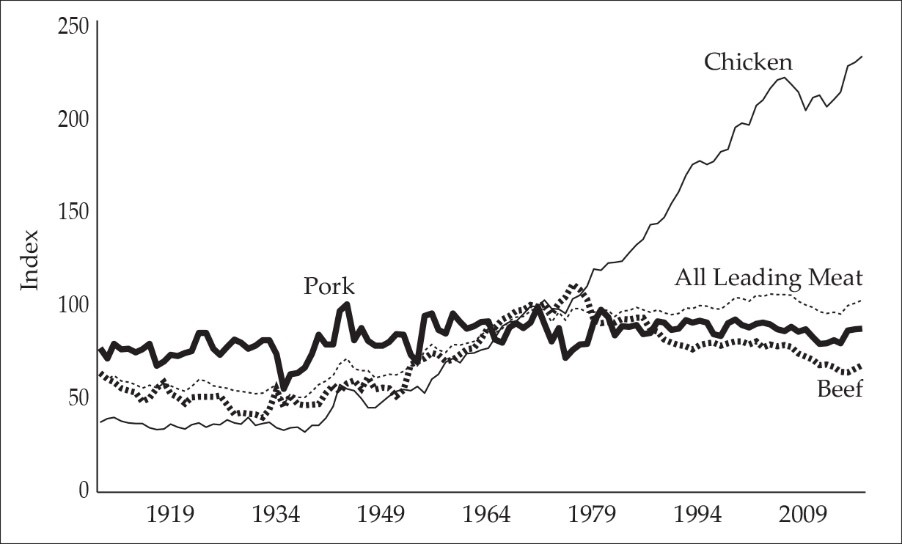
The ERS dataset for meats covers the period 1909–2019 and measures availability in pounds per capita. In 1909, there were 51.1 pounds of beef, 41.2 pounds of pork, and 10.4 pounds of chicken available per capita, for a total of 102.7 pounds of all meats per capita. In 2019 the figures were, respectively, 55.4, 48.8, and 67.0 per capita, for a total of 171.2 pounds of all meats per capita. While meat consumption had gone up, the composition of the diet had changed drastically. If we add the fact that veal and delicious lamb, minor components in 1909 at 5 and 4.4 pounds per capita, respectively, had virtually disappeared from the diet in 2019, the change becomes even more noticeable.
The following graph indexes the changing composition of meat availability over the century (1971=100). As we see, there is a steady and drastic rise in chicken availability from about the early 1950s, while the expansion of beef availability peaks in 1976 and then drops steadily back toward the 1909 level. While availability of all meats expands until about 1970, it stagnates thereafter.
If we look at changes in the relative prices of the various foodstuffs over the long run, a similar picture emerges. Beef prices have increased since the middle of the twentieth century, while other prices have fallen.
Unfortunately, poultry prices are not listed in the dataset. However, we can approximate them by looking at grain prices, as this is a main input in the raising of chicken.
I have here chosen barley and corn prices, but it does not matter much, since the trend is similar for the prices of all grains. Prices have decreased since midcentury despite some fluctuations in the seventies and are now far below the level that prevailed for decades. Beef prices, on the contrary, have trended much higher and were in 2020 about double the level in 1900 or 1850. If we consider the relative price of beef, it is much, much higher, so we should not be surprised that meat consumption has shifted to cheaper substitutes: pork and especially chicken. It is clear that a fundamental change has happened in modern food production.
Kristoffer Mousten Hansen is a research assistant at the Institute for Economic Policy at Leipzig University and a PhD candidate at the University of Angers. He is also a Mises Institute research fellow.
This tactic was quickly seen to backfire for when thoroughly analyzed the strain of anthrax used was found, egads!, to have come from US government labs. Shocking.
If the notion that, ‘truth always lies 180 degrees opposite to the direction pointed by the corporate media’ is not yet a modern maxim, it should be. A useful corollary might be added to the effect that, ‘the depth to which an event is consigned to the establishment memory hole is inversely related to its actual significance’.
Such an event is the occasion of the October, 2001 anthrax attacks in the United States, for coming close upon the heels of those of 9/11, the anthrax attacks of early October seemed to stamp with the imprimatur of destiny itself the coming of a new age, a new ‘clash of civilizations’, and, of course, a new conflictual modality, ‘The Global War on Terror’. It is ironic then that barely a decade later the entire episode should be so completely forgotten as almost never to have happened.
So what did happen?
The bald facts – as detailed by author Graeme MacQueen – are these:
From early October until November 20, some twenty-two people became infected by anthrax spores contained in letters sent through the US public mail system. Of these five died. A number of letters containing the spores were sent to several major news organizations and two were sent to the offices of US Senators Tom Daschle and Patrick Leahy.
The US Administration immediately laid blame for the attacks at the door of Al Qaeda – and, significantly, Iraq, even though the latter had in no way been implicated in the 9/11 attacks themselves.
A number of crude ‘Islamic’ propaganda letters also accompanied some of the anthrax mailings. As it turned out, these proved so crude as to convince virtually no one, but rather as to suggest blatant fraud. Even more problematic was that the ordained authorities chose early on to push the notion that the spores had physical characteristics whose provenance could only be that of Iraq.
This tactic was quickly seen to backfire for when thoroughly analyzed the strain of anthrax used was found, egads!, to have come from US government labs. Shocking.
Needless to say, the Al Qaeda / Iraq motif was quietly dropped as was the heavy curtain of amnesia over the entire wayward affair. In 2010, just by way of tying up loose ends, a government anthrax vaccine researcher, one Dr. Bruce Ivins, was, after conveniently committing suicide, judged in absentia as the ‘lone wolf’ culprit. Case closed.
Well not quite.
In 2008, following Ivins’ death and under pressure from Congress, the FBI reluctantly asked the National Academy of Sciences to review its scientific methodology in the case.
The NSA, after hurdling multiple bureaucratic and technical obstacles placed in its way by the FBI, concluded (in 2011) that, far from being airtight, the case against Ivins was, in fact, built on a foundation of sand.
Thus, not only was Ivins’ alleged ‘deception’ of authorities strongly called into question, but so was the actual physical link between Ivins’ research and the anthrax spores used in the mailings. The NSA findings received reinforcement that same year from an unexpected source.
Fact checkers at Twitter and elsewhere furiously took to their keyboards yesterday in defense of America’s Big Pharma Covid profiteers. This time, the fact checkers circled the wagons around Pfizer, which is developing an expensive drug that serves a suspiciously similar function to the cheap, time-tested, generic drug ivermectin. This time, Twitter’s approved fact checkers trafficked in deception, misinformation, and carefully worded lies, as they so often do, in order to “debunk” an article from ZeroHedge.
Let’s dissect their work.
Here is what Twitter highlighted at the top of their “fact check”:
Pfizer is not developing a version of ivermectin to treat COVID-19, according to fact-checkers and medical professionals
A new oral drug being produced by Pfizer is not a repackaged version of the antibacterial medication often used to prevent parasites in animals, according to PolitiFact, Snopes and Full Fact. While the drugs share similar functions and effects, this does not mean they are identical or interchangeable, according to fact-checkers. Pfizer’s new oral drug “is not similar to that of an animal medicine and is not the same mechanism,” according to a statement from the company.
WATCH: Check out Darren Beattie’s latest interviews
Further on down the page, Twitter deigned to tell us “What We Need to Know.” Thanks, Twitter!
What you need to know
– Pfizer told Snopes that the new drug is “designed to block the activity of the main protease enzyme that the coronavirus needs to replicate”
– Dr. Stephen Griffin, a virologist at Leeds Institute of Medical Research, told Full Fact that the two drugs “are extremely structurally different”
– Health agencies around the globe have declined to authorize ivermectin for the treatment of COVID-19, and studies on its potential use have been inconclusive, according to FactCheck.org
Here’s more from the Twitter-approved fact checkers, who we can obviously trust so much. They are overly fixated on the fact that ivermectin and the new Pfizer drug do not share the same chemical structures.
A Facebook post suggests that a new trial medication is just a rebrand of ivermectin.
But a virology expert has told us that the two drugs are completely different chemical compounds, which are “extremely structurally different.”https://t.co/pgr6L1T09V
Anyway, according to data released by Pfizer, the chemical structure of their drug looks nothing like ivermectin and it was reportedly designed from the bottom up to specifically target the coronavirus https://t.co/V17bPm061o
So, Twitter and our highly trusted “Fact Checkers” tell us that the two drugs are totally different, because they have a different chemical structure, which makes the Zero Hedge totally false, right? An open and shut case?
Not so fast. The ZeroHedge article in question never stated that ivermectin and the new Pfizer drug had a similar chemical structure. Rather, ZeroHedge argued that ivermectin and the new Pfizer drug share at least one function, or mechanism of action. See here from ZeroHedge:
Another piece US anti-Ivermectin puzzle may have emerged. On Monday, Pfizer announced that it’s launching an accelerated Phase 2/3 trial for a COVID prophylactic pill designed to ward off COVID in those may have come in contact with the disease.
Coincidentally (or not), Pfizer’s drug shares at least one mechanism of action as Ivermectin – an anti-parasitic used in humans for decades, which functions as a protease inhibitor against Covid-19, which researchers speculate “could be the biophysical basis behind its antiviral efficiency.”
Lo and behold, Pfizer’s new drug – which some have jokingly dubbed “Pfizermectin,” is described by the pharmaceutical giant as a “potent protease inhibitor.”
In other words, the Twitter Fact checkers dishonestly failed to acknowledge the central point of the article from ZeroHedge.
This was not the end of their dishonesty, however. The article from ZeroHedge was written with a tongue in cheek headline: Pfizer Launches Final Study For COVID Drug That’s Suspiciously Similar To ‘Horse Paste’. Obviously, ZeroHedge did not literally mean ‘Horse Paste,’ as ivermectin is a drug that has been prescribed to humans for over 50 years. ZeroHedge was poking fun at the media smear campaign against ivermectin as a “horse drug.”
After a crafted “horse dewormer” smear campaigns on a 35yr old safe, effective, off-label drug, i.e. Ivermectin, media brazenly started to praise unproven pills for which Pfizer & Merck are pushing EUA following that of experimental vaccines. https://t.co/fhopikcPVP
But of course, the PR flaks at Pfizer pretended to not get the joking reference, and Twitter dutifully republished their humorless statement like the good toadies they are: “Pfizer’s new oral drug “is not similar to that of an animal medicine and is not the same mechanism,” according to a statement from the company.
Wow! Thanks for clearing that up, Pfizer/Twitter!
Clearly, Big Tech and Big Pharma have our best interests at heart, and we should trust them with all of our heart, soul, and livelihood.
So, is ivermectin actually effective against COVID-19? Some initial studies have suggested it is effective at inhibiting replication of the virus, but we do not definitively know for certain. But there is one thing that we do know, and that is that Big Pharma, Dr. Fauci and Dr. Walensky will never spend a dime on any sort of large-scale study to establish whether or not this low-cost, safe, time-tested drug works. Big Pharma’s captured puppets are not looking out for the best interest of the American people and the American taxpayer. In fact, the more expensive the drug or treatment, the more they get paid.
The casual observer may by now be asking the question, why did Twitter go to the wall for Pfizer on this occasion? It makes no sense, until one realizes that Big Tech and Big Pharma are ultimately two heads of the same foul hydra—that ghastly, stinking, foul beast we’ve dubbed the Globalist American Empire. One hand washes the other, if you’ll kindly allow us to mix our metaphors. Over the course of the past few decades, power has become more and more concentrated in the same stale, rotting managerial ruling class clique that is illegitimately occupying the ruling heights of our great nation. And therein lies the very problem waiting to be solved.
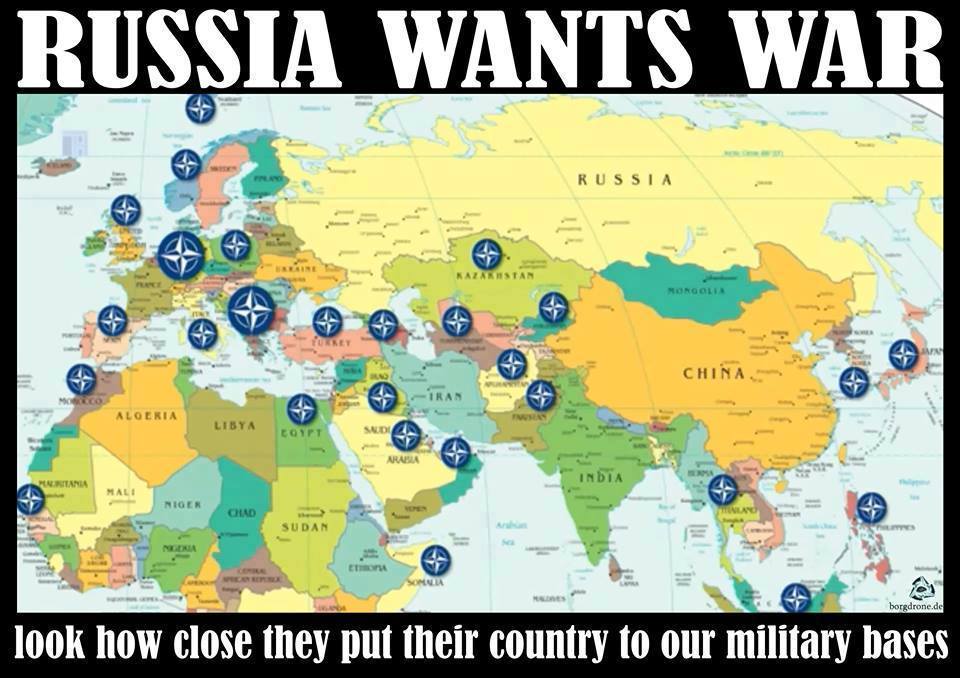
Spying activity is often driving tensions between NATO and Russia. This is the case in the Baltic right now, where US and British surveillance planes are very visibly active around the Russian exclave of Kaliningrad.
The surveillance is being conducted by RC-135W, planes that conduct electronic surveillance, surveying the electromagnetic spectrum in the area to gather intelligence.
Kaliningrad was historically Ostpreußen, a part of Germany, and before that Prussia. The Soviet Union took the land in 1946 after WW2. The exclave loomed large around the start of WW2, as the lack of a land connection between Ostpreußen and the rest of Germany was the source of a lot of tension with Poland. Germans were expelled by the Soviets, and Soviet citizens were moved in in the late 1940s.
During the Cold War, Kaliningrad was physically connected to the rest of the Soviet Union through the Baltic States, but with them now independent and in NATO, the exclave is unconnected, and often a target of NATO exercises.
From a strategic perspective Kaliningrad is used to monitor NATO operations, and Russia often threatens to deploy arms, including nuclear weapons, in Kaliningrad to counter US deployments in central Europe.
Very active surveillance, like the kind the US and Britain are conducting, would be considered a provocation if Russia was doing it, and probably will be considered provocation by Russia since it’s being done to them.
NATO is almost always needling Russia in the region, building up ever-growing numbers of troops in the Baltic states and conducting growing military exercises, centered around engagements against Russia in general and Kaliningrad in particular.



 by Tyler Durden




 The surveillance is being conducted by RC-135W, planes that conduct electronic surveillance, surveying the electromagnetic spectrum in the area to gather intelligence.