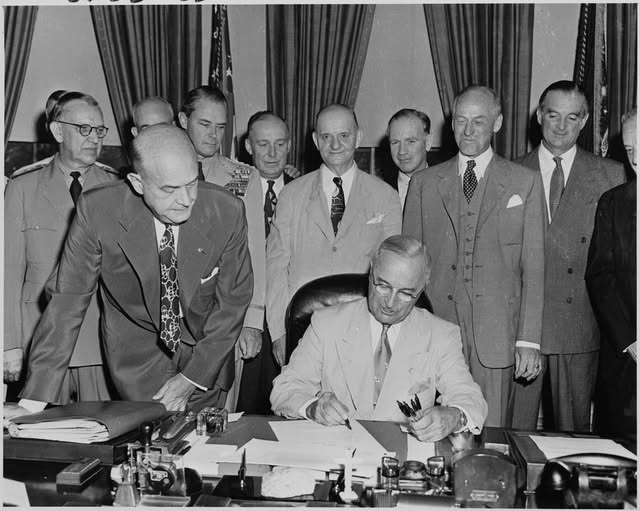
On this day, July 26th, 1947, the National Security Act spawned the CIA, DoD, and more, centralizing power for the Cold War. This birthed the surveillance state—everything from the NSA to mass surveillance.
The Libertarian Party of Pennsylvania demands their end—decentralize power, protect liberty, and stop the spying.
Equally important, the Cold War brought ever-increasing taxpayer-funded largess flowing into the coffers of the “defense” industry, along with the ever-increasing power and influence of the Pentagon, the CIA, and the NSA within the overall federal structure.
After the Cuban Missile Crisis, Kennedy achieved a breakthrough, one that threatened not only the ever-increasing power, money, and influence of the national-security branch, but also its very existence. Kennedy came to realize that the Cold War was just one great big racket — and a highly dangerous one at that.
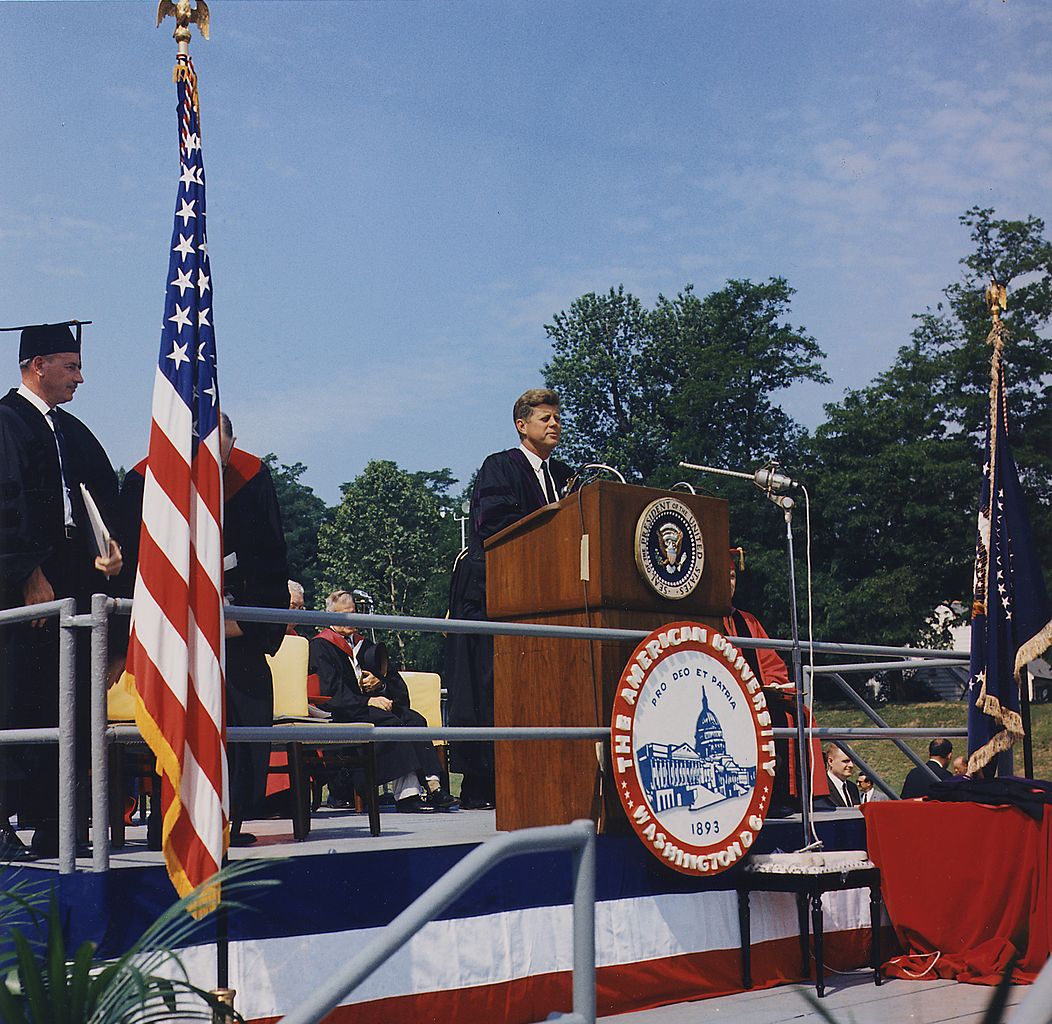
While the decision to eliminate President Kennedy undoubtedly took place after his resolution of the Cuban Missile Crisis, it was without a doubt solidified when Kennedy ambushed his enemies within the U.S. national-security establishment with his Peace Speech at American University on June 10, 1963. With his Peace Speech, JFK was upsetting the Cold War apple cart that the Pentagon and the CIA were convinced would last forever.
What was so significant about that speech?
After the end of World War II, the U.S. government was converted from its founding system of a limited-government republic to a governmental structure called a national-security state. The justification for this radical change, which was accomplished without even the semblance of a constitutional amendment, was that the United States now faced an enemy that was said to be even more threatening than Nazi Germany. That new enemy was “godless communism” as well as a supposed international communist conspiracy to take over the United States and the rest of the world — a conspiracy that was supposedly based in Moscow, Russia — yes, that Russia!
With the conversion to a national-security state, the U.S. government acquired many of the same totalitarian powers that were being wielded by the totalitarian communist states, such as the Soviet Union and Red China — powers that had been prohibited when the government was a limited-government republic. Such powers included state-sponsored assassinations, torture, kidnapping, indefinite detention, and coups.
Equally important, the Cold War brought ever-increasing taxpayer-funded largess flowing into the coffers of the “defense” industry, along with the ever-increasing power and influence of the Pentagon, the CIA, and the NSA within the overall federal structure. Over time, the national-security branch of the federal government would become the most powerful branch, the one to which the other three would inevitably defer.
After the Cuban Missile Crisis, Kennedy achieved a breakthrough, one that threatened not only the ever-increasing power, money, and influence of the national-security branch, but also its very existence. Kennedy came to realize that the Cold War was just one great big racket — and a highly dangerous one at that.
That danger was manifested during the Cuban Missile Crisis. U.S. officials and their loyalists in the mainstream press have always maintained that the crisis was brought on by the Soviet Union and Cuba. Not so! It was brought on by the Pentagon and the CIA. It was those two entities that brought the world to within an inch of all-out nuclear war.
The Soviets and the Cubans knew that the Pentagon and the CIA wanted to invade Cuba and effect a regime-change operation there, one that would oust Cuban leader Fidel Castro from power and replace him with another pro-U.S. dictator, similar to Fulgencio Batista, the corrupt pro-U.S. brute that ruled Cuba before the revolutionaries ousted him in 1959.
That was why the Soviets installed those nuclear missiles in Cuba — to deter U.S. officials from attacking or, if deterrence failed, to enable Soviet and Cuban forces to defend themselves from a U.S. attack.
“It is time to acknowledge that the U.S. military presence in Africa is a failure, bring our troops home, and replace violence with diplomacy and commerce. It is the right thing for America and the best thing for Africa.“
Pretty soon the government will run out of places on the OTHER side of the planet for proxy wars.
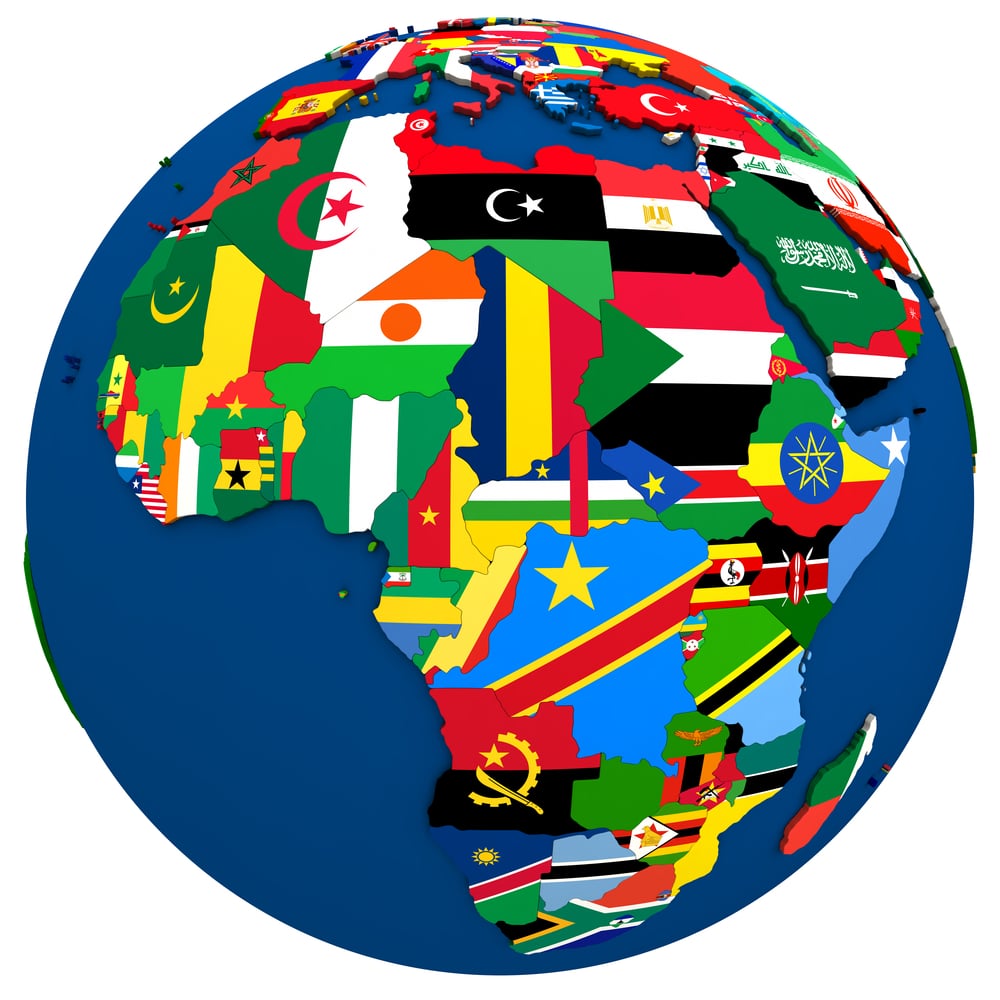
Political map of Africa with each country represented by its national flag.
On October 26, Senator Rand Paul (R-KY) forced a debate and vote on the U.S. military presence in Niger. The Senate overwhelmingly voted to keep our troops in that troubled country. There has been an increased focus on Africa due to widespread instability and a contest between superpowers for the continent. The presence of U.S. troops puts Americans in danger while failing to solve any of Africa’s problems.
During the Cold War era, the United States mostly relied on “soft power” in Africa, but U.S. military presence has continued to increase over the past 30 years. It is time to acknowledge that the U.S. military presence in Africa is a failure, bring our troops home, and replace violence with diplomacy and commerce. It is the right thing for America and the best thing for Africa.
When U.S. troops were first permanently deployed to Africa following 9/11 there were no known transnational terrorist organizations on the continent. The United States got a better excuse for its presence after the Islamic Courts Union took control of Somalia in 2006. The ICU were then expelled by an Ethiopian-led invasion, leaving in their wake an offshoot known as Al-Shabab which later pledged allegiance to Al Qaeda. Following the Ethiopian invasion, the United Nations authorized the African Union Mission in Somalia [ANISOM] which the United States has supported since it began in 2007 with a large air and ground presence.
Radical Islamic terrorism did not spread across Africa in earnest until the 2010s, when it was greatly spurred by U.S. and NATO actions across North Africa and the Middle East. Most notably, when a NATO coalition overthrew Libya’s longtime leader Gadaffi in 2011 fighters he had been employing looted his armory and returned to their home countries, restarting dormant rebellions.
What would have happened if Kennedy had lived? The national-security establishment would have immediately become irrelevant and immaterial. They would have been left twiddling their thumbs, with nothing to do. Remember, after all, that the supposed threat from the Russian Reds was why the federal government was converted to a national-security state in the first place. Peaceful coexistence with the communist world would have meant no more justification for a national-security state. The Pentagon, the CIA, and the NSA would have been dismantled and America’s founding system of a limited-government republic would have been restored.
Three days ago — June 10 — was the 60th anniversary of President Kennedy’s Peace Speech at American University. Reading or listening to the speech today, it is not difficult to see why the U.S. national-security establishment deemed Kennedy to be a grave threat to national security, just as it did with certain foreign leaders, such as Prime Minister Mohammad Mossadegh of Iran, Congo leader Patrice Lumumba, Guatemalan President Jacobo Arbenz and, later, President Salvador Allende of Chile.
For some 150 years, the federal government had been a limited-government republic. After World War II, however, the federal government was converted to a national-security state.
The difference was day and night.
With a limited-government republic, there was openness and transparency in governmental operations. Moreover, there was only a relatively small, basic military force. No Pentagon, no vast military-industrial complex, no CIA, no NSA, and no empire of foreign military bases. Governmental powers were limited and tightly constrained. No power to assassinate, kidnap, torture, or indefinitely detain people. No power to initiate coups or regime-change operations in foreign countries. No power of mass secret surveillance.
With a national-security state, dark-side secrecy became everything. “National security” became the two most important words in the American political lexicon. A large, permanent military establishment, along with the CIA and the NSA, came into existence. This vast national-security establishment vested itself with omnipotent, totalitarian-like powers, including assassination, torture, coups, secret surveillance, kidnapping, and indefinite detention. It established a vast empire of military bases, both foreign and domestic, and initiated a program of regime change in foreign nations. Foreign wars in faraway lands, such as Korea and Vietnam, became the norm.
The Cold War was actually one great big racket, one that became a cash cow for the vast military-intelligence complex and its ever-growing army of “defense” contractors who loved feeding at the public trough. This enormous racket was justified under the rubric of keeping America safe from a supposed vast communist conspiracy that supposedly was based in Moscow, Russia. Yes, that Russia!
There was no possibility whatsoever of a peaceful resolution of the forever war between the United States and Russia, U.S. oficials said. There could never be peaceful coexistence, they maintained. The war against the Russian Reds, U.S. national-security officials held, was a war to the death. That was why the Joint Chiefs of Staff recommended to Kennedy that the United States initiate a surprise nuclear attack against the Russians, a recommendation that Kennedy indignantly rejected.
Having achieved a “breakthrough” after the Cuban Missile Crisis, Kennedy had decided that he was going to lead America in an entirely different direction from that of the national-security establishment. In his Peace Speech, Kennedy threw down the gauntlet against what had now become his enemy — the national-security establishment. Kennedy essentially declared an end to the Cold War racket and announced that henceforth Russia and the United States would live in peaceful coexistence. He declared an end to to the extreme anti-Russia hostility that the national-security establishment had inculcated in the American people, and he even praised the Soviet Union.
The very next night — June 11 — Kennedy delivered a nation-wide speech expressing support for the civil-rights movement, which the national-security establishment was convinced was controlled by the Russian Reds. That’s why the FBI wiretapped Martin Luther King and used blackmail with the aim of inducing him to commit suicide.
A large part of the international division of labor was abolished during the twentieth century by war, socialism, and the Cold War. Nothing destroys the benefits of the division of labor more than war. Americans are always isolated from those whom they are waging war with, giving the lie to the standard neocon line that the advocates of peace are “isolationists.” Nothing—nothing—isolates us from other parts of the world than war.
[This article is adapted from a lecture delivered at the Reno Mises Circle in Reno, Nevada. on May 20, 2023.]
It is not an exaggeration to say that property rights are a prerequisite for civilization. As Ludwig von Mises wrote in The Free and Prosperous Commonwealth:
Private property creates for the individual a sphere in which he is free of the state. It sets limits to the operation of the authoritarian will. It allows other forces to arise side by side with and in opposition to political power. It thus becomes the basis of all those activities that are free from violent interference on the part of the state. It is the soil in which the seeds of freedom are nurtured and in which the autonomy of the individual and ultimately all intellectual and material progress is rooted (emphasis added).
The story of the Pilgrims shows that America was literally created because of the recognition of this truth. In 1607 all but 38 of the original Jamestown, Virginia settlers were dead from famine. An additional 500 came and 440 died. This was known as the “starving time.” Sir Thomas Dale, the high marshal of the Virginia colony, recognize the problem to be what we would today call agricultural socialism. The residents of the colony worked the fields and shops and everything was put into a common store. Each family was given an equal allotment. Thus, the man who worked diligently fourteen hours a day was paid the same as the man who decided to work not at all.
Sir Thomas Dale gave each man three acres of private land to homestead, which was soon expanded to 50 acres. It made all the difference, as people realized that the harder, smarter, and longer they worked, they more they and their families would prosper.
The exact same scenario played out years later in Plymouth, Massachusetts where half of the original pilgrims died. The wife of William Bradford, the leader of the Mayflower expedition, committed suicide by jumping off the Mayflower because of all the death surrounding her. Her husband, like Sir Thomas Dale, finally figured out the problem—the absence of private property and secure property rights. Homesteading of private property was established, and the American colonists began to thrive.
Homesteading combined with secure property rights and almost no government intervention resulted in each region of the colonies excelling by relying on their comparative advantages. New England excelled in shipping, fishing, and primitive manufacturing, while the Southern colonies became agricultural powerhouses. The American economy in 1775 was 100 times larger than it was in the 1630s and the American colonists had one of the highest per capita incomes in the world.
The American Revolution was a war of secession from the corrupt mercantilism of the British empire characterized by cronyism, protectionism, military imperialism, and central banking in the form of the Bank of England. Citizens of empires are viewed by their rulers as mere tax slaves and cannon fodder at the disposal of the state, and the American colonists had had enough of it.
The Department of Energy uses words such as “remediation,” “decommission,” and “deactivation” to describe what’s going on in the tiny Appalachian town of Piketon, Ohio—the home of a facility that was used to enrich uranium for nuclear bombs during the Cold War.
But Piketon residents say that the DOE is actively poisoning them. That’s because the DOE is conducting open-air demolitions of buildings tainted with enriched uranium, plutonium and other radioactive material, according to the residents.
Vina Colley, the president of Portsmouth/Piketon Residents for Environmental Safety, or PRESS, shared a letter with Headline USA that she wrote to President Joe Biden about the matter.
“Mr. President, while the world celebrates Earth Day this April, we in southern Ohio are struggling with fear and living with a deadly and invisible threat to our families and our lives. The plant is scheduled for open-air demolition, posing inevitable and undeniably hazardous consequences to our community,” Colley told Biden in her April 7 letter.
“In addition, while the Knolls Atomic Power Laboratory received a negative pressure tent and enclosed demolition, those in charge here are charging recklessly ahead with an open-air demolition of the Piketon plant, where plutonium has been proved to pass through the plant since 1955.”
The DOE, for its part, disagrees with Colley’s claims. The department did not respond to Headline USA questions about the matter, but its website color-codes the Piketon facility “green”—a marker for supposed environmental safety.
However, other people who lived and worked at Piketon’s Portsmouth Gaseous Diffusion Plant, or PORTS, agree with Colley—including Jeff Walburn, Charles Lawson, Dr. David Manuta and Dr. Michael Ketterer. Walburn and Lawson have investigated the matter for years—Lawson also recently discovered nuclear contamination in his house miles away from the Piketon facility—and Manuta was a former chief scientist there.
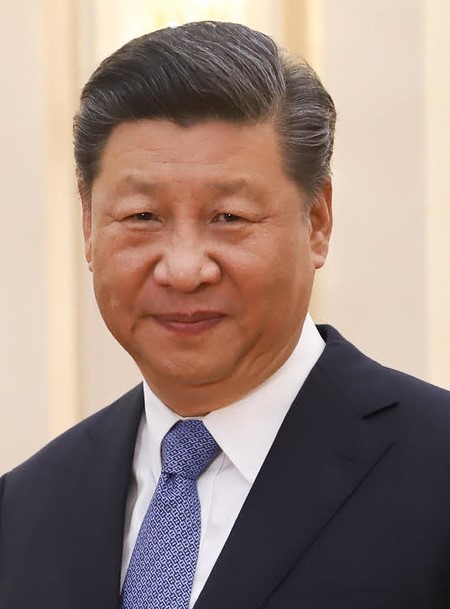
Chinese leader Xi Jinping has issued a direct critique against the U.S. government’s policy of containment when it comes to China. According to an article in the Wall Street Journal, the critique is unusual in that it comes directly from China’s leader rather than indirectly through governmental spokespersons.
The Journal article quotes Shirley Martey Hargis, fellow at the Washington think tank Atlantic Council, who suggests that Xi might just be shifting the blame for economic problems in China. “It’s either take the blame or shift it,” she said.
Notwithstanding China’s economic problems, however, the fact is that Xi is right. There is no denying that U.S. national-security establishment, led by the Pentagon and the CIA, have been pursuing a Cold War policy of containment against China, with the aim of renewing its old Cold War racket.
Of course, as the Russians will attest, the Pentagon and the CIA have been doing the same with them — doing everything they can to gin up their old Cold War racket against Russia, just as they are doing against China.
Take a look at this map. You might be shocked, or maybe not. It displays the number of U.S. military bases near China. Tom Orsag, a freelance leftist journalist, points out that “China is effectively encircled by US bases all across the Pacific.” Orsag adds, “The U.S. is the biggest bully in the Pacific, with rings of military bases blocking and threatening China.”
Now, take a look at this map. It depicts the number of Chinese military bases near the United States. Number? Zero! In fact, according to an article at Eurasia Times entitled “Over 750 Military Bases Across 80 Countries: How US Military Overshadows China In Projecting Power Overseas,” China has the grand total of one foreign military base — in Djibouti, which is more than 7,000 miles away from the United States.
Take a look at this map. It shows the number of U.S. military bases near both Russia and China.
By no means should Anton be taken as a supporter of the policies of Vladimir Putin, and those who in response urge the defects of the Russian dictator have not grasped the key point of Anton’s argument. We no longer face the bleak prospect of being “Red or Dead,” if indeed we ever did, and nothing less than this could justify pushing Russia to the nuclear brink.
In last week’s column, I discussed Christophers Coyne’s excellent book In Search of Monsters toDestroy, a cogent account of America’s endeavor to build a “liberal” informal empire. Coyne shows the inherent contradiction of using brutal means to achieve humane values. This week, I’d like to discuss an even more deplorable part of American foreign policy, one which threatens the world with destruction. During the Cold War, the United States risked nuclear war with the Soviet Union; and though the Cold War ended long ago, American support for Ukraine in its war with Russia again risks atomic war. The dangers inherent in American policy have been discussed by Michael Anton, whom readers will recall from previous columns, in his thoughtful article “Nuclear Autumn,” which appeared in the fall 2022 Claremont Review of Books, and I’m going to focus my comments on his remarks.
Anton’s argument is in essence this: The United States came close several times during the Cold War to nuclear war with the Soviet Union, and this would have had appalling consequences. Nevertheless, the danger of losing the world struggle to communism made this risky policy at least arguably rational, at least until 1983, after which the Cold War lessened in intensity. In present circumstances, though, matters are entirely different. Russia, unlike Soviet communism, poses no threat to the United States, yet America’s nuclear policy is more reckless than ever before. Given the consequences of nuclear war, we ought to adopt a less interventionist Ukrainian policy.
As you would anticipate, I agree with the latter part of Anton’s analysis, but the former seems questionable. Anton says,
Conservative conventional wisdom soon hardened around this interpretation, where it has remained ever since: Reagan’s initial toughness was a necessary corrective to Carter’s fecklessness and Nixon’s détente, put the Soviets on their back foot, and forced them back to the table, resetting the stage for a Western victory. Nineteen eighty-three came to be seen as a kind of mirror-image of 1938, teaching the same lesson: appeasement begets war, toughness brings peace—or better yet, victory.
There is no doubt something to this, but even on its own terms, this rendering skips over important elements. The first is that the stakes matter. And the stakes in the Cold War were the very highest: the survival of the free world and maybe even the existence of the whole world. By 1980, it was plausible to fear that freedom and even humanity were losing. It was therefore not unreasonable to believe that calculated risks were warranted.
But you never know where toughness might lead, what it might provoke. When the consequences of toughness could be total destruction, it is rational—moral, even—to be tough only when the stakes are equally enormous. Toughness not in the service of a core interest—or the core of all core interests—is not merely foolish but reckless.
The apostles of nuclear brinkmanship said that the survival of the free world was at stake during the Cold War, but though they were no doubt right that the horrors of living under the gulag were worth fighting to prevent, it is not evident that the nations of the “West,” to use the Cold War argot, faced this threat. The Soviet Union had a relatively poor economy and had enough trouble keeping the Warsaw Pact nations in line without pursuing Western expansion in serious fashion. The Cold Warriors would have done better to heed the lessons of Ludwig von Mises’s calculation argument: so long as the Soviets continued their efforts at central planning, their economy was bound to collapse.
Outside the US, UK and Europe, the war in Ukraine looks more complicated than it does in the US. And many of those countries want to reserve the right to remain nonaligned and want to push for a diplomatic solution to the war. It is not true that the US does not ask those countries to choose sides, that it does “not ask any nation to choose between the United States or any other partner.”
In his September 21 address to the United Nations General Assembly, President Biden said “We do not seek a Cold War. We do not ask any nation to choose between the United States or any other partner.”
It took a lot of courage to make that claim.
On October 5, OPEC+ announced that they were cutting oil production by two million barrels a day. That represents a 2% reduction of the daily global supply, larger than expected and the biggest cut in over two years.
That cut in oil production comes despite Biden’s plea to Saudi Arabia to increase oil production to offset rising prices caused by Russian sanctions and, crucially, boost the efficacy of sanctions on Russia. Biden offered Saudi Arabia an expanded “strategic partnership,” a “commitment to supporting Saudi Arabia’s security and territorial defense,” and a further commitment to uphold Saudi Arabia as the dominant power in the region.
Biden welcomed the pariah kingdom back into the world community in a trade for siding with the US by increasing oil production. He got rejected. And that is when the White House proved that they do ask nations to choose sides: “It’s clear that OPEC+ is aligning with Russia with today’s announcement,” announced White House press secretary Karine Jean-Pierre.
And there is a penalty for not being on America’s side. Several members of congress have called for the US to respond by putting an end to all US military aid to Saudi Arabia. Senator Bob Mendez, the chair of the Senate Foreign Relations Committee, promised that, because of Saudi Arabia’s “decision to help underwrite Putin’s war,” he “will not green-light any cooperation with Riyadh until the kingdom reassesses its position with respect to the war in Ukraine.” Legislation has been introduced to remove US troops and missile systems from Saudi Arabia and to stop all arms sales to Saudi Arabia. The price that Saudi Arabia will pay is not for its decision’s effect on oil markets or anything other than choosing sides: the military relationship could be restarted if Saudi Arabia “reconsiders its embrace of Putin,” said Senator Richard Blumental and Representative Ro Khanna, describing the legislation they have proposed.
The experience of Saudi Arabia is not an isolated example that refutes Biden’s claim that the US does not ask countries to choose sides.




 MCViewPoint