MCViewPoint

Opinion from a Libertarian ViewPoint

Posts Tagged ‘Conservatives’

Pat Buchanan Was Right…And Young Conservatives Agree!

Posted by M. C. on November 8, 2024

Are things a’changing?

by Daniel McAdams

Well not quite total. It turns out there was another writer who, like Buchanan and Sobran, was fiercely independent and came to embrace the conservatism of old – some call it paleo-conservatism but it should just be conservatism. I am referring to my former mentor, the late Robert Novak, whose half century career in media had come to define not only modern conservatism but the evolution of a young liberal “mugged by reality,” as neocon godfather Irving Kristol put it.

https://ronpaulinstitute.org/pat-buchanan-was-right-and-young-conservatives-agree/
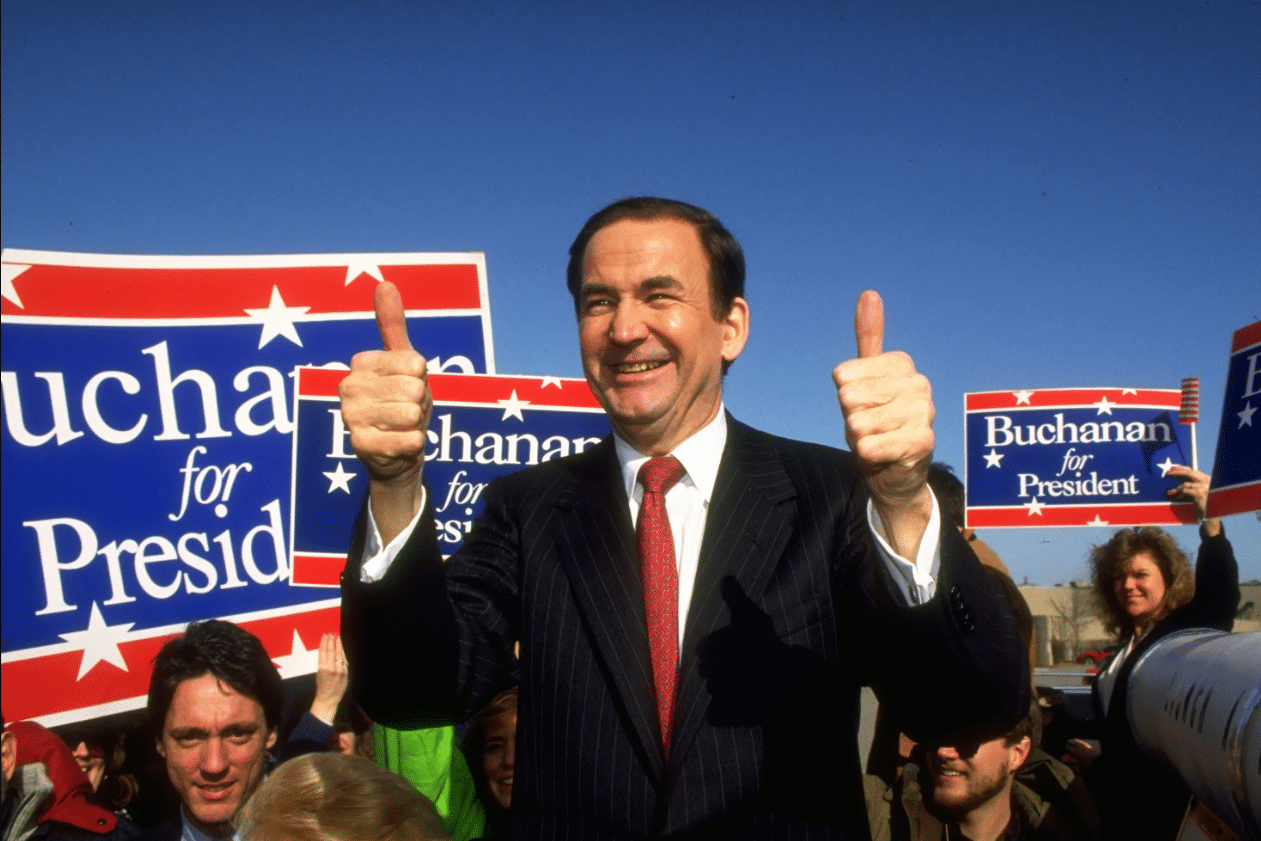
As we arrive at today’s election, there is good news in the US conservative movement regardless of who wins. While the old guard – mostly “boomers” – who still cling to the levers of power continue to mouth the tired old shibboleths (“peace through strength,” “rules based order,” “our greatest ally“), a new generation of young conservatives has emerged that is revitalizing the Old Right view that the focus of conservatism should be to conserve what is actually great about the United States.

First and foremost is the idea, espoused by our first president George Washington, that the United States can only prosper if it is capable of jettisoning “passionate attachments” to any foreign country and embrace, as outlined by John Quincy Adams, the view that America…

…goes not abroad, in search of monsters to destroy. She is the well-wisher to the freedom and independence of all. She is the champion and vindicator only of her own. 

To this point, the focus in the mainstream media and among “boomer” and Beltway neocon Republicans has been that the opposition to US backstopping the Israeli destruction of Gaza is made up of radical, Marxist, Hamas-loving dupes. As I decry in my recent speech to the “Rage Against the War Machine” rally at the Washington Memorial in DC, there has been a notable absence among my fellow “pro-life” and right wing Americans to speak out against the snuffing out of perhaps 200,000 innocent civilian lives – many of them Christian – in Gaza and Lebanon.

I chalked some of that hesitation up to the fear of being labeled “anti-Jewish,” while at the same time I pointed out that a significant proportion of the US university campus protests against the Israeli slaughter in Palestine and Lebanon are led by Jewish students. Likewise, Jewish intellectuals in the US constitute a significant and powerful voice against the policies of the Israeli government and in opposition to the US “special relationship” with that country.

Whatever the case, a younger generation on the Right is getting it. And they are threatening the establishment in ways that should warm all of our conservative hearts. Take for example a new poll by the progressive “Data for Progress” outlet. Among the usual fluff about progressive attitudes toward Kamala etc., a fascinating metric was reported:

In our survey of voters aged 18-29, we find that young voters support imposing an arms embargo on Israel by a +26-point margin.https://t.co/zHxVe4yW9i pic.twitter.com/fmrKiBizRV— Data for Progress (@DataProgress) October 23, 2024

By a solid 52 percent majority, Republicans aged 18-24 support a US arms embargo against Israel over their massive slaughter of civilians in Gaza and Lebanon.

See the rest here

Be seeing you

Posted in Uncategorized | Tagged: , , , | Leave a Comment »

Questions That Only Libertarians Are Asking

Posted by M. C. on October 26, 2024

by Laurence M. Vance

It is only libertarians who are asking these questions and getting to the real issues. It is only libertarians because libertarianism is based on the timeless principles of individual liberty, economic freedom, private property, and a government limited to the protection of these things. Libertarians don’t just hold to these principles when it is expedient or popular to do so. This is what sets them apart from the proponents of every other political philosophy.

Although on the surface, Democrats, liberals, socialists, and progressives seem to be ideological opposites of Republicans, conservatives, nationalists, and constitutionalists, and although both groups are often contrasted with moderates, populists, centrists, and independents, in reality, every one of these groups has something in common: their opposition to libertarianism.

Libertarianism

Libertarianism is the philosophy that says people should be free from individual, societal, or government interference to live their lives any way they desire, pursue their own happiness, accumulate wealth, assess their own risks, make their own choices, participate in any economic activity for their profit, engage in commerce with anyone who is willing to reciprocate, and spend the fruits of their labor as they see fit — as long as their actions are peaceful, their associations are voluntary, their interactions are consensual, and they don’t violate the personal or property rights of others.

Libertarians maintain that as long as people don’t infringe upon the liberty of others by committing, or threatening to commit, acts of fraud, theft, aggression, or violence against their person or property, the government should leave them alone and not interfere with their pursuit of happiness, commerce, personal decisions, economic enterprises, or what they do with their body or on their property.

Libertarians thus believe that —

Individuals, not society or the government, should be the ones to decide what risks they are willing to take and hat behaviors they want to practice.

Everyone should be free to pursue happiness in his own way — even if his choices are deemed by others to be harmful, unhealthy, unsafe, immoral, unwise, stupid, destructive, or irresponsible.

Every crime needs a tangible and identifiable victim who has suffered measurable harm to his person or measurable damages to his property.

Markets should be completely free of government regulation, licensing, restriction, and interference.

No industry or individual should ever receive government grants, subsidies, loans, or bailouts.

The functions of government should be limited to prosecuting and exacting restitution from those individuals who initiate violence against, commit fraud against, or violate the property rights of others.

Contrary to Democrats, liberals, socialists, progressives, Republicans, conservatives, nationalists, constitutionalists, moderates, populists, centrists, and independents — who all may claim to believe some of these things — libertarians believe these things consistently and without exception.

The issues

Be seeing you

Be seeing you

Posted in Uncategorized | Tagged: , , , , , , , , , , , , , | Leave a Comment »

The Case for Libertarian Internationalism

Posted by M. C. on April 19, 2024

Since when does not supporting an aggressive, belligerent, interventionist, and meddling foreign policy mean that you are an isolationist?

Libertarians believe in internationalism just like conservatives claim they do. But their idea of internationalism is quite different.

Libertarianism internationalism favors peace and friendship with all nations. No sanctions and embargoes should be imposed against any country.

by Laurence M. Vance

Libertarians and conservatives share a common enemy. Whether it is described as liberalism, progressivism, collectivism, or socialism; whether its adherents term themselves liberals, progressives, Democrats, or democratic socialists — the agenda is the same: paternalism, universal health care, free college tuition, more gun-control laws, social justice, green energy, environmentalism, climate-change alarmism, affirmative action, government-mandated family leave, government-funded child care, more antidiscrimination laws, privileges for organized labor, an ever-increasing minimum wage, increased taxes on “the rich,” easier access to welfare with fewer work requirements, and abortion on demand (at taxpayer expense for low-income women). The result of all of these things is a larger and more intrusive government and increased government regulation of the economy and intervention in society.Conservative internationalism is just a smokescreen for an interventionist foreign policy with all the trimmings.
[Click to Tweet]

Conservatism 

Although libertarians and conservatives may share a common enemy, this does not mean that the two groups are ideological cousins — no matter what President Ronald Reagan (1911–2004) thought. In a 1975 Reason magazine interview, Reagan said: “If you analyze it I believe the very heart and soul of conservatism is libertarianism…. The basis of conservatism is a desire for less government interference or less centralized authority or more individual freedom and this is a pretty general description also of what libertarianism is.” The reality, of course, is that conservatism desires less government interference, less centralized authority, and more individual freedom in just certain areas, only on select issues, and concerning just some subjects. Conservatives are big on reforming government programs or replacing them with other government programs instead of repealing them lock, stock, and barrel. Just because there is some overlap in the desires of conservatives and libertarians and in the progressive policies that they oppose doesn’t mean that conservatism and libertarianism are two sides of the same coin.

The other problem with conservatives is that they often say the same things as libertarians but with a somewhat or entirely different meaning. Consider the conservative mantra of fidelity to the Constitution, federalism, limited government, private property, less government, lower taxes, less regulations, individual freedom, fiscal conservatism, traditional values, the free market, free enterprise, and a strong national defense.

Libertarians certainly believe that the federal government should actually follow its own Constitution and the federal system of government put in place by the Founders. Limiting the government, lowering taxes, and reducing regulations are music to the ears of libertarians. Individual freedom and private property are the twin pillars of libertarianism. There is nothing inherent in libertarianism that is in opposition to fiscal conservatism or traditional values. Free enterprise and the free market is the cry of every libertarian. And libertarians undoubtedly believe in the legitimacy of defense against aggression.

But regardless of how many times they recite their mantra, conservatives don’t follow the Constitution in many areas. They believe in federalism except when they don’t. The only limited government they seek is a government limited to control by conservatives. They don’t accept the freedom of individuals to do anything that’s peaceful. They don’t believe in the inviolability of private property. They think traditional values should be legislated by government. Fiscal conservatives they are not. They don’t yearn for free enterprise and a free market in everything. And conservatives confound national defense with national offense.

The conservative mantra is simply a ruse to persuade grass-roots conservatives to continue to vote Republican in order to keep those evil Democrats out of office.

Conservative internationalism

See the rest here

Be seeing you

Posted in Uncategorized | Tagged: , , , , , | Leave a Comment »

The Case for Paleolibertarianism

Posted by M. C. on November 13, 2022

Since the role of the State schools is-as one official put it-to “mold these little plastic lumps on the social kneading board”-then a key part of the State agenda must be subverting the family. Libertarians, on the other hand, should cherish and support it.

Like all bureaucrats, police, prosecutors, and judges have no incentive to respond to consumer demand, in this case would-be consumers of protection against crime or justice against criminals. There is no consumer sovereignty when the State has a monopoly of fighting crime, and when the only crimes it treats seriously are those against itself: counterfeiting, tax evasion, etc

https://rothbardrockwellreport.substack.com/p/the-case-for-paleolibertarianism?r=iw8dv&utm_medium=android

The following was an article by Lew Rockwell, first published in Liberty Magazine in January 1990. Published prior to the first edition of the Rothbard-Rockwell Report.

This marked the beginning of the paleolibertarian movement.

“The conservative crack-up is near,” writes Charles Krauthammer. As Communism unravels, so does … the conservative alliance.” Indeed, old-fashioned conservatives (paleoconservatives) are splitting with statist neoconservatives.

Patrick J. Buchanan argues that America should “come home”: we are not “the world’s policeman nor its political tutor.” Ben Wattenberg, a neocon advocate of what Clare Boothe Luce called globaloney, denounces Buchanan as a “Neanderthal.” Joseph Sobran then notes that democracy is not a good in itself, but only in so far as it restricts State power. Jeanne Kirkpatrick-a former Humphrey Democrat like most of the neocons-says none of these intellectual arguments mean anything because the neocons hold State power and don’t intend to let go.

Despite Kirkpatrick, these intra-Right arguments are extremely significant, and more than foreign policy is involved. As the U.S.S.R. is revealed as a paper bear, good conservatives are returning to their Old Right roots in other areas as well.

Conservatives are questioning not only foreign intervention, but the entire New Deal-Great Society-Kinder Gentler apparatus. This worries the neocons even more, since-like their Svengali Irving Kristol-they give at most “two cheers for capitalism” but a full three cheers for the “conservative welfare state.”

This conservative crack-up presents an historic opportunity for the libertarian movement. The Cold War ruptured the Right; now the healing can begin, for Lord Acton’s axiom that “liberty is the highest political end of man” is at the heart not only of libertarianism but of the old conservatism as well. Many issues separate good conservatives from good libertarians, but their number is lessening and none of them is so broad as to prevent intelligent, exchange, and cooperation.

There have been more than ideological disputes, however; culture has also separated us, and there is no more powerful unifier or divider. So divisive has it been in this case that good libertarians and good conservatives have forgotten how to talk to each other.

For the sake of our common ideals we should restore the old concord. But can we? In my view, not until libertarianism is deloused.

The Conservatives Are Right: Freedom Isn’t Enough

Conservatives have always argued that political freedom is a necessary but not sufficient condition for the good society, and they’re right. Neither is it sufficient for the free society. We also need social institutions and standards that encourage public virtue, and protect the individual from the State.

Unfortunately, many libertarians – especially those in the Libertarian Party – see freedom as necessary and sufficient for all purposes. Worse, they equate freedom from State oppression with freedom from cultural norms, religion, bourgeois morality, and social authority.

In its 17-year history, the LP may never have gotten 1% in a national election, but it has smeared the most glorious political idea in human history with libertine muck. For the sake of that glorious idea, it’s time to get out the scrub brushes. Most Americans agree that aggression against the innocent and their property is wrong. Although these millions are potential libertarians, they are put off by the Woodstockian flavor of the movement. Hair may have left Broadway long ago, but the Age of Aquarius survives in the LP.

The cultural anti-norms that mark the libertarian image are abhorrent; they have nothing to do with libertarianism per se; and they are deadly baggage. Unless we dump that baggage, we will miss the greatest opportunity in decades.

Americans reject the national Democratic Party because they see it as disdaining bourgeois values. If they have ever heard of the LP, they rebuff it for similar reasons.

The Libertarian Party is probably irreformable-and irrelevant even if it weren’t. Libertarianism is neither. But unless we cleanse libertarianism of its cultural image, our movement will fail as miserably as the LP has. We will continue to be seen as a sect that “resists authority” and not just statism, that endorses the behaviors it would legalize, and that rejects the standards of Western civilization.

Arguments against the drug war, no matter how intellectually compelling, are undermined when they come from the party of the stoned. When the LP nominates a prostitute for lieutenant governor of California and she becomes a much-admired LP celebrity, how can regular Americans help but think that libertarianism is hostile to social norms, or that legalization of such acts as prostitution means moral approval? There. could be no more politically suicidal or morally fallacious connection, but the LP has forged it.

With their counter-cultural beliefs, many libertarians have avoided issues of increasing importance to middle-class Americans, such as civil rights, crime, and environmentalism.

The only way to sever libertarianism’s link with libertinism is with a cleansing debate. I want to start that debate, and on the proper grounds. As G.K. Chesterton said, “We agree about the evil; it is about the good that we should tear each others eyes out.”

See the rest here

Be seeing you

Posted in Uncategorized | Tagged: , , | Leave a Comment »

Liberalism, True and False

Posted by M. C. on October 20, 2022

What else are we to think when a president of the United States says that his selection for a new appointment to the U.S. Supreme Court had to be a “black woman,” but when that nominee was asked during the Senate confirmation hearings if she could define a “woman,” she declined, saying that she was not a biologist. So, a “black woman” accepts being nominated for the highest court of the land, but she cannot explain what makes her eligible for that appointment under the declared criteria.

So, to give our own answer to Elliot Dodds’ question, “Is liberalism dead?” Not for as long as there are any who cherish the liberty and autonomy of every human being, along with their own freedom.

by Richard M. Ebeling

The death of liberalism has been hailed or feared for well over a century now. In the United States, the tribal collectivists of identity politics and critical race theory insist that America has never been about freedom. It has always been a racist society born with the institution of slavery. The idea of liberal individualism is a ruse to hide the oppression and exploitation of women and “people of color” by capitalist white males.There was an underlying humility in the older classical liberalism that assumed that each person could better find his own way than to presume that political paternalists could make better decisions for them.
[Click to Tweet]

Among conservatives, liberalism is rejected for not fostering a proper moral sense in people and creating a group loyalty of something outside of and better than “merely” the autonomy of the narrowly self-interested individual, both inside and outside of the marketplace. The role of a properly led political order is to inculcate and instill such views and values in the American citizenry. A renewed sense of national identity and purpose is necessary to save the “soul” of America.

Both on “the left” and among conservatives, there is an intolerance and vehement dislike for many, if not all, forms of intellectual and cultural diversity (the latter having nothing to do with the scam notions of “diversity” among the “politically correct”). There is a deep desire among both these political groups for a far greater homogenization of humanity in thought, deed, and societal identity.

“Progressives” and conservatives want to plan your life

This is reflected in their respective willingness to turn to those in political power to use the coercive authority of government to impose their dogmas on the general population. Those on “the left,” in the name of “racial and gender justice” and saving the world from “climate change,” wish to use the government to control, regulate, and plan the economic and social activities of everyone in society. Their ideal is the centrally planned economy under which “right-thinking” people in government (that is, people like ‘them”) would determine and dictate the wages we could earn and the prices we might pay, the types of employment and workplace environments we would be required to accept, and the variety of goods and services and the means of production to provide them.

Our use of words is to be circumscribed to fit their ideological lexicon of race and gender. But if someone is looking for a revised dictionary of clearly defined new terms and meanings that can serve as a “safe space” to assure one does not offend any in society, they will not find it. Male and female and all imaginable things in-between are now amorphous concepts that have no linguistically certain meanings. What else are we to think when a president of the United States says that his selection for a new appointment to the U.S. Supreme Court had to be a “black woman,” but when that nominee was asked during the Senate confirmation hearings if she could define a “woman,” she declined, saying that she was not a biologist. So, a “black woman” accepts being nominated for the highest court of the land, but she cannot explain what makes her eligible for that appointment under the declared criteria.

See the rest here

Be seeing you

Posted in Uncategorized | Tagged: , , , | Leave a Comment »

Who Are the “Straussians”?

Posted by M. C. on October 20, 2022

By Brion McClanahan

BrionMcClanahan.com

I’ve received several emails over the years asking me to explain what I mean by the “Straussians.”

With the theme of “myths” this week, I thought it was a good time to go into more detail.

The Straussians are a particular type of American conservative based on the teachings of Leo Strauss through perhaps his most important student, Harry Jaffa.

Jaffa became somewhat of a star in the post-World War II conservative movement when he began challenging traditional American conservatives on the War, Lincoln, and the ambiguous term “equality.”

While never directly stating this as his primary motive, it became clear that Jaffa and other “conservatives” worried that American conservatism was intertwined with segregation, racism, and the ghosts of slavery, and thus mainstream Americans would consistently reject traditional conservatives once the Civil Rights Movement had become ingrained in American society.

Nixon may have won with a “Southern strategy” designed to blunt the influence of someone like George Wallace, a man William Buckley hated calling a “conservative”, but the Civil Rights movement had also helped produce Kennedy and Johnson and the Leftist “treasury of virtue.”

To Jaffa, Lincoln offered a rebuttal to this charge. You see, if Lincoln was a conservative–and Jaffa thought he was–and if the War had been fought against racism and slavery–and Jaffa thought it had–and if Lincoln believed in the “proposition that all men are created equal”–and the Gettysburg Address showed that he did–then American “conservatism” was based on an idea, born in the Declaration, defended by blood by Union soldiers and codified in November 1863 at Gettysburg.

Every event leading to civil rights was then a “conservative” reaction to a distortion of the “idea” of America.

Jaffa’s fairy tale, and it was just that, was based on ideology. Jaffa was a brilliant man always willing to engage in intellectual debates, but like Strauss he was an ideologue wrestling with tangible history that did not fit his narrative. The two are incompatible.

More than anything, Jaffa and his students (the Claremont Institute in California) now have an oversized influence on the direction of “conservatism” and it’s public image. It’s clear why. Jaffa took the sting out of being a conservative by allowing his students to point fingers at the antithesis of American history–the South–while feigning the moral high ground.

The one major problem with this interpretation is that the Left never really bought it.

Read the Whole Article

Be seeing you

Posted in Uncategorized | Tagged: , , , , , | Leave a Comment »

TGIF: True Liberals Are Not Conservatives

Posted by M. C. on May 23, 2022

by Sheldon Richman

As he closed his essay Hayek confessed that since the word liberal had been corrupted, thanks to the French Revolution and other forces, by “overrationalis[m], nationalis[m]” and socialis[m],” it had ceased to a good label for his political outlook, which he shared with Tocqueville and Acton: “What I should want is a word which describes the party of life, the party that favors free growth and spontaneous evolution. But I have racked my brain unsuccessfully to find a descriptive term which commends itself.” 

https://libertarianinstitute.org/articles/tgif-true-liberals-not-conservatives/

The relevance of F. A. Hayek’s essay “Why I Am Not a Conservative,” the postscript to his important 1960 book, The Constitution of Liberty, is demonstrated at once by the opening quote from Lord Acton:

At all times sincere friends of freedom have been rare, and its triumphs have been due to minorities, that have prevailed by associating themselves with auxiliaries whose objects often differed from their own; and this association, which is always dangerous, has sometimes been disastrous, by giving to opponents just grounds of opposition. [Emphasis added.]

Who among true liberal advocates of individual liberty and free social evolution — aka libertarians — would deny the truth of that observation?

Hayek had European conservatism in mind when he wrote his essay, and for years, American conservatives, who still had affection for true liberalism, hastened to point this out. As Hayek wrote:

Conservatism proper is a legitimate, probably necessary, and certainly widespread attitude of opposition to drastic change. It has, since the French Revolution, for a century and a half played an important role in European politics. Until the rise of socialism its opposite was liberalism. There is nothing corresponding to this conflict in the history of the United States, because what in Europe was called “liberalism” was here the common tradition on which the American polity had been built: thus the defender of the American tradition was a liberal in the European sense.

Later in his essay, he elaborated that “in the United States it is still possible to defend individual liberty by defending long-established institutions. To the liberal they are valuable not mainly because they are long established or because they are American but because they correspond to the ideals which he cherishes.”

But he noted that “This already existing confusion [over labels] was made worse by the recent attempt to transplant to America the European type of conservatism, which, being alien to the American tradition, has acquired a somewhat odd character.” The confusion was compounded, Hayek wrote, when socialists began to call themselves liberals.

Many still suffer from this confusion today. But change has been afoot because the illiberals of the left and right increasingly want no part of true liberalism or the label — and in a way, that’s good. Those on the left who call themselves progressives or socialists don’t like the label liberal (or neo-liberal) because they associate it with the current permanent bipartisan prowar regime beholden to special corporate interests (so we liberals still have work to do), and virtually all conservatives eschew the label because they don’t want to be mistaken for libertarians. That’s also good.

So Hayek’s essay has new relevance for America. Would Hayek have been surprised? He would have distinguished national conservatism from neoconservatism because of the latter’s cosmopolitanism. But how could he embrace as bonafide allies people who view imperialist war as a way to create “national greatness” and social solidarity, as the neocons do? Hayek would have agreed with Abraham Bishop who said in 1800 that “a nation which makes greatness its polestar can never be free; beneath national greatness sink individual greatness, honor, wealth and freedom.”

Let’s look at Hayek’s problem with conservatism. For him, the “decisive objection” is that “by its nature,” conservatism can do no more than slow down the change that progressives have initiated. That’s not good enough: “What the liberal must ask, first of all, is not how fast or how far we should move, but where we should move.” He acknowledged that although the liberal’s differences with the “collectivist radical” are greater than his differences with the conservative, the latter “generally holds merely a mild and moderate version of the prejudices of his time.” Thus “the liberal today must more positively oppose some of the basic conceptions which most conservatives share with the socialists.”

See the rest here

Be seeing you

Posted in Uncategorized | Tagged: , , , , , | Leave a Comment »

On the Failure of Conservatives to Mount Effective Opposition to the Most Insane Policies Ever Visited Upon Mankind

Posted by M. C. on May 17, 2022

The leftist system is not meant to produce political stability or prosperity, and it feels a lot like it’s entering a death spiral. Getting these lunatics out of power, before they crash the entire West with no survivors, is the most urgent problem we face. Here MKH has the right idea: Respectable conservative politicians have failed above all,

Remarks inspired by Manfred Kleine-Hartlage’s ‘Invective against Conservatives’

eugyppius

Corona is the latest chapter in a long parade of insanity by Western governments.

I was first summoned from inattentive normie sleep in 2015, when Angela Merkel opened the German borders to mass third-world immigration. It was an intensely strange moment. Weeks upon weeks of clearly manufactured media hysteria culminated in people of all political persuasions donating money and clothes to notional Syrian refugees and joining welcome parties at train stations. There they encountered primarily fighting-age men from across the Middle East and Africa, a far cry from the crowds of Syrian women and children and “doctors” that the media had promised. These refugees, supported by taxpayers and unleashed upon the indigenous population of Europe, behaved after the pattern of invaders across history. The press and government officials studiously hid the details of their conduct until the mass sexual assaults perpetrated at Cologne on Silvesternacht 2015/16 overwhelmed even the propaganda capacities of German state media.

By the end of 2016, an astounding 1.3 million migrants had entered the Federal Republic of Germany – a massive incursion overseen not by a leftist government, but by the nominally conservative Christian Democrats. It was also the CDU, under Merkel’s leadership, who developed the genius plan to phase out nuclear energy and close our coal-fired power plants at the same time, and who masterminded some of the harshest and most destructive Corona containment measures in all of Europe. You elect allegedly prudent, far-sighted centrist conservatives, you get mass immigration, deindustrialisation, and nationwide hygiene house arrests.

How does that happen?

I’ve tried not to make right-wing politics a focus of this blog, mostly because I’m not even sure what it means to be on the right, in a world where there’s no operative political identity beyond establishment leftism. Everyone who opposes the leftist program, whatever his specific views, will find himself bearing the right-wing label. Nor do I consider myself in any real sense a conservative. Nevertheless, the complicity of conservative politicians in enacting lunatic leftist policy prescriptions is a very deep problem, and one that characterises politics not just in Germany but across the West.

It’s also the theme of a little book from 2020 by Manfred Kleine-Hartlage called Konservativenbeschimpfung, that I’ve found myself rereading these past few days.

Konservativenbeschimpfung

The title might be translated Invective against Conservatives, or merely Against Conservatives, but it’s not so much an attack as it is an explanation of conservative complicity in the leftist political program. As such it explains a great deal about our current moment, and in what follows I’ll venture to summarise some of its central ideas.

See the rest here

Be seeing you

Posted in Uncategorized | Tagged: , , | Leave a Comment »

Conservatives and the Free Trade Straw Man | Mises Wire

Posted by M. C. on December 18, 2021

Today, we get something quite different, a set of beliefs based upon the notion that because something was “American,” it was exceptional by nature. The limits of time and space only applied to other people, not Americans, and that included laws of economics. In fact, there were not real “laws” of economics, according to these conservative historicists, just epochs of history that came and went and set their own rules.

https://mises.org/wire/conservatives-and-free-trade-straw-man

William L. Anderson

When Ronald Reagan officially announced his candidacy for president of the United States in November 1979, he called for the establishment of a large free trade zone encompassing the USA, Canada, and Mexico. Not surprisingly, the so-called free trade agreement better known as the North American Free Trade Agreement (NAFTA) resembled the usual “managed trade” that falls much more into the category of what Randall Holcombe calls “political capitalism.” Politics has a way of doing that.

For all of the logic of theories of free trade and for all of the prosperity that has come about as international trade has expanded in the past few decades, freedom of exchange over international borders will always have its enemies. On the progressive Left, we have seen the political candidacies of Bernie Sanders and Elizabeth Warren, both of whom are hardcore protectionists.

Conservatives, however, have opposed free trade for decades and seem to be impervious to any arguments to the contrary, no matter how logical free trade policies might be. In a recent edition of the American Conservative, Clyde Prestowitz praises President Joe Biden’s proposal to heavily subsidize the US semiconductor industry. He writes:

President Biden has proposed that the U.S. government invest billions of dollars in the pivotal U.S. semiconductor industry as part of an effort to assure continued global leadership. It is a break with 70 years of U.S. free-trade doctrine, as well as a huge step back to America’s future.

While one can write volumes on the meaning of “invest” in that statement, nonetheless there is much more to understanding just how fallacious this latest conservative argument for “managed trade” really is. President Bill Clinton used that term regularly as a euphemism for more spending, and politicians recklessly have used the terminology ever since.

However, what exactly would be Biden’s “investments”? Will the federal government be financing new capital expenditures for US companies and, if so, what are the terms of financing and how will the capital be directed? Government “investments” by definition are political expenditures and require political outcomes, none of which will meet actual needs in the US economy.

Like so many conservatives that call for some forms of autarky, Prestowitz conjures up an American past that in his thinking was made possible only by protective tariffs. He writes:

This is a return to the trail first blazed by Alexander Hamilton in 1791. Hamilton proposed mimicking Britain’s budding industrial revolution by copying its technology, imposing tariffs on imports of manufactures and providing financial incentives for the development of domestic manufacturing.

Hamilton was initially opposed by Thomas Jefferson, who dreamed of an America of yeoman farmers trading produce and raw materials like timber for imported manufactures. The outcome of the debate was determined by the War of 1812, which the U.S. nearly lost for want of manufacturing capability. In its wake, Jefferson yielded to Hamilton, noting that manufactures were “as necessary to our independence as to our comfort.”

See the rest here

Author:

Contact William L. Anderson

William L. Anderson is a professor of economics at Frostburg State University in Frostburg, Maryland.

Be seeing you

Posted in Uncategorized | Tagged: , , , , | Leave a Comment »

Conservatives Created the War on Terrorism, and Are Now Its Victims | The Libertarian Institute

Posted by M. C. on April 30, 2021

The increasing use of scientific jargon has permitted the State’s intellectuals to weave obscurantist apologia for State rule that would have only met with derision by the populace of a simpler age. A robber who justified his theft by saying that he really helped his victims, by his spending giving a boost to retail trade, would find few converts; but when this theory is clothed in Keynesian equations and impressive references to the “multiplier effect,” it unfortunately carries more conviction. And so the assault on common sense proceeds, each age performing the task in its own ways.

https://libertarianinstitute.org/articles/conservatives-created-the-war-on-terrorism-and-are-now-its-victims/

by Tho Bishop

The security walls around the U.S. Capitol may be removed, but the federal response to the January 6 protests has only just begun. The Democrats in Washington are determined to treat the incident as on par with the events of September 11, which may explain a troubling report about the potential use of the famed No Fly List.

Yesterday Nick Fuentes, a right-wing social media pundit who attended the January 6 protests in the capital, alleged that he has been placed on the federal no-fly list, preventing him from traveling to Florida for a political rally. While Mr. Fuentes shared on social media audio of an airline employee suggesting that his flying restriction did come from the Transportation Security Administration (TSA), later that night Tucker Carlson informed his audience that his staff could neither confirm nor deny the report. While critics pointed to previous social media posts which documented his being removed from a plane for failing to comply with mask policies, Fuentes has noted that he had no problem flying to Washington in January.

It is unclear whether federal authorities will be in any rush to clarify the situation, but there is no reason not to assume that federal authorities would attempt to use this war on terror tool against political opponents. From its inception, what originally began as sixteen names federal authorities had connected to potential future terrorist attacks quickly grew to over 1 million. As is the case with other surveillance tools handed over to the deep state, there is very little oversight or due process involved in how federal authorities handle potential “terrorist threats.”

Since January there has been a concerted effort by Democrat leaders, former deep state officials, and America’s most despicable neoconservatives to push the Biden administration to utilize the power of the federal government against the supporters of Donald Trump. While the incidents at the Capitol on January 6 are used to justify these calls, the weaponization of federal power against political opponents goes back almost as long as the federal government itself. In more recent years, President Biden’s previous service in the White House saw a Democrat administration that used both the IRS and Department of Homeland Security to target conservatives.

Another reason to expect escalation from the Biden administration against vocal figures like Fuentes is the unique critique of the current regime from the right. The majority of Republican voters do not simply oppose President Biden due to politics, but flatly reject his democratic legitimacy.

As Murray Rothbard explained, it is precisely this sort of attack that the state fears most:

The increasing use of scientific jargon has permitted the State’s intellectuals to weave obscurantist apologia for State rule that would have only met with derision by the populace of a simpler age. A robber who justified his theft by saying that he really helped his victims, by his spending giving a boost to retail trade, would find few converts; but when this theory is clothed in Keynesian equations and impressive references to the “multiplier effect,” it unfortunately carries more conviction. And so the assault on common sense proceeds, each age performing the task in its own ways.

Thus, ideological support being vital to the State, it must unceasingly try to impress the public with its “legitimacy,” to distinguish its activities from those of mere brigands….

The gravest crimes in the State’s lexicon are almost invariably not invasions of private person or property, but dangers to its own contentment, for example, treason, desertion of a soldier to the enemy, failure to register for the draft, subversion and subversive conspiracy, assassination of rulers and such economic crimes against the State as counterfeiting its money or evasion of its income tax. Or compare the degree of zeal devoted to pursuing the man who assaults a policeman, with the attention that the State pays to the assault of an ordinary citizen. Yet, curiously, the State’s openly assigned priority to its own defense against the public strikes few people as inconsistent with its presumed raison d’être.

This perspective explains the disproportionate treatment that mostly peaceful protesters at the Capitol in January have received in contrast to those arrested during riots in American cities throughout the past year. The state will always treat those who seriously threaten its perceived legitimacy with greater zeal than those guilty of simply destroying the livelihoods of its citizens.

This also highlights the self-defeating nature of the modern American conservative movement.

For decades now, the same political party that often gives lip service to “federalism” has often been the party directly responsible for the growth of federal power. As noted earlier, it took exactly one administration before the Department of Homeland Security, created by the Bush administration, began to target the very voters who elected him to office. It was just two election cycles before the PATRIOT Act was used to target a Republican presidential campaign.

The biggest question that now lies in American politics is whether conservatives are capable of learning from these examples. If the American right is capable of fully absorbing the reality that the greatest threat to their lives, liberty, and prosperity lies domestically—and not abroad—perhaps there is potential for a political rollback of the American empire.

If not, American conservatives will come to understand how little constitutional rights truly mean in the face of a hostile state.

This article was originally featured at the Ludwig von Mises Institute

Be seeing you

Posted in Uncategorized | Tagged: , , , , | Leave a Comment »