MCViewPoint

Opinion from a Libertarian ViewPoint

Posts Tagged ‘covid-19’

How New York Turned Nursing Homes Into ‘Slaughter Houses’

Posted by M. C. on May 17, 2020

This presumption may stem from another kind of conceit: the dictatorial arrogance on display when Cuomo indignantly insisted that unquestioning compliance was the only appropriate response to his mandate.

Tragically, that conceit was quite literally fatal for many of the most vulnerable members of society.

https://libertarianinstitute.org/articles/how-new-york-turned-nursing-homes-into-slaughter-houses/

by

At an April 23 press conference, Gov. Andrew Cuomo sounded indignant when a reporter asked if anyone had objected to New York’s policy of forcing nursing homes to admit recently discharged COVID-19 patients.

“They don’t have the right to object,” Cuomo answered before the reporter finished his question. “That is the rule, and that is the regulation, and they have to comply with it.”

New York isn’t the only state to adopt a policy ordering long-term care facilities to admit COVID-19-infected patients discharged from hospitals. New Jersey, Massachusetts, and California—three states also hit particularly hard by the novel coronavirus—passed similar policies to free up hospital beds to make room for sicker patients.

The practice is coming under increased scrutiny by health experts and family members of deceased patients who say the orders needlessly put the most susceptible populations at risk.

“The whole thing has just been handled awfully … by everybody in regard to nursing homes,” said Kathleen Cole, a nurse who recently lost her 89-year-old mother who lived at Ferncliff Nursing Home in Rhinebeck, New York. “It’s like a slaughterhouse at these places.”

Cole, who shared her story with the Bucks County Courier Timestold the paper her mother, Dolores McGoldrick, became infected with COVID-19 on April 2 after Ferncliff re-admitted a resident who had been discharged in late March. Two weeks later her mother, a former school teacher, was dead.

McGoldrick is one of nearly five thousand COVID-19 victims who died in New York nursing homes, according to new figures from The New York Times. New York’s high nursing home death toll is not an outlier. California recently released data showing that some 40 percent of California’s COVID-19 fatalities have come from eldercare homes. In Pennsylvania, nursing homes account for 65 percent of COVID-19 deaths. Both states, like New York, had orders in place that required nursing homes to admit recently released COVID-19 patients.

These results are not surprising to some. Health experts and trade associations had warned early on that forcing nursing homes to take on newly discharged COVID-19 patients was a recipe for disaster, noting that such facilities didn’t have the ability to properly quarantine the infected.

“This approach will introduce the highly contagious virus into more nursing homes. There will be more hospitalizations for nursing home residents who need ventilator care and ultimately, a higher number of deaths. Issuing such an order is a mistake and there is a better solution,” American Health Care Association President and CEO Mark Parkinson announced in March after New York’s order went into effect.

David Grabowski, a professor of health policy at Harvard Medical School, sounded incredulous when asked about the policy.

“Nursing homes are working so hard to keep the virus out, and now we’re going to be introducing new COVID-positive patients?” Grabowski told NBC.

Richard Mollot, executive director of the Long Term Care Community Coalition in New York, echoed that sentiment.

“To have a mandate that nursing homes accept COVID-19 patients has put many people in grave danger,” Mollot told the Bucks County Courier Times.

The question, of course, is why states began ordering nursing homes to take in COVID-19 infected residents. The one thing we know of COVID-19, and have known from the beginning, is that the virus is particularly deadly for the elderly and people with compromised immune systems.

State leaders will have to answer that question themselves. But one answer might be that central planning is inherently irrational.

The Nobel Prize-winning economist F.A. Hayek observed that the problem with trying to centrally plan economies and other complex social orders is that central planners cannot possibly access, comprehend, and weigh the vast amount of information relevant to their sweeping decisions.

The only way to cope with this “knowledge problem” is by bringing to bear the special knowledge that each individual has about the matters he or she is intimately familiar with. And that can only happen through decentralized processes, like the market price system.

This lesson has been lost on many, but particularly so on politicians and bureaucrats who imagine they possess the knowledge to design a more perfect social order. As Hayek famously explained in The Fatal Conceit:

The curious task of economics is to demonstrate to men how little they really know about what they imagine they can design. To the naive mind that can conceive of order only as the product of deliberate arrangement, it may seem absurd that in complex conditions order, and adaptation to the unknown, can be achieved more effectively by decentralizing decisions and that a division of authority will actually extend the possibility of overall order. Yet that decentralization actually leads to more information being taken into account.

This is why individuals are more competent decision-makers about their own affairs than governments. For this reason, a society that removes decision-making from individuals and places it in the hands of central planners invites disorder and endangerment, the economist Thomas Sowell has observed.

“It is hard to imagine a more stupid or more dangerous way of making decisions than by putting those decisions in the hands of people who pay no price for being wrong,” wrote Sowell.

Media were quick to describe the nursing home tragedy as a “market failure,” pointing out that 70 percent of nursing homes in the US are for-profit. This is hardly a market failure, however. Long-term care facilities saw the danger and warned public officials what would happen.

What were they told?

“That is the rule, and that is the regulation,” Cuomo told them, “and they have to comply with it.”

Gov. Cuomo and other officials responsible for these policies are guilty of Hayek’s fatal conceit. In their hubris, they presumed to know enough to centrally plan a complex society’s response to a complex pandemic, and to know more than individuals with local knowledge, industry expertise, and skin in the game, like the elder care experts and businesspeople who tried to warn policymakers about the disastrous effects the policy would have.

This presumption may stem from another kind of conceit: the dictatorial arrogance on display when Cuomo indignantly insisted that unquestioning compliance was the only appropriate response to his mandate.

Tragically, that conceit was quite literally fatal for many of the most vulnerable members of society.

Be seeing you
 

Posted in Uncategorized | Tagged: , , , | Leave a Comment »

EconomicPolicyJournal.com: What the JC Penney Bankruptcy Filing Really Means

Posted by M. C. on May 17, 2020

But please note, it was not COVID-19 that caused the bankruptcy but the over-the-top lockdowns of much of the country by government officials who acted with no evidence (no scientific studies) that lockdowns are a sound policy to deal with the virus.

https://www.economicpolicyjournal.com/2020/05/what-jc-penney-bankruptcy-filing-really.html

The lockdown has taken down a retail giant.

The nationwide department store chain,  J.C. Penney, filed for Chapter 11 bankruptcy protection Friday evening.

J.C. Penney has received debtor-in-possession financing of $900 million of which $450 million is new money.

J.C. Penney said it believes the new financing and cash generated from its business, is expected to be sufficient to sustain its business and restructuring needs.

But, as part of the financing, J.C. Penney must explore additional opportunities to maximize value, including a third-party sale process.

The company, founded by James Cash Penney in 1902, operated 846 department stores in 46 states as of February 1.

J.C. Penney hinted at some store closures in the bankruptcy filing but didn’t go into specifics. It is, however, possible the retail chain might not survive at all.

The department store chain was dealing with a heavy debt burden before the lockdown occurred and the shutdown of stores across a large swath of the United States did it in.

“The Coronavirus (COVID-19) pandemic has created unprecedented challenges for our families, our loved ones, our communities, and our country. As a result, the American retail industry has experienced a profoundly different new reality, requiring JCPenney to make difficult decisions in running our business to protect the safety of our associates and customers and the future of our company. Until this pandemic struck, we had made significant progress rebuilding our company under our Plan for Renewal strategy – and our efforts had already begun to pay off. While we had been working in parallel on options to strengthen our balance sheet and extend our financial runway, the closure of our stores due to the pandemic necessitated a more fulsome review to include the elimination of outstanding debt,” said J.C. Penney CEO Jill Soltau in a statement.

JCP will not be the only victim of the lockdown, overall we are seeing a shrinkage of the productive capacity in the country while at the same time witnessing a massive (trillions of dollars) Federal Reserve money pump. More money floating around and fewer products and services is a prescription for accelerating price inflation.

But please note, it was not COVID-19 that caused the bankruptcy but the over-the-top lockdowns of much of the country by government officials who acted with no evidence (no scientific studies) that lockdowns are a sound policy to deal with the virus.

RW

Be seeing you

Posted in Uncategorized | Tagged: , , , | Leave a Comment »

Your Facebook Friends Are Wrong About the Lockdown – LewRockwell

Posted by M. C. on May 16, 2020

We have to be realistic, Emanuel urges us, and accept that we will be giving up cherished things for a long time, “things like schooling and income and contact with our friends and extended family.”

You read that right.

Things like schooling and income and contact with our friends and extended family.

This is insanity.

https://www.lewrockwell.com/2020/05/thomas-woods/your-facebook-friends-are-wrong-about-the-lockdown/

By

If you prefer to resume living a normal life, or not see everything you’ve spent decades building destroyed in a matter of months, or your children not to waste away in a world of computer screens and “virtual playdates,” you must want to kill people’s grandmothers. That’s what millions of your fellow Americans think.

Think that’s an exaggeration?

Take a glance at social media. Fact-free hysteria, and accusations of murder, are everywhere.

I myself was initially very concerned about COVID-19, and my Twitter feed bears this out. I am still concerned, and I think vulnerable people should take sensible steps to protect themselves. But when I observed how people I now call the Doomers conducted themselves, I began to wonder: if this is such a home-run case, why are they acting like this?

Wild, exaggerated predictions carried the day. In Florida, my state, we were told we’d have 465,000 hospitalizations by the end of April. We had about 5500. Our governor closed down the state two weeks later than the Doomers wanted, so they predicted piles of corpses. These never materialized.

What modest numbers have been seen in Florida have been concentrated overwhelmingly in just three of the state’s 67 counties.

Then I noticed that good news from around the world was greeted almost angrily. I have never seen anything like this. It’s as if some people need the virus to be an apocalyptic problem.

I would ask questions and get curt answers. “Wait two weeks,” I’d be told. Then, I was assured, I would see that some country or state that hadn’t joined the lockdown cult would get what was coming to it.

Piles of corpses were supposed to appear in Japan. Just wait two weeks, they said, and Japan will get what’s coming to it for not taking our advice. You’ll see!

Then…nothing.

Then it was, “Oh, the Japanese wear masks and wash their hands,” etc. Nice try, Bozo. You knew they did these things before you made the ghoulish predictions.

What’s so hard about admitting: we’re not entirely sure what’s going on here?

And although the news we’ve been hearing about declining cases in Georgia and Florida, which have been reopening, is good, “cases” are not primarily what should concern us. The more we test, the more “cases” we find. The point is, most “cases” wind up amounting to precisely nothing.

There were over 800 “cases” at that South Dakota meat packing plant, and so far over 800 recoveries.

In March we got lurid reports of a doubling of “cases” in Hong Kong. We’d better wait two weeks! Piles of corpses!

Eight weeks later, zero additional deaths.

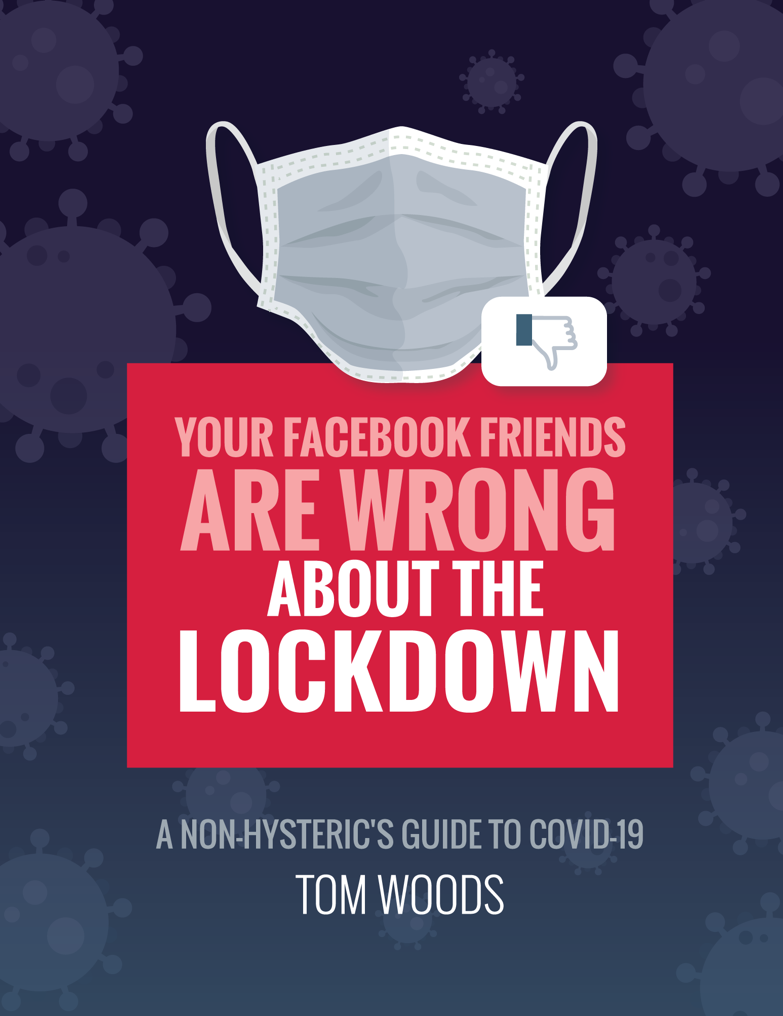
Meanwhile, the lockdowns are having horrific consequences on a scale most people do not realize, but which I describe in a free eBook I’ve just released, called Your Facebook Friends Are Wrong About the Lockdown: A Non-Hysteric’s Guide to COVID-19.

And interestingly enough, if you plot the timing of the lockdowns in the various states against their health outcomes, the result is completely random. More on that in the book.

Like most people, I am all for taking reasonable precautions and keeping an eye on the virus. And we can discuss which methods more effectively preserve biological life.

But is mere biological life worth living? This is not a question the “experts” are qualified to answer.

If people’s hopes, dreams, and aspirations are all dashed for an indefinite period of time, which purveyors of the present strategy almost flippantly propose, is that really living?

“Probably no large gatherings for a long time,” we’ve been told. How long?

And what are “large gatherings”?

Oh, just concerts, theater, lectures, church, sporting events, the arts in general – pretty much everything that makes life worth living.

The kind of “life” all this portends has a pulse, yes, but no soul.

If I may dwell on the “large gatherings” issue for a moment: for anyone who performs in front of an audience – dancers, musicians, comedians, magicians, athletes, singers, actors, whatever – the present pandemic strategy means your hopes and dreams are on indefinite hold, and may never be able to be fulfilled.

Dr. Zeke Emanuel of the ironically named Center for American Progress contends that we need to be on lockdown for 18 months until there’s a vaccine (as if that’s a guarantee, or the vaccine is effective, etc.). He says:

How are people supposed to find work if this goes on in some form for a year and a half? Is all that economic pain worth trying to stop COVID-19? The truth is we have no choice….

Conferences, concerts, sporting events, religious services, dinner in a restaurant, none of that will resume until we find a vaccine, a treatment, or a cure.

We have to be realistic, Emanuel urges us, and accept that we will be giving up cherished things for a long time, “things like schooling and income and contact with our friends and extended family.”

You read that right.

Things like schooling and income and contact with our friends and extended family.

This is insanity.

The response, meanwhile, has proceeded as if everyone were equally at risk. But the extraordinary thing about this virus, an aspect we had no right to expect but which should be helping us devise an appropriate response, is that it takes a particular toll on the elderly.

The fact remains: more people over age 100 than under age 30 have died. According to Neil Ferguson, the principal architect of the major UK model of the virus, between one-half and two-thirds of all people dying from COVID-19 would have died within a matter of months even in the absence of the virus.

So how about, instead of fruitlessly trying to distribute millions of “tests” all over the place, we concentrate our energies on helping the most vulnerable, and giving everyone else back the one life we each get?

For that matter, how about we avoid the approach of certain Democratic governors and not send COVID-19 patients, still contagious, back into nursing homes?

Those would be good starts.

In the UK, Lord Sumption just wrote:

What sort of life do we think we are protecting? There is more to life than the avoidance of death. Life is a drink with friends. Life is a crowded football match or a live concert. Life is a family celebration with children and grandchildren. Life is companionship, an arm around one’s back, laughter or tears shared at less than two meters. These things are not just optional extras. They are life itself. They are fundamental to our humanity, to our existence as social beings. Of course death is permanent, whereas joy may be temporarily suspended. But the force of that point depends on how temporary it really is.

Right on.

In the meantime, build up your intellectual ammunition against the lockdowners and civilization destroyers with my free book:

http://www.WrongAboutLockdown.com

Be seeing you


Posted in Uncategorized | Tagged: , , , , | Leave a Comment »

Why Media Coverage of COVID-19 Has Been So Bad | Mises Wire

Posted by M. C. on May 15, 2020

For example, when Neil Ferguson of Imperial College in London more than two months ago reported his model that predicted up to 2.2 million coronavirus deaths in the United States, the New York Times accepted the predictions as near reported fact, both in its news and editorial coverage.

I have found that most journalists work according to what one might call narratives. We see them in spades whenever we watch network news. On Fox News, Democrats in power always are weak in national defense. On MSNBC, you will hear that anyone who espouses free markets really wants black people to be thrown back into slavery and poor people to starve to death. Narratives are sets of beliefs that one holds that explain how things work in the world. Journalists forever are shaping their coverage to fit those narratives, and often they turn into just plain caricatures.

https://mises.org/wire/why-media-coverage-covid-19-has-been-so-bad?utm_source=Mises+Institute+Subscriptions&utm_campaign=0f39d537c2-EMAIL_CAMPAIGN_9_21_2018_9_59_COPY_02&utm_medium=email&utm_term=0_8b52b2e1c0-0f39d537c2-228343965

In my lifetime, I never have seen anything dominate news coverage like the COVID-19 virus and how federal, state, and local governments have dealt with the death, illness, and uncertainty it has created. That is a lifetime that has included the assassination of John F. Kennedy, the Vietnam War, the moon landing, Watergate, and the 9/11 attacks.

Suffice it to say that these were big events, yet I cannot say that I have seen anything quite like it, even in this modern media age. But although news coverage clearly has been extensive, I cannot say much for it except that with just a few exceptions, the coverage has been uniformly bad. When I mean bad, I mean that I as a reader, and especially as a reader who also is an academic economist and economic journalist, cannot trust it to be accurate.

For example, when Neil Ferguson of Imperial College in London more than two months ago reported his model that predicted up to 2.2 million coronavirus deaths in the United States, the New York Times accepted the predictions as near reported fact, both in its news and editorial coverage. Despite the fact that Ferguson has a long record of making wild exaggerations in his death-from-disease models, the media treated his dire predictions as Oracles from the Gods and demanded radical measures to counter this alleged threat.

Those of us who are skeptical of many apocalyptic claims from progressives—from Paul Ehrlich’s false predictions in The Population Bomb to Al Gore’s fabricated claims that sea ice was supposed to disappear from the Arctic fifteen years ago—wondered aloud if we really were to see a reprise of the 1918 Spanish flu epidemic and concluded that we were not. However, whenever so-called experts predict doom, members of the press eagerly await the next oracles. What always follows is the demand that government, with its stable of experts, step in and save us.

This is not just the mainstream media such as the New York Times or the network news stations running the gamut from CBS News to CNN to Fox News. This also includes the more ideological publications such as The Nation or the American Conservative. For example, if one were to read both the news and editorial sections of the New York Times on any day, one would find the coverage to be one sided and slanted toward what is a progressive view of society and governance, a viewpoint that is highly critical of the legal and social tradition of limitations upon state power. At the same time, one can read on the pages of TAC that the government should not only regulate consumer prices during the pandemic, but that the government should arrest anyone accused of “price gouging.”

A broad-brush view of progressivism, which today really is the dominant governing philosophy in the United States, is that constitutional limits upon government power are inadequate in a complex society like ours and that we should not be governed by bumbling politicians, but rather by experts. For example, a progressive would tout the difference between Anthony Fauci and Donald Trump; one is a public health expert, and the other is, well, Donald Trump, which goes without saying.

Given that most American journalists, both print and electronic, would proudly call themselves progressives, we should not be surprised when news coverage follows progressive narratives that hold to the view that expansion of state power is also the expansion of civilization itself. When I was in journalism school nearly a half century ago, my professors drilled into all of us that it was the press—the free press—that protected the rights of Americans from predatory government. Of course, the professors also happened to teach that maybe corporations might be more dangerous than government and that, well, you know, progressive government is really a good thing and should be encouraged, since progressive government is not the same as predatory government.

If one wished to probe my professors’ thinking even more, they really believed that the media really should be in the business of promoting “good government,” which was, in their minds, government by “experts.” What they meant by “good government” was not government that operated within strict constitutional limits, but rather progressive government, a government that could do things well, from providing medical care to building homes for the poor and providing food for hungry people. They wanted a competent government, the kind of government that to the generation that gave us the Progressive Era dreamed of occupying Washington, DC, and the rest of the country, the kind of government that they fervently believed that FDR had created with the New Deal.

Although my journalism professors didn’t teach me The Narratives in the classroom, over the years while I worked as a newspaper reporter and in my years as an academic economist, I have found that most journalists work according to what one might call narratives. We see them in spades whenever we watch network news. On Fox News, Democrats in power always are weak in national defense. On MSNBC, you will hear that anyone who espouses free markets really wants black people to be thrown back into slavery and poor people to starve to death. Narratives are sets of beliefs that one holds that explain how things work in the world. Journalists forever are shaping their coverage to fit those narratives, and often they turn into just plain caricatures.

Perhaps the strongest narrative of all is informed by the belief that experts hold everything we need to know and that when there are emergencies we need experts to tell us what to do. As Ryan McMaken recently wrote, so-called progressive governance is what one would call a technocracy, a government by the Competent Ones:

Over the past several decades—and especially since the New Deal—official experts in government have gradually replaced elected representatives as the primary decision-makers in government. Public debate has been abandoned in favor of meetings among small handfuls of unelected technocrats. Politics has been replaced by “science,” whether social science or physical science. These powerful and largely unaccountable decision-makers are today most noticeable in federal courts, in “intelligence” agencies, at the Federal Reserve, and—long ignored until now—in government public health agencies.

One can see the endorsement such a regime clearly by visiting the editorial page of the New York Times, which is not only the standard bearer for progressive America, but also is called “the Newspaper of Record” and a media mecca for most American journalists, print and electronic. What the NYT chooses to put on its editorial and news pages matters, because whatever the paper’s leadership selects ultimately is what is covered by the rest of the mainstream media. Yes, there are independent journalists, and once in a while something from outside progressive political circles that the NYT would rather ignore becomes so public that the paper cannot ignore it. Not surprisingly, it is the NYT and like media outlets that have turned Anthony Fauci’s every word into fulfilled prophecy (even if what he said actually was not true), and if Fauci is cautious about allowing people to reopen their businesses and go back to work, then we should all remain self-quarantined.

But why Fauci? For that matter, why would the “Newspaper of Record” take Neil Ferguson seriously when none of his vaunted models have been even near-accurate? Why do mainstream journalists still believe that Paul Ehrlich is an authority on population?

There are two reasons. First—and this is standard for any news outlet—bad news and especially sensational bad news always will get the headlines as long as it fits within the narratives of that particular outlet’s leaders. For example, the NYT and mainstream media reported every sensational accusation of sexual assault against Supreme Court then nominee Brett Kavanagh, because it fit the liberal left’s narrative that Republicans don’t care about women being sexually assaulted.

Likewise, when Tara Reade recently said that presumptive Democratic presidential nominee Joe Biden sexually assaulted her in 1993, Fox News reported it in part because its reporters live by the narrative that Democrats are hypocrites. (True to form, the NYT refused to report on the accusations for nearly three weeks, giving fuel to the conservatives’ beliefs about that paper.)

Second, although bad news sells, how journalists define bad news is even more important. Most journalists fall into the category of being progressives and have worldviews in line with such an ideology. As noted earlier, progressives are far more likely to defer to so-called experts, and experts have found that people are far more likely to listen to them when they predict doom than when they say all is (nearly) well. For most of their formal education, journalists have been taught that we are running out of resources, that overpopulation of the planet is a dire threat, and that environmental catastrophe (this time with climate change) is always around the corner. Most journalists I know have not even developed the intellectual capacity to believe otherwise, even when time and again the dire predictions that they have come to religiously believe don’t actually occur. Thus, in 1989, the New York Times editorialized that acid rain was destroying the forests of New York State even when extensive scientific research at that same time demonstrated otherwise. The editors had come to believe that the environmentalist narrative was true and were not about to be confused by facts, even if legitimate scientific inquiry pointed in another direction.

Something like the COVID-19 saga fits into nearly every narrative from progressive journalists that one can imagine.

First, it is easy to blame Donald Trump given that it seems that journalists employed by the NYT, CNN, and other media outlets have made it their collective mission in life to have him ousted from the White House—and Trump’s “leadership style” in something like a pandemic makes him an easy target.

Second, given that progressives are more likely to believe in all things apocalyptic when it comes to the environment and health issues, they are less likely to be skeptical when the Neil Fergusons of the scientific world predict millions of deaths.

Third, because of their reflexive belief that experts have all of the answers, they are more likely to frame the story as one of the experts versus the uneducated (who want to go back to work or open their shuttered businesses). Anyone who contradicts such wisdom is treated as an ignorant pariah, even if that person is a scientist with an elite background in higher education.

Last, journalists can clearly see that politicians are much more likely to act on what seems to be certain catastrophe, and in return journalists heap praise on those politicians that take the most extreme measures. Take Governor Andrew Cuomo of New York, for example. Despite the fact that Cuomo ordered nursing homes to admit COVID-19 patients—despite the vulnerability of elderly people to the coronavirus—with his directive leading to numerous deaths, the media coverage is largely positive precisely because he is seen as “doing something.”

Conversely, South Dakota governor Kristi Noem has received scathing national news coverage, because she refused to force businesses and individuals to lock down and “shelter in place.” Much of the coverage insinuated that the death toll there was likely to skyrocket as a result, yet at this date South Dakota has suffered thirty-four COVID-19 deaths, hardly a hot spot.

It would be nice if we could count on the mainstream news outlets to give reliable news on the coronavirus, but that will remain unlikely. Most journalists are wedded to the progressive narratives, and even if for a moment they are swatted by a reasonable interpretation of the facts at hand, they quickly recover and go on preaching doom and more doom.

Be seeing you


Posted in Uncategorized | Tagged: , , , , , | Leave a Comment »

Nations Spent $73bn on Nuclear Arms Amid COVID-19, UK in 3rd as US Tops at Half of Global Costs – ICAN – Sputnik International

Posted by M. C. on May 15, 2020

Alicia Sanders-Zakre, author of the report, said: “The figures do not include the massive humanitarian costs and the environmental toll from a legacy of nuclear testing and production. Even in the unlikely chance these weapons are never used, governments are paying massive sums to poison their environments and put their people at grave risk.”

https://sputniknews.com/world/202005131079291833-ican-nations-spent-73bn-on-nuclear-arms-amid-covid-19-uk-in-3rd-as-us-tops-at-half-of-global-costs/

by

Despite being the global epicentre of COVID-19 cases and deaths, the world’s leading nuclear power accounted for roughly half of total global spending on nuclear arms, a shock report from a major Swiss nonprofit coalition found.

Nuclear armed states spent a record $73bn on nuclear weapons amid the ongoing COVID-19 pandemic, a report from the Geneva-based International Campaign to Abolish Nuclear Weapons (ICAN) revealed.

The report, entitled Enough Is Enough: 2019 Global Nuclear Weapons Spending, found an increase of nuclear weapons spending in 2019, up $7.1bn from 2018.

The findings, which assessed the world’s leading nuclear powers – The United States, United Kingdom, France, China, Russia, Pakistan, India, Israel and North Korea – revealed that top nuclear powers spent $138,699 on over 13,000 nuclear weapons every minute of 2019.

But the United Kingdom was the third highest spender at $8.9bn after the US and China at $35bn and $10.4bn, respectively, according to the report.

“It is absurd to be spending $138,700 every single minute on weapons that cause catastrophic human harm rather than spending it to protect the health of their citizens. They are abdicating their duty to protect their people,” ICAN executive director, Beatrice Fihn, said in a statement.

Nuclear arms were banned by the Treaty on the Prohibition of Nuclear Weapons (TPNW), which the UN will enforce after all participating 50 nations ratify or accede the document, effectively criminalising such expenditures under international law.

But the figures only included direct spending on nuclear warheads and delivery systems costs for operation and deployment, with real numbers skyrocketing after factoring in costs due to environmental damage and victim compensation, with ICAN calling on governments to remain transparent in disclosing expenses, the statement read.

2019 Nuclear Defence Spending ICAN
A new report has found nuclear-armed states spent a record $73 billion on nuclear weapons in 2019, a $14 billion increase from 2018 expenditures. The United States, the center of the global coronavirus pandemic, accounted for nearly half of that spending.

Alicia Sanders-Zakre, author of the report, said: “The figures do not include the massive humanitarian costs and the environmental toll from a legacy of nuclear testing and production. Even in the unlikely chance these weapons are never used, governments are paying massive sums to poison their environments and put their people at grave risk.”

The news comes as British MPs slammed the Ministry of Defence for wasting £1.3bn ($1.6bn) on upgrading the country’s nuclear Trident programme, which is currently six years behind schedule. Costs were estimated at £2.5bn for the three upgrade programmes, which have spiked an additional £1.35bn, according to reports.

Be seeing you


Posted in Uncategorized | Tagged: , , , , | Leave a Comment »

A Nation of Sheep – LewRockwell

Posted by M. C. on May 14, 2020

For a few weeks now, I thought the most extreme of these governors
has been Gov. Phil Murphy of New Jersey, who publicly admitted that he
didn’t think or care about the Bill of Rights, even though he took an
oath to uphold it. Yet, Gov. Tom Wolf of Pennsylvania has surpassed him.

When Wolf learned that some Pennsylvania county sheriffs would not
use force to enforce his non-law edicts, and some public accommodations
would open their doors — consistent with public safety but in defiance
of his non-law edicts — he threatened to withhold state aid from all who
live in those counties and to close the liquor stores that, by his
non-law edicts, remain open. This is straight out of 1930s Germany —
punish the community because of the resistance of a few. In Wolf’s
Pennsylvania, the people work for the government.

Does the government really work for us, or are we afraid of it?

https://www.lewrockwell.com/2020/05/andrew-p-napolitano/a-nation-of-sheep-2/

By

“When the people fear the government, there is tyranny. When the government fears the people, there is liberty.” — Thomas Jefferson (1743-1826)

To Thomas Jefferson, the fulcrum between the people and the government they have elected was fear. He argued succinctly that the government would only respect liberty if it feared losing power. Today, the relationship between people and government is power. Does the government have the power to tell us how to make personal choices, or do we have the power to tell the government to take a hike?

Stated differently, does the government work for us or do we work for the government?

Jefferson’s answer to that question in 1801, the year he became president, was that the government worked for us. Today, unfortunately, this same question has two answers — a functional one and a formal one. One would stumble answering this question if one looked only at how some state governors are treating the people for whom they claim to be working. One needs to look as well at the nature of government in a free society.

Six months ago, no one could have imagined where we are in America today. Then, if anyone had suggested that the governors of all 50 states, in varying degrees of severity, would be using police to interfere with personal choices — choices that we and our forbearers have all made without giving a second thought to the preferences of the government — no one would have believed it.

Think for a moment of how you would have reacted to any pre-COVID-19 idea that the police in America — using not the force of opinion but the force of arms — would prevent you from going out of your home, operating your business, jogging in a park, patronizing a restaurant or clothing store, buying a garden hose, going to Mass or church or temple or mosque or even joining a small public gathering of folks who want to protest these prohibitions.

Where did these prohibitions come from? They have come from the ever-changing edicts of governors and mayors, who rely on the ever-changing evaluations of medical data from an ever-changing cast of scientific experts. They are the pronouncements of politicians who have forgotten that they are elected to enforce laws, not to write them, and to be the servants of the people, not their masters.

Why do Americans accept this? We are a nation born in a bloody revolution against a king. The founders of America made the profound and indisputable choice of establishing a government dedicated to the cacophony of liberty over the illusion of safety.

They embedded that choice in the Declaration of Independence and the Constitution. The former states, unequivocally, that no government is legitimate without the consent of the governed and that government’s principal duty is to secure our rights. The latter — which expressly protects the right to make personal choices — is the supreme law of the land, and thus all governmental acts are subordinate to it.

We have fought wars against tyrants who wanted to tell us how to live. Today, we have elected our masters who are doing just that.

Americans seem to accept the restrictions on our rights to speech, religion, travel and commercial activities simply because the origin of those restrictions is a popularly elected person. But even an elected government can be tyrannical. Should you bow to these restrictions merely because their authors were elected and they have persuaded your neighbors that the prohibitions are for their own good — the Declaration and the Constitution be damned?

Stated differently, the governments that have interfered with our well-established rights to go about our daily lives as we see fit — taking chances whenever we cross the street, drink a glass of water, bite into food, sit next to a stranger on a train or at a baseball game, or go through a green light in our vehicles — have failed their first obligation, which is to safeguard our freedoms to take those chances.

Instead of safeguarding our freedoms — our natural rights to make personal choices — the governors and their police enforcers have treated us as if we work for them.

Does the government work for us or do we work for the government? Formally, it works for us. We elect officials because we trust their judgment. We authorize those officials to protect our rights, and we prohibit them from interfering with our personal choices.

For a few weeks now, I thought the most extreme of these governors has been Gov. Phil Murphy of New Jersey, who publicly admitted that he didn’t think or care about the Bill of Rights, even though he took an oath to uphold it. Yet, Gov. Tom Wolf of Pennsylvania has surpassed him.

When Wolf learned that some Pennsylvania county sheriffs would not use force to enforce his non-law edicts, and some public accommodations would open their doors — consistent with public safety but in defiance of his non-law edicts — he threatened to withhold state aid from all who live in those counties and to close the liquor stores that, by his non-law edicts, remain open. This is straight out of 1930s Germany — punish the community because of the resistance of a few. In Wolf’s Pennsylvania, the people work for the government.

My colleagues at The Wall Street Journal have unearthed the facts that more Americans die annually from heart disease, cancer, accidents and non-COVID-19 respiratory failure than die annually (annualized) from this coronavirus. Every death diminishes me. So does every suppression of liberty. So does every denial of the right to make choices and take risks.

Does the government really work for us, or are we afraid of it?

Be seeing you


Posted in Uncategorized | Tagged: , , , | Leave a Comment »

Antibody Testing: Proves We’ve Been Had!

Posted by M. C. on May 14, 2020

https://townhall.com/columnists/kevinmccullough/2020/04/23/antibody-testing-proves-weve-been-had-n2567516

There is simply no other way to state this.

Nearly everything we’ve been told about models, rates of infection, deaths, and recoveries was inaccurate.

I’m not here to argue that it was malfeasance or ignorance — both are unacceptable. But the one thing that Governor Andrew Cuomo’s stunning announcement made clear on Thursday is that there are some pretty shocking — and what should be — reassuring truths.

Cuomo announced that antibody testing in New York state, which only began four days previous, was already demonstrating that at minimum 13.9% of New Yorkers, had COVID-19 late stage antibodies.

The implication of this is a shockwave to the system.

With a population of 19,540,500 the findings point out that over 2,500,000 New Yorkers had the virus and have recovered. Keep in mind that as of this writing that only 263,000 New Yorkers have currently confirmed cases. Also as of this writing New York has reported 19,543 fatalities.

We’ve been told that the true death rate is 7.4% in New York. We were told there would be hundreds of thousands dead. We were told that this was worse than the flu, which has still recorded more deaths to date in this past flu season—even though the CDC instructed medical personnel to start counting influenza, heart disease, pulmonary, respiratory, drug overdose, and possibly even car crash deaths as COVID-19 deaths.

We were told that we had to upend an economy, go into solitary confinement, and divorce ourselves from normal life because this would rage beyond any previous pandemic. We were told that this virus with 846,000 current confirmed cases was worse than the H1N1 that broke out on Obama’s watch that infected 60,000,000 people. (We were conveniently not told that Obama had authorized $3.7 million U.S. tax dollars to be used at the Wuhan Institute of Virology to utilize corona viruses in bats in 2015 — but that’s yet another deception of omission.)

But none of these “truths” turned out to be so.

The death rate in New York State isn’t 7.4%, it is actually .75%. The recently ended influenza season numbers from the CDC indicate possibly 56,000,000 cases of flu, 740,000 hospitalizations, and 62,000 deaths. Under the current count from the Johns Hopkins Dashboard in this five month stretch CoVid19 has racked up 845,959 confirmed cases, 122,000 hospitalizations and 46,972 deaths.

A couple of other observations are extremely relevant. To begin with the flu — which has no vaccine but rather a randomized version of a shot designed to help develop antibodies to fight the version of the flu that “smart people” *think* will be the primary version that particular year — has remedies that physicians prescribe in primary care on an as needed basis. So we’re not accustomed to thinking that the flu is this deadly killer that all of life must be shut down to prevent. CoVid19 had no known treatments at the beginning of the breakout, and for political reasons—and possibly financially incentivized ones to boot—the most effective treatment for CoVid19 became a political football. Even the supposed “negative” trials that were reported on this past weekend, had cherry picked subjects that were mostly late stage victims of the virus. As Dr. Vladimir Zelenko pointed out on my show this week, doing so created the negative outcomes “purposefully & by design.” When used under a physician’s care, in the primary care basis, and early on after testing or onset of symptoms, the hydroxycholoroquine, azithromycin, & zinc cocktail reduced the rates of deaths and long term infectious stages. Zelenko’s numbers to date: 1,450 patients treated, two deaths, four ventilator cases (all fully recovered,) and all others recovered. Zelenko and other physicians using the treatment are releasing the world’s largest Meta-study to date within the next few days that will examine more than 2,000 confirmed cases.

The antibody numbers from Cuomo also scream one other harsh reality. The virus was in America long before January.

No thanks to the Communist Chinese Party — who bear the sole responsibility for every American who died from CoVid19 — the infection made its way to American sooner than we had believed. With three flights a day from Wuhan to New York’s John F. Kennedy airport alone the virus was being imported faster than understood.

Since going into national lockdown we’ve also failed one other key component of recovery from this virus—herd immunity. We’ve developed not nearly enough of it. For if 2.5 million New Yorkers were able to fight it off without any treatment at all—unaware they even had it—how much more immunity did we miss out on creating by simply sheltering everyone in place?

We are well on our way to a vaccine. We’ve also got a $12 treatment with the hydroxychloroquine cocktail that has smashed Brazil’s fatality rate by 95%.

Most importantly we’ve got millions upon millions of Americans who have been exposed to CoVid19 and who now have the late stage antibodies that demonstrate immunity.

It is time to acknowledge these facts, draw the necessary conclusions they lead us to, make changes for the benefit of the American people (for once), and end this nightmare.

Thank you Governor Cuomo for acknowledging it, now let’s go!

Be seeing you

Posted in Uncategorized | Tagged: , , , , , | Leave a Comment »

The Ron Paul Institute for Peace and Prosperity : COVID-19 Puts Spotlight on Science — but Scientists Often Lie

Posted by M. C. on May 12, 2020

“The Great Betrayal: Fraud in Science,” is a 2004 expose about the true state of science, and science that’s been peer-reviewed — that is, self-checked, self-policed. It’s 480 pages long. And in a terse assessment of his findings, author Horace Freeland Judson wrote, “Their claims about science are unscientific.” He was speaking of the scientific greats — of Gregor Mendel, of Charles Darwin, of Louis Pasteur, of Sigmund Freud.

They all fudged data.

What’s more, it’s well-known they all fudged data.

http://ronpaulinstitute.org/archives/featured-articles/2020/may/11/covid-19-puts-spotlight-on-science-but-scientists-often-lie/

Written by Cheryl K. Chumley

We can beat COVID-19 — just trust the science, we’re told. Trust in the scientists, we’re told. And that’s not a paraphrase.

“From the Editors: We Can Beat COVID-19. Just Trust Science,” Wired wrote.

Well and good. Fine and dandy. But fact is, scientists often lie. Science isn’t always the beacon toward truth. It’s not just frequently flawed; it’s frequently deceptive. And purposely so.

So tossing citizens’ civil rights into the sea and allowing medical professionals and scientists to steer the COVID-19 boat may not be the best case scenario for a free America.

“Stanford researchers uncover patterns in how scientists lie about their data,” wrote Stanford News, back in late 2015.

The story went on to report how a couple of researchers “cracked the writing patterns of scientists who attempt to pass along falsified data,” a finding that gave the science world a tool to “identify falsified research before it is published.” The discovery of the pattern is one thing; the fact that the pattern had to be pursued in the first place is entirely another thing. It says, not so subtly, that falsified scientific data is so prevalent that a tool to identify — and slow the creep of — the false data was actually an in-demand item.

In fact, books have been written about the prevalence of falsified science.

“The Great Betrayal: Fraud in Science,” is a 2004 expose about the true state of science, and science that’s been peer-reviewed — that is, self-checked, self-policed. It’s 480 pages long. And in a terse assessment of his findings, author Horace Freeland Judson wrote, “Their claims about science are unscientific.” He was speaking of the scientific greats — of Gregor Mendel, of Charles Darwin, of Louis Pasteur, of Sigmund Freud.

They all fudged data.

What’s more, it’s well-known they all fudged data.

“Freud was a lousy scientist,” The New Yorker wrote, in 2017. “He fudged data; he made unsubstantiated claims; he took credit for other people’s ideas. Sometimes he lied.”

Mendel, the founder of modern genetics, “may have falsified data,” The Great Courses Daily reported in 2016. It’s been a lingering shadow. From an August 2016 abstract, “Are Mendel’s Data Reliable? The Perspective of a Pea Geneticist,” published in the Journal of Heredity: “Based on a large number of statistical analyses as well as the review of several well-known geneticists, there can be little doubt that the data Mendel presented in 1866 corresponded much more closely to the predictions of his model than could be reasonably expected by chance.”

Moving on; Darwin.

“New Book Uncovers ‘the Life and Lies of Charles Darwin,’” Evolution News wrote in 2009.

And of especial note, given the ongoing COVID-19 debate and vaccinations, this 1993 headline from The Independent: “Pasteur ‘told lies about vaccines,’” — specifically, about the public trial of an anthrax vaccine, and by using a child as a test-case for a rabies vaccine that he had claimed to use on hundreds of dogs.

The Washington Post, The New York Times, The Chicago Tribune — these are all papers of record that have reported over the years about Pasteur’s record of scientific deceptions.

Those are hardly the only bad apples.

Science magazine, in a 2018 piece entitled, “Tide of Lies,” wrote of bone researcher Yoshihiro Sato’s fabricated data — “fraud” that was called “one of the biggest in scientific history.”

The American Council on Science and Health, in a 2017 piece entitled, “Lying Politicians Is One Thing, Lying Scientists Is Another,” wrote of “the crappy science” of researchers Peter Eklov and Oona Lonnstedt who reported in a 2016 paper that “tiny particles of plastic in the ocean were harming fish,” and that “microscopic plastic must [therefore] be harmful to fish” — findings that led them to be slapped with the peer-based “misconduct in research” label; findings that the pair subsequently retracted.

QZ, in a 2016 piece entitled, “Nearly all of our medical research is wrong,” wrote: “Something is rotten in the state of biomedical research. Everyone who works in the field knows this on some level. We applaud presentations by colleagues … but we know in our hearts that the majority or even the vast majority of our research claims are false.”

Wow.

Look: Do the research. Google some headlines. There are more, so many more examples of scientists gone wrong, scientists gone rogue, science gone deceptive.

“This scientist nearly went to jail for making up data,” The Washington Post wrote in 2016.

“Researchers Behaving Badly: Known Frauds Are ‘the Tip of the Iceberg,’” Leapsmag wrote in 2018.

“Take That Back: The Top Scientific Retractions of 2019,” Live Science wrote in 2019.

Deceptions are part of the game.

Lies, skews, half-truths, selectively chosen data, biased conclusions, flawed interpretations, outright wildly inaccurate information — these are all part and parcel of scientists’ lives. And why? Because scientists are human, too.

Scientists have deadlines. They have pressures. They have funding goals. They have peer competition. They have personal agendas, political leanings, partisan purposes — spiritual blindnesses. In short: they are not perfect.

Scientists are not perfect; the science they present is not perfect.

And in this COVID-19 atmosphere, where scientists and researchers and medical professionals and scholars have taken over much of the control of US politics and government and how American citizens are supposed to now behave and function — it’s more important than ever to remember this: Scientists can be wrong, very wrong.

Moreover, scientists can lie. And very often, as history shows, they do.

from WashingtonTimes.com

Be seeing you


Posted in Uncategorized | Tagged: , , , , | Leave a Comment »

What Did Society Benefit By Social Distancing? | The Libertarian Institute

Posted by M. C. on May 9, 2020

https://libertarianinstitute.org/articles/what-did-society-benefit-by-social-distancing/

by

To be governed is to be watched, inspected, spied upon, directed, law-driven, numbered, regulated, enrolled, indoctrinated, preached at, controlled, checked, estimated, valued, censured, commanded, by creatures who have neither the right nor the wisdom nor the virtue to do so.”- Pierre-Joseph Proudhon

Despite the fact that there has already been ample writing, both in the mainstream and in alternative press, on this subject from authors who are both persuasive and amply qualified mathematically and scientifically, this author finds himself wanting to offer a brief entry. As someone who has spent the larger portion of his professional career designing experiments, analyzing data, generating graphs, and writing reports about all of it, articles featuring science, statistics, charts and graphs aplenty seems be natural for me. However, none of that is needed. Instead, let us confine ourselves to the most basic logic.

At present, the United States and the world are locked in the grip of the COVID-19 Pandemic. One might be inclined to call it, “The COVID-19 Panic.” If he did, this author would agree. To fight this threat to life and apparently our very existence on Earth as we know it, the public has been forced to abide by the edicts of mayors, governors, and other leadership, at the local and national level. Those edicts can be summarized via two hashtags that started to trend on Twitter about six weeks ago. To assure that we have the same understanding of these concepts, a couple of definitions are in order.

The concept of flattening the curve, represented by the hashtag #FlattenTheCurve, refers to a statistical approach to mitigating the virus’s impact on society, using what is called a normal distribution to model the number of cases over time. In real life, this type of distribution is a representation of an idealized histogram, that is, vertical bars representing the count of observations per unit time, and positioned on a graph next to each other. The unit of time could be days, hours, minutes, or anything like that. (As an aside, for the vast majority of phenomena observed in our daily lives, a normal distribution is applicable, as justified by the Central Limit Theorem. Why this is true could be the subject of another essay, or hell, an entire book.)

The basic premise is that the height of the bars—representing counts of observations—start out small, and get bigger and bigger, eventually reaching a maximum value or peak, and then returning to getting smaller and smaller. The tallest bar—or peak of the distribution—can then be thought of as the maximum number of individuals (per unit time) who actively have the virus. Let us term this ‘Maximum COVID-19 Patients’. The area under the curve, which is equivalent to simply adding up all the observations in each of the bars, is the total number of people who are stricken with COVID-19. Let us term this, ‘Total COVID-19 Cases’.

From the start of discussions of the pandemic and how to deal with it, this number—the total number of people who would be stricken with the virus, ‘Total COVID-19 Cases’—has not been the subject of major debate; that is to say, the area under the curve was not expected to change markedly. In fact, no one in his or her right mind thought that anything could be done to stop the spread of the disease via behavior. The best we could hope for would be to slow the spread, ostensibly so that the medical establishment—hospitals and other front-line structures—could deal with the onslaught. (One might, if he were optimistic, think that we could develop and distribute a vaccine quickly enough that lengthening societal exposure time was no big deal. That is, if he were an idiot.) That everyone, or effectively everyone, would eventually be exposed was not in doubt.

Flattening the curve could, at best, decrease that peak value, i.e., the maximum number of people exhibiting the disease at a point in time, in exchange for a longer timeframe of population exposure, what I will term ‘Societal Exposure Time’. In summary, ‘Total COVID-19 Cases’ (the area under the curve) would be unchanged, but we would exchange a lower ‘Maximum COVID-19 Patients’ for a longer ‘Societal Exposure Time’. Total number of deaths, unchanged. Length of time, extended. Put a pin in that point.

The concept of social distancing, represented by the hashtag #SocialDistancing, refers to the limiting interpersonal contact. Standing X feet from someone, or wearing a mask, or canceling events that are crowd-centric (such as basketball games or concerts) are all implementations of social distancing. The same is true of forcing the temporary closure of ostensibly “non-essential” businesses. So then, #FlattenTheCurve is the what, and #SocialDistancing is the how. No matter what methodology is utilized for social distancing, it is a means that has, as its raison d’être, flattening the curve. Put a pin in that point as well.

So then, flattening the curve via social distancing could produce, at best, one outcome: slow the progression of the disease so as to limit the loading on hospitals and treatment centers. In a perfect world, that outcome could also result in fewer deaths overall, i.e., a reduction in ‘Maximum COVID-19 Patients’ could, given limited medical resources, decrease the net number of deaths. As already noted, built into this approach is the secondary effect that it also must increase ‘Societal Exposure Time’. Slowing the progression of the disease means, automatically, that the disease is present in a society for longer, other factors being equal.

The direct outcome of government-imposed social distancing was a lock-down on businesses such as bars, restaurants, as well as sporting events and concerts, and on non-essential businesses. This led inexorably to limited or no income for certain sectors of the economy. That lack of income placed a huge strain on people who depended upon the “interaction economy,” such as hospitality and those non-essential businesses, to exist, i.e., people who are paid by or receive a large percentage of their income from those industries and industries related to or dependent upon them. The calculus of this lock-down on the economy generally, and these specific sectors of the economy in particular, was supposedly always a consideration, although it is becoming increasingly obvious that it was not given full examination by those with the power to impose the lock-downs. A simple trade-off was presented: “Put a little strain on a few industries now, and save lives as a result.”

However, and this is the worrisome case, if flattening the curve via social distancing does not result in fewer deaths, which it could only do in the event that hospitals were overwhelmed, then the best-case result of the approach is to only increase ‘Societal Exposure Time’. The net effect of supposedly flattening the curve, assuming the curve was actually flattened, could actually be looked upon as wasted time, while people dependent on the interaction economy and/or unlucky enough to work in an ostensibly non-essential sector have limited, reduced, or no income—along with all the related secondary and tertiary industries who supply or are served by them. From much of the reporting, the vast majority of hospitals were not overwhelmed.

One could even argue if the healthcare establishment would have been overwhelmed without ostensibly flattening the curve. While it is possible that in some places, such as New York City or Detroit, social distancing had some effect, it is equally likely, nay probable, that some social distancing, without lockdowns, would have sufficed almost everywhere else. Moreover, what if the progression of COVID-19 through the population was unaffected by social distancing? Every year the flu comes and goes and not everyone gets it. This, despite almost no social distancing practices and despite the fact that not everyone gets vaccinated, all without machinations such as lock-downs imposed on the public and marketed with puffery such as, “Stay Home and Save a Life.” By virtually any evaluation then, flattening the curve via social distancing had almost no net positive effect for the majority of the United States! Zilch. Zip. Zero. Bupkis.

Even if these draconian lock-downs did have a positive effect, (and that is a big-assed IF) the time for them is long over. The increased ‘Societal Exposure Time’ has turned directly into massive negative economic impact across multiple sectors of the economy. And let us be clear, this negative economic impact is not about rich dudes going on fewer vacations, it is about the people who previously depended upon the interaction economy—that ecosystem of businesses, one of them the hospitality and restaurant sector and another of them the supposedly non-essential sector—for income to eat and pay bills. Those people are part of the over twenty-five million people who have gone from working to unemployed over a few weeks as a result of those lock-downs.

Will they find new employment quickly? Will businesses closed in the wreckage of bungled government approach to COVID-19 rapidly re-open? Who knows? Doubtful on both counts. Built into the supposed calculus of flattening the curve via social distancing was the horribly simplified and sound-byte-ready idea and/or belief that “saving lives trumps worrying about any negative economic effects.” The negative side of that calculus was evidently never fully grasped, particularly in the event that flattening the curve via social distancing did not result in markedly fewer deaths, which it did not.

This is exactly where we are today in the United States: massive negative economic impact and still no obvious plan to immediately remove the government-imposed lock-downs. Little (if any) benefit, but all the pain—with more pain on the horizon. The fact that many government leaders are taking a measured, pensive approach to ending the lock-downs and thereby un-doing what they did with knee-jerking half-assery is laughable. The government-mandated lock-downs should end just as quickly as they were implemented. That none of the losers who imposed them is likely to apologize for any of the irreparable damage done to society is par for the course.

Wilt Alston


Be seeing you


Posted in Uncategorized | Tagged: , , , | 1 Comment »

Europe’s Communists Are Trying to Blame COVID-19 on Markets and “Neoliberalism” | Mises Wire

Posted by M. C. on May 9, 2020

What they consider as capitalism’s flaws—globalization and laissez-faire—are indeed its strong points. And what they accuse capitalism of—a lack of solidarity and forsaking disadvantaged people—relies upon incorrect theoretical and historical analysis. Don’t trust them and their fallacious narratives.

https://mises.org/wire/europes-communists-are-trying-blame-covid-19-markets-and-neoliberalism?utm_source=Mises+Institute+Subscriptions&utm_campaign=15be745cdc-EMAIL_CAMPAIGN_9_21_2018_9_59_COPY_01&utm_medium=email&utm_term=0_8b52b2e1c0-15be745cdc-228343965

As the COVID-19 pandemic is taking place worldwide, many leftist pundits and communist politicians are blaming its spread on the alleged inborn flaws of neoliberalism—which they identify with globalization, laissez-faire, the absence of solidarity and greater inequality. However, all their claims and theories are either factually wrong or deductively and praxeologically nonsensical.

Globalization Is Enhanced Social Cooperation

First of all, antiglobalization leftists and communists do not seem to clearly understand what globalization really is—i.e., an economic and institutional framework wherein both economic products (consumers’ goods and services) and factors of production (commodities, labor, and capital) can move and circulate worldwide with relative freedom.

As it can be easily understood, such freedom of circulation and movement is nothing different from enhanced social cooperation. In fact, the fewer the constraints on resources’ allocation (both consumers’ and producers’ goods), the greater the efficiency (with respect to producers’ goods allocation, cost minimization, and profit maximization) and the satisfaction (in terms of variety of consumption goods and cost saving) that producers and consumers can enjoy.

In fact, as we all know, social cooperation is the only means whereby human societies can progress and provide better living conditions for all their members. As Mises ([1949] 1998) stated in Human Action,

Every step by which an individual substitutes concerted action for isolated action results in an immediate and recognizable improvement in his conditions. The advantages derived from peaceful cooperation and division of labor are universal. (p. 146, emphasis added)

Provided that globalization means nothing more than international peaceful cooperation and division of labor, it is clear that it would (and actually does) deliver better economic and welfare conditions than isolationism and autarky could possibly do. This fact can be praxeologically deduced (as we have briefly done so far) or empirically proven—by innumerable historical examples of disasters, misery and famine brought upon innocent people by autarkic and isolationist policies.

Laissez-Faire Is Trial-and-Error Learning

Secondly, communist politicians and leftist pundits get totally wrong what laissez-faire really is, what it entails, and how beneficial (or, even better, fundamental and indispensable) it is for the correct functioning of capitalism—which is the only social cooperation framework (both historically and praxeologically) suitable to bettering human beings’ material conditions.

Unfettered laissez-faire is the only institutional scenario wherein economic agents (consumers and producers) can freely and promptly adjust their choices and behaviors to the changes occurring within the free market—which is the ultimate display and epitome of social cooperation. Whenever laissez-faire is impaired by government intervention, social cooperation performs worse and society loses something in terms of efficiency in resource allocation.

Moreover, laissez-faire is indispensable in a capitalistic framework spoiled by fractional reserve banking and government fiat money. In fact, as Austrian business cycle theory teaches, the faculty to create “money out of thin air” (fiduciary media) that commercial banks are legally granted brings about divergences between savings (resources whose consumption agents are willing to forego today) and investments (means of production shifted toward higher orders of production so as to yield increased consumption tomorrow). In Mises’s ([1949] 1998) own words,

The inference to be drawn from the monetary cycle theory by those who want to prevent the recurrence of booms and of the subsequent depressions is…that they [banks] should abstain from credit expansion. (p. 789n5​, emphasis added)

However, since reforming the fractional reserve banking and government fiat money system we live in does not seem to be feasible (at least not in the short run), letting agents free to correct the mistakes they make in resource allocation seems to be the only way to cope with the credit-induced boom-and-bust cycles we experience.

In this respect, laissez-faire and globalization are intertwined. What the COVID-19 economic shock is teaching us—besides the questionability of indiscriminate economic shutdowns—is that, perhaps, entrepreneurs underestimated the pandemic risk while engineering the global value chain we all benefit from.

But this does not mean that laissez-faire and globalization were the wrong option: they are tools, nothing more. And through these tools a capitalistic society can adjust its productive structure and perform better in the future, learning from previous mistakes. Were the Western world to have a socialist central planner instead of freely choosing entrepreneurs, this corrective process of improvement could not possibly occur.

Neoliberalism: Greater Inequality and Lower Solidarity?

Lastly, laissez-faire does not imply rejection of the social protection we enjoy in Western world. This can be briefly shown both theoretically and empirically.

The critics of capitalism and neoliberalism blame markets for a system that is—allegedly—inevitably converging an toward ever more unequal distribution of resources. However, even if this were true (intertemporal changes in inequality are complex and challenging to measure), the egalitarian alternative is evidently worse.

Consider two possible social welfare functions (i.e., two possible quantifications of people’s well-being in a given society): the egalitarian one and the “Rawlsian” one. The first one postulates that society is better off the more equal agents’ utilities (i.e., states of well-being) are, whereas the second one postulates that society’s welfare depends upon the condition of its less affluent members.

As Figure 1 shows, you can have a more unequal society wherein, nonetheless, every single member is better off than in the previously more equal scenario: this is what is involved with the movement from scenario 1 to scenario 2, and it is what globalization entails. Notice that, from an egalitarian viewpoint, society would be better off in 1, when it was “more equal,” than in 2, where both agents A and B enjoy greater (even though less equal) utilities.

Figure 1: Individual Well-Being and Social Welfare Functions

Individual and Social Welfare Functions

This simple sketch provides valuable insights about communism and utopian ideologies: hoping to achieve scenario 3, where everybody would be better off and society more equal, which might not be feasible under production and technological constraints, communists and utopians prefer to force upon us scenario 1, where we are all poorer and worse off—but, hey, we have defeated inequality! Moreover, accepting scenario 2 (i.e., following a “Rawlsian” approach) is exactly what modern capitalistic welfare states are designed for: nobody is left behind if truly disadvantaged—no libertarian free marketer argues against that. However, taking care of disadvantaged people does not mean embracing an egalitarian viewpoint.

Also, historically we observe that the level of solidarity in Western world has increased—not decreasing, as modern anticapitalists contend—as markets and globalization have asserted themselves. Even using the Left’s own measures of “solidarity”—such as social spending—public social spending has been increasing in OECD (Organisation for Economic Co-operation and Development) countries from the 1980s onwards and is higher today—even after the Great Recession—than it was back then.1

Figure 2: Social Public Spending, Percentage of GDP, 1980–2018

Social Public Spending GDP
Source: OECD, https://data.oecd.org/socialexp/social-spending.htm.

Conclusion

Even if leftists and antiglobalists were correct (and I believe they are not) in blaming capitalism and its various facets for the current pandemic, they are utterly wrong in downplaying capitalism’s ability to heal and correct its path.

What they consider as capitalism’s flaws—globalization and laissez-faire—are indeed its strong points. And what they accuse capitalism of—a lack of solidarity and forsaking disadvantaged people—relies upon incorrect theoretical and historical analysis. Don’t trust them and their fallacious narratives.

  • 1. That social spending is a useful measure of solidarity is a dubious assertion, but this is nonetheless a metric that anticapitalists use.

Be seeing you


Posted in Uncategorized | Tagged: , , , , , | Leave a Comment »