MCViewPoint

Opinion from a Libertarian ViewPoint

Posts Tagged ‘EU’

EU Leaders Demand “Standardised” Vaccine Passport For Travel | ZeroHedge

Posted by M. C. on January 14, 2021

However, the EU’s data protection chief Wojciech Wiewiórowski recently labeled the idea of an immunity passport “extreme” and has repeatedly said it is alarming, and ‘disgusting’.

Recently, the government in Ontario, Canada admitted that it is exploring ‘immunity passports’ in conjunction with restrictions on travel and access to social venues for the unvaccinated.

https://www.zerohedge.com/markets/eu-leaders-demand-standardised-vaccine-passport-travel

Tyler Durden's Photoby Tyler DurdenThursday, Jan 14, 2021 – 3:30

Authored by Steve Watson via Summit News,

EU leaders are demanding that the Commission should ‘standardise’ a vaccine passport across all member countries, and that it should be required for people to travel throughout the area.

Greek Prime Minister Kyriakos Mitsotakis has penned a letter to EU Commission chief Ursula von der Leyen, outlining that “Persons who have been vaccinated should be free to travel.”

The letter calls for a “standardised certificate, which will prove that a person has been successfully vaccinated.”

While it stops short at advocating mandatory vaccination, the letter further urges that “It is urgent to adopt a common understanding on how a vaccination certificate should be structured so as to be accepted in all member states.”

Mitsotakis has pledged to raise the issue during an upcoming EU summit on January 21, declaring that “there is an urgent need for a high-level EU-wide mobilization to move things forward.” 

Vaccine passports have previously been touted by the EU, with officials suggesting back in April that visa applicants would also be required to be vaccinated.

EU countries including SpainEstoniaIceland, and Belgium have all indicated that they are open to some form of vaccine passports, as well as sharing the data across borders.

This week, it was also revealed that Denmark is the latest country to announce that it is rolling out a ‘Covid passport’, to allow those who have taken the vaccine to engage in society without any restrictions.

However, the EU’s data protection chief Wojciech Wiewiórowski recently labeled the idea of an immunity passport “extreme” and has repeatedly said it is alarming, and ‘disgusting’.

The spectre of so called ‘immunity passports’ is looming globally.

Having left the EU, Britain would not be part of any standardised European scheme, however it has now confirmed that it is rolling out vaccine passports, despite previous denials that it would do so.

Recently, the government in Ontario, Canada admitted that it is exploring ‘immunity passports’ in conjunction with restrictions on travel and access to social venues for the unvaccinated.

Last month, Israel announced that citizens who get the COVID-19 vaccine will be given ‘green passports’ that will enable them to attend venues and eat at restaurants.

litany of other government and travel industry figures in both the US, Britain and beyond have suggested that ‘COVID passports’ are coming in order for ‘life to get back to normal’.

Anna Beduschi, an academic from Exeter University, commented on the potential move toward vaccine passports by EU, noting that it “poses essential questions for the protection of data privacy and human rights.”

Beduschi added that the vaccine passports may “create a new distinction between individuals based on their health status, which can then be used to determine the degree of freedoms and rights they may enjoy.”

A report compiled last year by AI research body the Ada Lovelace Institute said so called ‘immunity’ passports “pose extremely high risks in terms of social cohesion, discrimination, exclusion and vulnerability.”

Sam Grant, campaign manager at the civili liberties advocacy group Liberty has warned that “any form of immunity passport risks creating a two-tier system in which some of us have access to freedoms and support while others are shut out.”

“These systems could result in people who don’t have immunity potentially being blocked from essential public services, work or housing – with the most marginalised among us hardest hit,” Grant further warned.

“This has wider implications too because any form of immunity passport could pave the way for a full ID system – an idea which has repeatedly been rejected as incompatible with building a rights-respecting society,” Grant further urged.

Be seeing you

Posted in Uncategorized | Tagged: , , | Leave a Comment »

‘Project Fear’ is here: Perfect storm of the new Covid variant and looming Brexit deadline exposes Boris the buffoon’s empty hand — RT Op-ed

Posted by M. C. on December 22, 2020

Fear is a handy tool. like a crisis, don’t let it go to waste.

https://www.rt.com/op-ed/510326-project-fear-brexit-covid/

Tom Fowdy

Tom Fowdy

is a British writer and analyst of politics and international relations with a primary focus on East Asia.

With lorries lining the roads, food shortages & the UK cut adrift by its former EU allies to suffer its fate, the prime minister is in a pickle he won’t be able to bluster his way out of this time.

Britain is in crisis, a multifaceted one at that. Over the weekend, Prime Minister Boris Johnson announced that areas of London and south-east England would be placed under “Tier 4 restrictions,” or in other words, a total lockdown, following the revelation that a new mutation of Covid-19 has gained rapid traction. The new variant of the virus is reportedly 70 percent more contagious, and has been described as “out of control” by Health Secretary Matt Hancock.

If that wasn’t bad enough, a growing number of countries, including most of Europe, have subsequently responded to the development by blockading travel from the UK. Most alarmingly, this has also included incoming lorries and freight from the port of Dover into France via the Channel tunnel, the artery of Britain’s supply chains to the continent. Although it will not be a permanent measure, this has provoked serious warnings from politicians and supermarkets concerning potential food and supply shortages throughout the country.

Of course, all the talk about cargo delays, Calais and Dover sounds very familiar. Because in the background of this crisis is the looming deadline for Brexit trade talks between the UK and the European Union (EU). Johnson has repeatedly threatened a no-deal outcome if he does not secure preferential terms for Britain, and while there is some suggestion he may be bluffing as a negotiating tactic, suddenly this strategy doesn’t seem too smart on his behalf. Why? Because what is currently happening with Covid-19 is a taster of what a no-deal outcome will be like, and for the UK, it doesn’t look good at all. With potential shortages and national panic, the coronavirus crisis has just served to undermine the prime minister’s negotiating hand. Boris has failed the country on multiple fronts.

The entire logic of Brexit in its most dogmatic form is premised on the belief that the UK does not need to rely on the EU, and is, in fact, fundamentally “better off” as an “independent sovereign nation.” This attitude has thrived on a sentiment of national identity, rather than on geographic and economic realities. Britain is perceived to be “global,” born out of imperial nostalgia, rather than part of Europe, which is deemed to be separate and different. Stark warnings of potential repercussions from leaving the bloc have for years been dismissed under the popularised termproject fear” – and as the debate became polarised and toxified, many stopped listening.

The Conservative government has actively pushed a mantra of Brexit optimism: “This is going to be a fantastic year for Britain,” boasted Johnson in January, talking of potential new trade deals with far-flung countries which Brussels apparently got in the way of. As talks have approached the climax, with just 10 days left until the transition period comes to an end, he’s not hesitated from weaponising the threat of a no-deal, saying Britain will walk away and even subtly threatening to deploy the Royal Navy against France to protect fishing rights. Of course, it may play triumphantly domestically, but leaders on the continent have long deciphered that this isn’t really serious and that Boris is playing to the political gallery.

Now, he’s been made to look the fool. Brexit is one thing, but the prime minister’s utterly catastrophic approach to Covid-19 is another. European leaders must be laughing as Johnson has bluffed over a no-deal Brexit, only to see his virus mismanagement shut down Dover in the precise way his trade threats would do. It blows apart the fantasy that leaving without an agreement will be fine, and illustrates to the public just what beckons in that scenario, meaning that support for his position, and thus his negotiating hand, is seriously undermined. Brussels may now believe it can make him capitulate, not the other way round. The overlapping disasters of Covid-19 controls and a no-deal would serve a hammer blow to an already depleted UK economy, and his support would evaporate.

So, what does Johnson do now? The freight situation will not last for the long term and will eventually be resolved before it inflicts serious problems, irrespective of the spread of the virus at home. However, Brexit negotiations are going on simultaneously regardless. Now that Europe has shown that it can bring the UK economy to heel with collective action, Boris’ bluster isn’t going to wash. The prime minister may be inclined finally to compromise on EU demands at the last minute, or if the timing doesn’t suffice, even extend the transition agreement. 

Of course, either of those options might also be politically destructive for him, but what choice does he have? This is a true case of the ‘Prime Minister’s New Clothes’ – initially going against Europe with tough rhetoric, when in fact he had nothing. Now everyone sees the naked truth for what it is, and it’s not a pretty sight.

Think your friends would be interested? Share this story!

Be seeing you

Posted in Uncategorized | Tagged: , , , , | Leave a Comment »

The More the EU Tightens Its Grip, the More Countries Slip Through Its Fingers — Strategic Culture

Posted by M. C. on October 27, 2020

These lockdowns have nothing to do with public health. They have everything to do with maintaining the political health of the current ruling classes. Nothing more.

https://www.strategic-culture.org/news/2020/10/24/more-eu-tightens-its-grip-more-countries-slip-through-its-fingers/

Tom Luongo

It finally looks like the four-and-a-half-year saga of Brexit is coming to an ignominious end. British Prime Minister Boris Johnson called the final bluff of the incompetent bureaucrats in Brussels, walking away from trade talks while leaving the door open.

But that door is only open if the EU is willing to crawl in on its knees and give the UK what it wants, a minimal free trade deal, Canada-style, which was offered by then President of the European Council Donald Tusk.

The EU played hardball giving zero ground for four years while undermining the UK from within its own political and bureaucratic structures. It was as transparent as it was cynical, but it couldn’t sway the British people and that gave Johnson the political will to just say no.

And it was this hardball negotiating stance that had worked in the past finally broke like waves along the Cliffs of Dover. The reason why it failed was that arrogance was fueled by powerful forces having their back,

They believed in the power of coercion being stronger than the will of the British people.

And they were wrong. Dead wrong.

In an instant this past weekend the entire façade of he the EU’s inevitability vaporized as Johnson went on TV and told the world to prepare for a No-Deal Brexit, regardless of whether that was the optimal outcome or not.

It signaled to the rest of Europe that no longer do you have to take the diktats of a bunch of feckless, unelected technocrats if you don’t want to. And this failure to secure submission of the Brits will have immense consequences during this next election cycle in Europe.

This is why the fiction of the Second Wave of the Coronapocalypse persists all across the continent. Germany, France, Spain and other countries are implementing the worst kind of draconian lockdowns on people hanging on by a thread while the pols in Brussels scheme as to how best to continue advancing their plans for a future with the people trapped in the neo-feudalism of the EU corporatocracy.

These lockdowns have nothing to do with public health. They have everything to do with maintaining the political health of the current ruling classes. Nothing more.

And I include the UK in this as well but for different reasons. It’s my feeling that even though Johnson may have given the EU ‘two fingers up’ the EU and those behind it aren’t done with the Brits yet.

Walking away from narcissists inevitably invokes anger. There is too much at stake for the European Project for the annoying Brits to just walk away from it and give everyone else the wrong idea.

So, I feel very strongly we should be watching for more signs of the same color revolution tactics on display in the U.S. to depose Donald Trump showing up in the UK I don’t rule out an attempted coup against Johnson in the next seven weeks.

This is why I think he’s imposing similar lock downs in the UK to manage the inevitable activation of ‘ground forces’ once things get down to the wire later this year.

Brexit has exposed a myriad of fault lines within the EU, most notably between the two heavyweights, Germany and France. And Johnson, for all his shambolic organization, understood this perfectly, playing Angela Merkel and Emmanuel Macron off each other capturing their agendas in amber so when crunch-time came, they were paralyzed with inaction.

Weasels on both sides of the channel refused to accept the vote for any number of reasons but it didn’t matter.

The UK always had the upper hand in this situation if it stood its ground, made its demands known and negotiated like an equal rather than a wayward child.

Ever the abusive parent, the EU Council and its Chief Negotiator continue to treat the Brits like they treated Greece in 2015 and are now openly furious that no one is taking them seriously.

But why should anyone take Brussels seriously, other than because it is backed by the failing and sclerotic post-WWII institutions revealed to be complicit in the wholesale destruction of Western culture and economic vitality who are pushing a Great Reset on them whether they want it or not?

One need look no further than the insipid way Merkel has handled the obvious intelligence job surrounding Russian opposition figure Alexei Navalny. Navalny is a nobody outside the halls of the CIA and MI-6 who, through the media, sell him to the West as a major thorn in Russian President Vladimir Putin’s side.

But he’s nothing of the sort. He has fewer people show up to his ‘rallies’ now than Joe Biden. So, the idea that Putin would poison this bozo is laughable. And yet, because the EU, and specifically Germany, are so scared of angering the U.S. they entertained this fantasy hoping the Russians would bail them out and play along with the fiction, publicly threatening the completion of the Nordstream 2 pipeline over it.

Putin told Merkel to go scratch, and why not? She’ll be out of the picture in a year.

So, now she has personally lost Russia as a potential ally for Germany. Instead of finally choosing a side, Merkel, ever the dutiful soldier, kept playing the U.S. and Russia off each other alienating both.

Germany will get no help from Russia when a vindictive second-term Trump tightens the screws on her even more. Because stop looking at polls designed to gaslight you and look at what’s happening in the U.S. People will walk over broken glass to vote for Trump. The biggest worry about Biden is whether he’ll soil his Depends.

Merkel ham-fistedly played for time hoping to run out the clock on Trump and Johnson both over the U.S. election and it will cost Germany everything in the long run. She has a chance post-election to make things right with Putin but don’t bet on it.

Once she loses Russia, she’ll lose the Visegrad nations as the U.S. abandons Europe and the 21st century will turn most unkind on a hubristic and vainglorious European elite.

If the EU leadership want to be taken seriously then they need to act like world leaders and not like a bunch of vindictive high schoolers vying for class president. That these incompetent people are leading some of the most powerful countries in the world should frighten you.

They also reflect very poorly on the people who stand behind them, who I like to call The Davos Crowd, whose policies they were chosen to implement.

And now that the best of all possible Brexits is near at hand, the rest of Europe is going to get an object lesson in just how much it costs to keep them around as the UK thrives in the post-Brexit world and why they shouldn’t be afraid of their wrath.

© 2010 – 2020 | Strategic Culture Foundation | Republishing is welcomed with reference to Strategic Culture online journal www.strategic-culture.org.

Be seeing you

Posted in Uncategorized | Tagged: , , , , , , | Leave a Comment »

Who will salute Trump’s man in Berlin? – UnHerd

Posted by M. C. on August 14, 2020

But in some respects, Macgregor has gone even further than the president and will doubtless spell out some hard truths to the German government if he becomes the next US Ambassador to Berlin. Just last year, he called NATO a “zombie”. Even more controversial during a period of bogus “Russiagate” fanaticism, Macgregor has inconveniently reminded us that “the promises given to President Mikhail Gorbachev by President George H. W. Bush, Prime Minister Margaret Thatcher, President Francois Mitterrand, Chancellor Helmut Kohl and their foreign ministers in 1990 — not to expand NATO eastward; not to extend membership in the NATO alliance to former member states of the Warsaw Pact—were ignored.”

https://unherd.com/2020/08/how-trumps-new-hire-subverts-the-status-quo/

BY and

Two centuries ago, the British statesman John Bright warned against “following visionary phantoms in all parts of the world while your own country is becoming rotten within”.

It is symptomatic of how diseased American strategic thinking has become over the past 30 years that so few Americans in a position to influence the direction of US foreign policy would have the guts or insight to issue a similar warning today.

That cannot be said of President Trump’s nominee to become ambassador to Germany, retired US Army Colonel Douglas Macgregor. It’s a selection that sends a clear message in the run-up to the 2020 election.

Colonel Douglas Macgregor’s selection sends a clear message in the run-up to the 2020 election

Macgregor, who has previously been on the shortlists to be either US national security advisor or Undersecretary of Defense for Policy, would be that rarest of creatures in Trumpworld: an appointee actually in line with the policies the President campaigned on in 2016.

In him, Trump would at long last have a high profile advocate for foreign policy positions that arguably won him the election four years ago. Macgregor has been a staunch supporter of the President’s efforts to finally bring a real and lasting peace to the Korean peninsula. He has also long been an outspoken proponent of a worldwide US military drawdown, in particular calling for a serious rethink of the benefits of NATO. Read the rest of this entry »

Posted in Uncategorized | Tagged: , , , , , , | Leave a Comment »

Why the EU Keeps Fighting Brexit | Mises Wire

Posted by M. C. on July 11, 2020

To put this into perspective, the UK is as rich and powerful as the nineteen weakest economies in the EU combined. This shows that although Brexit is not an easy transition for the UK, it will not be without consequences for the EU.

Although Brexit now appears to be a done deal, the EU bureaucracy may find ways to punish the UK for its independence. Moreover, the EU may use the Brexit experience as a reason to further limit the freedom of member states so as to avoid any future exit by other member states. This represents a sort of bait-and-switch for member states that were sold on membership as an opportunity to join a free trade bloc and a chance to participate in a more cooperative Europe. The reality today is something much different.


https://mises.org/wire/why-eu-keeps-fighting-brexit?utm_source=Mises+Institute+Subscriptions&utm_campaign=c96eb260b4-EMAIL_CAMPAIGN_2020_07_10_03_38&utm_medium=email&utm_term=0_8b52b2e1c0-c96eb260b4-228343965

The 2016 Brexit referendum was the culmination of a debate which had been ongoing for years. While the Leave promoted rhetoric targeting the EU as an illegitimate and despotic entity threatening the freedom of all British citizens, the EU institutions together with politics and media supporting the Remain disregarded most of the concerns raised by the Leave to focus on the pieces which could be easily labeled as either xenophobic or anti-European. It was difficult to find any constructive conversation about the motivations of citizens supporting the leave option. Nevertheless, listening to what the Leave said shows that behind Brexit is a complex of interconnected issues about what the EU has become and what perspectives the EU proposes for the future.

But opposition to the EU has long been about the growing power of the EU bureaucracy over the member states and their populations. During his last speech in front of the EU parliament, UK deputy Nigel Farage summarized his viewpoint by reminding them that the UK had signed an agreement to facilitate business relationships, reciprocity, and exchanges of scientific and technical expertise, all of this to foster collaborations among Europeans. Mr. Farage pointed out that the initial agreements never included the legal framework for the implementation of a bureaucracy made up of unelected technocrats interfering with affairs normally controlled by the states. He also reminded his audience what problems appear and worsen with bureaucracies designed so that a minority of individuals is granted power without accountability.

Brexit in a Nutshell: What Is (Really) at Stake

The EU’s power rests in many ways on its revenue, and this is among the reasons why the EU has so long fought a British exit.

To understand the importance of the UK’s exit from the EU, one should keep in mind that the UK is the fifth-largest economy in the world. With a population of 65 million, the UK represents around 13 percent of the EU’s population while its economy accounts for 18 percent of Europe’s GDP. This makes the UK the second-largest economy of the EU. To put this into perspective, the UK is as rich and powerful as the nineteen weakest economies in the EU combined. This shows that although Brexit is not an easy transition for the UK, it will not be without consequences for the EU.

The EU should feel the economic consequences of Brexit in three stages. In the short term, there is the loss of the British contribution to the community budget. As the contribution of member states to the EU budget is dependent on their GDP, it is understandable that behind Brexit there will be considerable financial consequences. It was sometimes said that the negotiations, from the day after the initial Brexit vote and through their interminable duration, only served to perpetuate the English contributions to the EU budget which should have otherwise been compensated mainly by Germany and France. In the medium term, both parties need to redefine agreements to ensure the continuity of trade and business relationships. Trade talks should continue until December 31, 2020, when it will be known whether the transition period has allowed the two sides to establish strong points of convergence. Finally, in the longer term, the UK having freed itself from all European regulations, there is a good chance of seeing there develop an economic and social model competing with that advocated and imposed by the EU on its members. The UK will be free to conclude trade agreements with new partners and could reach an advantageous agreement with an EU that cannot do without either the British market or its army, whereas with the withdrawal of the British, the military expenditure of Europe is cut by 21 percent.

EU Destiny: From Fostering Collaboration to Empowering a New Form of Continental Statism

In any case, the regulatory power of the EU has grown over time.

Until the Maastricht treaty of 1992, the European Economic Community applied the principle of subsidiarity by confining itself to its areas of exclusive competence. The exclusive powers of the union were the Customs Union; the establishment of the competition rules necessary for the functioning of the internal market; monetary policy for member states whose currency is the euro; the conservation of marine biological resources within the framework of the common fisheries policy; common commercial policy; and the conclusion of international agreements. In terms of barriers to trade, the EU has been beneficial when it has put an end to customs barriers and to repeated devaluations which were a means for companies to avoid the need to make productivity gains. European integration, as it took place up to and including the Single European Act of 1986 (which preceded the 1992 treaty), has made European economies more modern and more competitive.

The EU in its current form is different in the sense that it has “shared competences” with the member states, “competences to support, coordinate or supplement the action of the Member States,” and, finally, “competences to take measures to ensure that member states coordinate their policies.” To the Europe of free trade was added the Europe of standards, regulations, and lobbying. There is no longer any principle of subsidiarity, and the EU can interfere in fields such as culture or social policies. With the extension of its prerogatives, the EU has turned into a bureaucratic organization whose institutional bodies continuously centralize powers. The EU pushes to reduce economic and societal disparities among its members, and this induces conflicting relationships between some European countries and European institutions. The UK often dissented within the EU and argued against EU policies while requesting exemptions. During the debates at the EU parliament, one deputy claimed that the Brexit started when the EU granted exceptions and that it was this that impaired integration under a homogeneous regulatory scheme. Far from questioning this quest for homogenization of the EU political and economic spaces, he asserted that the solution for avoiding such catastrophes was to ensure that no similar treatment would ever be granted in the future.

There remain many defenders of EU institutions, which are seen as guardians of “continental stability.” It is also argued that the EU is a powerful tool that constitutes a system of balances to protect individual rights against encroachment by member states. For the proponents of minimum governance, it would be preferable to decrease the government power at the national level rather than adding a layer of institutions acting at the continental level. The EU might look like a protective entity, but centralized structures are never politically neutral and are not exempt from regulatory overreach or abuses of power. Over time they tend to distance themselves from the viewpoint of the citizens. Technocrats working from within become convinced that they know better and that this justifies intrusions and interference in the business of others.

Although Brexit now appears to be a done deal, the EU bureaucracy may find ways to punish the UK for its independence. Moreover, the EU may use the Brexit experience as a reason to further limit the freedom of member states so as to avoid any future exit by other member states. This represents a sort of bait-and-switch for member states that were sold on membership as an opportunity to join a free trade bloc and a chance to participate in a more cooperative Europe. The reality today is something much different.


Be seeing you

Posted in Uncategorized | Tagged: , , , , | Leave a Comment »

The Things You CANNOT Say About Coronavirus

Posted by M. C. on April 6, 2020

This is a very bad situation but…

don’t take any statistics at face value. It will take months or maybe years before anything close to accuracy is available.

Consider that Italy is bankrupt and the EU periodically threatens to shut off the euros if Italy doesn’t do as is told.

The more casualties the more the euros and free stuff will flow.

Sad to say, there is money to be made…and not just in Italy.

and…if you don’t know many caught C and didn’t go to the doctor because of mild or no symptoms, you DO NOT KNOW rates.

https://off-guardian.org/2020/04/03/the-things-you-cannot-say-about-coronavirus/

James Corbett

…But there’s some problems with those numbers. As Prof Walter Ricciardi—scientific adviser to Italy’s minister of health—recently revealed, “The way in which we code deaths in our country is very generous in the sense that all the people who die in hospitals with the coronavirus are deemed to be dying of the coronavirus.”

Be seeing you

Social Engineering - Lamar University

Posted in Uncategorized | Tagged: , , , , | Leave a Comment »

Who’s Next to Fail in the Post-COVID World?

Posted by M. C. on April 1, 2020

Europe’s troubles are multiplying because the basic premise of how to fight this virus and the deflation it is engendering is functionally flawed. More money dropped from helicopters isn’t the solution.

Freeing Europe from the euro is.

And then there won’t be enough credit in the world to keep the engine of the world from sputtering and dying. That’s when real leadership is needed.

https://tomluongo.me/2020/03/30/whos-next-engine-world-failure/

As much as I hate to invoke The Ayn Rand lest I give off the impression I’m some kind of Objectivist, which I am most certainly not, the engine of the world is coming to a halt.

Money velocity has been falling for years. It is now cratering as we hide in our homes from a bug that eventually we will all have to reconcile with. Credit is the engine of the world of today.

It is the gas which fuels the engine of the world.

COVID-19 has cratered the global economy exposing the internal rot within our hyper-financialized global economy as nothing more than a pyramid of Ponzi schemes…

… piling credit on top of credit until there are no more greater fools to sell the new debt to.

That’s the system we have. And it is collapsing precisely because the world is situated at the point where there is little more productive capacity to monetize and pull that capital from the future to fund the new debt.

It won’t matter if we replace this system with pure helicopter money without debt as the Modern Monetary Theory proponents argue. We’re already doing a version of this by having the central banks buy debt they never intend to sell on the open market. So, the debt itself is without value. The money printed from those bonds is as much scrip as if the bond had never been issued.

But the time lost by people in pursuit of uneconomic ends by mispricing risk and servicing debt they are legally obligated to service is real.

The engine is sputtering as trillions are printed to kick it back over one more time. But the gas has too much ethanol in it. There’s not enough air.

The engine is dying.

And it can no longer outrun the abyss swallowing the world staring back at us saying, “Thanks for the snack, those frackers and restaurants are tasty, but I’m still hungry. Who’s next?”

I’ve been very clear that Europe is the next big meal for the Abyss.

In the end, a home builder here, an over-leveraged bank there are nice. These are but apéritifs in the grand scheme of things. They are like sugar to a starving child, revving it up but not fulfilling its real needs.

Europe’s troubles are multiplying because the basic premise of how to fight this virus and the deflation it is engendering is functionally flawed. More money dropped from helicopters isn’t the solution.

Freeing Europe from the euro is.

And it will set Italy in the post-COVID-19 world at odds completely with the rest of Europe.

Ambrose Evans-Pritchard adds more color to what happened at last week’s meeting of EU national leaders in which both sides of the fiscal divide dug in their heels.

Dutch premier Mark Rutte has become the spokesman for the hardliners – giving political cover to Germany – categorically ruling out emergency “coronabonds” or other forms of debt mutualisation. “It would bring the eurozone into a different realm. You would cross the Rubicon into a eurozone that is more of a transfer union,” he said. “We are against it, but it’s not just us, and I cannot foresee any circumstances in which we would change that position.”

Enrico Letta, Italy’s former-premier and an ardent EU integrationist, accused the Netherlands of leading the pack of “irresponsibles” and trying to “replace the United Kingdom in the role of ‘Doctor No’”. The reflexive use of the UK as a rhetorical foil evades of the true issue. It was not London that blocked moves to fiscal union over the last decade; it was Germany.

Pritchard brings up the spectre of Lega’s Matteo Salvini coming back into the picture, especially as the mood sours among even the most ardent Euro-integrationists like Italian President Sergio Mattarella.

Merkel is hiding behind her quarantine and letting Dutch Prime Minister Mark Rutte speak for her. And that is driving the Italians to the point of no return.

Giuseppe Conte’s government is at a loss to fight the virus. It was ignored by the EU when it asked for help it paid for when this began. As Pritchard points out, what purpose does the EU serve when it won’t act to help a member in need as it is supposed to do?

The answer is the EU’s purpose is to be obeyed.

Italy’s two ways out of this mess is leaving the euro or forcing the northern bloc to cry uncle. But that has to occur within the prospect of removing so many internal roadblocks to Italian economic growth, starting with the euro but entailing much wider reforms, which are most definitely not on the post-Keynesian/MMT technocrats’ agenda.

Italy’s debt numbers are a large part of the hunger of the Abyss and no amount of blackmail by them and France will get Germany to go along with bailing them out.

I discussed these issues and more at length with Alexander Mercouris of The Duran in this series of videos we recorded over the weekend (here, here, and here) in which we tie Europe’s collapse to all the other things we’re experiencing in the world right now.

Most EU economies are fundamentally hampered by the ossified bureaucracy of the EU which is an over-layer of domestic bureaucracies.

And, as such, these national systems are barely capable of acting in a coordinated manner normally, no less with the EU enforcing its fiefdoms at the same time in the face of overwhelming strain.

In all situations the primary objective of all organizations is survival. All else is secondary.

The more credible the threat the more extreme their response.

They will dig in to protect against that threat rather then fulfill their stated mission. In the case of the EU that means using this crisis as the excuse to force fiscal integration and monetary reform on those that don’t want it as a means to survive.

Because in a crisis period there is no time for such luxuries as national sovereignty. There isn’t any reflection that the organization itself is the source of the problem. The organization is a default setting.

And now both sides of the fiscal debate are seeing the other for what they are and the result will most likely be an irreparable fracturing of the European Union.

Italy has now seen the true face of the EU. Conte has now tried histrionics to get his bailout, which won’t actually solve anything, because he’s aligned with the Euro-integrationists. What his country needs is a new currency and different leadership.

But he’s held onto power because his opposition would have already broken with the EU.

Like the obsequious worm that he is, instead of doing the right thing, issuing mini-BOTs, to free up domestic liquidity issues, Conte is looking at putting up the whole of the Italian government’s holdings as collateral against new debt to pay for stimulus of Einsteinian proportions.

This is the ultimate sellout of Italy to the EU. As a proposal it is the ultimate betrayal of the Italian people. These buildings and infrastructure are their legacy and they will be sold as collateral to loan sharks as opposed to reclaiming their national dignity.

There is no market for these bonds. So,who will buy them? The ECB.

Who then owns all of this property, ultimately?

The ECB and therefore the EU.

This is a proposal designed for Merkel to take back to home to the Bundestag and sell to the German people. If they bail out Italy, they will get something in return for their risk.

It’ll be just like they did with Greece in 2015, except then it was Germany forcing this upon them rather than the satrap Italian government offering themselves up like lambs.

But even with this desperation attempt to find buyers for their debt, Italy is facing a bleak future without serious reform.

And the odds are about equal at this point as to whether Germany or Italy breaks the EU. Because neither side can live with the other under the other’s terms.

At it’s core, however, this fight is a symbolic one over the continued belief that government can provide the solutions to our problems rather than being the source of them in the first place.

Socialized markets with bureaucratic controls are incapable of reacting in real time to swiftly changing conditions. No amount of helicopter money will change that. No amount of taxation as social engineering tool will create preferred outcomes.

Because remember when you advocate for things like that, you’re putting in charge of those taxes the same people who are mismanaging them now. Our governments aren’t staffed and run by angels. These are the same misinformed, mal-educated, biased, myopic, flawed people as everyone else.

In short, they are human.

And they have the same pretense to knowledge everyone else does. And they will make the same mistakes as everyone else. Under the pressure of outrunning the Abyss the character of the people in charge of the money reveals itself.

All that does is create the false signal of stability while perpetuating systems that are wholly inadequate to the job. COVID-19 has exposed them ruthlessly.

And still the Abyss stares back, like an implacable kidnapper, demanding its payday. Because there is no escaping the it.

So, while you can chuck funny money in there for as long as you want it doesn’t create value. It doesn’t produce sustainable outcomes. It produces theft and graft, it extends the grift, bails out the unproductive and punishes those that honestly went about their business.

Digging holes and filling them in doesn’t produce wealth anymore than breaking a window stimulates aggregate demand for glass.

It just creates an accounting fiction which costs twice as much as having not dug the hole or broken the window in the first place. It may delay the Abyss from swallowing you until tomorrow.

Until, of course, you run out of time.

And then there won’t be enough credit in the world to keep the engine of the world from sputtering and dying. That’s when real leadership is needed.

Be seeing you



Posted in Uncategorized | Tagged: , , , , , | Leave a Comment »

Russia and China Assist European Nations – LewRockwell

Posted by M. C. on March 26, 2020

US/NATO bombs Serbia, EU ignores it, Russia and China save it.

https://www.lewrockwell.com/2020/03/yvonne-lorenzo/russia-and-china-assist-european-nations/

By

Lew Rockwell recently in his powerful “War on China?” wrote that “People are understandably upset about the coronavirus epidemic, but if we’re not careful, an even greater danger lies ahead. Sinister forces in American political life are using the crisis to incite war with China and to stir up bad feelings towards the Chinese people. The Chinese people are in fact heroic. They are our friends, not our enemies. But the forces of evil want you to think otherwise.”

I don’t know if Washington would consider or China would be interested in providing medical protective gear and respirators to America, given recent statements by President Trump and Secretary of State Pompeo. But even if the Chinese government is “authoritarian,” certainly, as I and others have written recently, America too has an authoritarian bent as well.

As is documented both on China’s CGTN channel on YouTube, and on RT, both nations are helping, especially in the case of Serbia whose request for EU aid was refused. Today, as I write these words, is the anniversary of the NATO bombing campaign on Serbia. From the article:

“Twenty-one years ago, NATO, without obtaining permission to intervene from the United Nations, launched armed aggression against Serbia, thus crudely violating the UN Declaration, the Helsinki Accords, a number of other international conventions and its own act on the creation of NATO of 1949,” the statement runs. “It has been and will remain a crime against peace and humanity. The act of aggression, committed in alliance with the terrorist Kosovo Liberation Army, left an estimated 3,500-4,000 people dead and 12,500 others injured and caused tremendous economic damage. The use of depleted uranium rounds and other prohibited weapons was a long-term hazard to the people and the environment. NATO turned itself into an aggressive, interventionist alliance with an outspokenly expansionist policy targeting the East first and foremost.”

Therefore, I am not surprised that the EU refused Serbia’s request for assistance and China has been a major help, as these videos from CGTN show. This video posted on March 16th.

Serbia’s state of emergency: ‘China is the only country that can help’

This video also posted:

Serbian landmarks lit up red to salute China

“A number of landmarks in the Serbian capital were lit up in red on March 21 and 22 as a tribute to China. The local government used this gesture to thank the Chinese government for providing medical assistance and to pay tribute to the Chinese medical expert group.”

And this video was posted as well:

“Serbian president kisses Chinese national flag as support team arrives.”

“Serbian President Aleksandar Vucic greeted Chinese medics who arrived in Serbia on Saturday. He kissed the Chinese national flag in a show of gratitude for China’s timely support against the COVID-19 outbreak. Read the rest of this entry »

Posted in Uncategorized | Tagged: , , , , , , , , | Leave a Comment »

In the Pandemic, It’s Every Nation for Itself – LewRockwell

Posted by M. C. on March 18, 2020

But what governments in Europe are saying by closing their borders, what Americans are saying by banning travel from Europe, is that while all men may be created equal, we will always put our own people first, ahead of the rest.

When a crisis comes, be it a war in which the survival of the nation is at stake or an epidemic where the health and survival of our people is at stake, we take care of our own first.

This is human nature. This is the way the world works.

https://www.lewrockwell.com/2020/03/patrick-j-buchanan/in-the-pandemic-its-every-nation-for-itself/

By

“The lamps are going out all over Europe, we shall not see them lit again in our life-time,” said Foreign Secretary Sir Edward Grey to a friend on the eve of Britain’s entry into the First World War.

Observing from afar as the coronavirus pandemic ravages the Old Continent, Grey’s words return to mind. And as the Great War changed Europe forever, the COVID-19 pandemic seems to be changing the way European peoples see each other.

“All for one and one for all!” These were the words by which “The Three Musketeers” of Alexandre Dumas lived their lives.

This was the ideal upon which the EU and NATO were built. An attack against one is an attack against all. The Schengen Agreement by which citizens of Europe are as free to travel through the countries of their continent as Americans are to travel from Maryland to Virginia is rooted in that ideal.

Yet, suddenly, all that seems to belong to yesterday.

How the EU’s nation-states are reacting to the coronavirus crisis brings to mind another phrase, a French phrase, “Sauve qui peut,” a rough translation of which is, “Every man for himself.”

The New York Times has written of the new reality. In Sunday’s top story, “Europe Locks Up and Faces Crisis as Virus Spread,” the Times wrote:

“While some European leaders, like President Emmanuel Macron of France, have called for intensifying cooperation across nations, others are trying to close their countries off.

“From Denmark to Slovakia, governments went into aggressive virus-fighting mode with border closings.”

Describing a host of countries heeding the call of tribalism and nationalism, the Times laments Monday:

“Today, Europeans are… erecting borders between countries, inside their cities and neighborhoods, around their homes — to protect themselves from their neighbors, even from their own grandchildren.”

“Confronting a virus that knows no borders, this modern Europe without borders is building them everywhere.”

In a few days, the Europe of open borders has become history.

“As the pandemic spreads from Italy to Spain, France, Germany,” reports the Times, “there is a growing sense of the need for harsh, even authoritarian methods, many of them taken from China.

“Europe has been terrified by Italy. Suddenly, many of the continent’s countries are trying to lock down, to protect themselves and their citizens. The idea of European solidarity, and of a borderless Europe where citizens are free to travel and work, seems very far away.”

Italy, hardest-hit country after China, is on lockdown. Germany is closing its borders with Austria, Denmark, France, Luxembourg and Switzerland. The Czech Republic, Cyprus, Denmark, Latvia, Lithuania, Poland and Slovakia have announced they will close borders to all foreigners. President Donald Trump has expanded his travel ban on Europe to include two of America’s oldest friends, Britain and Ireland.

Slovenia has closed its border with Italy. Norway is on lockdown. International travelers who arrive in Norway risk a mandatory 14-day quarantine, regardless of their health.

Prime Minister Justin Trudeau has announced that Canada is barring entry to all travelers who are not citizens or permanent residents. The only exceptions are air crews, diplomats, and, “at this time,” U.S. citizens.

What we are witnessing is the clash of the claims of human nature and of ideology.

Through history, most men have put attachments of family, tribe, faith, country, race and nation above the claims of liberal ideology.

But while all citizens may have the same God-given right to life and constitutional right to “equal protection of the laws,” all people do not have equal rights to our affections or concerns.

For most men, the claims of the heart are superior to those of the mind. Foreign folks do not have the same claims upon us as our own. In a crisis, people put families, friends and country first.

In the Declaration of Independence, Jefferson declares that, “all men are created equal.” Yet, what truly seems to enrage him and to justify the rebellion against George III are the crimes the king had committed and that he had been “deaf to the voice of justice and of consanguinity.”

The king had violated the claims of our common blood while we Americans had not been “wanting in attentions to our British brethren.”

Closing borders is a grievous offense against liberalism that is supposedly rooted in the sin of xenophobia. But what governments in Europe are saying by closing their borders, what Americans are saying by banning travel from Europe, is that while all men may be created equal, we will always put our own people first, ahead of the rest.

When a crisis comes, be it a war in which the survival of the nation is at stake or an epidemic where the health and survival of our people is at stake, we take care of our own first.

This is human nature. This is the way the world works.

Be seeing you


Posted in Uncategorized | Tagged: , , , , , | Leave a Comment »

The EU’s Latest Screw-You to the UK Shows a Big Problem with Trade Agreements | Mises Wire

Posted by M. C. on February 29, 2020

Let me translate that for you: European politicians are concerned
there might be too much freedom in the UK after Brexit is finished.
Brussels fears producers in the UK might use that freedom to produce
goods and services that will be more affordable to European consumers.

Thus, the EU’s negotiators want to force British producers to labor
under all the same entrepreneurship-crushing and innovation-destroying
regulations that Europeans now must endure.

Should they refuse, the EU plans to hike tariffs or employ other trade-blocking sanctions.

A free trade agreement longer than one page is not “free” and is benefiting someone that’s not you.

https://mises.org/wire/eus-latest-screw-you-uk-shows-big-problem-trade-agreements?utm_source=Mises+Institute+Subscriptions&utm_campaign=323a87f091-EMAIL_CAMPAIGN_2019_12_31_06_15_COPY_01&utm_medium=email&utm_term=0_8b52b2e1c0-323a87f091-228343965

All too often, discussion over trade deals focuses almost solely on tariffs.

It’s true that tariffs—i.e., taxes—are always a significant barrier to free exchange at all levels, but there are also plenty of ways to block or lessen trade that are not primarily tariff-based. Recent conflicts over the pending negotiations between the UK and the EU are a reminder of this.

For instance, The Guardian reported yesterday “The EU will demand the right to punish Britain if the government fails to shadow the Brussels rule book in the future….The bloc will demand that the British government apply EU state aid rules in their entirety as they evolve.”

Specifically, EU countries—especially France—want to make sure

that Britain must comply with strict “level playing field” provisions to ensure that the UK does not undercut the EU on issues like the environment, state aid and workers’ rights.

Let me translate that for you: European politicians are concerned there might be too much freedom in the UK after Brexit is finished. Brussels fears producers in the UK might use that freedom to produce goods and services that will be more affordable to European consumers.

Thus, the EU’s negotiators want to force British producers to labor under all the same entrepreneurship-crushing and innovation-destroying regulations that Europeans now must endure.

Should they refuse, the EU plans to hike tariffs or employ other trade-blocking sanctions.

The Creation of a Global Trade Bureaucracy

This isn’t to say that the EU is the only state or quasi state guilty of working to limit trade while also claiming to be expanding it.

The United States-Mexico-Canada Agreement (USMCA, the successor to NAFTA) features the use of government regulations to manage trade and limit foreign freedoms that might be used to “undercut” other countries.

As with NAFTA, under the USMCA Mexico can’t export goods to the United States unless those producers are subject to new labor laws demanded by US negotiators. Mexican firms must also adhere to US-approved environmental regulations and to intellectual property laws that extend corporate monopolies (mostly patents) into ever longer time periods.

And, of course, Mexico must conform to “country of origin” rules designed to ensure that other countries aren’t using Mexico as a pass-through for their goods.

What if Mexico doesn’t comply? Well, then tariffs go up, thus illustrating that the agreement was never really about free trade in the first place.

After all, under both the USMCA and the EU agreements, enforcement of all these regulatory provisions requires a whole host of bureaucratic agencies designed to monitor and regulate trade so as to ensure compliance.

When your “free trade” agreement depends heavily on thousands of pages of rules and regulations, then somebody has to check to make sure “40 to 45 percent of automobile parts must be made by workers who earn at least $16 an hour,” or that 75 percent of a manufactured good’s components come from an approved location. There must be inspections, reports, audits—and when necessary—judicial-type proceedings designed to determine guilt and punishment.

We should also expect these requirements, regulations, and mandates to get worse over time. Ever since NAFTA was inked, there have been complaints that the agreement did not impose enough new requirements on the Mexicans to suit the desires of environmentalists and labor union advocates. And, of course, huge corporations are always demanding ever-more-exploitive intellectual property rules. We should not expect those demands to go away with the USMCA.

Meanwhile, Europe isn’t exactly in any danger of liberalizing its regulatory regime. If the past decade is any indication, the next ten years will bring a host of new regulations. Through it all, the EU is now telling us the British will be expected to “keep up” or “harmonize” its own laws with those of the EU. Otherwise, Britain will be accused of abusing the system by providing a means for employers and producers to avoid some regulations but still get access to the EU trading bloc.

Poor Countries Often Get the Worst of It

But at least the UK is already a rich country. In the case of Mexico, as with other developing countries, these nontariff trade barriers “may erode the competitive advantage that developing countries have in terms of labour costs and preferential access.”1

Yes, poor countries can offer cheap labor to bring down costs of producing goods. But when exporting those goods requires jumping a host of regulatory burdens, costs can quickly climb again. Moreover, these regulatory requirements can be stacked on top of each other. Under EU rules, for example, a trading partner in Africa might need to meet “sanitary” requirements around food quality while also meeting labor requirements and quality control mandates on manufactured goods. In many cases, these requirements are difficult to meet because producers in poorer nations lack the expertise and capital to achieve compliance at a level far above what the market itself demands.

For this reason, “tariff liberalization alone has generally proven unsuccessful in providing genuine market access [and] has drawn further attention to non-tariff measures (NTMs) as major determinants in restricting market access.”2

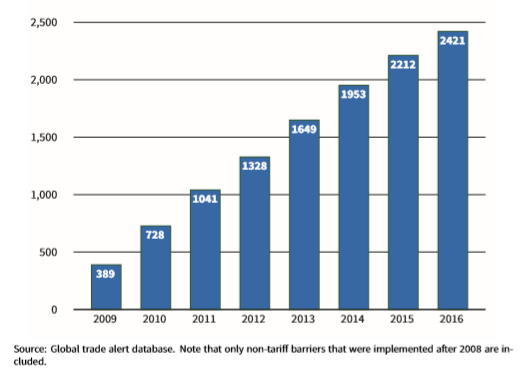
Nor are these “regulatory harmonization” efforts the only sort of nontariff barriers at work. According to this 2017 study,3 these can include domestic subsidies designed to make domestically produced goods more competitive than foreign ones. Other nontariff barriers include straight-up quotas on foreign goods and laws requiring governments procure goods and services only from domestic firms. Given the size of the public sector in many countries—including the US, which heavily employs this type of trade barrier—those kinds of provisions have a sizable impact on international trade.4

Global non-tariff barriers, 2009-2016:

ntb
Source: Erdal Yalcin, Gabriel Felbermayr, Luisa Kinzius, Hidden Protectionism: Non-Tariff Barriers and Implications for International Trade (Munich: Liebniz Institute for Economic Research, 2017), p. 8.​

Of all of these, though, it may be the use of regulatory mandates as a trade barrier that is the most insidious. By requiring trade partners to expand their own regulatory states so as to “harmonize” their legal environments with those of trading partners, trade agreements actually expand the power and jurisdictions of bureaucratic regimes.

Trade Bureaucracy Destroys Innovation and Entrepreneurship in Rich and Poor Countries Alike

Like all trade barriers, this may be a net win for certain interest groups within the country where the state is pressing for greater regulatory mandates. But these measures also cut out much of the benefit of expanded international trade for entrepreneurs and consumers.

For example, imagine a small chain of US restaurants discovers a new much more affordable source of avocados in El Salvador. The restaurant chain then begins to demand more avocados than it could afford to buy before. Farmers in El Salvador start to hire more workers to harvest the avocados and ship them north. The American restaurants then hire more truckers to deliver the avocados and more waiters to serve their customers.

But then it turns out that the El Salvador farmers aren’t paying the workers the wage mandated in the trade agreement between the US and El Salvador. US trade negotiators then demand that the farm owners pay higher wages or submit to a 20 percent tariff. As a result, El Salvador workers are laid off and become once again unemployed. Meanwhile in the US the restaurant chain must scale back its operations and close stores as a result of rising food costs. Had there been real free trade, of course, the workers, the restaurant owners, and the diners would have all been free to produce avocados in a way that everyone could agree on. But then regulators got involved and imposed regulations to make sure Salvadoran workers and farmers weren’t “undercutting” US workers and farmers. The enforcement of these provisions might be a win for certain American farmers and labor unions. But it’s a loss for everyone else.

So much for “free trade.”

Here we see again the dark side of economic integration: what was billed as a lowering of taxes, barriers, and “transaction costs” was in many ways just an expansion of the state’s jurisdiction. We are witnessing something very similar in the Brexit negotiations. The UK is angling for an agreement to facilitate trade, but in the end it may just end up increasing Brussels’s power over British consumers.

Be seeing you


Posted in Uncategorized | Tagged: , , , , , | Leave a Comment »