MCViewPoint

Opinion from a Libertarian ViewPoint

Posts Tagged ‘Fed’

Why Fighting Inflation Is Not a Priority for the Fed | Mises Wire

Posted by M. C. on January 29, 2022

While a few quotes do not define a person, they’re worth paying attention to. I get the impression that these people want to expand the Federal Reserve’s power and believe the threat of inflation pales in comparison to climate change and racial inequities. So, in a world where investing largely revolves around guessing how a group of seven people will choose to arbitrarily tinker with our country’s financial system, I’m betting these folks will stay looser for longer.

https://mises.org/wire/why-fighting-inflation-not-priority-fed

Liam Cosgrove

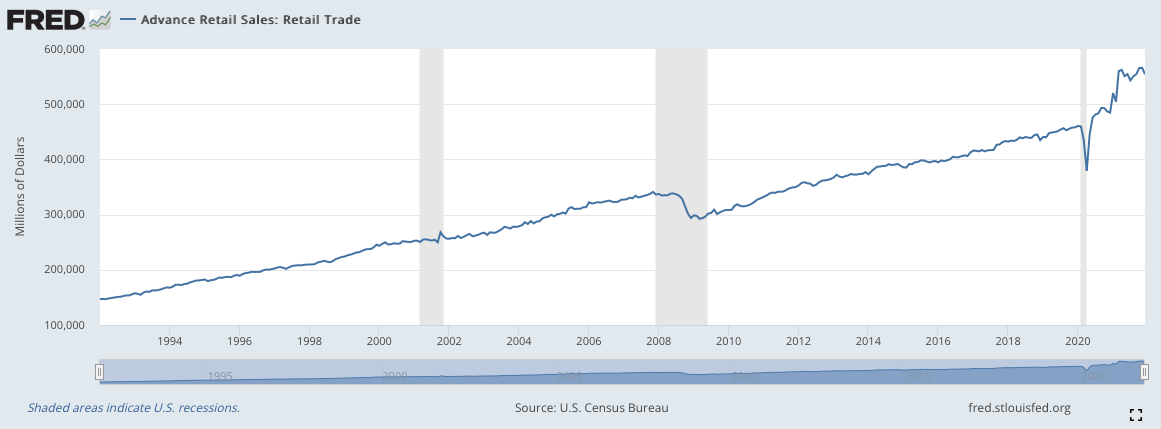
On Wednesday, the Federal Open Market Committee (FOMC) held true to its monetary-tightening timeline despite last week’s 10 percent drawdown in most major indices, effectively saying, “10 percent is not enough.” With retail sales numbers that will surely return to trend without more stimulus (see chart), a gridlocked Senate, and the prospect of higher interest rates surely to discount equity valuations, why aren’t more people selling?

lc

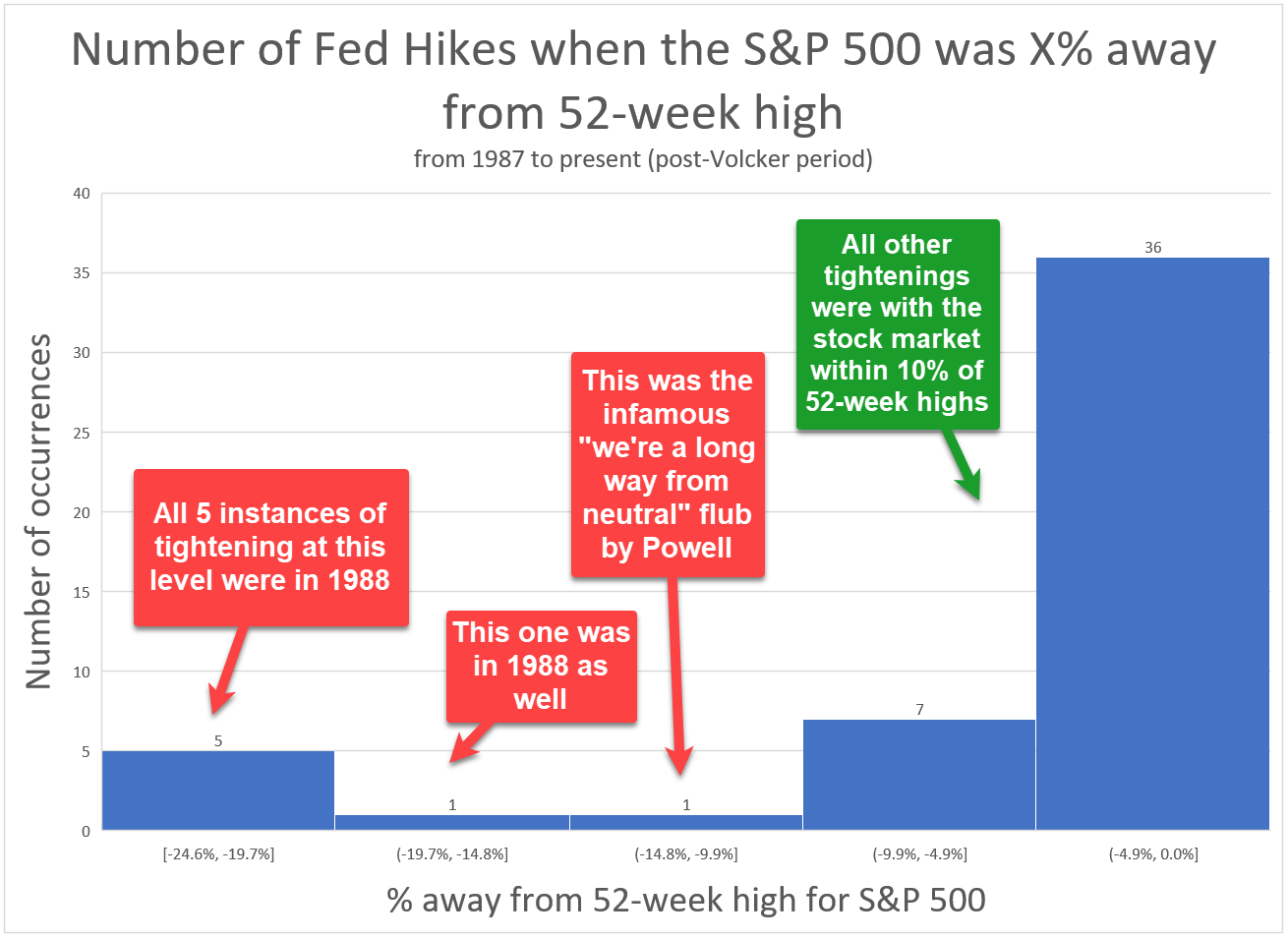
Don’t get me wrong, the Fed will cave eventually, but they just sent a clear message that they need to see more selling. Will they ever make it to “lift off”? This handy chart, courtesy of the Macro Tourist newsletter, can shed some light:

lc2

As you can see, there has been just one rate hike post-1988 during which the S&P 500 was more than 10 percent off its fifty-two-week high. This rate hike was enacted by Jerome Powell and set off the infamous Taper Tantrum episode. So, we have two months before he is faced with this decision again. Suppose the market remains relatively flat or even increases between now and March. Given yesterday’s tolerance and historical precedence, I’d bet on lift off proceeding, which would hurt valuations. Alternatively, if the market continues to decline before the March meeting, historical precedence and Powell’s taper trauma tell us there will likely not be a rate hike in March, which is where things will get interesting. Long story short, markets are going down before they go up. I ask again, Why isn’t everyone selling?

See the rest here

Be seeing you

Posted in Uncategorized | Tagged: , , , | Leave a Comment »

The Fed Has No Real Plan, and Will Likely Soon Chicken Out On Rate Hikes | Mises Wire

Posted by M. C. on January 28, 2022

The idea that “wages are going up” whenever there is inflation is rather fanciful.

https://mises.org/wire/fed-has-no-real-plan-and-will-likely-soon-chicken-out-rate-hikes

Ryan McMaken

The Fed’s Federal Open Market Committee (FOMC) released a new statement today purporting to outline the FOMC’s plans for the next several months. According to the committee’s press release:

With inflation well above 2 percent and a strong labor market, the Committee expects it will soon be appropriate to raise the target range for the federal funds rate. The Committee decided to continue to reduce the monthly pace of its net asset purchases, bringing them to an end in early March. Beginning in February, the Committee will increase its holdings of Treasury securities by at least $20 billion per month and of agency mortgage‑backed securities by at least $10 billion per month. The Federal Reserve’s ongoing purchases and holdings of securities will continue to foster smooth market functioning and accommodative financial conditions, thereby supporting the flow of credit to households and businesses.

The lesson here is that even when inflation is high and the labor market is supposedly strong, the Fed will still only proceed toward tapering and tightening in the slowest, most cautious manner possible.

Although price inflation is at a forty-year high, the Fed is still unwilling to commit to a rate hike in March, and it’s planning to only end new asset purchases for its balance sheet by March. The Fed still refuses to acknowledge any connection between inflation and the incredibly large amounts of money creation and credit creation it fostered over the past decade and especially over the past two years. After all, in its statement, the Fed emphasized that “supply and demand imbalances related to the pandemic and the reopening of the economy have continued to contribute to elevated levels of inflation.”

All of this, however, only amounts to what the Fed is willing to say right now. The “plans” outlined here are no more than the stated, tentative plans for the FOMC. Whether or not any of this actually happens is another matter.

The Fed Is Prepared to Turn More Dovish at the First Sign of Trouble

Indeed, the Fed’s fear and lack of backbone was much more clearly emphasized in Jay Powell’s Q&A with reporters, which followed the release of the FOMC’s statement.

During the presser, Powell repeatedly emphasized that the Fed must remain flexible and that the targeted policies could change at any time, depending on the economic situation. “We need to be adaptable,” he said, and managed to include the typical dovish remarks when he stated that really the current goal with the balance sheet is—at some point—“allowing the balance sheet to begin to run off.” Although the press released mentioned movement toward quantitative tightening for the balance sheet, Powell repeatedly downplayed this in the Q&A.

So, while some news reports covering the Fed’s announcements today appear to conclude that the Fed will surely begin raising rates in March, that remains very much up in the air. And beyond that, the lack of focus on the balance sheet in Powell’s remarks suggested that the Fed is still very much only at the stage of merely contemplating an end to new additions to its portfolio. Actual reductions are still not on the table.

Indeed, it still looks like we’re looking at a repeat of 2016, when the Fed claimed it was going to implement four rate hikes that year. Only one rate hike actually occurred. Anticipated rate hikes based on Fed signals also failed to appear in 2019, when Fed wathers at Goldman and JP Morgan predicted four Fed hikes that year. What actually happened was one rate hike (from 2 percent to 2.25 percent), followed by rate cuts later in the year. That’s likely what Powell is referring to when he says the Fed must be adaptable and flexible. It must be prepared to become even more dovish at any given time.

Déjà vu pic.twitter.com/FWrnPTKUKT— StockCats (@StockCats) January 10, 2022

The Fed Admits Price Inflation Is Actually a Problem

In any case, politically, it is clear that the Fed has been feeling the pressure on price inflation. The Fed has clearly now abandoned its position—expressed repeatedly last fall—that inflation is “transitory” and no big deal. Powell today admitted price inflation “hasn’t gotten better. It’s probably gotten a bit worse … I think to the extent the situation deteriorates further, our policy will have to address that.”

Powell also stated what has long been obvious about price inflation—namely that it hurts the lowest-income people in the population. “Some people are just really prone to suffer more” from inflation, Powell said. He noted that inflation for the wealthy can be unfortunate, but that “it’s particularly hard on people with fixed income and low income.” It’s hard on people with lower incomes, of course, because those people have to spend a higher percentage of their incomes on food, gasoline, and other basic necessities. Many can’t afford to be homeowners—thanks to easy-money-fueled asset price inflation—and so must keep up with rising rents.

This, of course, pours cold water on all those columns from financial columnists in recent months who have been repeatedly penning articles on how price inflation is actually good for most everyone because when there’s inflation, debtors repay their debts in devalued dollars. That narrative, of course, is based on the myth that it’s lopsidedly ordinary people and lower-income people who benefit from devaluing debt payments. In reality, inflation tends to favor people and organizations with more wealth and higher incomes because it’s those people who are most able to access large loans on favorable terms. Much of the time, people with few assets and low incomes can’t get loans at all. Or they can obtain these loans at much higher interest rates which greatly reduce the benefits of paying off debts with devalued dollars.

One example of this is a column by Allison Morrow last month in which she wrote:

But on the whole, inflation can actually be a good thing for many working-class Americans, especially those with fixed-rate debt like a 30-year mortgage. That’s because wages are going up, which not only empowers workers but also gives them more money to pay down debt. Plus, in the case of a mortgage, your monthly payment will be the same but your house will increase in value…

See the rest here

Be seeing you

Posted in Uncategorized | Tagged: , , , , | Leave a Comment »

What the Regime Will Do to Fight Private Digital Currencies | Mises Wire

Posted by M. C. on January 12, 2022

Yes, states have many tools to push the public to use the government’s money. But governments also know there are limits to this and they fear hyperinflationary scenarios. These situations have a tendency to bring extreme political and monetary instability. Cryptocurrencies may help make that fear more acute and immediate. If that’s the case, it’s good news.

https://mises.org/wire/what-regime-will-do-fight-private-digital-currencies

Ryan McMaken

During a confirmation hearing with the US Senate this week, Fed chairman Jerome Powell was asked about whether or not a digital currency issued by a central bank could exist side by side with private cryptocurrencies. Powell responded that there is nothing that would prevent private cryptos from “coexisting” with a “digital dollar.”

This, of course, is obviously true so long as federal regulators do not decide to ban the usage of cryptocurrencies.

Business Insider meanwhile has reported that Powell’s comments “appeared to be a shift” from his earlier comments stating that “you wouldn’t need” cryptocurrencies in a world of central bank digital currencies (CBDCs).

It’s not clear that this is a “shift,” however. Powell’s earlier comments simply communicated Powell’s apparent position that the Fed’s CBDC would be preferred by the users of these currencies. If the central bank’s digital currencies are wonderful, there no “need” to have any other. 

Central Banks Plan to Outcompete Crypto

Indeed, Powell’s two statements on this matter likely reflect the fact that the central bank apparently plans to outcompete private cryptocurrencies. This would be a reasonable goal for the Fed given the central bank’s vast regulatory power and legal privileges. Because the central bank directly regulates banks and is so entrenched in the financial sector overall, it could more easily facilitate a virtually seamless introduction of its own digital currencies into the financial sector and make its digital currency more convenient than others. Moreover, the Congress can use its powers to “encourage” the public to favor the regime’s currency, digital or otherwise. 

Does the Higher-Quality Currency Necessarily Win Out?

This doesn’t worry many supporters of cryptocurrencies, who are generally confident that their currencies are higher quality than anything a central bank can offer. When they say “higher quality” these private crypto backers—especially those backing bitcoin—often mean that their currency cannot be inflated as can fiat currencies. Thus, these private currencies do not lose their value as fiat currencies do. Presumably the public would flock to the higher-quality currency. 

It is debatable, however, whether this sort of quality really determines the use of a currency as a general medium of exchange. Indeed, if anything, experience suggests otherwise, and this has long been seen in the workings of Gresham’s law. When competing against “lower quality”—that is, more inflation-prone—currencies, “higher quality” currencies tend to become hoarded rather than used as money. This is reflected in the “HODL” movement, in which it is assumed that it is better to hold on to cryptos indefinitely rather than convert them into “inferior” assets, whether dollars or anything else. So long as this thinking prevails, it’s difficult to see how a crypto can make the transition to a general medium of exchange—i.e., money. Even if the inferiority of the government’s fiat currency is not in dispute, this does not necessarily lead to widespread use of the “superior” currency for daily use.

How to “Convince” People to Use Fiat Currency

Yet one could also define “quality” as the ease with which one can use a currency. Bitcoin advocates, for instance, have pointed to the relative ease with which bitcoin can be used in purchases without the need for intermediate institutions. Even in this arena, though, inflationary currencies controlled by central banks may nonetheless be competitive, even if inferior in terms of maintaining value.

This, of course, is one of the purposes of issuing new CBDCs. It’s to more fully and directly co-opt and compete with private digital currencies. Presumably, payments using CBDCs need not go through intermediary institutions either. Will these CBDCs be “better” than private digital currencies? Perhaps not by many metrics. But to stay relevant, fiat currencies need not be the best money. They only need to be good enough. Government regulations can do the rest. 

After all, when it comes to propping up the official currency, a regime or central bank has several tools. For one, the regime can continue to make a certain currency legal tender. Contrary to what many believe, this does not force people to use a certain currency for all transactions. Nevertheless, legal tender laws do impel users of money to favor one specific money over others for the repayment of loans and other uses. Moreover, a regime can mandate that tax bills be paid in the currency of the regime’s choosing. Borrowers would continue to pay back loans in devalued dollars—and this would likely include many huge institutional borrowers.

In an inflationary atmosphere, this can continue to offer significant support to at least some use of a currency—or a digital version thereof—even in the face of steeply declining value. Imagine, for example, a world in which every employer must pay withholding taxes in dollars and in which every homeowner must pay property taxes in dollars. Imagine a world in which every commercial and residential real estate lender—lenders heavily regulated by federal policymakers—must accept repayment in depreciating dollars. This is no small advantage for a currency—even one in decline. 

Using Coercion to Protect Fiat Currency

And then there are more crude methods of protecting the official currency. Beyond legal tender laws, the regime could use the tax code to punish the use of private currencies in other ways. Charging capital gains taxes on alternative money is just one method. Regimes have been known to become quite creative when it comes to punitive taxes against activities the regime does not like.

There is also always the “nuclear option,” which is banning these currencies altogether. Let it never be forgotten that the US regime once banned the private ownership of gold bullion, punishable by draconian fines and by imprisonment. 

None of this contradicts economic arguments that in an unhampered market, certain private cryptocurrencies are far superior to fiat money in terms of value retention. Those are economic questions, though. The political questions are different, and once government regimes become involved, the calculus can change considerably. States have long jealously guarded their prerogatives over the money supply and are likely to resort to any number of violent, dangerous, or risky policies when these privileges are threatened. 

But What If the Regime’s Money Hyperinflates?

On the other hand, states, with all their vast coercive power, sometimes lose their ability to ensure the continued usage of the state’s official currency.

As Daniel Lacalle recently noted, sometimes a government’s currency ceases to be money altogether:

If the private sector does not accept this currency as a unit of measure, a generalized means of payment, and a store of value backed by reserves and demand from the mentioned private sector, the currency becomes worthless and ceases to be money. Ultimately, it becomes useless paper.

This happens when a currency devalues so completely and so rapidly, that neither convenience nor legal status can save the currency’s status as money.

Extreme hyperinflation, however, appears to be the only scenario—short of big ideological changes undermining the state overall—under which a private cryptocurrency is likely to become the general medium of exchange. Government currencies would likely have to implode and not just slowly depreciate at a rate of, say, 5 or 10 percent per year. It has already been demonstrated for more than a century that deflationary fiat currencies can go on for many decades so long as inflation rates are within what the public considers to be a tolerable range. Unfortunately, the public also appears to have a high threshold for what is tolerable. 

The Importance of a Competing Store of Value

But even if regimes manage to prop up their currencies indefinitely, the existence of cryptocurrencies nonetheless has the potential for offering a valuable service. That is, the existence of private cryptocurrencies could work to force greater discipline on regimes in terms of deficit spending and other activities that lead to the debasement of government currencies. If users of fiat currency can more easily flee to some other store of value, this will put greater pressure on inflationary currency and force regimes to think twice about indulging in high levels of deficit spending and the all-but-inevitable money printing that follows. That is, if savers can easily sit on their savings in some form other than fiat currencies, this raises the political risk to regimes in terms of triggering dangerously high inflation rates. This means cryptocurrencies could serve a helpful political function even if they don’t lead to a scenario in which government fiat currencies are fully abandoned any time in the foreseeable future.

Yes, states have many tools to push the public to use the government’s money. But governments also know there are limits to this and they fear hyperinflationary scenarios. These situations have a tendency to bring extreme political and monetary instability. Cryptocurrencies may help make that fear more acute and immediate. If that’s the case, it’s good news.

Author:

Contact Ryan McMaken

Ryan McMaken is a senior editor at the Mises Institute. Send him your article submissions for the Mises Wire and Power and Market, but read article guidelines first.

Be seeing you

Posted in Uncategorized | Tagged: , , , , | Leave a Comment »

Watch “Don’t Be Deceived: The Fed Is The Main Culprit of Rising Prices” on YouTube

Posted by M. C. on October 24, 2021

By creating many trillions of new dollars out-of-thin-air, the Federal Reserve set in motion an economic disaster. The warnings are over. Infation is now here. Every excuse imaginable will be offered up as “reasons” for the economic pain. Don’t be deceived. The unconstitutional Federal Reserve is the problem.

https://youtu.be/pNBFgc0N2TM

Be seeing you

Posted in Uncategorized | Tagged: , | Leave a Comment »

Corruption at the Fed: Are America’s Money Masters Engaged in Self-Dealing? | The Libertarian Institute

Posted by M. C. on September 29, 2021

Documents revealed that Dallas Fed President Robert Kaplan and Boston Fed President Eric Rosengren made several trades of individual stocks, in some cases worth $1 million or more, in markets where Fed actions have impacted financial performance.

Additionally, several Fed officials personally held the same type of assets the Fed itself was buying.

https://libertarianinstitute.org/articles/corruption-at-the-fed-are-americas-money-masters-engaged-in-self-dealing/

by Jp Cortez

America’s central bankers are tasked with impartial oversight over aspects of the American economy. But could these individuals be making decisions on interest rates and bailout operations based on what is best for their own personal investment portfolios?

After some embarrassing revelations regarding the trading activities of two senior officials, Federal Reserve Chairman Jerome Powell abruptly ordered a comprehensive examination last week into internal compliance with an ethics rule directing Fed employees to avoid “actual and apparent conflicts of interest.”

According to the Fed’s official code of conduct, Fed officials are “prohibited from participating personally and substantially in an official capacity in any particular matter in which, to the employee’s knowledge, the employee has a financial interest if the particular matter will have a direct and predictable effect on that interest.”

Documents revealed that Dallas Fed President Robert Kaplan and Boston Fed President Eric Rosengren made several trades of individual stocks, in some cases worth $1 million or more, in markets where Fed actions have impacted financial performance.

Additionally, several Fed officials personally held the same type of assets the Fed itself was buying.

According to CNBC, Chairman Powell held between $1.25 and $2.5 million of municipal bonds. The bonds were purchased in 2019 but they were in Chairman Powell’s control while the Fed bought more than $5 billion in municipal bonds to support that market.

Fed President Rosengren held between $151,000 and $800,000 worth of real-estate investment trusts that owned mortgage-backed securities – all while the Fed was active in that market.

More specifically, Rosengren made as many as 37 separate trades in four investment trusts contemporaneous to the Fed’s own purchase of almost $700 billion in mortgage-backed securities.

Meanwhile, the Federal Reserve announced last year that it would open a corporate bond-buying facility and purchased almost $47 billion of corporate bonds.

Rosengren wasn’t the only Fed official making money on corporate bonds. CNBC noted that Richmond Fed President Thomas Barkin held $1.35 million to $3 million in individual corporate bonds of Pepsi, Home Depot, and Eli Lilly purchased before 2020.

And according to Reuters, Fed President Kaplan’s financial disclosure included several sales or purchases of at least $1 million in individual company shares or investment funds, including Apple Inc. (a stock that’s almost doubled since COVID-relief efforts began in March 2020). In July 2020, the Federal Reserve bought $25.5 million in Apple’s corporate bonds.

So far it’s undetermined whether the above trades violated Fed ethics rules. But to outside observers, it certainly stinks.

America’s central bank exists, ostensibly, to foster price stability and maximum sustainable employment.

In their often misguided and even harmful attempts to monkey with financial asset prices, Fed officials constantly pull different levers of monetary policy and wield an inordinate amount of power over markets and financial institutions.

The potential for conflicts of interest when concentrating such financial power in the hands of a few individuals has always been obvious. Indeed, central bank senior officials may have exercised their power, in part, to increase their personal wealth.

Following disclosures of their trading and the subsequent public backlash, Fed Presidents Kaplan and Rosengren both agreed to divest any holdings of individual stocks by Sept. 30.

However, this half measure hasn’t assuaged the critics, who point out the ongoing market interventions by the Federal Reserve have disproportionately benefited owners of assets while the Fed’s resulting price inflation in foodhousing, and medicine have especially hurt savers, wage earners, and pensioners.

Far from achieving their supposed goal of creating price stability, Fed officials seem to have deliberately engineered widespread price increases and inflated potentially dangerous bubbles in asset markets.

Turning to sound money would ensure the purchasing power of Americans isn’t sapped away by bureaucrat bankers with ulterior motives.

Unlike the central bankers’ depreciating fiat currencies, physical gold and silver are incorruptible, free-market forms of money that retain their purchasing power over time.

This article was originally featured at Money Metals

Be seeing you

Posted in Uncategorized | Tagged: , , , | Leave a Comment »

Why the Fed Is So Desperate to Hide Price Inflation

Posted by M. C. on September 9, 2021

Otherwise, as noted earlier, rising interest rates would collapse the debt pyramid and result in a collapse in output and employment. It is, therefore, no wonder that the Fed is doing whatever it can to hide the inflationary consequences of its policy from the public:

Thorsten Polleit

Speaking at the Jackson Hole meeting on August 27, 2021, Federal Reserve (Fed) chairman Jerome J. Powell indicated that he supported “tapering” toward the end of this year and hastened to add that interest rate hikes are still a long way off. The term “tapering” means that the central bank reduces its monthly purchases of bonds and slows down the monthly increase in the quantity of money accordingly. In other words, even with tapering, the Fed will still churn out newly printed US dollar balances, but to a lesser extent than before; that is, it will still cause monetary inflation, but less than before. 

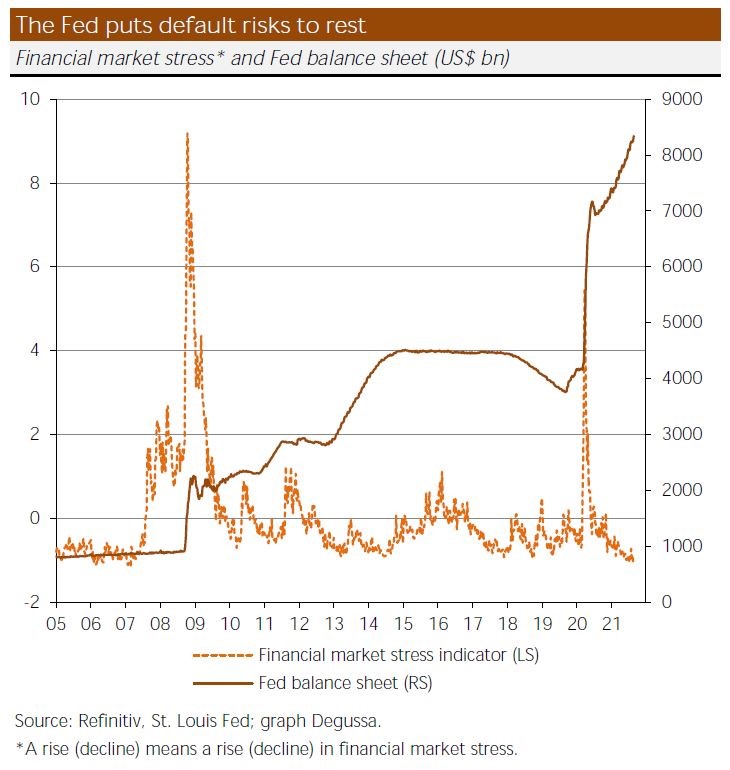
Financial markets were not alarmed by the Fed’s announcement that it might take its foot off the accelerator pedal a little: ten-year US Treasury yields are still trading at a relatively low level of 1.3 percent, the S&P 500 stock index hovers around record highs. Could it be that investors do not believe in the Fed’s suggestion that tapering will begin soon? Or is tapering of much lower importance for financial market asset prices and economic activity going forward than we think? Well, I believe the second question nails it. To understand this, we need to point out that the Fed has put a “safety net” under financial markets.

As a result of the politically dictated lockdown crisis in early 2020, investors feared a collapse of the economic and financial system. Credit markets, in particular, went wild. Borrowing costs skyrocketed as risk premiums rose drastically. Market liquidity dried up, putting great pressure on borrowers in need of funding. It wasn’t long before the Fed said it would underwrite the credit market, that it would open the monetary spigots and issue all the money needed to fund government agencies, banks, hedge funds, and businesses. The Fed’s announcement did what it was supposed to do: credit markets calmed down. Credit started flowing again; system failure was prevented.

tp

In fact, the Fed’s creation of a safety net is nothing new. It is perhaps better known as the “Greenspan put.” During the 1987 stock market crash, then Fed chairman Alan Greenspan lowered interest rates drastically to help stock prices recover—and thus set a precedent that the Fed would come to rescue in financial crises. (The term “put” describes an option which gives its holder the right, but not the obligation, to sell the underlying asset at a predetermined price within a specified time frame. However, the term “safety net” might be more appropriate than “put” in this context, as investors don’t have to pay for the Fed’s support and fear an expiry date.)

The truth is that the US dollar fiat money system now depends more than ever on the Fed to provide commercial banks with sufficient base money. Given the excessively high level of debt in the system, the Fed must also do its best to keep market interest rates artificially low. To achieve this, the Fed can lower its short-term funding rate, which determines banks’ funding costs and thus bank loan interest rates (although the latter connection might be loose). Or it can buy bonds: by influencing bond prices, the central bank influences bond yields, and given its monopoly status, the Fed can print up the dollars it needs at any point in time.

Or the Fed can make it clear to investors that it is ready to fight any form of crisis, that it will bail out the system “no matter the cost,” so to speak. Suppose such a promise is considered credible from the financial market community’s point of view. In that case, interest rates and risk premiums will miraculously remain low without any bond purchases on the part of the Fed. And it is by no means an exaggeration to say that putting a safety net under the system has become perhaps the most powerful policy tool in the Fed’s bag of tricks. Largely hidden from the public eye, it allows the Fed to keep the fiat money system afloat.

The critical factor in all this is the interest rate. As the Austrian monetary business cycle theory explains, artificially lowering the interest rate sets a boom in motion, which turns to bust if the interest rate rises. And the longer the central bank succeeds in pushing down the interest rate, the longer it can sustain the boom. This explains why the Fed is so keen to dispel the notion of hiking interest rates any time soon. Tapering would not necessarily result in an immediate upward pressure on interest rates—if investors willingly buy the bonds the Fed is no longer willing to buy, and/or if the bond supply declines.

But is it likely that investors will remain on the buy side? On the one hand, they have a good reason to keep buying bonds: they can be sure that in times of crisis, they will have the opportunity to sell them to the Fed at an attractive price; and that any bond price decline will be short lived, as the Fed will correct it quickly. On the other hand, however, investors demand a positive real interest rate on their investment. Smart money will rush to the exit if nominal interest rates are persistently too low and expected inflation persistently too high. The ensuing sell-off in the bond market would force the Fed to intervene to prevent interest rates from rising.

Otherwise, as noted earlier, rising interest rates would collapse the debt pyramid and result in a collapse in output and employment. It is, therefore, no wonder that the Fed is doing whatever it can to hide the inflationary consequences of its policy from the public: the steep rise in consumer goods price inflation is being dismissed as only “temporary”; asset price inflation is said to be outside the policy mandate, and the impression is given that increases in stock, housing, and real estate prices do not represent inflation. Meanwhile, the increase in the money supply—which is the root cause of goods price inflation—is barely mentioned.

However, once people begin to lose confidence in the Fed’s willingness and ability to keep goods price inflation low, the “safety net trickery” reaches a crossroads. If the Fed then decides to keep interest rates artificially low, it will have to monetize growing amounts of debt and issue ever-larger amounts of money, which, in turn, will drive up goods price inflation and intensify the bond sell-off: a downward spiral begins, leading to a possibly severe devaluation of the currency. If the Fed prioritizes lowering inflation, it must raise interest rates and reign in money supply growth. This will most likely trigger a rather painful recession-depression, potentially the biggest of its kind in history.

Against this backdrop, it is difficult to see how we could escape the debasement of the US dollar and the recession. It is likely that high, perhaps very high, inflation will come first, followed by a deep slump. For inflation is typically seen as the lesser of two evils: rulers and the ruled would rather new money be issued to prevent a crisis over allowing businesses to fail and unemployment to surge dramatically—at least in an environment where people still consider inflation to be relatively low. There is a limit to the central bank’s machinations, though. It is reached when people start distrusting the central bank’s currency and dumping it because they expect goods price inflation to spin out of control.

But until this limit is reached, the central bank still has quite some leeway to continue its inflationary policy and increase the damage: debasing the purchasing power of money, increasing overconsumption and malinvestment, and making big government even bigger, effectively creating a socialist tyranny if not stopped at some point. So, better stop it. If we wish to do so, Ludwig von Mises (1881–1973) tells us how: “The belief that a sound monetary system can once again be attained without making substantial changes in economic policy is a serious error. What is needed first and foremost is to renounce all inflationist fallacies. This renunciation cannot last, however, if it is not firmly grounded on a full and complete divorce of ideology from all imperialist, militarist, protectionist, statist, and socialist ideas.”1

  • 1. Ludwig von Mises, “Stabilization of the Monetary Unit–from the Viewpoint of Theory (1923),” in The Cause of the Economic Crisis. And Other Essays before and after the Great Depression, edited by Percy L. Greaves Jr. (Auburn, AL: Ludwig von Mises Institute, 2006), p. 44, appendix.

Author:

Thorsten Polleit

Dr. Thorsten Polleit is Chief Economist of Degussa and Honorary Professor at the University of Bayreuth. He also acts as an investment advisor.

Be seeing you

Posted in Uncategorized | Tagged: , , , , , , | Leave a Comment »

The Smart Money Has Already Sold – LewRockwell

Posted by M. C. on August 21, 2021

Generations of punters have learned the hard way that their unwary greed is the tool the Smart Money uses to separate them from their cash and capital. The tricks outlined in Reminiscences of a Stock Operator may have changed over time, but the game of selling at the top while stretching out the top to enable massive selling without moving markets is very much alive and well.

https://www.oftwominds.com/blogaug21/smart-money-sold8-21.html

Charles Hugh Smith

Generations of punters have learned the hard way that their unwary greed is the tool the ‘Smart Money’ uses to separate them from their cash and capital.

The game is as old as the stock market: the Smart Money recognizes the top is in, and in order to sell all their shares, they need to recruit bagholders to buy their shares and hold them all the way down. Once the catastrophic losses have been taken by the bagholders, then the Smart Money slowly builds up positions amidst the wreckage.

It’s easy to become a bagholder; all you need is greed. Been there, done that, for the siren songs luring bagholders to their ruin are compelling and numerous. The Smart Money doesn’t have to mislead anyone; all they do is let the strident super-Bulls talk up the riches to be had by all those who buy today and hold indefinitely, and human greed does the rest.

Siren songs to lure the unwary greedy include these classics:

1. The Fed has our back, i.e. the Fed will never let stocks go down, so there’s no risk in buying more shares today.

2. Innovation stocks can only go higher as they create new industries that are the future of the economy.

3. Institutional buyers are coming in, and that means prices can only go higher.

4. This is a new era, old measures of valuation no longer matter.

5. Over time, stocks only go higher, so buy and hold is the winning strategy.

The greatest ally of the Smart Money is buy the dip, as the bagholders trained to buy the dip will continue buying every dip on the way down until their capital is expended. Bagholders see every rally off a dip as proof buy the dip works, when every rally off a dip has been engineered to suck in bagholders.

Every rally is another opportunity to sell for the Smart Money.

The greatest hindrance to the Smart Money selling is low volume. The main point of selling is to dribble out shares in such modest doses that the price doesn’t move. If a big block of shares is dumped all at once, then the price collapses in low-volume markets. So the Smart Money sells slowly and methodically, transferring 100 million shares over time to a million bagholders who each buy 100 shares.

When questioned, the Smart Money prevaricates with generalities rather than show their hands. The market is “constructive” and “supportive of equities,” etc., meaningless terms intended to mask their steady selling and lull the bagholders into a false confidence in the Fed, innovation leaders, buy the dip, this time it’s different, etc.

The Smart Money can count on one thing: greed is sticky. Once a bagholder has decided that Innovation-XYZ is their one-way ticket to unearned wealth–just look at all the newly minted millionaires who did nothing but trade call options in Innovation-XYZ–then the Smart Money knows the bagholder will never let go of that belief until there’s no more money to throw into call options.

Generations of punters have learned the hard way that their unwary greed is the tool the Smart Money uses to separate them from their cash and capital. The tricks outlined in Reminiscences of a Stock Operator may have changed over time, but the game of selling at the top while stretching out the top to enable massive selling without moving markets is very much alive and well.

Be seeing you

Posted in Uncategorized | Tagged: , , , , | 1 Comment »

NO RESERVE REQUIREMENT: The Fed will replace fractional reserve banking with NO RESERVE BANKING and 0% interest rates. Thousands of banks now free to create limitless amounts of loans without any reserves.

Posted by M. C. on August 15, 2021

Oops, missed this one from a year and a half ago.

Banks can lend out all savings holding nothing in reserve to fund withdrawals. If your bank goes belly up, can there be a bank run if there is nothing to run with?

https://www.investmentwatchblog.com/no-reserve-requirement-the-fed-will-replace-fractional-reserve-banking-with-no-reserve-banking-and-0-interest-rates-thousands-of-banks-now-free-to-create-limitless-amounts-of-loans-without-any-reser/

Historically, banks are required to keep 10% of their loaned-out capital in reserves. However, the Fed just took an extraordinary step of reducing that to 0%.

Banks no longer to keep any assets in reserve. This will turn a house of cards into a gargantuan palace of cards.

See the rest here

Be seeing you

Posted in Uncategorized | Tagged: , , , | Leave a Comment »

Central Planners Don’t Have A Clue, So Don’t Trust The Fed

Posted by M. C. on August 7, 2021

Central planning always fails, without exception. Civilization is never created from a blueprint developed in the imaginations of a few elitists. In fact, it’s the exact opposite. Civilization is always destroyed by central planners. So why do people constantly find themselves suffering under the yolk of utopians, when the only possible endgame is failure?

Central Planning = distortion and disaster

Be seeing you

Posted in Uncategorized | Tagged: , , , , , | Leave a Comment »

The US Housing Bubble Visualized – LewRockwell

Posted by M. C. on July 31, 2021

Sell now, buy later.

https://www.lewrockwell.com/2021/07/no_author/the-us-housing-bubble-visualized/

By Bern in Williamsburg, VA

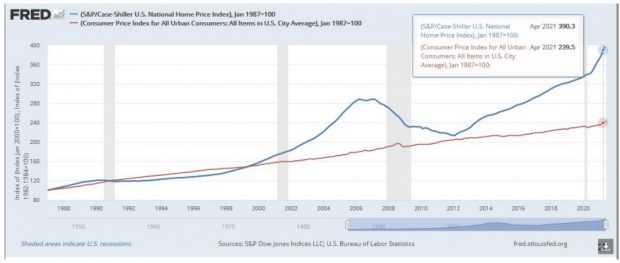
Take a look at what the FED’s manipulation of interest rates has done to housing prices.  The chart below is from the data on their own website.  It’s in real dollars and the indices synch perfectly.  The USA is currently in the biggest housing bubble of all time.  A “correction” in the stock market will bring down housing also.  It’s going to be a mess.  And it could have been avoided if only there was “honest” money management at the FED.

I also downloaded the data and added a regression line for the Case Shiller Index.  It’s just another way to visualize the bubble we’re in.  I’ve given up on buying a house now because I don’t want to own a property that will be significantly underwater when housing corrects.  There’s no way that “normal” inflation can explain these prices.  It’s all been done by the dishonest policies of the FED serving their own interests and their banking clients.

Keep plugging away……..

Be seeing you

Posted in Uncategorized | Tagged: , , , | Leave a Comment »