MCViewPoint

Opinion from a Libertarian ViewPoint

Posts Tagged ‘inflation’

Do People Accept Money Because Government Endorses It?

Posted by M. C. on September 24, 2022

Money must emerge as a commodity because something can be demanded as a medium of exchange only if it has a pre-existing barter demand.

https://mises.org/wire/do-people-accept-money-because-government-endorses-it

Frank Shostak

Demand for goods arises because of perceived benefits. For instance, individuals demand food because it nourishes them. This is not so, however, about pieces of paper we call money, so why do we accept them?

According to Plato and Aristotle, the acceptance of money is a historical fact endorsed by government decree. It is government decree, so it is argued, that makes a particular thing accepted as the general medium of the exchange. Carl Menger, however, doubted the soundness of that view, writing:

An event of such high and universal significance and of notoriety so inevitable, as the establishment by law or convention of a universal medium of exchange, would certainly have been retained in the memory of man, the more certainly inasmuch as it would have had to be performed in a great number of places. Yet no historical monument gives us trustworthy tidings of any transactions either conferring distinct recognition on media of exchange already in use, or referring to their adoption by peoples of comparatively recent culture, much less testifying to an initiation of the earliest ages of economic civilization in the use of money.

Why Conventional Demand—Supply Analysis Fails to Explain the Price of Money

How does something the government proclaims become the medium of the exchange, acquiring value? We know that the price of a good is the result of the interaction between demand and supply. From this, we could reach a conclusion that the price of money is also set by the laws of demand and supply.

While demand for goods emerges because of perceived benefits, people demand money because of its purchasing power with respect to various goods. The demand for money depends upon the purchasing power of money while the purchasing power of money depends on the demand for money.

We are caught in a circular trap. (The demand for money is dependent on its purchasing power while the purchasing power is dependent for a given supply on the demand for money). The circularity seems to vindicate the view that the acceptance of money is the result of the government decree.

Mises Supports Menger’s Insight

Ludwig von Mises’s regression theorem supports Menger’s insights. Mises not only solved the money circularity problem, but he also confirmed Carl Menger’s view that money didn’t come from a government decree.

See the rest here

Be seeing you

Posted in Uncategorized | Tagged: , , , | 1 Comment »

The Fed’s “Full Employment” Mandate Is a Mandate for Inflation

Posted by M. C. on September 21, 2022

Over time, repeated referenced to “the dual mandate” were really just calls for continued activist monetary policy and even for the wildly experimental “unconventional monetary policy” employed after 2008. 

  • board

https://mises.org/wire/feds-full-employment-mandate-mandate-inflation

Ryan McMaken

In recent years, Congress has attempted to add various new mandates to the Federal Reserve’s mission. In 2020, Democrats introduced the “Federal Reserve Racial and Economic Equity Act.”  Then, in 2021, pundits and politicians were telling us that it’s the Fed’s job to “combat climate change.” These are just the latest efforts to use the enormously powerful central bank to achieve political ends to the liking of elected officials.

This is a helpful reminder, of course, that the Fed is not independent from politics. The Federal Reserve has never been politically independent, and it certainly isn’t so now. Fed independence is a fairy tale academic economists like to tell their students. The debate over new mandates has also highlighted the fact the Fed already has no fewer than three mandates explicitly written into law: moderate long term interest rates, maximum employment, and stable prices

In practice, however, the Fed has only two mandates because the Fed is so limited in what it can do to target long term interest rates in a global marketplace. This has led to what is now a de facto “dual mandate.” 

This dual mandate is now all about maximizing employment while also maintaining “stable prices.” What this all means is never precisely spelled out in policy or law. It also changes over time. zero-percent CPI inflation was once the goal. Now the goal is the arbitrary two-percent standard. Similarly, what is meant by “maximum employment” is subject to the arbitrary definition of “full employment.”

In any case, it has been the view of central bankers for decades that one of the easiest ways to “maximize” employment is to embrace accommodative monetary policy. This, however, works counter to the mandate of stable prices by inflating the money supply. This leads to price inflation in the medium to long term. 

So, the two mandates are essentially at odds. So which half of the mandate to focus on or emphasize? That’s up to the Fed. 

In practice, however, experience suggests that the Fed tends strongly toward embracing the “maximum employment” side of the equation. Time and time again, central bankers have chosen to downplay the stable-prices mandate and embrace expansive monetary policy. 

How the Fed Favors Maximum Employment 

As a de facto instrument of the federal government, Federal Reserve policy tends to focus on what the federal government focuses on. So, the Fed was moved in the direction of greater focus on employment with the passage of the Employment Act of 1946. The Act stated

The Congress hereby declares that it is the continuing policy and responsibility of the federal government to use all practicable means consistent with its needs and obligations and other essential considerations of national policy with the assistance and cooperation of industry, agriculture, labor, and state and local governments, to coordinate and utilize all its plans, functions, and resources for the purpose of creating and maintaining, in a manner calculated to foster and promote free and competitive enterprise and the general welfare, conditions under which there will be afforded useful employment for those able, willing, and seeking work, and to promote maximum employment, production, and purchasing power.

Although highly controversial at the time, the belief that the federal government ought to intervene to maximize employment—whether through fiscal or monetary policy—became well accepted over time. In terms of Fed policy following the adoption of the act, Allan Meltzer—author of a huge history of the Federal Reserve—concludes that “Interpretations of the 1946 Employment Act usually emphasized primacy of full employment.” In other words, the bias was in favor of easy money and intervention designed to stimulate the economy so as to ensure higher employment numbers. 

See the rest here

Be seeing you

Posted in Uncategorized | Tagged: , , , | 1 Comment »

Looking at the Economic Myth of the “Soft Landing”

Posted by M. C. on September 14, 2022

If inflation is defined as increases in the money supply rather than increases in prices, then it becomes clear that all that is required to counter it is to close all the loopholes for the generation of money out of “thin air.” The increases in the money supply and not increases in prices inflict damage to the wealth generation process.

Originally, paper money was not regarded as money but merely as a representation of gold. Various paper money receipts represented claims on gold stored with the banks. The holders of paper receipts could convert them into gold whenever they deemed necessary. Because people found it more convenient to use paper receipts to exchange for goods and services, these receipts came to be regarded as money itself.

https://mises.org/wire/looking-economic-myth-soft-landing

Frank Shostak

According to commentators, countering inflation requires monetary authorities to actively restrain the economy, with “experts” believing that higher interest rates need not cause an economic slump. Instead, they believe that the Fed cab orchestrate a “soft landing.” It is questionable, however. that a soft-landing scenario is possible.

Money Printing Creates Economic Damage

If inflation is defined as increases in the money supply rather than increases in prices, then it becomes clear that all that is required to counter it is to close all the loopholes for the generation of money out of “thin air.” The increases in the money supply and not increases in prices inflict damage to the wealth generation process.

Originally, paper money was not regarded as money but merely as a representation of gold. Various paper money receipts represented claims on gold stored with the banks. The holders of paper receipts could convert them into gold whenever they deemed necessary. Because people found it more convenient to use paper receipts to exchange for goods and services, these receipts came to be regarded as money itself.

By fulfilling the role of the medium of exchange, money enables something to be exchanged for it and this, in turn, enables the received money to be exchanged for something else, also by means of money. If the receipts for gold that are accepted as genuine money are backed by gold. there will be an honest exchange—i.e., something for something or wealth for wealth.

In contrast, receipts not backed by gold, which are employed in an exchange, set in motion an exchange of nothing for something. The unbacked receipts are not proper money, which is gold. By means of the unbacked by gold receipts, goods are diverted from wealth generators to the holders of the unbacked by gold receipts. This in turn weakens wealth generators and in turn weakens the process of wealth formation.

See the rest here

Be seeing you

Posted in Uncategorized | Tagged: , , , | Leave a Comment »

Inflation, the Price Level, and Economic Growth: Everything the Elites Tell You about It Is Wrong

Posted by M. C. on September 9, 2022

Inflation is not a product of corporate greed or rising wages. It is a fraud perpetrated by government authorities that impoverishes average people while enriching elites.

In the late nineteenth century both the UK and America had strict gold standards and declining price levels. This was also the period of greatest relative advancement in economic history, when both countries asserted themselves as truly industrialized economies, and the most powerful nations in the world.

https://mises.org/wire/inflation-price-level-and-economic-growth-everything-elites-tell-you-about-it-wrong

J.R. MacLeod

Fundamentally, inflation is fraud. The central government or bank printing more money lessens the value of the money already in circulation. A truckload of sand isn’t particularly valuable in Saudi Arabia. An increased supply of money means ultimately that prices denominated in that money will go up. Unless you are the one to receive that new money at its point of entry, and thus keep pace with the inflation, the real value of your money holdings will go down.

So, in essence the government has taken wealth from you, and offered nothing in return, except the vague promise that the inflation will grow the economy, from which you will subsequently benefit. As we will show in this article, that is a false promise that has never once worked, and there is plentiful evidence against it ever working. Fortunately, there is another way.

If inflation is a fraud on the general populace in that its false promise of improved growth rings hollow time after time, it is more specifically a fraud on ordinary working people. When new money is created it enters the economy through the government, financial, and corporate sectors. The distributors and initial recipients of this new money obtain it before prices go up, in fact prices are then driven up by their spending of the new money. Those responsible for the inflation are thus ahead of it.

Ordinary people, however, are behind the inflation. The new money only works its way to them after prices have already increased. And if the inflation is continuous, then they are already behind the next wave of money printing and price increases.

Even if there is a limited burst of inflation which is then totally halted, the elite still benefit at ordinary people’s expense. The new money is printed, the first holders spend it when prices are still low, this spending drives up prices, the money then works its way through the economy in a more general distribution, and ordinary people are right back where they started: with higher nominal wages but having to pay higher nominal prices too. Meanwhile the elite gained increased real purchasing power at the beginning, without doing anything to earn it, instead just having the right connections to obtain the newly printed cash.

Thus, inflation can only ever benefit the elite at the expense of ordinary people. Which is hardly surprising given the revolving door between the federal reserve and the financial sector. The same people who control the power of inflation are the ones who can directly benefit from it.

However, inflation is completely unnecessary for a growing and prosperous economy. Under a strict gold standard, inflation, defined by Mises as the printing of money by a government entity, does not take place. Thus the only way price inflation, or more aptly, price increases, can take place are due to natural economic or environmental factors and government folly other than inflation.

Though there may be price increases in specific areas, under a strict gold standard the guaranteed general trend is for price decreases. How so? If the government isn’t printing money, then prices are dictated fully by the market. In a free-market competition and innovation drive prices down. To stay in business, firms must make a profit; to make a profit, they have to attract customers; to attract customers, they have to offer higher quality products at a lower price than their competitors.

This process has taken place consistently throughout economic history. Take, for example, the pocket calculator. Free inquiry and the ability to make a profit led to the innovation of the first commercially available calculators. Initially they are very expensive as a cutting-edge product. However, over time the price came down as near universal demand for the product combined with the effective resource marshaling of a free and competitive market made pocket calculators widely available at a low price.

And yet despite a lowering of prices, economic growth has occurred, as more people have a new and useful product in their hands. Furthermore, at the same time the price came down, competition led to the product becoming sleeker and more powerful.

Inflation is pursued as a fundamental misconception of the nature of wealth and economic growth. Money is not wealth, printing more money does not lead to a growth in the real economy. Were all those trillionaires in Zimbabwe in the mid-2000s wealthy, even though in real terms they could purchase fewer goods than in previous eras? Why was their economy declining if they were printing so much money?

Rather, wealth and growth are defined by the standard of living. While this has a subjective component, common sense can inform us of some objective ways to gauge an individual’s material well-being.

Inflation is not necessary for real wealth and real growth. These things are obtained by producing more goods and services available at the lowest cost. A declining general price level takes place as a consequence of true economic growth and wealth generation.

It is logically impossible that under a strict gold standard with no inflation, combined with a free market in goods and services, there could be any situation other than economic growth at the same time as a declining price level. But this is also backed up by the empirical record.

In the late nineteenth century both the UK and America had strict gold standards and declining price levels. This was also the period of greatest relative advancement in economic history, when both countries asserted themselves as truly industrialized economies, and the most powerful nations in the world.

See here, for example. Or, for a lengthier (yet still pleasantly concise) discussion of this subject, see George A. Selgin, “Less than Zero: The Case for a Falling Price Level in a Growing Economy

Be seeing you

Posted in Uncategorized | Tagged: , , , | Leave a Comment »

Fed Paper Admits Central Bank Can’t Control Inflation; Finger-Points At Federal Government

Posted by M. C. on September 1, 2022

Tyler Durden's Photo

BY TYLER DURDEN

THURSDAY, SEP 01, 2022 – 07:20 AM

Authored by Michael Maharrey via SchiffGold.com,

First, the authors acknowledge that the federal government uses inflation as a tool to handle its debt. In other words, it acknowledges that we’re all paying an inflation tax.

Second, the paper concedes that merely tinkering with interest rates won’t slay inflation if the government continues to spend far beyond its means.

https://www.zerohedge.com/markets/fed-paper-admits-central-bank-cant-control-inflation-finger-points-federal-government

It appears somebody at the Federal Reserve has figured out that the central bank can’t tame inflation, so it’s setting up a scapegoat – Uncle Sam…

A paper co-authored by Leonardo Melosi of the Federal Reserve Bank of Chicago and John Hopkins University economist Francesco Bianchi and published by the Kansas City Federal Reserve argues that central bank monetary policy alone can’t control inflation.

The paper’s abstract asserts, “This increase in inflation could not have been averted by simply tightening monetary policy.”

In a nutshell, Melosi and Bianchi argue that the Fed can’t control inflation alone.

US government fiscal policy contributes to inflationary pressure and makes it impossible for the Fed to do its job.

Trend inflation is fully controlled by the monetary authority only when public debt can be successfully stabilized by credible future fiscal plans. When the fiscal authority is not perceived as fully responsible for covering the existing fiscal imbalances, the private sector expects that inflation will rise to ensure sustainability of national debt. As a result, a large fiscal imbalance combined with a weakening fiscal credibility may lead trend inflation to drift away from the long-run target chosen by the monetary authority.”

There are a couple of startling admissions in this single paragraph.

First, the authors acknowledge that the federal government uses inflation as a tool to handle its debt. In other words, it acknowledges that we’re all paying an inflation tax.

Peter Schiff talked about this inflation tax in an interview on Rob Schmitt Tonight.

Inflation is a tax. It’s the way government finances deficit spending. Government spends money. It doesn’t collect enough taxes, so it has to run deficits. The Federal Reserve monetizes those defiticts – prints money. They call it quantitative easing, but that’s inflation. Government is getting bigger and bigger, and families across America are going to have to bear that burden through higher prices.”

Second, the paper concedes that merely tinkering with interest rates won’t slay inflation if the government continues to spend far beyond its means.

See the rest here

Be seeing you

Posted in Uncategorized | Tagged: , , | Leave a Comment »

Ratio Of Full- And Part-Time Workers Spells Inflation Peak

Posted by M. C. on August 22, 2022

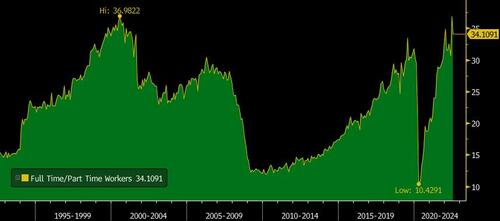
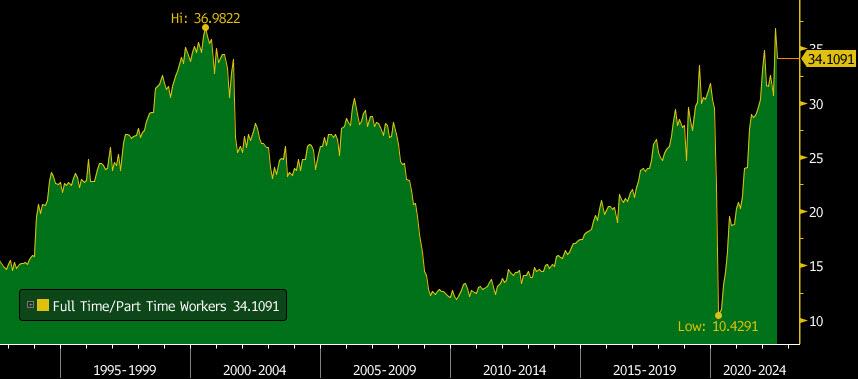
Getting that full time job is getting tougher thanks to your congress and the Fed.

https://www.zerohedge.com/markets/ratio-full-and-part-time-workers-spells-inflation-peak

Tyler Durden's Photo

BY TYLER DURDEN

SUNDAY, AUG 21, 2022 – 10:00 PM

By Vincent Cignarella, Bloomberg markets live commentator and reporter

Is the US at full employment and we just don’t know it yet?

The ratio of full-time workers to part-time workers is at a near 20-year high. It may be turning, and a drop in the ratio may spell peak inflation as companies adjust to cut costs. That’d mean a better environment for stocks and bonds going forward.

If the ratio falls, it likely means companies are either looking to replace higher paid full-time workers with less expensive part-time employees or they are seeing declining sales. Either way, it is a sign of rising costs and an attempt to lower them or a slowing economy.

Both scenarios could prompt a Fed pivot. A slowing economy and peaking inflation are the signs the Fed needs to see in order to pause rate hikes.

Be seeing you

Posted in Uncategorized | Tagged: , | Leave a Comment »

Inflation Makes People Poorer (And It’s the Government’s Fault)

Posted by M. C. on August 17, 2022

Therefore, the poorest are the ones who actually pay for the government. It is precisely because of governments that the poor and the lower middle class, in most cases, don’t get richer. It is the government that perpetuate poverty, precisely to justify their existence by pretending to help the poorer. After all, if there were no monetary inflation created by governments, prices would tend to decrease as the productivity of the economy rose and the standard of living would rise.

  • burden

https://mises.org/wire/inflation-makes-people-poorer-and-its-governments-fault

André Marques

The Consumer Price Index (CPI) in the US was 9.1 percent in June. Taking into account that the government lies about inflation, it is better to consider Shadow Government Statistics’ CPI (based on the 1980s CPI methodology), which was (as of July 13) about 17 percent.

The government claims that this high CPI is due to Russia’s invasion of Ukraine (you could argue that, one of the reasons is the sanctions on Russia’s economy, which don’t do much to harm to the Russian government and hurts ordinary people both inside and outside Russia). But this is just an excuse for the government to not admit the blame. It is clear the war has an influence on the CPI, as it eliminates the supply of various goods and services, which ends up increasing prices. However, the CPI has been going up since February 2021.

The 2020 and 2021 lockdowns (and the followed supply shocks) were also a big factor, but the real reason prices are going up is the inflation (monetary expansion) created by the US government both in 2020 and 2021.

Yes, supply shocks cause increases in SOME prices in the economy, but not a general increase in the prices of goods and services. If there is a supply shock of certain goods (making their prices higher), but the money supply does not change, there will be a new equilibrium of supply and demand for the various goods and services in the economy (since the money supply is the same and individuals will have to change the allocation of their budget, so the prices of the goods that will have a lower demand will decrease).

Once the supply shock of these goods ended, their supply would increase, and their prices would decrease (changing the equilibrium of supply and demand once again). Only an increase in money in circulation can make ALL (or almost all) prices in the economy rise simultaneously, as the value of money decreases and more units of currency are needed to pay for goods and services.

Inflation (the expansion of the money supply) and the consequent increase in prices is a disguised tax. The US government increased its spending and its budget deficit. So, it issued more debt securities, which were mostly purchased by the Federal Reserve (Fed) through an increase in the monetary base (M0). Then, the government spent the newly created money, increasing the amount of money in circulation in the economy (M1 and M2), which tends to make prices higher.

See the rest here

Be seeing you

Posted in Uncategorized | Tagged: , , | Leave a Comment »

Your suffering prevents inflation, citizen

Posted by M. C. on August 11, 2022

One of the most frustrating things about being a libertarian is how consistently the state gets away with ripping off the people, and the people don’t even realize it.

The public has been trained to think of the people who run the state as “public servants” who “work for us.”

Let’s get one thing straight: they do not work for us. We work for them.

Their salaries come from taxing the salaries of you and me. Running afoul of their zillion and one rules and regulations can get you and me put in prison.

Imagine trying to persuade an alien from another planet that in this relationship those people work for us!

And since most people lack the necessary economic knowledge, they are easily duped into blaming forces other than the state for problems caused by the state.

So of course it’s not difficult to persuade people that rising prices are caused by greedy businessmen or whoever the current villain is.

In fact, rising prices economy-wide are caused by the fiat money system. Before we had this system, we did not have economy-wide price increases. To the contrary, prices fell over time.

So the cause of the rising prices is the regime’s crappy money, and the solution is restraining its money creation or even adopting a hard-money standard.

But they’ll never admit that.

So instead, rising prices are caused by bad guys in the private sector. Or, more recently, they’re caused by you and your wicked desire to consume.

How about that: the state causes a problem, blames you for it, and the solution is for you to suffer.

Our friend Saifedean Ammous puts it this way: a fiat system’s way of putting a lid on inflation “is for you to live like a 12th-century peasant.”

Exhibits A, B, and C:
“Climate change,” incidentally, is the ideal elite fixation. Almost any state power can be justified in its name, and the victims of the various alleged mitigation policies are the kind of poor and helpless people the elites pretend to love but actually despise.

There was a time when climate-change propaganda was just a background annoyance, but now that the people who rule us have seen what they can get away with, it’s turning into a lot more than that these days.

If you can believe it, there is actually a sliver of the libertarian world that considers AOC and “The Squad” to be the most libertarian members of Congress.

The Squad is all in on the civilization-destroying Green New Deal, but we’re evidently supposed to overlook that small matter because of their opinions on…ICE? Who even knows or cares?

At any rate, I guess one silver lining of the Covid episode is that thinking people are now far less likely to accept impositions on them in the name of some expert consensus.

One more thing: I know some of my readers are interested in homesteading, so let me point out that our friend and repeat Tom Woods Show guest John Bush, whom I’ve known since the Ron Paul days, is running a virtual summit on homesteading on a budget. He’ll cover growing food, buying inexpensive but high-quality groceries, prepping, and even buying land on a budget. If that floats your boat, check it out:
 http://www.tomwoods.com/budgethomestead
Tom Woods

Be seeing you

Posted in Uncategorized | Tagged: , , | Leave a Comment »

“Transitory” No Longer: Double-Digit Inflation Is Already Here!

Posted by M. C. on July 23, 2022

https://mises.org/wire/transitory-no-longer-double-digit-inflation-already-here

Joseph T. Salerno

The Bureau of Labor Statistics (BLS) and the media reported the inflation rate—that is, the Consumer Price Index‘s rate of increase—to be 1.3 percent for June 2022 and 9.1 percent year over year (for the last twelve months). This shocked markets and investors because economists’ median forecast had been 1.1 percent for June and 8.8 percent year over year. This shock would have been much greater, however, had the annual inflation rate been reported as the CPI’s compounded annual rate of change for the month or quarter. This calculation method would have revealed the stark reality that double-digit inflation is not just a specter looming on the horizon but is here right now. According to computations I made using the interactive economic data website (FRED) of the Federal Reserve Bank of St. Louis (FRB of St. Louis), the annualized inflation rate for June 2022 was 17.1 percent, while for the second quarter of 2022, the rate was 10.5 percent.

Let us compare these two methods of calculating the annual inflation rate using the figures in the preceding paragraph. According to the BLS, CPI changes are “a measure of the average change over time in the prices paid by urban consumers for a market basket of consumer goods and services.” To say that the monthly inflation rate is 1.3 percent, then, means that the CPI increased by 1.3 percent from the month before. Similarly, a year-over-year inflation rate of 9.1 percent means that the CPI rose by 9.1 percent over the past twelve months. This way of calculating the annual inflation rate is backward looking, because the most recent monthly rate is heavily outweighed by the previous eleven months’ rates.

In contrast, calculating the annual inflation rate by compounding and annualizing the most recent monthly or quarterly rate of change in the CPI gives a better idea of what inflation currently is and how it may be trending. For instance, the 17.1 percent compounded annual inflation rate reported above is derived by assuming that the 1.3 percent monthly rate of change for June continues unchanged for the next eleven months. If the monthly inflation rates appear to be volatile, the compounded annual inflation rate for the last three months may also be computed in a similar manner. As noted above, the compounded annual inflation rate for April 2020 to June 2022 was 10.5 percent. In any case, this computation method is forward looking and more useful for analyzing the implications of fresh inflation data and recent events’ likely impact on the inflation trend.

Now this may seem like merely a technical matter, but some forms of data presentation are clearer and more useful than others, especially during a time of rapid inflation. Presenting the inflation rate as a year-over-year calculation obscures shorter-term but substantial fluctuations that may occur and what they portend for the future, especially if inflationary expectations are beginning to become unhinged. Furthermore, presenting inflation data in annualized form permits clear and easy comparison of inflation rates in periods of varying length. For example, up until January 1997, the FRB of St. Louis, which for many years was the most “monetarist” and inflation conscious of the regional FRBs, displayed inflation rates with “growth triangle” in its monthly release (suspended in March 2015), National Economic Trends (NET). The triangle, which resembles an intercity mileage table on a highway map, consisted of compounded annual inflation rates for each of the nineteen immediately preceding months and for all series of consecutive months in that range, totaling 190 rates in all.\

See the rest here

Be seeing you

Posted in Uncategorized | Tagged: , , , | Leave a Comment »

How Governments Expropriate Wealth with Inflation and Taxes

Posted by M. C. on June 28, 2022

Government does not give excess reserves as social programs. Government takes away from existing and future wealth of the economy via currency printing, taxation, spending and debt, but math never works for those who believe extractive and confiscatory policies will work. 

RE: The Janet Yellen reference below. The WSJ used to treat her every utterance as wisdom from God. A trip to the comments section revealed the readers weren’t fooled.

https://mises.org/wire/how-governments-expropriate-wealth-inflation-and-taxes

Daniel Lacalle

In an interview with the Wall Street Journal, Treasury secretary Janet Yellen admitted that the chain of stimulus plans implemented by the US administration helped create the problem of inflation. “Inflation is a matter of demand and supply, and the spending that was undertaken in the American Rescue Plan did feed demand,” Yellen admitted. Of course, Yellen went on to say that the spending was appropriate due to the collapse of the economy as governments were trying to prevent a recession.

This reminds us of a few of the problems of disproportionate government intervention and the negative impact on the middle class. The misguided massive lockdowns were imposed by the government. Countries that had strict testing, like South Korea and other Asian and European countries, kept the economy working and the pandemic under control. However, the problem is larger and deeper. Central banks and governments have exhausted all demand-side policies at the expense of the middle class by eroding real wages and deposit savings.

Even worse, governments created a larger inflationary spiral by maintaining all “pandemic relief” packages even after the reopening, well beyond the recovery. They expected a spectacular aggregate demand increase and they got it. Now the result is higher inflation and lower economic growth. But government size and deficit spending remain.

Everything that government spends is paid by you. There is no free money. Even for the recipients of benefits in constantly depreciated currency. Inflation, the tax on the poor.

Governments do not avoid recessions through spending, they simply make the accumulated problems larger by constantly adding debt that central banks monetize via quantitative easing. This uncontrolled increase in M3 money supply (a broad money proxy) leads to asset inflation first and everyday goods price inflation afterwards. Both consequences lead to inequality and a constant deterioration of the purchasing power of the currency, making salaries in real terms lower.

Central-planned money creation is never neutral. It disproportionately benefits the first recipients of money, government and those with assets and debt, and negatively impacts those with a monetary salary and some savings in cash deposits, which dissolve over time. No socialist excel spreadsheet can erase the fact that massive deficit spending financed with newly created money destroys the poor and the middle class. They may say that government spending goes to social programs that benefit the poor, but that does not happen. Social programs in a constantly devalued currency become irrelevant, inefficient, and worthless while at the same time the wrongly named welfare state condemns a substantial proportion of the population to being hostage clients of government plans.

See the rest here

Be seeing you

Posted in Uncategorized | Tagged: , , , , | Leave a Comment »