As the Biden administration continues to pursue a normalization deal with Israel and Saudi Arabia, supporters of a U.S. security guarantee for the Saudis have started making their case in public.
The Israeli foreign minister, Eli Cohen, took to the opinion page of The Wall Street Journal earlier this week to sell a U.S. defense commitment to Riyadh as “the foundation upon which true regional harmony can be built” and used the example of Washington’s treaty with South Korea as a model.
A new formal security commitment is one of the biggest Saudi demands as part of their steep price for normalizing relations with Israel, and recentreports suggest that the Biden administration is seriously entertaining the idea.
President Biden should shut this down now. The U.S. does not need and cannot afford any additional security commitments. It certainly shouldn’t be pledging to send its soldiers to fight on behalf of a despotic monarchy that has been waging an aggressive war against its poorer neighbor for most of the last ten years. The U.S. has already put its military personnel in harm’s way too many times on behalf of the Saudis, and there should be no guarantee to do so in the future.
A formal defense commitment to Saudi Arabia is unacceptable and contrary to U.S. interests, and it is far too large of a bribe to give Riyadh just so that it will establish relations with Israel.
The case for a U.S. commitment to fight for the Saudis is weak on the merits. The U.S. does not have vital interests at stake that would warrant making a pledge to defend the kingdom. It is also unnecessary. Iran isn’t about to invade or even attack Saudi Arabia. Aside from the strikes on the ARAMCO facility at Abqaiq in 2019, which were themselves a reaction to the Trump administration’s economic war, Iran and Saudi Arabia have no history of direct clashes.
Cohen’s comparison with Korea is bizarre. For one thing, the animosity between Iran and Saudi Arabia is nothing like the decades-long hostility between North and South Korea. Iran has no interest in conquering the kingdom, and it lacks the means to do it even if it wanted to try. Unlike North Korea, Iran does not have nuclear weapons, and despite the best efforts of the U.S. and Israeli governments in the last few years their government has still not decided to pursue them.
Creating a stronger U.S.-Saudi security relationship in opposition to Iran would likely make regional tensions worse and might encourage hardliners in Iran to pursue more confrontational policies. Far from fostering “true regional harmony,” this would stoke conflict by expanding the U.S. role in the Persian Gulf.
“We know China has been amassing the largest stockpile of crude in the world. Nevertheless, last year, the United States sold off part of our reserves to China.
The Senate on Thursday passed an amendment to the National Defense Authorization Act (NDAA) that would ban sales of oil from the Strategic Petroleum Reserve (SPR) to China, North Korea, Iran, and Russia.
The effort, which passed the Senate 85-12, was spearheaded by Senator Ted Cruz (R-TX) and West Virginia Senator Joe Manchin (D-WV). Under President Joe Biden, the SPR has been drained to 40-year lows.
“We know China has been amassing the largest stockpile of crude in the world. Nevertheless, last year, the United States sold off part of our reserves to China. I have been working with Senator Manchin to prohibit such inexplicably reckless moves in a bipartisan way. Our amendment prevents the federal government from selling oil from the strategic petroleum reserve to China, Russia, Iran, or North Korea. We should not be selling our emergency oil reserves to our adversaries,” Cruz said.
Manchin, a critic of the Biden administration’s energy policy, also warned about American oil going to China.
“Following Putin’s invasion of Ukraine, the U.S. ramped up production and exports to help meet global demand. It had been devastating to the world. China, on the other hand, stockpiled oil and held back refinery production and while China was stockpiling, one of its state-owned companies purchased over 1.4 million barrels from the United States of America, the people of our great country, from our own stock of reserves. That’s what we’re trying to stop,” the West Virginia Democrat said.
After decades of stewardship of the Middle East, during which the United States pursued the absurd policy of not talking to its enemies and creating and enforcing blocs to oppose and isolate those enemies, the predictable outcome occurred. The region was left with blocs and enemies who were not talking to each other. The result was horrid wars and the threat of even worse wars.
It has long been known that a key to opening those blocs and initiating diplomacy would be a negotiated peace between the heads of the two main rivals, Saudi Arabia and Iran. It has also long been known that the United States withheld that key. Unlocking the blocs is not in American interest. Hegemony in the region requires punishing and isolating countries that won’t follow you. That requires sanctions, threats of war, and isolation. Iran is such a country. So, the establishment and maintenance of a coalition against Iran is a key feature of U.S. policy in the region. At the heart of that coalition is Saudi Arabia, firmly in the U.S.-led anti-Iran camp.
But the emergence of China as diplomatic power has “blindsided” the United States and changed the diplomatic environment in the Middle East. China chose peace instead of sides and brought Saudi Arabia and Iran together for talks. Having the blocs talk to each other instead of enforcing their isolation shook the U.S. world order. On March 10, those talks resulted in an agreement between Saudi Arabia and Iran.
And the key to opening talks, ending wars, and bringing peace to the Middle East is already showing its promise. After years of region destabilizing enmity, Saudi Arabia and Iran signed “an agreement to resume diplomatic relations between them and re-open their embassies and missions within a period not exceeding two months.”
The agreement is showing signs of working. True to their word, on April 6 the foreign ministers of Saudi Arabia and Iran met in Beijing where they signed an agreement to reopen their embassies and consulates in each other’s countries. And Saudi King Salman bin Abdulaziz Al Saud has invited Iranian President Ebrahim Raisi for an official visit. Raisi has accepted the invitation and “stressed Iran’s readiness to expand co-operation.” The two countries have also agreed to hold a meeting of their foreign ministers. Peace is breaking out.
But the potential for peace is bleeding beyond the two countries.
The first to feel the effect of the change in environment was Syria. President Bashar al-Assad survived the war against Saudi-backed rebels in large part because of the support of his Iranian allies. Peace in Syria would also require peace between Saudi Arabia and Iran.
China’s facilitation of talks between Saudi Arabia and Iran opened the door for Russia to facilitate talks between Saudi Arabia and Syria. Within two weeks of the Saudi-Iran breakthrough, Saudi Arabia and Syria agreed to reopen their embassies.
The entire Arab world is ending its isolation of the Assad regime.
Unforeseen by the warparty wizards, the pentagram and their puppet, NATO.
The point of trade sanctions is to make the intended victims (civilian men, women and children) suffer so much that they rise up against their government. Didn’t work, again.
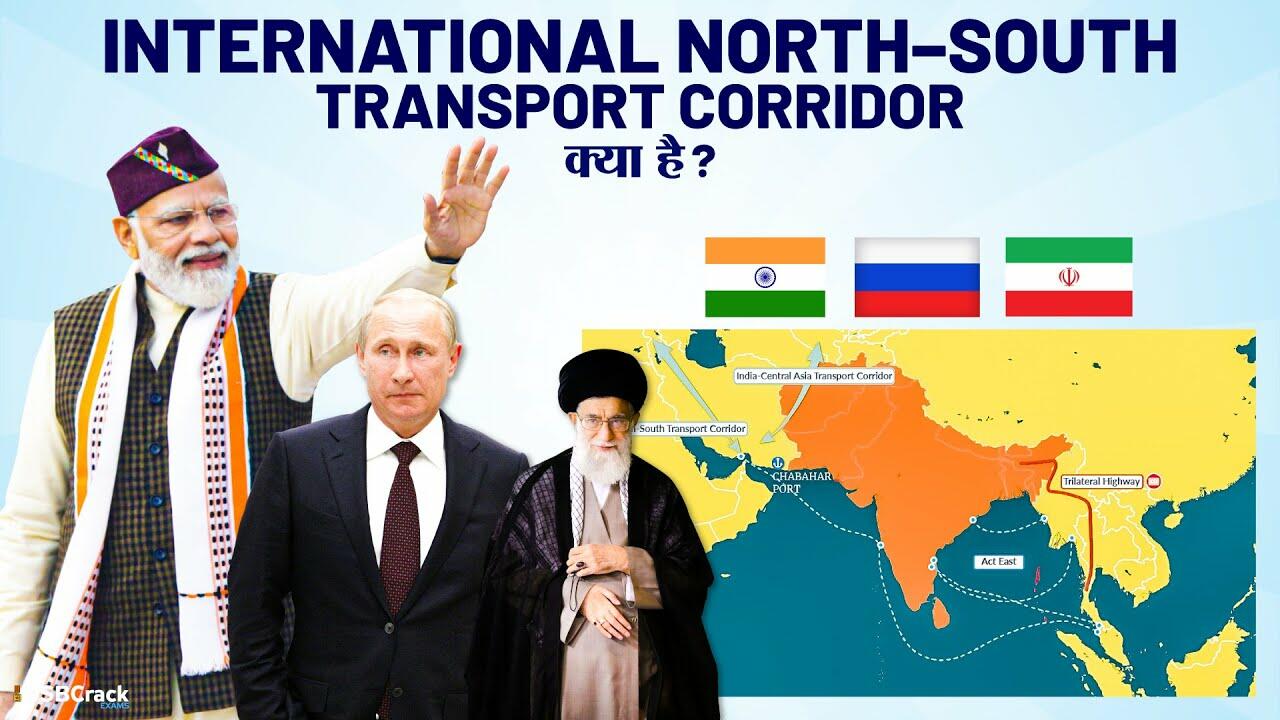
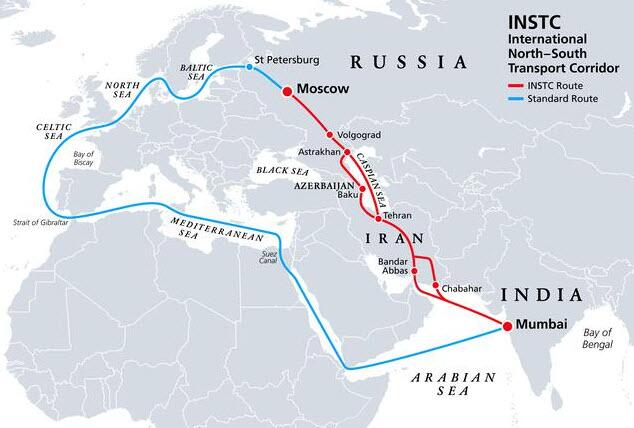
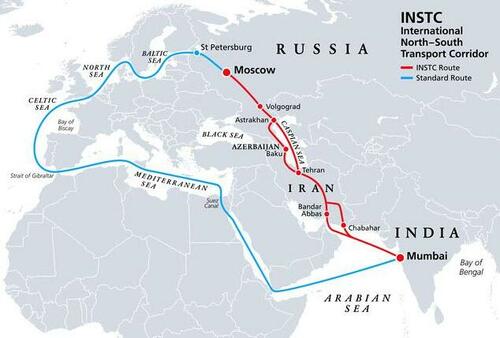
Russia, Iran, and India are speeding up efforts to complete a new transport corridor that would largely cut Europe, its sanctions, and any other threats out of the picture.
The International North-South Transport Corridor (NSTC) is a land-and sea-based 7,200-km long network comprising rail, road and water routes that are aimed at reducing costs and travel time for freight transport in a bid to boost trade between Russia, Iran, Central Asia, India.
For Russia, the “sanction-proof” corridor provides a major export channel to South Asia without needing to go through Europe. But Brussels and Washington, frustrated by their losing in Ukraine and inability to put much of a dent in the Russian economy, could lead them to take more desperate measures.
Lately, Estonia, which has a population smaller than Russia’s armed forces, has been making noise about causing problems in the Gulf of Finland, Estonian Minister of Defense Hanno Pevkur is talking about how Helsinki and Tallinn will integrate their coastal missile defense, which he says would allow the countries to close the Gulf of Finland to Russian warships if necessary. Estonia is also floating the possibility of trying to inspect Russian ships. From Asia Times:
It is unlikely Estonia can carry out any inspections given that it only has two patrol vessels (EML-Roland and EML-Risto) and no other warships except some mine layers. But if Estonia even tried, it would create another friction point that Russia could exploit if it chose.
There is also a strategic element. With Finland joining NATO and already a de facto member, the Gulf of Finland becomes significantly more hostile for Russia and there will be growing pressure on Russian political leaders to take action against a rising threat to Russian security.
While Ukraine is far away, the Russians see NATO’s “ganging up” on Russia as a key issue for Russian security and stability. This brings the Baltic region into sharper focus because Russians see NATO trying to surround them and undercut their economic and military advantages.
It’s hard to take Estonia’s bluster seriously but equally difficult to put anything past the neocons in Washington and their adherents in the Baltics. Regardless, Russia would prefer a trade route with India that saves time and money and avoids Europe.
While NATO’s war against Russia has sped up the cooperation between Moscow, Tehran, and New Delhi, India and Iran are coming under various types of pressure that could delay full implementation of the corridor. And Azerbaijan, a key nexus in the INSTC, is a wildcard as it grows increasingly confrontational with both Iran and Armenia.
First the recent developments on the INSTC:
India is helping to develop the Shahid Beheshti Terminal at Iran’s Chabahar Port in cooperation with the Iranian government.
Iran and Russia recently signed a contract for Russia to build a cargo vessel for Iran to be used at the Caspian port of Solyanka, which is being developed jointly by the two nations as part of efforts to strengthen the Caspian Sea transportation network.
RZD Logistics, a subsidiary of Russian railway monopoly RZD, has begun regular container train services from Moscow to Iran to serve growing trade with India by transloading.
Rezaul Hasan Laskar, the foreign affairs editor at Hindustan Times, says the strategic Chabahar Port in southeastern Iran has “become more important following its growing use” but that “it needs to be connected to Iran’s railway network.” Iran has accelerated that project, and with an investment boost from Russia, is speeding up the completion of the Astara-Rasht-Qazvin railway, another transport corridor that will connect existing railways of Russia, Azerbaijan and Iran to the INSTC.
In the meantime, most of the goods that Russia normally transported across the Baltic Sea to reach the North Sea port of Rotterdam now sail instead to India. Oilprice reports:
Russian crude oil loadings from Baltic ports are on track for a 50% hike from December to January, Reuters reports, citing its own data combined with trader insights.
Russian Urals and KEBCO crude oil loadings specifically from the ports of Primorsk and Ust-Luga will experience the increase, Reuters said, adding that the bulk of those loadings (some 70%) will head to India.
In December, Russia loaded 4.7 million tonnes of Urals and KEBCO from the Baltic ports, Reuters said, citing Refinitiv data.Russia now accounts for approximately 25% of India’s crude purchases, while some sources put it closer to 30%.
The increased trade with Russia is a primary driver bringing New Delhi and Tehran closer together – largely a result of Europe severing itself from Russia. According to Reuters, at the end of November Moscow sent India a list of more than 500 products it wants India exporting to Russia, “including parts for cars, aircraft and trains.” The report added:
Indian imports from Russia have grown nearly five times to $29 billion between Feb. 24 and Nov. 20 compared with $6 billion in the same period a year ago. Exports, meanwhile, have fallen to $1.9 billion from $2.4 billion, the source said. India is hoping to boost its exports to nearly $10 billion over coming months with Russia’s list of requests, according to the government source.
And with all the increased trade, New Delhi and Moscow are looking for more efficient supply lines.
Kish, since you are wondering, is an Iranian island in the Persian Gulf famed for its tourist and shopping attractions. It is becoming a serious rival to other nearby vacation hubs in Doha and Dubai.
Along with pristine beaches and extensive malls, Kish is—or rather ought to be—known more widely for another feature and institution which the Iranian mullahs established there way back in 2003; namely, the Kish Bourse (i.e., Kish Stock Exchange). بورس کیش if you prefer the Farsi.
Think of it as the Chicago Mercantile Exchange of Iran, a country stacked with natural resources, a relatively well-educated and sophisticated population (the literacy rate is 97 percent among young adults, which, if you consider the deplorable state of secondary education in the United States, means that Iranian youth are most assuredly smarter than your average young American adult), and an economy burdened by mismanagement of their own Islamic theocracy and crippling, long-duration sanctions from the American secular theocracy.
That American secular theocracy has considered it a dogmatic rite of passage into the state and corporate media (their temples) that one must, at the very least, excuse the economic, cultural, and political warfare against Iran as necessary for a variety of spurious reasons. Who really has enough free time to investigate and then suggest otherwise? After all, Iran is plagued by terroristic Islamic fundamentalists who have pledged—like their former president, Mahmoud Ahmadinejad—“to wipe Israel off the face of the earth.”
That hero of American warfare and empire and regime change and nation building, George W. Bush, declared Iran to be one of the hinges of the “axis of evil”; so, since George W. Bush is so much better than Donald J. Trump, well, all Iranians must be malevolent thugs. Iran deserved to have the United States aid Saddam Hussein in the 1980s, to have the United States provide Hussein chemical weapons (mostly made in Germany and the United Kingdom), and then have those chemical weapons unleashed on them.
Why has Iran, then, incurred such wrath from the American military-industrial complex establishment? The regime’s Sturm und Drang regarding Iran—and, for that matter, any state that even intimates that it will conduct trade in oil without the dollar, cf. Russia—is all about the petrodollar system.
Let’s define it with some historical context: When Richard Nixon removed the dollar from its peg to gold in 1971, chaos followed. It was not just the Yom Kippur War (1973) and resultant OPEC embargo that led oil prices to skyrocket in the United States. The dollar, as the new, floating, purely fiat global reserve currency had lost its allure when compared to other sovereign currencies and precious metals.
It—incredibly—gets worse. King Faisal accepted the arrangement (one that was sure to make his desert-oil kleptocracy a major regional power and global player) on one condition: The rest of the world could not know the extent of the agreement. That is to say that Faisal knew that in the rest of the Islamic world, underwriting America’s drunken-sailor imperial spending, well, that would not play in Cairo, Damascus, and Kuala Lumpur.
The US is locked in endless proxy war with Russia over Ukraine.
The US is locked in rapid escalation with China leading to possible war over Taiwan.
The US is locked in a collision course with Iran over their imaginary nuclear program that could blow up the Middle East.
I’ve not been as concerned about the world stumbling into nuclear war since the Cuban Missile Crisis, 60 years ago next month. A high school senior then, I worried about being denied a long life. Now, at 77, I fret more about my children and grandkids being denied that privilege.
US world dominance since collapse of the Soviet Union is over, but it doesn’t realize it. Like a wounded animal, the US is lashing out on 3 fronts, none of which may have an ending short of nuclear war, and none of which can resurrect American world dominance.
Once the US falls into to abyss of uncontrolled war, we will be no better off than Humpty Dumpty.
Walt Zlotow became involved in antiwar activities upon entering University of Chicago in 1963. He is current president of the West Suburban Peace Coalition based in the Chicago western suburbs. He blogs daily on antiwar and other issues at www.heartlandprogressive.blogspot.com.
Venezuelan President Nicolas Maduro ended his visit to Iran by holding high level talks with President Ebrahim Raisi and Ayatollah Sayyed Ali Khamenei on 11 June.
Both sides spoke about the successful experiences they have had in countering punitive economic sanctions imposed on them by the US.
Khamenei praised the Venezuelan people for their victory against hybrid war of Washington, saying: “Your resistance and that of the people of Venezuela is valuable because it enhances the value, status and merits of a nation and a country as well as its leaders.”
“Today, the US views Venezuela in a different [manner] compared to the past,” Khamenei added.
Earlier in the day, Raisi and Maduro signed a 20-year “cooperation road map,” focusing mainly on the areas of agriculture and food production.
“It is essential to consolidate the sovereignty and food security of our country,” Maduro said.
“I believe that between the two of us we will create an indestructible friendship for the future of our people and we will witness how our countries grow in the face of difficulties and how a new world is growing,” Maduro told the Iranian President.
In response, Raisi highlighted how Iran’s foreign policy “has always been to have relations with independent countries, and Venezuela has demonstrated incredible resistance against threats and sanctions by enemies and imperialism.”
“Sanctions and threats against the Iranian nation over the past 40 plus years have been numerous, but the Iranian nation has turned these sanctions into an opportunity for progress,” Raisi added.
Now, as they beg OPEC, Venezuela and Iran for help to reduce onerous price and inflation consequences of their own policies ahead of 2022 midterm elections, they are likely to discover that maybe Putin and petroleum companies really aren’t their biggest problems after all.
As his administration now scrambles to solicit supply oil shortages from OPEC, Venezuela, and Iran to reduce skyrocketing energy costs ahead of Democrat congressional mid-term election casualties, let’s remember this contradicts former 2019 candidate Joe Biden’s campaign pledge that “I guarantee you we’re going to end fossil fuels.”
Let’s also recall that President Biden then inherited an America that was not only energy independent, but also a leading global oil and gas exporter, and that gas prices began going up long before Putin’s invasion of Ukraine recently provoked a bipartisan ban on Russian oil, gas and coal imports.
That ban was likely influenced by a March 8 Reuters/Ipsos poll which found that 80% of all likely voters surveyed responded that the U.S. “should not buy oil or gas from Russia during this [Ukraine] conflict, even if it causes American gas prices to increase.”
Simultaneously, inflation over the past year has risen to a 40-year high of 7.9%, most all occurring prior to the Ukraine conflict catastrophe.
Also, recall that immediately upon taking office, Joe Biden revoked a permit essential for the Keystone XL pipeline to deliver oil from Canada.
Shortly thereafter, his administration launched an effort to overturn an oil drilling program in the Arctic National Wildlife Refuge (ANWR) in Alaska, and empowered Department of Interior regulatory efforts to delay drilling permits.
Blaming U.S. companies—not Biden policies—for not producing more oil and gas, White House press secretary Jen Psaki asserted that there are 9,000 available unused drilling permits, while only 10% of onshore oil production takes place on federal land.
A big problem here, is that the companies first must obtain additional permits for rights of way to access leases and build pipelines to transport fuel, a requirement that the Biden administration’s Interior Department has made more difficult.
Next, the companies must build up a sufficient inventory of permits before they can contract rigs – requiring added regulatory difficulties of operating on federal lands.
For example, it takes 140 days or so for the feds to approve a drilling permit versus two for the state of Texas.
The nuclear deal with Iran is not dead yet, but the prospects for its revival and longer-term survival are bleak. While there are reports of some progress in the latest round of talks in Vienna, the U.S. and its European allies keep insisting that time is running out for the negotiations. The Biden administration has already begun laying the groundwork for its damage control campaign in the event that the talks fail, suggesting that they have already all but given up on the Joint Comprehensive Plan of Action (JCPOA). It is possible that the talks might still yield something of value, but it is more likely that the most successful nonproliferation agreement in recent history will be consigned to the ash heap because the US cannot make durable, credible diplomatic commitments.
The Iranian government has demanded that the US make a binding “legal pledge” to ensure that a future administration can’t do what the Trump administration did when it reneged on the JCPOA in 2018. The demand is understandable given that the US violated all its commitments when Iran was fully complying with theirs, but the Biden administration isn’t in a position to make such a guarantee. Even if the administration could provide such a formal pledge right now, there would be nothing to stop the next president from tearing up that pledge just as Trump tore up more than one ratified treaty during his term. Biden’s Republican critics have already said that the next administration would throw out any revived agreement. Formal pledges mean nothing to ideologues that despise all diplomatic engagement.
A basic problem with US diplomacy is that there are major political obstacles to concluding almost any agreement with a hostile or pariah state and virtually no political incentives to honor those agreements when they are made. When a president negotiates with these states, he has to burn a tremendous amount of political capital to get an agreement, and his successor can undo all of that effort with the stroke of a pen. Trump’s decision to renege on the nuclear deal is now widely condemned as one of his worst foreign policy moves, but the reality is that he paid no political price for doing it and he encountered remarkably little resistance from Congress or the foreign policy establishment. Even when tensions with Iran brought the US very close to a new unnecessary war, Trump faced almost no backlash against the policy that had taken the US to the brink.
Diplomacy with Iran is further complicated by the fact that the US does not view Iran as an equal or even as a sovereign state, but instead treats it as if it were a disobedient vassal that has to be forced back into submission. Iran is expected to adhere to the restrictions contained in the nuclear deal without exception, but the US and the other major powers are effectively free to flout their obligations without suffering any penalties. The US now disingenuously cites Iran’s reduced compliance since 2019 as justification for keeping in place all the sanctions that spurred Iran to take those actions, and that means that the upfront sanctions relief that could break the current impasse won’t even be considered.
Sanctions advocates like to claim that the economic wars they support facilitate negotiated agreements by using sanctions as “leverage” against targeted states, but in practice their pressure tactics provoke the target governments to engage in more of the unwanted behavior to build up their own “leverage.” Because it is taken for granted that the US never grants sanctions relief first, the US just keeps applying more pressure with predictable counterproductive results. When the additional pressure also fails to deliver the desired outcome, the US begins casting around for any other “option” except the obvious one of lifting sanctions. According to the conventional view in Washington, lifting sanctions amounts to “rewarding” the targeted government, and sanctions advocates believe it is preferable to keep useless sanctions in place rather than make any concession that might resolve the outstanding issue.
Another reason why the US so rarely delivers sanctions relief is that it is much easier politically to demand more sanctions on a targeted government than it is to remove them. That makes it extremely difficult if not impossible for US negotiators to make promises that the other side can believe. If the main thing that the US has to offer is the removal of the sanctions that it imposed, and if it cannot credibly commit to that removal because it is too politically risky at home, that guarantees that US diplomacy won’t succeed. In the rare event when the US does provide sanctions relief, however halting and partial, the targeted government cannot trust that the relief won’t be reversed in a few years when American hardliners come back into power.
US diplomacy is compromised by its heavy reliance on using an economic weapon that achieves nothing except inflicting misery on ordinary people. Because American policymakers are so attached to the idea that the economic weapon gives them leverage, they never want to put the weapon down and instead they keep holding out for the other side to capitulate. Even though a gesture of goodwill and some early sanctions relief would likely lead to a mutually beneficial agreement in most cases, US policymakers would rather watch a good agreement go up in flames than show the slightest flexibility that their domestic critics could denounce as “weakness.” If the talks in Vienna are going to be successful, the Biden administration will have to break with that pattern.
Daniel Larison is a contributing editor and weekly columnist for Antiwar.com and maintains his own site at Eunomia. He is former senior editor at The American Conservative. He has been published in the New York Times Book Review, Dallas Morning News, World Politics Review, Politico Magazine, Orthodox Life, Front Porch Republic, The American Scene, and Culture11, and was a columnist for The Week. He holds a PhD in history from the University of Chicago, and resides in Lancaster, PA. Follow him on Twitter.
The admission comes after the US and Iran resumed indirect negotiations to revive the nuclear deal
Burns’ comments counter the Israeli claims and could be a sign that the US might be breaking from Israel on the issue. Last week, Israeli Prime Minister Naftali Bennett demanded to Secretary of State Antony Blinken that the US must “immediately” halt negotiations with Iran
The CIA “doesn’t see any evidence that Iran’s Supreme Leader [Ali Khamenei] has made a decision to move to weaponize,” Burns told The Wall Street Journal’s annual CEO Council, The Times of Israel reported.
Burns’ admission comes a week after the US and Iran resumed indirect negotiations in Vienna to revive the nuclear deal, known as the JCPOA. The latest round of talks concluded Friday and are expected to resume this Thursday.
Israeli officials have been claiming that Iran is only trying to buy time with the negotiations as it secretly develops a nuclear bomb. For decades now, Israel has been making similar warnings, but Iran has always insisted it does not want nuclear weapons and Israel is currently the only nuclear-armed state in the region.
Burns’ comments counter the Israeli claims and could be a sign that the US might be breaking from Israel on the issue. Last week, Israeli Prime Minister Naftali Bennett demanded to Secretary of State Antony Blinken that the US must “immediately” halt negotiations with Iran.






 MCViewPoint