MCViewPoint

Opinion from a Libertarian ViewPoint

Posts Tagged ‘Lockheed Martin’

America Dominant Again (in Arms Sales) – TomDispatch.com

Posted by M. C. on May 26, 2021

https://tomdispatch.com/america-dominant-again-in-arms-sales/

William Hartung

Think about this: on Saturday, May 12th, with barely an hour’s notice, Israel took out the al-Jalaa Tower, a high-rise building in Gaza City that housed the Associated Press, al-Jazeera, and other media outlets. That act of destruction, among so many others, caused shock globally and protests not just by those media groups but by previously Israeli-supporting Democrats in Congress. As it happens, the weapon that destroyed that tower was a GBU-31, a Joint Direct Attack Munition, or JDAM (aka a “smart bomb”) that was manufactured in the United States. Not only that, but in the midst of the ongoing carnage in impoverished, increasingly devastated Gaza (as well as in Israel), the Biden administration has been pushing through a new $735-million package of just such weaponry for Israel, ensuring more of the same to the horizon.

This has even disturbed key pro-Israeli congressional figures like Representative Gregory Meeks (D-NY), chairman of the House Foreign Affairs Committee, who, according to the New York Times, “told Democrats on the panel… that he would ask the Biden administration to delay a $735 million tranche of precision-guided weapons to Israel that had been approved before tensions in the Middle East boiled over.” Later, he would pull back on his threat, but Bernie Sanders has actually introduced a resolution in the Senate aimed at halting the future delivery of that weaponry (as several Democrats have already done in the House).

As the invaluable Pentagon specialist and TomDispatch regular William Hartung notes today, the U.S. leads all other nations on this planet by a country mile in selling the latest weaponry globally, as has been true for almost three decades. In other words, this country has been number one (U.S.A.! U.S.A.!) when it comes to such weapons sales (and so future destruction) forever and a day. In the case of Israel, those sales, however, are a secondary matter. For years, the U.S. has annually been giving — yes, giving — nearly $4 billion in military aid to Israel, a relatively wealthy country.  Since 2001, Israel has, in fact, received more than half of all the “military financing” approved by this country. Imagine what those tens of billions of dollars might have done had they been used instead for America’s fading infrastructure or other domestic investments.

In other words, Washington is complicit in the ravaging of Gaza in these last weeks, just as it has been in the devastation of Yemen in these years (thanks to similar sales of weaponry to Saudi Arabia and the United Arab Emirates). It’s a money-making, military-industrial tale from hell and Hartung tells it today in all its grim horror. Tom

America Dominant Again (in Arms Sales)

And Again… and Again… and Again

By William Hartung

When it comes to trade in the tools of death and destruction, no one tops the United States of America.

In April of this year, the Stockholm International Peace Research Institute (SIPRI) published its annual analysis of trends in global arms sales and the winner — as always — was the U.S. of A. Between 2016 and 2020, this country accounted for 37% of total international weapons deliveries, nearly twice the level of its closest rival, Russia, and more than six times that of Washington’s threat du jour, China. 

Sadly, this was no surprise to arms-trade analysts.  The U.S. has held that top spot for 28 of the past 30 years, posting massive sales numbers regardless of which party held power in the White House or Congress.  This is, of course, the definition of good news for weapons contractors like Boeing, Raytheon, and Lockheed Martin, even if it’s bad news for so many of the rest of us, especially those who suffer from the use of those arms by militaries in places like Saudi Arabia, Egypt, Israel, the Philippines, and the United Arab Emirates.  The recent bombing and leveling of Gaza by the U.S.-financed and supplied Israeli military is just the latest example of the devastating toll exacted by American weapons transfers in these years.

See the rest here

William D. Hartung, a TomDispatch regular, is the director of the Arms and Security Program at the Center for International Policy and the author, with Elias Yousif, of “U.S. Arms Sales Trends 2020 and Beyond: From Trump to Biden.”

Be seeing you

Posted in Uncategorized | Tagged: , , , , , , | Leave a Comment »

Forget Huawei, US spying on Denmark shows the real threat for European countries comes from Washington — RT Op-ed

Posted by M. C. on November 18, 2020

The purpose was to gather information on Denmark’s fighter jet acquisition program, with Washington aiming to secure Copenhagen’s procurement of Lockheed Martin F-35s at the expense of European defense firms.

https://www.rt.com/op-ed/506964-huawei-us-spy-denmark/

Tom Fowdy is a British writer and analyst of politics and international relations with a primary focus on East Asia.

Revelations that America engaged in surveillance on Denmark should come as no surprise. It has consistently spied on its allies, and its efforts to vilify Huawei are simply an attempt to create a smokescreen.

Denmark’s public broadcaster DK has revealed, citing anonymous sources, that the US National Security Agency (NSA) cooperated with the country’s intelligence services in spying on the Danish ministries of finance and foreign affairs.

The purpose was to gather information on Denmark’s fighter jet acquisition program, with Washington aiming to secure Copenhagen’s procurement of Lockheed Martin F-35s at the expense of European defense firms. 

The story, while covered in Denmark and the Netherlands, was largely ignored in the English-speaking international media. The espionage scandal comes at a time when Washington is aggressively pushing the idea of a “clean network”, demanding that European countries exclude the Chinese firm Huawei from their telecommunications networks amid allegations that it is an “espionage risk.” 

However, that isn’t what is happening here. The “clean network” isn’t really clean at all, and the threat to European countries lies far closer to home than Beijing. The US has a long, well-established history of utilizing its intelligence agreements to spy on European countries for commercial reasons, not least when it comes to the bidding of the ‘military-industrial complex.’ Yet, instead of being concerned about this, the public and media have lost themselves in hysteria about a single company, Huawei, whose alleged complicity in espionage has never been proven.

What is the military-industrial complex? The term refers to an oligarchy of American multinational aerospace and defense contractors which constitute the backbone of the US military, such as Lockheed Martin, Boeing and Raytheon, to name a few. These companies exert a disproportionate influence over American politics in order to uphold their enormous profit margins. 

They employ a number of strategies to do so, which include the funding of think tanks that actively promote aggressive and military-led foreign policies, such as the Centre for Strategic and International Studies (CSIS). But more alarmingly their representatives and lobbyists are immersed within the Washington DC system itself. Take for example Nikki Haley, who was until recently a member of Boeing’s executive board. What does she know about aerospace engineering? Nothing. What does she know about promoting war and neo-conservative policies? Plenty. 

Yet this isn’t all. What this revelation in Denmark reminds us is that the military-industrial complex also coordinates with US intelligence to promote their interests, even undermining competitors within allied countries.

For example, in 1994 it is publicly documented that the US Echelon program undermined a deal between the European firm Airbus and Saudi Arabia in order to secure a $6 billion contract for Boeing. Likewise, it was revealed several years ago that the NSA had spied on Germany’s Chancellery for decades. What has happened in Denmark is not new, it’s part of a trend. 

Despite the US spying on European countries with a view to promoting military-industrial complex interests, Secretary of State Mike Pompeo’s backing for the “clean network” comes with claims that the scheme promotes privacy and data security by excluding “untrusted vendors.” But it’s obvious that such a network does not exist because the US is able to infiltrate it at will; it is a disingenuous façade. 

The real reason the US seeks to exclude Huawei is not on legitimate security grounds, but to uphold its strategic monopoly over the global internet and network surveillance. Whether Huawei spies or not – and nothing has ever proved it does –  it is nonetheless a company which is not under the political control of the US and its intelligence partners, which makes its networks harder to infiltrate and subvert. 

The US hasn’t aggressively promoted its anti-Huawei campaign because it cares and acts in good faith. It has done so because there is an obvious set of interests which the rise of the Chinese company challenges, and Huawei’s growing influence also brushes against the military-industrial complex as well as America’s various internet surveillance efforts, such as Prism. 

Thus, the message should be this: forget China, the US is the biggest, most advanced and most unrivaled advocate of global surveillance in the world, much of it publicly documented and verified. Not only does America frequently spy on countries it claims to be its allies, but it also seeks to undermine their commercial interests to ensure the global monopoly and profit margins of the military-industrial complex are sustained. 

Therefore, what is described as “the clean network” is little more than hypocrisy from Pompeo, a packaged lie designed to sustain a status quo which favors Washington, and which a Chinese telecommunications firm poses a threat to.

Think your friends would be interested? Share this story!

Be seeing you

Posted in Uncategorized | Tagged: , , , | Leave a Comment »

Bombs Away | Lorissa Rinehart

Posted by M. C. on October 29, 2019

https://thebaffler.com/latest/bombs-away-rinehart

Lorissa Rinehart

Most of the world celebrated when the Berlin Wall fell and nuclear holocaust ceased to feel like it was just around the corner. But for the arms industry, the end of the Cold War meant catastrophe, shrinking their market by more than 50 percent in the following years. Those companies that didn’t fold entirely attempted to restructure mid-fall by diversifying their product output while implementing huge layoffs. Survival became Darwinian: adapt or die.

Part of adapting meant changing the way arms manufacturers reached potential clients, since they could no longer rely on the United States or the USSR to serve as an all-in-one PR firm, sales team, and procurement officer as they did when Cold War proxies were buying weapons by the boatload. Instead, companies like Boeing began contracting advertising firms to help increase their existing market shares while penetrating new ones. Starting in the late 1970s, the ads they produced began appearing in military journals that were produced largely in the Western world and distributed in developing nations, where there was room for growth, a practice that only increased into the 1990s. The U.S. government also began to lend a helping hand: in 1996, the Pentagon provided almost $380 million in marketing assistance to U.S. weapons-exporting firms…

As the world settled into its new, post–Cold War order, mergers, closures, and layoffs in the weapons industry accelerated. History was ending, and the future looked bleak—for arms dealers, anyway. Then, two essential paradigms shifted.

The first occurred with the September 11, 2001 attacks. The aftermath, of course, led to an exponential increase in arms sales not only to the United States and Russia, but also to secondary players, many of which are in the Middle East. According to the Stockholm International Peace Research Institute, U.S. arms sales to Saudi Arabia steadily increased from $3 million in 2000 to $3.5 billion in 2018. Though a much smaller number, the United States increased its sales to Morocco from a total of $4 million in 2000 versus a 2018 total of $333 million. Independent studies produced by the Congressional Research Service and the Cato Institute report similar trends throughout the Middle Eastern region.

The second shift remains largely unexamined, unquantified, and unqualified. Yet it constitutes a sea change in the methods and strategies employed in advertising conventional weapons. Quite simply, the launch of Facebook in 2004 and the universe of social media that followed revolutionized the way the arms trade is able to target, reach, and appeal to potential buyers.

Despite this glaring omission in analyses from both academia and the mainstream news,  the importance of social media as a plank in the weapons industry’s marketing platform is evident from the prodigious and extensive output of nearly every major manufacturer across multiple platforms.  One need only tune into Lockheed Martin’s YouTube Channel for corroboration. One of the company’s most recent videos, published on September 16, typifies their marketing strategy on the platform. Backdropped by a blue sky, a low angle image of a Warrior Armored Fighting Vehicle—in other words, a British tank—is interrupted by the kind of pixelated distortion familiar to video games, suggesting a resetting, the introduction of something new, as well as danger ahead.

The camera snaps back to three tanks kicking up dust beneath their tracks while a title card identifies them as being equipped with the “Warrior Capability Sustainment Programme (WCSP)” that upgrades rather than replaces existing armored vehicles. A score fades in with a looped baseline and progressive harmony that simultaneously suggests urgency and hope as the tanks fill the screen with steel and firepower. A cannon fires into a virginal landscape to demonstrate the product’s “Enhanced Lethality.” There are slo-mo shots that look modeled after the juicer moments in action movies, when higher frame rates allow viewers to savor the destruction being wrought on screen. Borrowing from video games, Hollywood, and the daydreams of would-be generals, Lockheed’s WCSP promotional video accomplishes what any good advertisement sets out to do: it establishes its product as cutting edge and cost effective, absolutely necessary and certifiably sexy. This strategy and aesthetic is replicated across multiple videos including those for their Long Range Anti-Ship Missile (LRASM), F-35 Fighter Jets, and fleet of unmanned aerial vehicles.

Northrop Grumman also has an active YouTube channel replete with high production value content, including a video for its OmegA Heavy Lift Rocket that looks more like a trailer for a patriotic space movie than an ad for a military payload delivery system. But none match the cinematic sophistication of Raytheon, with videos that seem to be taken right out of the Mission: Impossible franchise. A recent production for their Special Mission Aircraft, which “offers several modes of intelligence collection and analysis,” dispenses with the overwrought soundtrack featured by Northrop and the soon-to-be dated special effects in many of Lockheed’s videos. Instead, this short film, as well as many others on Raytheon’s channel, features clean visuals, highly legible text, and upbeat modular music; banners advertising the craft’s specs are punctuated by the telemetry sound effect that often accompanies urgent dispatches from headquarters in a spy film…

Highly produced promotional videos are only one aspect of the arms industry’s social media presence. More personal and “approachable” content can be found on Facebook, where Boeing’s page recently highlighted the Blue Angels, the Navy’s demonstration squadron of fighter jet pilots. Since 1986, the Blue Angels have flown the Boeing F/A-18 Hornet; conveniently, then, the Angels serve not only as entertainment at patriotic airshows, but also as de facto, and rather attractive, spokespeople for the manufacturer of their aircrafts.

But Facebook seems to be most effective for these companies when integrated with industry trade expositions targeted toward government weapons procurement officers and agencies. General Dynamics Mission Systems ramped up their posting during the 2019 Advanced Naval Technology Exercise (ANTX), a multi-day demonstration of new technologies with Naval implications. Specifically, the company used Facebook to promote their Bluefin-9, an unmanned underwater vehicle. This video of a General Dynamic’s salesperson posted during the expo, serves as an infotisement that includes technological specifications as well as potential military applications; its length and content suggest it was intended to serve both as an enticement to attract potential buyers to General Dynamic’s expo booth as well as a resource for procurement officers when presenting their findings to superiors back in the office.

Likewise, the UK’s largest weapons manufacturer, the ironically acronymed BAE Systems, took to Facebook regularly during the 2019 Defence and Security Equipment International conference, making a concerted push for their Light Attack Aircraft System (LAAS), a plug-and-play technology suite designed to interface with a variety of military aircrafts. One infographic posted during the event sets an LAAS equipped plane against a mountainous landscape backlit by a sherbet orange sunrise. Encircling it are a veritable halo of graphics and descriptions detailing its laser-guided rockets, mission computers, missile-warning systems, along with other high-tech features. The advertisement makes an appeal to those in the market for an affordable option that doesn’t sacrifice lethality. As Dave Harrold, BAE’s senior director of business development commented in a National Defense Magazine interview during DSEI, LAAS “can be much more efficient and cost effective. Not everybody can afford an F-35.”

Finally, there is the most rapid, least formal social media platform: Twitter, where users go to get quick hits of dopamine or to prove their pithy yet insightful points IN ALL CAPS once and for ALL. Here, the arms industry’s major players take full advantage of the virtual conveyor belt of infotainment. Posting up to fifteen times a day, Raytheon is perhaps the most prolific tweeter among weapons manufacturers. Aggressive tweets about neutralizing hostile drone swarms and innovative guided missile systems are counterbalanced with those promulgating an inclusive corporate culture, to project a holistic brand image and appease consumers who prefer their deadly war machines built in a welcoming and diverse environment…

To put it succinctly, conventional weapons are presented on social media as if they were any other consumer product. The result is an uncanny collage alternatively composed of banal, benign, and ultraviolet content that visually analogizes advertisements for tanks, fighter jets, and laser-guided bombs with those for cars, travel deals, and cleaning products. This leveling was warned of by the authors of a 1980 study on arms advertising—“If there is any use value of weapons at all it is the destruction of human life,” they wrote, “therefore, a line should be drawn between arms advertisements and all other forms of sales promotion”—and it has only become more pronounced in the intervening decades. It’s hard to know what its ultimate effect will be, but if nothing else, it creates a virtual reality in which ever more lethal weapons are accepted and a state of perpetual war is taken as a given. And, as is increasingly the case, what is true on social media transposes itself onto the real world, where the sale of conventional weapons is still steadily on the rise.

Be seeing you



Posted in Uncategorized | Tagged: , , , , , , | Leave a Comment »

DC’s Atlantic Council raked in funding from Hunter Biden’s corruption-stained employer while courting his VP father | The Grayzone

Posted by M. C. on October 17, 2019

Addressing the parliament in Kiev, Biden declared that “corruption can have no place in the new Ukraine,” stating that the “United States has also been a driving force behind the IMF, working to provide a multi-billion package to help Ukraine..”  

That same month, Hunter Biden was appointed to the board of Burisma.

https://thegrayzone.com/2019/10/13/dcs-atlantic-council-raked-in-funding-from-hunter-bidens-corruption-stained-employer-while-courting-his-vp-father/

By Max Blumenthal

With its relentless focus on corruption in Russia and Ukraine, the Atlantic Council has distinguished itself from other top-flight think tanks in Washington. Over the past several years, it has held innumerable conferences and panel discussions, issued a string of reports, and published literally hundreds of essays on Russia’s “kleptocracy” and the scourge of Kremlin disinformation.

At the same time, this institution has posed as a faithful partner to Ukraine’s imperiled democracy, organizing countless programs on the urgency of economic reforms to tamp down on corruption in the country.

But behind the curtain, the Atlantic Council has initiated a lucrative relationship with a corruption-tainted Ukrainian gas company, the Burisma Group, that is worth as much as $250,000 a year. The partnership has paid for lavish conferences in Monaco and helped bring Burisma’s oligarchic founder out of the cold.

This alliance has remained stable even as official Washington goes to war over allegations by President Donald Trump and his allies that former Vice President Joseph Biden fired a Ukrainian prosecutor to defend his son’s handsomely compensated position on Burisma’s board.

As Biden parries Trump’s accusations, some of the former vice president’s most ardent defenders are emerging from the halls of the Atlantic Council, which featured Biden as a star speaker at its awards ceremonies over the years. These advocates include Michael Carpenter, Biden’s longtime foreign policy advisor and specialist on Ukraine, who has taken to the national media to support his embattled boss.

Even as Burisma’s trail of influence-buying finds its way into front page headlines, the Atlantic Council’s partnership with the company is scarcely mentioned…

NATO’s think tank in Washington

The Atlantic Council functions as the semi-official think tank of NATO in Washington. As such, it cultivates relationships with well-established policymakers who take a hard line against Russia and support the treaty organization’s perpetual expansion.

Biden has been among the think tank’s most enthusiastic and well-placed allies.

In 2011, then-Vice President Biden delivered the keynote address at the Atlantic Council’s distinguished leadership awards. He returned to the think tank again in 2014 for another keynote at its “Toward A Europe Whole and Free” conference, which was dedicated to expanding NATO’s influence and countering “Russian aggression.” Throughout the event, speakers like Zbigniew Brzezinski sniped at Obama for his insufficiently bellicose posture toward Russia, while former Secretary of State Madeleine Albright fretted over polls showing low public support for US interventionism overseas.

In his own comments, Biden emphasized the need to power Europe with non-Russian sources of natural gas. This provided a prime opportunity to Ukrainian suppliers like Burisma and US energy titans. Many of these energy companies, from Chevron to Noble Energy, also happen to be top donors to the Atlantic Council.

“This would be a game-changer for Europe, in my view, and we’re ready to do everything in our power to help it happen,” Biden promised his audience.

At the time, the Atlantic Council was pushing to ramp up the proxy war against pro-Russian forces in Ukraine. In 2015, for instance, the think tank helped prepare a proposal for arming the Ukrainian military with offensive weaponry like Javelin anti-tank missiles.

Given that the Atlantic Council has been funded by the two manufacturers of the Javelin system, Raytheon and Lockheed Martin, this created at least the appearance of a conflict of interest. In fact, the think tank presented its Distinguished Business Leadership Award to Lockheed CEO Marillyn Hewson that same year.

Dubious arrangements like these are not limited to arms manufacturers. Anders Aslund, a neoliberal economist who helps oversee the Atlantic Council’s programming on Russia and Eastern Europe, was quietly paid by a consortium of Latvian banks to write an October 2017 paper highlighting the supposed progress they had made in battling corruption…

Biden made his first visit to the post-Maidan government of Ukraine in April 2014, just as Kiev was launching its so-called “anti-terrorist operation” against separatists who broke off from the new, NATO-oriented Ukraine and its nationalist government and formed so-called people’s republics in the Russophone Donbass region. The fragmentation of the country and its grinding proxy war flowed directly from the regime-change operation that Biden helped oversee.

Addressing the parliament in Kiev, Biden declared that “corruption can have no place in the new Ukraine,” stating that the “United States has also been a driving force behind the IMF, working to provide a multi-billion package to help Ukraine..”

That same month, Hunter Biden was appointed to the board of Burisma.

Be seeing you

Helterskelter to World War Three


Posted in Uncategorized | Tagged: , , , , , , | Leave a Comment »

How F-35 Fighters Will Siphon An Extra Trillion Dollars From Taxpayers – The National Memo – Smart. Sharp. Funny. Fearless.

Posted by M. C. on May 2, 2019

https://www.nationalmemo.com/how-f-35-fighters-will-siphon-an-extra-trillion-dollars-from-taxpayers/

When you buy a new car, you aren’t required to go back to the dealership for oil changes, but our nation’s taxpayers are stuck with billions of dollars in bills to maintain pricey weapons systems and aircraft from politically connected firms like Lockheed Martin and Boeing after they sell them to the government.

These “sustainment costs” for the next generation of F-35 fighter jets, already the world’s most expensive weapons program, are expected to top $1 trillion over the life of the program.

“Contractors want the government to accept whatever costs or prices they offer with little review or recourse for overpricing, regardless of contract type or the level of competition involved,” said J. David Cox, the national president of the American Federation of Government Employees.

Cox was criticizing a recent government report that recommends ways to ease regulations on contractors to make it easier for our country’s military to compete with China and Russia in modernizing weapons.

“Nothing could be farther from the truth,” Cox wrote in his letter to the chairmen and ranking members of the House and Senate Armed Services Committees. “If these changes were implemented, they would compound the effects of previous misguided ‘reforms’ and result in large unnecessary costs.”

Will Roper, the assistant secretary of acquisition, technology and logistics for the Air Force, wants to get away from the sustainment model. He suggested paying a license fee or royalties to contractors.

The Air Force could make contracts for upgrades and repairs part of a bidding process and use software that allows different companies to design add-ons for it.

Contractors are pushing back.

“I’m more convinced than ever that would be a mistake,” said Tim Matthews, a retired rear admiral and vice president of F-35 sustainment for Lockheed Martin.

In 2016, Lockheed Martin employed 55 former Defense Department officials as board members or lobbyists, according to a report by Project on Government Oversight.

Boeing, whose KC-46 tanker aircraft were temporarily rejected by the Air Force because of trash and tools left inside, has even more former Defense Department officials on its payroll – 84 in 2016. Acting Defense Secretary Patrick Shanahan spent 31 years at Boeing…

Be seeing you

F-35 helmet costs $400,000 — 4 times that of predecessor

https://www.usatoday.com/story/news/nation-now/2015/10/26/f-35-helmet-costs-400000-4-times-predecessor/74650574/


Posted in Uncategorized | Tagged: , , , , | Leave a Comment »

Too big to fail: With millions invested, the F-35 is here to stay

Posted by M. C. on April 5, 2019

“The military industrial congressional complex has perfected its methods for ensuring programs of this kind can endure despite disappointing performance in almost every objective military measure,”

https://www.opensecrets.org/news/2019/04/too-big-to-fail-with-millions-invested-the-f-35/

By

In 1997, Lockheed Martin was selected to compete to design and build what would become the F-35 Lightning II. Over that course of time, this fighter jet program has become one of the most expensive in American history and has faced a variety of serious technical and functional challenges. The plane was finally deemed ready for combat in 2018, despite remaining concerns about the plane’s ability to fly and fight.

Even with all the controversy regarding the plane, bipartisan members of Congress this week asked their colleagues to adjust President Trump’s 2020 budget request to include more F-35s. As Lockheed has invested millions in congressional candidates and created jobs in nearly every U.S. state, the political support of the project remains strong.

The House members that wrote the letter asking for more F-35s are part of the Joint Strike Fighter Caucus. The group, led by Reps. John Larson (D-Conn.), Martha Roby (R-Ala.), Marc Veasey (D-Texas) and Mike Turner (R-Ohio), was formed in 2011 by Rep. Kay Granger (R-Texas) and former Rep. Norm Dicks (D-Wa.). All five of the current caucus members mentioned above received the maximum in PAC contributions from Lockheed Martin in the 2018 cycle. In a press release announcing the caucus’ formation, Granger and Dicks called the fighter plane program “an absolute necessity,” citing the number of jobs it would support.

Initially, the planes were supposed to cost $38 million each, however even though it often dramatically underperforms each individual plane costs the U.S. government an average of $158.4 million. Lockheed Martin is the prime contractor, while Northrop Grumman and BAE Systems contributed parts…

“The military industrial congressional complex has perfected its methods for ensuring programs of this kind can endure despite disappointing performance in almost every objective military measure,” he said.

A recent report by the Project on Government Oversight (POGO) laid out the litany of problems facing the aircraft. Some of the issues include malfunctioning combat computer systems, cyber vulnerabilities which could allow hackers to access the planes’ network, problems with the accuracy of the planes’ guns and a tendency to develop cracks which require numerous repairs.

Dan Grazier, a former Marine Corps captain and military fellow at POGO and author of the report, said that even with all the program’s problems it will continue on.

“The military industrial congressional complex has perfected its methods for ensuring programs of this kind can endure despite disappointing performance in almost every objective military measure,” he said…

Since the 1990 cycle, Lockheed employees and the company’s PAC have contributed almost a combined $39.7 million. The 2018 cycle saw the most contributed by affiliates in a midterm with almost $4.7 million.

Granger was the top recipient of money from Lockheed’s PAC and employees in 2018 with $131,940, more than double the next closest recipient. Granger, the ranking member on the House Appropriations Committee, received $549,990, mostly from Lockheed employees, over the course of her career making it her top all-time donor.

Granger has been a member of the Appropriations Committee since 1999 and at different points served as Vice Chair and Chair of the House Appropriations Defense Subcommittee. One of the F-35 assembly plants is in Granger’s district and she has been described as a “champion” of the program…

“Even if the engineers can eventually complete the design and make it function the way we have been promised it would, the program comes with a high cost of ownership,” he said. “This is by design as it ensures Lockheed Martin receives lucrative, sole-source sustainment contracts for as long as the aircraft flies.”

He also laid out another unforeseen consequence of the program’s struggles — the possibility of pilots leaving the service as there will be “a difficult time keeping the aircraft flying.” And with fewer aircraft in the air, top pilots could get frustrated and leave the service, Grazier warned…

Be seeing you

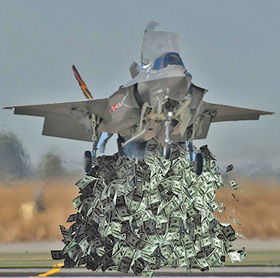
f35-moneydump


Posted in Uncategorized | Tagged: , , , | Leave a Comment »

Hiding in Plain Sight – US Military Sales Gone Rogue? – Antiwar.com Original

Posted by M. C. on February 18, 2019

Hillary Clinton, the former Secretary of State, wrote a memo in 2009 that was released by WikiLeaks. The memo acknowledged state “donors in Saudi Arabia constitute the most significant source of funding to Sunni terrorist groups worldwide… Saudi Arabia remains a critical financial support base for al-Qaida, the Taliban, LeT [Lashkar e-Tayyiba], and other terrorist groups, including Hamas, which probably raise millions of dollars annually from Saudi sources.”

https://original.antiwar.com/kimberly_dvorak/2019/02/17/hiding-in-plain-sight-us-military-sales-gone-rogue/

In the 60s the US military had the ingenious idea to purge the armed services of excess and dated weaponry that would increase operational capability of US forces and allow America’s allies to purchase military equipment that would improve interoperability. Congress formally created the Foreign Military Sales program (FMS), however, like any well-intentioned government program, it morphed into something other than its intended purpose, in this case, an international arms trafficking business… Read the rest of this entry »

Posted in Uncategorized | Tagged: , , , , , , | Leave a Comment »

Lockheed Martin CEO Marillyn Hewson sends out mass email attacking CODEPINK and appealing to Congress not to stop the war in Yemen | CODEPINK | AGR Daily 60 Second News Bites

Posted by M. C. on December 11, 2018

Certainly a brazen hussy!

Keeping Lockheed Martin’s and Saudi Arabia’s pockets lined by paying for the Yemen war. Yemen is the big loser. You and me somewhat less so…unless you are in the US military and dying or dismembered in Yemen.

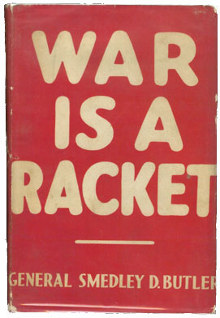
War_Is_a_Racket_(cover)

https://agrdailynews.com/2018/11/10/lockheed-martin-ceo-marillyn-hewson-sends-out-mass-email-attacking-codepink-and-appealing-to-congress-not-to-stop-the-war-in-yemen-codepink/

GENERAL NEWS

Lockheed Martin CEO Marillyn Hewson sends out mass email attacking CODEPINK and appealing to Congress not to stop the war in Yemen | CODEPINK

Marillyn Hewson, the CEO of Lockheed Martin, has sent out a mass email toady attacking the peace organization CODEPINK and asking U.S. citizens not to let Congress curtail weapons sales to Saudi Arabia by voting for new legislation introduced today that would do that. In her email, sent to over 200,000 people, she calls CODEPINK “bad for business” and openly criticizes H. Con. Res. 138, the War Powers Resolution to End US Military Involvement in Yemen…

Be seeing you

profiteering

War Is A Racket

Posted in Uncategorized | Tagged: , , , | Leave a Comment »

Bombing Yemeni School Children for Profit – Antiwar.com Original

Posted by M. C. on September 12, 2018

https://original.antiwar.com/mbenjamin/2018/09/11/bombing-yemeni-school-children-for-profit/

by 

As if the horrific Saudi bombing of a Yemeni school bus that killed 44 children on August 9, 2018 wasn’t bad enough, CNN reported that the bomb used in the attack was manufactured by Lockheed Martin, one of the major U.S. defense contractors. Nima Elbagir, reporting for CNN’s Situation Room, showed a map of Yemen pinpointing several other attacks where large numbers of civilians have been killed by bombs from not only Lockheed Martin, but also General Dynamics and Raytheon. It was a rare moment when a mainstream US media outlet made the connection between US weapons and the devastation they wreak.

The footage of the Yemen attack is heartbreaking, showing bloodied and screaming children (the ‘fortunate’ survivors) still wearing their blue backpacks. A global outcry for the Saudis to stop bombing civilians and for the US to stop selling weapons to Saudi Arabia arose immediately. Read the rest of this entry »

Posted in Uncategorized | Tagged: , , , , | Leave a Comment »

Seamus Bruner: Comey-Mueller ‘Cash in Through the Revolving Door’ of the Swamp

Posted by M. C. on August 26, 2018

Schweizer concluded, “What Seamus shows is this pattern where, when Mueller is in the private sector and Comey is in government, there seem to be contracts and resources that flow in that direction, as well. It’s kind of a tag team arrangement that these two have. It speaks to the financial underbelly that exists even at the Department of Justice. … There are lots of ways in which these officials self-enrich themselves.”

https://www.breitbart.com/big-journalism/2018/08/23/seamus-bruner-comey-mueller-cash-in-swamp/

by Robert Kraychik

Seamus Bruner, Government Accountability Institute (GAI) researcher and author of Compromised: How Money and Politics Drive FBI Corruptionexplained how former FBI Directors James Comey and Robert Mueller leveraged their government positions to enrich themselves. He joined Peter Schweizer, GAI president and Breitbart News senior editor-at-large, for a Wednesday interview with Sean Hannity.

“This is a familiar story [about] the revolving door; turning public service into self service,” said Bruner. “We followed the money. We followed it to the top, and we found that these choir boys or boy scouts — as the media likes to depict them — James Comey and Robert Mueller, they’re really no better than anyone else in the swamp. They use their public service [and] their contacts and they cash in through the revolving door.”

Bruner described Lockheed Martin’s — the country’s largest national defense and security contractor — hiring of James Comey in 2005 to the dual position of general counsel and senior vice president as unusual. Comey was 44 at the time and without requisite corporate experience.

Listen to the discussions below: Read the rest of this entry »

Posted in Uncategorized | Tagged: , , , , , | Leave a Comment »