
“They aren’t here because they hate freedom, it is because we are over there interfering.”
The Ron Paul Liberty Report
Be seeing you

Enemy of the State-Read the Book-Know the Man
This is not a Safe Space but Baby, I don't care.

"I am not a number, I am a Free Man" - No. 6
 Information Liberation Alex Jones’ Prison Planet Gary North Specific Answers Antiwar The Daily Bell Tenth Amendment Center Economics Policy Journal The American Thinker The New American Lew Rockwell
Posted by M. C. on October 2, 2024
“They aren’t here because they hate freedom, it is because we are over there interfering.”
The Ron Paul Liberty Report
Be seeing you
Posted in Uncategorized | Tagged: America, Middle East | Leave a Comment »
Posted by M. C. on February 7, 2024

https://substack.com/inbox/post/141442977
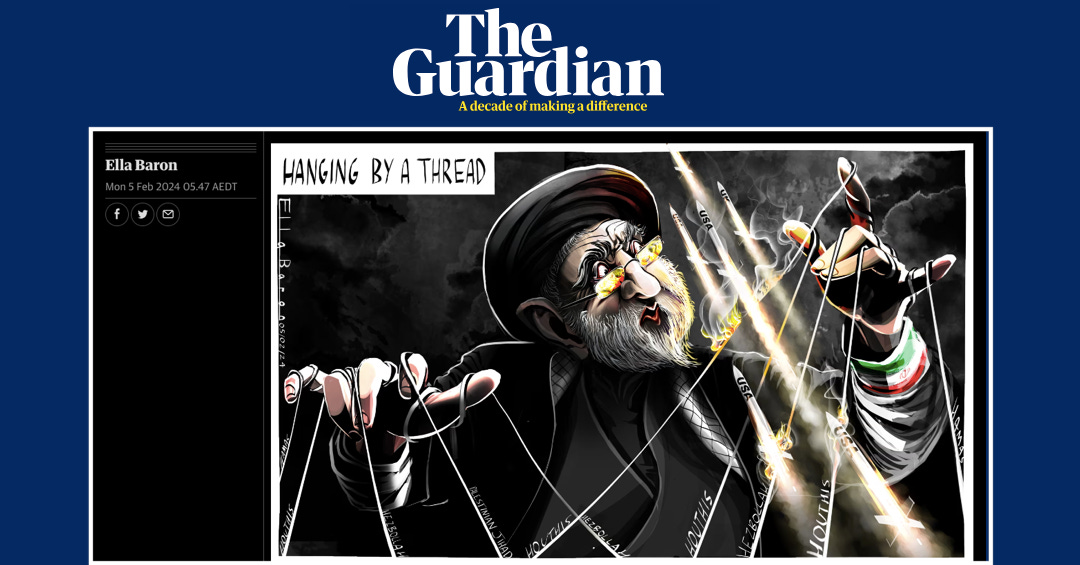
Mass media outlets like The Guardian, The New York Times and The Wall Street Journal have been allowing the publication of some amazingly racist pieces these last few days. All are directed at middle easterners and those of middle eastern descent, just as the western empire drops more and more bombs on more and more countries in the middle east.
On Monday The Guardian published a political cartoon which would be indistinguishable from Nazi propaganda of the 1930s, except that it happens to depict a Muslim instead of a Jew. The cartoon features Iranian leader Ali Khamenei holding puppet strings to so-called Iranian proxy groups in the middle east like the Houthis, Hezbollah and Hamas, in exactly the same way Nazis used to depict Jews as malignant puppet masters manipulating world affairs.
Compare this:
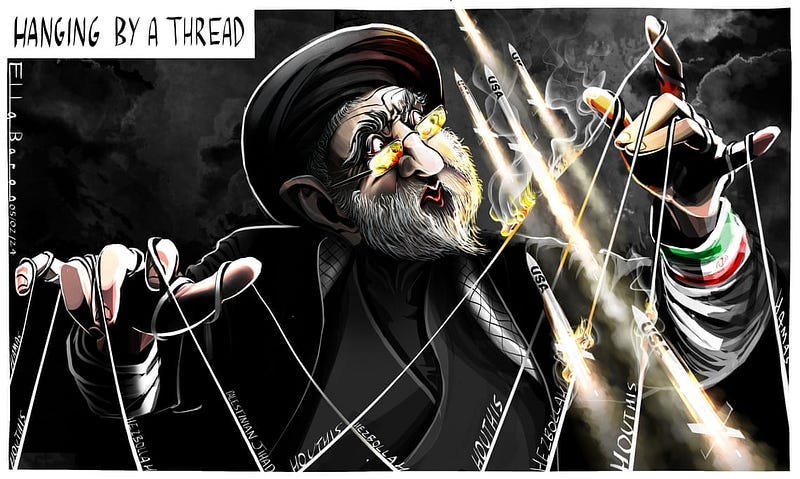
to Nazi propaganda about Jews puppeting world leaders during the lead-up to the Holocaust:


To this day it’s understood by the mainstream press that it’s unacceptable to depict anyone of the Jewish faith as any kind of puppet-master figure in any context at all. Fox News, the Dutch paper De Volkskrant, the Indian Bharatiya Janata Party and right wing political cartoonist Ben Garrison have all come under fire in recent years for depicting Jewish people in that way, so it’s safe to say that if The Guardian had published a similar cartoon about Israeli influence featuring an Israeli leader it would have been a massive scandal subject to international outcry.
In fact the bar is quite a bit lower for what qualifies as an outrageous racist trope when it comes to criticism of Israel
Be seeing you
Posted in Uncategorized | Tagged: Middle East, Nazi propaganda, Western Press | Leave a Comment »
Posted by M. C. on February 4, 2024

LEXINGTON, SC — With tensions continuing to rise in the Middle East and desperate calls for diplomacy being made around the world, former South Carolina Governor and current Republican presidential candidate Nikki Haley issued an urgent plea of her own, saying we must avoid peace in the Middle East at all costs.
Haley, still touting her distant second-place victory in the recent New Hampshire primary, stressed the need to fend off calls for any peaceful resolution to looming conflicts involving Iran and Palestine and emphasized the importance of maintaining a dangerous level of volatility in the region.
“We must find a path that leads us away from peace,” Haley said in a campaign speech to supporters in the Palmetto State. “There are dark forces at work behind the scenes who want nothing more than to bring about a meaningful, lasting peace in the Middle East the likes of which we have never witnessed in our lifetimes. That should never be our goal, and it never will be with me as your president.”
With political analysts warning that the region is becoming a growing powder keg, Haley voiced concern that a return to the White House of Donald Trump could have grave consequences for the quest to avoid peace. “I fear for the future,” she said. “If Donald Trump ends up back in power, we can all say goodbye to the days of war and bombings in the Middle East. None of us want that.”
At publishing time, Haley warned her supporters that a vote for Trump could lead to a total collapse of the military-industrial complex and a return of peace around the globe.
Bee seeing you
Posted in Uncategorized | Tagged: Middle East, Nikki Haley | Leave a Comment »
Posted by M. C. on January 25, 2024
It’s uneconomic to fight primitive people with modern weapons. Our million-dollar missiles blow up huts in the sand. At some point, some of their $10,000 missiles are going to get through and destroy a billion-dollar warship.
It’s almost always a mistake for foreigners to get involved in another country’s civil war, especially when it has religious overtones. It doesn’t matter which side you back; the people that you’re backing are not your friends, and the people on the other side will really hate you. It’s a no-win situation for the US. None of our business, with no upside. Except for US Government operatives who get to play bigshot.
by Doug Casey

International Man: Yemen has sometimes been called “the Afghanistan of the Middle East” because it is an impoverished tribal society that is well-armed, situated on mountainous terrain, and generally inhospitable to foreign invaders and a central government.
What are your impressions of this country?
Doug Casey: Regrettably, I haven’t been to Yemen and have no plans on going—partly because I’ve seen enough similar flyblown Islamic hellholes. But it’s well known that the country is extremely primitive, poor, tribal, and very religious.
Yemenis take their Mohammedanism quite seriously. No offense to believers, but the more primitive, poorer, and more tribal a place is, the greater the tendency for their lives to revolve around religion. It binds them together and gives their lives meaning. It is not a good place for foreigners of a different race, religion, or culture to invade. This begs the question, why would anybody want to invade it? There’s nothing there of any real value. Maybe there are some undeveloped resources, but the natural resource business is high risk/high cost under even the best circumstances.
You certainly don’t want to invest in a place with unfriendly natives. So, it’s entirely insane for outsiders to care about Yemen.
It has been said that war is nature’s way of teaching Americans geography. That’s true. Not one American in a thousand even knew the place existed until a few weeks ago; now, they all have opinions on what “we” should do, even if they still can’t find it on a map. But fear not. Even as we speak, plenty of reasons why we should care about Yemen are being fabricated in DC.
International Man: Yemen has long been a difficult place for foreign invaders.
Most recently, the Houthis, an Iran-backed group that controls most of Yemen, frustrated the military coalition of Saudi Arabia and its allies.
Though most people are unaware of this war or its details, it is remarkable that the Saudis, who are among the wealthiest in the Middle East and backed by the military and political support of the US, could not defeat the Middle East’s most impoverished people in Yemen.
What is your take on the Houthi–Saudi Arabian conflict and its implications?
Doug Casey: I doubt if one American out of 10,000, or even 100,000, had even heard the word Houthi before last year, but now it’s everywhere in the news. And for some reason, they’ve become our problem.
There used to be two Yemens—North Yemen and South Yemen—that were quite different politically and sociologically. They fought each other, then united in 1990. Now, the Houthis, who are Shia (hence the relations with Iran), are fighting a civil war with other locals. But it doesn’t seem to me Yemen is or has ever been a real nation-state. It’s impoverished, with no industry to speak of or the prospect of getting any. The income it has is from some oil production, and it all goes to corruption and paying the army. It has a large foreign trade deficit and debt. And the population is very young and exploding in numbers. It is, by any and every measure, one of the very most dysfunctional and essentially worthless places in the world.
It’s almost always a mistake for foreigners to get involved in another country’s civil war, especially when it has religious overtones. It doesn’t matter which side you back; the people that you’re backing are not your friends, and the people on the other side will really hate you. It’s a no-win situation for the US. None of our business, with no upside. Except for US Government operatives who get to play bigshot.
Be seeing you
Posted in Uncategorized | Tagged: Middle East, Mohammedanism, Yemen | Leave a Comment »
Posted by M. C. on December 7, 2023
It seems clear on the basis of this analysis, then, that more realist logic dictates the allocating of the nearly $40 billion dollars in U.S. aid that annually flows out to regimes around the world. However, given just how bad Washington has proven at playing grand strategy, from handing Baghdad to some of Tehran’s closest friends in the region to turning Libya into an extremist breeding ground, to pushing Russia and China together, that rationale too should ring hollow.
End foreign aid.

The period 2003-2018 saw Washington annually spending hundreds of millions to tens of billions of dollars supporting regimes across the Middle East and North Africa. While some of the effects and outcomes of these “investments” are obvious, such as the lost wars in Iraq and Afghanistan, the destruction of Libya, near destruction of Syria, and the rise of ISIS to name just a few, other outcomes and relationships are less readily apparent. Using a combination of the U.S. government’s own records of foreign aid contributions to each state in North Africa and the Middle East, and metrics calculating the relative protections accorded political rights and civil liberties in those same states, this statistical analysis focuses on the relationships, or lack of relationships, between these primary variables.
Below is a summary of its key findings:
The dataset utilized for the series of fixed effects (fe) panel regression analyses comprising this study was created by the author using the United States Agency for International Aid and Development (USAID) Greenbook data for U.S. government transfers to the states of North Africa and the Middle East for the years 2003-2018; while for those states’ political rights and civil liberties scores, the author used the annual “Freedom in the World” country by country report published by Freedom House. That report ranks the relative political rights and civil liberties in each state on a 1-7 scale, with lower numbers associated with more political freedom and better protections for civil rights. Lastly, other variables utilized over the course of the analyses included binary variables for which party controls the White House (1 for Republican, 0 for Democrat), whether the state receiving foreign aid experienced a military coup (1 for coup, 0 for no-coup), or whether there was serious civil unrest in a given country (1 for unrest, 0 for no-unrest).1
U.S. foreign aid programs, managed by organizations like USAID and supported by the U.S. State Department, aim to promote American values such as political freedom, civil liberties, democracy, and human rights across the globe. By providing assistance in various forms, including development aid, capacity-building, and humanitarian assistance, the United States claims to seek the strengthening of democratic institutions, support of civil society, and empowerment of individuals, thereby contributing to a more stable and prosperous world in line with alleged U.S. values. The first battery of tests put these goals under the statistical microscope; regressing U.S. aid by country with the annual fluctuations in its Freedom House scores for political rights and civil liberties for the years 2003-2018, the results are as follows:
Be seeing you
Posted in Uncategorized | Tagged: Civil Liberties, Foreign Aid, Middle East, North Africa, Political Rights, U.S. Aid | Leave a Comment »
Posted by M. C. on November 30, 2023
Had I never visited and lived among the oppressed as well as the oppressors, I certainly would be on the side of the Israelis. Just look at what they’ve done with their land and look at what the Palestinians have accomplished: zero. And yet, I have lived there and have seen what is going on with my own eyes and cannot ignore what I’ve seen and lived.
The question was a valid one: “How could you, a conservative and a gentleman, be for them?” The man is an acquaintance of long standing, also a gent, so I bothered to explain: “Because I’ve been there and have seen what’s going on up close.”
Needless to say, it was the Middle East we were talking about, and my sympathy for the Palestinians, as opposed to tiny Israel surrounded by hostile Arab nations. I was based in Amman back in 1969 and during “Black September” one year later, when King Hussein destroyed the PLO effort to take over his country. I had visited the Palestinian refugee camps for those evicted by Israeli settlers during the founding of Israel in 1948. I then covered the Yom Kippur War of 1973 and have visited many more such camps in Lebanon since then. All I can say is once you’ve seen the misery of life in those camps, it takes a heart of stone to ignore them.
But don’t take my word for it. Here’s David Schulman, a Hebrew professor at an Israeli university, writing in The New York Review of Books: “It is a regime of state terror whose raison d’être is the theft of Palestinian land and, whenever possible, the expulsion of its Palestinian owners. I have seen this system in operation over the course of the past twenty odd years.”
“Suffice it to say that Hamas knew very well that in its counterattack Israel would lose the PR battle.”
Mind you, pro-Israelis might immediately think, “There goes yet another self-loathing Jew.” I don’t know Schulman, but I’ve met a lot of Israelis who not only agree with him, but are adamant that Israel under Netanyahu has become an occupying power bent on capturing the whole West Bank. One thing is for sure, and I will get to the Hamas outrage and the Israeli reaction later on: To Palestinians living under the occupation over the past several years, state violence against them has escalated dramatically.
The question was a valid one: “How could you, a conservative and a gentleman, be for them?” The man is an acquaintance of long standing, also a gent, so I bothered to explain: “Because I’ve been there and have seen what’s going on up close.”
Needless to say, it was the Middle East we were talking about, and my sympathy for the Palestinians, as opposed to tiny Israel surrounded by hostile Arab nations. I was based in Amman back in 1969 and during “Black September” one year later, when King Hussein destroyed the PLO effort to take over his country. I had visited the Palestinian refugee camps for those evicted by Israeli settlers during the founding of Israel in 1948. I then covered the Yom Kippur War of 1973 and have visited many more such camps in Lebanon since then. All I can say is once you’ve seen the misery of life in those camps, it takes a heart of stone to ignore them.
But don’t take my word for it. Here’s David Schulman, a Hebrew professor at an Israeli university, writing in The New York Review of Books: “It is a regime of state terror whose raison d’être is the theft of Palestinian land and, whenever possible, the expulsion of its Palestinian owners. I have seen this system in operation over the course of the past twenty odd years.”
“Suffice it to say that Hamas knew very well that in its counterattack Israel would lose the PR battle.”
Mind you, pro-Israelis might immediately think, “There goes yet another self-loathing Jew.” I don’t know Schulman, but I’ve met a lot of Israelis who not only agree with him, but are adamant that Israel under Netanyahu has become an occupying power bent on capturing the whole West Bank. One thing is for sure, and I will get to the Hamas outrage and the Israeli reaction later on: To Palestinians living under the occupation over the past several years, state violence against them has escalated dramatically.
The question was a valid one: “How could you, a conservative and a gentleman, be for them?” The man is an acquaintance of long standing, also a gent, so I bothered to explain: “Because I’ve been there and have seen what’s going on up close.”
Needless to say, it was the Middle East we were talking about, and my sympathy for the Palestinians, as opposed to tiny Israel surrounded by hostile Arab nations. I was based in Amman back in 1969 and during “Black September” one year later, when King Hussein destroyed the PLO effort to take over his country. I had visited the Palestinian refugee camps for those evicted by Israeli settlers during the founding of Israel in 1948. I then covered the Yom Kippur War of 1973 and have visited many more such camps in Lebanon since then. All I can say is once you’ve seen the misery of life in those camps, it takes a heart of stone to ignore them.
But don’t take my word for it. Here’s David Schulman, a Hebrew professor at an Israeli university, writing in The New York Review of Books: “It is a regime of state terror whose raison d’être is the theft of Palestinian land and, whenever possible, the expulsion of its Palestinian owners. I have seen this system in operation over the course of the past twenty odd years.”
Mind you, pro-Israelis might immediately think, “There goes yet another self-loathing Jew.” I don’t know Schulman, but I’ve met a lot of Israelis who not only agree with him, but are adamant that Israel under Netanyahu has become an occupying power bent on capturing the whole West Bank. One thing is for sure, and I will get to the Hamas outrage and the Israeli reaction later on: To Palestinians living under the occupation over the past several years, state violence against them has escalated dramatically.
It is hard for me to describe what I’ve seen with my own eyes when Jewish religious fanatics—or settlers, as they’re called—mostly young men and women imbued with a burning, racist hate for Palestinians, come face-to-face with them. The Israeli army and the police, supposedly neutral, invariably side with the settlers, and thus one more Arab village empties out with religious fanatics moving in. The plan is a simple one and openly espoused by government officials: If life becomes unbearable, the Palestinians will leave and go to Jordan or Saudi Arabia, or anywhere, and the whole West Bank will be Jewish.
Well, it is a pipe dream because there are 8 million Palestinians not exactly wanted by other Arab countries. Netanyahu’s plan was to turn the West Bank into another Gaza, but then came Oct. 7 and we know the rest. Or do we? There is a longtime pattern in that disputed land: Palestinian suicide bombers propelled Netanyahu into the Prime Minister’s office, and it has been he and his hardliners who have fueled extremist Palestinian groups like Hamas and Islamic Jihad. The horror attacks of Oct. 7 have now been followed by the Gaza massacres of innocents, with more children reported killed in Gaza in the last three weeks than in all global conflicts together in the last year. This is according to Save the Children, not any Palestinian charity.
Be seeing you
Posted in Uncategorized | Tagged: David Schulman, Middle East, Palestinians | Leave a Comment »
Posted by M. C. on November 15, 2023
Our policymakers seem to have made up their minds without consulting the people or their representatives.
Did anyone ask you—or at least Congress—if it was O.K. to go to war again in the Middle East? After literal decades of fighting in that troubled part of the world, it looks like the U.S. is, without discussion, never mind vigorous debate, already at war in various sub-theaters of someone else’s conflict. See if anything that’s going on seems like war to you.
The U.S. is flying drones over Gaza. The Pentagon says the unmanned aerial vehicle flights began after Hamas’s October 7 terrorist attacks in Israel and are being conducted “in support of hostage recovery efforts.” The drone missions are also providing “advice and assistance” to Israel. A total of seven different aircraft are flying across the region, four of them per day, passing information to the Israeli Defense Forces (IDF). The U.S. is also supplying precision-guided munitions, fighter aircraft, and air defense capabilities, such as interceptors for Israel’s Iron Dome counter-drone systems, to the IDF.
U.S. Special Operations Forces (SOF) are in Israel. Officials anonymously told the New York Times several dozen special operators are on the ground working with the FBI, the State Department, and other U.S. government hostage recovery specialists. A senior Pentagon official told the “Forever Wars” blog that SOF are preparing for “contingencies,” which may include the active retrieval of hostages from Hamas. The U.S. previously said it has sent military advisers to help Israel. Christopher Maier, an assistant secretary of defense, indicated other soldiers have also been deployed. “We’re actively helping the Israelis to do a number of things,” Maier said.
Two American veteran-run organizations, the Special Operations Association of America (SOAA) and Save Our Allies, sent roughly two dozen volunteers, all former special operators, into Israel and Egypt to support evacuations. Each volunteer was chosen based on them having experience working with Egyptians or Israelis.
The volunteers arrange for local nationals to provide food and medical supplies to trapped Americans, and they have interfaced with the Egyptian military personnel who ultimately have to approve Americans’ departure. The special operations volunteers also coordinate directly with the IDF to ensure Americans are not targeted. They call their work “shepherding” and forswear a kinetic role. SOAA staff are also in Tel Aviv helping to coordinate evacuations. The volunteers’ actions, particularly working with the Egyptian and Israeli forces, come very close to off-limits traditional governmental roles, though the groups deny that.
Be seeing you
Posted in Uncategorized | Tagged: Israeli Defense Forces, Middle East, Pentagon, war | Leave a Comment »
Posted by M. C. on November 9, 2023
The latter have clearly dusted off “Plan R” and pulled it from the shelf and are now executing it. This Plan R looks like the one that Dick Cheney and company ran after 9/11; shift the focus away from the ones who did the deed onto the ones you need an excuse to go to war with.
So, 19 Saudis flew planes into the World Trade Center but we went to war with Iraq and Afghanistan.
Today “Hamas” slaughters a lot of jews and the first people threatened is Iran.
Power, empire building and who owes whom.
Author: Tom Luongo
The biggest stumbling block to analyzing what’s happening between Israel and the rest of the Middle East is dispensing with our biases and ignorance about pretty much the entire affair. I will be the first to admit to having profound ignorance about so much of the history between Israel and the Palestinians.
I really wish everyone else having opinions right now would at least admit that up front versus trying to sound like another incarnation of the Newly-Minted Subject Matter Expert of the Week thanks to having read a couple of articles in the New York Times.
And that’s the thing I believe we are fighting more than anything else at this point: the profound amount of propaganda and outright bullshit being slung around about every event of any significance.
All it does is create confusion and cognitive dissonance. That confusion is, by the way, the goal of the propaganda, from all sides.
That said, what’s abundantly clear is that this conflict has unleashed pent-up frustrations and simmering anger from all of the major players, not just the obvious ones like Hamas, the Israeli hardliners led by Prime Minister Benjamin Netanyahu and his echo chamber on K-Street, Capitol Hill and GCHQ.
The latter have clearly dusted off “Plan R” and pulled it from the shelf and are now executing it. This Plan R looks like the one that Dick Cheney and company ran after 9/11; shift the focus away from the ones who did the deed onto the ones you need an excuse to go to war with.
So, 19 Saudis flew planes into the World Trade Center but we went to war with Iraq and Afghanistan.
Today “Hamas” slaughters a lot of jews and the first people threatened is Iran.
Even though there is good evidence that “Hamas” wasn’t the only one involved in this attack, have closer ties to Sunni organizations than Shia, and are financed out of Qatar and the UK.
I’m not saying Iran has no role to play here. It did, according to Theirry Meyssan at Voltairenet (linked above), it was Iran, earlier this year, that brought all of the Palestinian factions together to reconcile their differences.
In 2023, Iran hosted talks between the region’s various pro-independence forces, Hezbollah, Islamic Jihad and Hamas. They were held in Beirut (Lebanon) under the presidency of General Ismaïl Qaani, commander of the al-Quds brigades of the Iranian Revolutionary Guards. Their aim was to reconcile these actors who had fought a ferocious war in Gaza, then in Syria. These meetings were made public in May 2023. On this occasion the Lebanese press discussed the preparation of the unitary operation which was carried out on October 7. Iran is therefore responsible for reconciling the Palestinian factions.
So, let’s dispense with the fiction that Bibi and company in Tel Aviv didn’t know about this operation beforehand. It’s preparation was made public knowledge in May.
But, in Neocon-speak this meeting was the equivalent of having masterminded the entire attack. Again, I’m not naïve here. Of course the simple narrative of “whatever is bad for Israel is good for Iran” holds water, but that doesn’t immediately elevate to “Iran did it!” as the South Carolinian hyenas Lindsay Graham and Nimrata Haley want you to believe.
Benefitting from something is not masterminding it or funding it.
Be seeing you
Posted in Uncategorized | Tagged: BRICS, Egypt, Erdogan, Gaza, Hamas, Iran, Middle East, Ottoman Empire, Plan R | Leave a Comment »
Posted by M. C. on May 23, 2023
The Saudi regime has grown closer to Moscow in the wake of US sanctions against Russia. For example, “Saudi Arabia and the UAE, traditional Middle Eastern allies of the United States, are not shying away from importing, storing, trading, or re-exporting Russian fuels despite American efforts to persuade them to join a crackdown on Russian attempts to evade the Western sanctions on its oil.”
What would one expect from the regime that financed 9/11? I think the US regime is beyond salvage. Only US foreign policy could unite mortal enemies, Sunni and Shia, against US.
https://mises.org/wire/thanks-sanctions-us-losing-its-grip-middle-east
On Friday, members of the Arab League welcomed the Syrian regime back to the organization. Representatives from several Arab member states shook Syrian leader Assad’s hand and gave him, a “warm” reception according to several news outlets. Syria was suspended from the league in 2011, but on May 7 in Cairo the league agreed to reinstate the Assad regime.
This represents a reversal from years of isolation placed on the regime, and a break with US policy which remains staunchly opposed to Assad. Indeed, the League’s rapprochement with Assad should be seen as a repudiation of US policy, and especially as a sign of how Washington’s influence among Leage members—the most powerful of which are Saudi Arabia and Egypt—has waned.
Moreover, this is just the latest bad news for Washington’s influence in the region coming mere weeks after Iran and Saudi Arabia reestablished diplomatic relations.
In both cases, we find regimes that Washington had sought to isolate and sanction, but both states have instead been expanding their relations with other states in the region with the help of China. Meanwhile, both Beijing and Riyadh have increased their ties with Russia. These development help illustrate how growing US attempt to impose—or threaten to impose—hard line sanctions against a growing number of regimes has only accelerated a global movement away from the US dollar and away from Washington’s orbit.
In March of this year, Saudi Arabia and Iran announced a resumption of relations following a deal brokered by China. The Saudi regime—a longtime Washington ally—had apparently not told the Biden administration of the meetings with Iran and China. Shortly after the agreement was announced, the administration dispatched CIA Director William Burns to Saudi Arabia where he reportedly “expressed frustration with the Saudis,” telling “Saudi Crown Prince Mohammed bin Salman that the U.S. has felt blindsided by Riyadh’s rapprochement with Iran and Syria.”
Although the White House now claims to be supportive of the new agreement between Riyadh and Tehran, this support is really just an admission that there’s not much Washington can do about it. After all, for decades, US policy has been to isolate Tehran and in recent years, Washington has imposed harsh sanctions, including Donald Trump’s “maximum pressure campaign” designed to cripple Iran even more. The Biden administration took no significant steps to reverse the Trump position. The Saudi regime’s newfound openness to Iran is thus contrary to US policy, and it is not plausible that Washington is in any way pleased with the change.
Be seeing you
Posted in Uncategorized | Tagged: Arab League, Assad, Middle East, sanctions, Syria | Leave a Comment »
Posted by M. C. on April 20, 2023
https://libertarianinstitute.org/articles/saudi-arabia-when-being-neutral-isnt-neutral-anymore/
by Ted Snider

After decades of stewardship of the Middle East, during which the United States pursued the absurd policy of not talking to its enemies and creating and enforcing blocs to oppose and isolate those enemies, the predictable outcome occurred. The region was left with blocs and enemies who were not talking to each other. The result was horrid wars and the threat of even worse wars.
It has long been known that a key to opening those blocs and initiating diplomacy would be a negotiated peace between the heads of the two main rivals, Saudi Arabia and Iran. It has also long been known that the United States withheld that key. Unlocking the blocs is not in American interest. Hegemony in the region requires punishing and isolating countries that won’t follow you. That requires sanctions, threats of war, and isolation. Iran is such a country. So, the establishment and maintenance of a coalition against Iran is a key feature of U.S. policy in the region. At the heart of that coalition is Saudi Arabia, firmly in the U.S.-led anti-Iran camp.
But the emergence of China as diplomatic power has “blindsided” the United States and changed the diplomatic environment in the Middle East. China chose peace instead of sides and brought Saudi Arabia and Iran together for talks. Having the blocs talk to each other instead of enforcing their isolation shook the U.S. world order. On March 10, those talks resulted in an agreement between Saudi Arabia and Iran.
And the key to opening talks, ending wars, and bringing peace to the Middle East is already showing its promise. After years of region destabilizing enmity, Saudi Arabia and Iran signed “an agreement to resume diplomatic relations between them and re-open their embassies and missions within a period not exceeding two months.”
The agreement is showing signs of working. True to their word, on April 6 the foreign ministers of Saudi Arabia and Iran met in Beijing where they signed an agreement to reopen their embassies and consulates in each other’s countries. And Saudi King Salman bin Abdulaziz Al Saud has invited Iranian President Ebrahim Raisi for an official visit. Raisi has accepted the invitation and “stressed Iran’s readiness to expand co-operation.” The two countries have also agreed to hold a meeting of their foreign ministers. Peace is breaking out.
But the potential for peace is bleeding beyond the two countries.
The first to feel the effect of the change in environment was Syria. President Bashar al-Assad survived the war against Saudi-backed rebels in large part because of the support of his Iranian allies. Peace in Syria would also require peace between Saudi Arabia and Iran.
China’s facilitation of talks between Saudi Arabia and Iran opened the door for Russia to facilitate talks between Saudi Arabia and Syria. Within two weeks of the Saudi-Iran breakthrough, Saudi Arabia and Syria agreed to reopen their embassies.
The entire Arab world is ending its isolation of the Assad regime.
Be seeing you
Posted in Uncategorized | Tagged: American peace, Assad, Iran, Middle East, Saudi Arabia | Leave a Comment »
 MCViewPoint