
MCViewPoint

Opinion from a Libertarian ViewPoint

Posts Tagged ‘NATO’

What will be the foreign policy of the next US President?, by Thierry Meyssan

Posted by M. C. on September 11, 2020

The two programs for the Trump and Biden candidacies are not similar to those of previous candidates. It is no longer a question of adjusting the United States to the changing world, but of defining what they will be. The question is existential, so it is quite possible that things will degenerate and end in violence. For some, the country must be a nation at the service of its citizens, for others it must restore its imperial status.

https://www.voltairenet.org/article210762.html

by Thierry Meyssan

The U.S. 2020 presidential campaign pits two radically different visions of the United States: empire or nation?

On the one hand, Washington’s claim to dominate the world by “containment” – a strategy articulated by George Kennan in 1946 and followed by all presidents until 2016 – and on the other hand, the rejection of imperialism and the desire to facilitate the fortunes of Americans in general – a strategy articulated by President Andrew Jackson (1829-37) and taken up only by President Donald Trump (2017-20).

Each of these two camps wields rhetoric that masks its true practice. Democrats and Republicans pose as heralds of the “free world” in the face of “dictatorships”, as defenders of racial, gender and sexual orientation discrimination, and as champions of the fight against “global warming”. The Jacksonians, for their part, take turns denouncing the corruption, perversity and ultimately hypocrisy of their predecessors while calling to fight for their nation and not for the empire.

The two camps have in common only the same cult of force; whether it is at the service of the empire (Democrats and Republicans) or the nation (Jacksonians).

The fact that the Jacksonians unexpectedly became a majority in the country and took control of the Republican Party adds to the confusion, but should not confuse trumpism with what the Republican ideology has been since World War II.

In reality, Democrats and Republicans tend to be well-to-do people or professionals in new technologies, while Jacksonians – like the “yellow vests” in France – are rather poor and professionally tied to the land from which they cannot escape.

For the 2020 campaign, Democrats and Republicans are united behind former Vice President Jo Biden. He and his supporters are extremely voluble about their intentions:
- “The Power of America’s Example”, by Joseph R. Biden Jr., Voltaire Network, 11 July 2019.
- “Why America Must Lead Again. Rescuing U.S. Foreign Policy After Trump”, by Joseph R. Biden Jr., Foreign Affairs, March/April 2020.
And especially the statement by senior Republican national security officials to Democrat Biden :
- “A Statement by Former Republican National Security Officials”, Voltaire Network, 20 August 2020.
On the contrary, Donald Trump is evasive in writing:
- “Donald Trump Second Term Agenda”, by Donald Trump, Voltaire Network, 24 August 2020 (foreign policy is the small paragraph at the end of the text).

In my view, the main disputes are not stated, but are constantly implied.
JPEG - 81.6 kb
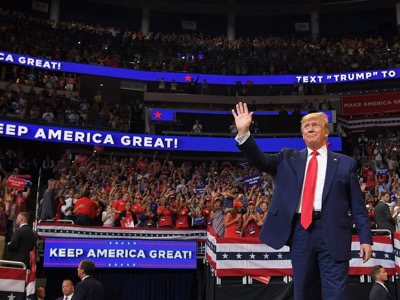
As a television host, Donald Trump dreamed of giving the country back to the people as President Andrew Jackson did.

The Jacksonian agenda

As soon as he took office, Donald Trump questioned the Rumsfeld/Cebrowsky strategy of annihilating the state structures of all the countries of the “Broader Middle East” without exception and announced his wish to bring home the troops lost in the “war without end”. This goal remains at the top of his priorities in 2020 (“Stop Endless Wars and Bring Our Troops Home”).

As a result, he excluded the Director of the CIA and the Chairman of the Chiefs of Staff Committee from regular meetings of the National Security Council. In so doing, he deprived the supporters of imperialism of their main tool of conquest.

See:
- “Presidential Memorandum: Organization of the National Security Council and the Homeland Security Council”, by Donald Trump, Voltaire Network, 28 January 2017. And “Donald Trump winds up “the” organization of US imperialism”, by Thierry Meyssan, Translation Anoosha Boralessa, Voltaire Network, 31 January 2017.

There followed a battle for the presidency of this council with the indictment of General Michael T. Flynn, then his replacement by General H. R. McMaster, the exceptionalist John R. Bolton, and finally Robert C. O’Brien.

In May 2017, Donald Trump called on U.S. allies to immediately cease their support for jihadists charged with implementing the Rumsfeld/Cebrowski strategy. This was the Riyadh speech to the Sunni heads of state and then to NATO heads of state and government. President Trump had declared NATO obsolete before changing his mind. However, he obtained not the abandonment of Russia’s policy of containment, but the halving of the credits used for this purpose and the allocation of the funds thus preserved to the fight against jihadism. In doing so, it partially stopped making NATO an instrument of imperialism and turned it into a defensive alliance. It has therefore demanded that its members contribute to its budget. Support for jihadism, however, was pursued by the supporters of imperialism with private means, notably the KKR Fund.

See:
- “Presidential Memorandum: Plan to Defeat the Islamic State of Iraq and Syria”, by Donald Trump, Voltaire Network, 28 January 2017.
- “Donald Trump’s Speech to the Arab Islamic American Summit”, by Donald Trump, Voltaire Network, 21 May 2017.
- “Remarks by Donald Trump at NATO Unveiling of the Article 5 and Berlin Wall Memorials”, by Donald Trump, Voltaire Network, 25 May 2017.

Hence his watchwords: “Wipe Out Global Terrorists Who Threaten to Harm Americans” and “Get Allies to Pay their Fair Share.

Like the Democrats and Republicans, the Jacksonian Donald Trump is committed to restoring the capabilities of his armies (“Maintain and Expand America’s Unrivaled Military Strength”). Unlike his predecessors, he did not seek to transform the Pentagon’s delusional management by privatizing one department at a time, but rather developed a plan to recruit researchers to compete technologically once again with the Russian and Chinese armies.

See:
- “National Security Strategy of the United States of America”, December 2017. And “Donald Trump’s National Security Strategy”, by Thierry Meyssan, Translation Pete Kimberley, Voltaire Network, 26 December 2017.

Only Donald Trump’s desire to regain primacy in missile matters is supported by Democrats and Republicans, although they do not agree on how to achieve it (“Build a Great Cybersecurity Defense System and Missile Defense System”) : the tenant of the White House wants the USA to equip itself alone with these weapons that it can eventually deploy on the territory of its allies, while its opponents want to involve the allies in order to maintain their hold on them. From the point of view of the Democrats and Republicans, the problem is obviously not withdrawing from the Cold War disarmament treaties to build a new arsenal, but the loss of means of diplomatic pressure on Russia.

A professional politician, Joe Biden hopes to restore the imperial status of the former First World Power.

The program of Democrats and non-party Republicans

Joe Biden proposes to focus on three objectives: (1) reinvigorate democracy (2) train the middle class to cope with globalization (3) regain global leadership.

- Reinvigorate democracy: in his words, this means basing public action on the “informed consent” of Americans. In doing so, he used Walter Lipmann’s 1922 terminology, according to which democracy presupposes “manufacturing consent”. This theory was discussed at length by Edward Herman and Noam Chomsky in 1988. It obviously has nothing to do with the definition formulated by President Abraham Lincoln: “Democracy is government of the people, by the people, for the people”.

Joe Biden believes he is achieving his goal by restoring the morality of public action through the practice of “political correctness”. For example, he condemns “the horrible practice [of President Trump] of separating families and placing the children of immigrants in private prisons,” without saying that President Trump was merely applying a democratic law to show its futility. Or he announces that he wants to reaffirm the condemnation of torture that President Trump justified, without saying that the latter, like President Obama, has already banned the practice while maintaining life imprisonment without trial in Guantánamo.

He announced his intention to convene a Summit for Democracy to fight against corruption, to defend the “Free World” against authoritarian regimes, and to advance human rights. In view of his definition of democracy, it is a question of uniting allied states by denouncing scapegoats for what is wrong (the “corrupt”) and promoting human rights in the Anglo-Saxon sense and especially not in the French sense. That is to say, to stop police violence and not to help citizens to participate in decision-making. This summit will launch an appeal to the private sector so that new technologies cannot be used by authoritarian states to monitor their citizens (but the USA and its NSA can always use them in the interest of the “Free World”).

Finally, Joe Biden concludes this chapter by highlighting his role in the Transatlantic Commission for Electoral Integrity alongside his friends, former NATO Secretary General Anders Fogh Rasmussen, who overthrew the Libyan Arab Jamahiriya, and Michael Chertoff, former US Secretary of Homeland Security, who put all US citizens under surveillance. Not forgetting John Negroponte who organized the Contras in Nicaragua and Daesh in Iraq.

- Educating the middle class to cope with globalization. Joe Biden believes that the politics that have been pursued since the dissolution of the USSR have led to the rapid disappearance of the middle class, and that training the remaining middle class in the use of new technologies will prevent the relocation of their jobs.

- Renewing U.S. leadership. In the name of democracy, this means stopping the rise of “populists, nationalists and demagogues. This formulation helps us understand that democracy, according to Joe Biden, is not only the fabrication of consent, but also the eradication of the popular will. If demagogues pervert democratic institutions, populists serve the popular will and nationalists serve the community.

Joe Biden then specifies that he will stop wars “forever”; a formulation that seems to support the same goal as the Jacksonians, but differs in terminology. It is in fact a question of validating the current adaptation of the system to the limits imposed by President Trump: why make US soldiers die abroad when one can pursue the Rumsfeld/Cebrowski strategy with jihadists at a lower cost? All the more so since when he was only an opposition senator, Joe Biden gave his name to the plan to partition Iraq that the Pentagon was trying to impose.

A verse follows on the enlargement of NATO to include Latin American, African and Pacific allies. Far from being obsolete, the Alliance will once again become the heart of U.S. imperialism.

Finally, Joe Biden pleads for the renewal of the 5+1 agreement with Iran and disarmament treaties with Russia. The agreement with President Hassan Rohani aims to classically divide Muslim countries into Sunni and Shia, while the disarmament treaties aim to confirm that the Biden administration would not envisage a global confrontation, but the continued containment of its competitor.

The program of the Democratic Party candidate and non-party Republicans concludes with the assurance of joining the Paris Accord and taking leadership in the fight against global warming. Joe Biden specifies that he will not give gifts to China, which is relocating its most polluting industries along the Silk Road. On the other hand, he omits to say that his friend, Barack Obama, before entering politics, was the drafter of the statutes of the Chicago Carbon Emissions Trading Exchange. The fight against global warming is not so much an ecological issue as a matter for bankers.

Conclusion

It must be said that everything is opposed to a clarification. Four years of upheavals by President Trump have only succeeded in replacing the “endless wars” with a low-intensity private war. There are certainly far fewer deaths, but it is still war.

The elites who enjoy imperialism are not ready to give up their privileges.

So it is to be feared that the U.S. will be forced to go through an internal conflict, a civil war, and break up like the Soviet Union once did.

Translation
Roger Lagassé
Be seeing you


Posted in Uncategorized | Tagged: , , , , , | Leave a Comment »

Defend America, Not Ukraine: Treat Kiev as a Friend Rather Than an Ally – Antiwar.com Original

Posted by M. C. on August 17, 2020

Yanukovych’s decision to reject an economic association agreement with the European Union and forge closer relations with Moscow triggered demonstrations in which violent demonstrators took over government buildings in Kiev’s center. Such protests were easy to organize since the capital was located in the country’s west, dominated by the opposition and oriented toward America and Europe.

https://original.antiwar.com/?p=2012340695

Should the U.S. be ready to go to war with Russia over Ukraine? NATO’s answer is yes. At least, leaders of the transatlantic alliance continue to encourage Kiev’s ambition to join NATO, thereby becoming yet another costly Washington defense dependent.

US policymakers should remember that alliances are supposed to be a means to the end, America’s security, not the end itself. Absent necessity to protect an overriding, genuinely vital interest, risking war with a nuclear-armed power, in this case Russia, would be a particularly stupid policy.

Ukraine has a long, storied, and tragic history. Subsumed by the Russian Empire, Kiev briefly gained independence amid the Russian Revolution, German victory over the Bolshevik regime, and the bitter Russian civil war. (Poland also was intimately involved in the ludicrously complicated period of chaos and conflict.)

Unfortunately, the territory, augmented by lands that had been governed by Austro-Hungary, ultimately was reabsorbed by Moscow, this time through the new but not improved imperial Russia in the form of the Soviet Union. Ukraine suffered through the murderous Stalin-induced famine, known as the Holomodyr, which killed millions. Estimates vary widely but range up to about ten million.

Unsurprisingly, many Ukrainians initially welcomed German troops as liberators in 1941. However, Adolf Hitler viewed Slavs as untermenschen and saw Ukrainians no differently. Berlin’s murderous mistreatment turned the population against the Nazis. Perhaps six million Ukrainians died during the war – and another 1.4 million were killed fighting with the Red Army. After Moscow’s forces returned Ukrainian resistance, this time against the Soviets, continued for years. The territory was beset by famine, again. About one-fifth of Ukraine’s population, including ethnic Germans and Tartars, was deported.

Freedom finally came. In 1990 a popularly elected parliament approved the Declaration of State Sovereignty of Ukraine, which set Ukrainian law before that of the Soviet Union. In late 1991 Ukraine voted for independence and a president. A nation then of 52 million, it was the largest constituent republic to break away from the U.S.S.R. Alas, the new country suffered from economic decline, corruption, awful leadership, and Russian meddling.

Kiev inherited some 3000 nuclear weapons, stationed in its territory during the Cold War. In 1994 Ukraine joined the Nuclear Non-Proliferation Treaty and two years later transferred the warheads to Russia to be dismantled. Through the Budapest Memorandum on Security Assurances the US, Russia, and the United Kingdom promised to respect Ukraine’s sovereignty and offered vacuous security assurances. The agreement was a presidential proclamation, not ratified by the US Senate, and provided no practical recourse, backed only by a promise to go to the UN Security Council for redress. Which in practice was no promise at all.

Ukrainians’ choice in leaders seemed perennially suspect. The first two presidents were essentially apparatchiks from the past. Among the least competent leaders was American favorite Viktor Yushchenko. This president won just 5.45 percent of the vote in his 2010 reelection campaign and his party garnered only 1.11 percent of the vote in the 2012 legislative election. His successor was the egregiously corrupt but freely chosen Viktor Yanukovych, who represented Ukraine’s Russia-friendly east.

Yanukovych’s decision to reject an economic association agreement with the European Union and forge closer relations with Moscow triggered demonstrations in which violent demonstrators took over government buildings in Kiev’s center. Such protests were easy to organize since the capital was located in the country’s west, dominated by the opposition and oriented toward America and Europe. As violence mounted Washington and Brussels promoted what amounted to a street putsch, even discussing their preferred candidates for prime minister. Yanukovych agreed to early elections, but his support dissipated and the Rada removed him.

Moscow responded violently, seizing Crimea, in which Sebastopol naval base is located. Russia subsequently held a referendum, which backed annexation. The vote was highly unfair but probably reflected local sentiment. The territory historically was part of Russia, transferred to Ukraine only in 1954. The shift caused little practical difference in the Soviet Union; the move likely reflected political maneuvers involving Ukrainian Communist Party officials as Nikita Khrushchev and his Politburo colleagues fought for supremacy in the aftermath of Joseph Stalin’s death.

Vladimir Putin’s government also backed ethnic-Russian insurgents in Donetsk and Luhansk. Some 13,000 people so far have died in the ensuing conflict. In 2016 both sides agreed to the Minsk Protocol, in which Kiev agreed to constitutional changes enhancing regional autonomy in the Donbas and Russia promised to end military support for opposition forces, after which the region would be reintegrated into Ukraine. The pact has not been fulfilled due to failures on both sides, especially by Kiev: nationalists opposed the accord from the start and some Ukrainians reconsidered retaining areas with a heavy ethnic Russian presence.

Although Ukraine is not a member of NATO – it was promised membership, along with Georgia, in 2008, without any timetable given – much of official Washington urged American military intervention. Some policymakers proposed rushing Kiev into the transatlantic alliance. Others urged sending US troops to Ukraine to serve as a tripwire for war to discourage further Russian action. Almost everyone backed arming Kiev’s armed forces.

The Obama administration provided non-lethal aid. Despite the Trump administration’s supposed pro-Russia bias, it ramped up tensions by shipping Javelin anti-tank missiles to Ukraine. Read the rest of this entry »

Posted in Uncategorized | Tagged: , , , | Leave a Comment »

Who will salute Trump’s man in Berlin? – UnHerd

Posted by M. C. on August 14, 2020

But in some respects, Macgregor has gone even further than the president and will doubtless spell out some hard truths to the German government if he becomes the next US Ambassador to Berlin. Just last year, he called NATO a “zombie”. Even more controversial during a period of bogus “Russiagate” fanaticism, Macgregor has inconveniently reminded us that “the promises given to President Mikhail Gorbachev by President George H. W. Bush, Prime Minister Margaret Thatcher, President Francois Mitterrand, Chancellor Helmut Kohl and their foreign ministers in 1990 — not to expand NATO eastward; not to extend membership in the NATO alliance to former member states of the Warsaw Pact—were ignored.”

https://unherd.com/2020/08/how-trumps-new-hire-subverts-the-status-quo/

BY and

Two centuries ago, the British statesman John Bright warned against “following visionary phantoms in all parts of the world while your own country is becoming rotten within”.

It is symptomatic of how diseased American strategic thinking has become over the past 30 years that so few Americans in a position to influence the direction of US foreign policy would have the guts or insight to issue a similar warning today.

That cannot be said of President Trump’s nominee to become ambassador to Germany, retired US Army Colonel Douglas Macgregor. It’s a selection that sends a clear message in the run-up to the 2020 election.

Colonel Douglas Macgregor’s selection sends a clear message in the run-up to the 2020 election

Macgregor, who has previously been on the shortlists to be either US national security advisor or Undersecretary of Defense for Policy, would be that rarest of creatures in Trumpworld: an appointee actually in line with the policies the President campaigned on in 2016.

In him, Trump would at long last have a high profile advocate for foreign policy positions that arguably won him the election four years ago. Macgregor has been a staunch supporter of the President’s efforts to finally bring a real and lasting peace to the Korean peninsula. He has also long been an outspoken proponent of a worldwide US military drawdown, in particular calling for a serious rethink of the benefits of NATO. Read the rest of this entry »

Posted in Uncategorized | Tagged: , , , , , , | Leave a Comment »

Nancy Pelosi and Liz Cheney Unite Against Putting America First | The American Conservative

Posted by M. C. on July 29, 2020

This episode captures why the Washington establishment loathes President Trump. Hint: it has nothing to do with the smears accusing him of racism or Russian sympathies.

Trump is the only president to challenge the internationalist interventionist orthodoxy that’s ruled Washington unquestioned for the last 70 years.

https://www.theamericanconservative.com/articles/nancy-pelosi-and-liz-cheney-unite-against-america-first-foreign-policy/

Ending wars is the one truly heretical act in Washington.

WASHINGTON, DC – JULY 21: U.S. Rep. Liz Cheney (R-WY) speaks during a news conference with House Minority Leader Kevin McCarthy (R-CA) and other Republican members of the House of Representatives at the Capitol on July 21, 2020 in Washington, DC. (Photo by Samuel Corum/Getty Images)

After President Trump stated his desire to withdraw troops from Afghanistan, Germany and South Korea, the bipartisan war party sprang into action.

Veto-proof majorities in both houses of Congress approved a defense appropriations bill that authorizes $740 billion in military spending. Along with all the other dubious and downright awful provisions, the House’s version of the bill has included a measure designed to thwart the president from bringing troops home. House Democrats worked with Liz Cheney (R-WY) on an amendment putting several conditions on the administration’s withdrawal from Afghanistan, requiring the White House to certify at several stages that further reductions wouldn’t jeopardize counterterrorism or national security.

This episode captures why the Washington establishment loathes President Trump. Hint: it has nothing to do with the smears accusing him of racism or Russian sympathies.

Trump is the only president to challenge the internationalist interventionist orthodoxy that’s ruled Washington unquestioned for the last 70 years.

Let’s go back to 1949, to the creation of NATO and the initial deployment of troops to Europe.

Joe Stalin and world communism was on the march, we were told. Russia controlled half of Europe and would take the rest—along with Korea—unless we acted. President Truman demanded American boys be ready to fight Russia in Germany, Japan, Greece, Turkey, Korea, wherever.

But even in that climate of crisis, support for permanent war was not unanimous.

Senator William “Wild Bill” Langer (R-North Dakota), one of the eleven Republicans in opposition (along with just two Democrats) called NATO “a barren military alliance directed to plunge us deeply into the economic, military and political affairs of the other nations of Europe.”

We’re still plunging new depths, ever seeking new frontiers and new missions for the barren alliance.

When President Trump declared before the immobile faces of Mt. Rushmore, “A nation must care for its own citizens first. We must take care of America first,” he was channeling that original America Firster, Joe Kennedy.

The man who would father three senators and a president offered this advice in 1950 (none of his children took it): America needs “to get out of Korea” and “apply the same principle to Europe.” We must “conserve American lives for American ends, not waste them in the freezing hills of Korea or the battle-scarred plains of Western Germany.”

Or in the mountains of Afghanistan or the deserts of the Middle East.

When you hear President Trump ask NATO countries to up their defense spending, compare that to the words of Joe Kennedy: “We cannot sacrifice ourselves to save those who do not wish to save themselves.”

Nancy Pelosi and her ilk call Trump a Russian asset for daring to put the interests of this country before empire.  Nothing new there.  Today’s Russia-baiters are cut from the same cloth as an earlier generation of liberals.

In 1951, The Nation magazine accused “Herbert Hoover and a good portion of the Republican Party” of being captured by Moscow—that portion opposed to NATO, because Hoover doubted the effectiveness of deploying ground troops against the communist nations.

The New Republic seconded the motion: refusing to commit American troops to NATO “may lead Stalin to attack Western Europe” and keep advancing until his minions “would bring out in triumph the first Communist edition of the Chicago Tribune.” Mitt Romney and his fellow impeachment travelers remain convinced we must fight the Russians over there so we don’t have to fight them over here!

Back then, the bipartisan war party insisted the president could send troops abroad without asking Congress. Now when President Trump wants to bring them home, Congress claims it has the authority to stop him. Whatever it takes to keep the war machine properly greased.

Until Trump, George McGovern was the only candidate of a major party to call for drawing down troops in Europe and Korea. The sentiment in McGovern’s 1972 acceptance speech is pure America First: “This is also the time to turn away from excessive preoccupation overseas to rebuilding our own nation.”

The establishment has hated McGovern ever since for the same reason they hate President Trump.

The America First program would dismantle the imperial project that brought us NATO and has kept us on permanent war footing until today.

The foreign policy sachems built a “post-war rules based international order” on the premise the United States can and must remake the world. They stationed our troops abroad and launched wars with no end. They merged the American economy with that of the rest of the world, destroying America’s industries, high wage scales and standard of living in the process. They constructed a permanent national security state with unchecked powers to pursue anyone including the president.

The precious “rules based international order” is empire by another name. To those who support it—Democrat, Republican, liberal, conservative, neoconservative, academics, lobbyists and pundits—it is the One True Faith.

Anyone who opposes it is anathema. Even the elected President of the United States.

about the author

Curtis Ellis is Policy Director with America First Policies. He was a senior policy advisor on the 2016 Trump campaign and Presidential Transition Team and served as special advisor to the Secretary of Labor in  the Trump administration.

Be seeing you

Posted in Uncategorized | Tagged: , , , , , | Leave a Comment »

The Washington Post and Its Cold War Drums – CounterPunch.org

Posted by M. C. on July 20, 2020

It is customary for the political rhetoric to get heated during a presidential campaign, which will find Donald Trump and Joe Biden vying for honors in the field of national security and militancy, but there should be some balance and context from the mainstream media.  The increasingly hard line of the Washington Post on the competition with China, Russia, and Iran suggests that the political contenders will be goaded—and not ameliorated—by the nation’s key newspapers.

https://www.counterpunch.org/2020/07/10/the-washington-post-and-its-cold-war-drums/#gsc.tab=0

The Washington Post has taken its Cold War campaign against China, Russia, and Iran to a new level.  In the Sunday edition of its Outlook section, the Post gave front-page coverage to long articles by former ambassador Michael McFaul and former New York Times’ writer Tim Weiner to trumpet Russia’s “constant aggression” and its “brutal Cold War rules.”  There was no hint whatsoever of Russian President Vladimir Putin’s efforts to improve Russian-American relations over the past two decades, and no suggestion that the actions of the United States over the past 25 years have significantly contributed to the poor state of relations between Moscow and Washington.

The companion pieces have supportive titles, which suggests an editorial decision to express an authoritative point of view.  McFaul’s article is titled “Trump always finds a way to let Putin win….”, and Weiner’s screed follows with “….even when Russia plays by brutal Cold War rules.”  Their joint thesis is a simple one: Donald Trump’s complacency has enabled President Putin’s “litany of belligerent acts.”  Neither writer notes U.S. actions over the past quarter-century that have worsened the international environment and helped to create a  revival of the Cold War.  Indeed, they absolve the last four American presidents of any responsibility for the current state of affairs, ignoring their actions that have been consistent with Cold War policymaking.  Is anyone going to address the importance of restoring a Russian-American dialogue revolving around arms control and disarmament as well as Third World conflict resolution?

McFaul’s article is particularly interesting in view of his role as the architect of President Barack Obama’s “reset” policy toward Russia, his standing as one of the leading scholars on post-communist Russia, and his appointment as the first non-career diplomat to be U.S. ambassador to the Kremlin.  His two-year tour was hardly a success as McFaul, only several days after his arrival in Moscow, chose to invite a number of organizers and prominent participants in the anti-Putin protest movement to the U.S. embassy.  McFaul immediately became an Internet celebrity in the tight-knit world of Russian opposition, which demonstrated a lack of awareness of Russian political sensitivities, particularly if the Obama administration was genuinely trying to “reset” relations.

McFaul’s article is totally one-sided.  He argues that “Trump has received nothing” from Moscow despite his concessions to the Russian president, citing “no new arms-control treaty, no help in deal with worsening relations with Iran.”  But it was Trump who backed away from arms control and disarmament with Russia, abrogating the Intermediate-range Nuclear Forces Treaty and walking away from the Outer Space Treaty.  Conversely, it is Putin who is trying to get back to arms control negotiations, particularly to extend the New START Treaty, which expires in January 2021.  Moreover, it is Putin who supports the Iran nuclear accord, and nowhere does McFaul explain what Russian leaders could possibly do to reverse the damage that the Trump administration has done to relations with Iran as well as to political stability in the Persian Gulf.

Weiner is welcome to his opinion that the CIA’s covert action in Afghanistan was the “last great battle of the Cold War,” but the Russians have dealt with genuine facts for the past 25 years that point to U.S. responsibility for the current disarray in Russian-American relations.  In the 1990s, it was the United States and President Bill Clinton who decided to expand the North Atlantic Treaty Organization, bringing former Soviet republics into NATO, a betrayal of commitments that President George H.W. Bush and Secretary of State James Baker gave to Soviet President Mikhail Gorbachev and Foreign Minister Eduard Shevardnadze not to “leap frog” over Germany in order to go into East Europe.

President George W. Bush went one terrible step further by bringing former Soviet republics into NATO; it took German Chancellor Angela Merkel to get him to stop flirting with membership for Ukraine and Georgia. Merkel convinced Bush that introducing Ukraine and Georgia to NATO would violate Putin’s red line regarding NATO membership.  Assistant Secretary of State for Europe Victoria Nuland used her cell phone to discuss specific individuals who would be in the government or out.  When the U.S. ambassador to Ukraine told Nuland that the European Union would have problems with her intervention, she replied “Fuck the EU.”  The Kremlin intercepted the call and had a field day spreading the news.  The Russian actions toward Ukraine and Georgia that McFaul and Weiner cite were, in fact, a response to U.S. manipulation of the politics and policies of both nations, which followed Putin’s red-line warnings to the United States.

One of the most severe moves reminiscent of the Cold War was President George W. Bush’s abrogation of the Anti-Ballistic Missile Treaty in 2002.  It was noteworthy that John Bolton served in influential administration positions in 2002 and 2019, when the ABM Treaty and the INF Treaty, respectively, were abrogated.  Bush followed up the abrogation with another offensive maneuver, the deployment of a regional missile defense in Poland and Romania, claiming the defense was designed to counter a possible attack from Iran.  This made no sense at the time, and even less sense during the Obama administration when the Iran nuclear accord was completed.  Not only has Donald Trump demonstrated no interest in the importuning from Putin regarding the need to return to disarmament negotiations, he has created a Cold War-like Space Force and suggested that U.S. troops to be withdrawn from Germany might end up in Poland.  McFaul needs to reconcile the fact that additional U.S. forces will be sent to Poland with his notion that “Trump always finds a way to let Putin win.”

It is customary for the political rhetoric to get heated during a presidential campaign, which will find Donald Trump and Joe Biden vying for honors in the field of national security and militancy, but there should be some balance and context from the mainstream media.  The increasingly hard line of the Washington Post on the competition with China, Russia, and Iran suggests that the political contenders will be goaded—and not ameliorated—by the nation’s key newspapers.

Melvin A. Goodman is a senior fellow at the Center for International Policy and a professor of government at Johns Hopkins University.  A former CIA analyst, Goodman is the author of Failure of Intelligence: The Decline and Fall of the CIA and National Insecurity: The Cost of American Militarism. and A Whistleblower at the CIA. His most recent book is “American Carnage: The Wars of Donald Trump” (Opus Publishing), and he is the author of the forthcoming “The Dangerous National Security State” (2020).” Goodman is the national security columnist for counterpunch.org.

Be seeing you


Posted in Uncategorized | Tagged: , , , , , , , , , | Leave a Comment »

Is Trump Using Nordstream 2 to Exit NATO?

Posted by M. C. on July 17, 2020

The Davos Crowd is making their big move to consolidate
power in Europe. Trump is working with Boris Johnson in the U.K. to
oppose that. That’s the simplified version of the chess board.

And this is why I think Trump refuses to give up on stopping Nordstream 2. He’s seen the depths to which The Davos Crowd will go to implement this radical change and he’s forcing the moment to its crisis, as T.S. Eliot put it.

He’s making the choice very clear for Merkel and company. If you want
Nordstream 2, suffer the consequences of having to do business without
the U.S.

This isn’t about Russia anymore, at all. It’s about Germany and the
future of the U.S. If Trump loses in November all of the work done to
slow down this push for transnational technocratic oligarchy will end.

https://tomluongo.me/2020/07/15/is-trump-using-nordstream-2-to-exit-nato/

The one thing I never thought I’d say is that Donald Trump is consistent, and yet on the subject of the Nordstream 2 pipeline he has been.

No single project has caused more wailing and gnashing of teeth than Nordstream 2. And since Nordstream 2 is simply the substitute for South Stream, which was supposed to come across the Black Sea into Bulgaria and then feed eastern Europe, this U.S. opposition to another Russian pipeline spans multiple administrations.

So, this is policy that goes far beyond simple 2020 electoral politics, Trump trying to look tough on the Russians, or his misguided Energy Dominance policy.

With Trump rescinding the sanctions exemption for Nordstream 2 he now has declared open war against Europe, specifically Germany over this project.

But here’s the thing, I think Trump is doing this for updated reasons that fit a different agenda than why the U.S. opposed Nordstream 2 previously, because he knows he can’t stop the pipeline now. All he can do is further alienate Germany, who he has targeted as the main problem in Europe.

Before I go any further, though, I think a little history lesson is in order.

U.S. opposition to Nordstream 2 is deeply ingrained on all sides of the political aisle in D.C. From Republicans still fighting the cold war to Democrats having deep ties to Ukrainian gas transit there are a multitude of reasons why Nordstream 2 is verboten in D.C.

On the other hand, Europe’s relationship with Nordstream 2 is, in a word, complicated.

Russian President Vladimir Putin scuttled South Stream back in late 2014 because the EU changed its pipeline rules during its development after the contracts were in place.

Most of that was U.S. pressure, but some of that was Germany’s Angela Merkel working with then-President Barack Obama to create the worst possible scenario for Gazprom – a pipeline that wasn’t profitable.

Merkel backed Obama’s play in Ukraine in 2014 as a power move to control prices for Russian gas into Europe, putting Soviet-era pipelines under EU gas directive jurisdiction.

The EU was always going to use Ukrainian gas transit as leverage over Putin to drive gas prices below Gazprom’s cost thinking they had no other options.

Putin famously pivoted to China, singing the mega-deal for Power of Siberia in retaliation to that. Since Putin had already brought Crimea in from the cold war and tacitly backed the breakaway of the Donbass Merkel was now the one on her back foot.

At the same time, to salvage the work done on South Stream to that point, Putin cut a deal with Turkish President Recep Tayyip Erdogan to replace South Stream’s volumes to eastern Europe with Turkstream’s to Turkey.

The plans for Turkstream include multiple trains into eastern Europe with countries like Serbia, Hungary and the Czech Republic itching for that gas.

Russia’s options were manifest and Putin deftly outmaneuvered Merkel and Obama. These events forced Merkel’s hand after she stupidly caved to the Greens over ending Germany’s use of nuclear power and now she needed Nordstream 2.

And so Nordstream 2 became a big geopolitical football because Merkel saw, as well, the opportunity to bring the recalcitrant Poles and Baltics under her control as well, solidifying long-term EU plans to engulf all of Euope to Russia’s borders. Read the rest of this entry »

Posted in Uncategorized | Tagged: , , , , , , , | Leave a Comment »

Congress Plays Hardball to Keep American Troops Overseas | The American Conservative

Posted by M. C. on July 10, 2020

Sen. Mitt Romney (R-Utah) and Rep. Mac Thornberry (R-Tex.) have proposed barring the use of funds to remove any troops. That is, at a time of budget crisis they want to keep more U.S. money flowing into Germany, rewarding a government dedicated to focus on its economy and society while expecting Americans to do the military defending.

https://www.theamericanconservative.com/articles/congress-should-serve-americans/

The U.S. should not prop up NATO allies who are unwilling to invest in their own defense.

The Europeans collectively have 11 times the GDP and three times the population of Russia. Germany has the world’s fourth largest economy, alone two and a half times the size of Russia’s.

Yet the Europeans affect to be helpless, vulnerable to attack by a revived Red Army. No European government spends much more than two percent of GDP on the military, not even the Baltic States and Poland, which squeal the most frequently and loudly about evil hordes massing just over the border. At least France and Great Britain have competent forces, though not directed at Moscow. Germany devotes just 1.38 percent of its GDP to a military far from battle-ready. Italy and Spain barely bother to maintain armed forces. And then there are nations like Luxembourg.

So why is it America’s responsibility to protect countries well able to defend themselves but not interested in doing so? Worse, why are U.S. policymakers constantly reassuring the Europeans that no matter how little they do Washington will always be there, ready to save them? Why have lawmakers, elected to represent the American people, turned NATO into a defense dole for what Ronald Reagan today might call foreign welfare queens?

To his credit, President Donald Trump has sharply criticized allies which prefer to leave the heavy lifting to Washington. Alas, his methods are dubious and have had little effect. Their small increases in military spending began before he was elected. His officials have thwarted his policies by increasing U.S. support for NATO, even expanding the alliance to such military behemoths as Montenegro and North Macedonia.

Most bizarre is Congress’s determination to always stand with European officials, who, in sharp contrast, put their own nations first. Legislators constantly ignore the plight of American taxpayers, who are expected to keep funding prosperous, populous allies which believe they have better things to do than enlarging and improving their militaries. Like preserving largescale social welfare programs at U.S. expense.

For instance, the president’s determination to pull 9500 U.S. personnel out of Germany caused congressmen, Republicans and Democrats alike, to go, well, completely nuts. In their view the president was inviting Vladimir Putin to invade Europe and conquer most of the known world. They imagined that a new Dark Ages was descending, the world was about to end, and the lion was poised to eat the lamb.

So, naturally, leading lawmakers are scheming to block the move, in order to ensure that the Europeans need never be bothered to take care of themselves. Sen. Mitt Romney (R-Utah) and Rep. Mac Thornberry (R-Tex.) have proposed barring the use of funds to remove any troops. That is, at a time of budget crisis they want to keep more U.S. money flowing into Germany, rewarding a government dedicated to focus on its economy and society while expecting Americans to do the military defending.

Who do Romney and Thornberry believe they are representing? Why do they care more about German than American taxpayers?

Republicans also are taking the lead in the Democratic-controlled House to sacrifice American interests for foreign governments. For instance, Rep. Liz Cheney (R-Wyoming), daughter of “I had other priorities” Dick Cheney, who avoided serving in Vietnam before plotting numerous wars for today’s young, backed a Democratic proposal to limit further withdrawals from Afghanistan, where Americans have been engaged in a nearly 20-year nation-building mission. The measure passed by a 45 to 11 vote: members of both countries seem determined to keep Americans forever fighting in Central Asia. They care more for the corrupt, incompetent regime in Kabul than America service members and taxpayers. In contrast, the president, despite his halting, inconsistent policy, better represents this nation’s interests.

The opposition to the president’s plan for getting out of Afghanistan was modest compared to the hysteria that consumed Washington when he ordered U.S. forces home from Syria. Unsurprisingly, though unfortunately, legislators took the lead in opposing his plan to focus on the interests of Americans.

For instance, Rep. Adam Kinzinger (R-Ill) complained that Trump’s refusal to keep the U.S. forever entangled in another nation’s civil war, tragic but irrelevant to American security, was “weak.” Sen. Minority Leader Charles Schumer (D-NY) pushed a resolution criticizing the president. Majority Leader Mitch McConnell issued the standard yet mindless response to every proposal to disengage from anywhere: the president should “exercise American leadership.” House Foreign Affairs Committee Chairman Eliot Engel, apparently (and thankfully) defeated in the recent primary by a young progressive, similarly complained that “At President Trump’s hands, American leadership has been laid low.” For all of them, “American leadership” apparently requires engaging in perpetual war on behalf of foreign governments and interests, irrespective of the human and financial cost to this nation.

It is hard to imagine a deployment more antithetical to U.S. security. In Syria Americans are occupying a foreign nation, expected to oust the incumbent government, fight jihadists created by Washington’s invasion of the country next door, force out personnel from Iran and Russia invited in by the legitimate government to battle insurgents supported by the U.S., and forever protect ethnic fighters considered to be an existential threat by the neighboring state, a NATO ally. All this is to be done through an illegal intervention, lacking both domestic and international legal authority. Yet the congressmen so determined to block the president are unwilling to commit themselves and vote to authorize the deployment. Apparently they fear having to justify their bizarre behavior to their constituents who are paying the price of their perverted priorities. A cynic might think U.S. legislators to be both policy morons and political cowards.

Congress has similarly sought to inhibit any effort by the president to withdraw troops from South Korea. Last year’s National Defense Authorization Act set a floor for U.S. troop deployments in the Republic of Korea. The 2020 NDAA raised the number, essentially prohibiting any reduction in current deployments. According to Congress, the Pentagon must forever provide a specific level of military welfare for one of the world’s most prosperous and industrialized states.

Americans should ask when legislators will be as solicitous of American military personnel and taxpayers as of the ROK government. The South enjoys roughly 53 times the economic strength and twice the population of North Korea. If Seoul needs more troops for its defense, why doesn’t it raise them? Why are Americans expected to pay for what South Koreans should be doing?

Of course, the president is not innocent of the temptation to do the bidding of foreign leaders instead of the American people. He appears to be in essentially full thrall of several foreign dictators and other master manipulators, including Turkey’s Recep Tayyip Erdogan, Egypt’s Abdel Fattah al-Sisi, Israel’s Benjamin Netanyahu, and Saudi Arabia’s Mohamed bin Salman.

In the last case Congress has taken the unusual stance of challenging the president for his unnatural obeisance to a foreign ruler. The U.S. continues to arm and assist the Saudi royals in their murderous campaign of aggression against their neighbor, Yemen, in order to reinstall a pliant regime prepared to carry out Saudi policy. The war has resulted in a humanitarian catastrophe in what already was one of the world’s poorest nations. The Saudi intervention also triggered a sectarian war, giving Iran an excellent opportunity to bleed the ineffective Saudi military, which has proved to be competent at little more than bombing weddings and funerals, destroying apartments and markets, and slaughtering civilians. It is difficult to imagine an intervention more antithetical to American interests. Here, unusually, Congress is on the right side.

Candidate George W. Bush advocated a “humble foreign policy,” a position he forgot after 9/11. Instead, he decided to try to reorder the world, determined to create a liberal, modern state in Central Asia and turn Iraq into the sort of de facto colony that Neoconservatives imagined a proper Arab nation should be. The result was little short of a catastrophe.

The next president should turn genuine humility into policy. And challenge Congress to abandon its pretensions of global social engineering, ignoring differences in history, interest, geography, religion, ethnicity, culture, and more. Instead of playacting as 535 secretaries of state, legislators should focus on protecting America, its territory, population, prosperity, and liberties.

A good starting point would be to stop treating the Defense Department as another welfare agency, only for foreign governments. America’s wealthy friends should do what serious nations have down throughout history: defend themselves.

Doug Bandow is a Senior Fellow at the Cato Institute. A former Special Assistant to President Ronald Reagan, he is author of Foreign Follies: America’s New Global Empire.

Posted in Uncategorized | Tagged: , , , | Leave a Comment »

Time To Pull the Troops From NATO: What Good Is an Alliance Full of Cheap-Riders? – Antiwar.com Original

Posted by M. C. on June 8, 2020

In doing so the Pentagon has turned itself into a welfare agency, underwriting the defense of prosperous, populous states which could protect themselves. Some of these are military nonentities, such as Montenegro and North Macedonia, modern versions of the Duchy of Grand Fenwick, made famous by The Mouse That Roared. Worst of all, the US increasingly allies, sometimes formally, sometimes informally, with countries that bring more military liabilities than assets. Georgia, Ukraine, Taiwan, and Saudi Arabia are the most obvious cases today. All four could drag America into conflicts, the first three with nuclear-armed powers.

https://original.antiwar.com/doug-bandow/2020/06/07/time-to-pull-the-troops-from-nato-what-good-is-an-alliance-full-of-cheap-riders/

President Donald Trump has ordered the Pentagon to remove 9,500 U.S troops from Germany by September. He also set a firm cap of 25,000, instead of allowing the number to swell to 52,000 as units rotate through or deploy for training.

It is a good start. But why did it take him more than three years to act on his criticism of allied cheap-riding on America? And what about the other 25,000 American military personnel in Germany?

Even after the US economy shut down and federal finances cratered, Washington’s foreign policy elite were seeking to add new international duties for Uncle Sam. America and China are teetering on a new cold war, which could turn hot in the Taiwan Strait or elsewhere in the Asia-Pacific. Thus, it is said, Washington must bolster its military alliances, security guarantees, and naval deployments.

Members of the Blob, as Washington’s foreign policy establishment has been called, continue to ferociously oppose the slightest withdrawal from the Middle East. America must fix Syria by confronting the Assad government, ISIS, other Islamist radicals, Turkey, Russia, and Iran. The US certainly cannot leave Iraq, irrespective of the wish of Iraqis. And America’s 18-year war in Afghanistan, in the heart of Central Asia surrounded by Iran, India, Pakistan, Russia, and China, should be accepted as the start of a beautiful permanent commitment. As the Eagles declared in their famous song Hotel California, Washington can never leave-from anywhere.

Finally, the US must increase troop deployments, naval dispositions, and financial assistance not only to NATO members, but alliance wannabe joiners Georgia and Ukraine. Forget the supposedly frontline states of the Baltics and Poland. America must bolster the southern front lest Russia solidify its dominance in the Black Sea and add a base in Syria and another in Libya, analysts warned at a recent forum organized by the Center for European Policy Analysis. Just another step or two and the Mediterranean Sea could become Moscow’s Mare Nostrum, like for the old Roman Empire. Russia then might seek control the Atlantic and perhaps even invade Washington, D.C., following in Britain’s footsteps a couple centuries ago. Or something like that.

The attempt to constantly ensnare America in other nations’ conflicts is foolish, even reckless. First, the US has never been more secure. Its geographic position remains unassailable: large oceans east and west, pacific neighbors north and south. No power threatens to breach that perimeter. America’s navy deploys 11 carrier groups, compared to two carriers by China and one by Russia. The US air force easily secures American airspace, or at least would do so if much of it wasn’t deployed overseas. Only nuclear-tipped missiles pose a serious threat, but America’s arsenal vastly outranges that of every country other than Russia, and the latter would be annihilated in return if it struck the US

Terrorism remains an ugly threat, but mostly against Americans overseas. And it is largely self-inflicted, the consequence of Washington’s promiscuous foreign intervention: bombing, invading, and occupying other states, such as Iraq; taking sides in bitter conflicts of no concern to the US, such as Lebanon’s civil war; supporting brutal dictatorships as in Egypt, Iran, and Saudi Arabia; and backing nations which occupy and oppress minority populations, most notably Israel. Alas, Washington continues to unnecessarily create additional enemies every day.

Americans should not be surprised if some day angry Yemenis use terrorist methods to strike back against the US, which sold and serviced aircraft used by Saudi Arabia to wreck Yemeni cities, provided munitions dropped by Saudi warplanes on Yemeni weddings, funerals, apartments, and hospitals, refueled planes on their missions to slaughter Yemeni civilians, and offered intelligence to aid Riyadh’s air force in selecting targets. Put bluntly, the Obama and Trump administrations invited retaliation against the American people by aiding true terrorists against the Yemeni people.

Second, Washington has turned a means, alliances, into an end. Instead of using such relationships as a mechanism to improve US security, policymakers routinely sacrifice Americans’ safety and prosperity to continually expand security guarantees, leaving tripwires for war around the globe.

In doing so the Pentagon has turned itself into a welfare agency, underwriting the defense of prosperous, populous states which could protect themselves. Some of these are military nonentities, such as Montenegro and North Macedonia, modern versions of the Duchy of Grand Fenwick, made famous by The Mouse That Roared. Worst of all, the US increasingly allies, sometimes formally, sometimes informally, with countries that bring more military liabilities than assets. Georgia, Ukraine, Taiwan, and Saudi Arabia are the most obvious cases today. All four could drag America into conflicts, the first three with nuclear-armed powers.

Third, Washington engages in never-ending social engineering that rarely succeeds and would be of little value to Americans even if it did work. Three successive administration have spent almost 18 years trying to turn Afghanistan into a liberal Western-style democracy. Worse was blowing up Iraq in expectation that contending ethnic, religious, and political groups would join together singing Kumbaya as they helped America battle Iran. President Barack Obama, a paladin of modern liberalism, ensured Libya’s destruction in the belief that something good would happen. He also imagined that Washington’s ivory tower warriors could fix Syria-simultaneously oust Bashar al-Assad, vanquish the Islamic State, empower “moderate” insurgents, pacify Turkey, oust Iran and Russia, protect Syrian Kurds, and foster democracy. Trump added the theft of Syrian oil as an American objective. Rarely have international plans been more chimerical, complicated, and costly.

The US is constantly expanding its defense obligations even as its financial health worsens. The federal government currently is borrowing record amounts-likely more than $4 trillion this year and $2 trillion next year-yet continues to subsidize the defense of populous, prosperous industrialized nation, rebuild failed states, bind together fake countries, hunt down other nations’ enemies, and sacrifice American lives and wealth to play international social engineer. The waste and hubris are bipartisan. Despite marginal differences among liberals and conservatives and Democrats and Republicans, the vast majority of Blob members work assiduously to ensure that the US spends as much as possible, devotes as many resources as possible, deploys as many soldiers as possible, and fights as many wars as possible, all in the name of protecting America despite almost always having the opposite effect.

Washington needs to start scaling back its outlandish ambitions, rediscovering humility and prudence. A good starting point, as the president apparently believes, is Europe.

Foreign policy determines military requirements and force structure. All should change along with circumstances. The North Atlantic Treaty Organization made sense as a temporary shield behind which Europe could revive economically and reconstruct politically. While it doesn’t appear that the Soviet Union ever seriously contemplated launching the Red Army on a march to the Atlantic Ocean, it would have been foolish to take the risk.

However, Dwight D. Eisenhower, the alliance’s supreme commander before becoming president, warned against permanent US deployments lest the continent become dependent on America. And he was right. Europe soon rebuilt and sped past the Soviet Empire, as even East German cities still sported evidence of World War II decades after the bombs stopped falling. Nevertheless, at the height of the Cold War the rising West Europeans continued to pass the bill for their defense to Washington. Their governments routinely promised to spend more and then reneged on their commitments. But the US still paid. The lesson was well-learned by Europe…

And so on

Be seeing you


Posted in Uncategorized | Tagged: , , , , , | Leave a Comment »

The U.S. Should Stop Collecting Military Allies Like Facebook Friends | The American Conservative

Posted by M. C. on June 5, 2020

Georgian President Mikhail Saakashvili believed Washington would rescue him after his forces began bombarding Russian troops stationed in South Ossetia. More recently, after a naval clash between China and the Philippines, President Rodrigo Duterte turned to Washington: “I’m calling now, America. I am invoking the RP-US pact, and I would like America to gather their Seventh Fleet in front of China. I’m asking them now.” He helpfully added: “When they enter the South China Sea, I will enter. I will ride with the American who goes there first. Then I will tell the Americans, ‘Okay, let’s bomb everything’.”

No need to ‘un-friend’ anyone, but some of them should be supplying their own boots and bombs by now.

Some of them?


There absolutely is a need to unfriend certain NATO members. The members in this “one for all, all for one” organization with countries whose size and militaries are closer to that of the Vatican’s. Members whose only reason they were admitted to NATO was their proximity to Russia, in violation of James Bakers promise to Gorbachev that NATO would not expand East once Germany was unified.

That NATO is obsolete and one public arm of the CIA is not mentioned in this CATO linked author.

Neither are there references to avoidance of “foreign entanglements” as described by a certain first US president.

https://www.theamericanconservative.com/articles/the-u-s-should-stop-collecting-military-allies-like-facebook-friends/

No need to ‘un-friend’ anyone, but some of them should be supplying their own boots and bombs by now.

Donald Trump at NATO Summit in 2018 (Gints Ivuskans / Shutterstock.com)

President Donald Trump has offended professional foreign policy practitioners since taking office. They accuse him of manifold offenses. But none is more serious than “mistreating allies.”

For instance, Mira Rapp-Hooper of the Council on Foreign Relations penned a lengthy article entitled “Saving America’s Alliances.” She complained that the president has targeted “the United States’ 70-year-old alliance system. The 45th president has balked at upholding the country’s NATO commitments, demanded massive increases in defense spending from such long-standing allies as Japan and South Korea, and suggested that underpaying allies should be left to fight their own wars with shared adversaries. Trump’s ire has been so relentless and damaging that U.S. allies in Asia and Europe now question the United States’ ability to restore itself as a credible security guarantor.”

For her, this is a damning, even crushing, indictment. Yet that reflects her membership in the infamous Blob, the foreign policy establishment which tends to differ over minor points while marching in lockstep on essentials, such as the imperative for Washington to defend the world.

Consider the transatlantic alliance. Seventy-five years after the conclusion of World War II, Europe collectively has ten times the wealth and three times the population of Russia. Yet the continent cowers helplessly before Moscow, expecting American protection. Not one supposedly vulnerable member of NATO devotes as large a share of their economy to defense as the U.S., not even the Baltic States and Poland, which routinely demand an American military presence.

Among the continent’s largest and wealthiest nations, Italy and Spain barely bother to create militaries. The readiness of Germany’s forces is a continuing joke, despite persistent calls for reform. Only the United Kingdom and France possess militaries of much capability, and primarily for use in conflicts linked to their colonial heritage. They have, for instance, shown little interest in fighting Russia to rescue “New Europe.”

Prior presidents have badgered, cried, begged, asked, demanded, and whined about the Europeans’ lack of effort, without effect. European states obviously aren’t particularly worried about attack. And they figure Washington would save them if something unexpected occurred. So why bother?

From an American standpoint, doesn’t scorching criticism seem appropriate?

Then there is the president’s pressure on the Republic of Korea and Japan to do more. The president is rude, to be sure, but there is much to be rude about. The Korean War ended 67 years ago. Today the ROK has about 53 times the GDP and twice the population of the Democratic People’s Republic of Korea. Why does Seoul require an American garrison for its defense? Why don’t the South Koreans do what is necessary to protect their own country?

Indeed, the main reason the North is building nuclear weapons is for defense against America, which has shown its proclivity to oust any regime which disrespects the U.S. The only circumstance under which the DPRK would use its nukes is if the U.S. joined in war between the two Koreas and threatened to defeat North Korea. Is anything at stake on the peninsula worth the risk of nuclear war? Foreign policy, defense guarantees, and military deployments should change as circumstances change. The U.S.-ROK alliance no longer makes sense.

Japan has spent years underinvesting in defense, even during the Cold War. Technically its constitution does not even allow a military, so Tokyo fields a “Self-Defense Force,” upon which it spends no more than one percent of GDP. Had Japan spent more on the SDF when it enjoyed the world’s second-ranking economy, the People’s Republic of China still would be working to overcome its defense gap with Japan before that with America.

There are obvious historical issues, of course. Tokyo points to the “peace constitution” foisted on defeated Japan by the U.S., but successive Japanese governments have interpreted away the military ban. And the constitution could be changed. The Japanese won’t do so as long as they can rely on America. Their assumption is that the U.S. is willing to risk Los Angeles to protect Tokyo. But that is a bad bargain for America.

Rapp-Hooper also complained that other countries might not believe in Washington’s security guarantees. That would be all to the good, however. Constantly “reassuring” America’s allies discourages them from doing more to defend themselves. There is something perverse about foreign nations believing that Washington has a duty to convince them that it is worthy of protecting them.

No doubt, allies are useful in a fight, but they should be viewed as a means rather than an end. That is, America should acquire allies when it needs them. Today Washington treats allies as an end, the more the merrier. It acts as if America benefits when it picks up helpless clients that must be defended against nuclear-armed enemies. Indeed, Uncle Sam appears to view allies like Facebook friends: the primary objective is to have more than anyone else, irrespective of their value or merit. What else can explain adding North Macedonia and Montenegro to NATO? Next up, the Duchy of Grand Fenwick!

Today the U.S. has no cause for conflict against Russia. Vladimir Putin is a nasty character, but has shown no inclination for war against Europe, even his neighbors in “New Europe,” let alone America. Washington and Moscow have no essential interests that clash or warrant war. So how does NATO benefit the U.S.?

The Europeans probably need not fear attack either, but they are in greater need of an insurance policy. In 1950 assurance had to come from America. But no longer. The Europeans are collectively able to protect themselves and their region. They should do so. Then how much they spend could be left up to them, without hectoring from Washington.

So too Japan and South Korea. Once they could not defend themselves. Decades later they are capable of doing so. And they have far more at stake in their survival than does America. They should take over responsibility for their own security.

Where a potential hegemon is on the rise—only the People’s Republic of China fits this description—the U.S. could play a role as an offshore balancer, backstopping the independence of important friendly states, such as Japan. However, even then the commitment should be limited. It is not America’s job to insert itself in a Chinese-Japanese fight over peripheral, contested territory, such as the Senkaku/Diaoyu Islands. Or, even worse, to go to war to save the Philippines’ control over territorial bits like Scarborough Shoal.

Moreover, it is critically important not to discourage allied states from making serious efforts on their own behalf, which Japan and the Philippines, to name two in East Asia, do not. It also shows the problem with Rapp-Hooper’s praise of America security guarantees for discouraging allies from developing nuclear weapons. What is at stake in the defense of America’s allies worth risking a nuclear assault on America’s homeland? How many cities should the U.S. sacrifice to save the ROK or Germany? In contrast, what would be a better constraint on the PRC than nuclear-armed Japan and Taiwan? There would be risks in that course, of course, but extending a “nuclear umbrella” over-friendly states creates real and potentially catastrophic dangers for Americans.

Analysts such Rapp-Hooper assume alliances are net positives financially. Why? Other countries offer cheap bases! But Washington does not need to scatter hundreds of facilities and hundreds of thousands of troops around the world for its own defense. America is perhaps the geographically most security nation on earth: wide oceans east and west, pacific neighbors south and north. Bases are used to protect other states and become tripwires for other countries’ conflicts.

Moreover, defense commitments require force structure. The military budget is the price of America’s foreign policy. The more Washington promises to do, the most Americans must spend on the military. Every additional commitment adds to the burden.

While alliances theoretically deter, they also discourage partners from taking responsibility for their own futures. And security guarantees ensnare. Countries as different as Georgia and Taiwan have acted irresponsibility when presuming America’s protection. Washington sometimes has worried about South Korean plans for retaliation against North Korean provocations, which could trigger full-scale war.

Georgian President Mikhail Saakashvili believed Washington would rescue him after his forces began bombarding Russian troops stationed in South Ossetia. More recently, after a naval clash between China and the Philippines, President Rodrigo Duterte turned to Washington: “I’m calling now, America. I am invoking the RP-US pact, and I would like America to gather their Seventh Fleet in front of China. I’m asking them now.” He helpfully added: “When they enter the South China Sea, I will enter. I will ride with the American who goes there first. Then I will tell the Americans, ‘Okay, let’s bomb everything’.”

Ending obsolete alliances does not preclude cooperation as equals to advance shared interests, such as terrorism, cybersecurity, piracy, and much more. How to deal with China is becoming a shared concern. Less formal partners can develop plans, launch joint exercises, provide base access, and much more. Alliance advocates act as if the only way America can work with other nations is by promising to defend them. Other states might like to create that impression, but they are the supplicants, not the U.S.

There is much to criticize in Donald Trump’s foreign policy. However, his criticism of alliances is not one. The Blob has made them into a sacred cow. However, policymakers should start treating alliances as only one of many means to advance U.S. security.

Doug Bandow is a Senior Fellow at the Cato Institute.

Be seeing you

Posted in Uncategorized | Tagged: , , , , , | Leave a Comment »

U.S. Warplane Profits Scramble Over Germany’s Anti-Nuclear Push — Strategic Culture

Posted by M. C. on June 1, 2020

This would explain why the recent German debate calling for removal of U.S. nuclear weapons has sparked such a fierce reaction from Washington. It’s not just about American dominance over Europe through its historic NATO nuclear pact. In addition, there are billions of dollars at stake for the makers of American warplanes. That’s why Washington is pressuring Berlin to keep its nuclear weapons. It’s part and parcel of selling more U.S. warplanes.

https://www.strategic-culture.org/news/2020/05/22/us-warplane-profits-scramble-over-germany-anti-nuclear-push/

Finian Cunningham

When Germany’s Social Democrats – the junior governing coalition partner – renewed long-standing calls for withdrawing U.S. nuclear bombs from the country, the backlash from Washington was fast and furious.

Richard Grenell, the U.S. ambassador to Berlin, wrote an oped for German media slamming the move as “undermining” NATO’s nuclear deterrence in Europe. Grenell, who is also the acting U.S. Director of National Intelligence, was scathing, reiterating President Trump’s vituperative claims that Germany was not pulling its weight in NATO commitments.

Grenell has been the bane of many German politicians of all stripes over what they view as his high-handed interference in the country’s internal affairs, with one former Social Democrat leader likening him to a “colonial officer”.

Then came the intervention from the American ambassador to Poland, Georgette Mosbacher, who mischievously proffered that if Germany didn’t want to station U.S. nuclear warheads, then Poland would provide an alternative site for the weapons. Given the history of bad blood between Germany and Poland, not to mention the incendiary provocation to Russia, Mosbacher’s suggestion is ludicrous. Nevertheless it illustrates the strenuous pushback by Washington to the renewed calls for removing U.S. nuclear weapons from German soil.

There are believed to be some 20 B-61-3/4 nuclear bombs stored at the Bucher airbase in western Germany under U.S. command. In the event of a nuclear war, the bombs would be fitted to German aircraft flown by Luftwaffe pilots and activated by American secret codes. The arrangement is part of a wider historical NATO nuclear-sharing agreement in Europe dating back to the Cold War, which sees U.S.-commanded bombs assigned also to Belgium, Netherlands and Italy.

German citizens have long called for the removal of the U.S. bombs from their territory, fearing that the weapons increase instability and the danger of war with Russia. In 2010, the German parliament (Bundestag) voted for the Berlin government to work towards Washington’s removal of the bombs.

However, successive German governments have ignored the parliamentary vote. Most recently, earlier this month, Berlin vowed it would continue to uphold the NATO nuclear-sharing agreement.

It must have come as considerable alarm to Washington when the Social Democrats – junior partner to Angel Merkel’s Christian Democrats – recently reinvigorated calls for the U.S. to withdraw its nuclear arsenal.

Rolf Mützenich, the parliamentary leader of the Social Democrats is quoted as saying: “It is time Germany ruled out them [U.S. nuclear weapons] being stationed here in future.

He added: “Nuclear arms on German soil do not strengthen our security, quite the contrary.”

Having its nuclear weapons on European territory is a crucial element of Washington’s control over NATO and European foreign policy. In particular, the bombs allow the U.S. to project power at Russia. But more importantly, the strategic value stems from Washington being able to impose a scaremongering agenda in order to divide Europe from conducting normal relations with Moscow. That has long been the real purpose of the U.S.-dominated NATO alliance. “To keep the Soviet Union out, the Americans in and the Germans down,” remarked one of its founders.

But there is also a more contemporary factor – multi-billion-dollar profits for the U.S. military industry.

There has been a long-running political fight in Berlin over the upgrade of Germany’s air force. The Luftwaffe’s aging fleet of Tornados dating from the early 1980s are due to be replaced by 2025. German officials have been mulling whether to replace the Tornados with European-made Eurofighter Typhoons or U.S.-made F-35s and F-18s. Sometimes Berlin seems to favor the Eurofighter, and then at other times the American option.

The Airbus consortium involved in manufacturing the Eurofighter is a joint venture between several European governments, including Germany’s. Apart from lucrative revenue from aircraft sales, there are also follow-on benefits from employment and service maintenance contracts.

Boeing, the maker of the F-18 fighter bomber, has been hit with devastating financial losses over the past year due to deadly crashes involving its civilian Max-8 airliner. There is thus a lot at stake for the company – a flagship of American manufacturing – depending on the decision by Germany on what aircraft it will purchase for upgrading its fleet of Tornados.

German Defense Minister Annegret Kramp-Karrenbauer reportedly informed her American counterpart Mark Esper in April that Berlin had finally made the decision to buy at least 45 F-18s.

Kramp-Karrenbauer is also head of the Christian Democrat party, having taken over the leadership from Chancellor Angela Merkel in 2018. She is a keen advocate of Germany remaining part of the NATO nuclear-sharing agreement, which means retaining U.S. nuclear bombs on German territory. Kramp-Karrenbauer has emphasized that any German aircraft upgrade must “seamlessly” fill the dual role of the aging Tornadoes to operate in conventional and nuclear warfare.

If a future Berlin government were to achieve the removal of American nuclear weapons from Germany that would obviate the need for nuclear-capable warplanes. The F-18 and F-35 are easily certifiable by Washington to carry the U.S. B-61 bombs whereas the Eurofighter is not certified and it would face long-drawn-out delay to gain American authorization, if it eventually did, which is not certain. The Americans have openly said that the Eurofighter would be disadvantaged compared with the F-35 or F-18 in acquiring authorization to operate with U.S.-made nuclear bombs.

However, if Germany were no longer part of the U.S. nuclear arsenal and its aircraft no longer providing delivery capability, the Eurofighter option would become even more attractive especially given the advantage for European industries and jobs.

This would explain why the recent German debate calling for removal of U.S. nuclear weapons has sparked such a fierce reaction from Washington. It’s not just about American dominance over Europe through its historic NATO nuclear pact. In addition, there are billions of dollars at stake for the makers of American warplanes. That’s why Washington is pressuring Berlin to keep its nuclear weapons. It’s part and parcel of selling more U.S. warplanes.


Be seeing you


Posted in Uncategorized | Tagged: , , , , , , | Leave a Comment »