Here is a crazy thought – “Atmeh near the Turkish border” – Why not use Turkish forces or Saudi forces or Israeli forces? Why are US forces deemed expendable?
We should therefore remember that it was US planners, with help from their regional allies, that first “pulled the trigger” in what became a ten-year imperialist dirty war on Syria that has claimed hundreds of thousands of lives, destroyed large segments of the country, created millions of refugees and internally displaced persons, and led to untold human suffering.
“I have been a refugee for 37 years due to my political engagement against the ruling Baath party. I cannot go back to Syria without being punished. But I see what the western countries, Turkey, and the Gulf states are now trying to do to my country. It has nothing to do with human rights or democracy. They want to divide the country and get rid of an opponent to the US´ plans for the region.”- Saliba Mourad
Introduction
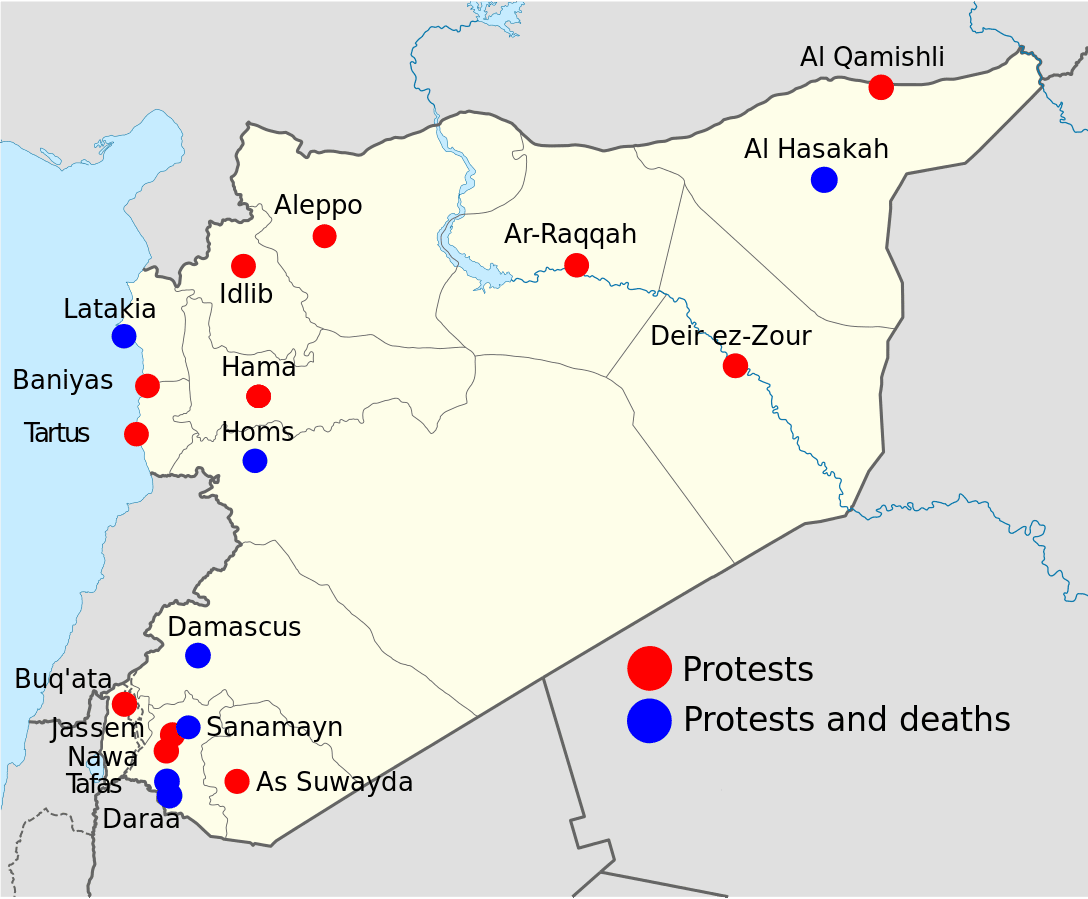
Since the beginning of the Syrian crisis, President Bashar al-Assad has claimed that Syria was the victim of a plot by Western imperialist powers seeking to effect regime in the country. Such a view has been widely ridiculed by opponents of the Syrian government, who argue that US and allied intelligence agencies played no role in sparking the anti-government protests that erupted in Syria in March 2011 as part of the so-called Arab Spring. Instead, as described by the New York Times, “Syrians, like other peoples across the region, rose up peacefully against their authoritarian government. Mr. Assad cracked down violently. Communities took up arms to defend themselves, then fought back in what became a civil war. Some soldiers joined the rebels, but not enough to win.”
According to this view, those pointing to the role of US and allied intelligence agencies in sparking the protests are conspiracy theorists who deny the agency of Syrians to determine their own fate. For example, pro-opposition activists and authors Robbin Yassin-Kassab and Leila al-Shami argue that considering the role of US and allied intelligence agencies in sparking the protests necessarily “leads some ever deeper into conspiracism. For such people, not only the Syrian revolution but the whole Arab Spring was a foreign plot, the English-language slogans at Kafranbel are proof of a CIA presence,” while efforts to blame the conflict on the Western imperialist powers, “remove the agency of the peoples concerned,” casting Syrians, “as innocents pleased to suffer poverty, torture and humiliation until some devilishly clever Westerner whispers in their ears.”
Such a view suggests further that if the Western powers deserve any blame, it is not for manufacturing the conflict in Syria, but for their supposed inaction and refusal to intervene in the war against the Syrian government and on behalf of the Syrian people.
However, as I have shown elsewhere, claims of US inaction in the Syrian conflict that erupted in 2011 are a myth. The CIA did intervene massively in the conflict, by covertly pumping billions of dollars of weapons to Salafist armed groups, both directly and via allied regional intelligence agencies, in what is now acknowledged as the costliest covert program in the agency’s history.
More importantly, there is clear evidence that US planners not only intervened in the Syrian conflict after it erupted, but that they covertly sparked the conflict itself. US planners prepared for years to ignite a sectarian civil war in Syria resembling that in neighboring Iraq, and successfully engineered the anti-government protests that erupted in March 2011 for this purpose. They then used these protests as cover to simultaneously launch an al-Qaeda led insurgency that quickly enveloped the country. It was hoped that this would spark a sectarian civil war that would pave the way for the fall of the Baath-led Syrian government and possibly even direct US military occupation of the country.
Any honest effort to understand the origins of the Syrian conflict must take account of this covert role played by US planners. Suggesting that any discussion of the US role amounts to promoting conspiracy theories, or denies the agency of Syrians, is not meant to shed light on the origins of the conflict but is meant to deliberately obscure them. For this reason, it is unsurprising that Robin Yassin-Kassab has been a vocal advocate of Western-backed regime change not only in Syria, but everywhere the Western powers have sought to intervene in recent years. As author Nu’man Abd al-Wahid observes, “Robin Yassin-Kassab has distinguished himself as one of Britain’s leading regime-change propagandists. Whether it’s Libya, Syria or Venezuela, Mr. Yassin-Kassab can be handsomely relied upon to supply the clever and poetic armoury to push forward narratives to facilitate Western imperialism militarily overhauling a nation-state not to its predisposition. For most of the last decade, Syria was his favoured target for spewing regime-change propaganda.”
Sadly, propaganda of the sort peddled by Yassin-Kassab and others in the service of Western imperialism is to be expected, as such propaganda accompanies every war. As Arthur Ponsonby observed in the wake of World War I, “Falsehood is a recognized and extremely useful weapon in warfare, and every country uses it quite deliberately to deceive its own people, to attract neutrals, and to mislead the enemy. The ignorant and innocent masses in each country are unaware at the time that they are being misled, and when it is all over only here and there are the falsehoods discovered and exposed.”
Almost a decade after the start of the Syria war, the role played by U.S. planners in launching it is still rarely recognized. In the remainder of this essay, I detail the efforts of U.S. planners to engineer the anti-government demonstrations that erupted in Syria in March 2011 as part of the so-called Arab Spring.
Early Experiments in Covert Action
The role of US planners in sparking the conflict in Syria in March 2011 was not immediately apparent to outside observers because it was covert and deliberately hidden. As philosopher and cultural critic Gabriel Rockhill observes, intelligence services such as the CIA “want to remain beneath the radar of history. They do not want to participate in or be identified as the heroes of history. But in a very paradoxical and quite pernicious way, they are often precisely those that are most powerful in the constitution of the visible histories we have and in the legacies that have been left.”
Covert US efforts to destabilize Syria in 2011 should not be surprising, as such efforts stretch back over 70 years. Attorney and international law expert Ernesto Sanchez observed that “During the Cold War’s early years, the United States tried to overthrow the Syrian government in one of the most sustained covert-operations campaigns ever conducted,” while historian Douglas Little explained that “This newly independent Arab republic was an important staging ground for the CIA’s earliest experiments in covert action.”
It is important to emphasize what motivated US planners to intervene in Syria during this early period. Historian William Blum notes that according to declassified National Security Council (NSC) documents, US planners were responding to the “popular leftward trend” in the Syrian government, which was allowing “continuous and increasing Communist activities,” while rejecting US military aid, which would have obligated Syria to support US efforts to “encourage the efforts of other free nations … to foster private initiative and competition [i.e., capitalism].”
As Robert F. Kennedy Jr. details, “The CIA began its active meddling in Syria in 1949—barely a year after the agency’s creation,” in a coup directed against Syria’s democratically elected president, Shukri al-Quwatli, after he “hesitated to approve the Trans-Arabian Pipeline, an American project intended to connect the oil fields of Saudi Arabia to the ports of Lebanon via Syria.”
The coup installed General Husni al-Za’im in power, who US officials viewed as a “Banana Republic dictator type” with a “strong anti-Soviet attitude.” This led a State Department political officer in Damascus, Deane Hinton, to admit that the successful 1949 coup was, “the stupidest, most irresponsible action a diplomatic mission like ours could get itself involved in, and that we’ve started a series of these things that will never end.”
The American Project
The roots of the most recent US intervention in Syrian affairs can be traced to the George W. Bush administration. In his 2005 book, “Inheriting Syria,” Flynt Leverett, former senior Middle East analyst at the CIA and senior director for Middle East affairs at the National Security Council explained why US planners wished to effect regime change in Syria during this period. Leverett noted that Syria is a “swing state” in the Middle East, and that since Hafez al-Assad came to power in 1970, US policy toward Syria has been motivated by an interest in bringing Syria into the pro-US camp and therefore “tipping the regional balance of power against more radical or revisionist actors,” in particular against Iran. Leverett complained that the US has “had to cope with Syrian resistance on a variety of fronts” since 1970, which resistance includes opposition to US support for Israel’s annexation of the Syrian Golan Heights, Syria’s “largely successful campaign to repulse Israel’s 1982 invasion of Lebanon,” and Syria’s “inauguration of a strategic alliance with Iran” which “ran against American moves throughout the 1980’s to bolster [Saddam’s] Iraq as a bulwark against the Islamic Republic’s revolutionary influence.” Leverett noted further that “As the Bush administration launched its military campaign against Saddam’s regime in 2003, Bashar [al-Assad] not only opposed the war but authorized actions that worked against the US pursuit of its objectives in Iraq.” Leverett also discusses Syrian support for Palestinian resistance groups (PFLP-GC, Hamas, and Islamic Jihad) and the fact that Syria “has for many years been the principal conduit for Iranian military supplies going to Hezbollah fighters in southern Lebanon.” Leverett then wondered whether the best course for “changing problematic Syrian behaviors” should entail US efforts to “ratchet up economic, political, rhetorical pressure on Damascus,” on the one hand, or “coercive regime change” on the other.
In short, as Syria expert David Lesch observed, Syria “did not give in to what, in the region during the Bush years, was often called the ‘American project.’”
Cleaning up the Middle East
Such threats were not new. According to former NATO supreme military commander Wesley Clark, then US Under Secretary of Defense for Policy, Paul Wolfowitz, told him after the First Gulf War in 1991 that “We didn’t get rid of Saddam Hussein and we should have. . . We’ve only got five or ten years to clean up the middle east. These old soviet surrogate regimes like Syria and Iraq, get rid of them before the next superpower comes along to challenge us.” According to Clark, the efforts of Wolfowitz and other neoconservatives in the Bush administration to aggressively use force to change regimes “appeared full blown after 9-11.”
As Samer Arabi observes, neoconservatives from the Project for the New American Century (PNAC) demanded at this time that “Iran and Syria immediately cease all military, financial, and political support for Hezbollah and its operations.” They threatened that, “Should Iran and Syria refuse to comply, the [Bush] administration should consider appropriate measures of retaliation against these known state sponsors of terrorism,” even though none of these countries played any role in the 9/11 attacks.
In March 2003, US planners launched the illegal US invasion and occupation of Iraq, a country which also played no role in the 9/11 attacks. Wesley Clark famously revealed as well that the Iraq invasion was part of a larger plan developed by US Secretary of Defense Donald Rumsfeld’s office “to take out seven countries in five years,” including Iran, Libya, and Syria. As academic Piers Robinson notes, Clark’s claims were confirmed by then Secretary of Defense Colin Powell’s Chief of Staff Lawrence Wilkerson, as well as by documents released by the UK Chilcot Inquiry showing British Prime Minister Tony Blair and US President George Bush planning a possible attack on Syria in the same context.
Syrian planners understood this threat well. David Lesch notes that “in the fresh glow of the Bush administration’s ‘mission accomplished’ in 2003, several implicit threats were directed at Damascus – threats that Syrian officials took very seriously: Syria could be next on the Bush doctrine’s hit list. [emphasis in the original].”
Not only Syrian planners, but also average Syrians were aware of these threats. Journalist and former US Marine Brad Hoff notes that during a lengthy stay in Damascus in 2005, many of his Syrian acquaintances expressed the view that “A war on Syria is coming. The Americans are coming here – whether in a few years or more, they will target Damascus.”
A Clean Break
The threat of regime change was reinforced in October 2005 by CNN reporter Christiane Amanpour during an interview with Syrian president Bashar al-Assad. She warned Assad that US planners were actively seeking to depose him, stating that, “Mr. President, you know the rhetoric of regime change is headed towards you from the United States. They are actively looking for a new Syrian leader. They’re granting visas and visits to Syrian opposition politicians. They’re talking about isolating you diplomatically and, perhaps, a coup d’etat or your regime crumbling. What are you thinking about that?” As Brad Hoff observed, Amanpour was married to former US Assistant Secretary of State James Rubin, who later advised both President Obama and Secretary of State Hillary Clinton. Amanpour was therefore not likely speculating, but instead appeared to be delivering a direct threat on behalf of US planners.
In December 2005, the Wall Street Journalreported that within US government circles, the “Pressure for regime change in Damascus is rising,” and that according to prominent neoconservative and architect of the US invasion of Iraq, Richard Perle, “Assad has never been weaker, and we should take advantage of that.” Perle, a member of the US Defense Policy Board, made his comments in the context of a US-sponsored effort to blame the Syrian government for the assassination of Lebanese Prime Minister Rafiq Hariri.
Perle’s advocacy for regime change in Syria stretched back at least a decade and was articulated in a 1996 policy document produced by a study group he led. Entitled, “A Clean Break: A New Strategy for Securing the Realm,” the document recommended to then incoming Israeli Prime Minister Benjamin Netanyahu that Israel “shape its strategic environment, in cooperation with Turkey and Jordan, by weakening, containing, and even rolling back Syria. This effort can focus on removing Saddam Hussein from power in Iraq, an important Israeli strategic objective in its own right, as a means of foiling Syria’s regional ambitions [emphasis mine].”
The text of the document was primarily authored by David Wurmser, a colleague of Perle’s at the American Enterprise Institute (AEI). Wurmser elsewhere argued that the US and Israel should “expedite the demise of Baathism in Syria,” and of secular Arab nationalism generally, to create new states in the region on based instead on “tribal/clan/familial alliances.”
Wurmser’s views were themselves reminiscent of the 1982 “Yinon Plan,” which viewed the break-up of the Baathist-led Syrian and Iraqi governments into weak, sectarian mini-states as beneficial for Israeli interests. In an article titled “A Strategy for Israel in the Nineteen Eighties,” former Israeli foreign ministry official Oded Yinon wrote that, “The dissolution of Syria and Iraq later on into ethnically or religiously unique areas such as in Lebanon, is Israel’s primary target on the Eastern front in the long run, while the dissolution of the military power of those states serves as the primary short term target. Syria will fall apart, in accordance with its ethnic and religious structure, into several states such as in present day Lebanon, so that there will be a Shi’ite Alawi state along its coast, a Sunni state in the Aleppo area, another Sunni state in Damascus hostile to its northern neighbor, and the Druzes who will set up a state, maybe even in our Golan, and certainly in the Hauran and in northern Jordan. This state of affairs will be the guarantee for peace and security in the area in the long run, and that aim is already within our reach today.”
CIA and NSC official Flynt Leverett notes that because both Perle and Wurmser obtained influential positions in the Bush administration (with Wurmser becoming Middle East advisor to Vice President Cheney’s staff) it was, “thus not surprising that the Office of the Secretary of Defense became the principal agent advocating coercive regime change strategy toward Damascus, supported by the office of the Office of the Vice President.”
Creative Chaos
Part of the neoconservative effort to impose regime change in Syria was the creation of the Syria Reform Party (SRF), led by Farid Ghadry, shortly after the 2003 invasion of Iraq. Ghadry had left Syria with his family for Lebanon at a young age before emigrating to the United States. He attended the American University in Washington DC and became a successful businessman. Ghadry enjoyed support from Richard Perle and other neoconservatives centered around then Vice President Dick Cheney’s office. Ghadry viewed Iraqi exile Ahmed Chalabi’s role in promoting the neoconservative-planned US invasion of Iraq as a positive model. Ghadry told the Wall Street Journal that “Ahmed paved the way in Iraq for what we want to do in Syria.” In an indication of how deeply Ghadry reflected the interests of his neoconservative US sponsors, and how little popularity he would ever enjoy among Syrians, Ghadry became a member of the American Israeli Public Affairs Committee (AIPAC), the most powerful Israel lobby in Washington, and wrote a column on his website titled “Why I Admire Israel.”
According to Syrian journalist Salim Abraham, Ghadry claimed to want “regime change by any means,” including a direct US invasion and occupation of the country. Ghadry also hoped to dismantle Syria’s largely socialist economy and replace it with a completely free market system. Abraham reports further that in November 2005, Ghadry met with both Perle and Chalabi in Washington where they discussed “the next steps in Syria” for regime change. Ghadry later described his plan to gather all Syrian opposition groups to create a government in exile, and “Then, take people to [the] streets. Some people get killed. The international community gets further angry at the regime. Then, have NATO forces protect a safe zone in northern Syria,” on the border with Turkey, after which “we will move right away into Syria.” Ghadry explained further that, “There will be some revenge killings, unfortunately. There will be a fight among opposition groups. . . . But the U.S. and France will be like traffic cops, who would organize and ensure” a peaceful transition.
The regime-change desired by Ghadry and his American handlers depended not only on an Iraq-style invasion and occupation, but also on inciting a sectarian civil war of the sort also raging in Iraq at the time. In reviewing an essay written by Ghadry, Syria expert and academic Joshua Landis observed, “Ghadry stipulates that by opening up a sectarian war inside Syria, the regime will fall. He encourages Washington to facilitate this and to — ‘stir trouble amongst the Sunnis of Syria’ — with the goal of causing the collapse of the Asad regime, preferably by a coup.” Landis notes further that Ghadry “takes the neocon policy of ‘creative chaos’ to its logical conclusion, which is to fan the flames of the sectarian war being waged in Iraq to bring down the neighboring regimes and break the Middle East wide open. He presumes that Washington will end up siding with the Sunnis in Iraq against the Shiites and harness Saudi Arabia to this task.”
Ghadry’s strategy to use sectarianism to destabilize the Syrian government likely did not originate with him, but with his American handlers such as Richard Perle. US planners had long viewed inciting sectarian tensions in Syria that would culminate in civil war as beneficial. This strategy was articulated in a 1986 CIA memo entitled, “Syria: Scenarios of Dramatic Political Change,” and is worth quoting at length due to the emphasis the document places on inciting anti-government protests in Syria of the kind seen in 2011. The memo explains that, “We believe that a renewal of communal violence between Alawis and Sunnis could inspire Sunnis in the military to turn against the regime. . . . disgruntlement over price hikes, altercations between citizens and security forces, or anger at privileges accorded to Alawis at the expense of Sunnis could foster small-scale protests. Excessive government force in quelling such disturbances might be seen by Sunnis as evidence of a government vendetta against all Sunnis, precipitating even larger protests by other Sunni groups. . . . Regime efforts to restore order would founder if government violence against protestors inspired broad-based communal violence between Alawis and Sunnis. A general campaign of Alawi violence against Sunnis might push even moderate Sunnis to join the opposition. Remnants of the Muslim Brotherhood, some returning from exile in Iraq, could provide a core of leadership for the movement. Although the regime has the resources to crush such a venture, we believe brutal attacks on Sunni civilians might prompt large numbers of Sunni officers and conscripts to desert or stage mutinies in support of dissidents, and Iraq might supply them with sufficient weapons to launch a civil war.”
Watching the Carnage in Iraq
According to a December 2006 US State Department cable leaked by Wikileaks, US embassy officials in Damascus similarly suggested that the US should use sectarianism to destabilize the Syrian government, in this case by playing “on Sunni fears of Iranian influence.” The cable explains that “There are fears in Syria that the Iranians are active in both Shia proselytizing and conversion of, mostly poor, Sunnis. Though often exaggerated, such fears reflect an element of the Sunni community in Syria that is increasingly upset by and focused on the spread of Iranian influence in their country through activities ranging from mosque construction to business. Both the local Egyptian and Saudi missions here, (as well as prominent Syrian Sunni religious leaders), are giving increasing attention to the matter and we should coordinate more closely with their governments on ways to better publicize and focus regional attention on the issue.”
As Robert Naiman observed, “This [December 2006 State Department] cable was written at the height of the sectarian Sunni-Shia civil war in Iraq. . . . No one working for the US government on foreign policy at the time could have been unaware of the implications of promoting Sunni-Shia sectarianism.”
US planners realized that the anti-Shia sectarianism of al-Qaeda in Iraq (AQI) leader Abu Musab al-Zarqawi (who was killed by US forces in June 2006) could be beneficial for US and Israeli interests in neighboring Syria. A leaked email to Hillary Clinton from her advisor Sidney Blumenthal explained that “the fall of the House of Assad could well ignite a sectarian war between the Shiites and the majority Sunnis of the region drawing in Iran, which, in the view of Israeli commanders would not be a bad thing for Israel and its Western allies,” because it “would distract and might obstruct Iran from its nuclear activities for a good deal of time,” and possibly “even prove to be a factor in the eventual fall of the current government of Iran.”
As noted in the State department cable above, US planners sought to coordinate closely with the Saudi government to publicize the alleged threat of Shiite and Iranian influence in Syria. In his book, “The last decade in the history of Syria: the dialectic of stagnation and reform,” Syrian sociologist Muhammad Jamal Barout, notes as a result that during early anti-government demonstrations in Syria in 2011, the slogan, “No to Iran! No to Hezbollah!” became common. Barout writes that, “The merging of hostility for the [Syrian] regime and Hezbollah was the result of the Salafi propaganda campaign originating from the Gulf countries which targeted Shiites generally, and which focused on the concept of the Shiite-Nusayri [Alawite] alliance, as expressed in the writings of Muhammad Sarour Zein al-Abbedine.” Muhammad Sarour was a prominent Syrian Salafi cleric living in exile who was famous for writing a book (under a pseudonym), titled “Then Came the Turn of the Majus,” which inspired al-Zarqawi to call for genocide against Iraq’s Shia population. As I have discussed elsewhere, Sarour and his followers later played a prominent, though often unacknowledged, role in the early protest movement that erupted in Syria in 2011, including in Deraa.
Al-Jazeera, the Qatari-owned satellite news channel, played a key role in promoting the Salafi propaganda campaign originating from the Gulf countries as well, in accordance with US interests. As Iraqi-British author Sami Ramadani notes, Qatar’s rulers “saw in Al Jazeera a vehicle for spreading their political influence,” just as “Qatar became the headquarters of US military operations throughout the Middle East. Al Jazeera remains one of the root sources of constant scares about a supposed sectarian threat from Iranian and ‘Shia’ influence in the region.”
It should further be noted that US planners were not promoting this Salafist propaganda campaign to topple Assad because he was unpopular with Syrians. As Syria analyst Camille Otrakji observed, “Had President Assad been so unpopular with ‘the Sunnis’ … why did America’s embassy need to manufacture Sunni anger?” US planners were aware that although President Assad did not come to power via democratic elections, he was nevertheless extremely popular. Washington Post reporter David Ignatius, who enjoys access to many US military and intelligence sources, wrote in November 2005 for example that, “It’s hard to find a Syrian who doesn’t want Assad to remain at least as a figurehead. He’s a symbol of stability for a country nervously watching the carnage in Iraq. Sami Moubayed, a Syrian analyst, is probably right when he tells me that ‘the president would win in a landslide if there was an election.’” Nevertheless, US planners were willing to spark a sectarian war in the country to depose Assad’s government.
Further, the al-Qaeda-led insurgency was sparked as a result of the efforts of U.S. planners, who worked with their British, Saudi and Lebanese allies to unleash these groups in Syria. They did so in the hope of triggering a sectarian civil war that would topple the Syrian government, destroy Syria’s delicate religious co-existence, and open the way for U.S. military intervention in the country. Tragically, hundreds of thousands of Syrians have died, and millions become refugees or displaced during the more than 10-year conflict their actions sparked.
In the mainstream view, al-Qaeda did not play a role in the Syria conflict until Islamic State of Iraq (ISI) leader Abu Bakr al-Baghdadi dispatched his deputy, Abu Muhammad al-Jolani, to Syria in August 2011 to establish a wing of the group there, called Jabhat al-Nusra, or the Nusra Front. Additionally, al-Qaeda allegedly did not carry out any military operations until December 2011 and did not announce its establishment until January 2012.
However, there is evidence that al-Qaeda affiliated militants were involved in the Syrian conflict much earlier. Saudi intelligence chief Prince Bandar bin Sultan, former Syrian Vice President Abd al-Halim Khaddam, and Lebanese Prime Minister Saad Hariri all played key roles in dispatching al-Qaeda affiliated militants to Syria in the early stages of the conflict. They did so at the direction of U.S. and UK planners, who hoped to spark a sectarian civil war that would lead to regime change in Damascus.
Militants from the Islamic State of Iraq (ISI) were dispatched to Syria from neighboring Iraq starting in late 2010. Starting in March 2011, they began attacking Syrian security forces, police, and soldiers under the cover of anti-government protests. Militants from Fatah al-Islam were dispatched from Lebanon to Syria for the same purpose as early as April 2011. Militants from the Libyan Islamic Fighting Group (LIFG) began fighting in Syria in October 2011, after successfully toppling the Libyan government under the cover of NATO airpower. Additionally, there is evidence that the first protestors killed in Deraa on March 18, 2011 were killed by Salafist militants as part of a false flag attack, rather than by Syrian government security forces, as is commonly assumed.
In this essay, I review U.S. and UK efforts to partner with al-Qaeda affiliated groups to topple the Syrian government, and the role played by such militants in the first weeks and months of the 2011 Syrian conflict.
Regime Change Coming Your Way
U.S. planners have long sought to topple the government of Syrian president Bashar al-Assad. U.S. General Wesley Clark famously revealed that the 2003 U.S. invasion of Iraq was part of a larger plan developed by U.S. Secretary of Defense Donald Rumsfeld’s office “to take out seven countries in five years,” including Iran, Libya, and Syria.
In December 2005, the Wall Street Journalreported that within U.S. government circles, the “Pressure for regime change in Damascus is rising,” and that according to prominent neoconservative and architect of the U.S. invasion of Iraq, Richard Perle, “Assad has never been weaker, and we should take advantage of that.” Perle, a member of the U.S. Defense Policy Board, made his comments in the context of a U.S.-sponsored effort to blame the Syrian government for the assassination of Lebanese Prime Minister Rafiq Hariri.
In March 2006, former Syrian vice president Abd al-Halim Khaddam partnered with Syrian Muslim Brotherhood leader Ali al-Bayanouni to form a new opposition group in exile, the National Salvation Front (NSF). In October 2006, several NSF members met with Michael Doran of the U.S. National Security Council, who was a close associate of prominent neoconservative and Bush administration official Elliott Abrams to discuss the possibility of regime change in Syria. Representatives of the NSF were also given a meeting with Saudi King Abdullah bin Abdul Aziz the same month.
The Wall Street Journalreported that Elliott Abrams warmed to the idea of partnering with the Brotherhood after Iranian-backed Lebanese Hezbollah fought Israel to a standstill in the summer of 2006, which caused Washington to become “increasingly concerned about Syria’s military alliance with Iran, and the threat it posed to U.S. interests in the region.”
Hezbollah’s surprisingly strong performance during the 2006 war, coupled with the rise of Iranian influence in U.S.-occupied Iraq, prompted what journalist Seymour Hersh described as a “redirection” in U.S. policy in the Middle East. This massive shift in policy was led by then Vice President Dick Cheney, Abrams, and Saudi national security advisor and former ambassador to the U.S., Prince Bandar bin Sultan.
The redirection involved working with Washington’s Sunni regional client states “to counteract Shiite ascendance in the region.” As part of this effort, the “Saudi government, with Washington’s approval, would provide funds and logistical aid to weaken the government of President Bashir [sic] Assad, of Syria.” Hersh notes further, “There is evidence that the Administration’s redirection strategy has already benefitted the Brotherhood,” and that according to a former high-ranking CIA officer, Abd al-Halim Khaddam and the NSF were receiving both financial and diplomatic support from the Americans and Saudis. Hersh notes further that Vice President Dick Cheney had been advised by Lebanese politician, Walid Jumblatt, that “if the United States does try to move against Syria, members of the Syrian Muslim Brotherhood would be ‘the ones to talk to.’”
Salafis Throwing Bombs
Hersh details further that the U.S. effort to topple the Syrian government would involve not only the Muslim Brotherhood, but also Salafist militant groups controlled by Saudi intelligence. According to a U.S. government consultant, “Bandar and other Saudis have assured the White House that ‘they will keep a very close eye on the religious fundamentalists. Their message to us was ‘We’ve created this movement, and we can control it.’ It’s not that we don’t want the Salafis to throw bombs; it’s who they throw them at—Hezbollah, Moqtada al-Sadr, Iran, and at the Syrians, if they continue to work with Hezbollah and Iran.”
In December 2006, the Charge d’Affaires of the U.S. embassy in Damascus, William Roebuck, had already acknowledged the possibility of exploiting Salafist militants to promote regime change in Syria. Roebuck wrote that, “We believe Bashar’s weaknesses are in how he chooses to react to looming issues, both perceived and real,” including “the potential threat to the regime from the increasing presence of transiting Islamist extremists. This cable summarizes our assessment of these vulnerabilities and suggests that there may be actions, statements, and signals that the USG can send that will improve the likelihood of such opportunities arising. These proposals will need to be fleshed out and converted into real actions and we need to be ready to move quickly to take advantage of such opportunities. [emphasis mine].”
We Have a Liberal Attitude
One reservoir of al-Qaeda-affiliated militants to be leveraged by U.S. planners was in the northern Lebanese city of Tripoli. Seymour Hersh notes that according to a 2005 International Crisis Group (ICG) report, pro-Saudi Lebanese politician, Saad Hariri (son of the assassinated Prime Minister Rafiq Hariri) had helped release four Salafist militants from prison who had previously trained in al-Qaeda camps in Afghanistan and were arrested in Lebanon while trying to establish an Islamic state in the north of the country. Hariri also used his influence in parliament to obtain amnesty for another 29 Salafist militants, including seven suspected of bombing foreign embassies in Beirut a year prior. Hersh notes as well that according to a senior official in the Lebanese government, “We have a liberal attitude that allows Al Qaeda types to have a presence here.”
Charles Harb of the American University of Beirut similarly observed in May 2007 that Saad Hariri was giving “political cover” to “radical Sunni movements.” Harb explains that to attract Sunni voters in the 2005 national parliamentary elections, Hariri had “pardoned jailed Sunni militants involved in violence in December 2000.” Harb also warned that “Courting radical Sunni sentiment is a dangerous game. Fear of Shia influence in Arab affairs has prompted many Sunni leaders to warn of a ‘Shia crescent’ stretching from Iran, through Iraq, to south Lebanon.” Harb also noted the involvement of Saudi intelligence in cultivating these groups. He explained that “Several reports have highlighted efforts by Saudi officials to strengthen Sunni groups, including radical ones, to face the Shia renaissance across the region. But building up radical Sunni groups to face the Shia challenge can easily backfire.”
Harb was writing in response to the eruption of violence in the Nahr al-Bared Palestinian refugee camp on May 19, 2007. The camp, located in northern Lebanon, had been occupied by militants from the al-Qaeda-affiliated group, Fatah al-Islam. Fighting had erupted between the militants and members of the Lebanese security forces, allegedly after an attempted bank robbery. The fighting left the camp almost entirely flattened and its Palestinian refugee population homeless.
Two months before the outbreak of violence in Nahr al-Bared, the New York Times had interviewed Fatah al-Islam’s leader, Shakir al-Abssi, a former associate of notorious al-Qaeda in Iraq leader Abu Musab al-Zarqawi. The NYT reports that, “Despite being on terrorism watch lists around the world, he has set himself up in a Palestinian refugee camp where, because of Lebanese politics, he is largely shielded from the government.” Major General Achraf Rifi, general director of Lebanon’s Internal Security Forces told the NYT that to enter the camp and detain al-Abssi, “We would need an agreement from other Arab countries.” In other words, al-Abssi was being shielded by Saad Hariri and Saudi intelligence.
Ever since Russia and China began challenging the Anglo-American scorched Earth doctrine in 2011 with their first vetoes against US intervention into Syria, the Gordian knots that have tied up the Arab world in chaos, division and ignorance for decades have finally begun to unravel.
Where just one decade ago the unipolar vision of the ‘new American century’ reigned unchallenged, by 2013 the Belt and Road Initiative (BRI) had sprung into life, and the largest purges of China’s deep state on record were launched under Xi Jinping’s watch. This latter crackdown even earned the ire of the American intelligence community, with war hawk John Bolton complaining that Xi’s authoritarianism has made the CIA job of maintaining its spies inside China nearly impossible.
This new operating system, tied closely to Russia’s Eurasian Economic Union, has grown in leaps and bounds. Today, a new multipolar future has emerged; one which plans to actually deliver long-term development for all those who choose to play by its rules.
One of these adherents will be Syria, which is re-emerging onto the world’s stage after having miraculously defended itself from a ten-year military onslaught launched by the old unipolar players.
Of course, the pain and destruction of the war is still deeply felt; illegal US sanctions continue to plague the hungry masses, prevent the reconstruction of basic infrastructure and access to potable water, and cripple schools, hospitals, businesses, and livelihoods.
The BRI and Syria’s new future
On 5 November, China’s President Xi Jinping spoke with Syrian President Bashar Al-Assad, saying “we welcome the Syrian side’s participation in the Belt and Road Initiative and Global Development Initiative” and calling for reconstruction, development, and the defense of Syria’s sovereignty and territorial integrity.
The discussion came in the wake of Chinese Foreign Minister Wang Yi’s whirlwind tour across West Asia and North Africa in July 2021, during which he met the Arab League’s chief to discuss Syria return to the fold.
By the end of this tour – which coincided with Assad’s re-election – China had signed a four-point proposal for solving Syria’s multifaceted crisis with a focus on large scale reconstruction, ending illegal sanctions and respecting Syria’s sovereignty.
Syria, in turn, re-affirmed its support for China’s territorial integrity in the face of western-sponsored separatist movements in Xinjiang, Tibet, Taiwan, and Hong Kong.
China’s interest in West Asian development was first made known in 2017 when Chinese foreign ministry spokesman Geng Shuang stated:
“Too many people in the Middle East are suffering at the brutal hands of terrorists. We support regional countries in forming synergy, consolidating the momentum of anti-terrorism and striving to restore regional stability and order. We support countries in the region in exploring a development path suited to their national conditions and are ready to share governance experience and jointly build the Belt and Road and promote peace and stability through common development.”
In 2018, China offered $28 billion in development aid to Syria while simultaneously coordinating the integration of Iraq into the BRI, made official in September 2019 when then-Prime Minister Adil Abdul Mahdi unveiled the China-Iraq oil-for-reconstruction program and Iraq’s broader integration into the BRI framework.
“The only assessment done immediately after the strike was performed by the same ground unit that ordered the strike,” according to the New York Times.
In war, things inevitably go wrong and people die as a result. But as events in Syria, Kabul, Niger and elsewhere have shown, the military has a tendency to use its investigations to absolve itself rather than to hold senior leaders accountable for their mistakes.
The New York Times recently revealed that a U.S. airstrike in March 2019 may have killed dozens of civilians at Baghouz, Syria. However when an Air Force lawyer and an evaluator with the Defense Department Inspector General’s Office tried to get military leaders to investigate whether a war crime had occurred, they were reportedly thwarted at every turn.
The circumstances surrounding the incident are complicated. Making things even murkier, a secretive group known as Task Force 9 may have repeatedly bypassed the process for determining if U.S. airstrikes would kill civilians by claiming that American or allied forces were in imminent danger, New York Times reporters Dave Philipps and Eric Schmitt revealed.
On March 18, 2019, the Islamic State group was making its last stand at Baghouz, where tens of thousands of women and children were mixed in with ISIS fighters. That morning, America’s Syrian Kurdish allies reported they were under attack and a U.S. special forces officer ordered an airstrike, according to the New York Times. The officer was relying on video from a drone with a standard definition camera and he was unaware that another drone in the area with a high-definition camera revealed women and children were present.
In the resulting airstrike, an F-15E dropped three bombs that may have killed up to 64 women and children, but military officials repeatedly undermined efforts to determine if the incident rose to the level of a war crime, the New York Times reported.
FILE PHOTO: Smoke after the shelling of Islamic State’s last holdout of Baghouz by Kurdish-led forces backed by US warplanes. (Getty Images.)
Last week U.S. forces operating in Syria were attacked by armed drones, allegedly by an Iranian-backed militia. On Tuesday, Al Jazeera reported that senior Biden Administration officials emphasized the president has no intention of withdrawing U.S. troops from Syria. That is a mistake that may, sooner or later, result in yet more pointless deaths of American service members.
President Biden needs to withdraw all the troops from Syria, immediately.
There are too many among Washington’s foreign policy elite who have become, frankly stated, addicted to the idea of keeping as many American troops deployed in combat operations around the world as possible. For many years they have fought, aggressively, any consideration of withdrawing troops from any fight, anywhere, any time – and except for ending the war in Afghanistan last August, they have succeeded at thwarting any withdrawal. This latest resistance to ending our combat operations in Syria is only the latest example.
In 2014, then-President Obama announced a plan to end the Afghan war and withdraw all U.S. troops by the end of 2016, saying that it was, “time to turn the page on more than a decade in which so much of our foreign policy was focused on the wars in Afghanistan and Iraq.” Americans, Obama also noted, “have learned that it’s harder to end wars than it is to begin them.” He learned just how hard barely one year later.
In October 2015, Obama retracted his promise to end the withdrawal and decided to punt to the next commander in chief. Yet as the Washington Post’s Craig Whitlock revealed in the 2019 Afghanistan Papers, Obama pulled the plug on the withdrawal because “the president faced countervailing pressures to stay put from the Pentagon and hawks in Congress.”
Instead of standing up to the pressure because it was the appropriate military response to the strategic circumstances, Obama folded. American troops paid the price in blood for his refusal, as 77 Americans died after 2016 and another 425 were wounded. All of those casualties would have been avoided if Obama had simply resisted the political pressure and done the right thing.
President Trump three times announced he was withdrawing troops from Syria during his term, and twice tried to completely end the war in Afghanistan. In all cases, Trump was fiercely opposed by senior members of his cabinet and national security apparatus and when he left office, none of the missions had ended. Because Trump unwilling to resist the institutional pressure and refused to end either the Syrian deployment or Afghan War on his watch, a number of U.S. troops in both countries were unnecessarily killed and wounded.
The attack by Iran-backed militia on the U.S. base at Tanf, Syria resulted in no casualties. As a result of the “complex, coordinated and deliberate attack,” Biden is almost certain to come under pressure to retaliate with lethal force against the alleged offending militia members. On Monday at a Pentagon, Press Secretary John Kirby said that he would not “talk about intelligence matters,” but then added that “if there’s to be a response, it’ll be at a time and a place and a manner of our choosing,” indicating the Pentagon is actively examining such options.
The president has for months been under pressure to respond with lethal force to such attacks. Biden approved airstrikes against targets in eastern Syria in February 2021 after U.S. personnel came under rocket fire in Erbil, Iraq. Before one more American service member pointlessly loses his or her life, it is time to end this unnecessary mission.
Obama sent U.S. troops into Syria in 2015 to help the Syrian Democratic Forces retake territory from ISIS. The Islamic State operating within the confines of Iraq and Syria were never a credible threat to U.S. security and Obama should never have sent troops in to fight for the benefit of the Iraqi government in Baghdad and the SDF in Syria (and, perversely, to the benefit of Assad in Damascus). ISIS was a direct threat to Iraq, Syria, and the SDF — the burden to defeat ISIS should have rested fully on their shoulders.
But even if one believes we should have fought in Syria and Iraq to deprive ISIS of their territorial holdings, that mission was fully accomplished over two years ago. Since that time, there hasn’t been a valid reason to operate and maintain active combat operations in either country. Remnants of ISIS in those land-locked locations pose no threat to the U.S. that our standard global counterterror capacity can’t handle. I cannot more strongly state: a few hundred combat troops on the ground in Syria do not materially contribute to U.S. national security.
It should be unconscionable to keep American service members at constant risk of their lives and limbs when their presence there is not necessary. It is only a matter of time before one of those rocket attacks finds the mark and Americans are killed or wounded. Biden will then come under enormous pressure to respond militarily.
The only result of such action will be to increase the tensions, raise the chance of stumbling into a pointless war with Iran, and make the Iranian and militia victims vow yet more revenge against Americans. It’s time for the president to withdraw our troops and end the unnecessary risk to our troops.
In less than six months in office President Joe Biden has already developed a national security policy that appears to lean strongly towards proactive use of military force in questionable circumstances, as if war is the answer to every problem. Biden should nevertheless be applauded for his persistence in withdrawing from Afghanistan after twenty years of ill-considered nation building, but even the departure from that country appears to be characterized by a lack of coordination, rather reminiscent of helicopters taking off from the embassy roof in Saigon in 1975.
For the second time the president has ordered a US bombing raid on two targets in Syria, and for the first time, he also attacked a site inside Iraq. According to one report possibly as many as seven Iraqis died in the attacks which targeted alleged weapons storage facilities along the Syria-Iraq border belonging to Kata’ib Hezbollah and Kata’ib Sayyid al-Shuhada militias. The US claims that the two Iraqi militias have ties to Iran, which may be more than usually true because the Iraqis and Iranians have cooperated regularly in the fight against the Islamic State in Syria (ISIS). The Pentagon also claims that the militias were behind recent attacks on American targets, see more below.
After the attacks carried out by US fighter-bombers, the excuse provided was the same one employed after Biden’s first air attack in February, namely that the US, as described by Pentagon spokesman John Kirby, “conducted defensive precision airstrikes against facilities used by Iran-backed militia groups in the Iraq-Syria border region.” He added verbiage what has now become a regular feature of all US military actions, that “the United States acted pursuant to its right of self-defense.” For those who are intrigued by Pentagon newspeak the expression “defensive precision airstrikes” must be considered as a new entry in the crowded field of phrases that largely have no meaning.
The strikes were framed as being retaliatory, but the most interesting aspect of this latest bombing is that the initial US government justifications for the action were on somewhat tentative. Reportedly, someone had used drones with explosives attached for mostly night-time attacks directed “against places where Americans were located in Iraq,” which were further described as including diplomatic, intelligence and military facilities. The Pentagon refers to the drones as “unmanned aerial vehicles” or UAVs. No Americans were killed in the alleged attacks and there were no reports of any substantial damage, though the Pentagon is apparently collecting information and preparing a comprehensive report which the public undoubtedly will not be allowed to see.
Oddly, the initial media reporting on what had occurred and who had been blamed for it included a weasel word, “suspected.” In government-speak that frequently means there was little or no evidence that the militias that had been targeted were actually the perpetrators, but it is convenient to assume that they are responsible, making them “suspects.” After all, it is relatively easy to transport a number of drones on the bed of a pickup truck, drive with it to a location where one is unlikely to be observed and then release them at a fixed target. Even if you don’t hit anything, you will spread fear and trigger a response that might well be exploited to vilify the occupying forces. You will also provide justification for your own retaliation.
The Iraqi government, which was not informed in advance of the US bombings, not surprisingly reacted strongly, registering its opposition to such activity on the part of its so-called ally, though occupier has been suggested as a more appropriate description. Prime Minister Mustafa al-Kadhimi’s office called the airstrikes a “blatant and unacceptable violation of Iraqi sovereignty and Iraqi national security.” After the assassination of General Qasem Soleimani at Baghdad Airport in January 2020, the Iraqi Parliament had called for the departure of all US forces, but the Trump Administration ignored the demand, claiming that it was in Iraq to help the Iraqis in their fight against ISIS and other terrorist groups.
The US currently has a claimed 2,500 soldiers in Iraq who, it asserts, are in country advising and training their local counterparts. Meanwhile, “Fighting terrorists and training friendly forces” is roughly the same excuse that has been used to justify remaining in neighboring Syria, where the US has deployed roughly 500 soldiers who have been taking possession of the production of the country’s oil fields, which it then provides to Israel. The US is also, by the way, trying to overthrow the legitimate Syrian government in Damascus, using some of the very terrorists it claims to be fighting to do the job, but that is of course another story.
If the United States government is beginning to sound a bit like the Israeli government that should surprise no one, as Israel is clearly heavily involved in whatever on goes vis-à-vis Syria and Iran directly and in Iraq by proxy. One almost expects new Israeli Prime Minister Naftali Bennett to provide an endorsement, parroting the Pentagon line as well as his own country’s rhetoric, saying “the US has a right to defend itself.” Of course, the unasked question then becomes “to defend itself against what?” Israel was at least able to pretend that there was some kind of threat coming from Gaza since the two share a border, but the United States would be hard pressed to explain why it has soldiers in Syria and Iraq at all, particularly since the Iraqi government has called upon them to depart.
A neocon journalist supportive of a global crusade to spread “democracy” once quipped that the nice thing about having an empire is never having to say you are sorry, but that has not meant that mindless acts of violence inflicted throughout the Middle East are have been consequence free. One has to suspect in this case that the use of force to include a target within the borders of a nominal ally was also mostly intended to send a signal to Iran. A Pentagon spokesman ironically boasted afterwards that “This action should send a message to Iran that it cannot hide behind its proxy forces to attack the United States and our Iraqi partners.” The spokesman appears to be oblivious to the fact that it was Iraqi militiamen tied to the government that had been killed, not Iranians. And his assumption that it would reduce the level of violence also proved wrong as there have been a number of new drone, rocket and mortar attacks against American targets in Iraq since Biden’s “defensive precision airstrikes” were launched. One of the militias that lost fighters to the US airstrikes, said it would “avenge the blood of our righteous martyrs.” Another Iranian supported group, the Popular Mobilization Forces went further, threatening to “enter an open war with the American occupation.” In short, all the attacks really accomplished was to anger the Iraqi people over the continued US presence and to guarantee more incidents.
Biden’s “sending a message to Iran” would undoubtedly be intended to do the same to the Iraqi government, telling them that drawing any closer to the Iranians is too close as far as the Pentagon and White House are concerned. In terms of the timing of the airstrikes, it is also important to note that the US has been working closely with the new Israeli government to establish a unified policy on Iranian “regional aggression” and its nuclear program. Biden met recently with retiring Israeli President Reuven Rivlin at the White House and Secretary of State Antony J. Blinken has been having discussions with Israel’s foreign minister, Yair Lapid. Iran was the focus of both meetings.
So, Joe Biden and whoever is advising him are continuing down the path that began with George W. Bush, with military action used as a substitute for any real foreign policy. The problem with the meddling in the Middle East is primarily that it permits no exit strategy. It will end ignominiously when it ends as is happening in Afghanistan, without any remorse and little to show for all the expense and the deaths. Given that reality, rather than concoct largely fabricated reasons to keep US troops in Iraq and Syria the Administration should be looking for ways to end the torment for everyone involved.
A detailed forensic analysis of the rocket used in the Ghouta attack – an improvised 330mm-to-350mm rocket equipped with a large receptacle on its nose to hold chemicals—by Richard Lloyd, a former United Nations weapons inspector, and Theodore Postol, a professor of science, technology and national security policy at the Massachusetts Institute of Technology, undermined the claims made by the US government assigning culpability for the attack. Not only were the weapons used not included in the arsenal of chemical weapons declared by the Syrian government to the Organization for the Prohibition of Chemical Weapons (OPCW) which oversaw the dismantling of Syria’s chemical weapons capability between 2013-2014, but the short range of the weapon made its being fired from government-held territory impossible.
is a former US Marine Corps intelligence officer and author of ‘SCORPION KING: America’s Suicidal Embrace of Nuclear Weapons from FDR to Trump.’ He served in the Soviet Union as an inspector implementing the INF Treaty, in General Schwarzkopf’s staff during the Gulf War, and from 1991-1998 as a UN weapons inspector. Follow him on Twitter @RealScottRitter
Truth and politics are often mutually exclusive concepts when dealing with the progressive American Left. This unfortunate fact is being driven home in spades in an ongoing spat between two lefty online personalities.
Anyone following Aaron Maté (149K followers on Twitter); The Young Turks (TYT, with 440K followers as an institution, and as many followers each tracking the activity of co-hosts Cenk Uygur and Ana Kasparian); the comedian Jimmy Dore (274K followers); or any number of other Twitter personalities whose online paths have crossed with any of the above; knows these left-leaning social media stars have been engaged in a vicious feud. Full disclosure, I have appeared on both Maté’s podcast, Pushback, as well as The Young Turks radio show. At issue is Syria and, more pointedly, the contention by both Uygur and Kasparian that Maté is shilling for President Bashar Assad.
A tale of two narratives
The sheer drama and vitriol which has emerged as a result of this feud has been entertaining for those who get a kick out of leftwing internecine warfare. Maté’s use of Jimmy Dore’s popular online program The Jimmy Dore Show as a platform for promoting his arguments has torn the scab off old wounds created when Dore left The Young Turks and struck out on his own, appears to underpin at least some of Uygur and Kasparian’s anti-Maté invective. However, more interesting is the fact that, as Maté pointed out in a recent interview with The Hill, the progressive wing of the American Left has hit a brick wall over the issue of Syria. Criticism of Assad has run up against the lies used to sustain US military hegemony in the Middle East.
“I think,” Maté noted, “that that meltdown reflects just like a general hostility they [The Young Turks] have towards people who are upholding actual progressive values and upholding actual journalism standards.” While the smear campaign waged by Uygur and Kasparian has been as unconscionable as it has been factually wrong, the fact that there is controversy among the progressive wing of the American political Left should not surprise anyone.As Maté observed, “[t]he reason why they slandered me at that time is because I was in Syria and Syria is a, you know, touchy subject for many people on the Left. It has been divisive.”
Syria is a touchy subject, especially for progressives who primarily focus on notions of human rights and democratic values. Maté has come under attack for taking a contrarian stance on two of the most hot-button issues surrounding Assad: allegations of chemical weapons use, and the suppression of political free will through the conduct of elections designed to keep the reins of political power in Syria firmly in his hands. (It should be pointed out that Maté is joined by other outstanding progressive journalists, including Eva Bartlett, Vanessa Beeley, Rania Khalek, and many others whose informative work predates Maté’s on the issue of Syria.)
On April 8, 2021, President Biden addressed the public concerning new executive orders he is planning on putting through. This will be on top of the forty-eight other executive orders that have already come from the man who just last October was saying, “I have this strange notion—we are a democracy … [there are] things you can’t do by executive order unless you are a dictator. We’re a democracy, we need consensus.” He’s already surpassed both Trump and Obama in executive orders issued during the first four months of their respective presidencies.
It looks like the next EOs Biden aims at mandating are related to the topic of gun control: “Gun violence in this country is an epidemic. Let me say it again. Gun violence in this country is an epidemic.” This is ironic coming from the former vice president of the Obama administration, which started regime change wars in countries like Yemen, Libya, and Syria which in large part included supplying certain “moderate” rebel groups like al-Nusra and ISIS with weapons, cash, and intelligence support that was ultimately used to slaughter innocent men, women, and children.
Weapons to Libya
In his most recent book, Enough Already, Scott Horton (2021) fully displays just how devastating the foreign policies of all the US presidents going back to Jimmy Carter have been for people living in the Middle East. For example, in Libya, the Obama administration had been secretly allowing weapons to arrive from Qatar during the attempted overthrow of then dictator Muammar Gaddafi. The story was that the US was helping “moderate” Libyan rebels overthrow their brutal dictator in order to bring liberty and democracy to the turmoiled country. However, as Scott makes abundantly clear: this was completely false and the Obama administration was really “taking the terrorists’ side against Gaddafi in Libya … they were Libyans who had just come home from fighting America in Afghanistan and Iraq War II” (2021, pp. 163, 165). It is especially worth pointing out that some of these terrorist groups receiving support from Obama were “a bunch of horrible anti-black racists” who had “cleansed the predominantly black town of Tawergha … many of whom were tortured and killed, their property put to the torch” (2021, p. 166). Apart from the murder and rape of innocents in Libya, the US government’s actions under Obama and Biden left the country in a state of devastating civil war and also opened the doors for modern-day chattel slave auctions. Even Obama admits that Libya was a “shit show.”
Weapons to Syria
Libya became a weapons pipeline for rebels in Syria—who were also being backed by the United States government—and it was headed by the CIA’s own director, David Petraeus. Again, Scott Horton, quoting journalist Seymour Hersh, points out that these weapons were being delivered to “jihadists, some of them affiliated with al Qaeda” (2021, p. 172). In Syria, a similar regime change was occurring just as had happened to Gaddafi. This time the target was President Bashar al-Assad. The hope was that if the US could overthrow Assad, they’d “further isolate Iran” by removing “Iran’s only Arab ally,” Syria (Horton 2021, p. 182). It should come as no surprise, however, that in the US’s endeavor to conduct another regime change, they would again be caught up in giving weapons and support to terrorists who also wanted to overthrow Assad. During this time (2012), Libya’s insurgency was basically controlled by terrorist organization al-Nusra. When the US worked to get weapons into the hands of these “moderate” rebels, they were really just ending back up in the hands of Islamist extremists whom the US had been going to war against just years before. Once again, the Obama administration made the US responsible for aiding the some of the most horrific insurgency groups, who
murdered children, used suicide car and truck bombs against civilian and military targets, blindly shelled civilian neighborhoods, used torture, carried out mass-executions of captured army soldiers, executed people with crucifixions and beheadings. (Horton 2021, p. 196)
In 2014, then vice president Biden even admitted to the absurdity of trying to find and support “moderate” rebel groups in Syria, although he tried to frame it as if it were all the United States’s alies’ fault. Thanks in large part to the US’s involvement in Syria, the country has been devastated and
the terrorists ha[ve] carved a new Islamist Caliphate the size of Great Britain out of the sands of western Iraq and Eastern Syria. [Bin Laden] could never have done it without the assistance of the United States of America in the hands of George W. Bush and Barack Obama. (Horton 2021, p. 202)
Weapons to Yemen
In 2015, Obama started yet another unauthorized war alongside the Saudis against the Houthis in Yemen—this being shortly after the Houthis had ousted their “democratically”1 elected president Hadi in 2014. The reason? The never-ending desire to gain more leverage against Iran, as well as to “placate the Saudis“ while the US was in the middle of the Iran Nuclear Deal (Horton 2021, p. 241). The US government was directly supplying the Saudis with bombs, parts for the aircraft dropping those bombs, fuel for tankers, and satellite intelligence over targets (Horton 2021, p. 241); more recently it has been shown that they are still sending shipments of US weapons and armored vehicles into Yemen—as reported by CNN. The US-Saudi coalition against the relatively small country has created what many have called the worst humanitarian crisis.
The destruction that the American politicians and their allies left with the Yemenis is unimaginable. After deliberately targeting nonmilitary infrastructure such as hospitals, water treatment plants, schools (including a school bus full of children), and food production systems, and then placing blockades on the country to further cripple its people, Yemen has been turned into a complete disaster. According to the Council on Foreign Relations, an estimated one hundred thousand people have been killed since 2015. Countless children are suffering and dying from cholera and other diseases. Scott Horton predicts that the number will really turn out to be something like “half a million or more civilians who have been killed by this war, beyond the tens of thousands killed in direct violence.” (2021, p. 252)
Violence at Home
Biden’s newest executive orders come just shortly after the Colorado shooting on March 22. The significance of this event is that the shooter, Ahmad Al Aliwi Alissa, was born in Syria and moved to the US when he was still a child. Less than a month before the Colorado tragedy, Biden ordered his first strike on Syria as president in retaliation to an Iranian missile attack on a military base in Iraq. While there hasn’t been any clear evidence that Alissa was motivated by the Syrian bombing, one outlet reported that a Facebook post by Alissa from 2019 addressed in part the “genocide in Syria.” Considering the long list of retaliatory terrorist attacks in the US over the years—e.g., the 2009 Ft. Hood massacre, the 2013 Boston Marathon bombing, the 2016 Pulse nightclub massacre in Florida, the 2017 Ariana Grande concert bombing (Horton 2021, pp. 271–76)—it isn’t a stretch to believe that Colorado is another tragedy following the trend. The longer the US continues its intervention overseas, the more likely we are going to see the violence come home.
Additionally, violence in the US has been exacerbated by policies like those supported and put forward by people like Joe Biden and Kamala Harris. Biden has a very lengthy and controversial history in his time as a “public servant.” He is notorious for contributing to the tough-on-crime attitude in the US as well as the war on drugs. Harris worked as a prosecutor for California and was rightfully called out by Tulsi Gabbard during the presidential debates for the 2020 elections for locking people up over marijuana charges. Such rhetoric and policies have devastated millions of lives. It was reported that in 2019 alone over 1.5 million arrests were made for drug violations—over 85 percent of those being for mere possession—and a significant portion of those arrests were in relation to marijuana. A 2014 American Civil Liberties Union report showed that between 2011 and 2012, 62 percent of SWAT raids were drug searches. One such raid was conducted on a family who was growing tea leaves. More recently we saw the murder of Breonna Taylor when the Louisville Metro Police Department also conducted a no-knock home invasion over drug charges. Duncan Lemp was murdered just twenty-four hours before Breonna Taylor in the same fashion.
The greatest irony about the claims against United States citizens having “weapons of war” is that while these claims refer to semiautomatic rifles, law enforcement inside the US actually receives equipment from the military thanks to the 1033 program. This program gets military equipment like mine-resistant ambush protected (MRAP)2 vehicles, M-16 rifles, helicopters, and even grenade launchers into the hands of local police agencies. During his presidency, Obama used an EO to put an end to the pipeline between police and military, but Trump, in 2017, revived the program. It seems that in all of his work via EOs to reverse certain policies by Trump, Biden has yet to undo the resurrection of the 1033 program. In fact, one statistic shows that in Q1 of Biden’s first year as president there’s been an increase in “flow of military gear.”
Reason to Doubt
While they might claim to be on the “right” side of certain issues now, it is hard to take seriously the words of politicians who claim to care about the people and their safety while they are supporting policies—or at least not making as much a fuss about them as they do about “domestic gun violence” or “Asian hate”—that put weapons and money into the hands of terrorists who help the US government slaughter innocent people overseas or starve children to death while causing others to die of disease because their country’s infrastructure has been blown to bits and blockades prevent the necessary medical aid to save them, tragedy that then inspires people of those countries to retaliate and bring more death upon the rest of us. The absurdity becomes even more apparent when these same “public servants” cry about “weapons of war” being placed into the hands of the people while actual military equipment is being funneled into law enforcement. They might cry and appear outraged about the deaths of victims like Breonna Taylor, but her death comes from the legacy of tough-on-crime and drug war policies that these politicians at one point supported and helped enforce.
1. Democratic in this context meaning that his name was the only one on the ballot.
2. In 2014 it was reported that thirteen thousand of these tanklike vehicles were given to police departments. Dan Parsons, “Repurposed MRAPs Find New Life in Police Agencies,” National Defense, April 2014.
He does not say this as an apology for his murderous Syria policy beginning under Obama. Nor as an apology for the sanctions that have only caused suffering among the most innocent, in tandem with the arming and training of psychotic jihadists to burn the sectarian, multi-confessional Syria to the ground.
No, the empty-eyed Blinken cries crocodile tears for the Syrian children as political cover for his re-introduction of policies that killed their country and their parents in the first place.
The 1963, Eichmann in Jerusalem: A Report on the Banality of Evil, written by Jewish philosopher Hannah Arendt, introduced the world to perhaps the most chilling aspect of the Nazi mass murder of so many Jews, Christians, other religious minorities – and so many others – at the hands of the national socialism of Hitler’s murder machine: the fact that the horror of mass killing on a colossal scale could be undertaken not with the fiery dramatics of drooling monsters, but rather could easily be carried out with the cold precision of the unthinking bureaucrat. The cog in the machine. The Eichmanns of the world, whose defense was, with a shrug, “I was only doing my job.”
For a period after the Nuremburg trials, which sought to criminalize such a defense of evil, it was accepted that the initiation of unprovoked aggression against others could no longer be justified with the excuse, “I was only doing my job.”
Arendt horrified us with the tale of Eichmann’s intellectual emptiness and the moral black hole that appeared at the center of his heart. He was not exceptional in his evil. He was just part of the machine. A bureaucrat.
As she put it:
The trouble with Eichmann was precisely that so many were like him, and that the many were neither perverted nor sadistic, that they were, and still are, terribly and terrifyingly normal. From the viewpoint of our legal institutions and of our moral standards of judgment, this normality was much more terrifying than all the atrocities put together.
Which brings us to current US Secretary of State Antony Blinken. This is not to compare Blinken with Eichmann or to suggest that he is a Nazi. Rather it is to point out that he shares the very same traits with those who actually feel a sense of moral superiority while implementing policies that result in the horrible deaths of tens of thousands – indeed hundreds of thousands and even millions – of innocents in the name of pursuing a “noble cause.”
So here we have this video Tweeted by Blinken’s office where he – shockingly – seeks to lecture us on the morality of his long-time Syria policy (while a senior official in the Obama Administration and now as Biden’s Secretary of State) that has resulted in the deaths of hundreds of thousands of innocent civilians and the displacement of millions. All in the pursuit of “regime change” in Syria.
Is it mere banality – or is it actual malevolence – that leads the co-author of Syria’s misery to Tweet the following about the victims of his criminal foreign policy:
When I think of the suffering of the Syrian people, including Syrian children, I think of my own two children. How could we not take action to help them? Our common humanity demands it. Shame on us if we don’t.
He does not say this as an apology for his murderous Syria policy beginning under Obama. Nor as an apology for the sanctions that have only caused suffering among the most innocent, in tandem with the arming and training of psychotic jihadists to burn the sectarian, multi-confessional Syria to the ground.
No, the empty-eyed Blinken cries crocodile tears for the Syrian children as political cover for his re-introduction of policies that killed their country and their parents in the first place.
“We have to find a way to do something to take action to help people,” he says, with carefully rehearsed deep emotion, in the video.
But Blinken’s “do something” is no act of contrition for supporting jihadists and sanctioning the country into a hell on earth. It does not mean the US reversing course on “regime change” in Syria and leaving the desperate Syrians to rebuild their country.
No. It means that he intends to reinvigorate a policy gone flaccid under Trump – with some disgusting exceptions – that the US, led again by neocons and demonic “humanitarian” interventionists, would wander about Syria seeking the ruin of innocent lives.
But don’t worry: Blinken justifies the coming slaughter of innocent Syrian children by telling us he thinks of his kids when he thinks of the Syrian children. What a comfort.
As C.S. Lewis famously wrote, “Of all tyrannies, a tyranny sincerely exercised for the good of its victims may be the most oppressive.
Somewhere Blinken’s mentor, Madeleine “it was worth it” Albright, cackles with glee…



 by Tyler Durden

 MCViewPoint