MCViewPoint

Opinion from a Libertarian ViewPoint

Posts Tagged ‘Woodrow Wilson’

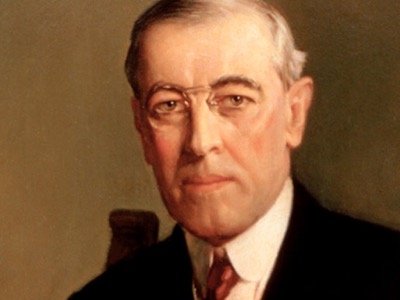
Woodrow Wilson

Posted by M. C. on April 2, 2025

And WW campaigned on a NON-intervention platform.

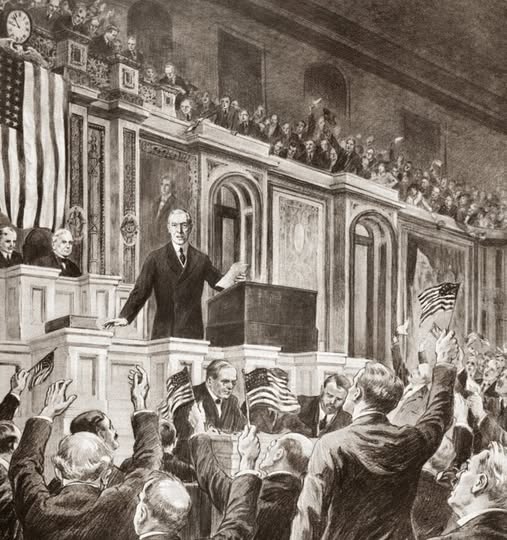
On this day, April 2, 1917, President Woodrow Wilson stood before Congress and urged a declaration of war against Germany, pulling the United States into World War I. He painted it as a moral imperative, but the U.S. had no vital interest in Europe’s brutal stalemate—submarine threats and alliances didn’t justify the cost. Over 116,000 Americans perished, millions more were wounded, and the nation racked up debt for a war that ended in a harsh treaty, planting seeds for WWII.

This wasn’t our fight; it was an unnecessary plunge into foreign chaos. The Libertarian Party of Pennsylvania condemns such interventions. Wars abroad don’t protect liberty—they expand government and squander lives. We thrive by staying out of distant battles, not by joining them.

Be seeing you

Posted in Uncategorized | Tagged: , | Leave a Comment »

David Stockman on the Indispensable Nation Meme

Posted by M. C. on August 5, 2024

So you can put the blame for the monumental evil of 20th century totalitarianism squarely on Thomas Woodrow Wilson. This megalomaniacal madman, who was the very worst President in American history, took America into war for the worst possible reason: Namely, a vainglorious desire to have a big seat at the post-war peace table in order to remake the world as God had inspired him to redeem it.

by David Stockman

The Indispensable Nation meme originates not in the universal condition of mankind and the nation-states into which it has been partitioned. Instead, it stems from an erroneous take on the one-time, flukish and historically aberrant circumstances of the 20th century that gave rise to giant totalitarian states in Hitler’s Germany and Stalin’s Russia, and the resulting mass murder and oppressions which resulted there from.

What we mean is that Stalinist Russia and Nazi Germany were not coded into the DNA of humanity; they were not an incipient horror always waiting to happen the moment more righteous nations let down their guard.

To the contrary, they were effectively born and bred in April 1917 when the US entered what was then called the Great War. And though it did so for absolutely no reason of homeland security or any principle consistent with the legitimate foreign policy of the American Republic, its entry tilted the outcome to the social chaos and Carthaginian peace from which Stalin and Hitler sprung.

So you can put the blame for the monumental evil of 20th century totalitarianism squarely on Thomas Woodrow Wilson. This megalomaniacal madman, who was the very worst President in American history, took America into war for the worst possible reason: Namely, a vainglorious desire to have a big seat at the post-war peace table in order to remake the world as God had inspired him to redeem it.

The truth, however, was that the European war posed not an iota of threat to the safety and security of the citizens of Lincoln NE, or Worcester MA or Sacramento CA. In that respect, Wilson’s putative defense of “freedom of the seas” and the rights of neutrals was an empty shibboleth; his call to make the world safe for democracy, a risible pipe dream.

Indeed, the shattered world extant after the bloodiest war in human history was a world about which Wilson was blatantly ignorant. And remaking it was a task for which he was temperamentally unsuited—even as his infamous 14 points were a chimera so abstractly devoid of substance as to constitute mental play dough.

The monumentally ugly reason for America’s entry into the Great War, in fact, was revealed—if inadvertently—by his alter-ego and sycophant, Colonel House. As the latter put it: Intervention in Europe’s war positioned Wilson to play,

The noblest part that has ever come to the son of man”. 

America thus plunged into Europe’s carnage, and forevermore shed its century-long Republican tradition of anti-militarism and non-intervention in the quarrels of the Old World. From Wilson’s historically erroneous turn—there arose at length the Indispensable Nation folly, which we shall catalog in depth below.

For now, suffice it to say that there was absolutely nothing noble that came of Wilson’s intervention.

It led to a peace of vengeful victors, triumphant nationalists and avaricious imperialists—when the war would have otherwise ended in a bedraggled peace of mutually exhausted bankrupts and discredited war parties on both sides.

See the rest here

Be seeing you

Posted in Uncategorized | Tagged: , | Leave a Comment »

Wilson’s Christmas Gift of 1913 – LewRockwell

Posted by M. C. on December 21, 2022

When the Fed began operations in late 1914 the man in charge of the system was Morgan banker Benjamin Strong, Jr., one of the Jekyll Island attendees who served as president of the Federal Reserve Bank of New York from its inception until his death on October 16, 1928.  Strong, in the Morgan tradition, was an anglophile who inflated the U.S. money supply from 1925-1928 to keep Britain from losing gold to the U.S.  Details of Strong’s reign and the pre-Crash conditions he created can be found in Murray Rothbard’s America’s Great Depression:

https://www.lewrockwell.com/2022/12/george-f-smith/wilsons-christmas-gift-of-1913/

By George F. Smith

We think of thieves as conducting their work when no one is looking, such as breaking into a house while the owners are away.  But the most successful thieves have done their stealing in plain sight, on a grand scale, while the owners are home and often with their tacit approval, though with sleight of hand techniques that few are able to detect.  Such a thief entered our lives when Woodrow Wilson signed the Federal Reserve Act into law on December 23, 1913.

A central bank such as the Fed has a remarkable character.  According to establishment boilerplate it’s purpose is to stabilize the economy and ensure prosperity and “full employment.”  The decision makers at the Fed are of necessity selected for their superhuman brilliance and neutrality of judgment, thus qualifying them to adjust the amount of money available to the banks so that they may in turn serve the interests of a public numbering some 330 million people.

If for some reason certain members of the public don’t reap the benefits of this policy — or worse, end up losing their jobs, their savings, their businesses, and/or their homes — it’s not because the Fed itself is a bad idea.  How could it be?  Without the Fed as an emergency lender bankers threw the economy into Panics in the 19th and early 20th centuries.

There’s another side to the Fed’s character that is somewhat less wholesome than its public image and is best revealed by the manner in which it was founded.

The Bankerss Dream

Before the Fed’s founding bankers in general and Wall Street in particular  complained about the lack of “elasticity” of U.S. currency.  “Elasticity” in this context is one of the great euphemisms of human history.  According to lore, this missing feature of “hard” money such as gold or silver was responsible for the Panics of 1873, 1884, 1893, and 1907.  The uncooperative coins that were behind the paper money substitutes couldn’t be increased in supply when needed.  They — gold and silver — were therefore said to be inelastic.  Because of this inelasticity, the legend persisted that banks were having trouble meeting the demand for farm loans at harvest time, as G. Edward Griffin explains in The Creature from Jekyll Island:

To supply those funds, the country banks had to draw down their cash reserves which generally were deposited with the larger city banks. This thinned out the reserves held in the cities, and the whole system became more vulnerable. Actually that part of the legend is true, but apparently no one is expected to ask questions about the rest of the story.

Several of them come to mind. Why wasn’t there a panic every Autumn instead of just every eleven years or so? Why didn’t all banks— country or city— maintain adequate reserves to cover their depositor demands? And why didn’t they do this in all seasons of the year? Why would merely saying no to some loan applicants cause hundreds of banks to fail? [Kindle, 7823]

The Morgan and Rockefeller bankers on Wall Street dreamed of having a central bank that could supply money when needed, as a “lender of last resort.”  A central bank would also control the rate of inflation of the banks under its control.  If bank reserves could be maintained at a central bank and a common reserve ratio established, then no one bank could expand credit beyond its rivals and therefore there would be no bankruptcies caused by the draining of currency from overly-inflationary banks.  All banks would inflate in harmony, and there would be tranquility and profits for all.

The bankers who traveled a thousand miles to meet on Jekyll Island in November, 1910 understood they needed a cartel to bring their dream to life.  And a cartel meant they needed the threat of state violence to make it work.  Thus, included in their secret meeting were two politicians serving as the bankers’s advocates in Washington.  Together with the media they could slip their cartel on the American public over the Christmas holidays, though for political reasons it was delayed until 1913.

The public would be a hard sell.  Americans were profoundly suspicious of Wall Street and cartels.  They distrusted anything big in business or government.  A central bank operating for the benefit of the big banks had no chance of becoming law, unless it was promoted as a way to shackle Wall Street itself.  This could be accomplished, it was widely believed, through a government bureaucracy of overseers.

The Pujo Committee

Frequent speeches by Wisconsin Senator Robert LaFollette and Minnesota Congressman Charles Lindbergh brought public outrage over the “Money Trust” to a boil.  LaFollette charged that the entire country was under control of just fifty men; Morgan partner George Baker disputed the allegation, claiming it was no more than eight men.  Lindbergh pointed out that bankers had controlled all financial legislation since the Civil War, through committee memberships.

Government, acting as the sword of justice, decided to take action, with most people oblivious to the fact that the executioner and the accused were one and the same.  From May 1912 until January 1913 it held hearings headed by Louisiana Congressman Arsène Pujo, then roundly considered to be a spokesman for the “Oil Trust.”

The Pujo Committee hearings followed the usual pattern, bringing forth immense quantities of statistics and testimonies from bankers themselves.  Though the hearings were conducted largely as a result of the charges brought forth by LaFollette and Lindbergh, neither man was allowed to testify.

See the rest here

Be seeing you

Posted in Uncategorized | Tagged: , , , | Leave a Comment »

Donald Trump and the Espionage Act

Posted by M. C. on August 20, 2022

A grab bag to prosecute anyone for anything.

Originally designed to jail critics of Woodrow Wilson’s WW I entry policy and instituting the draft.

Be seeing you

Posted in Uncategorized | Tagged: , , , , | Leave a Comment »

Rising to the Bait – Again

Posted by M. C. on May 12, 2022

By eric

How much more baiting will the Russians abide?

And will Americans tolerate it? Will they be fooled by it, if the bear takes the bait?

They will certainly be the ones paying for it, if he does.

$40 billion is still a great deal of money – even in the Biden Thing’s America. Except it’s not going to help Americans. Rather, the Biden Thing has taken $40 billion out of the pockets of Americans, to finance all-but-war with nuclear-armed Russia by arming and abetting Ukraine.

When the government – and the corporations that own the government – want war, they  usually get what they want.

Some 108 years ago, the government of Woodrow Wilson and the arms peddlers and financial interests behind Wilson wanted war with Germany – something few if any Americans wanted as they’d be the ones paying for it, in blood and treasure. To drag them into what was then styled the “war to end all wars,” Wilson’s government colluded with Britain’s government and the interests that owned both of them to arrange a pretext. A passenger liner called the Lusitania was loaded with war materiel and provocatively sailed into the war zone. The Germans rose to the bait. A submarine fired a couple or more torpedoes into the Lusitania’s flanks and she quickly sank – resulting in the drowning of about 1,198 “innocent civilians,” which they were.

But the governments of America and Britain weren’t.

They knew that, by goading the Germans into sinking Lusitania, they could feign outrage and cause Americans to actually be outraged. Sufficiently so as to drown out any voices who might raise a hand and ask why Lusitania, a passenger liner (loaded with war material from America meant to help Germany’s foe in the war) was sailed into the war zone, right in front of German subs.

Instead, Americans were roused to blood lust over “the hun” and sent to die (and kill) in a war that was as relevant to them as a wall phone is a to a Millennial.

Some twenty years after the “war to end all wars,” another war began. The government – and corporate interests – of the United States were, once again, extremely interested in getting Americans to fight in it. But – chastened by the carnage of the prior war – few Americans were interested.

How to fix that?

See the rest here

Be seeing you

Posted in Uncategorized | Tagged: , , | Leave a Comment »

Great Villians

Posted by M. C. on March 10, 2022

Jerome Powell, the Fed’s current chairman, will forever be remembered for claiming that price inflation, which is currently hitting Americans hard, would be “transitory.”

These people are the wrongiest of the wrong, every time.

https://mailchi.mp/tomwoods/fed?e=fa1aba8cd8

One of the great villains of American history — who ranks in the “Near Great” category according to our brain-dead historians — is Woodrow Wilson.

So much bad, including much of what ails us today, can be traced to the self-righteous former president of Princeton University.

The Federal Reserve System, whose boom-bust cycles and price inflation have littered more than one hundred years of U.S. history, was signed into existence by Wilson.

A sliver of the liberty movement has been tricked into thinking Wilson eventually came to regret having established the Fed. They point to a spurious quotation that begins, “I am a most unhappy man. I have unwittingly ruined my country.”

Wilson never said this. He was in fact proud of creating the Fed.

The rest of the quotation they use to claim that Wilson regretted creating the Fed is patched together from speeches on other subjects he gave while running for president, before the Fed was even established.

Others think John F. Kennedy was assassinated for trying to abolish the Fed. Oddly enough, most of these people have read, and have great praise for, G. Edward Griffin’s book The Creature from Jekyll Island. But if they’d read closely, they’d see that Griffin debunks the idea that Kennedy made any serious move against the Fed.

I’m not sure why people cling to these myths, although I have a theory: it’s much more comforting to live in a world in which there were some decent presidents who tried their best to advance the people’s interests. It’s nice to think Wilson was duped into creating the Fed, and that JFK heroically gave his life to try to stop it.

It’s much harder to live in a world in which they’re all in on it, and you and I are on our own.

The Fed is the principal regulator of the American banking system. In the years leading up to the 2008 fiasco, chairman Ben Bernanke assured us that the system was sound, that there was nothing fundamentally wrong with the housing market, and on and on with downright laughable denials of reality.

Then the crash came, and the alleged experts all pretended no one could have seen it coming.

Ron Paul and his economist colleagues saw it coming, some of them describing to a T precisely what would happen, but since Dr. Paul wasn’t fashionable he wasn’t listened to.

Jerome Powell, the Fed’s current chairman, will forever be remembered for claiming that price inflation, which is currently hitting Americans hard, would be “transitory.”

These people are the wrongiest of the wrong, every time.

It is not true that the Fed gave us fewer and shallower recessions than we saw before, or that we’ve had more stability with the Fed. Whatever the propaganda in the Fed’s favor, you can be sure it’s made up.

Well beyond COVID, I devote every single weekday on the Tom Woods Show to debunking the ridiculous narratives that the establishment expects us to believe.

I’ve spent plenty of time discussing the economics of the Fed, but I recently had the great Saifedean Ammous on the show to discuss other, less obvious consequences of fiat money, among them the industrial sludge we’re urged to eat.

Enjoy, and consider joining the tens of thousands who make the Tom Woods Show part of their daily routine:

Tom Woods

Posted in Uncategorized | Tagged: , , | Leave a Comment »

Joe Biden reinvents racism, by Thierry Meyssan

Posted by M. C. on May 12, 2021

https://www.voltairenet.org/article213027.html

by Thierry Meyssan

Contrary to a widespread idea, President Biden does not intend to guarantee “equality in Law” of all Americans without distinction of race. On the contrary, he intends to be the champion of “racial equity”, that is to say a form of equality between, not individuals, but what he considers as distinct racial groups. In this article, Thierry Meyssan will use the term “racism” in its literal sense and not in the common sense of “discriminatory behavior”. He will show that by announcing their intention to extend “racial equity” to the whole world, President Biden and the Democratic Party are threatening world peace.

In a federal state, somewhere in the world, the Department of Education decided to teach in primary and secondary schools that humanity is divided into distinct races.

Although these races are distinct, it is possible to mate them and give birth to children. However, these children will be sterile, like the mules of a donkey and a mare. This is why federal government statistics include whites, blacks, etc., but no mixed-race children.

Since there is an implicit hierarchy between these distinct races and, unfortunately, half-breeds are not sterile, they are automatically counted as belonging to the inferior race. The superior race must be preserved from all defilement.

This federal state was the Nazi Reich, but it is also the United States of Joe Biden and his Secretary of Education, Miguel Cardona.

We are witnessing the return of the “scientific racism” that caused the Second World War and its 70 million deaths. No one seems to be aware of the danger, however, and many people think that the U.S. Democrats are examples of openness to others.

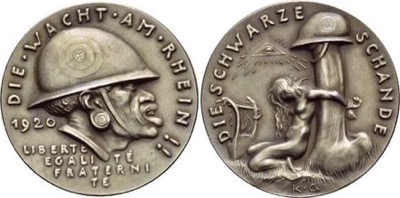
Let us remember that the racism of the 1930s had all the trappings of science. It was researched in many scientific institutes and taught in universities in both the United States and Western Europe. To preserve the master race, many “modern” states had banned interracial marriages before World War I.JPEG - 37.6 kbCommemorative medal designed by Karl Goetz (then ranked on the left). On the obverse, a caricature of a black French soldier with the motto “Liberté, Égalité, Fraternité”, on the reverse, a German woman bound and raped under a French helmet. This openly racist piece was distributed by a few right-wing organizations and by almost all Western left-wing organizations.

Racism is neither of the right nor of the left

In the collective imagination, racism would only develop in right-wing nationalist circles. This is absolutely false.

For example, at the end of the First World War, France occupied the Ruhr coal region militarily. Among the troops were Africans from Senegal and Madagascar for two years. Soon a protest movement developed in Germany, the United Kingdom, the United States and Canada to denounce the ignominy of the French who placed 20,000 blacks to dominate the German whites and rape their women. This racist movement was led by the main anti-racist figure of the beginning of the century, E. D. Morel [1], and gathered all the international feminist organizations in large demonstrations [2].

In France itself, socialists joined this racist movement, including Karl Marx’s grandson, Jean Longuet, a journalist at L’Humanité and future leader of the SFIO (Socialist Party).

It must be admitted that, in troubled times like the interwar period or the one we are living today, people follow their impulses whatever their ideas. They are often in complete contradiction with themselves and do not realize it.JPEG - 24.6 kbDemocratic President Woodrow Wilson (1913-1921) was the designer of the League of Nations, the predecessor of the United Nations. He favored the Klu Klux Klan within his party and established racial segregation.

The slavery and racist past of the American Democrats

In the United States, slavery and racism were mostly defended by the Democrats against the Republicans.

- The Democratic Party platforms of 1840, 1844, 1848, 1852 and 1856 asserted that abolitionism diminished the happiness of the people and endangered the stability and permanence of the Union.
- The 1856 program declared that the member states of the Union may or may not practice domestic slavery and write it into their constitutions.
- The 1860 program describes the efforts of abolitionist states that refused to arrest runaway slaves as subversive and revolutionary.
- The 14th Amendment granting full citizenship to freed slaves was passed in 1868 by 94% of Republican Party legislators and 0% of Democratic Party
- The 15th Amendment, which granted the right to vote to freed slaves, was adopted in 1870 by 100% of the members of the Republican Party and 0% of the members of the Democratic Party
- In 1902, the Democratic Party passed a law in Virginia removing the right to vote from over 90% of African Americans.
- President Woodrow Wilson instituted racial segregation of federal employees and mandated a photo on every job application.
- The 1924 Democratic National Convention at Madison Square Garden in New York City was called the “Klan-Bake” because of the influence of the Ku Klux Klan in the party.

Things did not really change until 1964, when, just after the Kennedys’ efforts, President Lyndon Johnson signed the Civil Rights Act into law. This was a painful turnaround, as Democratic lawmakers managed to block the legislation for 75 days.JPEG - 44 kbThe “1619 Project” is an operation of the New York Times Magazine. It aims to rewrite American history.

The “1619 Project”

See the rest here

Thierry Meyssan

Political consultant, President-founder of the Réseau Voltaire (Voltaire Network). Latest work in English – Before Our Very Eyes, Fake Wars and Big Lies: From 9/11 to Donald Trump, Progressive Press, 2019. Joe Biden reinvents racism Language inversion Open letter from retired military : a plot against the Republic ? France The Middle East is reorganizing Will the allies have to die for Kiev? The coup that didn’t happen in Jordan This author’s articles To send a message

Article licensed under Creative Commons

The articles on Voltaire Network may be freely reproduced provided the source is cited, their integrity is respected and they are not used for commercial purposes (license CC BY-NC-ND).

Be seeing you

Posted in Uncategorized | Tagged: , , , , , , | Leave a Comment »

Murray Rothbard on War and “Isolationism” | Mises Wire

Posted by M. C. on March 4, 2021

Well, the Progressive period begins around 1900 with Teddy Roosevelt and so forth. Woodrow Wilson cements it with his so-called reforms, which totally subject the banking system to federal power, and with the Federal Trade Commission, which did for business what the Interstate Commerce Commission did for the railroads. In other words, he imposed a system of monopoly capitalism, or corporate state monopoly, which we now call the partnership of the government and of big business and industry, which means essentially a corporate state, or we can call it economic fascism. It culminated in World War I economic planning, for the war consisted of a totally collectivized economy headed by the sainted and revered Bernard Mannes Baruch, head of the War Industries Board.

https://mises.org/wire/murray-rothbard-war-and-isolationism

Murray N. Rothbard

[These edited extracts, from an interview in the February 1973 issue of Reason magazine, first ran in the June 1999 issue ofthe Rothbard-Rockwell Report.]

Q: Why, in your view, is isolationism an essential tenet of libertarian foreign policy?

A: The libertarian position, generally, is to minimize state power as much as possible, down to zero, and isolationism is the full expression in foreign affairs of the domestic objective of whittling down state power. In other words, interventionism is the opposite of isolationism, and of course it goes on up to war, as the aggrandizement of state power crosses national boundaries into other states, pushing other people around etc. So this is the foreign counterpart of the domestic aggression against the internal population. I see the two as united.

The responsibility of trying to limit or abolish foreign intervention is avoided by many conservative libertarians in that they are very, very concerned with things like price control—of course I agree with them. They are very, very concerned about eliminating taxes, licensing, and so forth—with which I agree—but somehow when it comes to foreign policy there’s a black out. The libertarian position against the state, the hostility toward expanding government intervention and so forth, goes by the board—all of a sudden you hear those same people who are worried about government intervention in the steel industry cheering every American act of mass murder in Vietnam or bombing or pushing around people all over the world.

This shows, for one thing, that the powers of the state apparatus to bamboozle the public work better in foreign affairs than in domestic. In foreign affairs you still have this mystique that the nation-state is protecting you from a bogeyman on the other side of the mountain. There are “bad” guys out there trying to conquer the world and “our” guys are in there trying to protect us. So not only is isolationism the logical corollary of libertarianism, which many libertarians don’t put into practice; in addition, as Randolph Bourne says, “war is the health of the state.”

The state thrives on war—unless, of course, it is defeated and crushed—expands on it, glories in it. For one thing, when one state attacks another state, it is able through this intellectual bamboozlement of the public to convince them that they must rush to the defense of the state because they think the state is defending them.

In other words, if, let’s say, Paraguay and Brazil are going to get into a war, each state—the Paraguayan government and the Brazilian government—is able to convince their own subjects that the other government is out to get them and loot them and murder them in their beds and so forth, so they are able to induce their own hapless subjects to fight against the other state, whereas in actual practice, of course, it is the states that have the quarrel, not the people. The people are outside the quarrels of the state and yet the state is able to generate this patriotic mass war hysteria and to call everybody up to the colors physically and spiritually and economically and therefore, of course, aggrandize state power permanently.

Most conservatives and libertarians are very familiar with—and deplore—the increase in state power in the American government in the last 50 or 70 years, but what they don’t seem to realize is that most of these increases took place in giant leaps during wartime. It was wartime that provided the crisis situation—the spark—which enabled the states to put on so-called emergency measures, which of course never got lifted, or rarely got lifted.

Even the War of 1812—seemingly a harmless little escapade—was evil, and also in the domestic sense, in that it ruined the Jeffersonian Party for a long time to come, it established federalism, which means monopoly state-capitalism in essence, it imposed a central bank, it imposed high tariffs, it imposed domestic federal taxation, which never existed before, internal taxation, and it took a long time to get rid of it, and we never really did get back to the pre–War of 1812 level of minimal state power.

Then, of course, the Mexican War [Mexican-American War, 1846–48] had consequences of slave expansion and so forth. But the Civil War was, of course, much worse—the Civil War was really the great turning point, one of the great turning points in the increase of state power, because with the Civil War you now have the total introduction of things like railroad land grants, subsidies of big business, permanent high tariffs, which the Jacksonians had been able to whittle away before the Civil War, and a total revolution in the monetary system so that the old pure gold standard was replaced first by greenback paper, and then by the National Banking Act—a controlled banking system. And for the first time we had the imposition in the United states of an income tax and federal conscription. The income tax was reluctantly eliminated after the Civil War as was conscription: all the other things—such as high excise taxes—continued on as a permanent accretion of state power over the American public.

The third huge increase of power came out of World War I. World War I set both the foreign and the domestic policies for the twentieth century. Woodrow Wilson set the entire pattern for foreign policy from 1917 to the present. There is a total continuity between Wilson, Hoover, Roosevelt, Truman, Johnson, and Nixon—the same thing all the way down the line.

Q: You’d include Kennedy in that?

See the rest here

Author:

Murray N. Rothbard

Murray N. Rothbard made major contributions to economics, history, political philosophy, and legal theory. He combined Austrian economics with a fervent commitment to individual liberty.

Be seeing you

Posted in Uncategorized | Tagged: , , , , , | Leave a Comment »

Who Owns Your Face? – LewRockwell

Posted by M. C. on February 25, 2021

https://www.lewrockwell.com/2021/02/andrew-p-napolitano/who-owns-your-face/

By Andrew P. Napolitano

After listening to Dr. Anthony Fauci suggest last weekend that we should expect to be wearing two masks on our faces everywhere we go until the end of 2022, I began thinking again about first principles.

Fauci is entitled to express his opinions. Yet, because he is the president’s chief adviser on COVID-related medical matters, I cringed when I heard what he said. Was this a trial balloon or did he mean it literally? Are these suggestions or will they become commands with the purported force of law?

Because the Constitution is the supreme law of the land, it governs the government wherever it goes and whatever it does. The original purpose of the Constitution was twofold: to establish the federal government and to limit its regulatory and taxing powers to the 17 discrete powers articulated in Article I.

The former took place in 1789 when the Constitution was ratified. The latter has been a dismal failure.

The federal government recognizes next to no limits to its powers, no matter which political party controls Congress and the White House. The feds believe that they can right any wrong, tax any event and regulate any behavior — subject only to the express prohibitions in the Constitution. Even when there is a prohibition, such as, “Congress shall make no law … abridging the freedom of speech,” Congress has found ways around it. To the federal government, “no law” does not mean “no law.” Just ask the folks who have been prosecuted for their speech.

This is known as the Wilsonian model, named after President Woodrow Wilson, who advanced it shamelessly. All of his presidential successors have done the same.

Before Wilson, for the most part, and except for the Civil War years, the federal government recognized the limitations imposed upon it by the Constitution and, for the most part, stayed within their confines. This is known as the Madisonian model, named after President James Madison who wrote the Constitution and the Bill of Rights.

The first eight amendments in the Bill of Rights articulate negative rights. That is, the amendments don’t grant rights; they restrain the government from interfering with rights that already existed when the amendments were ratified. The Fifth and the 14th Amendments expressly require that the government prove fault and harm at a jury trial before it can interfere with property rights.

See the rest here

Andrew P. Napolitano [send him mail], a former judge of the Superior Court of New Jersey, is the senior judicial analyst at Fox News Channel. Judge Napolitano has written nine books on the U.S. Constitution. The most recent is Suicide Pact: The Radical Expansion of Presidential Powers and the Lethal Threat to American Liberty. To find out more about Judge Napolitano and to read features by other Creators Syndicate writers and cartoonists, visit creators.com.

Be seeing you

Posted in Uncategorized | Tagged: , , , , , | Leave a Comment »

The Coming of Corporate Collectivism – Doug Casey’s International Man

Posted by M. C. on October 28, 2020

Benito Mussolini stated that “Fascism should more appropriately be called Corporatism, as it is the merger of corporate and government power.”

https://internationalman.com/articles/the-coming-of-corporate-collectivism/

by Jeff Thomas

Benito Mussolini stated that “Fascism should more appropriately be called Corporatism, as it is the merger of corporate and government power.”

Quite so.

Interestingly, many, and perhaps most people today, lack an understanding as to the system under which they are ruled.

In the US in particular, most people who vote Republican take pride in believing that the US is a capitalist state.

Democrats, too, regard the US as a capitalist state, and take the view that that’s what’s wrong with America today. Increasingly, they seek a move in the socialist (or collectivist) direction to save them from the perceived evils of capitalism.

Interestingly, though, the evils to which they refer are the socio-economic inequalities that exist and the fact that those on the lower levels of society have decreasing opportunity to improve their lot in life. And, of course, since they believe they live under a capitalist system, they assume that capitalism must be the problem.

But this is not the case.

It can be said that the first major introduction of corporatist collectivism occurred in 1913, with the introduction of the Revenue Act and the Federal Reserve Act.

These were enacted under President Woodrow Wilson and were peddled to the American public as being anti-corporatist. The Revenue Act, which introduced income tax, was touted as creating a tax primarily for the rich, which would even out income disparities. The Federal Reserve was claimed to be a government agency that would ride herd over the greedy banking interests on Wall Street.

However, those few who actually read the bill learned that the Federal Reserve was neither federal nor a reserve. It was to be owned by the larger banks and would give them the power to control the currency of the US.

By promising collectivist changes, the goals of corporatism were advanced.

And so it is today. Virtually all the ills of American society, as described by liberals, have been caused by the introduction of collectivist concepts, capitalized upon by the plutocracy of the US.

The US is not a capitalist state. If we were to define it accurately, the economic system is corporatist and the social system is collectivist. It is, however, true that there exist the remnants of a free market, or capitalism.

Yet, to most – either liberal or conservative – this would seem impossible. We’ve been taught to regard Wall Street as a denizen for greedy capitalists. Surely, they would never support collectivism – the saviour of the masses.

Well, yes and no. Wall Street has dominated the American economy for over one hundred years. And in all of that time, they’ve sought a greater level of collectivism. They understand that collectivism (under any of its guises of socialism, fascism or communism) is a highly effective means by which to rule over others.

Collectivism does not raise up the masses, as Karl Marx suggested. Instead, it evens out the classes by lowering the great majority of people to an equal level of poverty.

The premise is a simple one: Promise largesse from the government, with the stipulation that basic freedoms must be relinquished in order to receive the largesse. Then, once all have been subjugated under collectivism, the largesse is steadily diminished. Corporate leaders convince the people to give up their rights, but then fail to deliver on their end of the bargain: to bestow riches upon the now-subjugated populace.

And again, this is nothing new. In 1917, one Leon Trotsky was hosted in New York by the most prominent banking and industrial firms. He was provided with funding, along with a US passport, courtesy of President Wilson. A contingent then went with Mister Trotsky to Russia with the funds necessary to wrest control of the new Soviet Union – to replace the Mensheviks with the Lenin/Trotsky-led Bolsheviks. The bargain was that the Soviet Union would be collectivist and that the goods needed by Russians would be supplied from New York, in perpetuity, unseen by the public in either Russia or the US.

Within a decade, the same firms began funding an up-and-coming Adolf Hitler. They funded his rise to power in 1933 and spent the remainder of the decade taking control of much of German industry, in addition to installing American-owned plants in Germany.

Prior to Hitler’s rise, Germany was flat broke and heavily in debt, but the massive monetary shot in the arm from Wall Street firms ensured that Germany would rise quickly and come to dominate Europe. Indeed, without US funding, the creation of the German war machine would have been impossible.

The term “Nazi” is an abbreviation for Nationalsozialistische – the National Socialist German Workers’ Party. Like the Russian people, the German people had been sold the collectivist promise, believing that their lives would somehow be better if they agreed to give up their liberties and accept totalitarian rule.

What they received was the totalitarian rule without the promised largesse.

The effort to create the same situation in the US has long been in the works. In the 1930s, great strides were made toward collectivism under the New Deal. However, post-war prosperity made Americans unwilling to give up liberties for largesse.

But today, increased governmental regulation has diminished the free market, diminishing opportunities for the average American. This has created a condition in which roughly half of Americans now buy into the empty promise of collectivism.

America no longer has true “liberal” and “conservative” parties. They now have “liberal” and “liberal-light” parties. Regardless of who is president, the US is on course to go full-bore in 2021 into dramatic social and legislative changes that will complete the transformation into Corporate Collectivism. All that’s needed is a trigger, as occurred in Germany in February of 1933.

Just two weeks prior to the 1933 German national elections, Adolf Hitler hosted a secret fundraising meeting for German and American industrialists, which netted him millions in donations, upon which he could finance a totalitarian corporate collectivist government.

He then surreptitiously created the Reichstag fire, blaming it on dissidents and political opponents, ensuring that he would be elected.

In his address at that fundraiser, he stated,

“There are only two possibilities, either to crowd back the opponent on constitutional grounds, and for this purpose once more we have this [upcoming] election, or a struggle will be conducted with other weapons, which may demand greater sacrifices… I hope the German people thus recognize the greatness of this hour.”

Germany was about to receive a totalitarian corporate collectivist rule, either through election or through the creation of civil unrest.

Similarly, the US today is about to undergo dramatic change. The remaining question is whether that will take place through election or its historic alternative.

Editor’s Note: The economic, political, and social volatility in the days and weeks ahead promises to be extreme. The impact on your savings, retirement funds, and personal freedoms could be unlike anything we’ve ever seen.

Do you want to know exactly what you should be doing differently with your portfolio and in your personal life?

EXCLUSIVE VIDEO: The Day After—How to Prepare for What Comes Next 

It reveals what you can do to prepare so that you can avoid getting caught in the crosshairs. Click here to watch it now.

Be seeing you

Posted in Uncategorized | Tagged: , , , , , , | Leave a Comment »