MCViewPoint

Opinion from a Libertarian ViewPoint

Archive for the ‘Uncategorized’ Category

If Global Warming Is Killing Us, Why Is Global Life Expectancy Increasing? | Mises Wire

Posted by M. C. on November 16, 2019

According to data compiled by the World Bank, life expectancy continues to grow fastest in Africa. During the ten-year period from 2007 to 2016, the largest gains were realized in Zimbabwe, Eswatini (formerly Swaziland), Botswana, Malawi, and South Africa. The gains in years ranged from 13 years over the period in Zimbabwe to nearly 10 years in South Africa. Wealthy and mid-level countries saw gains during this period as well, including Switzerland and Mexico, where life expectancy increased 1.1 years and 1.4 years, respectively.

Those who want to rein in economic activity in the name of climate-improvement would be destroying the very thing that’s improved the quality of life for billions already. Second, the anti-climate-change research would have to show that carbon taxes and similar policies will both reduce climate-change and increase access to better medical care, housing, and clean water. This has certainly not been done.

https://mises.org/wire/if-global-warming-killing-us-why-global-life-expectancy-increasing

According to a recent report from the Centers for Disease Control (“Mortality in the United States, 2017“), “Life expectancy for the U.S. population declined to 78.6 years in 2017,” largely due to obesity and drug addiction.

The American life expectancy trend does not reflect global trends, however.

Worldwide, the evidence continues to point toward rising life expectancy in most of the world, with the biggest gains in the poorest countries.

According to data compiled by the World Bank, life expectancy continues to grow fastest in Africa. During the ten-year period from 2007 to 2016, the largest gains were realized in Zimbabwe, Eswatini (formerly Swaziland), Botswana, Malawi, and South Africa. The gains in years ranged from 13 years over the period in Zimbabwe to nearly 10 years in South Africa. Wealthy and mid-level countries saw gains during this period as well, including Switzerland and Mexico, where life expectancy increased 1.1 years and 1.4 years, respectively.

Indeed, the continued gains should surprise no one who keeps up with global trends in health. Globally, access to sanitation and clean water has improved substantially while extreme poverty, malnourishment, and child mortality have all declined. This has especially been the case in Sub-Saharan Africa and Southern Asia, where some of the worst poverty can be found.

Why the Climate-Change Panic?

Oddly, however, you won’t hear much about this in the context of the climate change debate.

For years — as life expectancy numbers have continued to rise — pundits and researchers have repeatedly attempted to claim that climate change has led to — or will soon lead to — declines in overall life and health.

For example, The New Republic announced in 2015 that climate change “devastates food security, nutrition, and water safety.” Yet, the data shows that none of these things have been in any way “devastated” over the past decade. In fact, the indicators are all better now than where they were ten years ago.1

Meanwhile, The Lancet predicted (in a report released in November of last year) “continued progress in improving life expectancy.” The biggest gains are to be found in poorer countries. The report also predicts continued life-expectancy growth through the year 2040:…

The Lancet itself report also notes that natural-disaster related deaths are unlikely to be relevant to life expectancy predictions:

Predicted impacts in other studies on extreme weather-related deaths and heat wave deaths are not large enough to have much impact on global life expectancy.

So, while journalists like to talk about how many people climate change will supposedly kill this year, the fact remains that the net gains in life expectancy continue to be positive.  Those who want to rein in economic activity in the name of climate-improvement would be destroying the very thing that’s improved the quality of life for billions already. Second, the anti-climate-change research would have to show that carbon taxes and similar policies will both reduce climate-change and increase access to better medical care, housing, and clean water. This has certainly not been done. In fact, as Robert Murphy has noted, we have every reason to believe the costs of implementation of anti-climate change regimes will be very high.

Be seeing you

Carbon Tax - is it a key policy in the fight against climate change?


Posted in Uncategorized | Tagged: , , , | Leave a Comment »

Keynes on Eugenics, Race, and Population Control | Mises Wire

Posted by M. C. on November 16, 2019

Eugenics…it back.

In September 1925, he traveled with the SCR to the Soviet Union and he lectured to the Soviet Politburo. He said, “There is no more important object of deliberate state policy than to secure a balanced budget of population.”

https://mises.org/wire/keynes-eugenics-race-and-population-control?utm_source=Mises+Institute+Subscriptions&utm_campaign=a66cb00eae-EMAIL_CAMPAIGN_9_21_2018_9_59_COPY_01&utm_medium=email&utm_term=0_8b52b2e1c0-a66cb00eae-228343965

The literature on John Maynard Keynes’s life and ideas is enormous. However, his defenders have neglected his views on population. Why? His ideas in this area are highly problematic. This article provides documentation that shows Keynes advocated extensive government controls on the size and quality of the population.

Keynes was interested in eugenics from the very beginning of his academic career. His first major academic project was his fellowship dissertation, submitted in December 1907. In the dissertation, he refers to Sir Francis Galton’s essay Probability: The Foundation of Eugenics. This shows that Keynes was already interested in eugenics by 1907.1

fuller1.PNG
Image published with permission from ProQuest. Further reproduction is prohibited without permission.

The famous British economist Alfred Marshall was extremely close to the Keynes family. Keynes’s biographers note that he and Marshall debated Karl Pearson in 1910, but they suppressed the debate’s relation to eugenics.2 Marshall wrote to Keynes on July 14, 1910, “I am keeping as clear as I can of your ground & urging every one interested in Eugenics to read your paper. It is splendid.”3 In 1911, Keynes became treasurer of the Cambridge University Eugenics Society. On May 18, Marshall sent Keynes payment for lifetime membership in the society.4

On May 2, 1914, Keynes gave a speech called “Population.” This is perhaps his most important work on population. Unfortunately, this inaccessible speech was not included in The Collected Writings of John Maynard Keynes. A full transcript of the speech is included in the appendix below. After praising Malthus, he declares,

That degree of populousness in the world, which is most to be desired, is not to be expected from the working of natural order. … The natural degree of populousness is likely to exceed the ideal. … In most places the material condition of mankind is inferior to what it might be if their populousness were to be diminished. … In many, if not in most, parts of the world there actually exists at the present time a denser population than is compatible with a high level of economic wellbeing.5

To Keynes’s mind, “there would be more happiness in the world if the population of it were to be diminished.”6 Thus, he advocated government violence to restrict the size of the population. He wanted government to “mould law and custom deliberately to bring about that density of population which there ought to be.”7

Keynes was especially concerned about overpopulation in the East: “India, Egypt and China are gravely overpopulated.”8 He thought his race was facing a “race struggle.”9 He advocated the use of imperialistic government violence against Eastern races to protect the “white population.”

Almost any measures seem to me to be justified in order to protect our standard of life from injury at the hands of more prolific races. Some definite parceling out of the world may well become necessary; and I suppose that this may not improbably provoke racial wars. At any rate such wars will be about a substantial issue.10

fuller2.PNG
Image published with permission from ProQuest. Further reproduction is prohibited without permission.

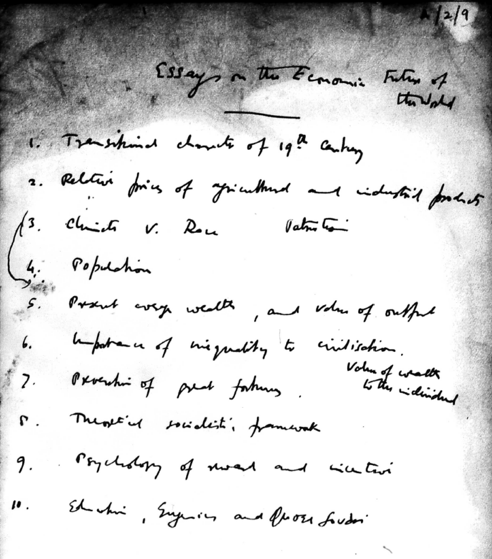
In the early 1920s, Keynes wrote an outline for a book called Essays on the Economic Future of the World. The fourth essay was on “Population” and the tenth essay was on “Education, Eugenics.” Interestingly, the eighth essay was on Keynes’s “Theoretical socialist framework.”

fuller3.PNG
Image published with permission from ProQuest. Further reproduction is prohibited without permission.

On January 4, 1923, Keynes wrote an article in the press called “The Underlying Principles.” He advocates restricting the number of births with government violence. But this may be insufficient. He imagines “positive policy” to reduce the population.

In the light of present knowledge I am unable to see any possible method of materially improving the average human lot which does not include a plan for restricting the increase in numbers [of population]. … It may prove sufficient to render the restriction of offspring safe and easy. … Perhaps a more positive policy may be required. … [I] would like to substitute [government] schemes conceived by the mind in place of the undesigned outcome of instinct and individual advantage playing within the pattern of existing institutions.11

On June 8, 1924, Keynes wrote an outline for a book called Prolegomena to a New Socialism. As shown below, he lists “Eugenics, Population” as “Chief Preoccupations of the State.” Clearly, government control over the quantity and quality of the population was key to his new socialism, or “rightly conceived socialism of the future.”12

fuller4.PNG
Image published with permission from ProQuest. Further reproduction is prohibited without permission.

In July 1924, Keynes was a founding vice president of the Society for Cultural Relations with the USSR (SCR for short). This socialist society was financed and controlled by VOKS, the Soviet government’s international propaganda agency. In September 1925, he traveled with the SCR to the Soviet Union and he lectured to the Soviet Politburo. He said, “There is no more important object of deliberate state policy than to secure a balanced budget of population.”13 He exclaimed,

I believe that there are many other matters, left hitherto to individuals or to chance, which must become in future the subject of deliberate state policy and centralised state control. Let me mention two — (1) the size and quality of the population and (2) the magnitude and direction of employment of the new national savings year by year [that is, socialization of investment].14

Leon Trotsky attended Keynes’s speech, and he observed: “Even the most progressive economist Keynes told us only the other day that the salvation of the British economy lies in Malthusianism! And for England, too, the road of overcoming the contradiction between city and country leads through Socialism.”15

Keynes was the chairman of the Malthusian League. He declared in his 1927 address to the league: “We of this society are neo-Malthusians,” and “I believe that for the future the problem of population will emerge in the much greater problem of Hereditary and Eugenics. Quality must become the preoccupation.”

fuller5.PNG
Image published with permission from ProQuest. Further reproduction is prohibited without permission.

Keynes was vice president of the British Eugenics Society from 1937 to 1944. Just 66 days before his death in 1946, he endorsed “the most important, significant and, I would add, genuine branch of sociology which exists, namely eugenics.”16

Keynes’s views on population are central to his politico-economic vision. No doubt, he viewed population as one of the most important problems facing humankind: “The question of population is the first and perhaps the most urgent and important of the problems facing those who seek to improve the material condition of mankind.”17 Keynes’s ideas on population must serve as a warning about Keynesian theory and policy. His Malthusianism indicates that he had a defective understanding of the division of labor and the law of returns. Beyond that, his population policies reveal the totalitarianism inherent in the Keynesian vision.

Appendix: “Population” by John Maynard Kenyes (1914)

Robert Malthus, the first of the Cambridge economists, came up to Jesus [College at Cambridge University] in 1784. He is said to have been fond of cricket and skating, obtained prizes for Latin and English Declamations, graduated as ninth wrangler in 1788 and was admitted Fellow of Jesus in 1793. He resided irregularly up to his marriage in 1804, and had the pleasure of signing an order to cut Coleridge off the kitchens for non-payment of his college bill, an indignity not unavenged afterwards by various members of the Lake School. The grandfather or great-grandfather, in his intellectual associations, of some of our own, Malthus was an original member of that Political Economy Club whose dinners still enliven the first Wednesday of every month, and of the Royal Statistical Society whose teas depress the first Tuesday.

In later life Malthus engaged in the controversy with Ricardo, out of which was hatched the Ricardian law of Rent; and the loss of his fellowship through marriage was the occasion of his becoming the first occupant of the first chair of Political Economy established in this country, the Professorship of History and Political Economy in the East-India College at Haileybury.

What we know of Malthus’s father Daniel must be added to these few details relating to Jesus and Haileybury, to complete a picture of ease, reflection, and gentleness. Daniel Malthus had been a friend and correspondent of Rousseau, and, it is alleged, one of his executors. He spent his life at the Rookery, ‘a small but beautiful estate’ between Guildford and Dorking, and is described as ‘a gentleman of good family and independent fortune attached to a country life, but much occupied in classical and philosophic pursuits, and with a strong bias towards foreign literature.’ Diffidence or idleness had prevented his bringing his powers to fruition; he was conscious of this; and anxious that his son should not suffer a like fate. He spent, therefore, peculiar pains on his son’s education, choosing for one of his instructors Gilbert Wakefield, and kept him under his own immediate supervision, until the time came for him to go to Wakefield’s college Jesus; — a course of action commented on thus by Malthus’s biographer Otter — ‘From some peculiar opinions which his father seems to have entertained respecting education, he was never sent to any public school; and in this respect, is one, amongst many other remarkable instances in the present time, of men who have risen into eminence under the disadvantage of an irregular and desultory education.’

A few letters, which have been preserved, written by Daniel Malthus to his son, when the latter was an undergraduate at Jesus, present the father’s character in a strong and amiable light. I will quote from a letter written by his father to Robert Malthus on his election to a fellowship: —

I heartily congratulate you upon your success; it gives me a sort of pleasure which arises from my own regrets. The things which I have missed in life, I should the more sensibly wish for you. Alas! my dear Bob, I have no right to talk to you of idleness, but when I wrote that letter to you with which you were displeased, I was deeply impressed with my own broken purposes and imperfect pursuits; I thought I foresaw in you, from the memory of my own youth, the same tendency to lose the steps you had gained, with the same disposition to self-reproach, and I wished to make my unfortunate experience of some use to you. It was, indeed, but little that you wanted it, which made me the more eager to give it you, and I wrote to you with more tenderness of heart than I would in general pretend to, and committed myself in a certain manner which made your answer a rough disappointment to me, and it drove me back into myself. You have, as you say, worn out that impression, and you have a good right to have done it; for I have seen in you the most unexceptionable character, the sweetest manners, the most sensible and the kindest conduct, always above throwing little stones into my garden, which you know I don’t easily forgive, and uniformly making everybody easy and amused about you. Nothing can have been wanting to what, if I were the most fretful and fastidious, I could have required in a companion; and nothing even to my wishes for your happiness, but where they were either whimsical, or unreasonable, or most likely mistaken. I have often been on the point of taking hold of your hand and bursting into tears at the time that I was refusing you my affections: my approbation I was precipitate to give you.

Write to me, if I could do anything about your church, and you want any thing to be done for you, such as I am, believe me, dear Bob, yours most affectionately,

Daniel Malthus

Malthus’s first essay in authorship, The Crisis, a View of the Recent Interesting State of Great Britain by a Friend to the Constitution, written in 1796, in his thirtieth year, in criticism of Pitt’s administration, failed to find a publisher. Extracts quoted by Otter and by Empson indicate that his interest was already aroused in the social problems of political economy, and even in the question of population itself:

On the subject of population [he wrote] I cannot agree with Archdeacon Paley; who says, that the quantity of happiness in any country is best measured by the number of people. Increasing population is the most certain possible sign of the happiness and prosperity of a state; but the actual population may be only a sign of the happiness that is past.

In 1798, when Malthus was thirty-two years old, there was published anonymously An Essay on the Principle of Population, as it affects the future improvement of Society: with remarks on the speculations of Mr Godwin, M. Condorcet, and other writers.

It was in conversation with Daniel Malthus that there occurred to Robert Malthus the generalization which has made him famous. The story is well known on the authority of Bishop Otter who had it from Malthus himself. In 1793 Godwin’s Political Justice had appeared. In frequent discussion the father defended, and the son attacked, the doctrine of a future age of perfect equality and happiness.

And when the question had been often the subject of animated discussion between them, and the son had rested his cause, principally upon the obstacles which the tendency of population, to increase faster than the means of subsistence, would always throw in the way; he was desired to put down in writing, for maturer consideration, the substance of his argument, the consequence of which was the Essay on Population. Whether the father was converted or not we do not know, but certain it is that he was strongly impressed with the importance of the views and the ingenuity of the argument contained in the MS., and recommended his son to submit his labours to the public.

The first edition, an octavo volume of about 50,000 words, is an almost completely different, and for posterity a superior book, to the second edition of five years later in quarto, which by the fifth edition had swollen to some 250,000 words in three volumes. 250,000 by an elaboration of proof and historical research, without any substantial improvement in the author’s clear and striking statement of the fundamental principles involved. Just as the fruitfulness and originality of Cambridge is largely preserved by the deficiencies of the University library, so the first edition of this book is not really the worse from having been written, as Malthus explains in the preface to the second edition, ‘on the impulse of the occasion, and from the few materials which were then within my reach in a country situation.’

Malthus’s Essay is a very great book. The author was deeply conscious of the bigness of the ideas he was elaborating. It is no case of a man of second-rate powers hitting, more by good fortune than desert, on an unexpectedly important generalisation. Indeed his leading idea had been largely anticipated in a clumsier way by other eighteenth century writers without attracting attention.

The high-spirited rhetoric of a young man writing in the last years of the Directory disappears from the late editions, which are quieter, more businesslike, more strictly attentive to the duties of a scientific pioneer in the study of sociological history.

This is how he begins —

the rest here

Be seeing you

Policy Science Kills - Foundation for Economic Education


Posted in Uncategorized | Tagged: , , , | Leave a Comment »

Yes, Taxation Is Theft | Mises Wire

Posted by M. C. on November 16, 2019

An example quickly discloses the authors’ fallacy. Suppose that the government banned advocacy of libertarian property rights. Against those who claimed that this interfered with free speech, advocates of the new measure replied in this way: “Don’t you see the obvious conceptual error that underlies your protest? ‘Free speech’ is a legal category. People have no independent liberty of speech, apart from what a particular legal system grants them. Your opposition is absurd: away with you!”

https://mises.org/wire/yes-taxation-theft

Libertarians think that taxation is theft. The government takes away part of your income and property by force. Your payments aren’t voluntary. If you think they are, try to withhold payment and see what happens.

An influential book by Liam Murphy and Thomas Nagel, The Myth of Ownership, tries to show that this view of taxation is wrong. Many people, they say, foolishly resent taxes. By what right does the government take away part of what we own? Isn’t this legalized theft? The government may claim that it needs the funds to provide essential social services: are the poor to be left to starve? But these assertions do not justify its policy of forcible seizure. Isn’t it up to each owner of property to decide what, if anything, he wishes to donate to charity and other good causes?

You might guess that the authors will respond, along conventional leftist lines, with a denial that property rights are absolute: you do not have the right to keep all that you own, if the government’s exactions are devoted to a good purpose. Quite the contrary, they adopt a much more radical stance. You are not giving away anything at all to the government when you pay taxes, since you own only what the laws say you do.

Our authors are nothing if not direct on this point: “If there is a dominant theme that runs through our discussion, it is this: Private property is a legal convention, defined in part by the tax system; therefore, the tax system cannot be evaluated by looking at its impact on private property, conceived as something that has independent existence and validity. Taxes must be evaluated as part of the overall system of property rights that they help to create. . . . The conventional nature of property rights is both perfectly obvious and remarkably easy to forget . . . We cannot start by taking as given . . . some initial allocation of possessions— what people own, what is theirs, prior to government interference.”

An example quickly discloses the authors’ fallacy. Suppose that the government banned advocacy of libertarian property rights. Against those who claimed that this interfered with free speech, advocates of the new measure replied in this way: “Don’t you see the obvious conceptual error that underlies your protest? ‘Free speech’ is a legal category. People have no independent liberty of speech, apart from what a particular legal system grants them. Your opposition is absurd: away with you!”

I doubt that Murphy and Nagel would display much patience for this sophistry. Legal rights indeed depend on the specifications of a particular legal system; but it is perfectly in order to say that people have moral rights, not created by the legal system, that the law ought to respect.

In like fashion, opponents of taxation are guiltless of the conceptual error Murphy and Nagel impute to them. They maintain that people possess property rights that the government ought to recognize. Why is the falsity of this view “perfectly obvious”? It is rather Murphy and Nagel who have lapsed into grievous error: they confuse legal with moral rights.

The authors at one place acknowledge the point at issue: “[D]eontological theories hold that property rights are in part determined by our individual sovereignty over ourselves. . . . On a deontological approach, there is likely to be a presumption of some form of natural entitlement that determines what is yours or mine and what isn’t, and this prima facie presumption has to be overridden by other considerations if appropriation by taxes is to be justified. On a consequentialist approach, by contrast, the tax system is simply part of the design of any sophisticated modern system of property rights.”

Our authors of course reject the entitlement view, but they have here made a crucial admission. Given that this theory exists, is it not evident that their earlier account is false? The alleged error that opponents of taxation commit is present only if the conventionalist theory is true. Supporters of Lockean entitlements to property may be incorrect, but they at least have a theory: they stand acquitted of simply failing to grasp a conceptual point, the charge that Murphy and Nagel bring against them. Do they think the Lockean account obviously incoherent? They say nothing against it but instead go on interminably to accuse opponents of their view of confusion.

The conventionalist theory they support leads quickly to disaster. Isn’t it “perfectly obvious” that it makes us all slaves of the government? Once more, Murphy and Nagel acknowledge the objection. Their view “is likely to arouse strong resistance” because it “sounds too much like the claim that the entire social product really belongs to the government, and that all after-tax income should be seen as a kind of dole that each of us receives from the government, if it chooses to look on us with favor”

They fail to see that their admission gives away the game. If, as they admit, individual rights require some degree of private property, then the government cannot morally tax away this property. If so, there are moral limits to the taxing power, and it is not “a matter of logic” that there cannot be a pre-tax income over which persons retain full control

Murphy and Nagel are pure conventionalists about property when this enables them to attack libertarians, but they shrink from the full implications of the position. How is this tension in their presentation to be resolved? I suspect that in practice they would not deviate very far from the total subordination of property rights to the state. They consider endowment taxation, in which people are taxed, not just on their income, but rather on their potential to generate revenue. Someone who abandoned a multi-million-dollar business career in order to become a Trappist monk might on the endowment account be taxed as if he continued to receive his former high income. Our authors eventually reject this monstrous proposal, though not on the grounds that it compels people to work.

To reject the proposal because it compelled people to work would put them suspiciously close to a famous argument, advanced very effectively by Robert Nozick, that income taxes are akin to forced labor. Of course our authors cannot accept so libertarian a view; “we may assume that this argument is not dispositive against taxation of earnings.” Since taxation is acceptable—this we know a priori—no argument that holds it illegitimate is right. But then we cannot reject endowment taxation if we reason in a way that would also condemn the income tax. “[T]here is no intrinsic moral objection to taxing people who don’t earn wages” (p. 124). We can, then, maintain that endowment taxation is “too radical” an interference with autonomy; but we cannot in principle reject it.

If you affirm a “conventionalist” account of property, you will wind up in dark waters. Taxation is indeed theft.


Be seeing you

wp-1555692458658.jpg

Posted in Uncategorized | Tagged: , , , , | Leave a Comment »

Rolling Stone: Men Who Abstain From Porn Are Dangerous Alt-Righters – The American Conservative

Posted by M. C. on November 16, 2019

https://www.theamericanconservative.com/articles/rolling-stone-men-who-abstain-from-porn-are-dangerous-alt-righters/

There’s a scene in The Big Lebowski in which The Dude bitterly objects that the pornographer Jackie Treehorn, viewed by the local sheriff as an upstanding citizen who “draws a lot of water” in Malibu, “treats objects like women, man.” Lazy, inarticulate stoner though The Dude may be, even he understands that porn is a shady business and that those who produce it are a detriment to society.

To read Rolling Stone, though, you’d think these people were providing a valuable public service. In a recent piece by EJ Dickson, the expert witness is Dr. David Ley, a “clinical psychologist and sex therapist” who “has partnered with the [pornographic] cam website Stripchat” to spread the word about “sexual health.” The story also includes interviews with the vice presidents of two different porn sites, an embedded tweet about the supposed health benefits of chronic masturbation, and—to wrap it up—a “comforting message” from an “adult performer and director.” They all want you to know that porn won’t hurt you or anyone else. After all, everyone is watching it.

A segment on Trevor Noah’s Daily Show takes it a step further, trotting out the same psychologist from the Rolling Stone piece to explain that porn and masturbation make “a lot of really good things happen in your body and your brain” and that “people who watch more pornography…are more feminist” and have “more egalitarian values.” The correspondent responds with a joke—delivered without a trace of self-awareness—about how watching a 95-on-1 gang bang made him realize that “women have it so hard.”

To the millions of Americans who struggle with porn addiction, to those raped and murdered by sexual sadists who cut their teeth on violent porn, to the sex trafficking victims coerced into porn, have no fear! Your sacrifice is not in vain; it will usher in a golden age of sex-positive emancipation!

But if the producers and consumers of pornography are so clearly dedicated to spreading sweetness and light in the world, what kind of monsters would oppose them?

According to Dickson, the enemy is anyone currently participating in #NoNutNovember, a viral internet challenge that encourages men to go 30 days without watching porn or masturbating. In what’s become a tell-tale sign that the hip vanguard of the cultural left’s late-stage sexual revolution feels threatened, Dickson lets us know, in no uncertain terms, that those who dare abstain from porn have embraced “the ideology…of the far right”: “anti-Semitism,” “homophobia,” “racism,” and “misogyny.” He even includes Ley’s “You know who else hated porn? Hitler!” argument and goes out of his way (and I mean waaaaaaay out of his way) to name drop Alex Jones and Milo Yiannopoulos.

Both Rolling Stone and The Daily Show focus on debunking the supposed boost in virility that comes from semen retention (which, granted, is bunk) that motivates some #NoNutNovember-ers. But the extent to which both outlets ignore the obvious reality that most participants are driven primarily by a desire for self-control is staggering.

Ley actually criticizes Jordan Peterson (whom he calls “a leader in the alt-right movement in Canada”) for telling young men that “there is nothing noble about masturbating to pornography.”

“That’s noble! That’s healthy!” Ley insists. Dickson, meanwhile, reacts indignantly to the “Coomer” meme, an image used by #NoNutNovember participants to mock those who compulsively watch porn.

Really? Noble? If that’s the case, it’s a recent discovery. Throughout the ages, Christians and pagans, Easterners and Westerners, philosophers and poets—and yes, even the hedonists, most of whom had some standards and would have sought out heartier fare than the low-hanging junk food of smartphone porn—have agreed that the uninhibited indulgence of sexual desire makes one not only weak but contemptible…

Fortunately, this attempt to create a society in which self-discipline is vilified is doomed to failure. Aristotle understood this when he insisted that the well-ordered, virtuous individual of the Ethics must precede the well-ordered state of the Politics. Self-control makes strong men. Self-indulgence makes weak men. Strong men make good citizens. Weak men make good slaves. Strong men are capable of doing harm. Weak men are incapable of doing anything else.

Be seeing you

?u=http2.bp.blogspot.com-vsL9x6b60BcTcjveUcibvIAAAAAAAAB7o1H7iFzRkTx0s1600000pulp_fiction_judy_miller_the_heretik.jpg&f=1

Posted in Uncategorized | Tagged: , , , , , | Leave a Comment »

Neil deGrasse Tyson & J. Ventura on the role of astrophysics in military conquests

Posted by M. C. on November 16, 2019

deGrasse Tyson starts at about 10:00.

Interesting interview as one would expect.

While lauding science and satellites the topic of spying on US, listening to US and that the military can shutoff GPS whenever and likely to whomever it chooses is carefully avoided.

Don’t bite the hand…

Posted in Uncategorized | Tagged: , , , | Leave a Comment »

The Big Electron

Posted by M. C. on November 16, 2019

Posted in Uncategorized | Tagged: , , | 1 Comment »

DARPA Seeks “Militarized Microbes” So They Can Spread Genetically-Modified Bacteria | Zero Hedge

Posted by M. C. on November 16, 2019

“No matter how paranoid or conspiracy-minded you are, what the government is actually doing is worse than you imagine.” ― William Blum, Rogue State: A Guide to the World’s Only Superpower

Spy agency controlled bacteria. What could go wrong?

https://www.zerohedge.com/technology/darpa-seeks-militarized-microbes-so-they-can-spread-genetically-modified-bacteria

Authored by Mac Slavo via SHTFplan.com,

The Pentagon’s DARPA (Defense Advanced Research Projects Agency) wants to be able to spread genetically modified bacteria as “explosives sensors.” The United States government could very well be looking into ways to militarize microbes.

The Pentagon has teamed up with Raytheon for this project, which seems like it should come straight out of a dystopian science fiction story. The government wants to develop a system capable of delivering genetically modified bacteria underground, according to a report by RT.

Initiated by DARPA, the same agency that led programs to create telekinetic super soldiers and weaponized robotic insects, the project seeks to “program two bacterial strains to monitor ground surfaces for explosive materials,” defense contractor Raytheon said in a joint press release with the Worcester Polytechnic Institute.

DARPA Can Exterminate Humanity: ‘You Could Feasibly WIPE OUT The Human Race’

DARPA Wants “Thought Controlled Weapons” By Finding Ways To “Read Soldiers’ Minds”

So the genetically modified bacteria are for your own good!

The first of the two strains, known as a “bio-sensor,” will “detect the presence or absence of explosives buried underground,” while the second will produce a “glowing light” in the event such materials are found. Remotely operated cameras or drones would then be sent to survey the area to find the glowing germs, and ultimately the buried explosives. –RT

“We already know that some bacteria can be programmed to be very good at detecting explosives, but it’s harder underground,” said Raytheon researcher Allison Taggart. “We’re investigating how to transport the reporting bacteria to the required depth underground.”

Though the Pentagon claims it only plans to use the system for “defensive” purposes only, some may find the idea of militarized microbes off-putting while conjuring apocalyptic scenarios of a runaway genetically engineered superbug.

Insider Reveals How DARPA Will Control Our Minds: “If Even 20% Of This Is True…”

DARPA has undertaken some projects that should raise the alarm in many.  However, it almost seems as though we’ve reached a point where the masses don’t care what’s being done to them, in their name, and with the money stolen from them. And these are just a few of the things we know DARPA is working on.

“No matter how paranoid or conspiracy-minded you are, what the government is actually doing is worse than you imagine.” ― William Blum, Rogue State: A Guide to the World’s Only Superpower

Be seeing you

Lyme disease

Lyme Disease

Posted in Uncategorized | Tagged: , , , , , , | Comments Off on DARPA Seeks “Militarized Microbes” So They Can Spread Genetically-Modified Bacteria | Zero Hedge

DARPA Can Exterminate Humanity: ‘You Could Feasibly WIPE OUT The Human Race’

Posted by M. C. on November 16, 2019

Humanity is known for making mistakes, but we can’t come back from an extinction of our own making. “You can call it a ‘tool’ all day, [but] it’s a weapon,”

https://www.shtfplan.com/headline-news/darpa-can-exterminate-humanity-you-could-feasibly-wipe-out-the-human-race_12142017

Mac Slavo

One of the most dangerous experiments that mankind has ever embarked upon is DARPA’s desire for gene drive technology. Scientists now have the knowledge and the tools they need to create and deliver “Doomsday genes” which can selectively target and exterminate an entire species.

According to Sputnik News, and as previously reported by SHTFPlan,  the United States highly-secretive and advanced military research body DARPA (Defense Advanced Research Projects Agency) announced that it will invest tens of millions of dollars into genetic extinction research. While the official aim of this research is said to be fighting harmful insects, like mosquitos which carry Malaria, there are significantly darker implications and speculations surrounding the possible use of such a tool.

Joe Joseph of The Daily Sheeple said a quick Google search would give you enough information to let you know how horrific this kind of technology can be. “…and you’ll find it fascinating just at how unbelievable a weapon this could be, how unintentionally mistakes can be made that can cause irreversible damage…irreparable damage…to the human race. And I mean, FAST!” Joseph said. “A gene drive…if let’s just say there’s a mistake, you could feasibly wipe out the human race in a very very short period of time. It’s an unbelievable tool at the disposal of madmen.”

Emails released under the Freedom of Information Act (FOIA), suggest that the U.S.’s uber-secretive military body, DARPA, has become the world’s largest funder of this “gene drive” research.

Silvia Ribeiro, Latin America director of the ETC Group, an international organization dedicated to the conservation and sustainable advancement of cultural and ecological diversity and human rights, said:  “When it is developed under an umbrella of a military research, you get a clear notion that there can be a dual purpose of this research.”

Jim Thomas, a co-director of the ETC group which obtained the emails, said the US military’s influence in furthering this technology would strengthen the case for a moratorium. “The dual-use nature of altering and eradicating entire populations is as much a threat to peace and food security as it is a threat to ecosystems,” he said. “Militarization of gene drive funding may even contravene the Enmod convention against hostile uses of environmental modification technologies.”

But while we are on the subject of UN bans, the sanctions they placed on North Korea are being willfully ignored by the rogue regime.  It stands to reason that should a military seek the use of this technology, they will also defy the UN’s “authority.” –SHTFPlan

Humanity is known for making mistakes, but we can’t come back from an extinction of our own making. “You can call it a ‘tool’ all day, [but] it’s a weapon,” says Joseph.

Be seeing you

Exterminate

Maybe not so far fetched.


Posted in Uncategorized | Tagged: , , , | Leave a Comment »

Uncle Sam’s ‘Moderate Rebels’ Make a Comeback in Syria, But Now They’re the Bad Guys | The Libertarian Institute

Posted by M. C. on November 16, 2019

However, Turkey’s army is not executing the mission on the ground, instead outsourcing the job to mercenaries. While rebranded from the Free Syrian Army (FSA) to the Syrian National Army (SNA) in late 2017, the Turkish-backed force now condemned for its brutal assault on the Kurds is the very same “moderate” Sunni Arab opposition supported and armed by the Obama administration earlier in the conflict. Indeed, the SNA fights under the same “revolutionary flag” flown by the FSA when it served at the pleasure of the United States.

https://libertarianinstitute.org/articles/uncle-sams-moderate-rebels-make-a-comeback-but-now-theyre-the-bad-guys/?fbclid=IwAR2CHyQIQersf_tpJUlJhaGID5Cv9yWjO8rJLrrDY-YIoVSWsjaNU1cf_Og

By

Will Porter

Washington’s former opposition quislings in Syria have been cast in the role of villainous thugs in the corporate press as they take part in Turkey’s cross-border incursion against Kurdish fighters, despite years of fanfare from the Beltway Blob, which hailed the rebels as heroic “moderates.”

Meet the new rebels, same as the old rebels

Initially a crusade to oust President Bashar al-Assad, the American mission in Syria has seen a number of radical revisions over the years, shifting between regime change, defeating the Islamic State, protecting Israel, stopping Iranian arms shipments to Lebanon and now – the pundits say in unison – protecting Kurdish proxies from a Turkish onslaught.

Ankara’s “Operation Peace Spring,” launched October 9 to clear US-backed Kurdish groups from the Syrian-Turkish border, appears to have triggered a partial reshuffling on the battlefield, forcing Washington to vacate Kurdish areas in the northeast which long served as a bastion for US forces and, in some towns, allow the Syrian Arab Army to take its place.

However, Turkey’s army is not executing the mission on the ground, instead outsourcing the job to mercenaries. While rebranded from the Free Syrian Army (FSA) to the Syrian National Army (SNA) in late 2017, the Turkish-backed force now condemned for its brutal assault on the Kurds is the very same “moderate” Sunni Arab opposition supported and armed by the Obama administration earlier in the conflict. Indeed, the SNA fights under the same “revolutionary flag” flown by the FSA when it served at the pleasure of the United States.

To the tune of hundreds of millions of dollars – much of that provided by the Saudis – Obama’s CIA carried out operation “Timber Sycamore,” training up rebel fighters and flooding the battlefield with weapons and gear. Turkey, Jordan, the UAE, Qatar, France and the UK also had a hand in the project, transforming the conflict from an internal civil war to a multinational proxy bonanza.

The CIA mission was conducted despite clear signs that the Syrian opposition was lacking in democracy-loving moderates, and lousy with radicals and head-chopping war criminals. A 2012 memo produced by the Defense Intelligence Agency (DIA) sternly warned that a “Salafist principality” – a term synonymous with “Islamic state” – could emerge from the jihadist-dominated opposition in Eastern Syria. Astonishingly, the document deemed that a desirable outcome in terms of the Obama administration’s policy goals, as it might help to “isolate” the Syrian government.

The United States watched as the rebels plunged deeper into insurgency, stoking a conflict in which hundreds of thousands of civilians and combatants were killed on all sides, yet the weapons kept flowing. The most radical factions – including the DIA’s “Salafist Principality,” the Islamic State – were soon awash in American arms, too, as FSA units defected and joined their ranks, or sold their weapons on the black market.

Writing on the wall

Though some analysts in the DIA, not to mention in the alternative media, could see that extremist elements dominated the Syrian opposition from early in the conflict, with the benefit of hindsight that fact is even clearer now to anyone who cares to look.

In the spring of 2013, a video surfaced online underscoring the “moderate” essence of the US-backed opposition. In the clip, rebel commander Abu Sakkar, then with a FSA break-off faction, the al-Farouq Brigades, is seen consuming the heart of a dead Syrian soldier. He then calls on his cohorts to follow his example to strike fear into the apostate Alawites. Farouq, like many of the FSA’s subgroupings, later merged with even more radical factions, and for a time fought alongside the Syrian al-Qaeda affiliate, Hayat Tahrir al-Sham (formerly Jabhat al-Nusra).

The War Party is scrambling to keep the game going, clinging to oil fields in Syria’s north and a base in the south, but the US occupation project is suffering convulsions and the conflict is entering an increasingly post-Washington phase…

it becomes clearer by the day that the United States cannot remain in Syria forever, and now simply has no productive role to play there. It never did.

Be seeing you


proxy.duckduckgo.com

Posted in Uncategorized | Tagged: , , , , , , , | Leave a Comment »

Doug Casey: These People Are the “Enemies of Humanity” – Casey Research

Posted by M. C. on November 16, 2019

These people share Big Brother’s psychology and way of thinking. They want to use language to control the way people act and feel.

The degradation of language is very important. It’s not a question of
just being able to express yourself. Language facilitates your ability
to think. If the enemy – and these people are actually enemies of
humanity – capture the language they almost automatically win the war.

https://www.caseyresearch.com/daily-dispatch/doug-casey-these-people-are-the-enemies-of-humanity/

Chris’ note: As longtime readers know, Doug Casey believes the politically correct (PC) movement is part of the accelerating collapse of Western civilization.

And this trend is getting worse by the day.

For example, San Francisco recently introduced a new “sanitized” language for criminals. You’re not supposed to say “convicted felon,” “delinquent,” or even “drug addict” now.

And that’s not the only example…

Below, Doug tells me why this is happening… who the true enemies are… and where he sees all this going from here…


Chris Reilly, managing editor, Casey Daily Dispatch: Doug, longtime readers know that you think the “politically correct” movement is destroying America. In fact, you’ve said in the past that “PC” culture is just “one more termite eating away at the foundations of Western civilization itself.”

And things don’t seem to be getting better.

San Francisco is the latest example.

It sounds crazy, but the city board recently “sanitized” a bunch of crime lingo. For instance, it’s getting rid of words such as “offender” and “addict.” Instead of “convicted felon,” you’re now supposed to say “justice-involved person.”

Are you surprised at all that this is happening?

Doug Casey, founder, Casey Research: No, I’m not surprised at all. It’s part of the accelerating collapse of civilization itself. And it’s not just a question of the language evolving, and people just saying things in different ways.

English has evolved, and the meanings of words have been changing since before Beowulf was composed in the 10th century. The language has become more precise as a result. This is different. It’s not an organic change. It’s an attempt by people who see themselves as the ruling class to not just influence the way the proletariat speaks, but the way they think. Or perhaps I should say the way they feel. Thinking is hard work, but even an imbecile can feel.

Political types – absolutely including the “woke” brigade and so-called Social Justice Warriors – specialize in appealing to the emotions, not the intellect. It makes sense when you’re trying to sway the mob. If people actually thought about the notions the wokesters promote, most would realize it was just claptrap to manipulate and swindle them. It’s smarter to sway their emotions. The mob acts on their feelings, which you can excite with a 30-second sound bite, and a picture. They don’t act on even simple intellectual arguments – forget about complex reasoning.

The degradation of language is very important. It’s not a question of just being able to express yourself. Language facilitates your ability to think. If the enemy – and these people are actually enemies of humanity – capture the language they almost automatically win the war.

Chris: One of the reasons San Francisco is doing this is because it wants to change people’s views about those who commit crimes.

Doug: Apparently none of these people have read George Orwell’s 1984. Or, more likely, they have, and took away exactly the wrong message. Orwell intended the book as a warning, not an instruction manual, where things often meant the opposite of what they said. Big Brother and the Party purposefully tried to change the language. If you can control what people say, or don’t say, you’re in effect controlling what people think and feel.

These people share Big Brother’s psychology and way of thinking. They want to use language to control the way people act and feel…

Chris: There’s nothing that can be done?

Doug: No, there’s not really much hope. The election of Donald Trump was actually the “last hurrah” for traditional America. As you know, I’m not a fan of Trump. His foreign policies are generally warlike and dangerous. His monetary policy of endorsing ZIRP, more debt, and money printing is idiotic. His fiscal policy of running trillion-dollar deficits is disastrous.

On the bright side, his traditionalism – wanting to see America the way it was at its peak in the days of “Father Knows Best,” “Ozzie and Harriet,” or “Mad Men” for the Millennials who otherwise wouldn’t know what I’m talking about – has a certain charm. Especially now that we’re on the ragged edge of a civil war.

The proverbial average American – someone with a steady job, a family, some savings, some belief in traditional American values – voted for him because he wasn’t a lifelong politician. He wasn’t one of these horrible Deep State creatures like McCain, or Romney, or those other phony non-entities on stage with him. And he wasn’t Hillary, America’s answer to Evita Peron.

Even so, in 2016 it was a very, very close election. This time around there will be a lot more young people voting. And a lot more migrants voting. They’ll all go for the kind of active socialists and sociopaths we’ve seen in the Democratic debates. It doesn’t matter that they’re all authoritarians, totally ignorant of economics and who actually despise personal freedom. It doesn’t matter that some of them appear to be clinically insane.

Fifty years ago was the last time we experienced something like this, a cultural revolution in the US. And coincidentally it happened at the same time in Europe and China. It flowed out of the universities into the streets then. Even though only a small number of people went to university from high school in those days. Now almost everybody goes from high school into at least junior college. Now the virus is not only much more virulent than it was during the ‘60s and ‘70s, but it’s much more widespread and much more ingrained in society. And it doesn’t just start in college. It starts in high school, and even grade school today.

So how do you turn this around at this point? How do you depoliticize a whole society? How do you convince hundreds of millions of people not to be busybodies? To think, not feel? To analyze the actual meaning of what teachers and demagogues say? The answer is: You can’t. The degradation has been going on a long time. You don’t reverse a trend overnight – assuming you can change its direction at all.

I expect that in the next few years, as the economy goes into full collapse, that we’ll see violence in the streets. It’s going to be really ugly.

But let’s end this on a happy note. George Carlin was a stickler for using words, and concepts accurately. Which is to say he was anti-PC, anti-woke and anti-SJW. Get a load of this.

Be seeing you

An Earth Day Message – ‘We’re Going To Save The Planet ...

Posted in Uncategorized | Tagged: , , , , , | Leave a Comment »