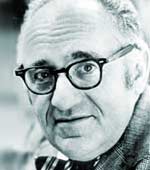
The Economist has described Friedman as “a giant among economists” and “the most influential economist of the second half of the 20th century.” Here are 12 things he said to serve as food for thought:
1. “Underlying most arguments against the free market is a lack of belief in freedom itself.” – >Capitalism and Freedom (2002)
2. “I’m in favor of legalizing drugs. According to my values system, if people want to kill themselves, they have every right to do so. Most of the harm that comes from drugs is because they are illegal.” – As quoted in If Ignorance Is Bliss, Why Aren’t There More Happy People? (2009)
3. “With some notable exceptions, businessmen favor free enterprise in general but are opposed to it when it comes to themselves.” –Lecture “The Suicidal Impulse of the Business Community” (1983)
4. “It’s a moral problem that the government is making into criminals people, who may be doing something you and I don’t approve of, but who are doing something that hurts nobody else.” – America’s Drug Forum interview (1991)
5. “One of the great mistakes is to judge policies and programs by their intentions rather than their results.” – Interview with Richard Heffner on The Open Mind (Dec. 7, 1975)
6. “You must distinguish sharply between being pro-free enterprise and being pro-business.” – Big Business, Big Government (1978)
7. “The society that puts equality before freedom will end up with neither. The society that puts freedom before equality will end up with a great measure of both.” – From “Created Equal,” an episode of the PBS Free to Choose television series (1980)
8. “Governments never learn; only people learn.” – As quoted in The Cynic’s Lexicon: A Dictionary Of Amoral Advice (1984)
9. “We have to recognize that we must not hope for a Utopia that is unattainable. I would like to see a great deal less government activity than we have now, but I do not believe that we can have a situation in which we don’t need government at all.” – As quoted in The Times Herald, Norristown, Pennsylvania (Dec. 1, 1978)
10. “The great virtue of a free market system is that it does not care what color people are; it does not care what their religion is; it only cares whether they can produce something you want to buy. It is the most effective system we have discovered to enable people who hate one another to deal with one another and help one another.” – “Why Government Is the Problem” (February 1, 1993), p. 19
11. “The case for prohibiting drugs is exactly as strong and as weak as the case for prohibiting people from overeating. We all know that overeating causes more deaths than drugs do.” – America’s Drug Forum interview (1991)
12. “There are four ways in which you can spend money. You can spend your own money on yourself. When you do that, why then you really watch out what you’re doing, and you try to get the most for your money. Then you can spend your own money on somebody else. For example, I buy a birthday present for someone. Well, then I’m not so careful about the content of the present, but I’m very careful about the cost. Then, I can spend somebody else’s money on myself. And if I spend somebody else’s money on myself, then I’m sure going to have a good lunch! Finally, I can spend somebody else’s money on somebody else. And if I spend somebody else’s money on somebody else, I’m not concerned about how much it is, and I’m not concerned about what I get. And that’s government. And that’s close to 40 percent of our national income.” – Fox News interview (May 2004)…
The recent Washington Post op-ed by Senator Mitch McConnell, “Withdrawing from Syria is a Grave Mistake,” is very disappointing. Rather than acknowledging and taking responsibility for the blunders U.S. foreign and military policy over the last 30 years, Senator McConnell and 69 other senators want the US to continue doing what has proven to be disastrous to world peace and US national security.
Having served two years in Iraq and six years in Afghanistan as a field-level civilian advisor, I witnessed daily the death, destruction and hardships these two Wars of Choice inflicted on the local populations. The aftereffects of these wars continue to this day. The current Congressional and media outrage over the plight of the Kurds in eastern Syria pales in comparison to the ongoing humanitarian tragedies that Washington’s intervention foreign policy caused in these two countries — not to mention Libya, Syria and elsewhere under Congress’ open-ended War on Terror. There was no significant Congressional or mainstream media outrage or resolutions of disapproval when tens of thousands of civilians were being killed as a result of US military operations in Iraq and Afghanistan. I don’t recall any Congressional leader writing an op-ed titled, “Invading Iraq in 2003 was a Grave Mistake?”
That said, the deceit inherent in Senator McConnell’s op-ed is more alarming than its hypocrisy. He uses counterfactual claims to justify and support the Washington establishment’s interventionist foreign policy that he champions as Senate Majority Leader.
In his op-ed, Senator McConnell repeats the neocon canard that President Obama is responsible for the creation of ISIS because of “his reckless withdrawal [of US troops] from Iraq” in 2011. This assertion is just as erroneous as the charge that ISIS will “regroup” and ” bring terror to our shores” now that US troops have left Syria. (ISIS itself has never conducted a terrorist attack in America.) This contrived construct is needed to support Senator McConnell’s and the neocon community’s worldview that US militarism abroad conducted under the guise of “no substitute for American leadership” advances peace and security in the world. With the corollary being, the withdrawal of US of troops from civil wars that this US itself created (in the case of Iraq) or aided and abated (in the case of Syria) represents America returning to “the comforting blanket of isolationism in the 1940s. With over 800 foreign military installations around the world and ongoing combat operations in 80 countries, President Trump’s decision to relocate 1,000 US soldiers from eastern Syria to western Iraq hardly represents a return to America’s pre-World War II noninterventionist foreign policy.
I was in Iraq when Grand Ayatollah Sistani in Najaf, Iraq’s most influential Shi’a cleric and the most authoritative voice in the country, pronounced publicly in July 2008 his opposition to the proposed Status of Forces Agreement and US soldiers remaining in Iraq. I was glad I had lined up a job in Afghanistan because I knew with Ayatollah Sistani’s pronouncement, “the fat lady had sung.” There was no chance of US troops staying in Iraq beyond the December 2011 date agreed to by the Iraqi Parliament and the Bush Administration. Had Ayatollah Sistani’s decree been disobeyed, it would have started a Holy War with Shi’a Iran intervening to supports Iraq’s Shi’ite majority in an epic battle to drive the infidels out of the Shi’ite part of Dar al-Islam (the Muslim homelands created in the 7th and 8th centuries).
That said, Senator McConnell is correct in saying the president’s action “have set back the United States’campaign against the Islamic State and other terrorists.” So what? All the local and regional actors who will “fill the vacuum” (favorite neocon expression) created by the US pulling out of Syria – the legitimate Syrian Assad government in Damascus, Turkey, Iran, Russia, and both Iraqi and Syrian Kurds – are more committed and capable of fighting and defeating ISIS and (other Sunni jihadi terrorists) than the US military. (Being able to speak Arabic – as all Muslims learn to read the Koran – is instrumental for being effective and respected in this part of the world.) These local actors all have skin the game. They will fight the Sunni jihadi terrorists for their own reasons – as Iran showed in its defeat of ISIS in Iraq. Contrarily, deploying US military personnel to fight in this region’s centuries-old ethnic, religious and territorial disputes is counterproductive. As I witnessed over my eight years in war zones, US soldiers are perceived as intruders and infidels in the Islamic World. This fact makes the US military’s presence in the Middle East inherently destabilizing.
This blind adherence to the ideas of the past ranks high among the principal causes of the downfall of Rome. If you were sufficiently lulled by these traditional fictions, there was no call to take any practical first-aid measures at all.
That describes the U.S. and indeed the entire global economy to a tee. All the “approved solutions” are retreads from 90 years ago: fiscal stimulus (now called MMT), lowering interest rates via central bank manipulation (now called QE), increasing social welfare (now called Universal Basic Income, UBI)–all “solutions” from the early 1930s, when the global economic system fell into its last Great Crisis…
If you’re truly interested in finding solutions to humanity’s pressing problems, then start helping us pry open the Overton Window.
The Overton Window describes the spectrum of concepts, policies and approaches that can be publicly discussed without being ridiculed or marginalized as “too radical,” “unworkable,” “crazy,” etc. The narrower the Overton Window, the greater the impoverishment of public dialog and the fewer the solutions available.
Those holding power in a socio-economic-political system that’s unraveling devote their remaining energy to closing the Overton Window so that only “approved” narratives and policies that support the status quo are “allowed” into the public sphere.
Everything outside this narrow band of status-quo-supportive narratives is immediately disparaged as “fake news,” “Kremlin talking points,” or other highly charged accusations designed to close the Overton Window–a process Noam Chomsky and Edward Herman called manufacturing consent: if no “outside” ideas are allowed, people accept the status quo as “all there is and all there can possibly be.”
This narrow Overton Window benefits those in power who are “legally looting” the system.
There is another source of a narrow Overton Window: the cultural, social and political elites have no new ideas and so they cling to doing more of what’s failed, relying on the past successes of now-failing strategies to cement their power.
Michael Grant described how this failure of imagination and devotion to the past leads inevitably to decline and collapse in his excellent account The Fall of the Roman Empire, a short book I have been recommending since 2009:
There was no room at all, in these ways of thinking, for the novel, apocalyptic situation which had now arisen, a situation which needed solutions as radical as itself. (The Status Quo) attitude is a complacent acceptance of things as they are, without a single new idea.
This acceptance was accompanied by greatly excessive optimism about the present and future. Even when the end was only sixty years away, and the Empire was already crumbling fast, Rutilius continued to address the spirit of Rome with the same supreme assurance.
This blind adherence to the ideas of the past ranks high among the principal causes of the downfall of Rome. If you were sufficiently lulled by these traditional fictions, there was no call to take any practical first-aid measures at all.
That describes the U.S. and indeed the entire global economy to a tee. All the “approved solutions” are retreads from 90 years ago: fiscal stimulus (now called MMT), lowering interest rates via central bank manipulation (now called QE), increasing social welfare (now called Universal Basic Income, UBI)–all “solutions” from the early 1930s, when the global economic system fell into its last Great Crisis…
The most important job of the alternative media is to pry open the Overton Window so new solutions become possible. We have been trained to believe that technology is our savior, and that “new solutions” arise only from technology. But the reality is that technology itself won’t solve economic-social-political problems; it can at best enable new solutions…
In the three years since the publication of the book and essay, I’ve gained a new appreciation for the potential for privately issued ‘paper’ money that is “backed” by transactions of goods and services. The advent of private-sector (i.e. non-state) blockchain currencies such as bitcoin has cracked open the Overton Window to a refreshing degree, but blockchain cryptocurrencies are only one of many potential systems of “money” that would better serve humanity that the doomed-to-implode fiat currencies issued by elites-dominated governments and central banks.
Technology is enabling new solutions, but only if we can conceptualize those solutions and pry open the Overton Window to let them into the public sphere.
If you’re truly interested in finding solutions to humanity’s pressing problems, then start helping us pry open the Overton Window. Those who dogmatically demand we all agree with their 1930s “solutions” and who marginalize any and all new ideas that threaten the status quo power structure are the problem, not the solution.
And it looks like the push is on. A while back, Brandon Turbeville wrote about the UK’s pro-microchipping coverage. And now, NBC News published a pro-microchipping video, gushing over the “convenience” of having your keys, your money, and your ID all placed in your hand in a device about the size of a grain of rice.
Are we literally at a place in humanity in which carrying a wallet is too much trouble? Heaven help those who feel that way if they ever have to acquire their own food and water.
Imagine the possibilities…of theft.
This would certainly take stealing your wallet to an entirely new level. Would thieves just hack off a person’s hand to gain access to their keys, credit cards, and ID? Or would it be even easier than that?
Considering we now need to carry our passports and credit cards in RFID-blocking wallets because criminals can walk around with scanning devices and steal our unprotected information. Will those with chips need to wear an RFID-blocking glove, ala Michael Jackson?
And how much more information will they put on microchips? Today, it’s your keys, your money, and your identification. Tomorrow will it be GPS trackers placed in children and the elderly? Then trackers in the rest of us because if we don’t have anything to hide, we shouldn’t have anything to worry about?
And how long before your medical information, personal history, and even your social media access will be able to be scanned by interested parties? Newer cell phones already use biometric ID, which could be forcibly used to unlock your devices by authorities or others with bad intent.
Just how far will microchipping go?
What do you think about the idea of having a microchip implanted? What type of information do you think could be placed on these chips? How soon do you foresee being “chipped” becoming mandatory to have a driver’s license, access to medical care, or a bank card?
Will “the system” be content until we’ve all been assimilated, chipped, and physically a part of the great database?
A few weeks ago I had a terrifying nightmare, so gruesome was it that I awoke screaming and had to run to the bathroom to vomit in the toilet. In this dark horror show, I was carving a pumpkin for Halloween. The cap came off easily and I disemboweled the slimy interior quickly, but as I did, I felt a strange sensation on my hand, as if a tongue were biting it. When I was finishing carving the face, however, the trouble really started. The pumpkin head came alive as the eyes and mouth moved and then it started speaking in a voice that was familiar but one I couldn’t place. Blond hair started sprouting from its head as it started shrieking and bouncing on the table in an hysterical manner. I jumped back in fear and trembling as it started cackling, “I running, I running.” Blood ran from between the carved teeth and the blue eyes pulsated with the mania of a serial killer in a horror movie.
I awoke with a scream when I realized it was Hillary Clinton.
So hideous was this night terror that I kept it to myself. But a week later when the next Democratic pseudo-debate was being promoted, I said to my wife that something told me that Hillary Clinton would be the Democratic nominee and the debates were a sideshow. She said she thought that would never happen and that Clinton was now hated and done for. I disagreed without recounting my nightmare because to describe it at that point would have induced more retching at the thought of the night monster.
Then this past week during the Democratic debate, the courageous Tulsi Gabbard put the lie to the murderous militarism of U.S. foreign policy and its regime change operations with its use of American supported terrorists in Syria and throughout the world. She calmly and eloquently denounced the militarist positions of the other candidates standing beside her, as they listened disquieted and disturbed to a patriotic American speaking truth that they dare not even think, so bought and sold are they.
She was a woman alone among a cast of sycophants denouncing the murderous policies carried out by presidents Democratic and Republican and foisted on the American people through a vast network of propaganda, appealing to their worst instincts. It was a stunning few minutes, for it is so rare, almost unheard of, for a politician to tell Americans the brutal truth about their government.
To many it was a sign of hope, but to the evil forces that run this country, Rep. Gabbard had gone too far and the knives came out in force, this time led by the pumpkin-headed Hillary Clinton and her accomplices at The New York Times and The Washington Post, who have consistently trashed Tulsi Gabbard in an effort to destroy her candidacy…
Halloween is the time for masks and dissembling. Hillary Clinton is a figure straight out of a grotesque Halloween party, as are her clones in the Democratic party. Tulsi Gabbard was not invited to their party but came anyway, and came to tell the truth about the masquerade.
She has torn off Clinton’s mask and asks the American people to see the true face of Clinton and all her minions, who represent the triumph of war and death, and the sick play we have been living through, an endless war on terror justified by endless lies.
Norman O. Brown so well describes our stage set:
Ancestral voices prophesying war; ancestral spirits in the danse macabre or war dance; Valhalla, ghostly warriors who kill each other and are reborn to fight again. All warfare is ghostly, every army an exercitus feralis (army of ghosts), every soldier a living corpse.
Lying is the leading cause of living death in the United States.
Tulsi Gabbard has told the truth.
Like me, I am sure you don’t want your nightmares to become reality. Let’s live in the truth.
NHS and UK government is ploughing money into studying ethnic groups in England for healthcare purposes.
This post has come about by mistake…I had intended to just get my flu jab. Whilst I was driving into the clinic, a man bounced out in front of the car, onto the road in front of me. Of course, I slowed down to avoid running him over.
I glared at him from the car whilst shaking my head, smiling at him as if to say, ‘what are you like?’ He turned and gave me a look that I can only describe as ‘so fucking what? I’ll do what I like.’ I had been expecting an apologetic face which he should have been wearing for making me slam on the breaks to save his dumb arse.
Driving on, I arrived at the GP surgery and park up. I’m a little shaken but okay. It is around ten steps into the surgery, I take my stick and trundle into the building. This has taken me a few minutes. I’m stood in reception, there is no staff on the desk, no signs of where to go, nothing telling me what to do.
Then the same young man glides past me and with a slight smile heads through a door towards the corridor which leads to the consulting rooms. I decide to follow. As I arrive at the corridor I can see the reception staff who are milling around and the young man sits down next to others waiting on a chairs. There are no other spare chairs.
There are around eight people sat in a row and as I watch the receptionist look at the man and she nods at him to go in. I ask her where the flu clinic is and she tells me I’m in it and to take a seat…
Now I am annoyed, I feel this man has jumped the queue and is very rude. I had arrived in the building first…I let it go as there is nothing else I can do. This man looks south Asian so who am I to question if he knows the rules to queuing and being polite? Trying to brush it off, I smile and chat with the others whilst I wait and am soon called in. I get the old jab in the old arm. All good and I leave, still a little annoyed but covering it well.
I’m happy that I have the jab. The NHS flu jab is only given to the most vulnerable, old and sick so I was pleased to have qualified again. I’ve been able to get one for the last five years, apart from last year. Last year it was refused as my notes weren’t over from my old GP. The new GP refused to believe I had lung and heart disease for months until I found and took down the paperwork to prove it.
After the clinic, I went onto to my next chore of collecting a prescription I had dropped in earlier in the week at Sainsbury’s – they have a Lloyds pharmacy at my local. This involves more organisation and a lot of effort on my part. After parking, getting the wheelchair together and getting myself across the store I am shattered. I’m not in the mood to be given bad news.
Saturday mornings are busy in supermarkets. It’s a hassle. Chemists don’t have to deliver medications so they don’t. Basically if I want my medication I have to go and physically get it regardless of how sick I am. Which I do – I’m just telling you as many people seem to believe everything floats to me on a disabled accessibility cloud.
At the counter in the middle of the supermarket, I’m told by the chemist, who insisted on talking quietly to me from the other side of the counter and asking me to speak up, that I can only collect half of the prescription. I sat there in the supermarket and cried out of frustration for a few minutes.
The lady behind the counter then becomes quite sweet and finds me a tissue, she explained that my GP hadn’t put the dosage on the script, it would be sorted out for next time she promised. I’ve lost count of the amount of times I’ve heard these same words. Also hinted at future delivery option too, faith a little restored.
Once home, in anger and frustration, I research my GP surgery. I’m looking for a complaints section on their website. This is not the first time they have been rather mean to me or we’ll just say they make continual mistakes in my care which are frustrating and sometimes bordering on dangerous.
It was easy to find them online. Distracted I searched through their special clinics where I found a some treatment programs listed. I got mighty upset….I have lifted the text directly from my GP surgeries site in Watford, Herts and show it here:
East London Genes and Health
South Asian people have some of the highest rates of heart disease, diabetes, and poor health in the UK. Living with a long term illness has a major impact on a person’s quality of life and on their family.
East London Genes and Health is a medical research study set up to help fight against these and other major diseases.
The primary objective of the research is to investigate and understand why some individuals have a disease and help suggest how new medicines and treatments might be developed.
*If this were actually true maybe I would applaud it however it isn’t.
This East London Genes and Health program intrigued me. It sent me on another little research mission and I could find no evidence to support what this program is saying.
In fact poor health, heart disease and diabetes are just as likely to strike a black or white person as an Asian person. Bad health affects all peoples equally. It is wrong that funding is going towards such a program and for so long too.
It is wrong that certain ethnicity’s in the UK are given preferential treatment and care.
It should probably also be noted that the ethnic group ‘South Asian’ is rather large. It covers a huge amount of countries so it isn’t about a control group for easy study. Here is what wiki says about the ethnicity of this group and where they could originate.
“SouthAsian ethnic groups are a composition of the diverse population of South Asia, including the nations of India, Afghanistan, Pakistan, Bangladesh, Nepal, Bhutan, Maldives and Sri Lanka.”
I look into this quite heavily for a few hours and I suggest if you do the same you will find the same – incidences of heart disease, diabetes and lung disease are not specific to race. However the NHS funnels monies into programs for this reason.
If this was a study of white people to make sure they were getting proper healthcare within the NHS it would be certainly classed as racist and as such this program of study and entitlement to medicines on ethnicity is racist.
The program does get it’s funding from several sources but its still for spurious reasons.
This outlines the study itself the cohort profile of the East London genes and health program. It gains its evidence for the program from this article,
The study does show that they looked at samples of a million patients of the NHS but the UK has many millions of patients… The result of the study are on page five. Again, I will say there really is very little evidence to support continual funding of special treatments and care for these individuals.
So is the nhs is being racist towards non south asians?
As many of the doctors and the chemists in my local area fall into this particular ethnic bracket it is considerably worrying as to how easy it is to prefer treatment to people they feel more obliged to through this program.
Also the changes in benefits rely heavily on your GP filling out the correct forms if you are poorly, if white people and black people are considered ‘stronger’ what does this mean regarding to how they are viewed by their south Asian doctors?
We must stop testing ‘groups’ of people…especially with NHS monies..surely this should be a private study funded purely by those involved?
Racism is a term used to describe when a certain set of peoples are not given the same services and use of facilities as others.
So I have some questions.
Where is independent scientific evidence to support that south Asians need more care?
How did they get funding?
How much money have they had?
What is the involvement of the doctors and why?
How many patients are currently in study?
How many patients have gained benefit through this scheme?
What has been gained?
Who will benefit from the overall research?
Will medicines which have been researched through this program be available to others of non south Asian descent?
This is divide and conquer theory at it’s best but that doesn’t excuse it. Now at fifty years old I am starting to realise that my tolerance for others was never met…this is a very sad state of affairs.
If I feel like this, I can only imagine how others feel watching their loved ones go untreated whilst wondering why others somehow seem to fly to the start of the queue.
Thanks for reading. Any questions and comments always welcome.
Facebook CEO Mark Zuckerberg has been quietly advising 2020 White House hopeful and South Bend, Indiana, Mayor Pete Buttigieg (D) on campaign staff hires.
Buttigieg campaign spokesperson Chris Meagher confirmed both Zuckerberg and his wife Priscilla Chan provided details on several names, two of which were eventually hired, in a statement to Bloomberg News.
Nina Wornhoff, now a data manager for the Buttigieg campaign, previously worked as a machine learning engineer at the Chan Zuckerberg Initiative, the couple’s philanthropic arm. Eric Mayefsky, a digital analytics adviser for the Democrat presidential candidate, worked at Facebook between 2010-2014.
Newly confirmed details of Zuckerberg’s communication with the Buttigieg campaign is a “rare example of direct political involvement from one of tech’s most powerful executives,” Bloomberg’s Tyler Pager and Kurt Wagner write.
Of course, news of the emails is not the first time the two have crossed paths. In 2017, Zuckerberg and Buttigieg, both Harvard University alumni, hosted a Facebook Live discussion during the Facebook CEO’s Midwest listening tour. The South Bend mayor made headlines in May when he expressed support for additional regulations on Silicon Valley giants like Facebook, despite his relationship with Zuckerberg.
Bloomberg News’ report comes as a new poll released Monday shows that Buttigieg has risen to third place in the key primary state of Iowa…
…but you can rest assured that in this court a horse thief always gets a fair trial before he’s hung. —Walter Brennan(as Judge Roy Bean) in The Westerner
Will Assange, like Bin Laden, die in a foreign country so he can’t tell what he knows?
A mumbling Julian Assange told a London judge that he didn’t understand a court proceeding Monday as the WikiLeaks founder complained that his isolation in a British prison made it hard to fight the U.S. extradition case against him.
In rambling, often inaudible comments, the 48-year-old said he wasn’t able to do research from his cell. The American government is seeking to bring him to the U.S. to face charges that he endangered national security by conspiring to obtain and disclose classified information.
Assange has been in Belmarsh prison since he was evicted from the Ecuadorian embassy in London in April. The Australian has been in hiding or in prison for seven years since he first jumped bail to avoid questioning in a Swedish sexual-assault case.
“It’s very hard where I am to do anything,” Assange, dressed in a sweater and jacket, said in court. “This is not equitable, what’s happening here.”
His comments came at the end of a hearing where his lawyers sought extra time to fight the American charges, arguing that political crimes aren’t covered by the U.K.-U.S. extradition treaty.
Judge Vanessa Baraitser set the full hearing for late February.
After Assange said he couldn’t understand, Baraitser told him that his lawyer could explain everything to him.
Daniel Benjamin and Steven Simon have written an excellent article on our government’s Iran obsession over the last forty years. They begin by observing that the fixation on Iran makes no sense when we consider the huge disparity in power between the U.S. and its clients on one side and Iran on the other:
In balance-of-power terms, Washington’s obsession with Tehran is absurd. Iran’s population is one-fourth the size of the United States’, and its economy is barely two percent as large. The United States and its closest allies in the Middle East—Israel, Saudi Arabia, and the United Arab Emirates—together spend at least $750 billion annually on their armed forces, about 50 times as much as what Iran spends.
Iran poses no real threat to the U.S. itself, and its ability to threaten other countries in the region is limited. Their government cannot possibly dominate the region, and there is not much to suggest that they want to try. A policy focused on “containing” Iran is unnecessary and a waste of resources. “Containing” Iran has become a catchall excuse for everything the U.S. does in the region, but this effort at “containment” is doing nothing to advance real U.S. interests and it has often contributed to regional instability. The U.S. has been stuck holding an unusually strong grudge against Iran that is out of all proportion to the harm that their government has done to us over the years. As Benjamin and Simon note, the U.S. has buried the hatchet with far more despicable governments responsible for tens of thousands of American deaths, but it remains trapped in a fruitless standoff with Iran almost half a century since the revolution in Iran began.
Despite the constant warnings we hear about Iran’s non-existent “expansionism,” Iranian power projection is not very great. Even Iran’s sponsorship of terrorist groups is not what it was:
It is true that Iran has committed more than its share of atrocities. Yet it is no longer the same country that it was in the 1980s, when its revolutionary Islamist government really was bent on remaking the regional order. Iran’s support for terrorism, for example, has diminished substantially in the last 20 years.
Compared to Sunni jihadist groups, Iran-backed terrorism is a much smaller problem. The oft-repeated label of “leading state sponsor of terrorism” that Iran hawks apply to the Iranian government is outdated and inaccurate. There are far greater threats to international security than Iran, but the U.S. insists on putting Iran in a different category from other states that engage in destabilizing behavior:
Iran’s activities are less damaging to global stability than, say, Pakistan’s support for terrorist groups that target India or Russia’s annexation of Crimea, yet Washington treats Tehran as a pariah while preserving relations with Islamabad and Moscow. There is clearly something going on that transcends strategic interest.
The Trump administration regularly demands that Iran become a “normal nation” at the same time that the U.S. has good relations and sometimes even close military cooperation with some of the worst and most destabilizing governments in the world. Iran is expected to meet a standard of being “normal” that the U.S. does not apply to many of its clients or to itself. Part of the problem is that Iran hawks remain stuck in a time warp and can’t recognize how Iran has changed over the last 40 years. They continue to explain Iranian foreign policy through the distorting lens of ideology, which keeps them from seeing that Iran has been acting defensively and opportunistically for decades. Benjamin and Simon write:
The archrealist Henry Kissinger famously said that Iran must “decide whether it is a country or a cause.” The phrase has been invoked by much lazier strategists to justify a permanent hard line against Iran. After all, if your adversary is motivated primarily by ideology, then it is less likely to be open to compromise or accommodation. The problem is that this framing has blinded many American analysts to Iran’s real motivations: maximizing its security interests in a deeply hostile environment.
Arron Merat made a similar observation in his interesting profile of Qasim Soleimani last week:…
Here’s one big reason that America is driving itself batshit crazy: the explosion of computerized records, emails, inter-office memos, Twitter trails, Facebook memorabilia, iPhone videos, YouTubes, recorded conversations, and the vast alternative universe of storage capacity for all this stuff makes it seem possible to constantly go back and reconstruct reality. All it has really done is amplified the potential for political mischief to suicide level.
It’s a major unanticipated consequence of the digital “revolution.” It has gotten us stuck looking backward at events, obsessively replaying them, while working overtime to spin them favorably for one team or the other, at the expense of actually living in real time and dealing with reality as it unspools with us. If life were a ballgame, we’d only be watching jumbotron replays while failing to pay attention to the action on the field.
Before all this, history was left largely to historians, who curated it from a range of views for carefully considered introduction to the stream of human culture, and who managed this process at a pace that allowed a polity to get on with its business at hand in the here-and-now — instead of incessantly and recursively reviewing events that have already happened 24/7. The more electronic media has evolved, the more it lends itself to manipulation, propaganda, and falsification of whatever happened five minutes, or five hours, or five weeks ago.
This is exactly why and how the losing team in the 2016 election has worked so hard to change that bit of history. The stupendous failure of the Mueller Investigation only revealed what can happen when extraordinary bad faith, dishonesty, and incompetence are brought to this project of reinventing “truth” — of who did what and why — while it provoked a counter-industry of detecting its gross falsifications.
This dynamic has long been systematically studied and applied by institutions like the so-called “intelligence community,” and has gotten so out-of-hand that its main mission these days appears to be the maximum gaslighting of the nation — for the purpose of its own desperate self-defense. The “Whistleblower” episode is the latest turn in dishonestly manipulated records, but the most interesting feature of it is that the release of the actual transcript of the Trump-Zelensky phone call did not affect the “narrative” precooked between the CIA and Adam Schiff’s House Intel Committee. They just blundered on with the story and when major parts of the replay didn’t add up, they retreated to secret sessions in the basement of the US capitol.
Perhaps you can see why unleashing the CIA, NSA, and the FBI on political enemies by Mr. Obama and his cohorts has become such a disaster. When that scheme blew up, the intel community went to the mattresses, as the saying goes in Mafia legend and lore. The “company” found itself at existential risk. Of course, the CIA has long been accused of following an agenda of its own simply because it had the means to do it. It had the manpower, the money, and the equipment to run whatever operations it felt like running, and a history of going its own way out of sheer institutional arrogance, of knowing better than the crackers and clowns elected by the hoi-polloi. The secrecy inherent in its charter was a green light for limitless mischief and some of the agency’s directors showed open contempt for the occupants of the White House. Think: Allen Dulles and William Casey. And lately, Mr. Brennan.
The recently-spawned NSA has mainly added the capacity to turn everything that happens into replay material, since it is suspected of recording every phone call, every email, every financial transaction, every closed-circuit screen capture, and anything else its computers can snare for storage in its Utah Data Storage Center. Now you know why the actions of Edward Snowden were so significant. He did what he did because he was moral enough to know the face of malevolence when he saw it. That he survives in exile is a miracle.
As for the FBI, only an exceptional species of ineptitude explains the trouble they got themselves into with the RussiaGate fiasco. The unbelievable election loss of Mrs. Clinton screwed the pooch for them, and the desperate acts that followed only made things worse. The incompetence and mendacity on display was only matched by Mr. Mueller and his lawyers, who were supposed to be the FBI’s cleanup crew and only left a bigger mess — all of it cataloged in digital records.
Now, persons throughout all these agencies are waiting for the hammer to fall. If they are prosecuted, the process will entail yet another monumental excursion into the replaying of those digital records. It could go on for years. So, the final act in the collapse of the USA will be the government choking itself to death on replayed narratives from its own server farms. In the meantime, events are actually tending in a direction that will eventually deprive the nation of the means to continue most of its accustomed activities including credible elections, food distribution, a reliable electric grid, and perhaps even self-defense.