
MCViewPoint

Opinion from a Libertarian ViewPoint

Archive for the ‘Uncategorized’ Category

New York vs. Texas: NY Has Nearly 50 Times More COVID-19 Deaths Per Capita | Mises Wire

Posted by M. C. on April 29, 2020

Many states now report total deaths per 100,000 that are
one-thirtieth the size of New York’s toll. Texas, for instance, reports
total deaths numbering 2.3 per 100,000. The total in South Dakota, which
has been much maligned for not imposing any statewide lockdowns, is 1.2
deaths per 100,000.

Were New York a foreign country, the US’s total death rate from COVID-19 would be cut by 36 percent:

The truth, of course, is that these statements by politicians and government “experts” were attempts to justify extreme government edicts that have created widespread unemployment, poverty, child abuse, and illness. They are irresponsible scare tactics employed for political purposes, and were never based on any actual evidence or knowledge about the situation. After all, these officials don’t even know the fatality rate of COVID-19.

https://mises.org/wire/new-york-vs-texas-ny-has-nearly-50-times-more-covid-19-deaths-capita?utm_source=Mises+Institute+Subscriptions&utm_campaign=da4fb45608-EMAIL_CAMPAIGN_9_21_2018_9_59_COPY_01&utm_medium=email&utm_term=0_8b52b2e1c0-da4fb45608-228343965

As of April 26, there were nearly 55,000 COVID-19 deaths reported in the United States. Of those, more than 22,000 (or about 40 percent) were in the state of New York alone. New Jersey was in second place, with nearly 5,900 COVID-19 deaths reported.

If we combine these two states, we find that a majority of COVID-19 deaths in the United States have come from them alone. Combined, these two states accounted for more than 51 percent (28,213) of all deaths, while all other states combined made up less than 48.5 percent (or 26,567) of deaths.

ny

Measured in terms of deaths per 100,000, New York (114 per 100,000) and New Jersey (66 per 100,000) also had the highest rates. But New York had the worst rate by far.

New York’s number of deaths per 100,000 soars above those of all other states, is double that of Massachusetts, and is more than seven times those of Maryland and Pennsylvania.

The difference becomes even more stark as we move west and south. New York’s death rate is now 22 times as large as Florida’s and 25 times that of Alabama.
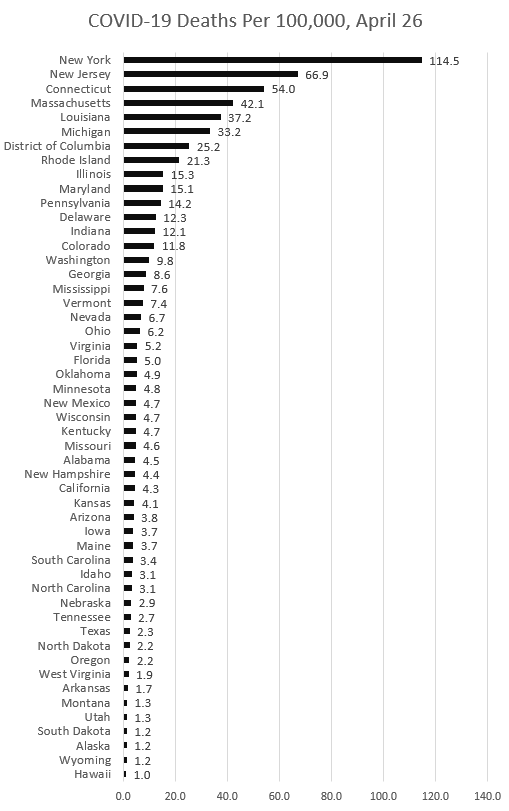
compared

Many states now report total deaths per 100,000 that are one-thirtieth the size of New York’s toll. Texas, for instance, reports total deaths numbering 2.3 per 100,000. The total in South Dakota, which has been much maligned for not imposing any statewide lockdowns, is 1.2 deaths per 100,000.

Were New York a foreign country, the US’s total death rate from COVID-19 would be cut by 36 percent:

ny

Whenever comparisons of this sort are made, however, many claim that all areas of the country will closely follow in New York’s footsteps unless ever more strict lockdown measures are taken immediately.

Indeed, we’ve been hearing for weeks that various states and regions are just “two weeks behind New York” in terms of COVID-19 infections and deaths.

For example, more than a month ago, the Philadelphia Inquirer on March 27 quoted one medical expert claiming: “We anticipate we are no more than two weeks behind New York City….Cases are doubling every two to three days. We had 46 confirmed cases last night. You do the math.”

Also in Pennsylvania, a medical expert from Lehigh Valley on March 22 insisted that “we are two weeks behind Manhattan in terms of spread and seriousness.”

On April 3, Maryland governor Larry Hogan proclaimed that his state was “about two weeks behind New York.”

Meanwhile, on April 1 WBHM reported that an Alabama health official had claimed: “Birmingham is about two weeks behind New York City.” Nearly a month later, Jefferson County, Alabama, where Birmingham sits, reports a death rate of 5 per 100,000, or 4 percent the size of New York’s death rate.

When we note outlandishly incorrect predictions such as these, a common response from lockdown boosters is “Well, social distancing prevented that!”

But did it?

So far, there’s no empirical evidence even showing that social distancing works. As T.J. Rodgers wrote in the Wall Street Journal this week, there is no correlation between government-forced “shutdowns” and a muted number of deaths from COVID-19:

No conclusions can be drawn about the states that sheltered quickly, because their death rates ran the full gamut, from 20 per million in Oregon to 360 in New York. This wide variation means that other variables—like population density or subway use—were more important. Our correlation coefficient for per-capita death rates vs. the population density was 44%. That suggests New York City might have benefited from its shutdown—but blindly copying New York’s policies in places with low Covid-19 death rates, such as my native Wisconsin, doesn’t make sense.

Similarly, political scientist Wilfred Reilly ran the numbers, taking into account factors such as population and population density. He found no evidence “that lockdowns are a more effective way of handling coronavirus than well-done social-distancing measures” and concluded:

The question the model set out to ask was whether lockdown states experience fewer Covid-19 cases and deaths than social-distancing states, adjusted for all of the above variables. The answer? No. The impact of state-response strategy on both my cases and deaths measures was utterly insignificant.

Moreover, the timing is less than convincing for the “lockdowns worked!” claims. For example, in the case of Maryland, the governor claimed, “we’re two weeks behind New York,” even after a stay-at-home order was in place. That is, his prediction assumed social distancing. Nearly a month later, Hogan was clearly very wrong.

In Alabama, on the other hand, a statewide stay-at-home order did not come down until thirteen days (i.e., nearly two weeks) after the New York lockdown. Had Alabama truly been “two weeks behind,” it would have already been nearly comparable to New York in its death rate by the time the order was implemented. Obviously, that didn’t happen.

The truth, of course, is that these statements by politicians and government “experts” were attempts to justify extreme government edicts that have created widespread unemployment, poverty, child abuse, and illness. They are irresponsible scare tactics employed for political purposes, and were never based on any actual evidence or knowledge about the situation. After all, these officials don’t even know the fatality rate of COVID-19.

Now, it’s entirely possible that as time progresses later waves of illness could increase total deaths, and there may be some “hot spots” where there are serious strains on the medical infrastructure. However, given the track record of the experts in predicting who is two weeks behind New York, it looks like it will only be a coincidence if these predictions of New York–like death rates prove correct at some point. Just as financial permabears often “predict ten of the last two recessions,” I have no doubt that many government-employed experts will predict twelve of the next three hot spots. Meanwhile, thanks to these experts’ recommendations, important medical procedures will be banned, people in need of medical care will be frightened into staying home, and food shortages may become a reality.

The real question we should be asking ourselves is why is New York is such a mess in terms of COVID-19? New York’s deaths aren’t just high by US standards. The state’s total deaths per 100,000 are higher than both Spain’s and Italy’s, both of which are considered to be among the most hard-hit countries on earth. New York has reported nearly as many COVID-19 deaths as Spain (23,500), even though Spain has a much larger population of 46 million. New York is also only about 5,000 deaths behind Italy, even though Italy has a population three times the size of New York State.

Indeed, these numbers are so high that one wonders if deaths are even being counted properly, or if there is something about New York’s medical infrastructure that is especially inferior. Perhaps New York is home to a particularly virulent strain of the disease. Perhaps the disease was in circulation for far longer than the experts insist is the case. The experts don’t know the answers to these questions.

Nor should we expect answers to these questions any time soon. But what we do know is that it strains the bounds of credibility to insist that South Dakota will soon be New York if it doesn’t impose similar lockdown measures. This doesn’t mean that no caution is warranted, or that high-risk populations should neglect social-distancing measures. But the claims that we’re all “two weeks behind New York” are neither accurate nor helpful.

Be seeing you

Avatar

Lived 30 miles from NYC for a year. Manhattan, with its persistent aroma of sewage, packs and stacks 70,000 people per square mile.

After a year near Cesspool City, I was so ready to return to a West Coast county with fresh air and two people per square mile.

Posted in Uncategorized | Tagged: , , , , , | Leave a Comment »

The US Is Doing The Same Thing In Greenland That It Accuses China Of Doing In Africa

Posted by M. C. on April 29, 2020

As such, strategic forecasts about the US’ interconnected military and economic interests in the New Cold War are much more realistic than those being written about China’s, making them comparatively less speculative and therefore by default more probable. With this understanding in mind, the US is interestingly doing exactly what it accuses China of, not just in form, but in substance as well.

http://oneworld.press/?module=articles&action=view&id=1432

Grants For Greenland

Greenland returned to the news late last week after an American official disclosed that his country will grant the world’s largest island $12.1 million in economic aid following reports last summer that the US was interested in purchasing this strategically positioned and energy-rich territory from Denmark. The author wrote about that at the time in his piece about how “Greenland Is Trump’s For The Taking If He Really Wants It“, which explained how the US could simply seize it from Denmark without suffering any serious consequences apart the negative press coverage that it would inevitably provoke across the world. Instead of undertaking that dramatic course of action, however, Trump is almost somewhat uncharacteristically opting for a much more subtle approach aimed at gradually swaying the island’s inhabitants and their local authorities to his country’s side through what can best be described as “economic diplomacy”.

“Economic Diplomacy”

Just like China is accused of doing in Africa, so too does the US seemingly intend to leverage economic aid for strategic ends, which in this case relate to its military and resource (energy and mineral) interests in Greenland. There’s nothing wrong with that either, and it can actually be argued that economic competition between states is less destabilizing than its other forms. China has been wildly successful practicing “economic diplomacy” across the Global South through its Belt & Road Initiative (BRI) of New Silk Road connectivity which relies on a combination of grants and loans in order to construct large-scale infrastructure projects that deliver jobs and development to its partners. The US has long been jealous of China’s achievements because it was unable to compete with its rival in this respect, hence why it launched an ongoing infowar campaign against those practices in order to fearmonger about Beijing’s alleged long-term intentions.

Infowar Insight

Ironically, the US is now emulating its rival’s strategically effective policy, and in the territory of one of its NATO allies, no less, showing that it was never really all that sincere about the speculative risks of this approach whenever China practiced it since they were evidently just waiting for the right opportunity to do the exact same thing. This “politically inconvenient” observation therefore debunks the fearmongering narratives that have been propagated about China’s international development policies, and in fact can actually be interpreted as a tacit endorsement of them. Nevertheless, it’s not expected that the US’ infowar will abate anytime soon since its underlying narrative feeds off of speculation about China’s intentions, the same as can be said about the US’ own vis-a-vis Greenland and wherever else it eventually practices this policy. Just like one can speculate about the US’ motives, so too can they speculate about China’s, and vice-versa.

The New Norm

What’s for certain, though, is that “economic diplomacy” is fast becoming the norm for Great Powers in the New Cold War after the world’s two most powerful ones are now actively practicing it. Other players have been doing something similar for a while now too, such as Russia in the former Soviet space and the EU in the formerly communist countries of the continent for example, but it was the US-provoked infowar controversy over China’s comparatively grander and more visibly successful practice of this form of diplomacy that brought it into the global mainstream. This narrative is politically appealing because it’s rife with speculation, which can rarely be proven or debunked given the nature of strategic forecasting, thus making it easier for dramatic claims to propagate through the global information space such as those about China supposedly wanting to convert deep water commercial ports into naval bases sometime in the future.

Alt-Media = Mainstream Media

Once again, the same can also be said of the US’ own intentions, and the Alt-Media Community routinely performs the same speculative analyses about America as the Mainstream Media does about China. This isn’t to condemn such practices in and of themselves since strategic forecasting is arguably an integral component of any quality analysis, though the resultant information product might be motivated by a desire to manipulate the target audience, as is frequently the case whenever the Mainstream Media reports on China’s alleged long-term intentions with BRI. Instead of considering the much more likely scenario that China simply wants to enhance its partners’ economic capabilities so that can all maximize their mutual benefits from one another, they’re more prone to imagining that the country’s military wants to expand across the world simply for the sake of it despite there being no evidence that it could even maintain such a speculative reach.

“Reverse Psychology”

The US, however, certainly has the military capability to do so and has proven as much over the decades, meaning that it’s much more likely that America will leverage its “economic diplomacy” with Greenland and other prospective partners to such ends instead of China doing the same in Africa or wherever else. As such, strategic forecasts about the US’ interconnected military and economic interests in the New Cold War are much more realistic than those being written about China’s, making them comparatively less speculative and therefore by default more probable. With this understanding in mind, the US is interestingly doing exactly what it accuses China of, not just in form, but in substance as well. This realization makes one wonder whether its infowar against BRI is “reverse psychology” intended to proactively shape the narrative so that the targeted global audience is less likely to accuse it of what it’s long planned to do, solely blaming China instead.


Be seeing you

Posted in Uncategorized | Tagged: , , , | Leave a Comment »

Governments don’t know what to do about Covid-19, but they’ll lock us down before admitting it — RT Op-ed

Posted by M. C. on April 29, 2020

Telling entire populations not to go anywhere is not a plan; it’s a lack of one.

https://www.rt.com/op-ed/487094-governments-covid19-lock-down/

Simon Rite

Most governments, institutions and experts don’t know the best way to deal with the coronavirus – that’s pretty obvious at this point – but they’ll never admit it publicly.

First, let’s start with some sympathy; global pandemics don’t happen every week, so it’s absolutely understandable that responding to one involves a level of improvisation for all involved.

Some nations are on lockdown, some aren’t. Some order populations to wear masks, some don’t. But honestly, they don’t even know how many people have Covid-19 or have died from it. Don’t fall for the show of confidence; it’s guesswork at this point.

The lockdowns are an obvious sign. Telling entire populations not to go anywhere is not a plan; it’s a lack of one. Think about all the times you’ve screamed “Don’t move.” Did you shout it because you had a strategy, or because you needed time to come up with one? Every time a lockdown is extended, it’s an admission that the authorities need a little more thinking time.


That’s why one characteristic of this crisis has been the array of methods used to say “We don’t know” without actually saying it. Governments deflect to the science, the science relies on the numbers, and journalists try to sound like they know what should be done while blaming the government. And on it goes.

Look, it’s the nature of politics that, whether they’re worried about re-election or avoiding uprisings and public lynchings, there is very little to be gained for governments in admitting ignorance. When trying to sell BS, it’s essential to do it with confidence.

Take the British government. The past masters of arse-covering phraseology have come up with “We’re being guided by the science.” This little motto was invaluable when the initial strategy of trying to achieve ‘herd immunity’ was slammed into reverse and replaced with legally enforced Netflix and chill.

The U-turn happened because there is no “the science” to be guided by; there are, in fact, all kinds of science you can choose from, depending which is the most politically expedient.

This is a brand new virus, and scientists are scratching their heads about what to do just like everyone else. While one group of boffins can concoct a model showing 97% of the population will be dead by Thursday lunchtime if a bat sneezes, another will produce a table of numbers suggesting only pensioners with advanced pneumonia and intimate knowledge of pangolins are at risk.

In the UK, Imperial College London came up with a deeply pessimistic prediction for the fatality rate among those who catch Covid-19, while another group at Oxford University predicted that large parts of the population may already have had it and not really noticed. In other words, neither group really knew.

The uncertainty of science can be a deeply flawed basis for guiding politicians who have to exude confidence. The scientific method involves a hypothesis (aka a wild guess) being drawn up before attempts are made to disprove it. That’s great, but once a government chooses a specific scientist’s model to guide policy, it becomes almost impossible to admit that it may not be 100% correct. And if the one they chose happens to be the most pessimistic, it becomes very hard to find a way out of lockdown after the population has been left petrified.

This is why I want to shout out to Sweden’s government, who have gone one step further in following the science and essentially put a scientist in charge. State epidemiologist Anders Tegnell is the driving force behind the Swedish refusal to close down society in the way much of the rest of the world has. He is the hero of this piece, because when he was asked how he knows it’s better not to shut restaurants and schools, he said that he didn’t know, but neither did anyone else. Honesty at last!

There is another phenomenon at play with Sweden though, as I get the impression that there’s a clamour for the strategy to fail miserably. Because at least then, other governments can say: “Sure, we didn’t know what we were doing, but at least we knew more than the Swedes!”

Be seeing you


Posted in Uncategorized | Tagged: , , | Leave a Comment »

Abolish family, eat bugs, inject female hormones: Covid-19 is Christmas for liberal control-freaks — RT Op-ed

Posted by M. C. on April 29, 2020

Armed with this fact, the New York Times decided on Monday that pumping men full of female sex hormones could be a cure.

Nuke the family

None of the last vestiges of this independence are off limits, including your family. “This pandemic has exposed the myth of the nuclear family,” the Guardian’s Zoe Williams wrote last month, before columnist Suzanne Moore exhorted“we need to disband the nuclear family for good.” The Washington Post’s Ian Corbin joined in the chorus when he prophesized“the coronavirus might break the nuclear family. That wouldn’t be a bad thing.” 

UN Agenda 21, New World Order…a crisis not going to waste.

https://www.rt.com/op-ed/487154-coronavirus-eat-the-bugs/

Graham Dockery

The coronavirus pandemic is already triggering a massive upheaval in the way we live. But amid the chaos, extreme liberal social engineers are plotting fresh attacks, hoping to upend even the things many of us take for granted.

In little over two months, governments across the Western world have granted themselves the power to place their entire citizenry under house arrest, all in the name of fighting the coronavirus. From the British constabulary breaking up illegal picnics, to American law enforcement seeking the power to detain indefinitely without trial, civil liberties have been assaulted in every corner of the free world.

Will the trade-off be justified? Only time will tell. However, just as governments have flexed their authoritarian muscles, the media and academia have already decided how they want the post-coronavirus world to look, and it’s a hellish dystopia.

Feminize if you want to live

Relatively little is known about the virus, and some of its characteristics – like the AIDS-like attack on the immune system it causes – have baffled scientists. However, the pathogen seems to pose a greater threat to men than women. Armed with this fact, the New York Times decided on Monday that pumping men full of female sex hormones could be a cure.

To be fair, scientists are only studying this as a potential avenue of treatment, yet the Times never once questioned the idea of chemically castrating half the population to stop the bug. Men, it says, will get used to “tenderness in the breast and hot flashes.”

While the idea of hormonally breaking the American male may excite a small subset of the Times’ cat-lady readership, the studies described are niche ones. But the mainstream media has some equally drastic plans to reshape your life, right down to the food you eat.

A bug, but also a feature

Tyson Foods, one of the US’ largest meat processing mega-corporations, announced on Sunday that “the food supply chain is breaking.” Sicknesses at its plants mean that “millions of pounds of meat will disappear from the supply chain,” Chairman John Tyson warned in a letter to the New York Times.

A simple fix for this looming crisis would be to relax USDA regulations that favor factory farmers, and allow small producers to sell to local retailers. At present, regulations essentially prohibit the slaughter of livestock in any facility that can’t afford to comply. Rep. Thomas Massie, a dissident Kentucky Republican, has already proposed a bill to resolve this, and to allow consumers to buy directly from farmers.

The media, however, have other ideas. “You should start eating bugs,” Popular Science wrote last week. “Here’s how,” it continued, before describing the “wonderful tanginess” of ants, and imploring readers to “conquer their fear” of scorpion stew. Hundreds of articles extolling the virtues of an insect-based diet are churned out every month. Insects are the “food of the future,” we hear. “Beef won’t be what’s for dinner much longer,” the bugmen proclaim. There are many such cases.

Of course, if we lusted after bugs the same way we crave red meat, they wouldn’t have to try so hard. These articles always mention Westerners’ “cultural hang ups” about eating creepy-crawlies as something to be overcome, something to be engineered out of us. In short, they’ll have to break us before we start guzzling down mealworms, and they relish the thought.


Why do these schoolmarm, micromanager types care so much? Apart from their having internalized the concept of equality so deeply that in the absence of happy meals for the world’s seven billion people they’d sooner see us all eating crickets, they care because a juicy, flame-grilled steak symbolizes the red-state, masculine independence they long to snuff out.

Nuke the family

None of the last vestiges of this independence are off limits, including your family. “This pandemic has exposed the myth of the nuclear family,” the Guardian’s Zoe Williams wrote last month, before columnist Suzanne Moore exhorted“we need to disband the nuclear family for good.” The Washington Post’s Ian Corbin joined in the chorus when he prophesized“the coronavirus might break the nuclear family. That wouldn’t be a bad thing.” 

The nuclear family – with all of its patriarchal overtones – has long been the mortal enemy of feminist bloggers and the wannabe lesbian commissars who write for the Guardian. However, the societal shake-up brought about by the coronavirus has given these people fresh impetus to push their ideas into the mainstream.

Single-family dwellings, the cornerstone of American life – are “racist,” liberal think tanks have declared. Homeschooling is evil and “authoritarian,” and perpetuates “white supremacy,” a Harvard professor claimed last week. Individualism itself will fade away, as “science reigns again,” a group of “thinkers” told Politico.

A serious crisis is “an opportunity to do things that you think you could not do before,” former Chicago Mayor Rahm Emanuel famously said in 2008. More than a decade later, and with the world softened up by a rampaging virus, the social engineers have taken his words to heart.

For these spiritual Grinches, the current crisis is Christmas. It’s an opportunity to purge the last spark of vitalism and danger from the human spirit, and further domesticate us. They want us to eat the bugs, to live in filthy communal harmony, and to remain forever in thrall to the state. They’ll tell you it’s for a greater good, but the end result is the same.

Those of us who value freedom need to push back. We can’t nod along when politicians talk of the “new normal.” We can’t assume things will return to how they were. We need to look our masters and their press apparatchiks in the eye and reply: “I will not live in the pod. I will not eat the bugs.”

Be seeing you


Posted in Uncategorized | Tagged: , , , , | Leave a Comment »

Freedom Advocate Explains How To Say NO If COVID-19 Vaccination Becomes Mandatory – Collective Evolution

Posted by M. C. on April 29, 2020

Jerry Day helps us here to bring the matter back into the real-world situation: the actual person who is physically administering the vaccine is rightly seen as the one who needs to assume responsibility for any consequences of their actions, rather than simply being a compliant cog of a faceless medical industry.

Let’s listen to the words of Dr. Allison Arwady, the head of Chicago’s Public Health Department, who tells us “We’ve already bought the syringes, we already know where it’s going to happen…”:

https://www.collective-evolution.com/2020/04/28/freedom-advocate-explains-how-to-say-no-if-covid-19-vaccination-becomes-mandatory/

By

In Brief

  • The Facts:There is a lot of talk in the mainstream that is trying to lead us towards an acceptance of the need for mandatory vaccination for COVID-19.
  • Reflect On:Can we use these foreboding signs as an opportunity to better understand and even exert, if necessary, our natural sovereignty and inalienable right to self-protection?

For those of us who believe vaccines to be unsafe and not properly tested, news coming out that plans are underway to mandate vaccination for COVID-19 is troubling.

Bill Gates, a man who everyone knows has the biggest financial stake in all this, has said that we won’t go back to normal until a vaccine has gotten out to the entire world.

Many world leaders are ready to follow Gates’ playbook, like Canadian Prime Minister Justin Trudeau who stated, “Normality as it was before will not come back full-on until we get a vaccine for this.”

And now some officials on the ground, those who are directing the logistics of a vaccine rollout, are telling us how imminent these plans may be. Let’s listen to the words of Dr. Allison Arwady, the head of Chicago’s Public Health Department, who tells us “We’ve already bought the syringes, we already know where it’s going to happen…”:

Defying Mandatory Vaccination Plans

In order to understand how you would be able to defy any initiatives that would attempt to force you or any of your family members to take any vaccines, or ingest or have anything injected into your body for that matter, it is important to grasp one of the most basic principles underlying life on Earth: each of us as individuals are free and sovereign beings. The only way someone can have any power over us is by our consent. Mostly without knowing it, we have consented to the entire political and legal structure that we believe has power over us. If you would like to dive more deeply into the broader discussion of this, please take a look at my series of articles on Natural Law here.

Keeping it within the context of mandatory vaccination, I would like to introduce you to Jerry Day, whose website FreedomTaker serves as a resource for those who would like to come to a better understanding of their sovereignty as individuals and learn about the practical defense of their innate liberty in our current society.

In the video below, Day gives a strong indictment against the Bill Gates/WHO vaccine agenda and its inherent risks to each of us personally, and explains what we need to do if we ever find ourselves being coerced by our government and medical establishment into taking a vaccine:

The first thing we must do is state our position clearly and on the record to those people who administer vaccines. We are certainly not protected if we haven’t even stated our position. You will see links to two free download documents at FreedomTaker.com. The first document is a requirement that all medical service and vaccine providers sign for you, to acknowledge the risks of vaccines, that they are causing that risk by offering vaccines, and that they accept full personal liability to pay for all damage they cause by administering a vaccine.

Of course, if vaccines were safe and effective, they would not hesitate to sign a liability agreement… [but] they know they are doing harm, so most likely, they will refuse to sign that document, and refuse to be responsible for the harm they cause. That refusal to sign is evidence that they know that vaccines have risk, and you therefore are fully within your rights to refuse the vaccine regardless of any legal mandates. That type of document is referred to as a ‘Conditional Acceptance.’ You agree to have a vaccine if they agree to pay for all damage you suffer. They will refuse to sign it. And that gives you the right to refuse their vaccine, because they failed to meet your reasonable requirements of safety.

Jerry Day helps us here to bring the matter back into the real-world situation: the actual person who is physically administering the vaccine is rightly seen as the one who needs to assume responsibility for any consequences of their actions, rather than simply being a compliant cog of a faceless medical industry. It is not hard to see that, once we all start to make those who are simply ‘doing their job’ carrying out the orders from above personally responsible for their actions, by and large they will not follow through and the whole control mechanism and ability to mandate anything falls apart.

The Takeaway

Perhaps the day will not come when you will be faced with having to refuse mandated vaccines for yourself or your family. However, coming to understand a way in which you can assert your inherent right of self-protection can be very empowering. Not only does it help give you confidence that you can assert your will in such a circumstance, it can broaden your understanding of your inalienable sovereignty. I believe if each of us is able to strengthen our sense of personal sovereignty and see that we are all co-creators of our collective experience, we will be much closer to bringing the world of our dreams into reality.

Be seeing you


Posted in Uncategorized | Tagged: , , , | Leave a Comment »

Will It Take Food Shortages to End Support for the Shutdown? | Mises Institute

Posted by M. C. on April 29, 2020

BBC images from India show the heartbreaking human toll of the unprecedented decision simply to stop human work activity due to an infectious disease. Americans should take note, and soon. 

https://mises.org/power-market/will-it-take-food-shortages-end-support-shutdown?utm_source=Mises+Institute+Subscriptions&utm_campaign=74533e8c5c-EMAIL_CAMPAIGN_9_21_2018_9_59_COPY_01&utm_medium=email&utm_term=0_8b52b2e1c0-74533e8c5c-228343965

Jeff Deist

Americans are uniquely privileged, to the point of simply imagining they can stay home for months and months without suffering severe economic hardship as a result. Our unique privilege is delusion, the mentality that America is rich and will remain rich without particular effort on our part. Abundance simply materializes around us, regardless of incentives, and the job of politicians is to rearrange this abundance more equitably.

Polls such as this one showing widespread American support for quarantines and business shutdowns are evidence of this American privilege. Eighty percent of respondents think shutdowns by various state governors are justified as a response to the COVID-19 virus, and one-third support extending closure for another six months!

This reflexive and unthinking complicity from the American public is partially explained by media hype, of course, over an illness which at this writing has killed fewer than sixty thousand Americans. Fear and hysteria always sell. The press clearly wants the coronavirus to be a major event, one that unseats Trump in the fall. (For its part, the administration is doing a terrible job, starting with the awful Dr. Fauci, whom the president should have sacked months ago.) And clearly the various governors’ responses are wildly out of proportion to the actual public health threat, even if initially well intentioned due to sheer uncertainty of the virus’s lethality.

But something far more fundamental is at work here. Americans simply fail to understand, or even much think about, the fragility of distribution chains and the goods and services we rely on. Earlier this week the chairman of conglomerate Tyson Foods warned that disruptions at processing plants could create very serious shortages of beef, chicken, and pork in US grocery stores, and decimate livestock farmers. And of course this was bound to happen as the dominos fell: the shutdowns would not only impact “nonessential” goods, but everything.

Who didn’t see this? Will it take outright food shortages to make Americans change their minds about whether the shutdown is “worth it”?

We only need look at India for an example of what business and work shutdowns create in a country without  as much existing wealth to consume, where far more people live close to the bone. The national work moratorium ordered by Prime Minister Modi has sent millions of migrant workers and unskilled laborers into very real danger of starvation. Already living hand to mouth and penniless, their jobs essentially banned, many have taken to walking hundreds of miles in 100-degree heat to their home villages—in hopes of being fed by their families. In a country with widespread poverty and depressingly little per capita capital investment, the shutdown is a death sentence for many. Without much capital accumulation, Indians have little savings and few investments to consume when income grinds to a halt. And India is hardly the only poor country at risk and needing food relief; one NGO official warns of “biblical” famines across thirty underdeveloped nations if supply chains continue to be disrupted and charitable economic aid dries up:

“We are not talking about people going to bed hungry,” he [David Beasley of the World Food Programme] told the Guardian in an interview. “We are talking about extreme conditions, emergency status—people literally marching to the brink of starvation. If we don’t get food to people, people will die.”

This is what poverty really means: having little or no cushion of wealth for an emergency. Poverty is best defined as a lack of savings and resulting capital, leaving people totally dependent on new and consistent income to survive. It is a condition only capital accumulation can improve. And yet “capitalism” is blamed for the unfolding tragedy before us:

tweet


Will stories like this finally make Americans understand the severity of the situation? BBC images from India show the heartbreaking human toll of the unprecedented decision simply to stop human work activity due to an infectious disease. Americans should take note, and soon.


Be seeing you


Posted in Uncategorized | Tagged: , , | Leave a Comment »

Ending the Lockdowns Isn’t about Saving Money. It’s about Saving Lives. | Mises Wire

Posted by M. C. on April 29, 2020

Translated to the COVID crisis, the relevant tradeoff is not lives lost versus less money (more accurately, resources) produced, as it is often portrayed. It is also a tradeoff between lives lost due to COVID and lives that will be lost from the policies adopted to reduce COVID deaths. The only real difference from the airbag example is that the COVID deaths come now, to specific people, making them more easily recognized, while the lives lost due to the costs of the policies adopted will come later, to unknown “statistical” people, and current policymakers are unlikely to be blamed.

https://mises.org/wire/ending-lockdowns-isnt-about-saving-money-its-about-saving-lives?utm_source=Mises+Institute+Subscriptions&utm_campaign=a64cf0e90e-EMAIL_CAMPAIGN_9_21_2018_9_59_COPY_01&utm_medium=email&utm_term=0_8b52b2e1c0-a64cf0e90e-228343965

The relationship between ends and means has long been debated. For instance, the legacy of “the end justifies the means” traces back to Sophocles’s Electra four centuries before Christ, Ovid’s Heroides, and Machiavelli’s The Prince. And more recently, Leonard Read pointed out that if the ends are just hopes that will not, in fact, be achieved, they cannot justify means that infringe on others’ rights.

Currently, the draconian and often arbitrary policies that have been imposed in response to COVID-19, combined with a result far less deadly than was originally forecast, have raised a different issue about ends and means.

More and more people have begun protesting that the policies are too costly, perhaps most commonly expressed as “the cure can’t be worse than the disease.” That, in turn, has led to current policy defenders’ condemnations, such as New York governor Andrew Cuomo’s assertion that “we’re not going to put a dollar figure on human life,” the New York Times’s characterization of the issue as “a moral trade-off between saving lives and sustaining economic livability,” or even Martin Gak’s more extreme characterization that objectors believe “a few should die so the many can live.” I even heard a sermon arguing that even one COVID-19 death justifies the continued government shutdown of the economy.

Unfortunately, such lives versus money (or the economy) comparisons make the mistake of comparing a particular end (reducing COVID-19 deaths) not to another end, but to a means (additional resources) that can achieve many alternative ends. And those alternatives include saving other lives.

Since the means (money or produced resources) are not anyone’s ultimate end, framing the issue as lives versus money makes it appear that we should stop at nothing to save a COVID-19 life, because that end is more valuable than something that is a “mere means.” And not far behind is the implication that those on the “other side” are just mean-spirited and selfish. But those are mischaracterizations.

The most recent edition of James Gwartney’s economics text addresses this issue well in its very first chapter, devoted to essential principles. “Using resources to do one thing leaves fewer resources to do another.” Using the example of mandatory airbags assumed to save four hundred lives annually a year at a cost of $50 billion dollars, Gwartney points out that “Economic thinking, however, forces us to ask ourselves if the $50 billion spent on air bags could have been used in a better way—perhaps, say, for cancer research that could have saved more than 400 lives per year….In this case, the appropriate analysis is not simply the lives saved with air bags versus dollars spent on them, but also the number of lives that could have been saved (or other things that could have been accomplished) if the $50 billion had been used differently.”

Translated to the COVID crisis, the relevant tradeoff is not lives lost versus less money (more accurately, resources) produced, as it is often portrayed. It is also a tradeoff between lives lost due to COVID and lives that will be lost from the policies adopted to reduce COVID deaths. The only real difference from the airbag example is that the COVID deaths come now, to specific people, making them more easily recognized, while the lives lost due to the costs of the policies adopted will come later, to unknown “statistical” people, and current policymakers are unlikely to be blamed.

Consequently, saving additional COVID victims today with a particular policy may result in even more avoidable deaths in the future. If that is the case, such a policy will result in more people dying, and “we’re not going to put a dollar figure on human life” has nothing to do with it.

Is such a consequence actually conceivable? Yes. For just one illustration, a 2016 analysis of the 2008 economic meltdown in The Lancet estimated that it “was associated with over 260,000 excess cancer deaths in the OECD alone, between 2008–2010.” Given the magnitude of the likely COVID death toll, that alone could mean that shutting down the economy kills more people than it saves. And added cancer deaths are not the only adverse effect of the economic shutdown and other COVID policies (as with delayed diagnoses of other diseases and surgeries not done because such cases have been crowded out of hospitals).

Further, a United Nations report this month summarized the potential effects of COVID policies on children: “Children are not the face of this pandemic. But they risk being among its biggest victims….the crisis is having a profound effect on their wellbeing. All children, of all ages, and in all countries, are being affected, in particular by the socio-economic impacts and, in some cases, by mitigation measures that may inadvertently do more harm than good. This is a universal crisis and, for some children, the impact will be lifelong.”

The Issues and Insights editorial board goes even further. They not only cite the UN study, in which “Hundreds of thousands of additional child deaths could occur in 2020,” but they remind us that “this is likely a low-ball estimate because it counts only the direct impact of a worldwide recession, not the impact shutdowns are having on access to health care, vaccines, prenatal care, food and nutrition, or mental health care.”

One of the most basic of economic principles is that of opportunity costs. Every time resources are directed to one purpose, those resources are no longer available for other purposes, which might well be more valuable. That mean we must always weigh the value of the ends accomplished by a policy against alternative ends that the resources involved could have accomplished. But when life-saving efforts are portrayed as lives versus money or production, as with current COVID policies, they are not proof that current policy choices are justified, but a rhetorical cheat that proves that questions which are essential to good policy formation are not being considered.

Be seeing you

Posted in Uncategorized | Tagged: , , | Leave a Comment »

Trump Wants All US Troops Out of Afghanistan on Coronavirus Fears – News From Antiwar.com

Posted by M. C. on April 28, 2020

but whether Trump’s impulse to leave will actually pan out this time depends heavily on how he reacts to the ever-present resistance of officials.

https://news.antiwar.com/2020/04/27/trump-wants-all-us-troops-out-of-afghanistan-on-coronavirus-fears/

With a peace deal in place in Afghanistan, at some point US troops would be expected to leave the country. Amid concerns of a coronavirus buildup, President Trump is thinking it is best to get those troops out of the country sooner, rather than later.

Officials say Trump complains about the troops not being out of Afghanistan yet almost daily, but that his advisers continue to stall and try to talk him out of it, arguing that if the virus is a reason to leave, US troops should also withdraw from Italy.

That argument seems a continuation of the strategy for getting out of Trump’s calls for drawdowns, which is to confuse the question and hope that Trump gets fixated on something else before they have to actually do anything.

Afghan officials have been emphasizing the risk of a pandemic, and how widespread it could be. While the US already has plenty of opportunity to leave Afghanistan now, this is just another opportunity on top of that, but whether Trump’s impulse to leave will actually pan out this time depends heavily on how he reacts to the ever-present resistance of officials.

Be seeing you


Posted in Uncategorized | Tagged: , , | Leave a Comment »

All Businesses Matter – LewRockwell

Posted by M. C. on April 28, 2020

That is, once it is accepted that the government can decide which businesses are essential, then no reasonable or logical argument can be made against the government deciding

  • which medical procedures are essential
  • which sporting events are essential
  • which recreational activities are essential
  • which foods are essential
  • which television programs are essential
  • which vitamins are essential  A
  • which medicines are essential…

And of course, when the government deems something to be essential, it also means that it intends to suppress what it deems to not be essential.

https://www.lewrockwell.com/2020/04/laurence-m-vance/all-businesses-matter/

By

“Governments have no right or authority to tell us what business or other activity is ‘essential.’ Only in totalitarian states does the government claim this authority.” ~ Ron Paul

Just as all lives matter, so all businesses matter.

Most Americans have been confined to their homes for the past month except when they need to get something from an “essential” business. And who in their omniscience has decided which businesses are essential? Why, the government, of course.

And what businesses does the government consider to be essential? Well, it depends on the state. But this doesn’t exonerate the federal government in the least. It is the federal Centers for Disease Control and Prevention (CDC) and the federal National Institute of Allergy and Infectious Diseases (NIAID) that is responsible for inciting the coronavirus insanity. And it is the federal Cybersecurity and Infrastructure Security Agency (CISA) of the Department of Homeland Security that last month issued its “Guidance on the Essential Critical Infrastructure Workforce: Ensuring Community and National Resilience In COVID-19 Response” that many states are following.

In my state of Florida, Governor Ron DeSantis, a Republican, issued an executive order (20-51) on March 1 “directing the Florida Department of Health to issue a Public Health Emergency” because of COVID-19 and then issued another executive order (20-52) On March 9 “declaring a state of emergency for the entire state of Florida as a result of COVID-19.” On March 17, DeSantis issued an executive order (20-68) restricting the operation of bars and restaurants and practically closing the beaches. On March 20, DeSantis issued an executive order (20-71) shutting down bars, restaurants, and gyms. Also on March 20, DeSantis issued an executive order (20-72) banning all “medically unnecessary, non-urgent or non-emergency procedure or surgery” and directing all dentists to cease performing “elective services.” On March 27, DeSantis issued an executive order (20-83) urging the elderly and those with serious underlying medical conditions to stay at home. Included also was “a public health advisory against all social or recreational gatherings of 10 or more people.” Also on March 27, DeSantis issued an executive order (20-87) suspending all “vacation rental operations.” On March DeSantis issued an executive order (20-89) restricting in four Florida counties “public access to business and facilities deemed non-essential.”

Finally, on April 1, DeSantis issued an executive order (20-91) directing “all persons in Florida” to “limit their movements and personal interactions outside of their home to only those necessary to obtain or provide essential services or conduct essential activities.” “Essential services” means and encompasses “the list detailed by the U.S. Department of Homeland Security in its Guidance on the Essential Critical Infrastructure Workforce” and “those businesses and activities designed by Executive Order 20-89 and its attachment.” “Essential activities” include “attending religious services conducted in churches, synagogues and houses of worship” and “participating in recreational activities (consistent with social  distancing guidelines) such as walking, biking, hiking, fishing, hunting, running, or swimming.” 

These executive orders are nothing but creeping fascism. Their destruction of civil liberties has resulted the insanity of churches closing when they don’t have to, “unessential” bookstores closing while “essential” liquor stores remain open, and outdoor seating areas at convenience stores wrapped in plastic.

Things are just as insane in other states. In Idaho, a woman was threatened with jail time for holding a “nonessential” yard sale. In Tennessee, churches are closed but abortion clinics are open. In all states (except Massachusetts) where recreational marijuana is legal, marijuana merchants have been deemed “essential.”

In a market economy, every business is essential because every type of industry relies on, stimulates, and necessitates the other industries. And of course, every business is essential to the owner of the business, the family of the owner, the employees who work at the business, and the customers who patronize the business.

Once it is accepted that the government can decide which businesses are essential, then no reasonable or logical argument can be made against the government deciding which products and services offered by businesses are essential.

That is, once it is accepted that the government can decide which businesses are essential, then no reasonable or logical argument can be made against the government deciding

  • which medical procedures are essential
  • which sporting events are essential
  • which recreational activities are essential
  • which foods are essential
  • which television programs are essential
  • which vitamins are essential  A
  • which medicines are essential
  • which clothing is essential
  • which car repairs are essential
  • which amusements are essential
  • which religious activities are essential
  • which movies are essential
  • which books are essential

And of course, when the government deems something to be essential, it also means that it intends to suppress what it deems to not be essential.

Governors and mayors forcing businesses to close—with the prompting and full support of the federal government—is a big leap toward a totalitarian police state. And there is a reason I did not say “a first step.” The United States has been heading this way for years, as John Whitehead has so chronicled in detail. The coronavirus insanity may just be the final straw.

Just as all lives matter, so all businesses matter.

Be seeing you


Posted in Uncategorized | Tagged: , , , , | Leave a Comment »

Dissident British ex-diplomat Craig Murray indicted for blog posts in Kafkaesque case | The Grayzone

Posted by M. C. on April 28, 2020

The new British justice.

Murray said he faces the possibility of “no jury, no ‘beyond reasonable doubt’ test, no public interest defence allowed, no freedom of speech defence allowed, and up to two years in jail and an ‘unlimited’ fine.”

Craig Murray served as Britain’s ambassador to Uzbekistan from 2002 to 2004. The UK Foreign Office fired him for his exposure of British and US involvement in egregious human rights violations in the country. Murray had blown the whistle on torture, warning that the CIA was using highly dubious intelligence obtained from tortured detainees.

https://thegrayzone.com/2020/04/27/craig-murray-indicted-blog-posts/

By Ben Norton

The renowned British peace activist and former diplomat Craig Murray has been charged with contempt of court for writing blog posts.

The suspicious indictment represents a heavily politicized, Kafkaesque case in which Murray has virtually none of his rights guaranteed. It also appears to be a part of the British government’s aggressive crackdown on the Scottish independence movement.

In comments to The Grayzone, Murray described the case against him as a thoroughly undemocratic attack on free speech, and warned it may be punishment for his dissident journalism and activism exposing the UK’s crimes and lies.

Murray said he faces the possibility of “no jury, no ‘beyond reasonable doubt’ test, no public interest defence allowed, no freedom of speech defence allowed, and up to two years in jail and an ‘unlimited’ fine.”

Craig Murray served as Britain’s ambassador to Uzbekistan from 2002 to 2004. The UK Foreign Office fired him for his exposure of British and US involvement in egregious human rights violations in the country. Murray had blown the whistle on torture, warning that the CIA was using highly dubious intelligence obtained from tortured detainees.

Since leaving the UK diplomatic service, Murray has become a prominent human rights activist who maintains a popular blog at his personal website.

On his blog and through social media, Murray has established himself as an outspoken supporter of WikiLeaks and its publisher Julian Assange, who is being tormented in Britain’s high-security Belmarsh prison while awaiting potential extradition to the United States.

In recent years, Murray has brought to light an array of US, British, and Israeli government crimes. He poked holes in Britain’s accusations that Russia poisoned double agent Sergei Skripal under official government orders. And in recent months, he has publicly excoriated the UK’s hypocrisy in a scandal involving Anne Sacoolas, a CIA operative who killed the British teenager Harry Dunn after she collided into him while driving on the wrong side of the road outside of a US Air Force spying station.

A resident of Scotland’s capital Edinburgh, Murray has been especially outspoken in his support for the country’s independence from the United Kingdom. His pro-independence agitation appears to be a key factor in his persecution at the hands of the government.

craig murray scottish independence
Craig Murray speaking at a pro-Scottish independence event in 2013

With Brexit looming and a grassroots movement still building for Scottish independence, Britain has ramped up its crackdown on dissent.

One of the most recognizable faces of the independence movement, Alex Salmond, has become a major target of the backlash. Salmond, who served as leader of the Scottish National Party (SNP) for more than two decades, was forced to resign from the party in 2018 after facing allegations of sexual assault by several women.

Craig Murray published a series of blog posts alleging questionable conflicts of interest and blatant irregularities in Salmond’s case, suggesting a politicization of the allegations. He also revealed some of the accusers’ suspicious ties to the police and to Salmond’s political rivals.

In the end, a majority-women jury found dropped all 14 charges against Salmond. The government in turn admitted to violating its own laws in the case, and wound up paying out hundreds of thousands of pounds worth of Salmond’s legal fees.

Since Salmond was pushed out, the SNP has lurched to the right. His replacement as the SNP’s new leader, Nicola Sturgeon, is a centrist who is less committed to Scottish independence and much more politically dubious. Sturgeon has expressed admiration for Henry Kissinger, and has praised Hillary Clinton, blaming the US presidential candidate’s defeat not on her neoliberal politics and lackluster campaign but rather on misogyny.

Murray attended two days of Salmond’s trial and published lengthy blog posts on the proceedings. The court refused to grant him media credentials, and subsequently banned him from the trial in a highly suspect move that was initiated by the prosecution, not the judge, as Murray later discovered.

On April 24, Murray published an article revealing that police were intimidating him and other journalists and activists who spoke out about the Alex Salmond case.

Murray said he knows four pro-independence activists who were called or visited by police. Some were threatened with charges of contempt of court for their social media posts on Salmond. Police subsequently raided the house of a Scottish journalist and confiscated his computers and phones.

Murray was the next victim, charged with contempt of court over his blog posts on the Salmond case — even after all the charges against Salmond were dropped.

“This is a blatant, one-sided political persecution. That much is entirely plain,” Murray wrote. He decided to make the indictment against public (PDF link here).

“This indictment is the basis on which they are attempting to put me in prison – in fact the indictment specifies up to two years in jail and an unlimited fine as the punishment sought from the court,” Murray stated.

“The state believes it has finally discovered a way to put me in prison without the inconvenient hurdle of a jury of my peers,” he continued. “Contempt of Court is just decided by a judge. It is extraordinary that you can go to jail for a substantial two years with no jury protection and no test of ‘beyond reasonable doubt’; and on the whim of a judge defending what he may view as the dignity of his own office. This really is the epitome of bad law. To use it against freedom of speech is disgusting.”

Murray also lamented that the “prosecution is taking a terrible toll on [his] family.”

Be seeing you


Posted in Uncategorized | Leave a Comment »