


Archive for the ‘Uncategorized’ Category
Watch “Brain Awareness Week Day 7 The Cranial Nerves” on YouTube
Posted by M. C. on March 23, 2020
Posted in Uncategorized | Tagged: brain awareness week, cranial nerves | Leave a Comment »
Trump is right about who’s to blame for bad relations with Russia
Posted by M. C. on March 23, 2020
The Chinese and Russians (and most of the rest of the world) simply cannot process the notion that the United States is run by clueless amateurs who stumble from one half-baked initiative to another, with no overall plan (except, of course, to persuade the Persians to become America’s friends rather than enemies).
People who were with Putin that night report his anger and disbelief at the unfolding ‘Orange’ revolution in Ukraine. ‘They lied to me,’ Putin said bitterly of the United States. ‘I’ll never trust them again.’ The Russians still can’t fathom why the West threw over a potential strategic alliance for Ukraine. They underestimate the stupidity of the West.”
http://www.atimes.com/article/trump-is-right-about-whos-to-blame-for-bad-relations-with-russia/
July 17, 2018
US President Donald Trump offended the entire political spectrum with a tweet this morning blaming Washington for poor relations with Russia. “Our relationship with Russia has NEVER been worse thanks to many years of US foolishness and stupidity,” the president said, and he is entirely correct…
Full disclosure: I was a card-carrying member of the neoconservative cabal that planned to bring Western-style democracy and free markets to Russia after the fall of Communism. As chief economist for the supply-side consulting firm Polyconomics, I got an appointment as an adviser to Boris Yeltsin’s finance ministry and made several trips to Moscow.
Of course, the finance ministry really was a family office for Yeltsin’s oligarch friends, who were too busy stealing Russia’s economy to listen to advice. The experience cured me of the neoconservative delusion that democracy and free markets are the natural order of things.
Unfortunately, the delusion that the United States would remake Russia in its own image persisted through the Bush and Obama administrations. I have no reason to doubt the allegations that a dozen Russian intelligence officers meddled in the US elections of 2016, but this was equivalent of a fraternity prank compared to America’s longstanding efforts to intervene in Russian politics…
The Maidan coup was the second American attempt to install a Ukrainian government hostile to Moscow; the first occurred in 2004, when Condoleezza Rice was Secretary of State rather than Hillary Clinton. As I wrote in Asia Times a decade ago, “On the night of November 22, 2004, then-Russian president – now premier – Vladimir Putin watched the television news in his dacha near Moscow. People who were with Putin that night report his anger and disbelief at the unfolding ‘Orange’ revolution in Ukraine. ‘They lied to me,’ Putin said bitterly of the United States. ‘I’ll never trust them again.’ The Russians still can’t fathom why the West threw over a potential strategic alliance for Ukraine. They underestimate the stupidity of the West.”
American efforts to promote a democratic opposition to Putin have failed miserably, and as John Lloyd wrote recently at Reuters, the Russian president remains genuinely popular. This remains a source of perpetual frustration for the neoconservatives, who cannot fathom why dictatorships still exist…
Thanks to President Trump, Russia (as well as China) now understands that America’s intervention in Iraq was not a deliberate effort to destabilize the region, and that its support for Sunni jihadists in Syria was not a deliberate effort to create an Islamist monster with which to destabilize Russia. Under the headline “They’ll never believe we’re that stupid,” I wrote in May 2015:
“Beijing and Moscow made up their minds some time ago that the United States had deliberately unleashed chaos on the Levant as part of a malevolent plan of some kind. The Chinese and Russians (and most of the rest of the world) simply cannot process the notion that the United States is run by clueless amateurs who stumble from one half-baked initiative to another, with no overall plan (except, of course, to persuade the Persians to become America’s friends rather than enemies).
Incompetence has consequences. One of the consequences will be that our competitors and adversaries will take us for knaves instead of fools, or even worse, will recognize that we are fools after all.”
Be seeing you

Posted in Uncategorized | Tagged: Maidan coup, ondoleezza Rice, Russia, Vladimir Putin | Leave a Comment »
Russia Strikes Back Where It Hurts: American Oil | The American Conservative
Posted by M. C. on March 23, 2020
https://www.theamericanconservative.com/articles/russia-strikes-back-where-it-hurts-american-oil/
Russia Strikes Back Where It Hurts: American Oil
Amid mounting sanctions aimed at crippling Moscow’s economy, Putin seems resolved to do the same to Trump’s re-election.

Russia and Saudi Arabia are engaged in an oil price war that has sent shockwaves around the world, causing the price of oil to tumble and threatening the financial stability, and even viability, of major international oil companies.
On the surface, this conflict appears to be a fight between two of the world’s largest producers of oil over market share. This may, in fact, be the motive driving Saudi Arabia, which reacted to Russia’s refusal to reduce its level of oil production by slashing the price it charged per barrel of oil and threatening to increase its oil production, thereby flooding the global market with cheap oil in an effort to attract customers away from competitors.
Russia’s motives appear to be far different—its target isn’t Saudi Arabia, but rather American shale oil. After absorbing American sanctions that targeted the Russian energy sector, and working with global partners (including Saudi Arabia) to keep oil prices stable by reducing oil production even as the United States increased the amount of shale oil it sold on the world market, Russia had had enough. The advent of the Coronavirus global pandemic had significantly reduced the demand for oil around the world, stressing the American shale producers. Russia had been preparing for the eventuality of oil-based economic warfare with the United States. With U.S. shale producers knocked back on their heels, Russia viewed the time as being ripe to strike back. Russia’s goal is simple: to make American shale oil producers “share the pain”.
The United States has been slapping sanctions on Russia for more than six years, ever since Russia took control (and later annexed) the Crimean Peninsula and threw its weight behind Russian separatists in eastern Ukraine. The first sanctions were issued on March 6, 2014, through Executive Order 13660, targeting “persons who have asserted governmental authority in the Crimean region without the authorization of the Government of Ukraine that undermine democratic processes and institutions in Ukraine; threaten its peace, security, stability, sovereignty, and territorial integrity; and contribute to the misappropriation of its assets.”
The most recent round of sanctions was announced by Secretary of State Mike Pompeo on February 18, 2020, by sanctioning Rosneft Trading S.A., a Swiss-incorporated, Russian-owned oil brokerage firm, for operating in Venezuela’s oil sector. The U.S. also recently targeted the Russian Nord Stream 2 and Turk Stream gas pipeline projects.
Russia had been signaling its displeasure over U.S. sanctions from the very beginning. In July 2014, Russian President Vladimir Putin warned that U.S. sanctions were “driving into a corner” relations between the two countries, threatening the “the long-term national interests of the U.S. government and people.” Russia opted to ride out U.S. sanctions, in hopes that there might be a change of administrations following the 2016 U.S. Presidential elections. Russian President Vladimir Putin made it clear that he hoped the U.S. might elect someone whose policies would be more friendly toward Russia, and that once the field of candidates narrowed down to a choice between Donald Trump and Hillary Clinton, Putin favored Trump.
“Yes, I did,” Putin remarked after the election, during a joint press conference with President Trump following a summit in Helsinki in July 2018. “Yes, I did. Because he talked about bringing the U.S.-Russia relationship back to normal.”
Putin’s comments only reinforced the opinions of those who embraced allegations of Russian interference in the 2016 U.S. Presidential election as fact and concluded that Putin had some sort of hold over Trump. Trump’s continuous praise of Putin’s leadership style only reinforced these concerns.
Even before he was inaugurated, Trump singled out Putin’s refusal to respond in kind to President Obama’s levying of sanctions based upon the assessment of the U.S. intelligence community that Russia had interfered in the election. “Great move on delay (by V. Putin) – I always knew he was very smart!” Trump Tweeted. Trump viewed the Obama sanctions as an effort to sabotage any chance of a Trump administration repairing relations with Russia, and interpreted Putin’s refusal to engage, despite being pressured to do so by the Russian Parliament and Foreign Ministry, as a recognition of the same.
This sense of providing political space in the face of domestic pressure worked both ways. In January 2018, Putin tried to shield his relationship with President Trump by calling the release of a list containing some 200 names of persons close to the Russian government by the U.S. Treasury Department as a hostile and “stupid” move.
“Ordinary Russian citizens, employees and entire industries are behind each of those people and companies,” Putin remarked. “So all 146 million people have essentially been put on this list. What is the point of this? I don’t understand.”
From the Russian perspective, the list highlighted the reality that the U.S. viewed the entire Russian government as an enemy and is a byproduct of the “political paranoia” on the part of U.S. lawmakers. The consequences of this, senior Russian officials warned, “will be toxic and undermine prospects for cooperation for years ahead.”
While President Trump entered office fully intending to “get along with Russia,” including the possibility of relaxing the Obama-era sanctions, the reality of U.S.-Russian relations, especially as viewed from Congress, has been the strengthening of the Obama sanctions regime. These sanctions, strengthened over time by new measures signed off by Trump, have had a negative impact on the Russian economy, slowing growth and driving away foreign investment.
While Putin continued to show constraint in the face of these mounting sanctions, the recent targeting of Russia’s energy sector represented a bridge too far. When Saudi pressure to cut oil production rates coincided with a global reduction in the demand for oil brought on by the Coronavirus crisis, Russia struck.
The timing of the Russian action is curious, especially given the amount of speculation that there was some sort of personal relationship between Trump and Putin that the Russian leader sought to preserve and carry over into a potential second term. But Putin had, for some time now, been signaling that his patience with Trump had run its course. When speaking to the press in June 2019 about the state of U.S.-Russian relations, Putin noted that “They (our relations) are going downhill, they are getting worse and worse,” adding that “The current [i.e., Trump] administration has approved, in my opinion, several dozen decisions on sanctions against Russia in recent years.”
By launching an oil price war on the eve of the American Presidential campaign season, Putin has sent as strong a signal as possible that he no longer views Trump as an asset, if in fact he ever did. Putin had hoped Trump could usher in positive change in the trajectory of relations between the two nations; this clearly had not happened. Instead, in the words of close Putin ally Igor Sechin, the chief executive of Russian oil giant Rosneft, the U.S. was using its considerable energy resources as a political weapon, ushering in an era of “power colonialism” that sought to expand U.S. oil production and market share at the expense of other nations.
From Russia’s perspective, the growth in U.S. oil production—which doubled in output from 2011 until 2019—and the emergence of the U.S. as a net exporter of oil, was directly linked to the suppression of oil export capability in nations such as Venezuela and Iran through the imposition of sanctions. While this could be tolerated when the target was a third party, once the U.S. set its sanctioning practices on Russian energy, the die was cast.
If the goal of the Russian-driven price war is to make U.S. shale companies “share the pain,” they have already succeeded. A similar price war, initiated by Saudi Arabia in 2014 for the express purpose of suppressing U.S. shale oil production, failed, but only because investors were willing to prop up the stricken shale producers with massive loans and infusion of capital. For shale oil producers, who use an expensive methodology of extraction known as “fracking,” to be economically viable, the breakeven price of oil per barrel needs to be between $40 and $60 dollars. This was the price range the Saudi’s were hoping to sustain when they proposed the cuts in oil production that Russia rejected.
The U.S. shale oil producers, saddled by massive debt and high operational expenses, will suffer greatly in any sustained oil price war. Already, with the price of oil down to below $35 per barrel, there is talk of bankruptcy and massive job layoffs—none of which bode well for Trump in the coming election.
It’s clear that Russia has no intention of backing off anytime soon. According to the Russian Finance Ministry, said on Russia could weather oil prices of $25-30 per barrel for between six and ten years. One thing is for certain—U.S. shale oil companies cannot.
In a sign that the Trump administration might be waking up to the reality of the predicament it faces, Treasury Secretary Steve Mnuchin quietly met with Russia’s Ambassador to the U.S., Anatoly Antonov. According to a read out from the Russian Ministry of Foreign Affairs, the two discussed economic sanctions, the Venezuelan economy, and the potential for “trade and investment.” Mnuchin, the Russians noted, emphasized the “importance of orderly energy markets.”
Russia is unlikely to fold anytime soon. As Admiral Josh Painter, a character in Tom Clancy’s “The Hunt for Red October,” famously said, “Russians don’t take a dump without a plan.”
Russia didn’t enter its current course of action on a whim. Its goals are clearly stated—to defeat U.S. shale oil—and the costs of this effort, both economically and politically (up to and including having Trump lose the 2020 Presidential election) have all been calculated and considered in advance. The Russian Bear can only be toyed with for so long without generating a response. We now know what that response is; when the Empire strikes back, it hits hard.
Be seeing you
Posted in Uncategorized | Tagged: American shale oil, Crimea, Nord Stream 2, oil price war, Russia, Saudi Arabia, Vladimir Putin | Leave a Comment »
Coronavirus Means America Is Really Broke. Trump Should Get the Hell Out of Syria. | The National Interest
Posted by M. C. on March 23, 2020
The U.S. is broke. Before the coronavirus made its malign appearance, Washington was set to run trillion-dollar annual deficits this year and as far as we can see beyond. Now revenues will fall and expenses rise this year, at least, as a result of the sharply contracting economy. And Congress is preparing to pass a $1 trillion “stimulus” package on top. Why are we still in Syria?
The U.S. is broke. Before the coronavirus made its malign appearance, Washington was set to run trillion-dollar annual deficits this year and as far as we can see beyond. Now revenues will fall and expenses rise this year, at least, as a result of the sharply contracting economy. And Congress is preparing to pass a $1 trillion “stimulus” package on top.
Yet America’s endless wars continue in the Middle East. If the U.S. stopped tomorrow it would end up spending an estimated $6.4 trillion on conflicts which by and large ended disastrously: Afghanistan, Iraq, Libya, Syria, and Yemen. Every day the Trump administration continues to pour good money after bad.
Why?
Washington’s promiscuous war-making is discretionary: the Mideast has lost its strategic significance. No one threatens to conquer the oil upon which the West depends. No one threatens the survival of Israel, a regional superpower. What justification is there for Americans to continue attempting to socially engineer one of the world’s most fractious, unstable regions?
It is not enough to say no to any new geopolitical crusades, such as war with Iran, which would be a regional catastrophe. The U.S. should pull out of existing conflicts. Ending support for Saudi Arabia’s depredations in Yemen should be easy. So should be exiting Iraq as anger grows against Washington for trading blows with pro-Iranian militias on Iraqi soil.
Most important is leaving Syria. American officials have spent nine years attempting to shape that conflict’s outcome, so far without success. The administration should withdraw U.S. forces, leaving the region’s powers to sort out that country’s future.
Washington’s involvement never made any sense. President Bashar al-Assad is an evil man who was no friend of America but never threatened the U.S. Nor had Damascus done much to endanger Israel in years. The Syrians did not even retaliate for an Israeli strike on a nuclear reactor being built with North Korean aid.
Syria’s collapse into civil war was a tragedy, though more complex than often portrayed. The Assad government was brutal, but not guilty of genocide: low-tech civil wars typically are bloody and many of the dead were regime supporters. Jihadist insurgents also killed prolifically and brutally, even using chemical weapons. It was the kind of conflict in which one could only wish all combatants ill.
Yet with the absence of a militarily effective, politically moderate movement—America’s attempt to find and aid such fighters was tragically ineffective, even incompetent—the best outcome for Washington was Assad’s survival. Turning a nation-state over to Islamist radicals was the sort of horrid specter typically presented as the reason the U.S. had to intervene in such conflicts. The Obama administration’s willingness to bring about that end, intentional or not, was perverse, even bizarre.
There is much bad to say about Trump’s foreign policy and decision-making process. However, apparently he alone in the administration—the result of his decision to surround himself with only members of the “endless war” crowd—understands the necessity of leaving Syria. When urged in 2017 to reinforce the U.S. military there, he reportedly responded: “I’m not sending any more forces into Syria. Arm the Kurds, take Raqqa, get ISIS out of there, and then get the hell out of Syria.”
Three years later the only proper bottom line remains the same: “Get the hell out of Syria.”
Yet the desire to play social engineer, ignoring religion, geography, history, ideology, interest, and culture, remains strong. Washington Post columnist Josh Rogin recently penned an article on why Americans, as their country slid toward crisis over COVID-19, “should care about Syria.” In fact, the piece brilliantly makes the opposite case.
Rogin’s contentions:
1. “What happens in Syria doesn’t stay in Syria. A New wave of refugees will destabilize European democracies.” Sure, but those “European democracies” match the U.S. in economic strength and exceed America in population. Let the Europeans, finally, after years of cheap-riding, confront a military problem rather than assume it is Washington’s responsibility. After all, in case they have not noticed, Americans are rather busy with their own problems right now.
2. “The United States has interests all over the region that will be threatened by the rising chaos.” Uh, the Mideast has been a disastrous mess for years. Much of it caused by U.S. policies. Washington destroyed democracy in Iran, blew up Iraq, helped destroy Libya, and is continuing to help dissolve Yemen. Stating that interests are stake does not mean that they are important enough to warrant war, or that military action can save them. What have American policymakers done in the last two decades to suggest they are capable of fixing Syria?
3. “The Islamic State will seize the opportunity to revive itself. Eventually, when strong enough, its fighters will attack Americans wherever they can.” Actually, ISIS broke sharply from al-Qaeda in seeking to create a caliphate, or quasi-nation state, not attack the far enemy, namely the U.S. The only Americans killed by the Islamic State before Washington intervened were those who had traveled to Syria. Anyway, the movement is opposed by every government and a host of groups in the region—Syria, Iran, Iraq, Jordan, Turkey, the Gulf States, Israel, Kurds, Hezbollah—as well as outsiders Russia and Europe. Is the emerging ISIS juggernaut so great that only Washington can halt a revival?
4. If Assad retakes Idlib, “his next target is Syria’s northeast, where several hundred U.S. servicemembers are based, which will make that our problem.” Actually, that is not a problem. Those personnel could and should be withdrawn. They are illegally occupying another country, with neither congressional nor United Nations authority, and for no good strategic reason.
5. “It we remove those troops, we will lose all leverage to push for a political solution.” At one point Assad was on the military ropes while Washington was funding insurgents and a gaggle of other nations, most notably Turkey and the Gulf States, also were aiding his opponents. That “leverage” gained nothing. Today he has won the civil war and is attempting to reconquer the last area, Idlib, under insurgent control. Now Washington’s pressure is expected to force him from power?
6. “The Islamic State and Iran will fill the vacuum.” Actually, the Syrian government, backed by Russia and Iran, is likely to fill the vacuum. One of the essential contradictions of U.S. policy was attempting to eliminate ISIS while overthrowing Assad, the group’s most important enemy. That effort failed as he left America to concentrate on the Islamic State while he targeted other insurgents. Allowed to occupy the rest of his country, Assad would battle any ISIS resurgence. As for Iran, it already is in Syria at the invitation of the government, its presence impelled by insurgencies backed by America. Freer access for Tehran to Syria’s north won’t matter to America, or even to Israel, which has demonstrated its ability to ensure its security.
7. “With just a few hundred soldiers and some help to our allies, the lives of millions can be spared from Assad’s cruel rule.” Having stood by for nine years as civil war ravaged Syria, it is a little late to imagine Washington doing much to protect civilians there. Anyway, exactly how this is to be accomplished is not clear. Surely not by direct U.S. military intervention. Supporting Turkey, which slaughtered Kurdish civilians in Turkey before illegally invading Syria to kill Kurds there, would be a strange step to take in the name of humanitarianism. (Never mind Ankara’s domestic slide toward authoritarianism and Islamism, intervention in Libya’s civil war, and dalliance with Russia.) Nor is leaving Idlib under the rule of a collection of Islamists, led by Hayat Tahrir al-Sham and Hurras al-Din, both connected to al-Qaeda, and other equally dubious jihadist groups, a humanitarian solution. Nor is this in America’s interest. Finally, since Syria, backed by Iran and Russia, is unlikely to voluntarily yield sovereign territory, any U.S. intervention would have to be perpetual, for no discernible American advantage or interest.
8. Citing David Miliband of the International Rescue Committee, “The war in Syria will, dangerously, become a precedent for a new normal for brutal, divisive, contagious conflict.” The conflict has raged for nine years killing upwards of a half-million people. If a precedent might be set, it already has been set. However, the past is filled with equally horrendous conflicts that long raged, slaughtering and destroying indiscriminately: Afghanistan, Burma/Myanmar, Burundi, Colombia, Rwanda, Sri Lanka, Sudan, Yemen, Zaire/Democratic Republic of Congo. Go back in history a little: Algeria, Angola, Cambodia/Kampuchea, Ethiopia, Mozambique, Nigeria (Biafra). Alas, the bloody precedent has been very well established.
9. “If Americans are not convinced by the moral or strategic arguments, consider this: There are at least six U.S. citizens being held as prisoners by the Assad regime right now. … If we leave Syria and don’t insist on playing a role in its future, our chances of negotiating their release go way down.” If Washington’s demand to play a role in Syria’s future hasn’t won their release after eight years—Austin Tice went missing in 2012—it isn’t likely to do so in the future. But if U.S. officials gave up their determination to oust the Assad government, they would have a much better chance of winning the release of people who are, after all, just bargaining chips to Damascus…
There is an annoying page 2
Be seeing you
Posted in Uncategorized | Tagged: coronavirus, deficits, endless wars, Syria, trillion-dollar | Leave a Comment »
This Is Not A Recession. This Is A Government Imposed Shutdown Of The Private Sector. – Center for Individualism
Posted by M. C. on March 23, 2020
We are about to enter a production slowdown – a collapse, really – not because some businesses miscalculated their investments, but because government intervened drastically and without warning to shut down all businesses. How did they do that? By taking away the freedoms of the people whose energy and application drive economic growth.
Economists and Wall Street analysts are using the word recession to describe the looming plunge in output in the US economy. We’ll just make the point early that economists, exhibiting the typical emptiness of their failed science, can’t even agree on the definition of recession.
Undeterred by lacking a definition, the geniuses at Goldman Sachs and elsewhere ion Wall Street are unrestrained in predicting the imminent arrival of the condition they can’t describe.
As is always the case, people understand the condition that economists can’t even describe in theory. They understand the lost jobs and wages, the reduction in activity at the businesses where they work, fewer shifts, fewer hours, a smaller paycheck, or layoffs or furloughs, unemployment and the need to ask the government for handouts to get by and to feed their families, when they’d rather be helping themselves. They understand uncertainty and disruption, they feel the fear of not knowing their own economic future. Recessions, like all economics, are subjectively experienced in the human mind, in individuals, in families, in communities.
We have an understanding of why recessions occur cyclically (although economists can’t agree, of course). Business growth, the opposite of recession, is driven by savings and investment in new capacity, new and more productive machines, new software, new roads, bigger ships, and all the capital that people put to work to produce more goods and services. Investment is a calculated bet on time: if a business spends this money now on new production that will occur in the future, they calculate a positive return on that investment. Recessions occur when governments get in the way and distort the calculation. They issue too much credit at too low a price, and the business calculus misfires. The low cost of credit entered into the investment calculation gives a false positive. When the investment is actually undertaken, it fails to deliver the expected profit. Projects are shut down. Jobs are lost.
We have seen this cycle many times. The failed investment calculus may apply to dot.com companies (2000), home mortgages (2008) or one or more of many other sectors. Typically, the malinvestment is quickly shaken out and economic growth resumes.
But wait. The coming recession in 2020, so coldly and unfeelingly computed in the cloud by Goldman Sachs, is not like this. We are about to enter a production slowdown – a collapse, really – not because some businesses miscalculated their investments, but because government intervened drastically and without warning to shut down all businesses. How did they do that? By taking away the freedoms of the people whose energy and application drive economic growth. Government told them to stay home. Don’t go to work. Don’t go to bars and restaurants and cinemas. Don’t take your kids to school. Don’t build cars or airplanes or computers or houses. Don’t provide hospitality at hotels. Don’t perform the tasks that constitute a growing economy where everyone who works serves everyone who consumes and everybody thrives.
Let’s leave aside for the moment the monumental error we made in allowing government to do this – to withdraw our economic freedoms with such damaging consequences. Let us try to understand the thinking and the motivations behind this tsunami of government hubris.
First, it is based on the worst error of government: central planning. Despite all repeated evidence to the contrary, and despite their endless failures, they believe they can predict and change the direction of the future based on mathematical modeling of the human condition. The models are computed using the government experts’ own assumptions, thereby achieving a self-referential circularity. They’re right because they’re right.
In the current case, the government experts input a wide range of unproven assumptions about coronavirus incidence and infection rates, and the exchange of infection between individuals. They arrive at predictions of infection for the population. There are wildly fluctuating model outcomes and predictions, so they pick the worst case.
The second step is the giant leap from the theoretical output of the models to the fantasy that government action can be taken against real people in order to change the inputs to the model. Reinfection rates too high? Order people to change their behavior to get no closer to each other than 6 feet (another assumption from some model somewhere). Tell them to stay home and abandon all economic activity. Lock down the state. Lock down the country.
Why are they doing this? Because they can. They have not actually given a reason. To save lives? Whose? Why now and not in previous flu seasons which are much more deadly? To reduce pressure on the healthcare sector? Find other ways to do it. Which one of us has been asked whether we want to sacrifice our livelihood in return for a theoretically reduced probability of a COVID-19 infection? They have the models and they have the political power to order us around. Control and power over individuals is the only justification.
Worse, this escalation in the power of government, reaching the point where they can order us not to leave our homes, and enforce the order at the point of a gun, will prove to irreversible. We won’t be able to un-remember what they did to us. It will be indelibly recorded in history. Governments will point to this instance to justify future, worse instances.
We must start to resist.
Be seeing you
Posted in Uncategorized | Tagged: Imposed Shutdown, malinvestment, point of a gun, recession | Leave a Comment »
Coronavirus Cases in the US Are Going To Explode Out of Nowhere? – LewRockwell
Posted by M. C. on March 23, 2020
By Bill Sardi
In a prior report I revealed the spring equinox (May 19) marks the beginning of the earth tilting back towards the sun and an increase solar ultraviolet radiation which results in elevate vitamin D levels in human populations that will abolish coronavirus cases and death. I also indicated quarantines will be counterproductive and force people indoors and further deprive them of life-saving vitamin D.
Ron Klain, the ex-federal EBOLA CZAR, issued a warning that coronavirus cases are going to “explode” in the U.S. On Thursday, March 19, 4,940 new cases were reported. Coronavirus deaths are also predicted to rise precipitously. But here is how this ruse is accomplished.
Buried in the news report is this language: “numbers in the U.S. are rising sharply partly because testing is being more widespread.”
So indiscriminate news reports will sound alarming because news agencies want to capture readership. This parade of irresponsible news reports is anticipated to raise levels of anxiety in the American population at large. The “What do we do now?” panic sets in.
Because there are more cases of coronavirus infection reported with more testing, and because testing produces a high percentage of false positive tests that falsely indicate a person has the disease when they don’t, it will be easy to mislead the public and cause the public to accept draconian community lockdowns. Just the intentional withholding of toilet paper supplies could provoke civilian unrest and cause the public to clamor for troops in the streets to halt civil unrest.
And just because more deaths are likely to be attributed to coronavirus does not necessarily mean the virus is the cause of the pneumonia that kills. It just could be a companion virus. Or it could even be tuberculosis.
An overlay of US maps shows the same geographical incidence for coronavirus as for tuberculosis. So which germ is it?
Despite the admission that coronavirus was in circulation in the U.S. prior to the initial news reports of a coronavirus outbreak in China in January 2020, this means coronavirus was either causing so few deaths it went unnoticed or simply was not causing symptomatic disease.
So, what are we worried about if we get infected, experience mild or no symptoms, and develop natural long-term antibodies against this pathogenic disease, without need for future vaccination?
Coronavirus induces a lower respiratory tract infection (lungs versus throat and bronchus) where lungs fill with fluid (pneumonia) blocking oxygen transfer to the blood. Patients drown in their own fluids.
Chronic lower respiratory diseases are already the number four cause of death in the U.S., resulting in 160,201 deaths in 2017.
More than 250,000 people are hospitalized for pneumonia annually in the US. The mortality rate for pneumonia in the US population (all ages) is 15.1 deaths per 100,000.
An estimated 50,000 Americans die of pneumonia annually (137/DAY).
An estimated 4,749 pneumonia-associated deaths per year (13/day) are reported for the State of New York (2018 data), an epicenter for this infectious disease. Unless New York health officials report excess pneumonia-related deaths over the normal seasonal occurrence, the published number will be totally misleading.
Most deaths associated with coronavirus infection and resultant pneumonia occur among aged adults, over age 70 and predominately over age 80.
According to STATISTA, there are ~12,680,000 Americans over age 80 (2018). Using an estimation that 80% of the 50,000 deaths due to pneumonia in the U.S. occur among 80-90-year-olds (40,000 deaths or 110 pneumonia-related deaths per day), the pneumonia mortality rate would only be ~4/10ths of one percent of that total population.
A Stanford University epidemiologist says reports of widespread death from COVID-19 coronavirus are unsubstantiated and irresponsible, but they are governing the daily decisions by politicians how to manage this disease.
The population at large has been ill-advised to wear masks and conduct habitual hand washing, which are meaningless.
All of the health pronouncements issued from public health agencies, particularly the Centers for Disease Control, emanate from an infectious disease that is not even as deadly as the seasonal flu. Yet every single case is being reported in the news, giving the false impression millions of Americans are going to die.
Bottom line, misleading news reports are likely to report thousands of new coronavirus-related deaths that are likely a part of the normal course of events.
PNEUMONIA VACCINE EFFECTIVENESS
An estimated 68.9% of adults over age 65 have been inoculated against pneumococcal infection.
The pneumonia vaccine is said to be 85% effective against strains of Streptococcus pneumococcal infection.
Data tabulated below does not support the claim that increased vaccination reduces deaths caused by pneumonia.
VACCINATION AGAINST STREPTOCOCCUS PNEUMOCCAL INFECTION IS NOT ASSOCIATION WITH REDUCTION IN PNEUMONIA DEATHS
| Year | Pneumonia, deaths Source:American Lung Association |
% of adults over age 65 ever received pneumococcal vaccination Source: Tableau, May 29, 2019 |

Be seeing you
Posted in Uncategorized | Tagged: coronavirus, Ebola, lockdowns, pneumonia, ultraviolet radiation, vitamin D levels | Leave a Comment »
Watch “Brain Awareness Week Day 6 Basal Ganglia Striatum Lentiform Nucleus” on YouTube
Posted by M. C. on March 22, 2020
Posted in Uncategorized | Tagged: Basal Ganglia Striatum Lentiform, brain awareness week | Leave a Comment »
What Rights You Will and Won’t You Have During Martial Law | The Survivalist Blog
Posted by M. C. on March 22, 2020
A declaration of martial law means that military forces are now in charge of keeping order and general law enforcement where typical police forces and local governments would otherwise.
What this means for you, dear prepper, is that uniformed soldiers are going to be in charge of your block, your town and your county, even potentially your entire state.
Aside from the suspension of habeas corpus, there are other civil rights as codified by the Bill of Rights that will be put out to pasture for the duration of the crisis while martial law is in effect:
- 1st Amendment
- Freedom of Speech
- Freedom of Assembly
- Freedom of the Press
- 2nd Amendment
- The Right to Keep and Bear Arms
- 3rd Amendment
- Freedom from Housing Soldiers
- 4th Amendment
- Protection from Unreasonable Searches
- Protection from Unreasonable Seizure
- 5th Amendment
- Protection of Life
- Protection of Liberty
- Protection of Private Property
It is not hard to imagine how and why our civil rights would be squashed under martial law
Fellow Pennsylvanians, you just moved to Maryland and California.
https://www.thesurvivalistblog.net/martial-law-rights/
Martial law. The very notion of it makes some preppers tremble, and gaze fearfully to the sky. Those preppers are right to be worried, as any time martial law has been declared, at least in the United States, you can be certain that things have taken a dire turn for the worse.
Martial law means things have gotten bad, perhaps society-shaking bad, and you can be sure that your day-to-day life is not going to be the same for the duration.
Martial law is a frightening thing to consider because it conjures ideas that people can be tossed in jail or detained indefinitely without due process, subject to search and seizure completely on the whims of the government and forced to endure random checkpoints and more infractions of our civil rights, all of this carried out by uniformed soldiers, those who nominally should be protecting us.
The Million Dollar Question is this: would your constitutional rights be abused under a declaration of martial law? In short, yes, almost certainly.
The only question after that is how bad it would get. In today’s article, I’ll tell you what you can expect when martial law is declared, what rights you can expect to lose, and if you are lucky, what rights you can expect to keep.
What is Martial Law?
A declaration of martial law means that military forces are now in charge of keeping order and general law enforcement where typical police forces and local governments would otherwise.
Martial law is enacted at the federal level by the President of the United States, and at the state level, within the confines of a given state, by any state’s governor.
What this means for you, dear prepper, is that uniformed soldiers are going to be in charge of your block, your town and your county, even potentially your entire state.
It is all but certain that a declaration of martial law will also see your civil rights curtailed to a greater or lesser degree. More on that in just a minute.
Note that typical domestic deployment of military forces including the National Guard, even if done en masse, is not a declaration of martial law.
Domestic deployments of military forces are entirely too common for this to be the case, and is often a first-step solution for disaster relief and other initiatives where a local or state government needs a lot of extra manpower.
Just because the military is out in force in a given area does not mean that martial law has been declared.
Compared to other places around the world, even civilized Western nations, martial law is rarely enacted in the United States.
That being said, you should expect to see it enacted more regularly in the not-too-distant future, and probably in increasing frequency.
It should go without saying that any organized, large-scale anti-government activity or serious civil unrest on a local or regional level will see the government declare martial law.
What Does Martial Law Mean for You?
Martial law simply stated means that civilians in the affected area will be living, for the duration of the martial law declaration, under military enforcement, interpretation, and judgment of the law.
If a civilian commits a crime or some other offense in an area currently under martial law, the military will be responsible for handling everything associated with that person’s detainment, trial (if applicable) and sentencing.
Of the greatest concern to the average citizen will be the suspension of civil rights that we typically take for granted during times when martial law is not in effect, most crucially that of habeas corpus.
Habeas corpus is a citizen’s right to be brought before a judge, in court, if they feel they have been unlawfully detained.
Without habeas corpus, you can be thrown in the tank, and held indefinitely until the powers-that-be deem it necessary to get around to your case or let you go, whichever comes first.
Aside from the suspension of habeas corpus, there are other civil rights as codified by the Bill of Rights that will be put out to pasture for the duration of the crisis while martial law is in effect:
- 1st Amendment
- Freedom of Speech
- Freedom of Assembly
- Freedom of the Press
- 2nd Amendment
- The Right to Keep and Bear Arms
- 3rd Amendment
- Freedom from Housing Soldiers
- 4th Amendment
- Protection from Unreasonable Searches
- Protection from Unreasonable Seizure
- 5th Amendment
- Protection of Life
- Protection of Liberty
- Protection of Private Property
It is not hard to imagine how and why our civil rights would be squashed under martial law, especially if the government has given way to tyranny.
Freedom of speech is likely the spark that set the government on this path in the first place. Systematic search and seizure of private property will likely become the norm, in the wake of a major disaster or not.
Stockpiled and accumulated resources will be captured for redistribution according to the government’s will.
Under the circumstances, your personal firearms and ammunition will also likely be seized in the name of public safety. If history has shown us anything, it is that armed citizenry is bad for tyrannical governments.
Private property, including bare land, will potentially be seized and repurposed for the organization, housing of soldiers and support of military operations in a given area.
Any resistance or complaint against this will likely get you slapped with an infraction or tossed in jail outright.
On top of all of this, you’ll be subjected to inspections and searches at any time of day or night, whether under the cover of looking for contraband or rooting out criminals and bad actors.
You’ll get a knock on the door and be fully expected to open up and comply. Curfews will become a reality, and your movement in, out of, and around the area affected by declaration of martial law will be watched, documented and analyzed.
All in all, there’s a pretty good chance that things will look dystopian indeed if martial law is declared.
The One Civil Right You May Yet Keep Under Martial Law
This is all grim news to be sure: of course none of us hope that our government to say nothing of our soldiers and sailors would ever become so corrupt as to subjugate unjustly the citizens of this country.
But if history has taught us only one more thing, it is that governments accumulate power and wield it unjustly given enough time.
That being said, there is a hope that you would preserve at least one civil right under a declaration of martial law.
The Supreme Court of the United States has indeed ruled with the citizenry on this one particular issue, and that issue is codified by Amendment 6 of the Bill of Rights. Amendment 6 of the Bill of Rights States:
“In all criminal prosecutions, the accused shall enjoy the right to a speedy and public trial by an impartial jury of the state and district wherein the crime shall have been committed, which district shall have been previously ascertained by law, and to be informed of the nature and cause of the accusation; to be confronted with the witnesses against him; to have compulsory process for obtaining Witnesses in his favor; and to have the assistance of counsel for his defense.”
Amendment 6 of the Bill of Rights
There exists an old and crucial precedent in defense of Amendment 6. It is a case known as Ex parte Milligan (71 US 1866).
The specifics are old, dry and boring, but vitally important to understanding this one and perhaps only check on government run amok in case martial law is declared.
The case revolves around the post-Civil War trial of four men accused of rebellion against the United States government. At this time, rebels, saboteurs and spies were being dealt with very harshly by military tribunal.
President Abraham Lincoln authorized the suspension of habeas corpus across the entirety of the United States prior to this and it was in effect for the trial of these four men when their trial began in October of 1864.
Long story short, all four men were found guilty and sentenced harshly. Only one of them did not receive the death penalty. In the aftermath of the trial one of the accused, Lambdon P. Milligan, had his legal team of lawyers petition the court for writ of habeas corpus.
As a reminder, habeas corpus is a citizen’s right to call for justification of their arrest and detainment. The judges who heard this motion did not come to agreement about the matter and kicked it up to the Supreme Court of the United States.
In the end, the Supreme Court ruled that military trials for citizens were unconstitutional so long as civilian courts were still operational. This verdict was handed down in April of 1866, and constitutional scholars have hung onto it like a dog on the back of a meat truck ever since.
The Takeaways
The case of Ex parte Milligan Is one of the strongest on record, being tried by the Supreme Court, that found even the president of the United States has limits on his legal powers, even during wartime, even for the suppression of what, at the time, was major dissent bordering on subversion.
But the key element that any prepper should keep in mind is noted in the section above: that ruling would only hold if civilian courts were still in operation.
If they aren’t, things have certainly gotten very bad, but you’ll also be completely out of luck. Your trial, assuming you get one if you’re detained under martial law, will be in the hands of the military.
It is exceedingly difficult to say what your treatment will be like. I believe that the men and women serving our militaries and our nation by extension are good, honorable and take their oaths very seriously.
On the other hand, none of us can say just how bad things would have really gotten if martial law has to be declared on this scale
Does that mean you’ll get a fair shake, or cursory kangaroo court before being summarily sentenced? None can say.
How Should a Prepper Deal with Martial Law?
I’m not going to get involved with the ethics of resisting a tyrannical government here in this article and instead will focus strictly on the practical concerns.
Your personal reaction to a declaration of martial law and its subsequent effects is going to largely revolve around the greater situation at large, i.e. what caused martial law to be implemented in the first place, and your own personal objectives, i.e. survive, escape, provide for family, etc.
There is a chance that your everyday life may not be too negatively impacted by martial law.
If enforcement is lax in your area, because you live in a place that is strategically unimportant or in a small or rural community, chances are you can avoid a lot of trouble if you go along, stay out of sight when you can and don’t cause any problems for the authorities.
It goes without saying that this may not be possible if you live in a densely populated region, or a place that is strategically important, such as a utility, industrial or commercial hotspot.
Have you considered what you would do if you’re being removed from your home, forced to evacuate or relocate? How about if your personal property is being seized and re-appropriated for the government’s own ends?
What about if there was a hard curfew in place, but you find yourself desperately needing to leave an area to get aid for your family or escape a dangerous situation?
All the above has happened under martial law enforced elsewhere; it can definitely happen here.
All you can do is start thinking through your possible responses to various scenarios now. Any of the above is a good enough reason to start getting away from cities and major population centers.
Anywhere you have a teeming mass of people the government is more likely to bring force to bear to keep order.
But even if you live out in the boondocks you may not be completely beyond the reach of the military and other government agents.
Posting online too much in the wrong circles about your anti-government sentiments, your huge gun collection and other socially sensitive topics are great ways to get yourself earmarked and moved to the top of the list for a friendly door-knock when martial law is declared.
It is too late to call it back once you’ve said it or posted it: now, as ever, keep your business your business if you want to stay off the government’s radar.
If you’re unlucky enough to be living in an area where martial law is declared you will need to act quickly if you want to get out from under it.
Right then and there would be the ideal time to bug out and head to your bug-out location or secondary rendezvous point.
Even if this is just a friend’s place outside of the immediately affected area, or a family member’s, go there and try to stay there for the duration. That will buy you a little more time to react.
But, if you are unable or unwilling to leave your only option is either to abide and get along with whoever is running the show as best you can, or go underground and hope you don’t get caught doing something naughty.
Martial law is unlikely to persist unless the very integrity of the nation is at stake.
As distasteful as it is, as much as you may hate it the situation can get a whole lot worse if you miss behave badly enough to get yourself detained by MP’s.
Don’t risk such an eventuality! If you can quietly tiptoe away to a place where the grass is greener, a place where you’ll have less breathing down your neck by military and other government agencies, do it.
If that is impossible, keep a low profile, keep your head down, smile and nod and persevere.
Conclusion
At least to the current date the declaration of martial law has been a rarity in the United States. But anytime martial law is declared you can count on your civil rights being sharply reduced for as long as the declaration lasts.
Unlike some other nations that declare martial law profligately, we do not have much experience with it as citizens in the United States and so have little experience to base our possible responses on.
Your best bet is to understand what a worst-case scenario under martial law will look like, and plan accordingly. With a little luck, and providence, it won’t be that bad.

Be seeing you

Posted in Uncategorized | Tagged: martial law, military forces, Rights | 1 Comment »
This Martial Law Will End, and End Badly
Posted by M. C. on March 22, 2020
The plebes – to their credit – know intuitively the economic reality which dictates there is no bottom in a market economy based upon closing the markets. Thus, they knew they had better stock up on food, guns and other necessities. And it will be bad: Great Depression-level bad. Last week, Tyler Cowen of George Mason University rather off-handedly posited that if current policy is maintained until August, the result would be 20 percent unemployment – not for months – but for years.
There are now two kinds of people in the world: 1. Those who believe the Democratic candidates for President, and 2. Adults. There’s no going back to the old economy or old jobs, and Biden and Sanders are both knowingly lying to you.
https://libertarianinstitute.org/articles/this-martial-law-will-end-and-end-badly/
by

First, let’s get the three principles for the post-COVID-19 world out there:
- If you think COVID-19 is fake, or not really scary, you don’t know science and are an ignorant person.
- If you post cavalierly about frolicking socially with your friends, you have no empathy for the elderly and other vulnerable populations and are a horrible person.
- If you think we only had two options to fight COVID-19 – “A. Destroy the economy, or B. Grandma dies.” – you are sheeple-level stupid, and the media programming has brainwashed you. There were options C, D, E and F.
Now that I’ve offended everyone on social media, let’s talk about that last principle, which also happens to be the one no one in the media or Washington wants you to talk about. Politicians and their media spokesliars call their policy “social distancing,” but that’s just the political marketing angle for an economic and social shutdown we’ve always called martial law.
The other options could have included a two-stage isolation of the infected and separately isolating the vulnerable elderly and immuno-compromised populations. The latter self-isolate in their own communities in many cases anyway. For those that don’t already self-isolate, all those empty hotel rooms today could have provided sanctuary, or the federal government could have cleared out all those ICE detention centers and welcomed boomers into them. Today’s closed casinos – already famous for feting seniors – could also have become a refuge for the oxygen-tank-and-walker set.
Moreover, Trump using his bully-pulpit to call for greater ICU capacity to accommodate COVID-19 cases would have been helpful. The pandemics of a century ago – polio, the Spanish flu, smallpox and cholera outbreaks – should have provided historical clues that increasing hospital capacity is key. The data thus far from Italy and China shows COVID-19 has taxed the capacities of hospitals, as the elderly and the younger with pre-existing conditions need hospitalization many multiples more frequently than the regular flu virus.
The unfolding disaster of martial law
The plebes – to their credit – know intuitively the economic reality which dictates there is no bottom in a market economy based upon closing the markets. Thus, they knew they had better stock up on food, guns and other necessities. And it will be bad: Great Depression-level bad. Last week, Tyler Cowen of George Mason University rather off-handedly posited that if current policy is maintained until August, the result would be 20 percent unemployment – not for months – but for years.
This false choice of “a new great depression or grandma and two million more dies” has already aged worse than a dead tuna on a hot summer day, so it shouldn’t be a surprise the Trump administration has already pulled lead on suppressing the dire jobs numbers. It will only stink more as time goes on. But that doesn’t mean people with a brain stem no more complex than a box jellyfish won’t defend the martial law status quo. I turned on Fox News the other night to hear that twit Sean Hannity agree with Sen. Lindsay Graham’s call for the federal government to – not end the closure of markets – but reimburse wages for people being prevented by federal and state mandates from producing the goods and services we all want. Meanwhile, Mitt Romney and Donald Trump have embraced Andrew Yang’s UBI platitude. With what money, neither pair said. Nor did they have to; there isn’t any money in a federal government already running a $1 trillion deficit whose tax revenue income source is about to hit the far slope of K2. So much for “conservative” small government principles. All politicians and mass media corporate whores are Keynesians now.
Democrats never pretended to have small government principles, but Joe Biden and Bernie Sanders likewise opted to cynically lie to the American people in the most recent Democratic debate rather than tell inconvenient truths. Biden claimed of people who have lost income to the virus shutdown: “We can make them whole now, now, and put in process a system whereby they all are made whole.” Sanders also deployed nearly identical language: “We have got to say to the American people, if you lose your job, you will be made whole.”
There are now two kinds of people in the world: 1. Those who believe the Democratic candidates for President, and 2. Adults. There’s no going back to the old economy or old jobs, and Biden and Sanders are both knowingly lying to you.
But the above at least confirms we will never have any relief from the politicians of either party in Washington or the establishment corporate media.
If working Americans want an end to the looming great depression, they’ve got to rise up in a revolution and end it themselves. Expect the stock market to lose a minimum of 5-10% per week and the effective unemployment rate (the unemployed plus furloughed employees no longer receiving a check) to increase 2% per week until that revolution happens. Much of that effective unemployment – maybe even half – will be permanent once the shutdowns are lifted, as leveraged or marginal firms shutter after accumulated fixed costs and no revenue make re-openings impossible.
The end of martial law will come, as the status quo becomes increasingly unbearable and a new Great Depression emerges. I’m convinced the workers will rise up, even if “social distancing” does make protests and riots more difficult. And the riots will come once the peaceful protests are inevitably ignored by Washington.
This end was known, or at least should have been obvious, owing to the likelihood that Trump had no clue. America is not just ruled by fascists; we are governed by dumb fascists.
If Trump had possessed the stones, and even a whiff of economic sense, he would have called out Italian President Sergio Mattarella as a lunatic for ruining his country by putting the entire nation on lockdown. He would have quipped that Mattarella is really “Stupid Mussolini”: Mussolini made the trains run on time, but Mattarella is dedicated to making sure the trains don’t run. Trump could have then recommended the voluntary isolation of the elderly in the US, and encouraged the markets to provide spaces for sanctuary to seniors. Instead, America’s Mango Mussolini decided to show solidarity with the Eurocratic democratic socialists ruining their nations by aping their stupid fascist policy of economic suicide.
This shutdown was probably the inevitable result of letting scientists set government policy: What else would one expect from a socially awkward group of pencil-necks with no knowledge of regular human social interaction, or, for that matter, economics? Of course scientists were going to suggest ruining society; these dweebs never understood human society in the first place. All that mattered was their “human social interaction” computer models about how the virus might spread. Scientists are like Bill Murray in the movie “Caddyshack,” blowing up the whole golf course in order to stop a gopher infestation. But it’s emblematic of any government by so-called “experts,” who will “solve” the problem but inevitably show shortcomings in areas in which they are not experts, creating greater overall misery.
Even Wall Street has also been slow on the uptake; it has certainly been behind the prols mobbing the grocery stores. If you happened to turn on CNBC, Bloomberg or any other financial network last week (or even yesterday), you were treated to the highly-paid and delusional chattering class telling us that the bottom is near. Yes, I’m talking about you, Jim Kramer. All they see are percentages and profit margins, and the directives of their corporate masters. But the plebes knew there is no bottom to a market when nobody is making things or providing services and everybody is still consuming them. The bottom won’t happen until the shutdowns end.
If there’s a “sheeple,” it’s the media class. Sure, there were lots of people who stupidly accepted the incremental state-based martial law in reaction to the COVID-19 virus, and blindly repeated the political talking points. But most workers intuitively know that’s not true, even when they’re repeating those same talking points. It’s actually the people who are America’s greatest chance for ending the madness. It’s time those workers lead, and demand an end to the charade and reopen the markets. The longer they wait, the greater the economic damage.
Workers of the world, unite … to reinstate capitalism!
Be seeing you

Posted in Uncategorized | Tagged: capitalism, covid-19, martial law, Sheeple | 1 Comment »
Rand Paul Proves Once Again He Is Too Good For Us, As He Upsets All the Right People
Posted by M. C. on March 22, 2020
Paul’s amendment, according to NBC News reporter Julie Tsirkin, was officially summarized as: To amend the Internal Revenue Code of 1986 to require a social security number for the purposes of the child tax credit, to provide the President the authority to transfer funds as necessary and to terminate United States military operations and reconstruction activities in Afghanistan.
Kentucky Senator Rand Paul is notorious for being a principled voice for limited constitutional government. Even better, he amuses us with how swiftly he induces tantrums among the political establishment’s flunkies.
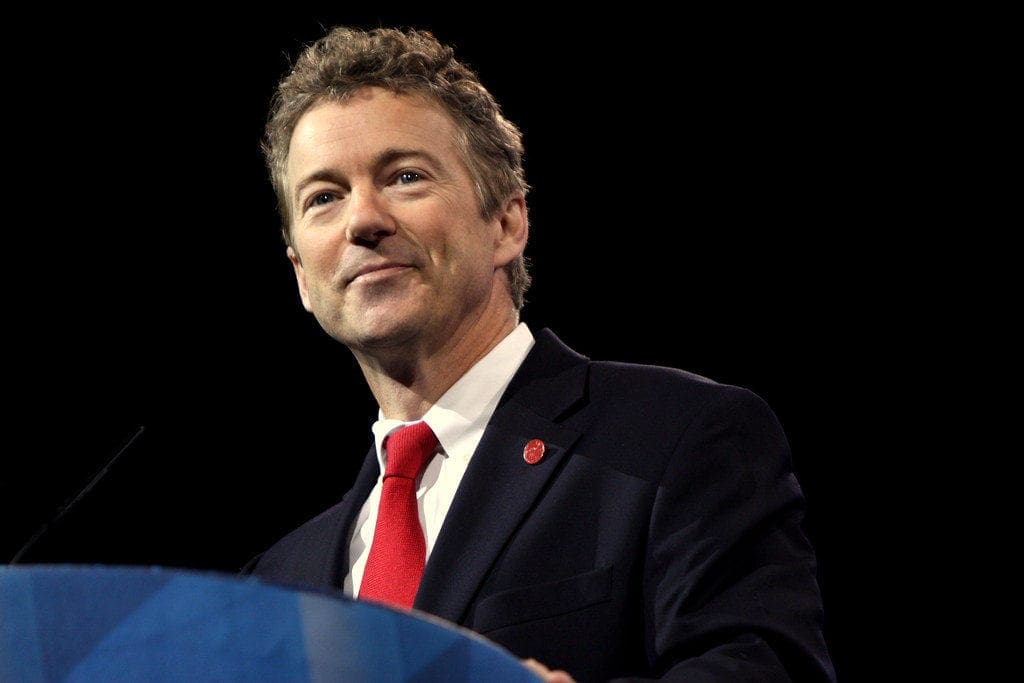 Aside from President Donald Trump, it’s Senate Majority Leader Mitch McConnell who is usually the face of evil for liberals. But on Tuesday night, an NBC News story, based on two anonymous McConnell-linked sources, redirected the ire squarely on Paul.
What did the libertarian ophthalmologist-turned-politician do to deserve this? He did his job.
Paul proposed an amendment to the coronavirus bill being rushed through the Senate after passing the House 363-40. For those keeping track, libertarian-leaning Republican Thomas Massie didn’t vote, and libertarian-leaning Independent Congressman Justin Amash voted present.
Paul’s amendment, according to NBC News reporter Julie Tsirkin, was officially summarized as: To amend the Internal Revenue Code of 1986 to require a social security number for the purposes of the child tax credit, to provide the President the authority to transfer funds as necessary and to terminate United States military operations and reconstruction activities in Afghanistan.
Twitter is littered with righteous indignation constantly, but Tuesday night, it was mostly directed at Paul. And it was mostly thanks to the NBC News story poorly co-written by Tsirkin.
Before getting into the catty tone of the article, let’s consider the actual concerns people have with Paul’s amendment.
First, isn’t there a national emergency going on? Now isn’t the time for nitpicking what’s legal under the Constitution or how Congress appropriates funds. There’s no time for delay, we’re led to believe.
The answer to this critique is short, because there simply is no delay in voting beyond a few minutes just because an amendment is proposed. All of this drama is just political theatre, with McConnell aides directing the show.
Second, and perhaps more reasonably, it may be asked what the war in Afghanistan has to do with this coronavirus. That almost begs the question though. Why is Congress leaping to this hot new political commodity known as a coronavirus when they’ve skirted their true duties for so long?
Beyond the deadly Afghanistan misadventure being a drain on financial resources, it’s worth investigating how human resources are wasting away, mired down in that desert. In Syria, most of the U.S. troops are from the South Carolina National Guard. Might be nice to have them here!
Here Paul is doing the job all the other senators are supposed to be doing. Unfortunately for him, it doesn’t fit into the narrative most comfortable for the political and media elites.
As a result, we end up with junior high school level journalism weaponized against patriotic dissent.
“Paul is notorious for forcing votes on amendments he knows will not pass,” the NBC News story goes.
It concluded in a similar fashion: “He even briefly caused the government to shut down in 2018, using a procedural tactic to block the Senate from meeting the deadline to keep the government open because he objected to the price tag.”
Both of these statements are lies, though the authors probably believe them. It’s a sure sign of the deep divisions in the country.
Whether it’s the 9/11 Victims bill, the Ukrainegate impeachment failure, or foreign aid, Paul consistently upsets the right people by doing the right thing. This doesn’t mean Paul is perfect, but it does mean Americans should appreciate his special role in Washington, DC.
Posted in Uncategorized | Tagged: congress, coronavirus, federal legislation, Rand Paul, Rep. Justin Amash, Rep. Thomas Massie, Ukrainegate | Leave a Comment »


