MCViewPoint

Opinion from a Libertarian ViewPoint

Posts Tagged ‘covid-19’

Nobody knows anything: West doesn’t trust China’s Covid-19 figures, but are its own numbers any more meaningful? — RT Op-ed

Posted by M. C. on April 12, 2020

Because their testing systems and data reporting vary, there is no way to glean any useful information, for example, about whether their lockdown measures have helped.

https://www.rt.com/op-ed/485425-west-china-covid-19-figures/

Whatever the eventual impact of the coronavirus, one thing has become apparent: when governments are the gatekeepers of data-gathering, there is no reliable source of information on the scale of the pandemic.

It did not take long for a war of information to break out over the true extent of Covid-19. Every morning, we wake up to the freshest figures for our own country. Another few hundred or thousand new cases, depending on where you live, and a fraction as many deaths. Every day, the colour-coded curves corresponding to the cases in various countries creep one day further into the future, like breakers approaching a beach.

But there is no way of comparing different countries’ statistics, based as they are on processes so riddled with holes and flaws that they may as well be guesswork. Obviously, comparing Italy and Belarus is comparing apples with oranges – the populations and the timelines of the pandemics in these countries are wildly different, so inferring results from their response plans is pointless.


In the same way, though, comparing Italy to a more superficially similar country, like Spain, is just as meaningless. Because their testing systems and data reporting vary, there is no way to glean any useful information, for example, about whether their lockdown measures have helped. The Mail on Sunday columnist Peter Hitchens has been terrier-like in his assertion that there is no known causal relationship between lockdown measures and fewer deaths, which has not made him any friends in the mainstream media.

Furthermore, there are too many unknowns about the virus itself and, as a brand new strain previously unknown to humans, attempts to understand it have come from a standing start. Every new piece of research seems to raise more questions than it answers. Are most people asymptomatic carriers? How long are people contagious for? Are there many strains or just one? And how deadly is it in comparison to the flu? It is likely to be a year or more before we know – such is the nature of scientific research. Until then, we will have to embrace our ignorance.

Not the only one

From the beginning, seemingly obvious inconsistencies and impossibilities came through the mainstream media. The most basic figures on case and death numbers did not stand up to the simplest back-of-the-envelope calculations. How could the mortality rate in Italy be 20 times what it was across the border in Germany?

Many people questioned the figures coming out of China, and they were right to do so. It is impossible to trust the Chinese government on matters of fact at the best of times, and when they felt backed into a corner – as they did when one of their major cities spawned this virus – they had every motivation to downplay the scale of the crisis. There is a danger, though, that in scapegoating China as the world’s only haven of lies and propaganda, people will automatically take at face value information from governments they trust more, such as their own. This would be a mistake, no matter what country one is in.

Testing times

Consider one element which is key to the statistic-gathering process: testing. In the simplest terms, a population contains people who have not yet been exposed to the virus, people who currently have the virus, and people who have had the virus but who are now recovered. On any given day, some of the people who have not yet been exposed to the virus contract it, and some will have symptoms of Covid-19 (with a broad range of severity, as we know).

What we would like to know is how many of those people there were today, ie. the number of new cases. Switch on the television and the news will be confidently reporting today’s figure. But in fact, this information is utterly unknowable. There is no mechanism by which all of these people could or would report for testing once they feel sick, because there is a global shortage of testing kits. And even if the right people were tested, there is currently no way of knowing how accurate the tests are – to find out the proportion of false negatives, you would need a test to test the tests.

Moreover, the tests, once done, have to be processed in some way to get the results. This is taking days or weeks for ordinary, non-celebrity people, but there is a suggestion that after a few days the positive tests actually turn negative, that the virus dies on the swab and does not show up in results. All of these possible points of failure are only to do with the testing. And it is on this basic premise that all other official and governmental statistics are based. Therefore, not trusting facts and figures is not a question of paranoia; it is a question of realism.

Known unknowns

William Goldman, the legendary screenwriter of ‘Butch Cassidy and the Sundance Kid’ and ‘The Princess Bride’, had a personal motto for understanding Hollywood. It was: “Nobody knows anything.” He did not live to see the present crisis, but his words of wisdom apply to the coronavirus too. Nobody knows anything, least of all the experts and politicians who are paid to regularly pontificate on the subject.

We have all been guilty of trying to pretend we know more than we really do. It is the natural human response in a crisis to try to understand. Our greatest adaptation, the thing that separates us from the animals and makes us who we are as a species, is our intellect. With our minds we have conquered the world, dominated every other animal, and subjugated the rivers, mountains and oceans to our will. How ironic then, that one of nature’s smallest organisms, invisible to us, has sent us into a tailspin. We are still subject to the whims of nature, and we would do well to remember that.

Like this story? Share it with a friend!

Be seeing you


Posted in Uncategorized | Tagged: , , , | Leave a Comment »

Why Central Planning by Medical Experts Will Lead to Disaster | Mises Wire

Posted by M. C. on April 12, 2020

More important, however, may be that in making recommendations to address COVID-19, those with detailed knowledge of the disease (the experts we have been told to obey) do not have sufficient knowledge of the consequences of their “solutions” for the economy and society to know what the costs will be. That means that they don’t know enough to accurately compare the benefits to the costs.

One major problem with such attacks is the substantial literature documenting the adverse health effects of worsening economic conditions. For just one example, an analysis of the 2008 economic meltdown in The Lancet estimated that it “was associated with over 260,000 excess cancer deaths in the OECD alone, between 2008–2010.” That is a massive “detail” to ignore in forming policy.

https://mises.org/wire/why-central-planning-medical-experts-will-lead-disaster?utm_source=Mises+Institute+Subscriptions&utm_campaign=439656abdd-EMAIL_CAMPAIGN_9_21_2018_9_59_COPY_01&utm_medium=email&utm_term=0_8b52b2e1c0-439656abdd-228343965

A great deal of the coverage of the COVID-19 crisis has been apocalyptic. That is partly because “if it bleeds, it leads.” But it is also because some of the medical experts with media megaphones have put forward potentially catastrophic scenarios and drastic plans to deal with them, reinforced by assertions that the rest of us should “listen to the experts,” because only they know enough to determine policy. Unfortunately, those experts don’t know enough to determine appropriate policies.

Doctors, infectious disease specialists, epidemiologists, etc. know more things about diseases, their courses, what increases or decreases their rate of spread, and so on than most. But the most crucial of that information has been browbeaten into the rest of us by now. Limited and imperfect testing also means that the available statistics may be very misleading (e.g., is an uptick in reported cases real or the result of an increasing rate of, or more accuracy in, testing, which is crucial to determining the likely future course COVID-19?). Further, to the extent that the virus’s characteristics are unique, no one knows exactly what will happen. All of that makes “shut up and listen” advice less compelling.

More important, however, may be that in making recommendations to address COVID-19, those with detailed knowledge of the disease (the experts we have been told to obey) do not have sufficient knowledge of the consequences of their “solutions” for the economy and society to know what the costs will be. That means that they don’t know enough to accurately compare the benefits to the costs. In particular, because of their relative unawareness of the many margins at which effects will be felt, the medical experts we are being told to follow will likely underestimate those costs. When combined with their natural desire to solve the medical problem, however severe it might get, this can lead to overly draconian proposals.

This issue has been brought to the fore by the increasing number of people who have begun questioning the likelihood of the apocalyptic scenarios driving the “OMG! We need to do everything that might help” tweetstorms, on the one hand, and those who are emphasizing that “shutting down the economy” is far more costly than planners recognized, on the other.

Those who have brought up such issues (how long before they are called “COVID deniers”?) have been pilloried for it. Exhibit A is the vilification of President Trump for “ignoring the scientists,” such as the New York Times‘s claim that “Trump thinks he knows better than the doctors” after he tweeted that “We cannot let the cure be worse than the problem itself.”

One major problem with such attacks is the substantial literature documenting the adverse health effects of worsening economic conditions. For just one example, an analysis of the 2008 economic meltdown in The Lancet estimated that it “was associated with over 260,000 excess cancer deaths in the OECD alone, between 2008–2010.” That is a massive “detail” to ignore in forming policy.

In other words, the tradeoff is not just a matter of lives lost versus money, as it is often portrayed as being (e.g., New York governor Cuomo’s assertion that “we’re not going to put a dollar figure on human life”). It is a tradeoff between lives lost due to COVID and lives that will be lost due to the policies adopted to reduce COVID deaths.

Larry O’Connor put this well at Townhall when he wrote:

Why should the scientific analysis of doctors solely focusing on the spread of the coronavirus carry more weight than the very real scientific analysis of the deadly health ramifications of shutting down our economy? Doesn’t the totality of the data make the argument for a balanced approach to this crisis?

This issue reminds me of a classic discussion of specialists and planning in chapter 4 of F.A. Hayek’s The Road to Serfdom. “The Inevitability of Planning” is well worth noting today:

Almost every one of the technical ideals of our experts could be realized…if to achieve them were made the sole aim of humanity.

We all find it difficult to bear to see things left undone which everybody must admit are both desirable and possible. That these things cannot all be done at the same time, that any one of them can be achieved only at the sacrifice of others, can be seen only by taking into account factors which fall outside any specialism…[which] forces us to see against a wider background the objects to which most of our labors are directed.

Every one of the many things which, considered in isolation, it would be possible to achieve…creates enthusiasts for planning who feel confident…[of] the value of the particular objective…But it is…foolish to quote such instances of technical excellence in particular fields as evidence of the general superiority of planning.

The hopes they place in planning…are the result not of a comprehensive view of society but rather of a very limited view and often the result of a great exaggeration of the importance of the ends they place foremost…it would make the very men who are most anxious to plan society the most dangerous if they were allowed to do so—and the most intolerant of the planning of others…there could hardly be a more unbearable—and much more irrational—world than one in which the most eminent specialists in each field were allowed to proceed unchecked with the realization of their ideals.

Panic has seldom improved the rationality of decision-making (beyond the “fight or flight” reaction to facing a “man-eater,” when to stop and think means certain death). However, much of media coverage has fed panic. But the illogical and intemperate media attacks against those questioning the rationality of draconian “solutions” drown out, rather than enable, objective discussion of real tradeoffs. And if “Democracy dies in darkness,” as the Washington Post proclaims, we should remember that it does not require total darkness. The same conclusion follows when people are kept in the dark about major aspects of the reality they face.


Be seeing you


Posted in Uncategorized | Tagged: , , , , | Leave a Comment »

Beware: Our New Online Culture is a Feast for Mass Surveillance | The American Conservative

Posted by M. C. on April 11, 2020

What! You still haven’t taped over your PC and selfie camera lenses?

Nothing is private online unless you are using VPNs and secure email. Even then…

Do you really think Facebook messenger and (Facebook’s) WhatsApp are secure?

https://www.theamericanconservative.com/articles/beware-our-new-online-culture-is-a-feast-for-mass-surveillance/

The rapid spread of COVID-19 has caused network traffic to surge as Internet users resort to video conferencing to work remotely.

For example, last December online meeting provider Zoom hosted roughly 10 million participants. In March this statistic jumped to 200 million. The public’s stampede to the cloud is an auspicious development for the intelligence community as sensitive discussions that once occurred in physical office buildings are now channeled through a relatively small number of digital gatekeepers. The implications are unsettling.

From the vantage point of professional spies, the desire to eavesdrop on popular communication channels is all but irresistible. In the United States we’ve witnessed classified programs like PRISM, where the NSA succeeded in convincing all of the big names in Silicon Valley to participate. Chatting up tech CEOs on a first name basis. Authoritarian regimes like China are even more eager to tap commercial data streams. Which is particularly salient given that most of Zoom’s engineers work over in China and that Zoom has unfettered access to the online conferences that it hosts despite marketing claims to the contrary.

Hence, efforts to limit the spread of contagion offer a golden opportunity to double down on mass surveillance. Data collection tools wielded during an emergency on behalf of public safety —facial recognition, drones, mobile device apps, smart phone geolocation, payment card records— over time take on a hue of legitimacy. Furthermore the bureaucrats using such tools are loath to give up their newfound access and will actively identify additional threats to justify it.

China serves as an instructive example. The Communist Party remains in power through an unspoken agreement with the rest of Chinese society. It’s the sort of deal that exists in many repressive nations. The government assures economic growth and in return citizens are expected to stay out of politics and submit to extreme social control measures. The Chinese government asserts that growth will continue at around 6 percent, but keep in mind that it also aggressively censors bad economic news, in the same manner that it suppressed news about the COVID-19 outbreak.

It’s highly unlikely that the Party will be able to keep delivering results forever. The COVID-19 outbreak will simply hasten a looming economic crisis in China, despite the Party’s best efforts to maintain control. With China’s towering mountain of debt, zombie factories, and conspicuous industrial overcapacity, it’s just a matter of time before the average citizen realizes that they’re not going to get what they were promised. This raises the specter of military action as the government directs attention outward in search of enemies to mobilize its restive populace. Against this backdrop mass surveillance will be ramped up in a desperate attempt to buttress the status quo.

Common sense dictates that relying on technology that’s developed in a police state like China is inherently risky. The instinctive response for many users is to turn to American technology. However, thanks to whistleblowers like Edward Snowden the public record shows that domestic companies are also cooperating with the intelligence community as well as monetizing their access to user data. So if you’re wondering whether a particular online platform is secure, you’re asking the wrong question. The salient question is which group of security services and big data aggregators have access?

Sadly this makes achieving higher levels of communication security a sort of DIY affair. The key is to prevent the current COVID-19 setting from becoming the new normal by recognizing what’s at stake. The more that we rely on Internet platforms to communicate the more power we yield to a narrow set of vested interests. Such that our need to stay in touch with each other during a disaster secretly morphs into a feeding frenzy for spies. Just as it did in the wake of the 9/11 attacks. As always, freedom entails responsibility. This means leaving mainstream channels for sensitive discussions and doing so in a manner that doesn’t create baseline anomalies that might alert watchers.

Pervasive monitoring is not the behavior of a confident nation. Mass surveillance isn’t the harbinger of stability. It’s a dangerous political tremor. A display of anxiety rather than strength. An indicator that leaders have recklessly chosen to dispense with civil liberties behind closed doors under the guise of addressing perceived threats. As citizens we have an obligation to protect the values which actually make America strong. To encourage lawmakers to resist the impulse to trade essential liberty for short-term promises of security and to forge our own paths forward when they fail to do so.

Be seeing you


Posted in Uncategorized | Tagged: , , , , , , , , | Leave a Comment »

How the CDC Prevented Fast and Accurate Testing for COVID-19 | Mises Wire

Posted by M. C. on April 10, 2020

Labs could only use tests that they had developed themselves if granted an emergency use authorization—which was given solely to the CDC on February 4. All other labs were prohibited from using their own tests, though many were already in the process of manufacturing them.

The CDC publicly recognized its blunder on February 12 and committed itself to making quick amends. At that point, only the three labs not facing reagent problems (out of more than one hundred) were allowed to continue testing.

https://mises.org/wire/how-cdc-prevented-fast-and-accurate-testing-covid-19

Listen to the Audio Mises Wire version of this article.

The coronavirus crisis has exposed how the federal health bureaucracy (i.e., the CDC and the FDA) has stymied progress and a quick response over and over again.

Crucial to understanding and potentially preventing a virus’ spread is having a sufficient stock of diagnostic test kits. If tests are plentiful and used properly, infected persons can be properly quarantined and treated, and health officials may begin monitoring those with whom infected patients were in close contact during the incubation period. For SARS-CoV-2 (severe acute respiratory syndrome coronavirus 2, the virus causing the coronavirus disease) the incubation period can range anywhere from two to fourteen days (with a mean of 5.1), making it of special importance that patients showing respiratory symptoms be tested as soon as possible.

Early Failures at the CDC

The US Centers for Disease Control and Prevention (CDC) began working on a test within the first few weeks of the virus’ global outbreak in conjunction with the Food and Drug Administration (FDA). With the federal government in control, all the country’s eggs were placed in a single basket—any mistakes were bound to carry wide, rippling effects.

On January 21, all plans and anticipations were suddenly brought to term when the US confirmed its first case of the virus—a thirty-five-year-old Seattle man who had recently visited Wuhan, China. This “patient zero” had checked into an emergency care center two days prior, which was able to send clinical samples from his nose, throat, and bloodstream on an overnight flight to the CDC lab in Atlanta. By the following afternoon, the lab had reported that the test had come back positive, and by nightfall the patient was being moved to a small containment unit originally built to house ebola patients. Despite these measures, the virus managed to infect others through some unknown carrier. The crisis, at last, had breached mainland America.

On January 24, the CDC digitally published information on its tests, essentially providing a blueprint for manufacturing them. It was clear that clinical and public health labs had to be capable of testing in case the virus became widespread.

But on January 31, the Department of Health and Human Services designated the coronavirus a “public health emergency, and four days later declared this condition just cause for the FDA to authorize the emergency use of diagnostic tests. Emergency use authorizations bypass the years-long approval process and accelerate the pace at which medical products reach labs and hospitals—the FDA at its most flexible. However, the layers of red tape still in force during such an emergency were thick and tangled.

Labs could only use tests that they had developed themselves if granted an emergency use authorization—which was given solely to the CDC on February 4. All other labs were prohibited from using their own tests, though many were already in the process of manufacturing them.

The CDC’s kits used polymerase chain reaction (PCR) testing, a common and inexpensive diagnostic method that’s been used for decades. As long as state and clinical labs could ensure the uberclean lab conditions required to develop coronavirus PCR primer (short DNA strands complementary to the SARS-CoV-2 viral sequence) there would be no trouble manufacturing test kits—they were fully capable. Giving the CDC the sole power to manufacture tests, on the other hand, would ultimately mean that fewer would be made and of a lower quality. But—against the interests of public health and practicality—production was centralized with the CDC anyway.

Slowing Everything Down

For more than two weeks, all testing had to be conducted via mail-in samples sent to the CDC, as with “patient zero.” On February 6 and 7, the CDC finally sent public health labs the test kits they’d been anxiously awaiting. At the time, this was a total of only ninety tests, though each one could process 700–800 patient samples—a suitable capability for the time, but one which would have to be expanded as the virus spread further.

After receiving the tests, the labs began to check them to ensure that they would produce valid results. However, nearly all of the labs ran into a problem with one of the test’s negative control reagents (mixtures used in chemical analysis). The test’s reagents contained genetic material unrelated to SARS-CoV-2 and that was not supposed to react; that’s how the labs would have been able to validate the tests’ accuracy. But in most labs, one of these reagents—called N3—did react, causing a stir of panic that the tests were defective.

The CDC publicly recognized its blunder on February 12 and committed itself to making quick amends. At that point, only the three labs not facing reagent problems (out of more than one hundred) were allowed to continue testing. All other labs had to again send their samples to the CDC’s Atlanta lab, delaying results by up to two days (which would have otherwise taken four to six hours to produce) at a time when knowledge of the virus’ spread was crucial.

To address its failure, the CDC initially planned to manufacture new, operative copies of N3 to send to the labs that had had difficulties, but this never came to fruition. Instead, for the next few weeks CDC officials continuously declared that they were working on the problem, ultimately helping to equip only an extra nine public health labs with the ability to test. A cocktail of bureaucratic incompetence and FDA lethargy left all the other labs without usable tests as the virus spread undetected across the country.

Finally, on February 26, the CDC announced its grand solution—that labs could simply disregard the faulty N3 reagent and otherwise continue using the tests as originally sent to them. That means that there was never anything fatally defective about them in the first place and that testing could have continued uninterrupted for the prior couple of weeks.

The real issue at hand was not with the tests, but with changing the test protocol to reflect what many virologists already knew—that having a third reagent was superfluous to begin with. That’s not even to mention the five public health labs that experienced problems with reagents besides N3, to which the CDC failed to propose a solution.

But just when most labs had at last resumed testing, a new—though unsurprising—problem presented itself: test kits were in short supply. The amount of kits distributed at the beginning of February was nowhere near enough to confront the hordes of patients requiring testing by the end of the month. Without sufficient ability to diagnose patients over the course of the month, the crisis quietly intensified.

Feds behind the Curve

CDC data records only twenty-four confirmed cases of coronavirus in the US by the end of February—a seemingly manageable number. But it was later learned that by that time a whopping 597 infected individuals had already begun to show symptoms. Each of these cases required testing, as did the thousands more who mistakenly feared themselves to be infected.

Virologists knew the reality of the matter to be much worse than the official figures were reflecting. Scarier yet, it’s likely that—without knowing it—the US had in excess of seventeen hundred cases by February 29 when asymptomatic carriers are taken into account—a far cry from the mere twenty-four that had been confirmed by that date. Much testing was needed right away, even if that wasn’t immediately apparent.

But then, at a moment of critical importance, the FDA updated one of its emergency testing policies, allowing certain certified labs to use their own tests before FDA review—a deus ex machina in the diagnostics narrative. The same day, a test from New York’s Wadsworth Center was also granted an emergency use authorization. The approval of many more tests beginning in mid-March followed.

The FDA could only salvage the testing situation by releasing its tight stranglehold over it. After all, the whole debacle had originated and then further worsened under the federal government’s watch—it was simply unable to manage the crisis correctly.

But even after giving innovation more room to operate, shortages did not immediately disappear. The first few weeks of a virus’ spread are always the most pivotal, making it very difficult to catch up if that precious time is squandered. The insufficiencies in diagnostics experienced early on allowed the coronavirus to spread more quickly and widely, causing an untold number of deaths later.

If the FDA had properly vetted the CDC’s tests before distributing them, everything might have been different. If public health labs had not, for weeks, been barred from using the tests sent to them, everything might have been different. If clinical labs could have used their own tests from the beginning, everything might have been different. But none of that happened—in fact, the worst of the worst happened when it came to test kits—and the blame for that lies solely with the federal government.


Posted in Uncategorized | Tagged: , , , | Leave a Comment »

Freedom Still Matters, Even in the Midst of a Virus | Mises Wire

Posted by M. C. on April 8, 2020

Protecting our lives and our liberty is a responsibility that is not simply delegated to the government—we still retain it. It is important to remind people of the benefits of a free society during and after this pandemic.

https://mises.org/wire/freedom-still-matters-even-midst-virus?utm_source=Mises+Institute+Subscriptions&utm_campaign=b2a0e2ec5a-EMAIL_CAMPAIGN_9_21_2018_9_59_COPY_01&utm_medium=email&utm_term=0_8b52b2e1c0-b2a0e2ec5a-228343965

On Friday, Pope Francis delivered a special sermon to pray for an end to the COVID-19 pandemic. Indeed, the depressing scenery of the deserted St. Peter’s Square on the rainy night matched the words of the Holy Father:

Thick darkness has gathered over our squares, our streets and our cities; it has taken over our lives, filling everything with a deafening silence and a distressing void, that stops everything as it passes by; we feel it in the air, we notice in people’s gestures, their glances give them away. We find ourselves afraid and lost.

The image of the “plague” crucifix added a special gravity to this prayer, as the unusually high mortality rates in Italy and especially Lombardy have made the disease seem like a modern plague. Some of my friends there intentionally did not travel to their home cities in fear of infecting their elderly parents and have spent the last four weeks isolated in their rooms. Regardless of our political views, all of us wish for a quick end to this situation. However, as a lot of us devote most of our attention to the “defeat” of the coronavirus, we pave the way for the unrestrained authoritarian measures of our governments.

There’s Little Public Resistance

Most of our government officials have not enforced these measures on their own initiative against a people that completely rejects the curbing of their civil liberties. On the contrary, some politicians feared that they might be seen as as too weak for not supporting lockdowns enough. Make no mistake, there is widespread public acceptance of the restrictions imposed by government, as, for example, the surging approval ratings of the Bavarian minister president, the first in Germany to impose strict measures, show.

This panic policymaking could easily be the basis for a modern form of unlimited government. As Lord Acton remarked:

Whenever a single definite object is made the supreme end of the State…the State becomes for the time inevitably absolute.

Right now, public health, which has already been a popular topic among the modern absolutists, is that single definite object. Politicians and wannabe politicians in the affected Western countries complain about how the health system is not capable of handling this exceptional situation because the government has not spent enough money, and they call for more spending, more taxes, and more debt to fund it. There are more contagious diseases than the novel coronavirus, so why not use the emergency powers to protect against them? The public will be susceptible to these points. COVID-19 might prove to be a similar catchword to “9/11” or “Bataclan,” that can always be invoked to expand the power of the state over the lives of its citizens.

It is important to be aware that the current government interventions are legitimated by the voters. Fear and the desire to abdicate some individual responsibility, which comes with the choice whether to change my lifestyle or not, have been important fuels for this havoc.

Pope Francis framed his sermon around Mark 4:37–41:

And there arose a great storm of wind, and the waves beat into the ship, so that it was now full. And he was in the hinder part of the ship, asleep on a pillow: and they awake him, and say unto him, Master, carest thou not that we perish? And he arose, and rebuked the wind, and said unto the sea, Peace, be still. And the wind ceased, and there was a great calm. And he said unto them, Why are ye so fearful? How is it that ye have no faith? And they feared exceedingly, and said one to another, What manner of man is this, that even the wind and the sea obey him?

The Holy Father notes that we find ourselves in the situation of the disciples, caught off guard by a disaster. And, naturally, in times of crisis, people look to their leaders. The leader of the disciples was Jesus, whom the wind and the sea obeyed. However, our leaders do not have his divine powers, and forgetting that there are limits to what single men and governments can achieve might create a modern absolutism of governments whose powers are assumed to be godlike. Only individual adaption to this new situation will be able to create a sustainable solution. For that, we need our civil liberties and the freedom to make choices for ourselves. Protecting our lives and our liberty is a responsibility that is not simply delegated to the government—we still retain it. It is important to remind people of the benefits of a free society during and after this pandemic.


Be seeing you


Posted in Uncategorized | Tagged: , , , | Leave a Comment »

Anti-China Hysteria Is Ultimately Not About Covid-19, Racism Or Communism, But Power – Caitlin Johnstone

Posted by M. C. on April 8, 2020

“Those who aren’t in power, such as rightwing journalists, realize their neoliberal ideology is unequipped to deal with the pandemic, and therefore is under attack,” Mastracci writes. “They won’t abandon their views, so they have to shift blame to an outside country with an ideology that is different in the right way. Attacking China clearly serves this purpose,…

https://caitlinjohnstone.com/2020/04/08/anti-china-hysteria-is-ultimately-not-about-covid-19-racism-or-communism-but-power/

In a recent article falsely titled “The U.S.-China propaganda war is on hold, but not for long“, The Washington Post‘s Josh Rogin made a very interesting admission.

“The United States is now in dire need of medical supplies, many of which are coming from China,” Rogin said. “If China’s leaders are willing to stop telling lies about us, we can pause pointing out the most embarrassing truths about them.”

Wait, sorry, “us”? “We”?

Rogin wasn’t quoting any US officials. He was referring, in the first person plural, to the US government, because he apparently sees himself as a part of it. He sees himself and others like him as an extension of the US government’s narrative control campaign, the branch that is responsible for distributing “truths” in America’s propaganda war to counter China’s “lies”. He sees himself as a state propagandist.

Which, of course, he is. The devoutly neoconservative Rogin consistently advances hawkish narratives against nations which have resisted absorption into the blob of the US-centralized empire, and he is showing no hesitation in running point on the new escalations in the narrative control campaign against China. This is because the USA and China have been on a collision course toward aggressive confrontation for a long time now, and the narrative managers need to manufacture consent for that horrific eventuality.

Passage‘s David Mastracci has a very worthwhile new article out titled “Don’t Blame China For Your Government’s COVID-19 Failures“, exposing what Rogin calls “embarrassing truths” about China’s handling of the Covid-19 pandemic for the distorted spin jobs that they are and highlighting the fact that the difficulties Americans are currently facing is due to their own governments failures, not China’s.

“Those who aren’t in power, such as rightwing journalists, realize their neoliberal ideology is unequipped to deal with the pandemic, and therefore is under attack,” Mastracci writes. “They won’t abandon their views, so they have to shift blame to an outside country with an ideology that is different in the right way. Attacking China clearly serves this purpose, and offers a chance for anti-communism, which, as Parenti notes, people have been primed to hate for more than a century.”

This is much closer to the truth than anything you’ll read in any mass media publication. This virus is brutally highlighting all the insanity of the neoliberal status quo upon which the US empire is built, and that status quo is indeed premised upon shutting down all leftward political movement which could potentially inconvenience plutocrats and war profiteers. Much of what we’re hearing from leading Republican and Democratic Party pundits these days can be accurately translated as a wailing temper tantrum about their entire worldview crashing to an embarrassing faceplant in front of the whole world.

But even that doesn’t really cover it.

If you ask a leftist what the west’s sudden uptick in anti-China hysteria is about, they might say racism, xenophobia, and/or anti-communism. If you ask a rightist, they might tell you it’s because China lied about the virus, or because of communism, or because of China’s economic relationship with the US, or because it’s a backwards culture of people who eat different animals from us. If you ask someone who occupies the mainstream so-called “center”, they might tell you that it’s because of humanitarian concerns about China’s oppressive government, along with racism or some mixture of the aforementioned claims.

Ultimately though, it’s not about any of those things. While racism, xenophobia, anti-communism, free trade deals, authoritarianism and the virus are all real concerns which play a real role in the propaganda campaign, it’s not ultimately about any of them. Ultimately, like so much else, this is about power.

There can only be one top dog in a unipolar world. After the fall of the Soviet Union the prevailing philosophy slowly coalesced among US policymakers that the world’s only remaining superpower needed to remain that way at any cost in order to preserve the so-called liberal world order. This philosophy rose to dominance when the neoconservatives took over the Executive Branch during the George W Bush administration, and from there their ideas simply became the mainstream orthodoxy. Now the “unipolarity at any cost” ideology of neoconservatism is so pervasive that when you see someone like Tulsi Gabbard basically just advocating for pre-9/11 US foreign policy, you see them demonized as though they supported child cannibalism.

Napoleon Bonaparte once said, “China is a sleeping giant. Let her sleep, for when she wakes she will shake the world.” Preventing the rise of China (and its loose network of other unabsorbed allies like Russia) has been a lasting agenda of the western world for generations, and the continuation of this agenda has set the world on a trajectory toward aggressive confrontation. The US has been surrounding China with military bases, many of them nuclear-armed, in preparation for a confrontation that it sees as ultimately inevitable, since China has no interest in being absorbed into the US power alliance and the US has no interest in allowing China to surpass it as a superpower.

What this means for us ordinary people is that we have found ourselves smashed between steadily increasing escalations between two nuclear-armed nations and their nuclear-armed allies hurtling toward a confrontation which benefits none of us in the slightest, while propagandists spoon feed us narratives about why this is something we should eventually support.

It doesn’t have to be this way. China doesn’t have to be the “sleeping giant” that we all fear. We don’t have to live in a world where nuclear-armed governments duel for planetary domination without our consent or permission and roll the dice on nuclear armageddon with greater and greater frequency each passing day. We don’t have to live in a world where the emergence of a new disease which kills human beings is seen as a tool to be exploited in a propaganda war instead of a problem to be solved together. We could all just get along and work together to create a better world for each other and for our ecosystem.

People will say this is unrealistic and unreasonable, but unrealistic and unreasonable as opposed to what? A few idiots waving armageddon weapons at each other because the other guys are standing on the wrong segment of dirt? A bunch of sociopaths pushing for the advancement of an omnicidal, ecocidal paradigm in service of an imaginary monetary system? Sounds like they’re the unreasonable and unrealistic ones to me.

Napoleon Bonaparte said China is a sleeping giant, but I know a bigger one. It’s all of us ordinary people who are sick of being crushed, exploited and imperiled by a few psychos who only care about power. All of us around the world, regardless of what dirt we stand on or what color our skin is or what political party they tell us we belong to. When we awaken, baby, that’s when the earth will shake.

____________________________________________

Thanks for reading! The best way to get around the internet censors and make sure you see the stuff I publish is to subscribe to the mailing list for my website, which will get you an email notification for everything I publish. My work is entirely reader-supported, so if you enjoyed this piece please consider sharing it around, liking me on Facebook, following my antics onTwitter, checking out my podcast on either YoutubesoundcloudApple podcasts or Spotify, following me on Steemit, throwing some money into my hat on Patreon or Paypalpurchasing some of my sweet merchandise, buying my books Rogue Nation: Psychonautical Adventures With Caitlin Johnstone and Woke: A Field Guide for Utopia Preppers. For more info on who I am, where I stand, and what I’m trying to do with this platform, click here. Everyone, racist platforms excluded, has my permission to republish, use or translate any part of this work (or anything else I’ve written) in any way they like free of charge.

Posted in Uncategorized | Tagged: , , , | Leave a Comment »

Four things only libertarians can see about COVID-19

Posted by M. C. on April 7, 2020

What is unseen are the variety of harms that occur because people have been denied freedom of association and movement.

Second, don’t overlook the harm caused by government actors.

No matter the doomsday scenario, it’s hard to imagine a single governor (or president) outsmarting millions of people.

The Principle of Human Respect is a natural, cause-and-effect relationship. If I rob you at gunpoint, your happiness decreases. Social harmony and prosperity are diminished too.

https://www.theadvocates.org/2020/03/four-things-only-libertarians-can-see-about-covid-19/

A new form of political correctness has spread, like a virus, across the fruited plain. Libertarians are taking heat – getting angry responses for criticizing governors who have used the spread of COVID-19 to issue edicts that shutter businesses and impose martial law-like schemes.

coronavirus covid-19 libertarians politics

Still, libertarians find they cannot keep quiet. Their philosophy of self-government is forged in an understanding of consequences. Libertarians are the only members of society who can see – even foresee – the following four things about the State’s edicts and regulations…

The seen and the unseen

First, libertarians can visualize the Unseen.

What is seen is that which is obvious to us. In the present case, it’s easy for us to see the way the virus is spreading and how the healthcare system is overrun in Italy.

What is unseen are the variety of harms that occur because people have been denied freedom of association and movement. Politicians are using wartime powers and preening before TV cameras. There will be short-term and long-term effects stemming from their actions. Nearly everyone, especially the regime media, is overlooking these costs.

The proper way to analyze this situation is to take all of the effects into account.

Libertarians are just like you; they’re sheltering and practicing physical distance. But let’s be clear, not everyone has that luxury. There’s no way that a governor could anticipate, let alone solve all of these sticky issues. Edicts are “one size fits all.” Each person understands their unique situation better than a politician in a distant capitol could. There are many scenarios to consider. Here’s a sampling…

  • Right now, families are trapped in a home with an abuser. Perhaps the abuser’s workday was a time of relief, or the victim’s school or work was an escape path to safety.
  • Suicides will increase during the crisis.
  • Addiction will worsen because the sense of purpose or even mere interruption that occupational work provides has been stolen away.
  • Businesses that were operating on a thin margin will fold, crushing dreams, resulting in unemployment, and even reducing supply. Supply reductions will fuel price increases for all of us.

Notice State failures

Second, don’t overlook the harm caused by government actors. For example, Donald Trump’s aides were afraid to give their reelection-minded boss any bad news until it was too late. And the sudden, jarring, gubernatorial edicts have caused fear, uncertainty, and doubt – provoking shortages.

In a libertarian world, reliable tests would already be for sale! And if the tests were universally available, the crisis would’ve been far smaller and Americans would be back to work.

There are two reasons tests are not already on the market.

  1. Political suppression of information. If they had gotten the signal earlier, then entrepreneurs, inventors, and existing businesses would’ve started delivering tests by now. We know there was sufficient time because a handful of U.S. Senators were briefed in January. After seeing the impending crisis, they sold off their stocks.
  2. Ironically, regulations are supposed to make us safer. What they do instead is create barriers which increase delays and costs. Frequently, the innovator realizes that no action is profitable, choosing not to invent (another unseen effect). The FDA has been in the way of tests getting to market.

Wisdom of the crowd

Third, self-government is the best solution to the Knowledge Problem. No matter the doomsday scenario, it’s hard to imagine a single governor (or president) outsmarting millions of people.

No matter how brilliant the governor and his or her advisors are, he or she lacks the capacity to win a problem-solving contest against tens of millions of people.

Worse, political acts are prone to cause injuries (which tend to be unseen and unreported). The miracle of “stuff” arriving on our store shelves involves millions of micro-decisions. Sudden edicts have replaced that. Shortages result because the governor deploys unanticipated force. Consider…

Restaurants who planned menus suddenly have too much food. Grocery stores, who thought people would be at restaurants, find that they have new customers instead. The restaurant owner takes a bath.

Even with nearly-empty shelves, stores need to make sure they don’t over-order in response. Grocers know these effects are temporary, but they don’t know when they will end. They don’t want to end up like the restaurants, stuck with too much stock on hand. Uncertainty prevails. Shortages will remain a problem until governors back out of the equation.

Human respect

Fourth and most important of all, is the matter of Human Respect. The libertarian uniquely recognizes that everyone seeks happiness and that no one person can make everyone happy.

The Principle of Human Respect is a natural, cause-and-effect relationship. If I rob you at gunpoint, your happiness decreases. Social harmony and prosperity are diminished too.

Since this is a principle, even governors cannot violate it. Bans and edicts are ultimately enforced by armed men and women. These are not acts of persuasion; they are threats to achieve a desired result. When anyone, be they a criminal or your governor, coerces another human being, they never increase happiness. And in the present situation, the bans have obviously decreased social peace and material prosperity.

The damage to prosperity is already so obvious that no one is contesting it.

And before the governors started acting, we had peaceful cooperation. Most people were already practicing physical distancing. We also witnessed allegedly greedy corporations voluntarily sacrificing many millions of dollars. To prevent the spread of COVID-19 the NCAA closed events to the public. Then, the NBA suspended its season and Disney closed its parks. Like falling dominoes, tons of businesses followed.

AFTER that, governors forced the holdouts to close. Libertarians began raising important questions like the four you’ve just reviewed. They’re getting accused of wanting to clog hospitals and increase the death toll. Therefore, consider the role politicians are playing. Are their acts increasing harmony or did they introduce new divisions into our society?

Be seeing you


Posted in Uncategorized | Tagged: , , , , , , , , , , , , | Leave a Comment »

Fake Coronavirus Data, Fear Campaign. Spread of the COVID-19 Infection – Global ResearchGlobal Research – Centre for Research on Globalization

Posted by M. C. on April 7, 2020

This is not the first time that a global health emergency has been called by the WHO in close liaison with Big Pharma.

In 2009,  the WHO launched the  H1N1 Swine Flu Pandemic predicting that “as many as 2 billion people could become infected over the next two years — nearly one-third of the world population.” (World Health Organization as reported by the Western media, July 2009).

One month later WHO Director General Dr. Margaret Chan stated that  “Vaccine makers could produce 4.9 billion pandemic flu shots per year in the best-case scenario”,( Margaret Chan, Director-General, World Health Organization (WHO), quoted by Reuters, 21 July 2009)

While creating an atmosphere of  fear and insecurity, pointing to an impending global public health crisis, the WHO nonetheless acknowledged that the H1N1 symptoms were moderate and that “most people will recover from swine flu within a week, just as they would from seasonal forms of influenza” (WHO statement, quoted in the Independent, August 22, 2009).


https://www.globalresearch.ca/fake-coronavirus-data-fear-campaign-spread-of-the-covid-19-infection/5708643

Introduction

Do not let yourself be misled by the fear campaign, pointing to a Worldwide coronavirus calamity with repeated “predictions” that hundreds of thousands of people are going to die.

These are boldface lies. Scientific assessments of the health impacts of  the COVID-19 have been withheld, they do not make the headlines. 

While COVID-19 constitutes a serious health issue, why is it the object of  fear and panic?

According to the WHO, “The most commonly reported symptoms [COV-19] included fever, dry cough, and shortness of breath, and most patients (80%) experienced mild illness.”  

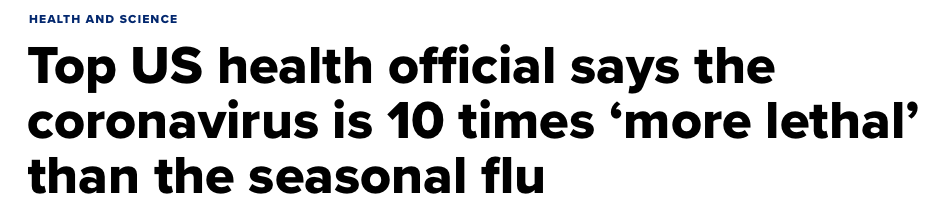
Examine the contradictory headlines:

Screenshot The Hill

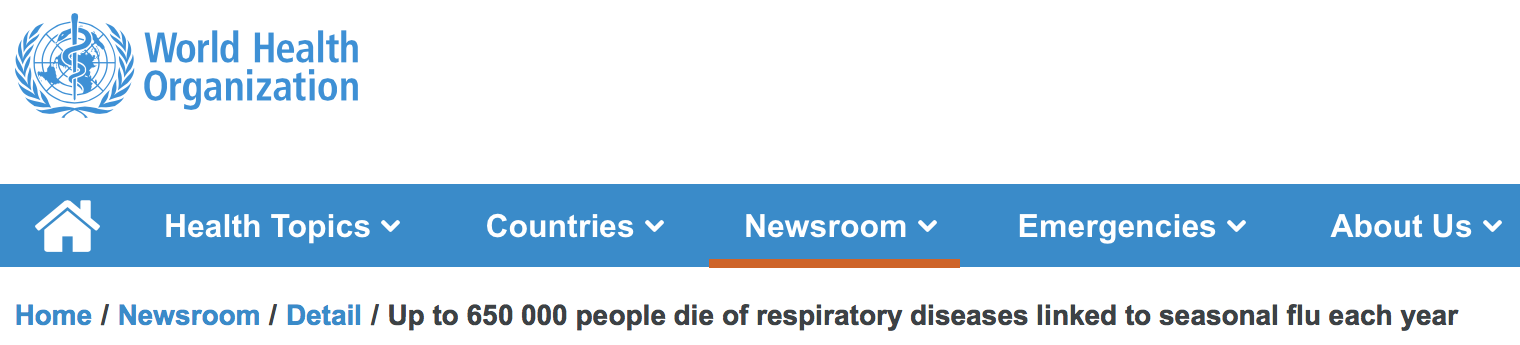
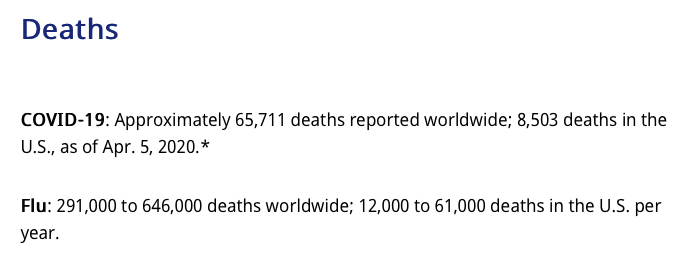
According to the WHO and John Hopkins Medicine (see below),  the risks of dying from influenza are higher than from COVID-19. 

Source; John Hopkins Medicine

Moreover, the media fails to acknowledge that there are simple and effective treatments for COVID-19. In fact, the reports on the treatment of COVID-19 are being suppressed. And the issue of “recovery” is barely mentioned. 

Persistent headlines and TV reports. Fear and panic. Neither the WHO nor our governments have taken the trouble to reassure us. 

According to latest media hype, citing and often distorting scientific opinion (CNBC)

Statistical Models by Washington think tanks predict a scenario of devastation suggesting that “more than a million Americans could die if the nation does not take swift action to stop its spread as quickly as possible”.

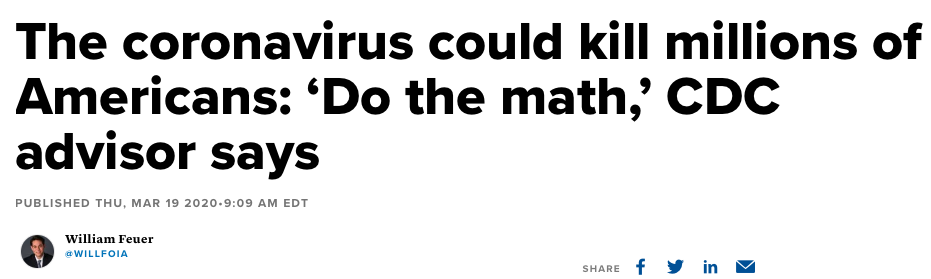
One model from the Centers for Disease Control and Prevention (CDC) suggested that between 160 million and 210 million Americans could contract the disease over as long as a year. Based on mortality data and current hospital capacity, the number of deaths under the CDC’s scenarios ranged from 200,000 to as many as 1.7 million. (The Hill, March 13, 2020)

The Unspoken Truth:  Unprecedented Global Crisis

The unspoken truth is that the novel coronavirus provides a pretext to powerful financial interests and corrupt politicians to trigger the entire World into a spiral of  mass unemployment, bankruptcy, extreme poverty and despair. 

This is the true picture of what is happening. “Planet Lockdown” is an encroachment on civil liberties and the “Right to Life”. Entire national economies are in jeopardy. In some countries martial law has been declared.

Small and medium sized capital are slated to be eliminated. Big capital prevails. A massive concentration of corporate wealth is ongoing. 

Is a diabolical “New World Order” in the making as suggested by Henry Kissinger (WSJ Opinion, April 3, 2020)

“The Coronavirus Pandemic Will Forever Alter the World Order”.

Recall Kissinger’s historic 1974 statement: “Depopulation should be the highest priority of US foreign policy towards the Third World.” (1974 National Security Council Memorandum) Read the rest of this entry »

Posted in Uncategorized | Tagged: , , , , , | Leave a Comment »

Dr Brownstein | Coronavirus XIV: The Good News is Still There But Not Reported By Mainstream Media

Posted by M. C. on April 6, 2020

“So, my advice is STOP watching the news. They revel in the bad news and censor the good news. What good news am I talking about?

How about this news: Three US hospitals use of IV vitamin C and other low-cost, readily available drugs cut the death-rate of COVID-19-without the use of ventilators! A press release dated March 30, 2020 stated:

“If you can administer Vitamin C intravenously starting in the Emergency Room and every 6 hours thereafter, while in the hospital, the mortality rate of this disease and the need for mechanical ventilators will likely be greatly reduced,” says Dr. Pierre Kory, the Medical Director of the Trauma and Life Support Center and Chief of the Critical Care Service at the University of Wisconsin in Madison.”

https://www.drbrownstein.com/coronavirus-xiv:-the-good-news-is-still-there-but-not-reported-by-msm/?inf_contact_key=5e1f14412fe95f7e17190047185dd29c842e902fbefb79ab9abae13bfcb46658

Coronavirus XIV: The Good News is Still There But Not Reported By Mainstream Media

You wouldn’t know it, but there is still good news about COVID-19 out there. Listening to the media would make you believe that the sky is falling and we are all going to die from coronavirus.

Before I get into the good news, let me preface this article by stating that I am not minimizing the dangers of COVID-19. It is a serious illness as I have observed in both patients and friends. Thousands have died and, unfortunately, more deaths are coming. However, our fear level is much too high for this illness. Children are not dying in droves from this. Nor are children being maimed and paralyzed. This is not Ebola or hemorrhagic fever where the death rate is 50% or higher in those that get it. The final death rate from COVID-19 will probably be at or slightly higher than the regular yearly influenza death rate of 0.01%–once we start testing everybody to see how prevalent this illness actually is.

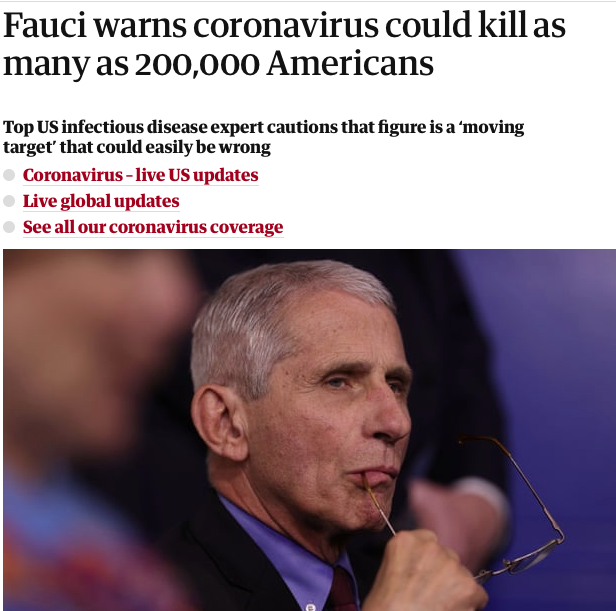
Original modelling estimates predicted that millions could die in the US. Dr. Fauci stated recently that the worst of the recent modelling estimates may result in 100,000-200,000 deaths. The 100,000-200,000 number is awful. But, it needs to be put in proper perspective. Let’s say that 200,000 Americans die of COVID-19. That means that COVID-19 will kill o.o6% of our population (200,000/329,500,000). In other words, 99.94% of us will survive. If it kills 100,000, 0.03% of us will die and 99.97% of us will live.

The death of 200,000 Americans is a big deal. But, I don’t think it deserves the fear level we are at right now. Another important point about these numbers is that COVID-19 primarily kills the elderly and those with co-morbid conditions. Those who do NOT fall into those categories have a LOWER risk of death from it. This should be wakeup call for all Americans to get healthy.   We are too heavy, eat poor diets and don’t exercise enough. Adopting a holistic health plan can not only help you feel better, it can lower your risk of dying from many diseases including COVID-19.

For comparison, 630,000 Americans die from heart disease each year.

So, my advice is STOP watching the news. They revel in the bad news and censor the good news. What good news am I talking about?

How about this news: Three US hospitals use of IV vitamin C and other low-cost, readily available drugs cut the death-rate of COVID-19-without the use of ventilators! A press release dated March 30, 2020 stated:

“If you can administer Vitamin C intravenously starting in the Emergency Room and every 6 hours thereafter, while in the hospital, the mortality rate of this disease and the need for mechanical ventilators will likely be greatly reduced,” says Dr. Pierre Kory, the Medical Director of the Trauma and Life Support Center and Chief of the Critical Care Service at the University of Wisconsin in Madison. He explains that it’s the inflammation sparked by the Coronavirus, not the virus itself, that kills patients. Inflammation causes a condition called Acute Respiratory Distress Syndrome (ARDS), which damages the lungs so that patients, suffering fever, fatigue, and the sense that their inner chest is on fire, eventually cannot breathe without the help of a ventilator.

The vitamin C is a combination therapy developed in 2017 by Dr. Paul Marik at Eastern Virginia Medical School.   He gives critically ill patients IV doses of hydrocortisone, vitamin C, and vitamin B1 within six hours of entering the emergency room. Dr. Marik reported a significantly lowered death rate in those treated with his regimen. When COVID-19 came to Virginia, Dr. Marik used his protocol. He reported saving four COVID-19 patients including an 86-year-old man admitted to the hospital with 100% oxygen. Elderly people on oxygen usually do not survive COVID-19.

Dr. J. Varon at United General Hospital In Houston reported saving 16 lives with this protocol. He reports that his patients are getting off the ventilator at 48 hours instead of 10-21 days!

My faithful readers know that I have been yelling as loudly as I can that all COVID-19 patients should be getting vitamin C IVs. IN FACT, they should be getting vitamin C IVs within six hours of entering the ER because data shows a markedly reduced mortality rate if the IV is started within six hours of admission. A delay above that markedly increases the death rate. Once 12 hours has passed, it is too late. There is no mortality benefit from the IV protocol.

So why isn’t IV vitamin C along with the other therapies Dr. Marik recommends being used in every COVID-19 patient? I am rarely at a loss for words, but here I am.

IT IS INFURIATING! I have shown you our success in treating COVID-19 patients with a holistic protocol that includes oral dosing of vitamins A, C, D, and iodine as well as IV vitamin C, ozone, and hydrogen peroxide. I passed along the information I presented above to two local hospitals and offered my services to explain how to properly administer IV nutrients. To date, I have heard that one of the hospitals is using vitamin C.  That is great news.  I hope the results mirror Dr. Marik’s results.

Conventional medicine can wait for a vaccine. At the Center for Holistic Medicine, we know there is not time to wait for a vaccine. Natural therapies work. It is time for you to find a holistic doctor who understands the best way to treat COVID-19 (and many other illnesses) is to support the host.  In particular, provide the immune system with the right nutrients so that it can appropriately fight back and overcome the disease.

Final Thoughts:

The press release regarding the success with vitamin C in treating COVID was sent to me late at night Monday (March 30, 2020).   On Tuesday morning, I had a meeting with my nurses and said, “Finally, the hospitals are going to start using vitamin C on COVID patients. They are going to see what we have been seeing.”

I guess I called that one wrong. I thought the press release would be the lead story on Fox, CNN, MSN, and every other media outlet. I thought there would be a run on IV vitamin C. I guess good news is not worth reporting. I say turn off the news. It is not worth watching. In fact, it is shameful. Where are the vitamin C reports? What about the reports that hydroxychloroquine appears to be helping?

Folks, there is other good news about COVID that I want to share. I will report that to you soon.

It is most important to keep in mind that if the worst-case modelling estimate comes true–200,000 die– 99.94% of us will be ok. And, I believe those estimates are too high.  More about that later.

To All Our Health,
~DrB


Be seeing you


Posted in Uncategorized | Tagged: , , , , | Leave a Comment »

‘The alleged cure is immensely worse than the disease’ – spiked

Posted by M. C. on April 6, 2020

https://www.spiked-online.com/2020/04/03/the-alleged-cure-is-immensely-worse-than-the-disease/

Peter Hitchens on the dangerous folly of the Covid-19 shutdown.

In the past few weeks, society has been shut down, the economy has been put on hold, and civil liberties have been curtailed in the name of fighting against coronavirus. There has been hardly any scrutiny of or opposition against these ever-stricter measures. Mail on Sunday columnist Peter Hitchens has been one of the few dissenting voices in the media. He joined spiked editor Brendan O’Neill for the latest episode of The Brendan O’Neill Show. What follows is an edited extract. Listen to the full conversation here.

Brendan O’Neill: We live in a country where parliament has been suspended, our most basic freedoms have been eroded, we are all virtually under house arrest, and there are a whole bunch of new rituals we all have to observe when we encounter other people, which is increasingly rare. Like me, are you a bit terrified by the speed and the ease with which Britain became this country?

Peter Hitchens: I wouldn’t say terrified – distressed and grieved, but not terrified. I am actually not shocked because in several controversies in recent years, where I have thought that the people of this country would stand against the way in which they were being bullied and messed around, I have noticed that there hasn’t been all that much spirit of liberty. I think there is an awful lot of conformism now in this country and people have accepted being pushed around.

I’m not sure parliament has been suspended exactly. It has just folded up or dissolved into a pool of blancmange. If it had any kind of leadership, it could insist on continuing to sit, just as it could have opposed the action or subjected it to anything remotely resembling scrutiny. But it just folded up and stole away in the night. All the institutions of civil society which are supposed to protect us did the same thing. The judiciary, the human-rights lot, the civil service, the media, parliament, Her Majesty’s Opposition and public opinion in general have simply failed to do their jobs. It has demonstrated that we don’t really have a civil society any longer.

In the Soviet Union, where I spent a lot of time, it was clear that there was only one official point of view and that people were being pushed around. I don’t recall ever being compelled to stay at home, and there was at least a pretence made of having a legislative body as well. But the point that strikes me here is that – particularly in the Eastern European countries, but also largely in Russia – most people regarded the Soviets’ rule with a certain amount of contempt and made jokes about it and realised they were being mocked and fooled. In this case, the population accepts what they are being told, without any question. It’s extraordinary. The old USSR would have loved to have had a population like that in the Western world and in the United Kingdom, which genuinely believes the propaganda and does what it is told. You could say, ‘The chocolate ration has gone up’, when in fact it has gone down and people will believe it.

‘In this lockdown, dissent is a moral duty’

Podcast

‘In this lockdown, dissent is a moral duty’

spiked

O’Neill: You have written some very solid pieces, questioning the need for this kind of shutdown. Let’s just talk for a moment about the extraordinary situation we find ourselves in. There is this novel virus, which undoubtedly causes great harm, especially to older people and to medically vulnerable people, and in response to it – which is unprecedented in human history – we have closed down virtually the whole of society and most of the economy, and in the process we have stored up immeasurable problems for the future. I think you have found it a bit of a struggle to convince people that this might not be the best way to tackle a virus?

Hitchens: It’s extraordinary. Again, the willingness of people to accept that ‘something must be done, and this is something, so we will do this’. The argument goes, ‘We have a problem, the way of solving it is to shut down the country and strangle civil liberties. Therefore, let’s do that.’

What I have been surprised by is how little examination there has been to whether there is any logic to this. It is as if you went to the doctor with measles and the doctor said that this was serious measles and the only treatment for it is to cut off your left leg. And he cuts off your left leg and then later on, you recover from the measles and he says, ‘This is fantastic. I’ve cured you of the measles, sorry about your leg.’ That is more or less what is going on now. We are being offered a supposed treatment which has nothing whatever to do with the problem.

Other countries have not resorted to these measures. We have modelled ourselves, bizarrely, on the most despotic country in the world, the People’s Republic of China, whose statistics are wholly unreliable and whose media are totally supine, so we can’t really know what is going on there. And in fact, all the countries which have had serious outbreaks of Covid-19, they have almost all reacted differently. Even Singapore and Hong Kong, which are widely praised for what they did, did different things. And yet, oddly enough, the results in Singapore and Hong Kong were quite similar. Japan has done something different. South Korea did something different. And again, the virus actually did not continue to grow at the rates which Imperial College apparently think are inevitable if we don’t shut down our society.

After the pandemic: whither capitalism?

Recommended

After the pandemic: whither capitalism?

Phil Mullan

Even if you went for the post hoc ergo propter hoc fallacy that because A happened, and B happened after it, B happened because of A, there isn’t even a basis for that – let alone anything remotely resembling research showing a causal relationship between a Chinese-type shutdown and the defeat of the disease. There are rational responses to this. And of course it seems to me, the crucial test of any policy, and indeed almost any human action, is not absolute right or absolute wrong – which very rarely arises in practical life – it is proportionality. Is the action in proportion to the problem?

If you look at the past and the problems which this country and its medical system have almost every winter, for instance with influenza, the complications of it are considerable. In one year recently, 28,000 people died of influenza because the vaccines didn’t work and it was a particularly virulent strain. The average number who die of influenza every year is 17,000 in England alone, and this does not cause the country to be shut down. It is doubtless tragic for all those involved, but you can’t use emotionalism to justify policy.

I have a quote here from Jonathan Sumption’s interview on The World At One on Monday because it simply hasn’t been stressed enough in the coverage of what he said. They have gone on about what he said about the police, which was a marginal part of what he said. His key point was this:

‘The real question is, is this serious enough to warrant putting most of our population into house imprisonment, wrecking our economy for an indefinite period, destroying businesses that honest and hardworking people have taken years to build up, saddling future generations with debt, depression, stress, heart attacks, suicides and unbelievable distress inflicted on millions of people who are not especially vulnerable, and will suffer only mild symptoms or none at all?’

Actually, that’s exactly what I think. But I’m not a former Supreme Court judge. I’m not one of Britain’s most distinguished lawyers. And I’m not one of Britain’s most distinguished historians. I’m not the deliverer of last year’s Reith Lectures. This is a perfectly valid sentiment expressed by somebody with considerable authority and wisdom. And it isn’t even reported by the media when he says it. They leave it out of the reports of what he says because no one is prepared to confront this.

There is an omertà – a total, supine, consensus over this matter. The complete failure to debate it is astonishing to me. And it’s the lack of proportion that Sumption is stressing there. Even if this were an effective policy, could it possibly be justified, given the disastrous results?

As I say, if you had a disease from which you might or might not recover, and you were offered the amputation of all four of your limbs, and perhaps your head, and were asked to sign a consent form, you would probably say no, even if it would kill you, because you would recognise that the cure was worse than the disease – a phrase which repeatedly occurs to me, even though Donald Trump has used it, which always puts people off. But it is the case.

The alleged cure – and it is only alleged in this case – is immensely worse than the disease, because what happens to a society which trashes its economy? I will tell you what happens. It is unable to afford proper health provision, all of its standards decline, its food gets worse, its air quality gets worse, its housing gets worse, its water quality gets worse, and everybody gets iller.

The other point is one made by the extraordinary Professor Sucharit Bhakdi of Mainz University in Germany, an absolute genius in the microbiological method, who is utterly against these measures. He has said, what about the healthy old now they have been deprived of all the things that make life worth living? He reckons that this shutting down of their lives will be catastrophic, and almost certainly cause large numbers of deaths. So you can’t just say, ‘Oh, you don’t care about people dying’. That’s not what the argument is about. I care about people dying unnecessarily as much as anybody else, and my motives are as good as anybody else’s. It is just that my emotions are also driven by more intelligent thought, more reason and a better grasp of the facts.

O’Neill: I think Sumption’s intervention was very useful for a number of reasons. But one of them is what you have just touched upon, which is this really poisonous accusation that has been made against anyone who criticises the shutdown of society, which is, ‘You don’t care about old people,’ or even, ‘You want old people to die.’

Hitchens: Well, during the Iraq War, if you said, ‘Actually this war is wrong’, people said, ‘Oh, so you support Saddam Hussein’s fascist regime, do you? You believe that Saddam should be allowed to torture people, do you? That’s the sort of person you are, are you?’. And because of that shutting down of serious debate on a major matter, I think this should probably be called VMD – the virus of mass destruction. It is so very similar in the attempts to crush dissent.

O’Neill: They make this completely false distinction. They say this is a question of lives versus the economy. They talk about the economy as if it’s just some kind of abstract machine, just numbers and money and profits, when in fact the economy is people’s lives and their livelihoods. It’s how we create things, it’s how we produce things. Dr John Lee made a very good point in the Spectator, which is that this is lives versus lives. And that’s the kind of debate we need to be having.

Hitchens: That’s assuming, again, that the fundamental premise that shutting down the country will do any good is true, which I believe, is seriously in doubt. I’m a Christian, and there’s this wonderful part of the scriptures in which we are said to live and move and have our being in God. But in a material way, we live and move and have our being in the economy. If nobody is buying, if nobody is selling, if nobody is working, if nobody is serving, if nobody is being served, then there is nowhere for people to live, how do we pay for our houses and our meals? How do we raise our children? How do we support an education system? How do we pay doctors or build hospitals? If we have no economy at the moment, I would reckon, if we could only know the sums, we are probably throwing three or four district general hospitals into the sea or their equivalents in money every week.

Be seeing you


Posted in Uncategorized | Tagged: , , , , | Leave a Comment »