
MCViewPoint

Opinion from a Libertarian ViewPoint

Posts Tagged ‘Edward Snowden’

Is the Government Running a Dragnet on VPN Users?

Posted by M. C. on April 7, 2026

This senator is read into classified surveillance programs. When he says “look here,” we should look.

“So when Wyden asked whether the NSA was collecting data on millions of Americans, he was asking whether the wall between foreign and domestic surveillance, one of the foundational lines in how the American security state is allowed to operate, had quietly been taken down.

“Clapper said, “No, sir.”

Three months later, Edward Snowden’s leaks revealed that the NSA was, in fact, collecting phone metadata on essentially every call placed in the United States. Clapper had lied to Congress under oath

NBTV Media

In March 2013, something interesting happened that almost nobody noticed at the time, but became enormous news three months later.

Senator Ron Wyden was questioning James Clapper, the Director of National Intelligence, in an open hearing of the Senate Intelligence Committee. Wyden asked him a simple question: “Does the NSA collect any type of data at all on millions or hundreds of millions of Americans?”

To understand why this question mattered, you have to understand what the NSA is supposed to be. The National Security Agency is a foreign intelligence agency. Its job is to spy on foreign governments, foreign militaries, and foreign nationals abroad. This kind of work would be flatly unconstitutional if pointed inward. Domestic investigations are supposed to belong to the FBI, which has to play by Fourth Amendment rules and requires warrants, probable cause, and judicial oversight.

The wall between the NSA and FBI exists for a reason: we have built all kinds of powerful tools for foreign surveillance, like bulk collection, warrantless interception, and dragnet monitoring. But the Constitution was written to expressly prohibit the government from turning this machinery of war and broad surveillance powers against its own citizens.

So when Wyden asked whether the NSA was collecting data on millions of Americans, he was asking whether the wall between foreign and domestic surveillance, one of the foundational lines in how the American security state is allowed to operate, had quietly been taken down.

Clapper said, “No, sir.”

Wyden pressed. Clapper added: “Not wittingly.”

Three months later, Edward Snowden’s leaks revealed that the NSA was, in fact, collecting phone metadata on essentially every call placed in the United States. Clapper had lied to Congress under oath. He later apologized for what he called his “clearly erroneous” testimony, claiming he’d given the “least untruthful” answer he could think of. He was never charged; the statute of limitations expired in 2018.

But let’s focus on the most relevant part of this story: Why did Wyden ask the question in the first place?

Wyden already knew the answer

Wyden sits on the Senate Intelligence Committee. It’s one of two committees (the other is in the House) whose members get read in to classified intelligence programs. It’s their job to make sure the intelligence community is operating above board. These committees are small, and the rest of Congress and the public stay in the dark, on a need-to-know basis.

So when Wyden asked Clapper whether the NSA was collecting data on millions of Americans, Wyden already knew the answer was yes. He’d been briefed. And when Clapper said “no,” Wyden knew, in real time, that the Director of National Intelligence was lying to Congress.

But Wyden couldn’t just stand up and tell the country what he knew. He was bound by classification rules. Asking the question in open session, with the answer pre-submitted to Clapper’s office a day in advance, was one of the only tools he had to let Congress know that he believed the intelligence community was running an illegal program.

He turned out to be right. In 2015, the Second Circuit ruled in ACLU v. Clapper that the NSA’s bulk phone records program exceeded what Congress had authorized under the Patriot Act. In 2020, the Ninth Circuit went further, holding that the program had violated federal surveillance law and was likely unconstitutional as well.

In fact, the 2015 court was pointed about why this mattered.

Congress, the judges wrote, “cannot reasonably be said to have ratified a program of which many members of Congress — and all members of the public — were not aware.”

Only a small circle of lawmakers on the intelligence committees knew. The rest of Congress, voting to reauthorize the Patriot Act, did not. Neither did the public. You cannot meaningfully consent to a program whose existence has been deliberately hidden from you.

But back to Wyden’s question: It’s a pattern worth remembering.

When Senator Wyden goes out of his way to ask a pointed question about a surveillance program, it’s usually because he already knows something he can’t say out loud.
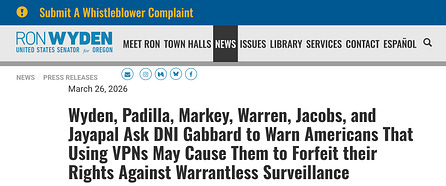
Wyden: “Pay Attention To VPNs”

Which brings us to last week.

On March 26, 2026, Wyden (along with a handful of other Senators) sent a letter to the current Director of National Intelligence, Tulsi Gabbard. The letter asks Gabbard to publicly warn Americans that using a VPN may cause them to forfeit their Fourth Amendment rights against warrantless surveillance.

The mechanism is explained in Wyden’s press release: Under Section 702 of FISA and Executive Order 12333, when the U.S. government can’t tell what country a person is in, it’s allowed to assume that person is a foreigner. Foreigners outside the United States have no Fourth Amendment rights, and a VPN hides where you are.

So while these tools are used as a privacy protection, the intelligence community might be quietly stripping you of constitutional protections against your own government.

We don’t know exactly what Wyden has been briefed on. But the pattern from 2013 is clear: when he asks a pointed question in public, it’s usually because of something he can’t say out loud.

And then there’s the third-party doctrine

This Section 702 loophole is bad enough on its own. But there’s a second legal mechanism worth raising.

Under the third-party doctrine, U.S. law enforcement currently takes the position that it doesn’t need a warrant to obtain information you’ve voluntarily handed to a third party, such as your bank, your phone company, and your ISP. The doctrine traces back to the Katz “reasonable expectation of privacy” test: the Fourth Amendment kicks in only where you have a reasonable expectation of privacy, and the government’s argument is that once you’ve given data to someone else, that expectation disappears.

Now apply that to a VPN. A VPN routes 100% of your internet traffic through a third party. Under the government’s theory, that traffic is fair game without a warrant.

Which produces a genuinely absurd result: the legal system says you have no reasonable expectation of privacy in data you handed to a service whose entire purpose is privacy. The tool you bought specifically to assert a privacy interest is recharacterized as the act of waiving it.

In Carpenter v. United States (2018), the Supreme Court carved an exception into the third-party doctrine, holding that the government does need a warrant to obtain historical cell-site location data, on the theory that some kinds of third-party data are too revealing to fall under the old rule. VPN traffic seems like an even stronger candidate. It might be time for someone who uses a VPN to sue the government.

Ludlow Institute’s NBTV Newsletter is funded by community support. Consider becoming a free or paid subscriber.

Upgrade to paid

What Now?

So should we, or should we not, be using a VPN? The honest answer is that there’s no clean solution, because the problem isn’t really VPNs. The problem is that the entire modern internet is built on handing your data to third parties, such as your ISP, your DNS resolver, your email provider, the ad networks embedded in every website you visit, and so on. And the third-party doctrine turns every one of those interactions into a warrantless surveillance opportunity. A VPN just shifts which third party holds your traffic, it doesn’t change the underlying legal theory that says the government can help itself to it without a warrant.

That said, I still use a VPN, and I’m going to keep using one. I don’t want my IP address handed to every website I interact with, and the protection a VPN offers against that is real, even if it’s narrower than the marketing suggests. But it’s really important to be careful about which one. As I covered in a previous video, an overwhelming number of VPN providers are just data-collection shells, and some are outright malware. “Use a VPN” isn’t the advice. “Use a VPN you’ve actually vetted” is closer.

Longer term, it’s time to explore the tools that can’t aggregate your data in the first place. I’ve been digging into decentralized VPNs and mixnets lately, and if you’ve used any, I’d love to hear about your experience.

But the deeper fix is actually legal: The third-party doctrine is a relic of a world where “data you gave to someone else” meant a very narrow scope of information. It does not belong in a digital age that turns everything we do into data held by someone else.

As long as the third-party doctrine stands, we lose one of the most important protections we have against the government’s ability to surveil its own citizens: the warrant requirement. It’s a loophole the size of the entire internet. Closing that loophole is how we get the Fourth Amendment back.

Yours In Privacy,
Naomi

Consider supporting our nonprofit so that we can fund more research into the surveillance baked into our everyday tech. We want to educate as many people as possible about what’s going on, and help write a better future. Visit LudlowInstitute.org/donate to set up a monthly, tax-deductible donation.
Posted in Uncategorized | Tagged: , , , , | Leave a Comment »

Fighting the Surveillance State Begins with the Individual | Mises Wire

Posted by M. C. on October 26, 2023

It’s a simple fact of life that when the government is given a power—whether that be to regulate, surveil, tax, or plunder—it is nigh impossible to wrestle it away from the state outside somehow disposing of the state entirely. This is why the issue of undoing mass surveillance is of the utmost importance. If the government has the power to spy on its populace, it will.

https://mises.org/wire/fighting-surveillance-state-begins-individual

Joseph Lawrence

It’s a well-known fact at this point that in the United States and most of the so-called free countries that there is a robust surveillance state in place, collecting data on the entire populace. This has been proven beyond a shadow of a doubt by people like Edward Snowden, a National Security Agency (NSA) whistleblower who exposed that the NSA was conducting mass surveillance on US citizens and the world as a whole.

The NSA used applications like those from Prism Systems to piggyback on corporations and the data collection their users had agreed to in the terms of service. Google would scan all emails sent to a Gmail address to use for personalized advertising. The government then went to these companies and demanded the data, and this is what makes the surveillance state so interesting. Neo-Marxists like Shoshana Zuboff have dubbed this “surveillance capitalism.”

In China, the mass surveillance is conducted at a loss. Setting up closed-circuit television cameras and hiring government workers to be a mandatory editorial staff for blogs and social media can get quite expensive. But if you parasitically leech off a profitable business practice it means that the surveillance state will turn a profit, which is a great asset and an even greater weakness for the system.

You see, when that is what your surveillance state is predicated on you’ve effectively given your subjects an opt-out button. They stop using services that spy on them. There is software and online services that are called “open source,” which refers to software whose code is publicly available and can be viewed by anyone so that you can see exactly what that software does. The opposite of this, and what you’re likely already familiar with, is proprietary software. Open-source software generally markets itself as privacy respecting and doesn’t participate in data collection. Services like that can really undo the tricky situation we’ve found ourselves in.

It’s a simple fact of life that when the government is given a power—whether that be to regulate, surveil, tax, or plunder—it is nigh impossible to wrestle it away from the state outside somehow disposing of the state entirely. This is why the issue of undoing mass surveillance is of the utmost importance. If the government has the power to spy on its populace, it will.

See the rest here

Be seeing you

Posted in Uncategorized | Tagged: , , , | Leave a Comment »

EXPOSED: Biggest FBI Spy Scandal of the Year

Posted by M. C. on May 31, 2023

But will Congress finally stop the federal spying spree on Americans? As I tweeted on December 27, 2012, “FISA Renewal: Only a fool would expect members of Congress to give a damn about his rights and liberties.” Without radical reform, FISA should be renamed the “Trust Me, Chumps!” Surveillance Act.

https://libertarianinstitute.org/articles/exposed-biggest-fbi-spy-scandal-of-the-year/

by Jim Bovard

jpb photo mass anti spying demonstration dsc 0867 scaled

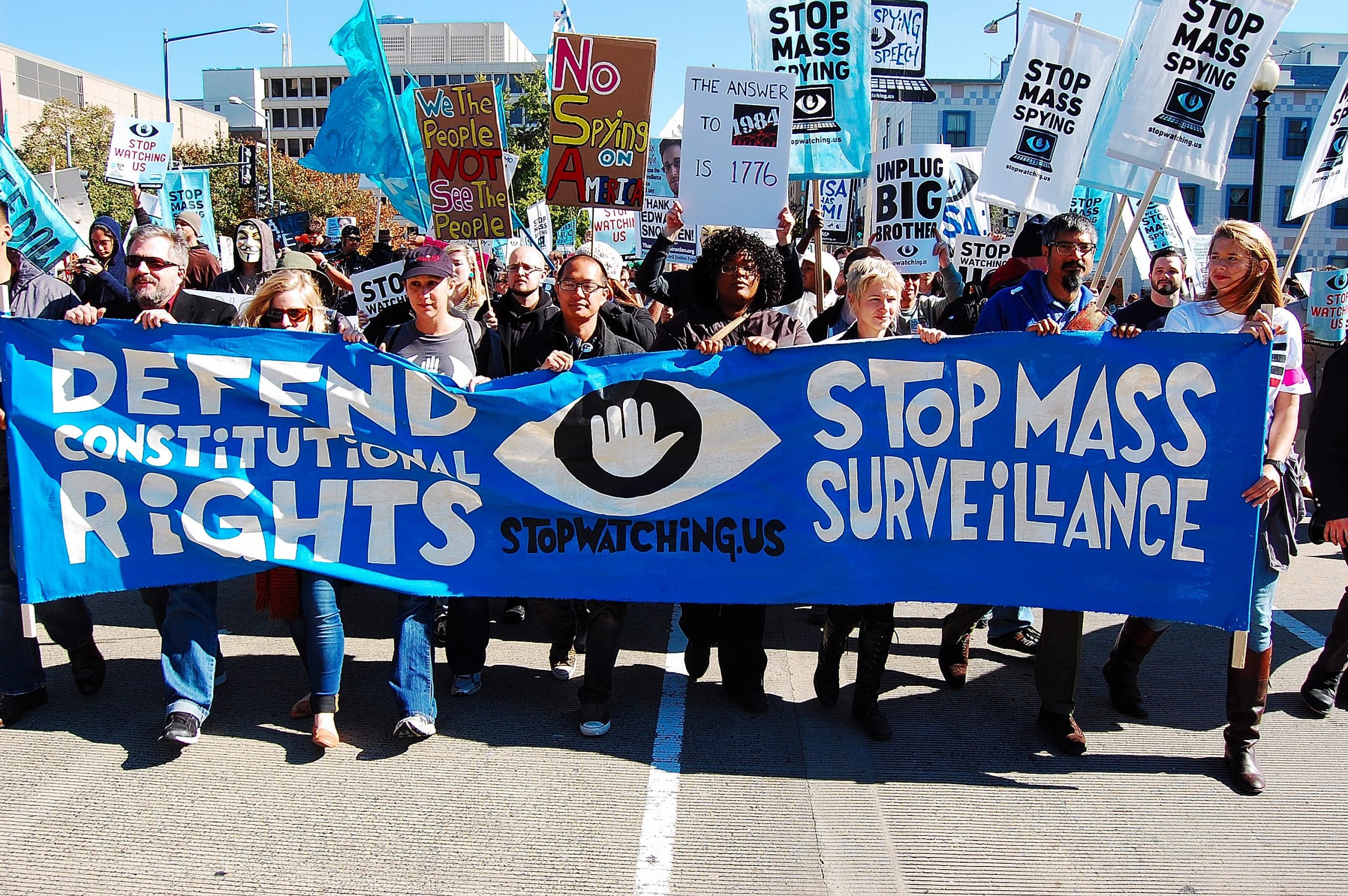
A Foreign Intelligence Surveillance Court opinion released last week revealed that the FBI violated the constitutional rights of 278,000 Americans in 2020 and 2021 with warrantless searches of their email and other electronic data. For each American that the FISA court permitted the FBI to target, the FBI illicitly surveiled almost a thousand additional Americans. This is only the latest federal surveillance scandal stretching back to the years after 9/11.

The FISA law was enacted in 1978 to curb the rampant illegal political spying exposed during the Richard Nixon administration. After the 9/11 attacks, the George W. Bush administration decided that the president was entitled to order the National Security Agency to vacuum up Americans’ emails and other data without a warrant. After The New York Times exposed the surveillance scheme in late 2005, Attorney General Alberto Gonzales announced that “the president has the inherent authority under the Constitution, as commander in chief, to engage in this kind of activity.” Gonzales apparently forgot the congressional impeachment proceedings against President Nixon. The Bush White House also asserted that the September 2001 “Authorization to Use Military Force” resolution Congress passed entitled Bush to tap Americans’ phones. But if the authorization actually allowed the president to do whatever he thinks necessary on the homefront, Americans had been living under martial law.

Federal judges disagreed with Bush’s prerogative to obliterate American privacy. The result was a 2008 FISA reform that authorized the feds to continue commandeering vast amounts of data. But under Section 702 of that law, the FBI was permitted to conduct warrantless searches of that stash for Americans’ data only to seek foreign intelligence information or evidence of crime.   

President Barack Obama responded to the new law by sharply expanding the NSA’s seizures of Americans’ personal data. The Washington Post characterized Obama’s first term as “a period of exponential growth for the NSA’s domestic collection.” Obama’s Justice Department thwarted court challenges to the surveillance, thereby permitting the White House to claim that it was respecting Americans’ rights and privacy.

Edward Snowden blew the roof off the surveillance state with his disclosures starting in June 2013. But there was no reason to presume that federal crime sprees were not occurring before Snowden blew the whistle. Professor David Rothkopf explained in 2013 how FISA’s Section 702 worked:

“What if government officials came to your home and said that they would collect all of your papers and hold onto them for safe-keeping, just in case they needed them in the future. But don’t worry…they wouldn’t open the boxes until they had a secret government court order…sometime, unbeknownst to you.”

The 2008 FISA amendments and Section 702 snared vast numbers of hapless Americans in federal surveillance nets. The Washington Post analyzed a cache of 160,000 secret email conversations/threads (provided by Snowden) that the NSA intercepted and found that nine out of ten account holders were not the “intended surveillance targets but were caught in a net the agency had cast for somebody else.” Almost half of the individuals whose personal data was inadvertently commandeered were U.S. citizens. The files “tell stories of love and heartbreak, illicit sexual liaisons, mental-health crises, political and religious conversions, financial anxieties and  disappointed hopes,” the Post noted. If an American citizen wrote an email in a foreign language, NSA analysts assumed they were foreigners who could be surveilled without a warrant.

Snowden also leaked secret court rulings that proved that the FISA Court had “created a secret body of law giving the National Security Agency the power to amass vast collections of data on Americans,” The New York Times reported in 2013. FISA judges rubberstamped massive seizures of Americans’ personal data that flagrantly contradicted Supreme Court rulings on the Fourth Amendment. The Times noted that the FISA court had “become almost a parallel Supreme Court, serving as the ultimate arbiter on surveillance issues,” and almost always giving federal agencies all the power they sought.

See the rest here

Be seeing you

Posted in Uncategorized | Tagged: , , , , , | Leave a Comment »

Flashback 2017: Security or Surveillance? … Edward Snowden on The Ron Paul Liberty Report

Posted by M. C. on December 30, 2022

The Ron Paul Liberty Report

https://rumble.com/v22m2fw-flashback-2017-security-or-surveillance-…-edward-snowden-on-the-ron-paul-.html

Be seeing you

Posted in Uncategorized | Tagged: , , | Leave a Comment »

Watch “”It Happens With This Device! I Never Use It!” Edward Snowden” on YouTube

Posted by M. C. on January 15, 2022

Edward Snowden talks about Google, Facebook and Apple. And what is happening behind these companies.

https://youtu.be/ZeaYBp-kVHM

Be seeing you

Posted in Uncategorized | Tagged: , , , | Leave a Comment »

A Republic of Spies – LewRockwell LewRockwell.com

Posted by M. C. on January 13, 2022

What has it collected? Quite simply, everything it can get its hands on. These domestic spies — the CIA, the NSA, even the FBI — all have access to every keystroke and all data on every digital device everywhere in the United States, without a warrant.

https://www.lewrockwell.com/2022/01/andrew-p-napolitano/a-republic-of-spies/

By Andrew P. Napolitano

Late last Friday, the National Counterintelligence and Security Center warned the American public against the dangers of spyware manufactured by one Israeli corporation. Spyware is unwanted software that can expose the entire contents of one’s mobile or laptop device to prying eyes

This warning from the feds, issued with a straight face, is about as credible as American television executives warning about the dangers of watching too many British period dramas.

Here is the backstory.

Though America has used the services of spies since the Revolutionary War, until the modern era, spying was largely limited to wartime. That changed when America became a surveillance state in 1947 with the public establishment of the Central Intelligence Agency and the secret creation of its counterparts.

The CIA’s stated public task at its inception was to spy on the Soviet Union and its satellite countries so that American officials could prepare for any adverse actions by them. This was the time of the Red Scare, in which both Republicans and Democrats fostered the Orwellian belief that America needed a foreign adversary.

We had just defeated Germany in World War II, and an ally of ours in that war — an ally that suffered horrendous losses — suddenly became so strong it needed to be kept in check. The opening salvo in this absurd argument was fired by President Harry Truman in August 1945 when he used nuclear bombs intentionally to target civilians of an already defeated Japan. One of his targets was a Roman Catholic cathedral.

But his real target — so to speak — was his new friend, Joe Stalin.

When Truman signed the National Security Act into law in 1947, he also had Stalin in mind. That statute, which established the CIA, expressly stated that it shall have no internal intelligence or law enforcement functions and its collections of intelligence shall come from outside the United States.

These limiting clauses were integral to the statute creating the CIA, as members of Congress who crafted it feared the U.S. was creating the type of internal surveillance monster that we had just defeated in Germany.

Of course, no senior official in presidential administrations from Truman to Joseph R. Biden has taken these limitations seriously. Last week, this column reminded readers that as recently as the Obama administration, the CIA boasted that it had the capability of receiving data from all computer chips in the homes of Americans.

The same column reminded state lawmakers that, contrary to the law that created it, the CIA is physically present in all 50 state houses in America. What is it doing there?

Fast-forward to today and we know that the CIA has rivals in the government for the acquisition of intelligence data. Today, the feds admit to funding and empowering 16 domestic intelligence agencies — spies next door. The most notorious of these is the National Security Agency, which, when it last reported, employs 60,000+ persons, mostly civilians, with military leadership.

What do they do? They spy on Americans. We know this thanks to the personal courage of Edward Snowden and others who chose to honor their oaths to uphold the Constitution. NSA spying has produced so much data that the NSA recently built in Utah the second largest building in the U.S. — after the Pentagon — for use as a storage facility of the data it has collected; and it is running out of room.

See the rest here

Be seeing you

Posted in Uncategorized | Tagged: , , , , | Leave a Comment »

The CIA Has Stultified American Consciences – The Future of Freedom Foundation

Posted by M. C. on October 11, 2021

To get America back on the right track, what we need is a moral awakening, one that entails the operation of conscience. If that day were to come, there is no doubt that the American people would cast the CIA into the dustbin of history, where all evil agencies belong.

https://www.fff.org/2021/10/05/the-cia-has-stultified-american-consciences/

by Jacob G. Hornberger

REMINDER: Tonight, 7 p.m. Eastern Time, via Zoom: Tufts University professor of law Michael Glennon‘s presentation as part of our ongoing conference series on restoring civil liberties in America. To receive a zoom link, register at our conference web page. Registration fee: FREE.

****

One of the worst consequences of converting the federal government to a national-security state has been the stultification or warping of the consciences of the American people. With unwavering allegiance to the Pentagon, the CIA, and the NSA, all too many Americans have sacrificed their sense of right and wrong at the altar of “national security,” the two-word term that has become the most important term in the political lexicon of the American people.

The best example of this phenomenon is the CIA’s power of assassination. Most Americans have come to passively accept this power, with nary a thought as to the victims against whom it is carried out and under what what circumstances it is carried out.

Consider recent revelations that the CIA was planning to assassinate Julian Assange, the head of WikiLeaks, for disclosing dark-side secrets of the U.S. deep state to to the world. 

That’s why U.S. officials have pursued him with a vengeance — not because he lied about the Pentagon’s and the CIA’s dark-side activities but rather because he disclosed the truth about them. 

That’s why they were seeking to murder him — to silence him, to punish him, and to send a message to other potential disclosers of dark-side secrets of the national-security establishment. 

But anyone with a conscience that is operating would easily see that assassinating Assange would be just plain murder. And at the risk of belaboring the obvious, the murder of an innocent person is just plain evil. 

Yet, the reaction to all this from the mainstream press has been one great big collective yawn. No big deal. It’s just another state-sponsored assassination intended to protect “national security.” If U.S. national-security state officials have decided that Assange needs to be taken out, then that’s just the way it is. That’s why we have a CIA, after all. We have to defer to its judgment, even if it means sacrificing our consciences in the process. After all, that’s its job — to protect “national security.”

By the way, there is virtually no doubt that if they could get away with assassinating Edward Snowden for disclosing the truth about NSA dark-side activity, they would murder him too. The probable reason they haven’t assassinated Snowden is because they haven’t figured out a way to get the assassins out of Russia.

When the federal government was converted to a national-security state after World War II, the American people made an implicit bargain with the devil. The bargain empowered the national-security establishment to engage in dark-side activity, including assassination. But another part of the bargain was that officials would keep their dark-side activity secret from the American people so that people wouldn’t have to deal with their consciences over a governmental entity that was assassinating people. 

Assange’s and Snowden’s great “crime” was in violating that pact. By bringing dark-side activity to the attention of the American people, they ran the risk that people’s consciences might start operating. 

So far, there appears to be no risk of that happening. Consider, for example, the assassination of Iranian General Qassem Suleimani. That was just plain murder. Iran and the United States are not at war with each other. Sure, we are told that Iran is a “rival,” an “enemy,” an “opponent,” or an “adversary,” but does that morally entitle U.S. officials to murder Iranian officials? It does not, just as it doesn’t entitle Iranian officials to murder U.S. officials. 

Again, however, the reaction among the mainstream press to the assassination of Suleimani was one great big collective yawn. Revealingly, there was also no moral outrage expressed among church ministers across America. If the Pentagon and the CIA deemed it necessary to assassinate Suleiman, that’s all we need to know. 

To get America back on the right track, what we need is a moral awakening, one that entails the operation of conscience. If that day were to come, there is no doubt that the American people would cast the CIA into the dustbin of history, where all evil agencies belong.

Be seeing you

Posted in Uncategorized | Tagged: , , , , | Leave a Comment »

Silencing Julian Assange: Why Bother With a Trial When You Can Just Kill Him? — Strategic Culture

Posted by M. C. on October 10, 2021

Or, as Assange’s lawyer put it more to the point, “As an American citizen, I find it absolutely outrageous that our government would be contemplating kidnapping or assassinating somebody without any judicial process simply because he had published truthful information.” Unfortunately, that is not all that the Assange case is about. It is not just a question of truth or fiction and journalistic ethics, but rather an issue of the abuses enabled by powerful men who believe that their power is unlimited.

https://www.strategic-culture.org/news/2021/10/07/silencing-julian-assange-why-bother-with-trial-when-you-can-just-kill-him/

Philip Giraldi

An English friend recently learned about the U.S. Central Intelligence Agency (CIA) plan to either kidnap or kill journalist Julian Assange and quipped “I’ll bet he’s happy to be safe and sound in Belmarsh Prison if he has a chance to read about that!” I replied that his time in Belmarsh has been made as demeaning as possible by an English judge and the British are just as capable of executing a Jeffrey Epstein suicide or “accident” if called upon to do so by their American “cousins.” He agreed, reluctantly. Indeed, the roles of American allies Britain and Australia in what is turning out to be one of the world’s longest-playing judicial dramas has been reprehensible.

For those readers who have missed some of the fun of the Assange saga, a recap is in order. Julian Assange, an Australian citizen who was living in London, was the Editor in Chief and driving force behind Wikileaks, which debuted in 2006 and was one of the alternative news sites that have sprung up over the past twenty years. WikiLeaks was somewhat unique in that it often did not write up its own stories but rather was passed documentary material by sources in government and elsewhere that it then reprinted without any editing.

Assange attracted the ire of the ruling class when he obtained in 2010 a classified video from an unidentified source that showed an unprovoked 2007 shooting incident involving U.S. Army helicopters in Baghdad in which a dozen completely innocent people were killed. The government’s anger at WikiLeaks intensified when, in 2013, Edward Snowden, a National Security Agency contractor, fled to Hong Kong with classified material that demonstrated that the U.S. government was illegally spying on Americans. WikiLeaks also reportedly helped to arrange Snowden’s subsequent escape to Russia from Hong Kong.

The bipartisan animus directed against WikiLeaks intensified still further in the summer of 2016 when the group’s website began to release emails from the Democratic Party and Hillary Clinton’s campaign. The immediate conclusion propagated by Team Hillary but unsupported by facts was that Russian intelligence had hacked the emails and given them to WikiLeaks.

It was perhaps inevitable that Assange’s reporting, which has never been found to be factually inaccurate, was in some circles claimed to be based on information provided to him by Russian hackers. Even though he repeatedly denied that that was the case and there are technical reasons why that was unlikely or even impossible, this led to a sharp Russophobic response from a number of intelligence and law enforcement services close to the United States. Assange was charged in Britain in November 2010 on an international warrant demanding that he be extradited to Sweden over claims that he had committed rape in that country, an accusation which later turned out to be false. He posted bail but lost a legal battle to annul the warrant and then skipped a preliminary hearing in London in June 2012 to accept asylum in the Ecuadorean Embassy, which has diplomatic immunity. He stayed in the Embassy for eighty-two months, at which point a new government in Quito made clear that his asylum would be revoked and he would be expelled from the building. He was preparing to leave voluntarily in April 2019 when police arrived and he was arrested on a charge of his failure to appear in court seven years before which was regarded as “bail jumping.” He was sent immediately to Belmarsh high security prison, where Britain’s terrorist prisoners are confined.

After his arrest, Assange continued to be incarcerated due to a U.S. Justice Department extradition request based on the Espionage Act of 1918, apparently derived from possible interaction with the Chelsea Manning whistleblower case. Assange has now been in Belmarsh for 29 months in spite of increasing international pressure asserting that he is a journalist and should be released. The British have hesitated to extradite him on the basis of the evidence produced by the U.S. government, which included the claim that Assange aided the former U.S. Army analyst Manning break into a classified computer network in order to obtain and eventually publish classified material, but they have likewise failed to release him. The British judge denied extradition in January, suggesting that if he were to be returned forcibly to the U.S. he would likely commit suicide, but she also denied Assange bail as he was considered to be a flight risk. The U.S. appealed that verdict and the next hearing is scheduled for the end of October. It should be noted that no evidence produced by the Justice Department has plausibly linked Assange to the Russian intelligence services.

Which brings us to the Yahoo news revelation regarding the CIA plot to shoot, poison or kidnap Assange while he was sheltering in the Ecuadorian Embassy. It goes something like this: in 2017, Assange’s fifth year in the Embassy, the CIA debated going after him to end the alleged threat posed to government secrets by him and his organization, which was still operating and presumed to be in contact with him. WikiLeaks had at that time been publishing extremely sensitive CIA hacking tools, referred to as “Vault 7,” which constituted “the largest data loss in CIA history.”

In an April 2017 speech, Donald Trump’s new CIA Director Mike Pompeo said “WikiLeaks walks like a hostile intelligence service and talks like a hostile intelligence service and has encouraged its followers to find jobs at the CIA in order to obtain intelligence. It’s time to call out WikiLeaks for what it really is: a non-state hostile intelligence service often abetted by state actors like Russia.” It was a declaration of war. The label “non-state hostile intelligence service” is a legal designation which more-or-less opened the door to non-conventional responses to eliminate the threat. CIA Stations where WikiLeaks associates were known to be present were directed to increase surveillance on them and also attempt to interdict any communications they might seek to have with Assange himself in the embassy. A staff of analysts referred to as the “WikiLeaks Team” worked full time to target the organization and its leaders.

At the top level of the Agency debate over more extreme options prevailed, though there were legitimate concerns about the legality of what was being contemplated. In late 2017, in the midst of the debate over possible kidnapping and/or assassination, the Agency picked up alarming though unsubstantiated reports that Russian intelligence operatives were preparing plans to help Assange escape from the United Kingdom and fly him to Moscow.

CIA responded by preparing to foil Assange’s possible Russian-assisted departure to include potential gun battles with Moscow’s spies on the streets of London or crashing a car into any Russian diplomatic vehicle transporting Assange to seize him. One scenario even included either blocking the runway or shooting out the tires of any Russian plane believed to be carrying Assange before it could take off for Moscow. Pompeo himself reportedly favored what is referred to as a “rendition,” which would consist of breaking into the Ecuadorian Embassy, kidnapping Assange, and flying him clandestinely to the U.S. for trial. Others in the national security team favored killing Assange rather than going through the complexity of kidnapping and removing him. Fortunately, saner views prevailed, particularly when the British refused to cooperate in any way with activity they regarded as clearly illegal.

So Assange is still in prison and what does it all mean? The only possible charge that would convincingly demonstrate that Assange was spy paid by Russia would be related to his possibly helping Chelsea Manning to circumvent security to steal classified material, but there is no real evidence that Assange actually did that or that he is under Russian control. So that makes him a journalist. That he has embarrassed the United States, most often when it misbehaves, is what good journalists do. But beyond that the disgraceful CIA plans to kill or abduct Assange as an option to get rid of him reveal yet again the dark side of what the United States of America has become since 9/11.

More to the point, getting rid of Assange will accomplish nothing. He worked with a number of like-minded colleagues who have been more than able to pick up where he left off. He has been largely incommunicado since he has been languishing in Belmarsh Prison and it is his associates who have continued to solicit information and publish it on their site. Mike Pompeo’s unapologetic response to this assassination or kidnapping story was “They were engaged in active efforts to steal secrets themselves, and pay others to do the same …” Of course, if all that were true Mike and the government lawyers have had an opportunity to demonstrate just that in a British court. They couldn’t do so and instead promoted the easier option of just killing someone for publishing something true. And assassination is a blunt instrument that rarely accomplishes anything. One recalls that in January 2020 Pompeo certainly participated in the assassination of Iranian General Qasem Soleimani and Iraqi Militia Leader Muhandis in Baghdad. What did that accomplish apart from turning a nominally friendly Iraq hostile to the U.S. presence?

Or, as Assange’s lawyer put it more to the point, “As an American citizen, I find it absolutely outrageous that our government would be contemplating kidnapping or assassinating somebody without any judicial process simply because he had published truthful information.” Unfortunately, that is not all that the Assange case is about. It is not just a question of truth or fiction and journalistic ethics, but rather an issue of the abuses enabled by powerful men who believe that their power is unlimited. That is the real abyss that the United States has fallen into and the only way out is to finally hold such people, starting with Pompeo, accountable for what they have done.

Be seeing you

Posted in Uncategorized | Tagged: , , , , | Leave a Comment »

Watch “”It Happens To Everyone! Be Careful With This Device!” Edward Snowden” on YouTube

Posted by M. C. on September 8, 2021

Edward Snowden’s Ultimate Warning! The Biggest Spy Trap In The World! “You Are Being Spied 24/7”

https://youtu.be/zekWsnLHH3w

Be seeing you

Posted in Uncategorized | Tagged: , | Leave a Comment »

Watch “””You Think Your Phone It’s Off, But It’s Not!” | Edward Snowden Part 1/2″ on YouTube

Posted by M. C. on September 7, 2021

“Google keeps a permanent record of everything you type”.

https://youtu.be/0dGqR4ue8dg

Be seeing you

Posted in Uncategorized | Tagged: , | 1 Comment »