MCViewPoint

Opinion from a Libertarian ViewPoint

Archive for the ‘Uncategorized’ Category

America’s Little-Known Mission to Support Al Qaeda’s Role in Libya | The National Interest

Posted by M. C. on August 14, 2019

https://nationalinterest.org/feature/americas-little-known-mission-support-al-qaedas-role-libya-73271

by Alan J. Kuperman

THE 2011 intervention in Libya, authorized by the United Nations and led by the United States and some NATO allies, has been criticized for two main reasons. First, it was justified on phony grounds—that Libyan leader Muammar el-Qaddafi was slaughtering civilians, when in fact he was carefully targeting rebels who had attacked first. Second, the interveners aimed at regime change and thus failed in their ostensible humanitarian mission, instead magnifying the death toll at least ten-fold while fostering anarchy that persists until the present day. Yet perhaps the most profound drawback has remained hidden: the intervention rescued a rebellion that was actually led by Al Qaeda militants, not by pro-Western liberals as reported at the time.

This starkly contradicts the press narrative of 2011, which claimed that Libya’s unrest had started with peaceful protests over the arrest of a human rights lawyer. Allegedly, the regime used lethal force against these nonviolent demonstrators, compelling them to reluctantly take up arms in self-defense. These amateur rebels then supposedly seized control of eastern Libya within days, prompting Qaddafi to deploy forces to commit genocide, which was stopped only by intervention. In reality, however, scholars and human rights groups have long disproved key parts of this story: the uprising was violent from the first day, the regime targeted militants rather than peaceful protesters and Qaddafi never even rhetorically threatened unarmed civilians.

The remaining mystery has been who actually launched the rebellion in eastern Libya—that is, which militants did the interveners rescue from defeat and help overthrow Qaddafi? The conventional narrative improbably suggests that Libyan human rights lawyers, reacting spontaneously to regime violence, somehow acquired arms and conquered half the country in a week. The truth makes much more sense: the rebellion was led by Islamist veterans of wars in Afghanistan, Iraq and Libya. Thus, the United States and its allies, not realizing it at the time, intervened to support Al Qaeda.

This remarkable story has remained obscured for eight years due to deceit and gullibility. The deception was spearheaded by Libya’s non-Islamist opposition groups who sought intervention to overthrow Qaddafi by falsely claiming he was massacring civilians. The gullible audience was initially the international news media, which parroted the propaganda, and then Western politicians who responded with intervention. Meanwhile, the Islamist rebels refrained from touting their Al Qaeda connection, in order to benefit from the interveners’ supply of airpower, weapons and training.

After years of research, I unraveled this mystery starting with an unlikely source: YouTube. Perhaps not surprisingly, in the age of smartphones, some rebels videoed their exploits and uploaded them in near real time. Western analysts largely overlooked this evidence because it was unconventional, posed language barriers and contradicted the conventional wisdom. However, the videos suggest an alternative history, which I was able to confirm using retrospective interviews and fragments of contemporaneous reporting that had been overwhelmed at the time by the flood of propaganda.

This evidence reveals that the Islamists planned the launch of the rebellion prior to any peaceful protests and then used snowball tactics, targeting a series of increasingly important security installations by obtaining weapons from each facility to use against the next larger one. At many such targets, some of the defending forces defected out of fear or sympathy, further bolstering the rebels for their next assault. The militants initially attacked police stations with rocks and petrol bombs to get firearms, which they used against internal-security forces to acquire higher-caliber weapons. In turn, they utilized this materiel to attack an army barracks to acquire even heavier weapons and armored vehicles, which they then deployed to capture eastern Libya’s main garrison and four air bases—all during the week of February 15–21, 2011…

DERNA WAS long known as Libya’s militant Islamist heartland. In the mid-1990s, it had been the capital of the Libyan Islamist Fighting Group (LIFG), the biggest previous threat to Qaddafi’s rule. Several years later, Derna became the world’s most concentrated source of Al Qaeda foreign fighters to Iraq. Thus, it should be unsurprising that in 2011, Derna was also the first place in Libya where the rebels obtained military weapons to confront the regime. On February 16, less than a day after the Benghazi protests started, Derna’s “Islamist gunmen . . . assaulted an army weapons depot and seized 250 weapons, killed four soldiers and wounded 16 others,” Agence France Presse reported. These jihadis were assisted by the defection of an army colonel, who “joined them and provided them with a rocket-propelled grenade launcher, three pieces of anti-aircraft artillery and 70 Kalashnikov” rifles, according to a Libyan security official.

Two days later, following Friday prayers on February 18, Derna’s Islamist militants launched a broader offensive. They attacked the port and seized seventy military vehicles, and set fire to the general security directorate, internal security directorate and Revolutionary Committee building. As security forces fled, the militants seized control of these installations and the city. According to a supporter of the rebels, they also captured Libyan officials, locked them in a jail cell and then burned the building with the officials inside…

A final takeaway for humanitarians is that their advocacy of quick intervention to avert incipient genocide may also backfire. The inclination toward rapid response is understandable given that civilians can be killed relatively swiftly, as I myself have documented in The Limits of Humanitarian Intervention: Genocide in Rwanda. However, a rushed decision increases the danger that misinformation or disinformation will prompt counter-productive intervention. In Libya, both pathologies manifested, as the West failed to recognize that Al Qaeda was leading the rebellion and then fell for opposition propaganda that Qaddafi was slaughtering civilians. The precipitous timing of the intervention—barely one month after the first whiff of protest against Qaddafi—undoubtedly contributed to these misjudgments. Thus, humanitarians are left with a terrible dilemma: wait too long to intervene and risk failing to prevent violence, or intervene prematurely and risk exacerbating violence. Faced with this ominous choice, the Hippocratic principle of “first, do no harm” would recommend more patience.

Ironically, in 2011, the swiftness of intervention in Libya was touted as a historic success that would help codify the emerging norm of the “Responsibility to Protect.” In retrospect, such haste empowered Islamic militants, amplified human suffering and created a failed state—all of which has undermined international support for any future humanitarian intervention.

Be seeing you

Funny Muammar Gaddafi Memes of 2017 on SIZZLE | Donald Trump


Posted in Uncategorized | Tagged: , , , , , | Leave a Comment »

Why Not Eliminate Both Departments? – LewRockwell

Posted by M. C. on August 14, 2019

https://www.lewrockwell.com/2019/08/laurence-m-vance/why-not-eliminate-both-departments/

By

The U.S. Department of Agriculture (USDA) has announced plans to move its Economic Research Service and National Institute of Food and Agriculture out of Washington, D.C., to the Kansas City metropolitan area.

The USDA, established in 1862, “is made up of 29 agencies and offices with nearly 100,000 employees who serve the American people at more than 4,500 locations across the country and abroad.” It provides “leadership on food, agriculture, natural resources, rural development, nutrition, and related issues based on public policy, the best available science, and effective management.” Its vision is “to provide economic opportunity through innovation, helping rural America to thrive; to promote agriculture production that better nourishes Americans while also helping feed others throughout the world; and to preserve our Nation’s natural resources through conservation, restored forests, improved watersheds, and healthy private working lands.”

The U.S. Department of the Interior (DOI) has announced plans to move the headquarters of its Bureau of Land Management (BLM) out of Washington, D.C., to Grand Junction in western Colorado.

The DOI, established in 1849, “conserves and manages the Nation’s natural resources and cultural heritage for the benefit and enjoyment of the American people, provides scientific and other information about natural resources and natural hazards to address societal challenges and create opportunities for the American people, and honors the Nation’s trust responsibilities or special commitments to American Indians, Alaska Natives, and affiliated island communities to help them prosper.” It “manages the Nation’s public lands and minerals, including providing access to more than 480 million acres of public lands, 700 million acres of subsurface minerals, and 1.7 billion acres of the Outer Continental Shelf.” It “is the steward of 20 percent of the Nation’s lands, including national parks, national wildlife refuges, and other public lands; manages resources that supply 30 percent of the Nation’s energy; supplies and manages water in the 17 Western States and supplies 15 percent of the Nation’s hydropower energy.”

I have a better idea. Instead of moving agencies of the USDA and the DOI, why not eliminate both departments?

The existence of the USDA cannot be justified in any way by the Constitution. The Constitution nowhere authorizes the federal government to have anything to do with agriculture, food, farm subsidies, food stamps, loans to farmers, agricultural price supports, food distribution, food inspection, nutrition guidelines, or school breakfast and lunch programs.

Farming is an occupation and a business. It comes with risks and uncertainties just like any other business. There is nothing special about agriculture that necessitates that the federal government be involved in it in any way.

The DOI includes a diverse number of agencies:

  • Bureau of Indian Affairs
  • Bureau of Indian Education
  • Bureau of Land Management
  • Bureau of Ocean Energy Management
  • Bureau of Reclamation
  • Bureau of Safety and Environmental Enforcement
  • National Park Service
  • Office of Surface Mining Reclamation and Enforcement
  • U.S. Fish and Wildlife Service
  • U.S. Geological Survey

There is no constitutional authority for the federal government to have anything to do with fish and wildlife, minerals and mining, operating parks, or supplying water and power. The main problem is simply that the federal government still owns too much land…

  • 28.6% of Washington
  • 29% of Montana
  • 35.4% of New Mexico
  • 38.7% of Arizona
  • 45.9% of California
  • 53% of Oregon
  • 61.3% of Alaska
  • 61.6% of Idaho
  • 63.1% of Utah
  • 79.6% of Nevada…

Republicans used to talk about eliminating federal departments, agencies, bureaus, commissions, and corporations. But when they gained control of the White House and a majority in the House and Senate they did absolutely nothing to limit the size or scope of government. They actually made things worse with their creation of the monstrous Department of Homeland Security.

The Departments of Agriculture and the Interior don’t need some of their agencies moved, they need to eliminated in their entirety.

Be seeing you

Trail of Trouble - Bureau Of Indian Affairs - Magazine ...


Posted in Uncategorized | Tagged: , , , | Leave a Comment »

RAY McGOVERN: Rich’s Ghost Haunts the Courts – Consortiumnews

Posted by M. C. on August 14, 2019

https://consortiumnews.com/2019/08/12/ray-mcgovern-richs-ghost-haunts-the-courts/

By Ray McGovern

As if it weren’t enough of a downer for Russiagate true believers that no Trump-Russia collusion was found, federal judges are now demanding proof that Russia hacked into the DNC in the first place.

It is shaping up to be a significant challenge to the main premise of the shaky syllogism that ends with “Russia did it.”

If you’re new to this website, grab onto something, as the following may come as something of a shock. Not only has there never been any credible evidence to support the claim of Russian cyber interference, there has always been a simple alternative explanation that involves no “hacking” at all — by Russia or anyone else.

As most Consortium News habitués are aware, Veteran Intelligence Professionals for Sanity (which includes two former NSA technical directors), working with independent forensic investigators, concluded two years ago that what “everyone knows to be Russian hacking of the Democratic National Committee” actually involved an insider with physical access to DNC computers copying the emails onto an external storage device — such as a thumb drive. In other words, it was a leak, not a hack.

VIPS based its conclusion on the principles of physics applied to metadata and other empirical information susceptible of forensic analysis.

But if a leak, not a hack, who was the DNC insider-leaker? In the absence of hard evidence, VIPS refuses “best-guess”-type “assessments” — the kind favored by the “handpicked analysts” who drafted the evidence-impoverished, so-called Intelligence Community Assessment of Jan. 6, 2017.

Conspiracy Theorists

Simply letting the name “Seth Rich” pass your lips can condemn you to the leper colony built by the Washington Establishment for “conspiracy theorists,” (the term regularly applied to someone determined to seek tangible evidence, and who is open to alternatives to “Russia-did-it.”)

Rich was a young DNC employee who was murdered on a street in Washington, DC, on July 10, 2016. Many, including me, suspect that Rich played some role in the leaking of DNC emails to WikiLeaks. There is considerable circumstantial evidence that this may have been the case. Those who voice such suspicions, however, are, ipso facto, branded “conspiracy theorists.”

That epithet has a sordid history in the annals of U.S. intelligence. Legendary CIA Director Allen Dulles used the “brand-them-conspiracy-theorists” ploy following the assassination of President John F. Kennedy when many objected — understandably — to letting him pretty much run the Warren Commission, even though the CIA was suspected of having played a role in the murder. The “conspiracy theorist” tactic worked like a charm then, and now. Well, up until just now…

In the meantime, here are seven pieces of circumstantial evidence suggesting that Rich may have indeed leaked the DNC emails to WikiLeaks:

  • Butowsky said Rich’s parents told him they know their son leaked the emails. Parents deny it.
  • Butowsky said Ellen Ratner told him and others that Assange told her Rich was the leaker. Video emerges of Ratner saying Assange told her a Democratic insider leaked the emails but she didn’t name Rich. She now denies it was Rich.
  • Kim Dotcom, a leading expert on the internet, says the metadata shows it was a leak, not a hack, and that he communicated with Rich and put him in touch with a middleman to transfer the emails to WikiLeaks. Dotcom also says he communicated with Rich’s parents who said they knew their son was the leaker.
  • The NSA said in a FOIA request from Butowsky’s lawyer that they have 15 documents regarding conversations Rich had with one of several people named in the request, which include the possibility Rich communicated with Assange and/or Kim Dotcom.
  • Investigative journalist Sy Hersh, in audio interview with Butowsky, says he has a source in FBI who had seen the report of Rich’s computer proving he had sent emails to WikiLeaks. When Butowsky made this secretly recorded interview public Hersh’s sources dried up and he then tried to deny what he’d told Butowsky.
  • WikiLeaks publisher Julian Assange strongly suggested in a Dutch TV interview that Rich was the source of the DNC emails. WikiLeaks also offered a $20,000 reward leading to information about Seth’s killers.
  • Craig Murray, a former British ambassador to Uzbekistan, has said he met the leaker and he was not Russian.

Be seeing you

wp-1502576056369.


Posted in Uncategorized | Tagged: , , , , | Leave a Comment »

Tomgram: William Astore, Military Strength Is Our National Religion | TomDispatch

Posted by M. C. on August 14, 2019

http://www.tomdispatch.com/post/176596/tomgram%3A_william_astore%2C_military_strength_is_our_national_religion/#more

Posted by William Astore

After almost 18 years of the war (or rather wars) on (or perhaps of) terror, there’s some good news! The Washington Post reports that American troops are finally coming home from Afghanistan! Actually, let me amend that slightly. They will only come home if Taliban and U.S. negotiators complete a deal by September that leads to a countrywide ceasefire (and if the Taliban agrees to certain other conditions as well). In fact, let me amend that one more time: “they” turns out to refer to the withdrawal of just about 5,000 U.S. military personnel, leaving 8,000-9,000 U.S. troops still in place after “peace” breaks out.

For Donald Trump who, years ago, repeatedly demanded that the Afghan War be ended and all American troops brought home, only to agree in mid-2017 to dispatch another 4,000 of them to that land, such a peace pact would just return U.S. troop levels to more or less what they were at that moment two years ago. In the age of Trump, that, I suppose, is the definition of “progress” in America’s never-ending wars. Perhaps you won’t be surprised to also learn that, according to the Post, the U.S. commander in Afghanistan, General Austin Miller, is “open” to such a peace proposal precisely “because he believes it would protect U.S. interests by maintaining a counterterrorism force that can strike the Islamic State and al-Qaeda.” If one were to turn this into a riddle, it might go something like: When is a Trumpian withdrawal hardly a withdrawal at all?

On the other hand, don’t let any of this worry you. The troops may not be coming home, but the wars have been on their way here for a long time. That should have been obvious at least since, in 2014, local police, using equipment off America’s distant battlefields, made such a public splash in responding to protests in Ferguson, Missouri. From thousands of troops sent to the U.S.-Mexican border to the Pentagon spy drones that have long flown over parts of the U.S., further examples of the growing militarization of this country abound. Perhaps the most recent, as reported by the Guardian, is the news that the military is now “conducting wide-area surveillance tests across six Midwest states using experimental high-altitude balloons… Travelling in the stratosphere at altitudes of up to 65,000 feet, the balloons are intended to ‘provide a persistent surveillance system to locate and deter narcotic trafficking and homeland security threats,’ according to a filing made on behalf of the Sierra Nevada Corporation, an aerospace and defense company. The balloons are carrying hi-tech radars designed to simultaneously track many individual vehicles day or night, through any kind of weather.”

As it happens, almost unnoticed, America’s twenty-first-century wars have been coming home in another way as well: in the increasingly worshipful attitudes of so many Americans (especially those in the seats of power in Washington, D.C.) toward the Pentagon and the U.S. military, as vividly described today by retired Air Force lieutenant colonel, historian, and TomDispatch regular William Astore. Tom

In Wars and Weapons We Trust
America’s Militarized Profession of Faith
By William J. Astore

When I was a teenager in the 1970s, I looked to the heavens: to God and Christianity (as arbitrated by the Catholic Church) and to the soaring warbirds of the U.S. military, which I believed kept us safe. To my mind then, they were classic manifestations of American technological superiority over the godless Communists.

With all its scandals, especially when it came to priestly sexual abuse, I lost my faith in the Catholic Church. Indeed, I would later learn that there had been a predatory priest in my own parish when I was young, a grim man who made me uneasy at the time, though back then I couldn’t have told you why. As for those warbirds, like so many Americans, I thrilled to their roar at air shows, but never gave any real thought to the bombs they were dropping in Vietnam and elsewhere, to the lives they were ending, to the destruction they were causing. Nor, at that age, did I ever consider their enormous cost in dollars or just how much Americans collectively sacrificed to have “top cover,” whether of the warplane or godly kind.

There were good and devoted priests in my Catholic diocese. There were good and devoted public servants in the U.S. military. Admittedly, I never seriously considered the priesthood, but I did sign up for the Air Force, surprising myself by serving in it for 20 years. Still, both institutions were then, and remain, deeply flawed. Both seek, in a phrase the Air Force has long used, “global reach, global power.” Both remain hierarchies that regularly promote true believers to positions of authority. Both demand ultimate obedience. Both sweep their sins under the rug. Neither can pass an audit. Both are characterized by secrecy. Both seem remarkably immune to serious efforts at reform. And both, above all, know how to preserve their own power, even as they posture and proselytize about serving a higher one…

“Show me your budget and I will tell you what you value” is a telling phrase linked to Joe Biden. And in those same terms, there’s no question what the American government values most: its military, to the tune of almost $1.5 trillion over the next two years (although the real number may well exceed $2 trillion). Republicans and Democrats agree on little these days, except support for spending on that military, its weaponry, its wars to come, and related national security state outlays…

In that context, I’ve been wondering what kind of “profession of faith” we might have to recite, if there were the equivalent of Mass for what has increasingly become our military church…

* We believe in wars…

* We believe in weaponry, the more expensive the better…

* We believe in weapons of mass destruction. We believe in them so strongly that we’re jealous of anyone nibbling at our near monopoly…

* We believe with missionary zeal in our military and seek to establish our “faith” everywhere. Hence, our global network of perhaps 800 overseas military bases…

* We believe in our college of cardinals, otherwise known as America’s generals and admirals…

* We believe that freedom comes through obedience…

* We believe military spending brings wealth and jobs galore, even when it measurably doesn’t…

* We believe, and our most senior leaders profess to believe, that our military represents the very best of us, that we have the “finest” one in human history.

* We believe in planning for a future marked by endless wars, whether against terrorism or “godless” states like China and Russia, which means our military church must be forever strengthened in the cause of winning ultimate victory.

* Finally, we believe our religion is the one true faith…

Be seeing you

Vietnam-Era Zippos Engraved With Soldier's Personalities


Posted in Uncategorized | Tagged: , , , | Leave a Comment »

How Important Is Today’s Racial Discrimination? – LewRockwell

Posted by M. C. on August 14, 2019

https://www.lewrockwell.com/2019/08/walter-e-williams/how-important-is-todays-racial-discrimination/

By

There is discrimination of all sorts, and that includes racial discrimination. Thus, it’s somewhat foolhardy to debate the existence of racial discrimination yesteryear or today. From a policy point of view, a far more useful question to ask is: How much of the plight of many blacks can be explained by current racial discrimination? Let’s examine some of today’s most devastating problems of many black people with an eye toward addressing discrimination of the past and present.

At the root of most of the problems black people face is the breakdown of the family structure. Slightly over 70% of black children are raised in female-headed households. According to statistics about fatherless homes, 90% of homeless and runaway children are from fatherless homes; 71% of pregnant teenagers lack a father figure; 63% of youth suicides are from fatherless homes; 71% of high school dropouts come from fatherless homes; and 70% of juveniles in state-operated institutions have no father. Furthermore, fatherless boys and girls are twice as likely to drop out of high school and twice as likely to end up in jail…

In the late 1800s, depending on the city, 70% to 80% of black households were two-parent. Dr. Thomas Sowell has argued, “The black family, which had survived centuries of slavery and discrimination, began rapidly disintegrating in the liberal welfare state that subsidized unwed pregnancy and changed welfare from an emergency rescue to a way of life.”

As late as 1950, only 18% of black households were single parent. From 1890 to 1940, a slightly higher percentage of black adults had married than white adults. In 1938, black illegitimacy was about 11% instead of today’s 75%. In 1925, 85% of black households in New York City were two-parent. Today, the black family is a mere shadow of its past.

Let’s ask a couple of questions about crime and education and racial discrimination. It turns out that each year more than 7,000 blacks are victims of homicide. That’s slightly over 50% of U.S. homicide victims. Ninety-four percent of the time, the perpetrator is another black person. Along with being most of the nation’s homicide victims, blacks are most of the victims of violent personal crimes such as assault and robbery. At many predominantly black schools, chaos is the order of the day. There is a high rate of assaults on students and teachers. Youngsters who are hostile to the educational process are permitted to make education impossible for those who are prepared to learn. As a result, overall black educational achievement is a disaster.

Here are my questions to those who blame racial discrimination for the problems of black people: Is it necessary for us to await some kind of moral rejuvenation among white people before measures can be taken to end or at least reduce the kind of behavior that spells socioeconomic disaster in so many black communities? Is it a requirement that we await moral rejuvenation among white people before we stop permitting some black youngsters from making education impossible for other black youngsters? Blacks were not the only people discriminated against in America. While Jews and Asians were not enslaved, they encountered gross discrimination. Nonetheless, neither Jews nor Asians felt that they had to await the end of discrimination before they took measures to gain upward mobility.

Intellectuals and political hustlers who blame the plight of so many blacks on poverty, racial discrimination and the “legacy of slavery” are complicit in the socioeconomic and moral decay. Black people must ignore the liberal agenda that suggests that we must await government money before measures can be taken to improve the tragic living conditions in so many of our urban communities. Black and white intellectuals and politicians suggesting that black people await government solutions wouldn’t begin to live in the same high-crime, dangerous communities and send their children to the dangerous schools that so many black children attend.

Be seeing you

'Welcome to 'All Sides of the Issues.' Here's our panel of commentators -- a communist, a socialist, a liberal, and a progressive....'


Posted in Uncategorized | Tagged: , , , | Leave a Comment »

Craig Murray – Historian, Former Ambassador, Human Rights Activist

Posted by M. C. on August 14, 2019

https://www.craigmurray.org.uk/

by

The highly dubious death of Jeffrey Epstein in a US maximum security prison is another strong reason not to extradite Julian Assange into one – particularly as many of the same people who are relieved by Epstein’s death would like to see Assange dead too.

But there is every reason to fear Assange is already in danger, in Belmarsh maximum security prison, where he is currently incarcerated. As the great journalist John Pilger tweeted six days ago:

Do not forget Julian #Assange. Or you will lose him.
I saw him in Belmarsh prison and his health has deteriorated. Treated worse than a murderer, he is isolated, medicated and denied the tools to fight the bogus charges of US extradition. I now fear for him. Do not forget him.

There is no official explanation as to why Julian’s health has continued to deteriorate so alarmingly in Belmarsh. Nobody genuinely believes him to be a violent danger, so there is absolutely no call for him to be imprisoned in the facility which houses the hardcore terrorist cases.

Assange is fighting major legal cases in the UK, Sweden and the United States, yet is permitted visitors for only two hours per fortnight, inclusive of time spent with his three sets of lawyers. All of his visitors have been alarmed by his state of physical health and many have been alarmed by his apparent disorientation and confusion.

It is because of Assange’s draconian one year sentence for “bail-jumping” on claiming political asylum that he can be kept in such harsh conditions and with so little access to his lawyers. That is why his sentence was so unprecedentedly stiff for missing police bail. Otherwise, as a remand prisoner awaiting extradition hearing his conditions would ordinarily be less harsh and his access to lawyers much better. The Establishment has conspired to reduce his ability to defend himself in court. I am not convinced it is not conspiring to destroy him.

Be seeing you

Assange


Posted in Uncategorized | Tagged: , , | Leave a Comment »

Why Mises Opposed a Global Government for Managing Trade | Mises Wire

Posted by M. C. on August 13, 2019

The dangerous fact is that while government is hampered in endeavors to make a commodity cheaper by intervention, it certainly has the power to make it more expensive. Governments have the power to create monopolies; they can force the consumers to pay monopoly prices; and they use this power lavishly. Nothing more disastrous could happen in the field of international economic relations than the realization of such plans. It would divide the nations into two groups — the exploiting and the exploited; those restricting output and charging monopoly prices, and those forced to pay monopoly prices. It would engender insoluble conflicts of interests and inevitably result in new wars.

https://mises.org/wire/why-mises-opposed-global-government-managing-trade

A recent episode of the Human Action Podcast dealt with Mises’ Omnipotent Government, written between 1939 and 1943 and first published in 1944.

Besides its treatment of German national socialism, Mises’ Omnipotent Government also contains an analysis of the various suggestions for “world government” toward the end of the second World War. This article is a short commentary on Mises’ analysis of proposed international economic frameworks, their shortcomings and their subsequent outcomes.1

A Type of World Government

After maintaining the distinction that he makes earlier in Omnipotent Government between the terms “socialism” and “interventionism,” Mises correctly foresees what later became the most important post-war technique of international economic planning. Namely, international agreements between sovereign states:

The more realistic suggestions for world planning do not imply the establishment of a world state with a world parliament. They propose international agreements and regulations concerning production, foreign trade, currency and credit, and finally foreign loans and investments.

After the second World War, these international agreements took the form of “three pillars”:

  • the Final Act of the Bretton Woods Conference, entering into force in 1945, which gave birth to the World Bank and the International Monetary Fund;
  • the General Agreement on Tariffs and Trade (later becoming the WTO Agreements) of 1947;
  • the Havana Charter for the International Trade Organization of 1948, which failed to enter into force after the United States refused to ratify it.

After the failure of the Havana Charter, the issue of international investment protection was the subject of several thousands of state-to-state bilateral and multilateral investment treaties (BITs and MITs), which specify the substantive rights of foreign investors and applicable dispute resolution mechanisms. A good example of such a treaty is Chapter 11, titled ‘Investment’ of NAFTA, which may be soon replaced by Chapter 14 of the USMCA.

Other important international agreements include the OECD Codes of Liberalisation of Capital Movements and of Current Invisible Operations and other, “soft,” law such as the World Bank’s Guidelines on the Treatment of Foreign Direct Investment and the FATF Recommendations on Combating Money Laundering and the Financing of Terrorism and Proliferation.

International Government Planning is Government Planning all the Same

Regardless of its form, Mises points out that the concept of planning, whether national or international, remains antithetical to the concept of free enterprise. This is well understood by our readers. Moreover, while planning cannot decrease the price of one good without increasing the prices of others, it can be used to increase prices by creating monopolies:

The dangerous fact is that while government is hampered in endeavors to make a commodity cheaper by intervention, it certainly has the power to make it more expensive. Governments have the power to create monopolies; they can force the consumers to pay monopoly prices; and they use this power lavishly. Nothing more disastrous could happen in the field of international economic relations than the realization of such plans. It would divide the nations into two groups — the exploiting and the exploited; those restricting output and charging monopoly prices, and those forced to pay monopoly prices. It would engender insoluble conflicts of interests and inevitably result in new wars.

This is a foreseeable scenario in the context of international agreements dealing with environmental issues. An example of what lies in store can be found in what has been called the “Renewable Energy Explosion” in Spain. After expanding subsidies for the production of renewable energy from 2004 to 2007, Spain was forced to eliminate these incentives in the wake of the financial crisis, leading to a substantial increase in energy costs and severe losses to previously subsidized enterprises.

Mises also identifies the no true Scotsman fallacy, which is invariably used to justify further planning after the initial plan fails:

[…] some of these schemes worked only for a short time and then collapsed, while many did not work at all. But this, according to the planners, was due to faults in technical execution. It is the essence of all their projects for postwar economic planning that they will so improve the methods applied as to make them succeed in the future.

Do Free Trade Agreements Promote Free Trade?

Mises was very skeptical of the outcomes of post-war foreign trade agreements, arguing that ‘the ultimate goal of every nation’s foreign-trade policy today is to prevent all imports’, and that “an international body for foreign-trade planning would be an assembly of the delegates of governments attached to the ideas of hyper-protectionism.”

It might be safe to say that Mises was too pessimistic on this subject. Arrangements between developed and developing nations after the second World War have substantially increased cross-border trade and and reduced protectionism. The trend was further strengthened in the 1990s after the collapse of the Soviet Union and the adoption by erstwhile Soviet Republics of more liberal approaches to foreign trade.

It is not clear, however, that this expansion can be attributed to the conclusion of international trade and investment agreements, and the question remains the subject of much debate.2 In any case, Mises correctly identifies the state’s ability to circumvent restrictions on protectionist policies by taking recourse to other forms of interventionism:

If pressure or violence is applied in order to force Atlantis to change its import regulations so that greater quantities of cloth can be imported, it will take recourse to other methods of interventionism. Under a regime of government interference with business a government has innumerable means at hand to penalize imports. They may be less easy to handle but they can be made no less efficacious than tariffs, quotas, or the total prohibition of imports.

International investor-state tribunals, constituted on the basis of international investment agreements, have successfully dealt with these forms of intervention since the 1990s, particularly by applying international law concepts of indirect expropriation and fair and equitable treatment.

These decisions, may, however, be regarded as unexpected developments, and have caused a significant backlash by states against the very concept of investor-state dispute settlement. For instance, in January 2019, 22 member states of the European Union undertook to terminate all intra-EU bilateral agreements providing for investor-state arbitration.

These decisions have also lead to the adoption by states of new treaties containing wider exceptions for economic regulation. India, for instance, announced in 2016 that it was terminating 58 of its 83 bilateral investment treaties, after publishing a new, more stringent draft treaty for future negotiations. In a striking illustration of the “planning mentality,” the draft treaty provides, inter alia, that:

Investors and their Investments shall strive, through their management policies and practices, to contribute to the development objectives of the Host State.

The Gold Standard, the Cantillon Effect, and “World Money”

It is interesting to note that just a few decades after the end of the belle époque, the “undesirability” of stable foreign exchange rates seems to have evolved into gospel truth for the governments of the 1940s. After observing that ‘the Keynesian school passionately advocates instability of foreign exchange rates’, Mises finds that “stability of foreign exchange rates was in [governments’] eyes a mischief, not a blessing.”

While the various excuses that lead to the abandonment of the gold standard are familiar to our readers, it may be noted that in the international context, protectionism provides another excuse for states:

The various governments went off the gold standard because they were eager to make domestic prices and wages rise above the world market level, and because they wanted to stimulate exports and to hinder imports.

Mises notes that any return to the gold standard would not require elaborate international agreements or international planning. All that would be required is “the abandonment of an easy money policy and of the endeavors to combat imports by devaluation.” Evidently, it is not necessary that the state re-establish the gold parity that previously existed:3

[…] every government is free to stabilize the existing exchange ratio between its national currency unit and gold, and to keep this ratio stable. If there is no further credit expansion and no further inflation, the mechanism of the gold standard or of the gold exchange standard will work again.

Finally, Mises dismisses the idea of an international fiat currency, issued by an international monetary authority acting as the lender of last resort. After dealing with what is commonly known today as the “Cantillon effect,” Mises explains that nations could never agree upon the basis of distribution of this new form of central bank money:

The more fateful results of inflation derive from the fact that the rise in prices and wages which it causes occurs at different times and in different measure for various kinds of commodities and labor. Some classes of prices and wages rise more quickly and to a higher level than others. While inflation is under way, some people enjoy the benefit of higher prices on the goods and services they sell, while the prices of goods and services they buy have not yet risen at all or not to the same extent […]

Under a system of world inflation or world credit expansion every nation will be eager to belong to the class of gainers and not to that of the losers. It will ask for as much as possible of the additional quantity of paper money or credit for its own country. As no method could eliminate the inequalities mentioned above, and as no just principle for the distribution could be found, antagonisms would originate for which there would be no satisfactory solution.

Could these observations give us some clues regarding the future prospects of the IMF’s SDR scheme?

Be seeing you

93 best images about Ludwig Von Mises on Pinterest ...


Posted in Uncategorized | Tagged: , , , , , , | Leave a Comment »

The NYT’s Pro-War Arguments Against War With Iran | FAIR

Posted by M. C. on August 13, 2019

https://fair.org/home/the-nyts-pro-war-arguments-against-war-with-iran/

The New York Times has published five editorials since the beginning of May that are ostensibly critical of a possible military war between the United States and Iran. As anti-war arguments, however, they are woefully lacking—vilifying Iran without subjecting the US to comparable scrutiny, and hiding US aggression towards Iran.

The editorials regurgitate the same anti-Iran demonology pro-war voices offer to try to justify an attack on the country. In one case (5/4/19), readers are told that

there is no doubt that the Revolutionary Guards is a malign actor. Founded in 1979, it was the revolution’s protector. In time, the corps became a tool of violence and military adventurism as Iran expanded its regional influence in Iraq, Lebanon, Yemen and Syria.

The same editorial implies that Iran has a nuclear weapons program about which Americans should be concerned, writing:

The administration has fiercely debated imposing sanctions on European, Chinese and Russian entities working with Iran to convert facilities capable of pursuing nuclear-weapons related activities to more peaceful, energy-oriented projects. On Friday, the State Department announced that while work at three key facilities will be allowed to continue for 90 days, the administration will reconsider the decision at the end of that period. Some other nuclear-related activities will be prohibited.

Saying that Iran has “facilities capable of pursuing nuclear-weapons related activities,” which should be “convert[ed]” so that they can work on “more peaceful, energy-oriented projects,” strongly implies that Iran has a nuclear weapons program or is close to having one, as does an editorial (7/19/19) that claims Iran has “nuclear ambitions.” There is no basis for this insinuation: Iran has no nuclear weapons program, hasn’t been close to having one since at least 2003, and perhaps never has. (See FAIR.org, 10/17/17.)

The series of editorials in this series, furthermore, describe Iran as doing (presumably nefarious) “work on missile systems” (7/19/19), and as “a despotic Middle East regime” (6/20/19) that provides “support for regional terrorist organizations” (7/19/19).

No US institution or practice is sweepingly condemned in a comparable fashion. Carrying out an invasion of Iraq, as the US military did, and causing as many as a million deaths is not considered the conduct of a “malign actor” or “a tool of violence and military adventurism”; nor is keeping children in cages or having the world’s largest prison population evidence of a “despotic…regime.” Whatever the Times’ definition of “support for regional terrorist organizations” is, it evidently does not include backing racist groups in Libya, laying waste to Syrian cities or flooding the country with weapons that helped ISIS, or carrying out massacres in Afghanistan, or underwriting brutality in Yemen and Palestine.

In this respect, the Times’ apparent anti-war editorials bolster the case for war against Iran: If Iran is a “despotic . . . regime” that provides “support for regional terrorist organizations” and has a military outfit that is “no doubt . . . a malign actor” and a “tool of violence and military adventurism,” readers can be forgiven for failing to rush out and organize a peace movement. And if the United States is or has none of these things—or, in the case of a nuclear weapons program and “work on missile systems,” is presumably allowed to have them—they may be confused about why the US shouldn’t bomb or invade Iran, or overthrow its government, or some combination of these.

The editorials also muddy responsibility for the crisis, presenting what is happening as roughly equally the fault of the United States and Iran. The first editorial (5/4/19) argued that the “Trump administration is playing a dangerous game in Iran, risking a serious miscalculation by either side.” The problem isn’t so much the risk of “a serious miscalculation by either side” as it is deliberate US calculations to inflict misery on Iranians in an effort to force Iran to submit to US orders. US sanctions are severely harming Iranians, causing food shortages, undermining the healthcare system, preventing flood relief from getting to Iranians, setting off a collapse in economic growth and driving the country into a deep recession while helping to push up inflation; all of this information was publicly available before any of these editorials were published. Iran, of course, has done nothing comparable to US society…

Be seeing you

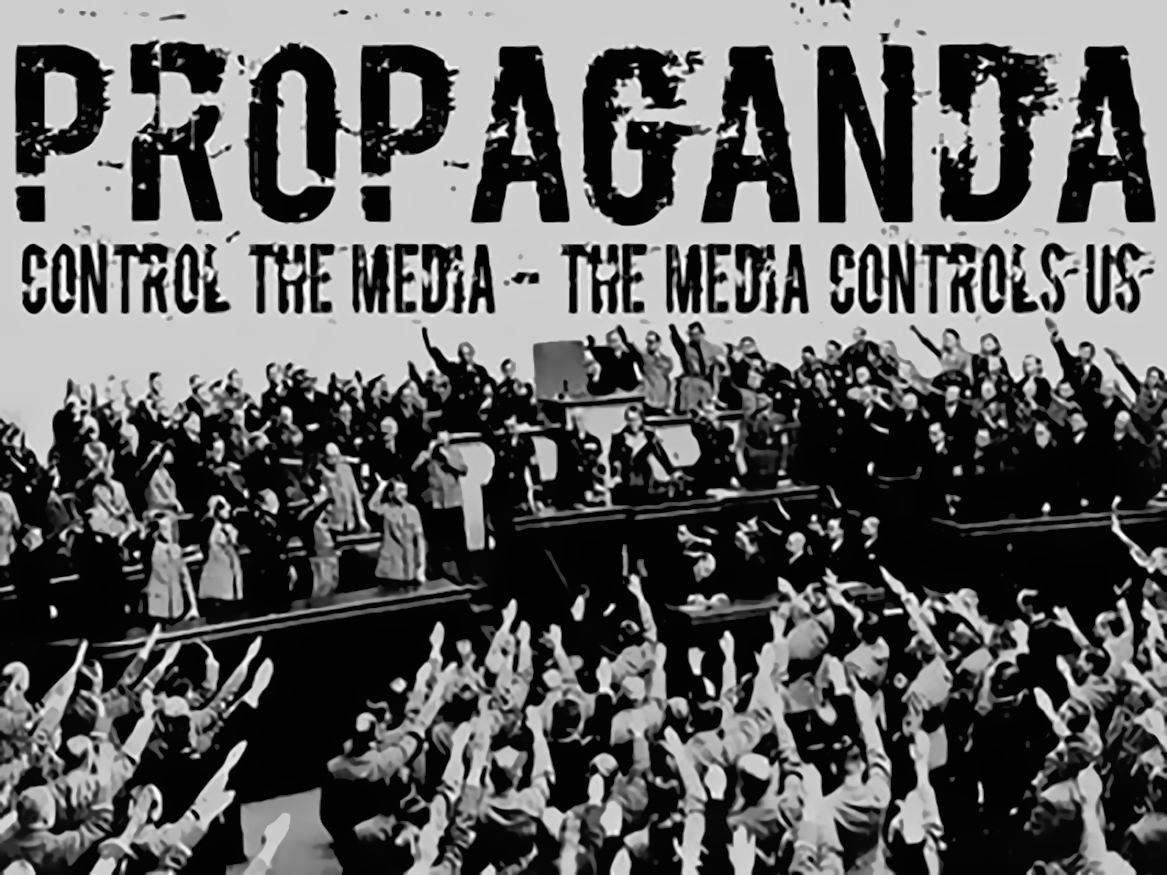
propaganda


Posted in Uncategorized | Tagged: , , , | Leave a Comment »

Everyone’s A Conspiracy Theorist, Whether They Know It Or Not – Caitlin Johnstone

Posted by M. C. on August 13, 2019

https://caitlinjohnstone.com/2019/08/12/everyones-a-conspiracy-theorist-whether-they-know-it-or-not/

Plutocratic propaganda outlet MSNBC has just run a spin segment on the breaking news that the medical examiner’s determination of the cause of Jeffrey Epstein’s death is “pending further information”.

“Our sources are still saying that it looks like suicide, and this is going to set conspiracy theorists abuzz I fear,” said NBC correspondent Ken Dilanian. “NBC News has been hearing all day long that there are no indications of foul play, and that this looks like a suicide and that he hung himself in his cell.”

Dilanian, who stumbled over the phrase “conspiracy theorists” in his haste to get it in the first soundbyte, is a known asset of the Central Intelligence Agency. This is not a conspiracy theory, this is a well-documented fact. A 2014 article in The Intercept titled “The CIA’s Mop-Up Man” reveals email exchanges obtained via Freedom of Information Act request between Dilanian and CIA public affairs officers which “show that Dilanian enjoyed a closely collaborative relationship with the agency, explicitly promising positive news coverage and sometimes sending the press office entire story drafts for review prior to publication.” There is no reason to give Dilanian the benefit of the doubt that this cozy relationship has ended, so anything he puts forward can safely be dismissed as CIA public relations.

When I mentioned Dilanian’s CIA ties on MSNBC’s Twitter video, MSNBC deleted their tweet and then re-shared it without mentioning Dilanian’s name. Here is a screenshot of the first tweet followed by an embedded link to their current one (which I’ve archived just in case):

Up until the news broke that Epstein’s autopsy has been unable to readily confirm suicide, mass media headlines everywhere have been unquestioningly blaring that that was known to have been the cause of the accused sex trafficker’s death. This despite the fact that the FBI’s investigation has been explicitly labeling it an “apparent suicide”, and despite the fact that Epstein is credibly believed to have been involved in an intelligence-tied sexual blackmail operation involving many powerful people, any number of whom stood plenty to gain from his death.

So things are moving in a very weird way, and people are understandably weirded out. The response to this from mass media narrative managers has, of course, been to berate everyone as “conspiracy theorists”.

“Jeffrey Epstein: How conspiracy theories spread after financier’s death” reads a BBC headline. “Epstein Suicide Conspiracies Show How Our Information System Is Poisoned” reads one from the New York Times. “Conspiracy Theories Fly Online in Wake of Epstein Death” warns The Wall Street Journal. “Financier Epstein’s Death Disappoints Victims, Launches Conspiracy Theories” reads the headline from US government-funded Voice of America.

These outlets generally match Dilanian’s tone in branding anyone who questions the official story about Epstein’s death as a raving lunatic. Meanwhile, normal human beings all across the political spectrum are expressing skepticism on social media about the “suicide” narrative we’re all being force-fed by the establishment narrative managers, many of them prefacing their skepticism with some variation on the phrase “I’m not a conspiracy theorist, but…”

“I’m not a conspiracy theorist but there are an awful lot of very powerful people who would like to see this Epstein thing go away. Is anyone investigating the guard on duty?” tweeted actor Patricia Heaton.

“I am not into conspiracy theories. But Epstein had destructive information on an extraordinary number of extraordinarily powerful people. It is not easy to commit suicide in prison. Especially after being placed on suicide watch. Especially after already allegedly trying,” tweeted public defender Scott Hechinger.

Journalist Abi Wilkinson summed up the silliness of this widespread preface very nicely, tweeting, “‘”I’m not a conspiracy theorist’ is such a weird assertion when you think about it, the idea there’s a binary between believing all conspiracies and flat out rejecting the very concept of conspiracy in all circumstances.”

Indeed, I think it’s fair to say that everyone is a conspiracy theorist if they’re really honest with themselves. Not everyone believes that the official stories about 9/11 and the JFK assassination are riddled with plot holes or what have you, but I doubt that anyone who really sat down and sincerely grappled with the question “Do powerful people conspire?” would honestly deny it. Some are just more self-aware than others about the self-evident reality that powerful people conspire all the time, and it’s only a question of how and with whom and to what extent.

The word “conspire” is defined by Merriam-Webster as “to join in a secret agreement to do an unlawful or wrongful act or an act which becomes unlawful as a result of the secret agreement”. No sane person would deny that this is a thing that happens, nor that this is likely a thing that happens to some extent among the powerful in their own nation. This by itself is a theory about conspiracy per definition, and it accurately applies to pretty much everyone. Since it applies to pretty much everyone, the label is essentially meaningless, either as a pejorative or as anything else.

The meaningless of the term has been clearly illustrated by Russiagate, whose adherents react with sputtering outrage whenever anyone points out that they’re engaged in a conspiracy theory, despite the self-evident fact that that’s exactly what it is: a theory about a band of powerful Russian conspirators conspiring with the highest levels of the US government. Their objection is not due to a belief that they’re not theorizing about a conspiracy, their objection is due to the fact that a highly stigmatized label that they’re accustomed to applying to other people has been applied to them. The label is rejected because its actual definition is ignored to the point of meaninglessness.

The problem has never been with the actual term “conspiracy theory”; the problem has been with its deliberate and completely meaningless use as a pejorative. The best way to address this would be a populist move to de-stigmatize the label by taking ownership of it. Last month Cornell University professor Dave Callum tweeted, “I am a ‘conspiracy theorist’. I believe men and women of wealth and power conspire. If you don’t think so, then you are what is called ‘an idiot’. If you believe stuff but fear the label, you are what is called ‘a coward’.” This is what we all must do. The debate must be forcibly moved from the absurd question of whether or not conspiracies are a thing to the important question of which conspiracy theories are valid and to what degree.

And we should probably hurry. Yahoo News reported earlier this month that the FBI recently published an intelligence bulletin describing “conspiracy theory-driven domestic extremists” as a growing threat, and this was before the recent spate of US shootings got establishment narrative-makers pushing for new domestic terrorism laws. This combined with the fact that we can’t even ask questions about extremely suspicious events like Jeffrey Epstein’s death without being tarred with this meaningless pejorative by the mass media thought police means we’re at extreme risk of being shoved into something far more Orwellian in the near future.

__________________

The best way to get around the internet censors and make sure you see the stuff I publish is to subscribe to the mailing list for my website, which will get you an email notification for everything I publish. My work is entirely reader-supported, so if you enjoyed this piece please consider sharing it around, liking me on Facebook, following my antics on Twitter, throwing some money into my hat on Patreon or Paypal, purchasing some of my sweet merchandise, buying my new book Rogue Nation: Psychonautical Adventures With Caitlin Johnstone, or my previous book Woke: A Field Guide for Utopia Preppers. For more info on who I am, where I stand, and what I’m trying to do with this platform, click here. Everyone, racist platforms excluded, has my permission to republish or use any part of this work (or anything else I’ve written) in any way they like free of charge.

Posted in Uncategorized | Tagged: , , , | Leave a Comment »

Of Two Minds – The Internal War in the Deep State Claims Its High Profile Casualty: Jeffrey Epstein

Posted by M. C. on August 13, 2019

https://www.oftwominds.com/blogaug19/deep-state-war8-19.html

Charles Hugh Smith

The “traditionalist” Neocons are going to have to decide to fish or cut bait.

I’ve been writing about the fracturing Deep State for the past five years:

Is the Deep State Fracturing into Disunity? (March 14, 2014)

Is the Deep State at War–With Itself? (December 14, 2016)

Epstein and the Explosive Crisis of the Deep State (July 15, 2019)

The conflict has now reached the hot-war stage where bodies are turning up, explained away by the usual laughable covers: “suicide,” “accident” and “heart attack.” That Jeffrey Epstein’s death in a secure cell is being labeled “suicide” tells us quite a lot about the desperation of the faction trying to protect the self-serving predators that have wormed their way into control of many Deep State nodes of power.

Here’s the basic structure of the Deep State conflict as I see it. For context: The Deep State exploded in size and power during World War II. At the war’s end, the proper role of the U.S. in the postwar era was up for grabs, and over the course of a few years, the CIA and other intelligence agencies were established and the doctrine of containment of the Soviet Union became the dominant narrative, a narrative that held with remarkable consistency for four decades until the Soviet Union collapsed in 1991.

This collapse was another critical juncture, and debates over America’s role in this “unipolar era” were finally settled in favor of the militarily-geopolitically activist ideology of neoconservatism (Neocons).

This globalist ideology spawned a variety of monstrous policy disasters and as a result the Neocons have been challenged by factions within the Deep State.

This Neocon Globalist camp is dominated by the amoral ideology of the ends justifies the means. This everything is allowed, anything can be hidden or justified ideology slowly spread from overseas black ops and a spectrum of interventions to the power nodes of the domestic Deep State.

The failures of Neocon globalism have ushered in another critical juncture in the Deep State…

As the policy disasters launched by Neocon Globalists piled up, the Neocons were desperate for domestic political allies...

Arrayed against this completely corrupt, degenerate camp of Neocon Globalists is a “nationalist” camp within the Deep State…

The “nationalist” faction within the Deep State is gaining ground, and now a fracture in the Neocon camp is threatening the Globalists:…

The debauchery of morals undermines the legitimacy of the state and thus of the entire power structure….

Having enabled and used amoral predators like Epstein, the “traditionalist” Neocons are forced to defend the debauched and now toxic “Liberal” defenders of the Neocon Globalist Project...

The final fracture is within the “rogue realists”:…

The “rogue realists” are attempting to use the judicial system to bring down the predatory self-serving elites, but given Epstein’s “mysterious” end, it appears the Department of Justice is also infiltrated…

This raises the issue that destroys democracies: who investigates the investigators? The “traditionalist” Neocons are going to have to decide to fish or cut bait: either swirl down the sewer by protecting everyone in Epstein’s black book and stash of videos, or clean house before they lose it all.

Be seeing you

Ajit Vadakayil: SECOND DEFEAT FOR DEEP STATE -- CAPT AJIT ...


Posted in Uncategorized | Tagged: , , , | Leave a Comment »