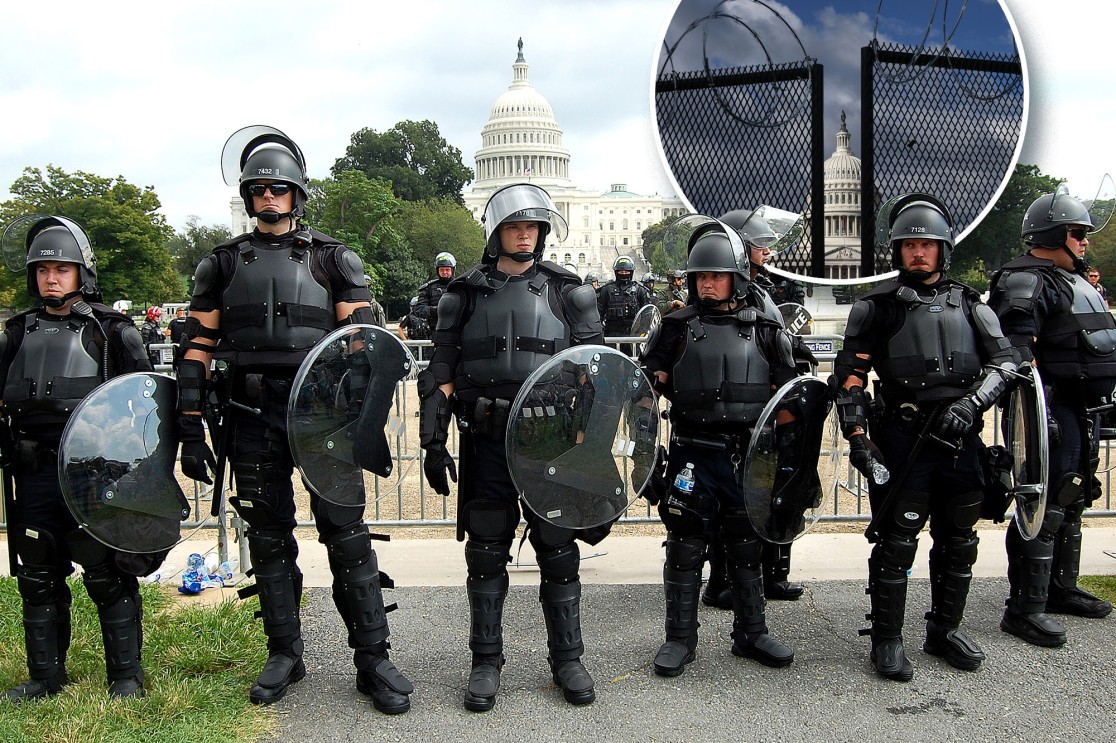
If the feds have an eyewitness who works for them — even though his presence at the scene was unconstitutional — and whose testimony contradicts the prosecutors’ narrative, the feds have a moral and legal obligation to reveal all this to defense counsel.
The New York Times has reported that the FBI had an undercover informant amid the protestors that entered the U.S. Capitol on Jan. 6 who had related to them his knowledge of the demonstrators’ plans beforehand and his observations of events in the building in real time. The informant was a genuine member of the Proud Boys, the group the feds have charged with conspiracy to overthrow the government.
According to the Times, the informant told the FBI in advance that there was no plan by his colleagues to disrupt the government. He also reported violence and destruction in the Capitol to his FBI handler as it was happening, and the FBI did nothing timely to stop it.
The presence of the informant as a de facto federal agent at the scene before, during and after the commission of what the government considers to be serious felonies raises serious constitutional questions about the FBI’s behavior.
The feds have not revealed the existence or identity of this informant; rather, the Times’ reporters found out about him and found another person to corroborate what they learned that he did.
Can the government insert a person into a group under criminal investigation — or “flip” a person who is already in the group — and use him for surveillance without a search warrant? And, when they do this, must prosecutors tell defense attorneys about their informant, particularly if his knowledge and observations are inconsistent with the government’s version of events?
(LifeSiteNews) – Ukraine’s President Volodymyr Zelenskyy has stated that Canadian Prime Minister Justin Trudeau was one of the reasons he got into politics.
After leaving his career as a comedian and entertainer and becoming Ukraine’s president in April 2019, Zelenskyy hailed Trudeau as “one of those leaders who inspired” him “to join politics,” when he became Ukraine’s president in 2019.
While Zelenskyy has shot to stardom from relative obscurity from the perspective of the West since the Russo-Ukrainian conflict became international news last week, his admiration for Trudeau comes as less of a surprise when looking into his background.
Like Trudeau, Zelenskyy is an acolyte of Klaus Schwab’s World Economic Forum, the globalist organization behind the now-infamous “Great Reset” agenda, which tells the world that by the year 2030, “You’ll own nothing and you’ll be happy.”
The ubiquitous support for Zelenskyy by the elite, including support from “defund the police” and Black Lives Matterleftistmega-donor George Soros, Trudeau, American President Joe Biden, and all sides of mainstream media, has led many to question the true motivation behind the West’s condemnation of Russia and a concern that a push for yet another foreign war involving the West is underfoot.
On Tuesday, for example, Ukrainian journalist Daria Kaleniuk made an emotional demand to British Prime Minister Boris Johnson, asking him to instruct NATO to enter the war in Ukraine. After the event was praised in Western media, reports surfaced showing that Kaleniuk is not just a journalist, but a member of the WEF and runs initiatives backed by Soros throughout Eastern Europe.
While many are skeptical of Russian President Vladimir Putin and his former ties to the KGB, scrutiny of the other side of the conflict seems absent in mainstream outlets which has worried many considering the radical nature of the WEF and their Great Reset goals.
Russia’s military offensive against Ukraine is an act of aggression that will make already worrisome tensions between Nato and Moscow even more dangerous. The west’s new cold war with Russia has turned hot. Vladimir Putin bears primary responsibility for this latest development, but Nato’s arrogant, tone‐deaf policy toward Russia over the past quarter‐century deserves a large share as well. Analysts committed to a US foreign policy of realism and restraint have warned for more than a quarter‐century that continuing to expand the most powerful military alliance in history toward another major power would not end well. The war in Ukraine provides definitive confirmation that it did not.
Thinking through the Ukraine crisis — the causes
“It would be extraordinarily difficult to expand Nato eastward without that action’s being viewed by Russia as unfriendly. Even the most modest schemes would bring the alliance to the borders of the old Soviet Union. Some of the more ambitious versions would have the alliance virtually surround the Russian Federation itself.” I wrote those words in 1994, in my book Beyond Nato: Staying Out of Europe’s Wars, at a time when expansion proposals merely constituted occasional speculation in foreign policy seminars in New York and Washington. I added that expansion “would constitute a needless provocation of Russia”.
What was not publicly known at the time was that Bill Clinton’s administration had already made the fateful decision the previous year to push for including some former Warsaw Pact countries in Nato. The administration would soon propose inviting Poland, the Czech Republic and Hungary to become members, and the US Senate approved adding those countries to the North Atlantic Treaty in 1998. It would be the first of several waves of membership expansion.
The ramp-up of money-printing by the Federal Reserve Bank since the COVID pandemic began has meant, like clockwork, an increase in CPI price inflation exceeding a seven percent annual rate. Though price inflation as measured by the CPI was temporarily delayed by the crosswinds of the shutdown-induced recession, the Fed inflation of the currency had already enriched the financial sector and created a wider income divide between the top one percent and the rest of the people. And this has not gone unnoticed by the political left, even if they remain ignorant of the real economic causes.
Economist and financier Richard Cantillon explained the impact of inflation upon the poor in his posthumous Essai nearly four centuries ago, in what has become called the “Cantillon Effect.” Cantillon posited that “the abundance of money makes everything more expensive” and that the persons who create the money benefit from its first use, while those who are further down the circulation river are robbed of the value of the money they do possess:
If the increase of hard money comes from gold and silver mines within the state, the owner of these mines, the entrepreneurs, the smelters, refiners, and all the other workers will increase their expenses in proportion to their profits.
Today, the miners and smelters are the financial sector, followed by the real estate sector, which Cantillon noted was a refuge from the ravages of inflation, observing that “an abundance of money naturally increases consumption and contributes above everything else to a higher valuation of the land.”
What that means from a practical point-of-view is that the poorer a man is, the more inflation hurts him. Inflation always takes from the creditor and gives to the debtor by devaluing dollar-denominated assets.
But how, you many ask, can a poor man be a creditor and a rich man be a debtor? One first needs credit in order to qualify for debt, and the poorer a man is, the less he is able to become a debtor. The working poor are always forced by the social construct to be a creditor:
Inflation always takes from the wage-earner and gives to the employer, to whom he has credited his labor while he awaits payday.
Inflation always takes from the renter and gives to the landlord, to whom he has advanced his rent and security deposit. But inflation protects the landowner by increasing the valuation of his land and comparatively diminishing the payments for his mortgage.
Inflation always takes from the wage-earner who deposits his wages and gives to the banker, whose very business is one of managing debt.
Inflation takes from the pensioner on a fixed income and gives to the financial sector.
Collectively, this is a huge transfer of wealth: an inflation tax on every single worker, collected from several weeks wages, a couple of months rent, all the bank deposits of the poor—levied also upon the value of fixed-income retirees—is transferred to those “miners and refiners” in the financial industry. Inflation is a direct redistribution of wealth from the working poor to the financial sector, which explains the extraordinary enrichment of the financial sector in the US since the end of the gold standard and rise of the age of inflation in the 1970s.
The rich man’s assets may include some cash and non-inflation-indexed bonds, but the overwhelming majority of the rich people’s assets are denominated in real estate, stocks and other assets that are relatively safe from inflation. And most of them benefit from inflation indirectly by being further up the inflation pipeline.
The middle class may have a home where the value of the mortgage payment is decreased by inflation (though this is never more than 29% of his income by industry rule) and may see a proportionate increase in the valuation of his home. But the other 71%-plus of his income is robbed regularly from inflation, so the middle class too becomes poorer overall.
The poor man is especially attacked by inflation. The poor man pays the inflation tax on 100% of his assets (which, however small they may be, are inevitably cash-denominated), 100% of his income, and everything he expects to receive as income, including the labor of his own hands.
Even before the CPI recorded price inflation, the increase in income disparity was already widened. Establishment politicians and their crony house economists will reliably deploy deflation as their tired, old bogey-man, inevitably bringing up irrelevant references to the Great Depression as a counter to this point. But deflation actually makes necessary goods more affordable to poor people during tough economic times at the expense of depreciation of the assets of the rich. The currency inflation created by the Fed actually cheated the poor out of this meager and needed benefit.
Inflation is the most regressive tax, and the most cruel. This is why there is so often starvation in nations with hyper-inflation; inflation preys on the most vulnerable in society, and the greater the inflation, the greater the harm inflicted upon the poor. It’s clearly long past time—for the sake of the poor—to abolish the Fed and restore a stable, commodity-based currency.
“There’s a problem with bank accounts, something happened… the transactions are being stopped, for whatever reason.”–Ukrainian activist Walter Lekh, in a Twitter Spaces conversation discussing avenues of donation in support of Ukraine.
Developments in Eastern Europe have taken center stage for much of the world in the past few days. Aggressive and consistent flows of reporting from the ground in Ukraine as the country sees Russian troops invade are dominating social feeds and headlines.Coming out of these updates of conflict and bloodshed have been reports of non-governmental organizations (NGOs) that have been working directly with the Ukrainian government since 2015 now taking donations in bitcoin.Before this article goes any further, I would like to expressly advise that nobody donate any bitcoin funds until significant effort has been dedicated to verifying addresses as best as can be done. This article is not meant to be a political admission of support, nor a call to action. There are significant efforts being undertaken by multiple parties engaging in deception and confusion of information and traffic at this time. Also, for those who are partaking in any live streams of footage and/or social media postings of this conflict: Do not click on links provided by parties that you do not know or trust.This is an extremely volatile situation, and these areas have become a battleground for intelligence organizations, with hacker groups such as Anonymous joining in efforts. Taking part online in these areas may actively insert you into the digital crossfire.SourceOne such NGO is “SaveLife,” an organization that is claiming to be distributing funds on a 50/50 basis between supporting veterans and casualties of war, and equipping Ukrainian elements with necessary equipment such as body armor.SaveLife recently had its Patreon account frozen– echoing similar events around the Canadian Freedom Convoy, as well as many other tangentially-related scenarios that have occurred over the past two years with regards to centralized organizations actively working to limit freedoms of information as well as money transmission.This NGO, also known as Come Back Alive, was taking BTC donations leading up to the launch of this most recent escalation of aggression in Eastern Europe.At the time of writing, the address for SaveLife has received a total of over 346 BTC (about a $15 million dollar value), up massively in the last few days…
What does the Russian invasion of Ukraine teach us about gun rights? Join FFF president Jacob G. Hornberger and Citadel professor Richard M. Ebeling as they discuss that question.
Because progressive governance ultimately clashes with reality, progressives must develop ways to enforce their measures, especially when the inevitable pushback occurs. As we have learned from China, a social credit system is one way to curb dissent and to force some people to the margins. American and Canadian progressives are finding social credit also can figuratively beat people into submission.
Critics of the Chinese Communist regime often point toward the government’s social credit system, in which the government traces individuals’ electronic paths, from their comments on social media to items they purchase, and issues rewards and punishments based on the information collected. For example, a Chinese citizen who receives a “bad” social credit score might not be permitted to ride one of the famous high-speed trains, being relegated to the slower trains for travel, and might be denied air travel.
Not surprisingly, people in the West have denounced the system as being heavy-handed, including CBS News, hardly a voice of antiprogressivism:
The fear is that the government will use the social credit scoring system to punish people who are not sufficiently loyal to the communist party, and trying to clear your name or fight your score is nearly impossible since there is no real due process.
Human Rights Watch, hardly a right-wing entity, is even more scathing in its criticism of China’s system:
Apple CEO Tim Cook looks forward to a “common future in cyberspace” with China, he told the Chinese government’s World Internet Conference earlier this month. This was an embarrassing gesture toward a state that aggressively censors the internet and envisions a dystopian future online.
Other progressive entities, including the New York Times, also have been critical of China’s social credit system but apparently have no problem with the establishment of a similar de facto
system here. The Washington Post went even further, openly taking part in a social credit scheme by publicly identifying people who recently contributed to the Canadian truck protesters and demanding to know why they gave money.
Understand that the Washington Post accessed an illegally hacked document and then used it as a weapon against people who dared contribute to something with which the newspaper’s staff disagreed, and the purpose was not to be informative but rather to endanger contributors and make them vulnerable to job loss, public shaming, and other kinds of attacks. This is not a rendition of “Democracy Dies in Darkness” but rather an attempt to impose a greater darkness on all of us.
This array includes promises not to expand NATO eastwards even by an inch. To reiterate: they have deceived us, or, to put it simply, they have played us. Sure, one often hears that politics is a dirty business. It could be, but it shouldn’t be as dirty as it is now, not to such an extent. This type of con-artist behavior is contrary not only to the principles of international relations but also and above all to the generally accepted norms of morality and ethics. Where is justice and truth here? Just lies and hypocrisy all around.
I will begin with what I said in my address on February 21, 2022. I spoke about our biggest concerns and worries, and about the fundamental threats which irresponsible Western politicians created for Russia consistently, rudely and unceremoniously from year to year. I am referring to the eastward expansion of NATO, which is moving its military infrastructure ever closer to the Russian border.
It is a fact that over the past 30 years we have been patiently trying to come to an agreement with the leading NATO countries regarding the principles of equal and indivisible security in Europe. In response to our proposals, we invariably faced either cynical deception and lies or attempts at pressure and blackmail, while the North Atlantic alliance continued to expand despite our protests and concerns. Its military machine is moving and, as I said, is approaching our very border.
Why is this happening? Where did this insolent manner of talking down from the height of their exceptionalism, infallibility and all-permissiveness come from? What is the explanation for this contemptuous and disdainful attitude to our interests and absolutely legitimate demands?